Polyorama, petit modèle, avec vues
| Macro-category | Ancient Games and Pre-cinema |
| Subcategory | Optical Devices |
| Author | LEFORT, Pierre-Henri Amand (inventor) |
| Provenance | France |
| Year | 1840 |
A Compact Theatre of Light
The small-format Polyorama Panoptique and its six transforming views, in which Paris, London, Constantinople and the modern railway
pass from broad day into illuminated night
for the private spectator of the Second Empire.
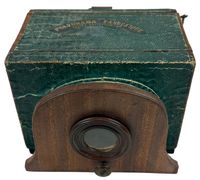
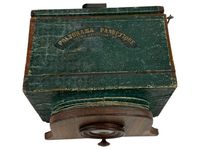
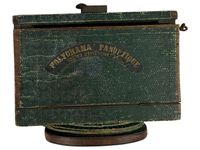
Polyorama Panoptique, small format, after the type patented by Pierre-Henri Amand Lefort (Paris, 1849). France (Paris), ca. 1852-1860. Accompanied by six original hand-coloured transforming picture panels.
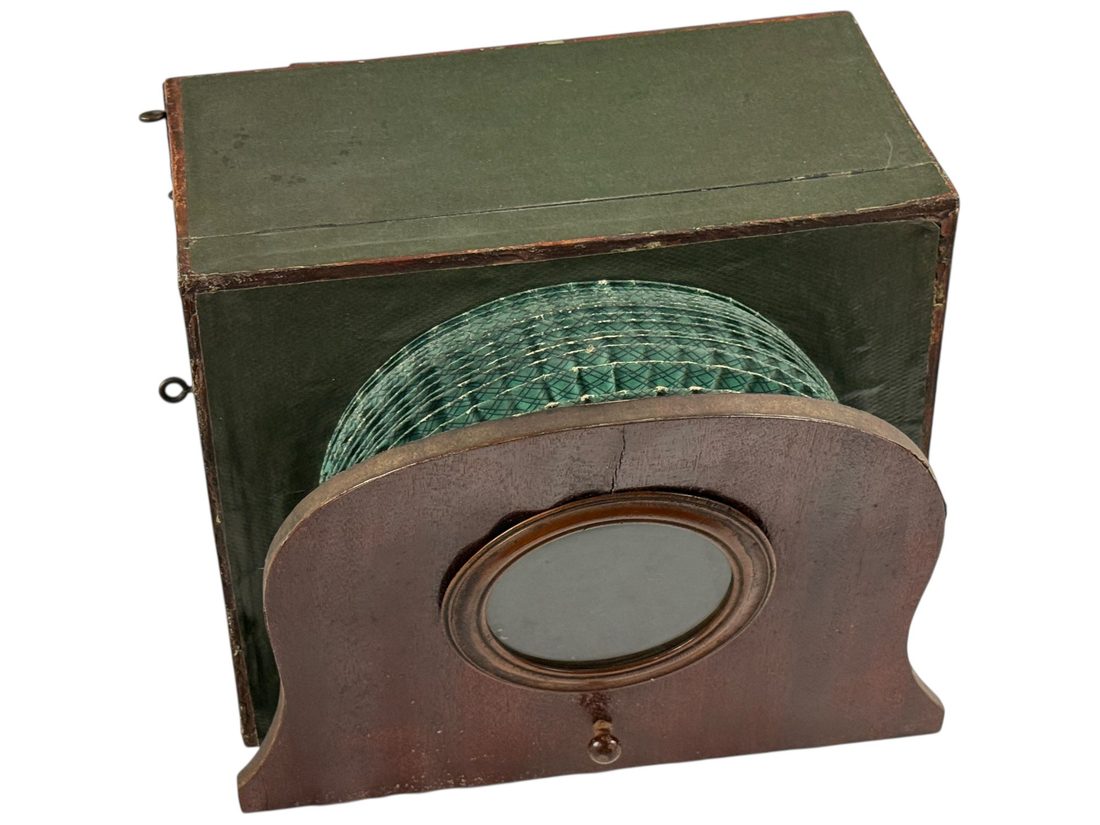
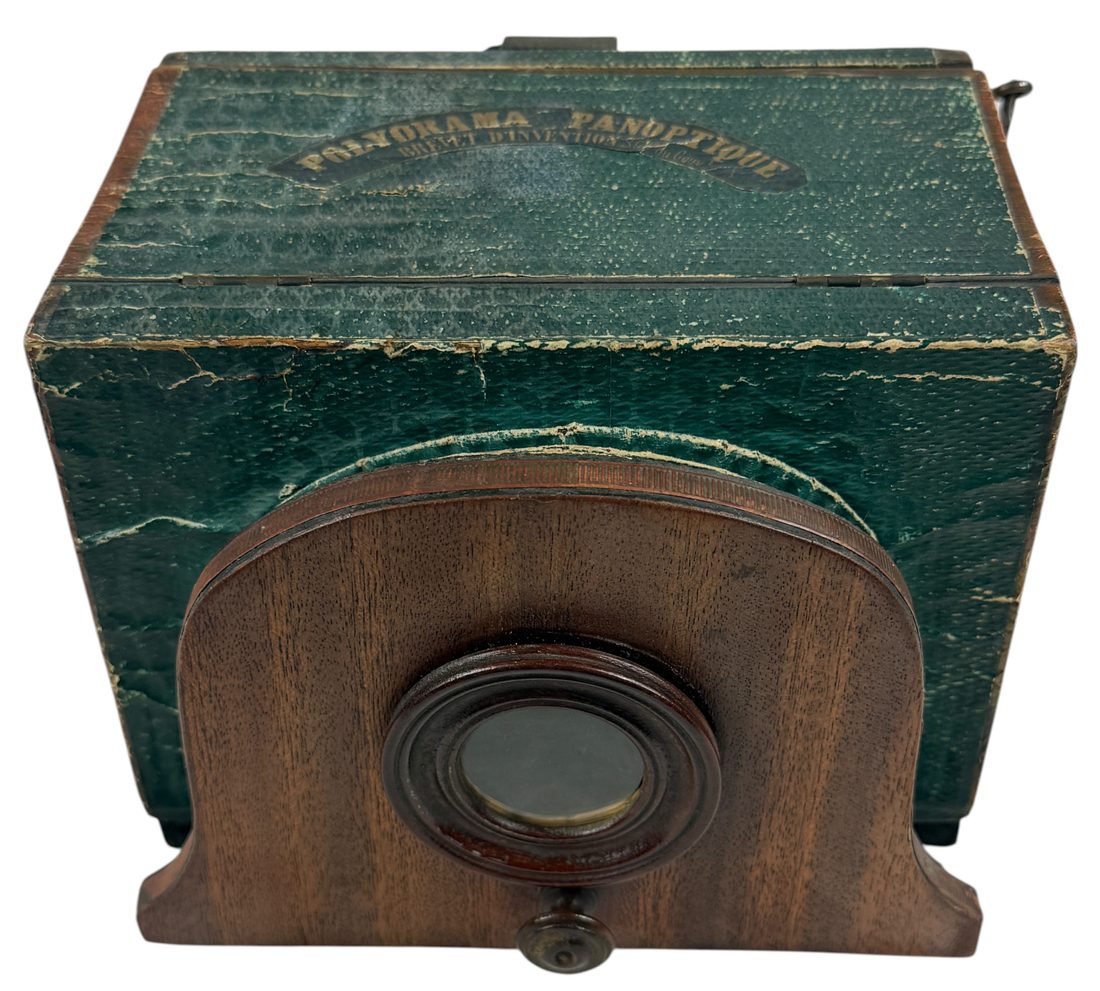
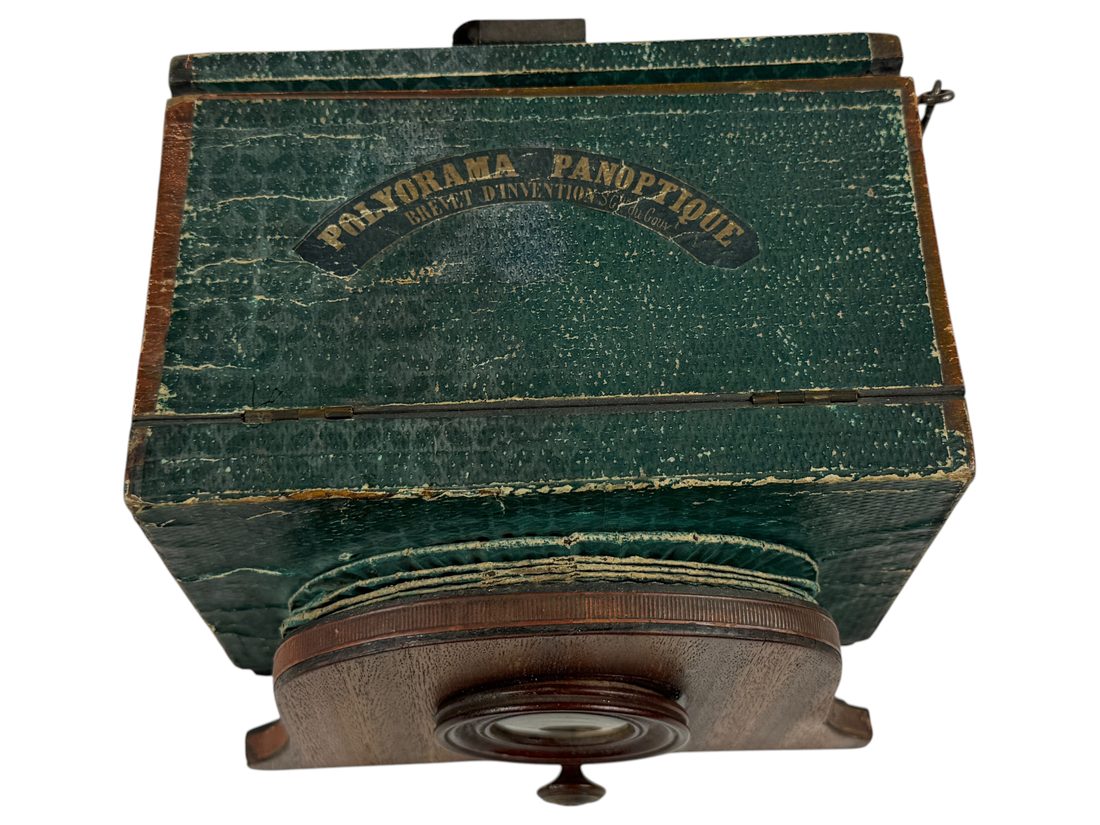
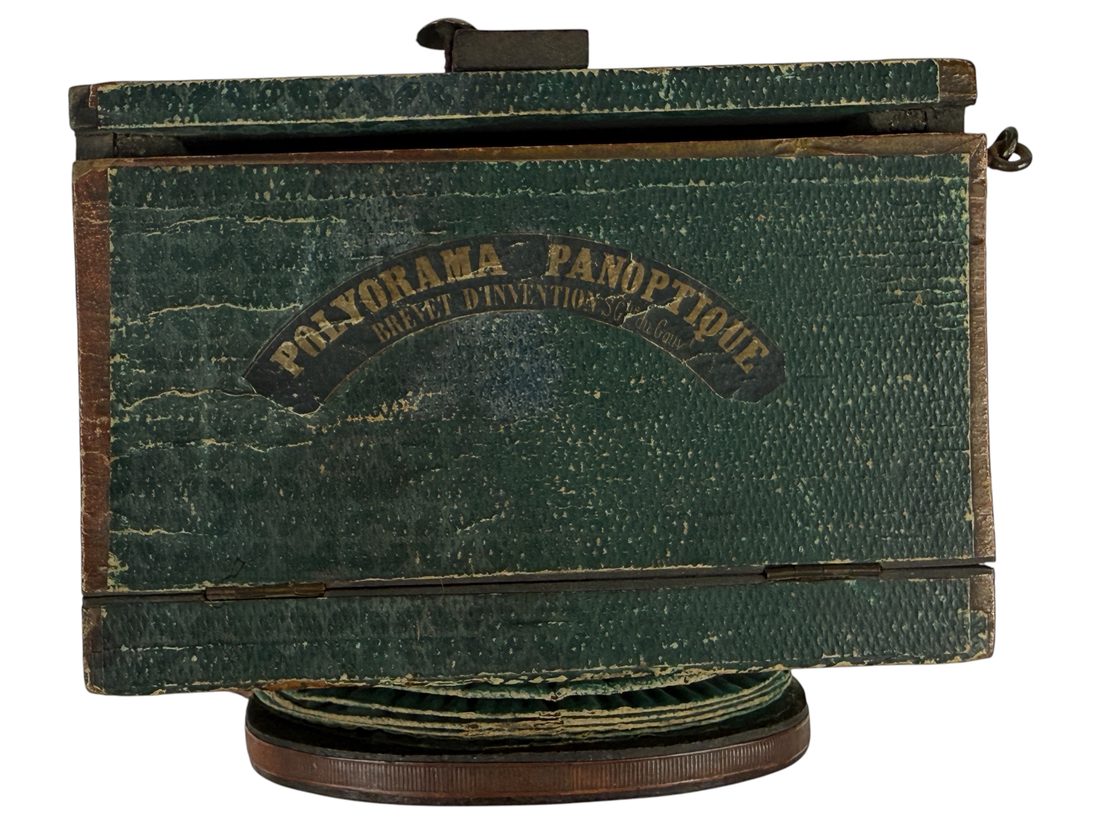
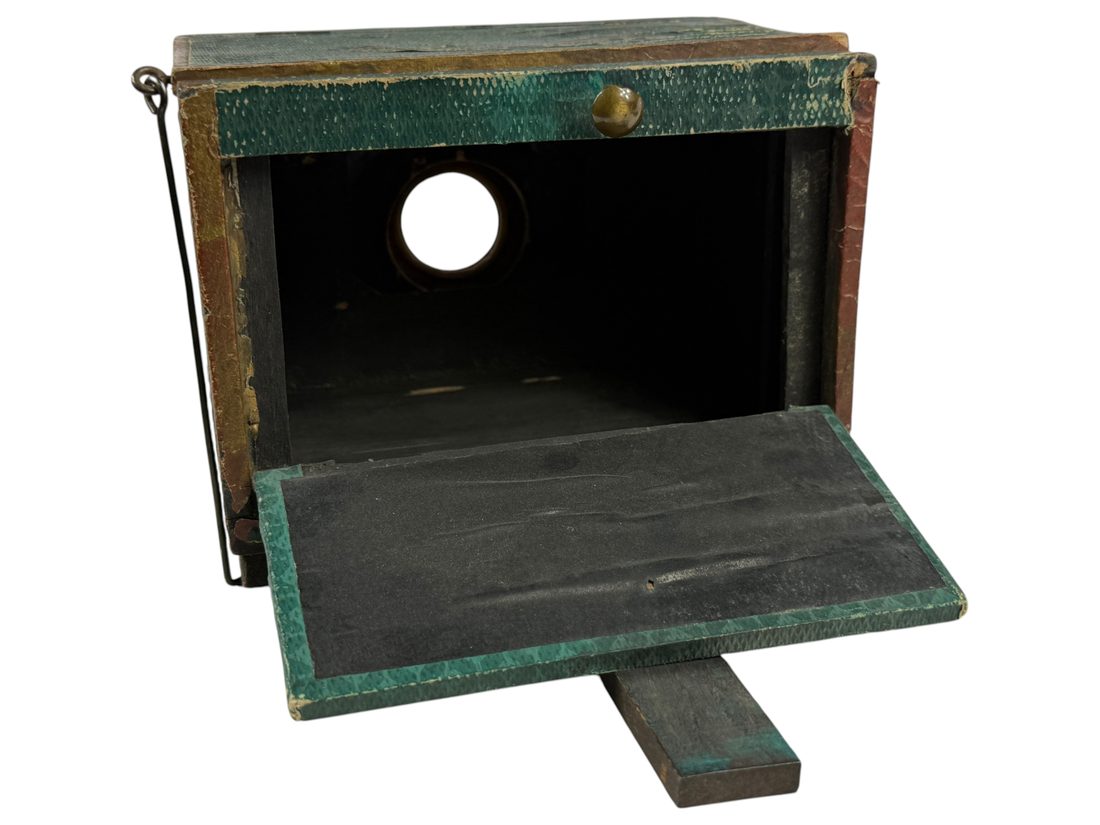
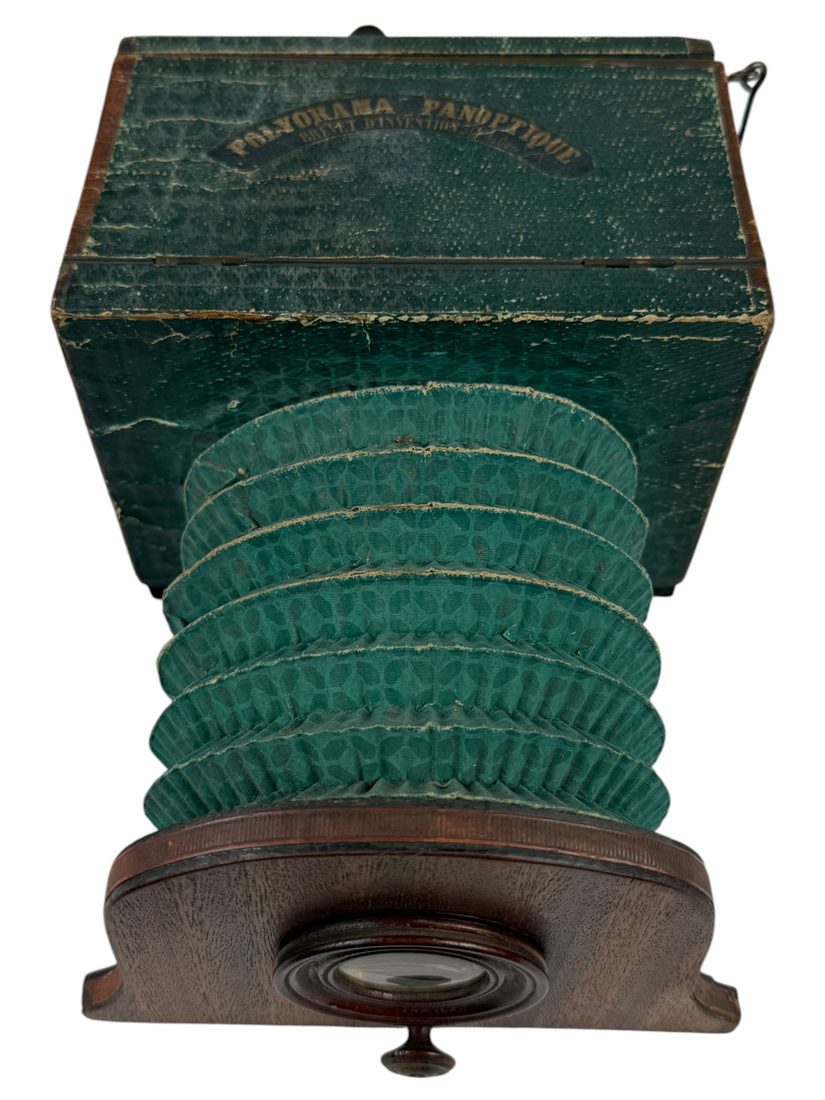
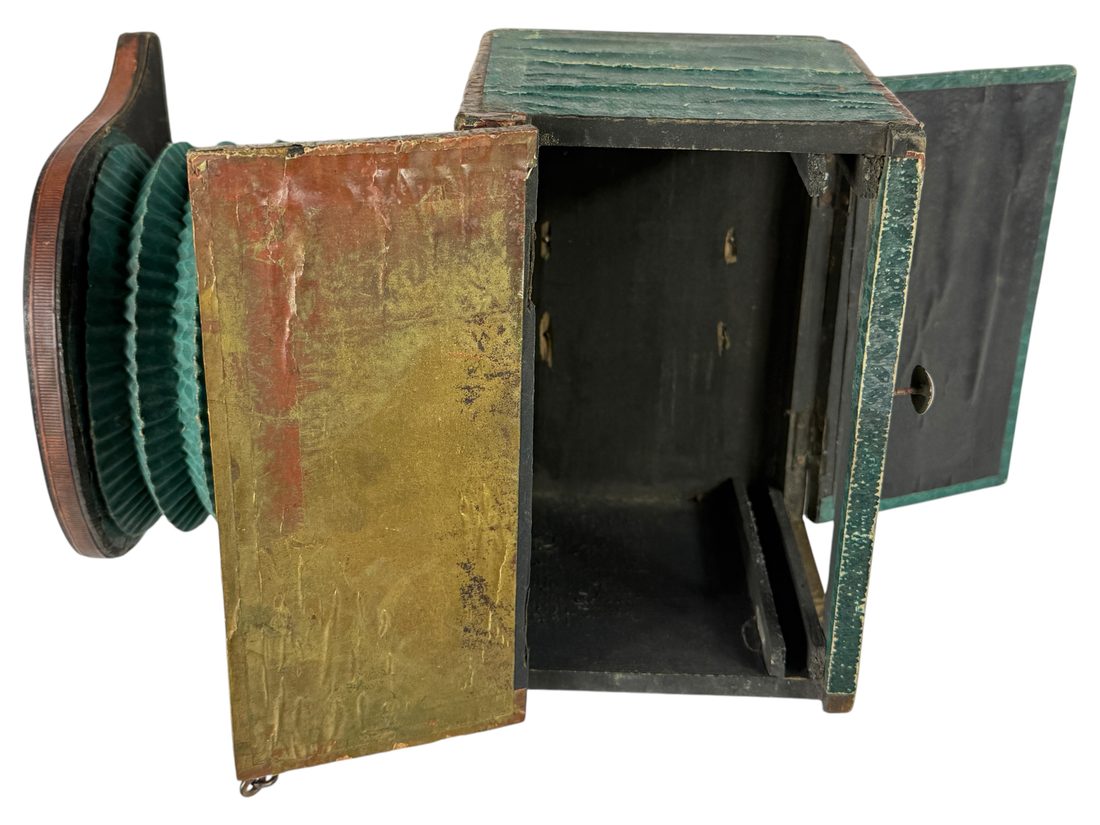
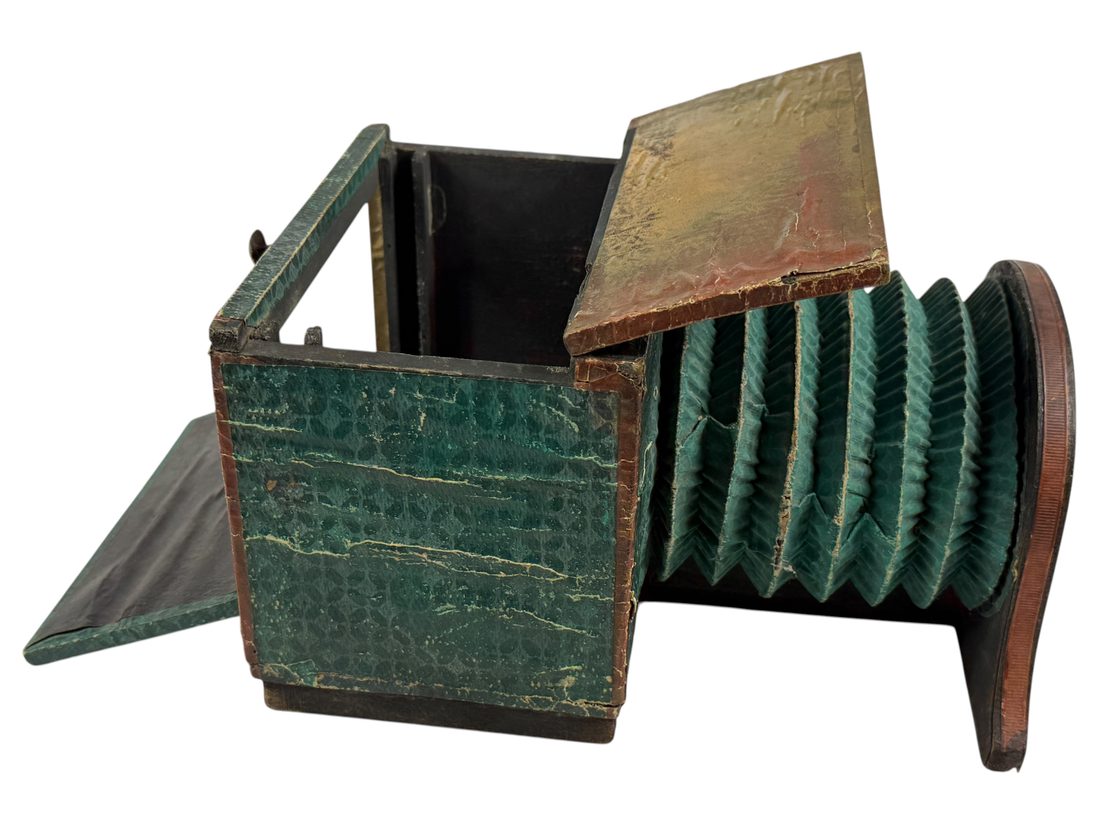
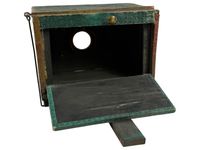
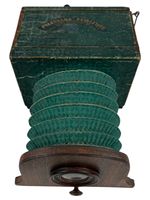
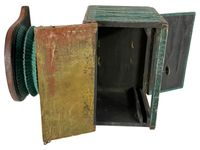
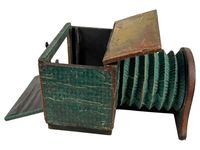
Small-format Polyorama Panoptique, comprising a rectangular wooden viewing box (approximately 165 x 120 x 110 mm) externally covered in green embossed paper, the hinged upper lid bearing a gilt paper label lettered “Polyorama Panoptique, Brevet d’Invention S.G. du Gouv.” The mahogany front panel carries a moulded ocular surround fitted with a single circular lens (35 mm in diameter), beneath which a small turned knob permits adjustment; the front is joined to the body by a collapsible green paper bellows that allows fine focusing. A hinged upper lid and a rear aperture regulate the incidence of light, so that the operator may alternate between reflected and transmitted illumination, while the blackened interior is fitted with a vertical slot for the insertion of the picture panels. A brass stud and a small metal hook complete the fittings.
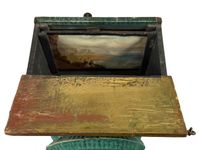
The instrument is accompanied by six original transforming picture panels, each of small rectangular format (approximately 140 x 95 mm) mounted on its wooden support and retaining, at the upper edge, a paper title label inscribed in French; five of these labels survive and one is now lost. In keeping with the established technique of the type, the images are coloured lithographs, painted and reinforced on the reverse and pierced with fine perforations and translucent passages, so that a concealed nocturnal state is disclosed only under transmitted light.
The Polyorama Panoptique is among the most refined expressions of nineteenth-century domestic optical entertainment, translating the spectacle of the public diorama into a compact apparatus for private use. According to whether light falls upon, or passes through, each hand-coloured plate, the viewer transforms a daylight scene into its nocturnal counterpart, kindling windows, illuminations and fireworks. The present example is among the smallest formats in which the device was produced and preserves a coherent set of six transforming views, whose subjects place the ensemble firmly within the Second Empire.
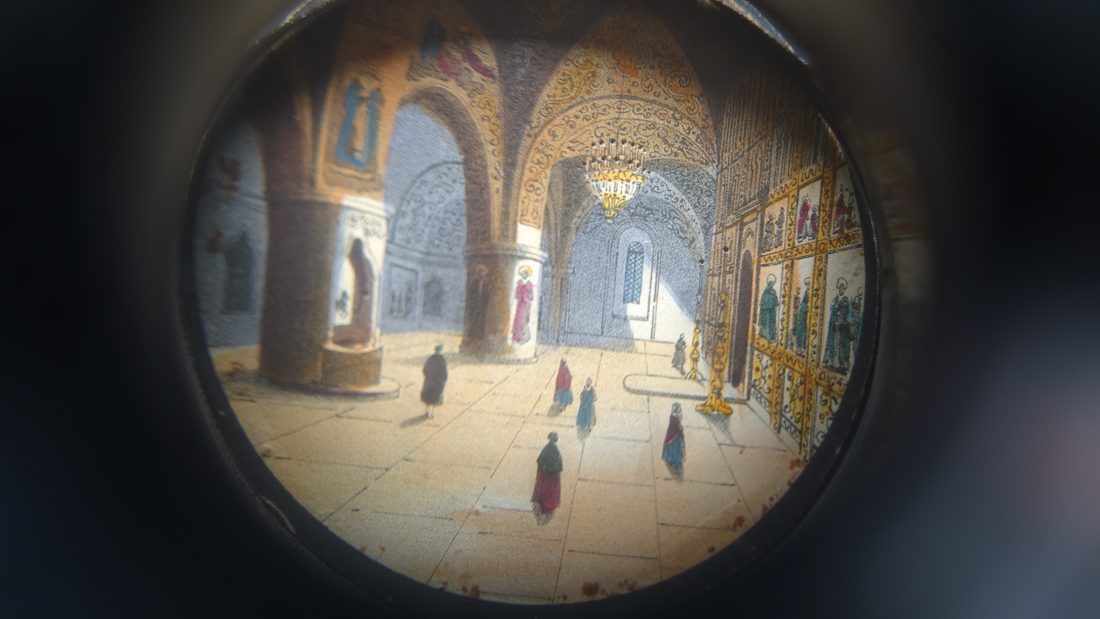
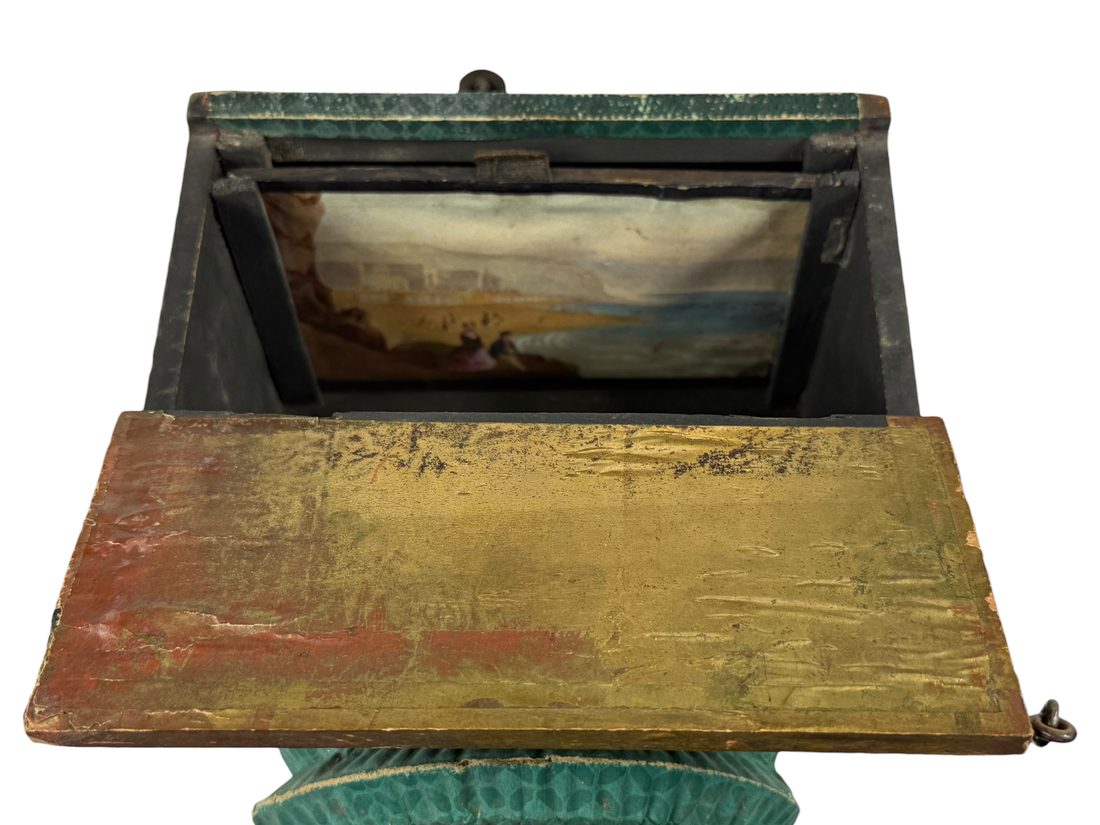
In use, the Polyorama depends upon a precise choreography of illumination. With the lid raised and ambient light falling upon the surface of the plate, the scene appears in its diurnal state, defined by opaque pigment and linear drawing. When light is admitted instead from behind, by closing the lid and opening the rear aperture, the concealed perforations and translucent washes are activated, and the same view is transformed into a nocturnal spectacle, its windows, lamps and skies quickened by apparent artificial light. The single frontal lens and the adjustable bellows bring the small image into sharp and magnified focus, sustaining the intimacy of a private, hand-held theatre of light.
The apparatus is accompanied by six transforming plates, each retaining, with a single exception, its original French title label. Together they compose a characteristic mid-century programme of leisure, travel, engineering and national spectacle.
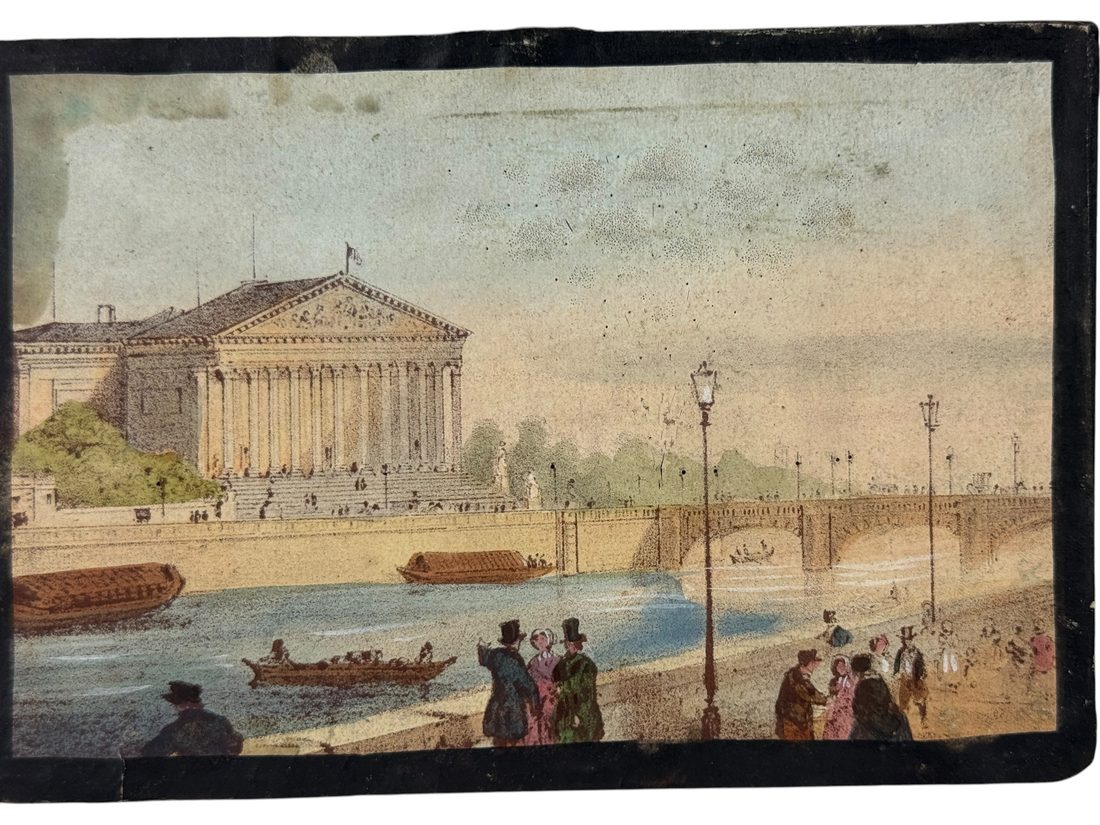
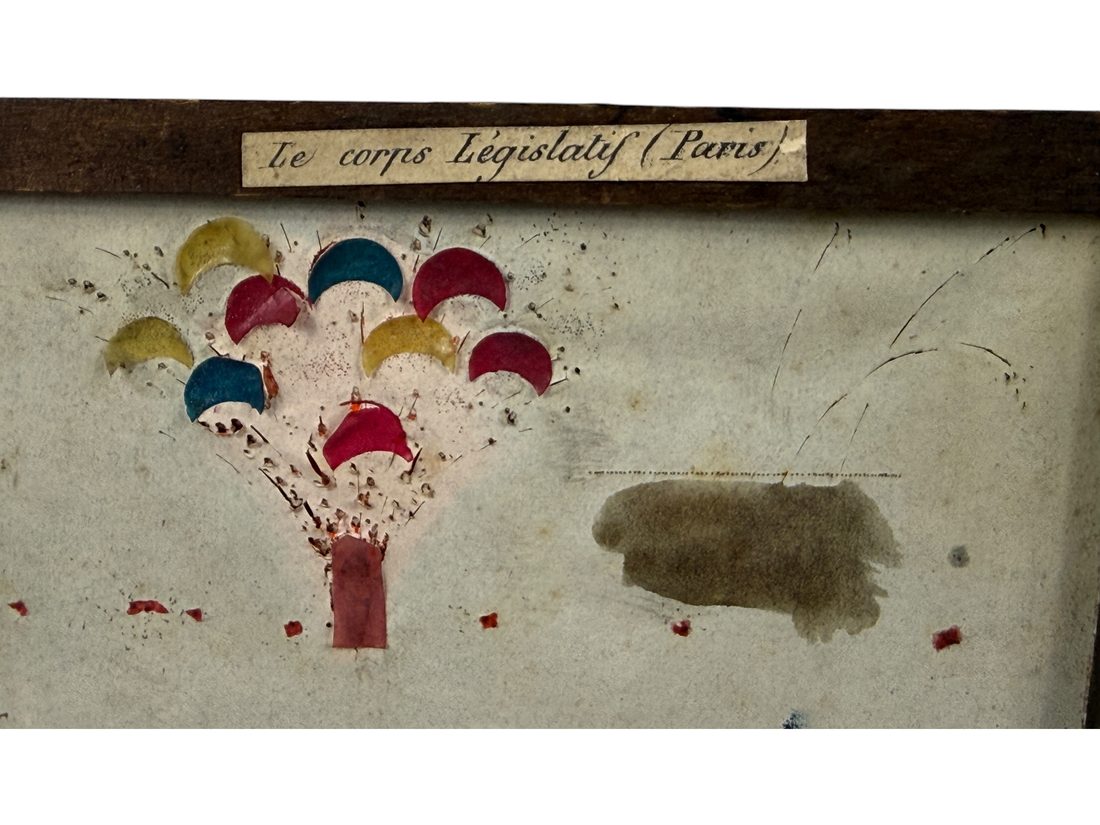
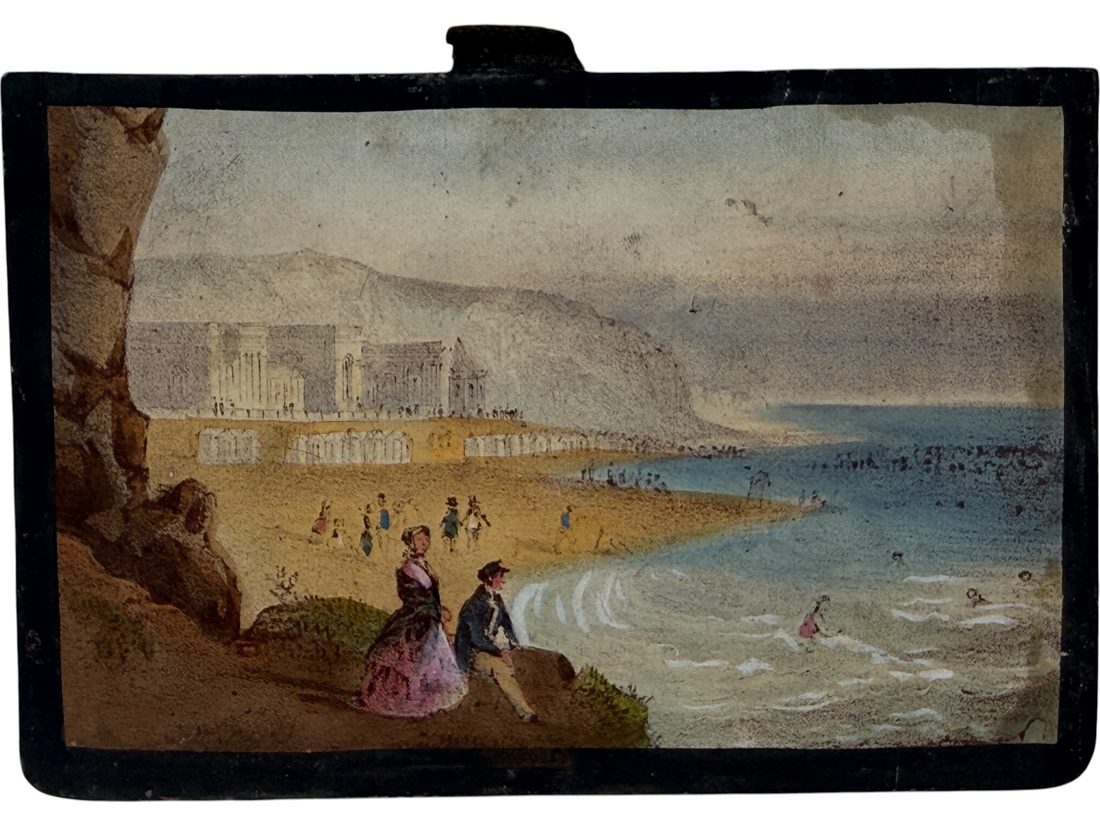
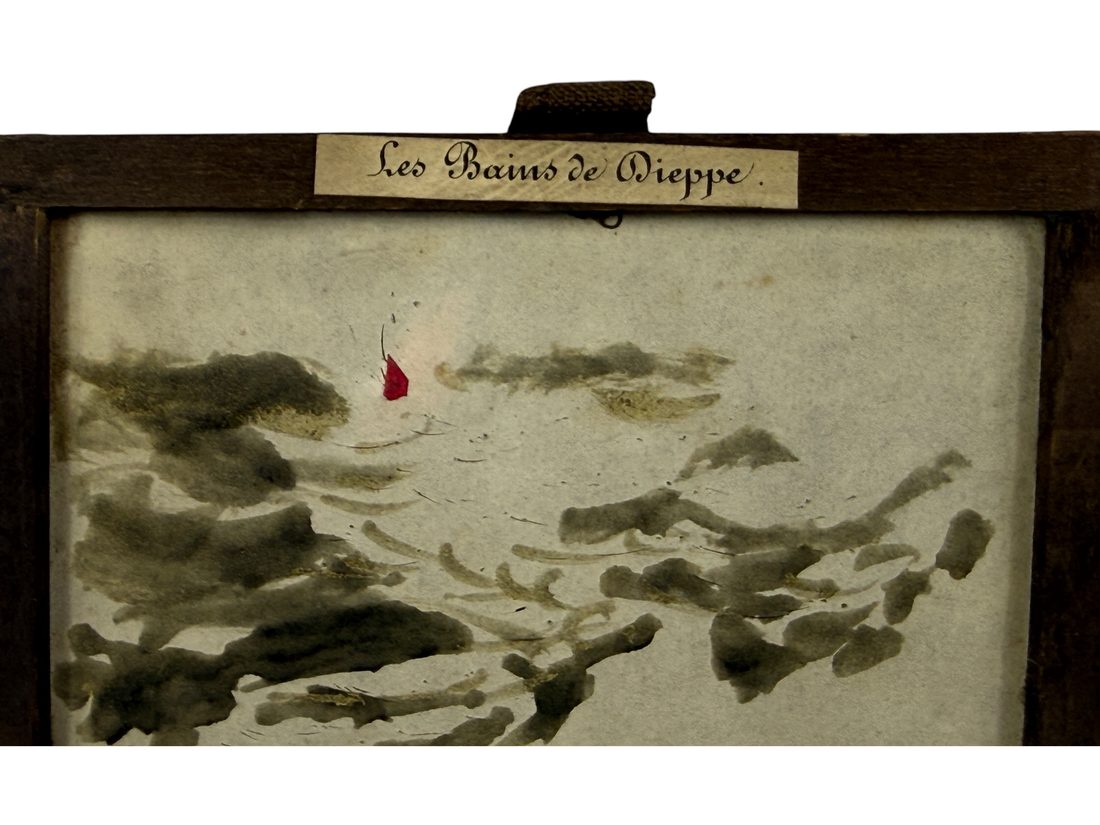
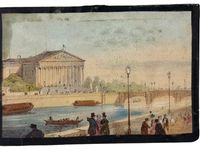
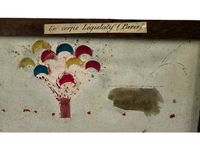
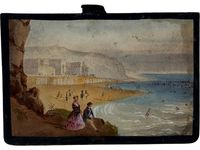
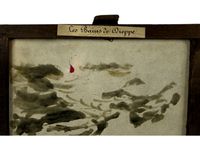
Les Bains de Dieppe presents the fashionable sea-bathing resort by day, its beach lined with cabins and animated by promenaders, and gives way by night to a dramatic storm at sea. Constantinople offers a view across the water toward the domes and minarets of the city, framed by a wisteria-hung arbour, its nocturnal state kindling the moon and a hanging lantern. Tunnel de Rolleboise (Chemin du Hâvre), a subject drawn from the Paris to Le Havre railway, shows navvies at work in the cutting by day and, by night, a locomotive emerging from the tunnel mouth with its headlamp ablaze. A fourth plate, its original title label now lost, is identified as a view of the Thames showing Somerset House, with the dome of St Paul’s beyond and paddle steamers upon the water, illuminated at night beneath a rising moon. Arsenal de Toulon depicts the great covered building slip of the naval arsenal, thronged with figures by day and, by night, lit by the glow of forges. Finally, Le Corps Législatif (Paris) shows the Palais Bourbon on the Seine, its calm daytime aspect yielding to a nocturnal celebration crowned by a great display of fireworks.
Click to Explore the Day/Night Effect
The choice and, above all, the wording of these subjects date the ensemble with some precision. The designation Corps Législatif for the Palais Bourbon belongs to the Second Empire, the assembly having been so named under the constitution of 14 January 1852, while the Tunnel de Rolleboise, opened in 1843 on the line completed to Le Havre in 1847, supplies a further terminus. The set is therefore to be placed in the eighteen-fifties, somewhat later than the generic dating of about 1850 usually assigned to the type.
The Polyorama Panoptique occupies a significant place in the archaeology of the moving image. Descended from the eighteenth-century optical box and the protean views, and conceived in the wake of Daguerre’s celebrated diorama, it miniaturised for the bourgeois interior the same manipulation of light that had astonished the paying public. Its very name, as later commentators observed, signified the contemplation of the manifold variety of the world.
The device emerged in France about the middle of the century, when the dioramic principle of the day-and-night image, protected by patents of 1848 and 1849, was given a portable, panoptic form and carried to a wide market by the Parisian opticians who issued such instruments in quantity and exported them across Europe. Its repertoire, ranging from celebrated European capitals and oriental cities to the emblems of modern engineering and naval power, mirrored the aspirations to prestige and progress of the age.
By allowing the private viewer to enact, at will and in miniature, the metamorphosis of day into night, the Polyorama contributed to the gradual redefinition of the image as a temporal event, a conceptual step toward photographic and cinematic practice, and it survives today as a fragile and increasingly uncommon witness to that pre-cinematic visual culture.
The Polyorama Panoptique belongs to the Parisian world of opticians and makers of scientific toys at the middle of the nineteenth century. A method for producing dioramic day-and-night images was patented by the draughtsman Auguste-Louis Régnier on 15 December 1848 and reduced to its practical, portable form by the toy manufacturer Pierre-Henri Amand Lefort, who obtained his patent (no. 7974) on 21 February 1849 at 35 rue du Faubourg Saint-Martin; the optician Lemaire was among the makers who produced and commercialised it under his own name for the European market. On the present example the lid label preserves only the name of the device and the patent formula, “Brevet d’Invention S.G. du Gouv.” without a legible retailer’s name, so that the instrument is referred to the Lefort and Lemaire type rather than to any single named maker.
Conditions: the green paper covering shows light wear and small losses, chiefly to the edges and corners, while the bellows remains supple and intact. The six transforming plates are generally well preserved, with minor surface soiling, occasional small marginal losses and light abrasions consistent with repeated insertion and handling; the hand colouring remains fresh and the nocturnal effects operate as intended. The title label of one plate is lost. The ensemble is sound and well preserved, complete with a coherent set of six original views.
References: R. Balzer, Optical Amusements: Magic Lanterns and Other Transforming Images. A Catalog of Popular Entertainments, Watertown (Mass.): the author, 1987 (pp. 56 to 58, the three formats illustrated at p. 56); G. Füsslin, Der Guckkasten: Einblick, Durchblick, Ausblick, Stuttgart: Füsslin Verlag, 1995 (section on the Polyorama panoptique, pp. 90 to 93); L. Mannoni, The Great Art of Light and Shadow: Archaeology of the Cinema, Exeter: University of Exeter Press, 2000.