Polyorama Panoptique, large size, with seven transforming views
| Macro-category | Ancient Games and Pre-cinema |
| Subcategory | Optical Devices |
| Author | Anonymous |
| Provenance | France |
| Year | 1850 |
a theatre of light in a box
a complete mid-19th Century
large-size «Polyorama Panoptique» by Lemaire
with seven original transforming views
Lefort, Pierre-Henri Amand (inventor). Polyorama Panoptique. Paris: Lemaire, opticien, ca. 1850.
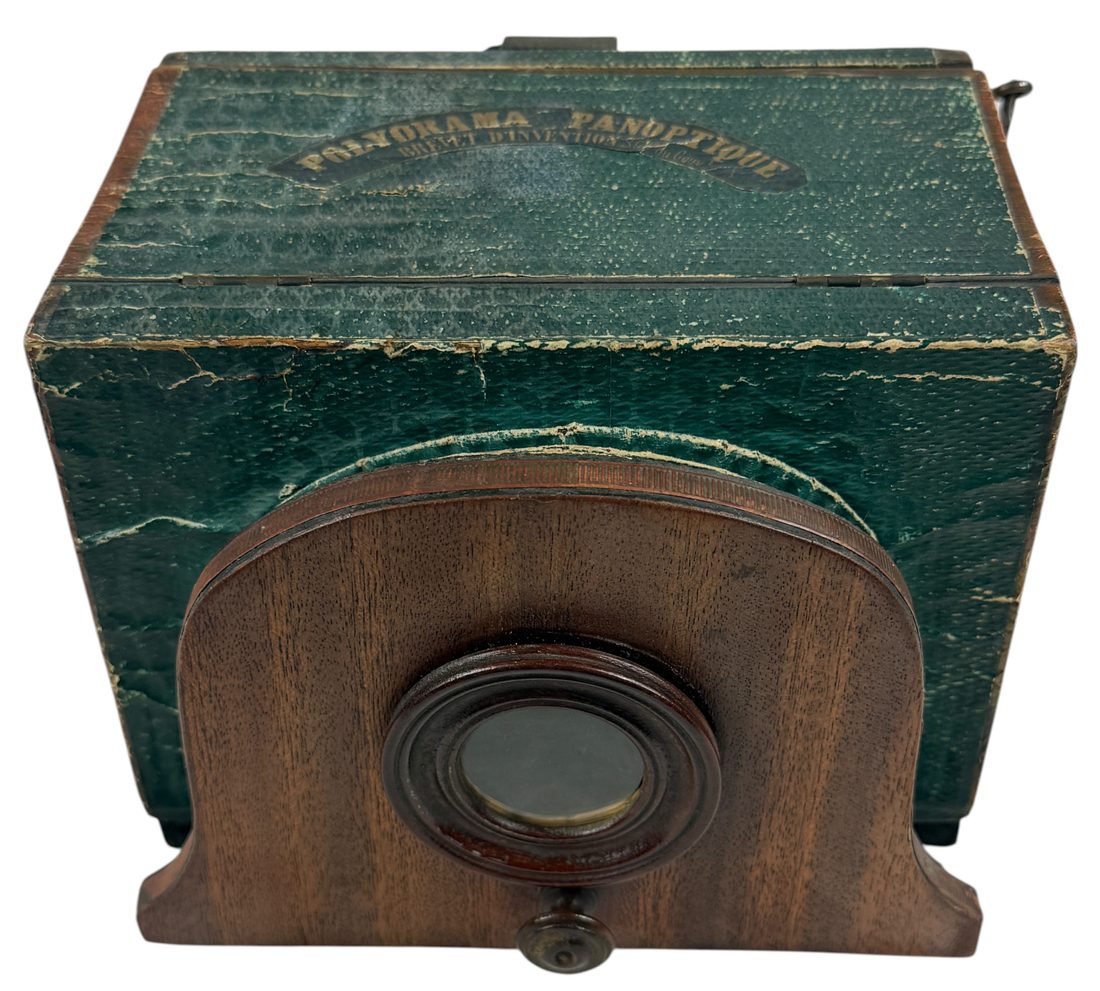
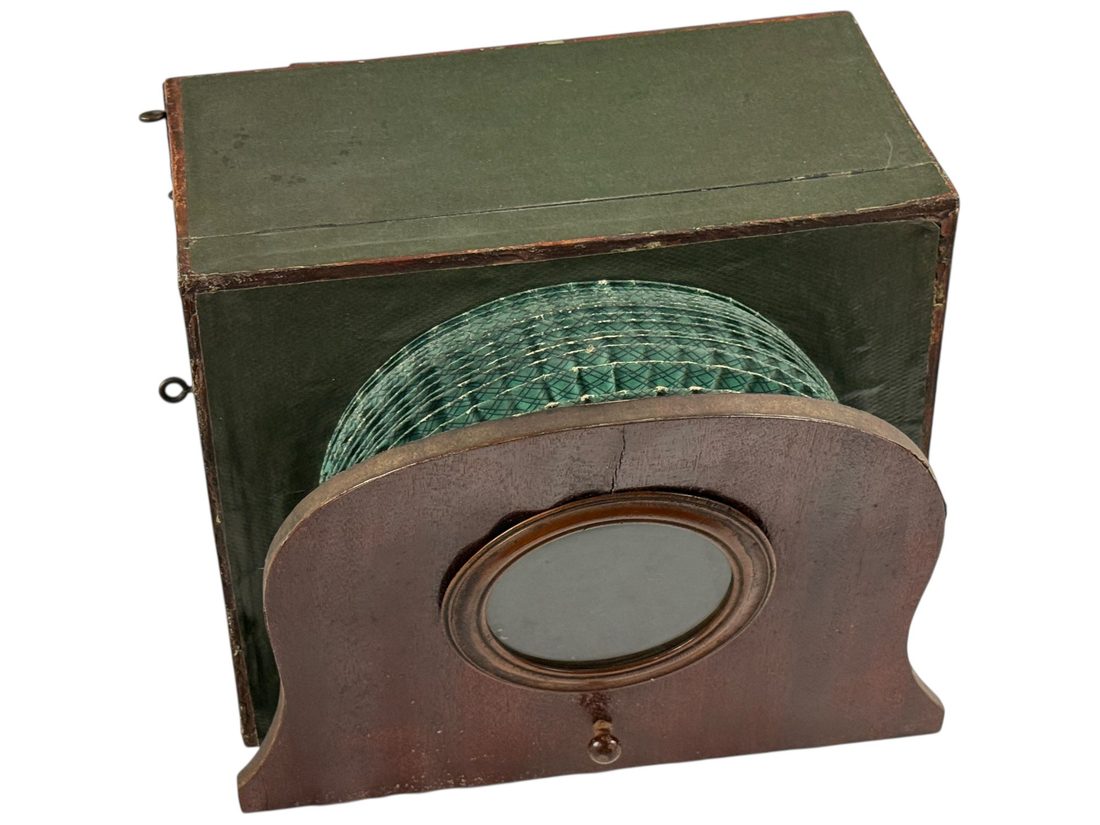
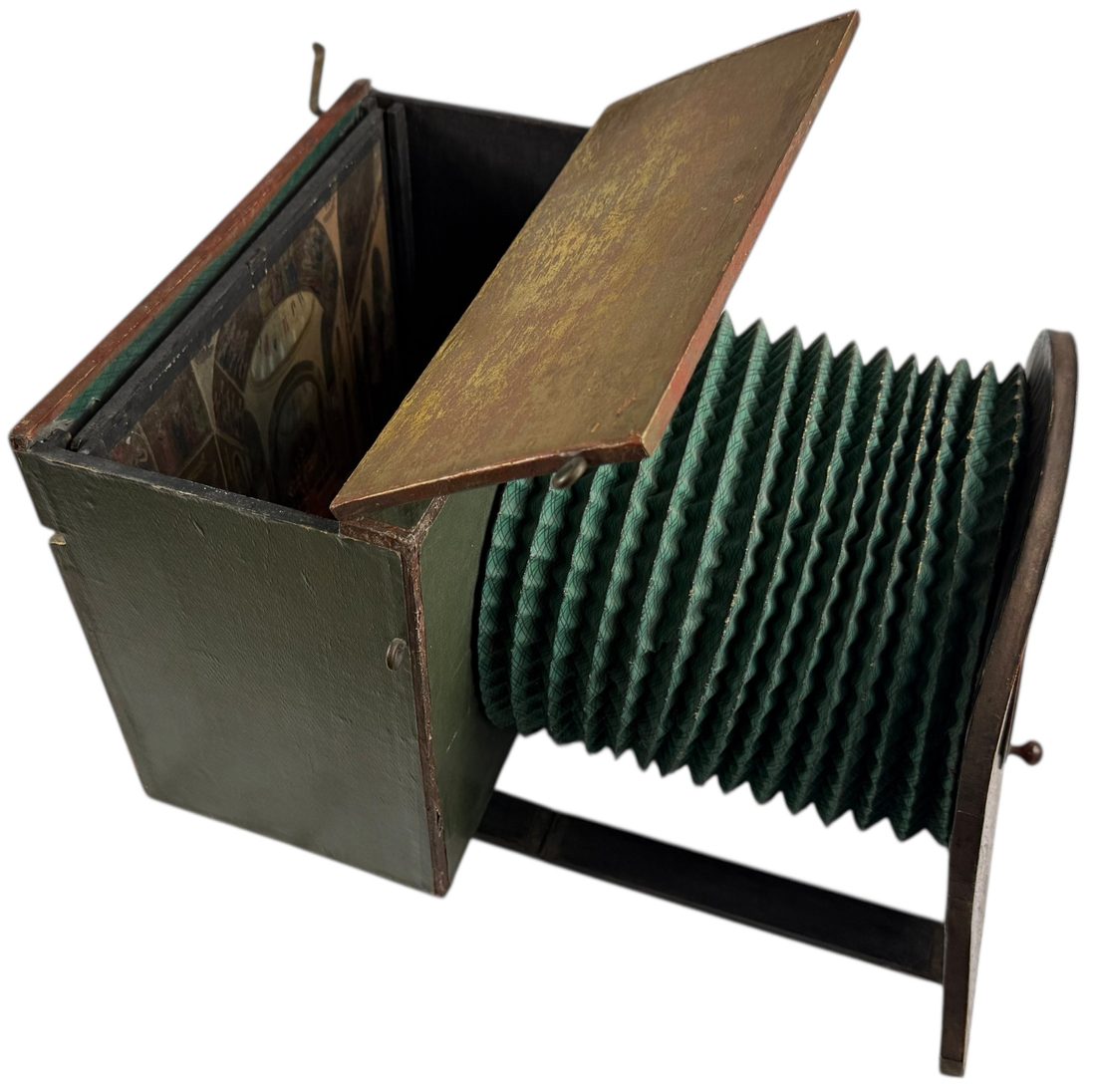
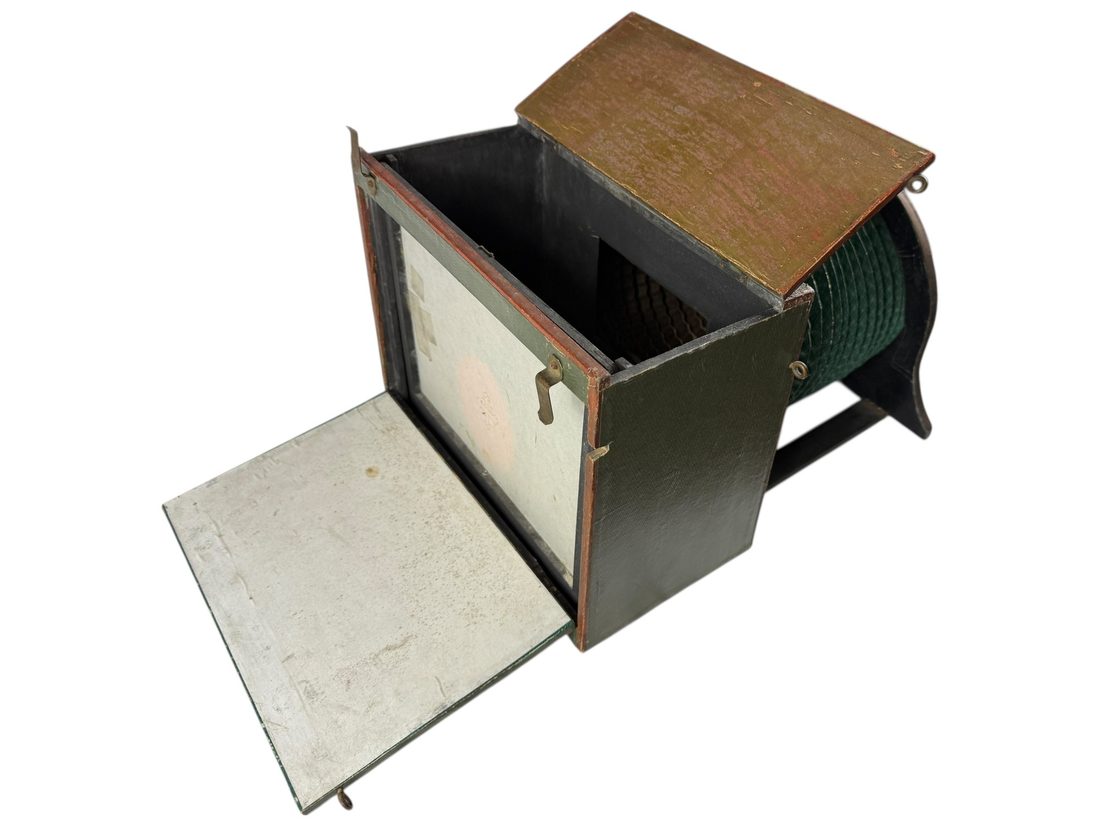
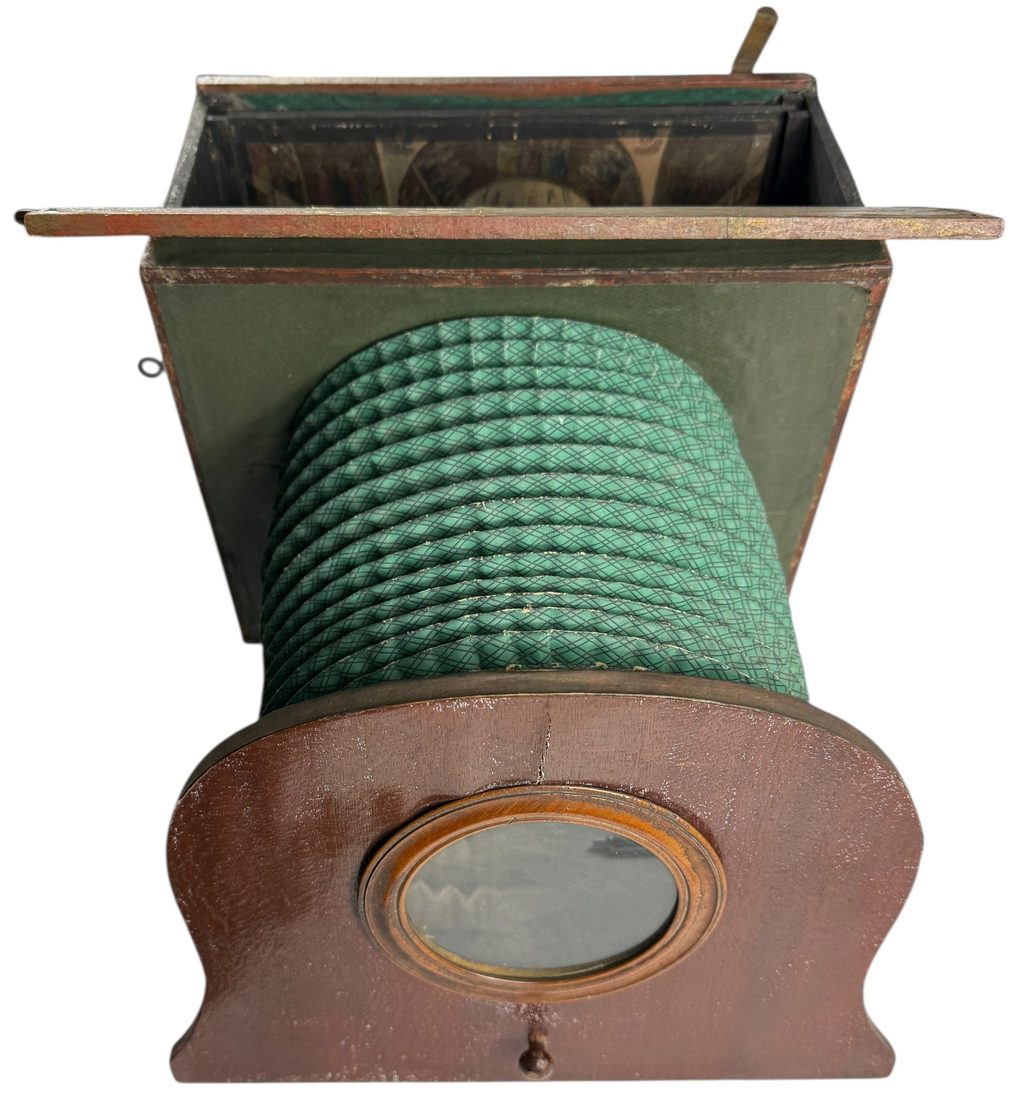
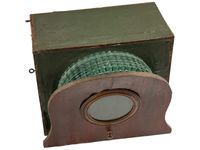
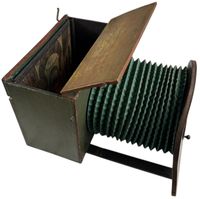
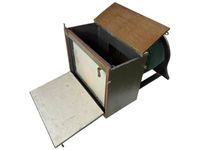
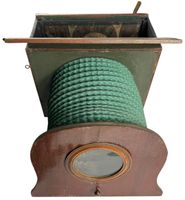
Wooden box viewer (210 × 380 × 140 mm with box closed, extending to 210 × 380 × 360 mm with bellows), with front ocular panel in stained hardwood, shaped at the base and fitted with a circular viewing lens (84 mm diameter), the lens retained within a concentric wooden mount, and a small pull or knob positioned beneath the lens. The apparatus is furnished with an extending green paper bellows, intact, terminating at the ocular board. The body incorporates a hinged upper lid for the modulation of reflected light and a rear opening element for transmitted illumination. The interior is painted or papered dark in order to enhance contrast. Seven original hand-coloured lithographic paper slides mounted in thin wooden frames (each approximately 250 × 190 mm), with selective perforations and reverse painting to produce a dual day-and-night effect under alternated reflected and transmitted light.
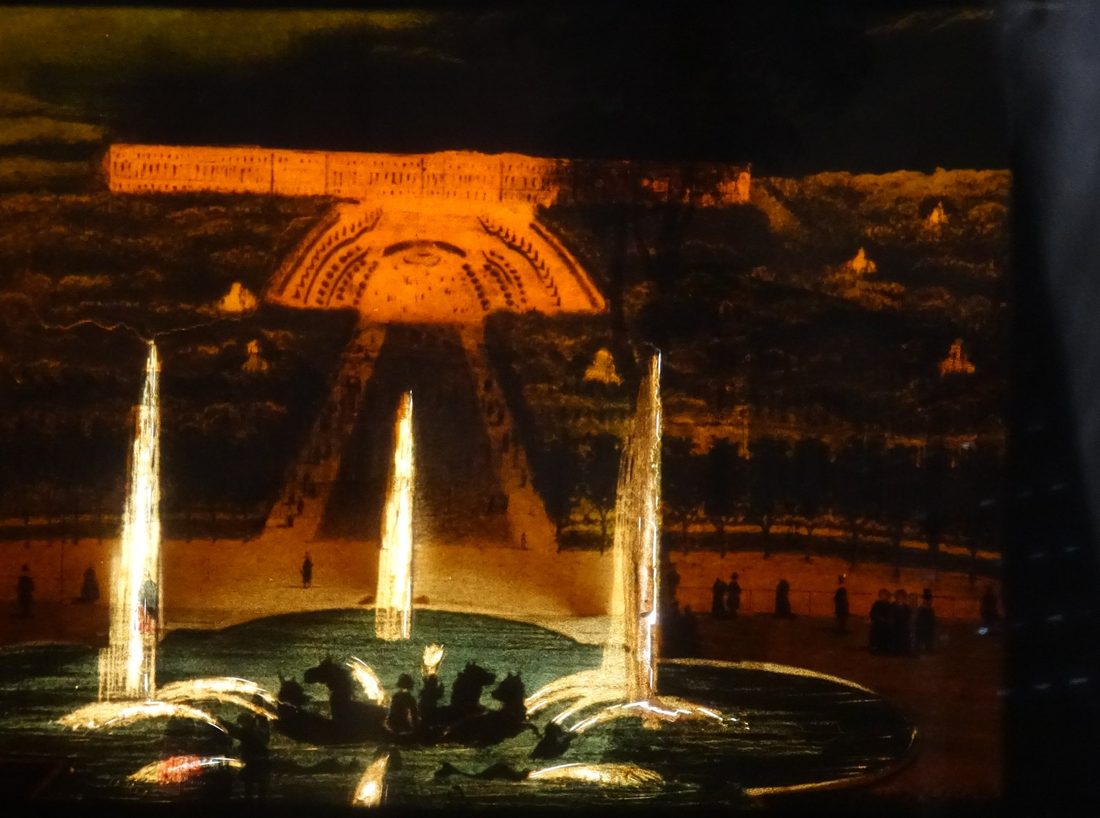
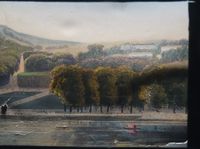
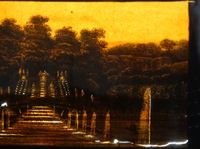
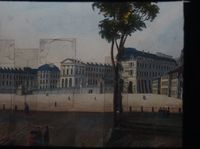
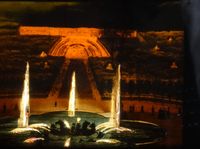
The Polyorama Panoptique belongs to the nineteenth-century family of domestic optical entertainments that miniaturised the spectacular dioramic transformations of large public venues into a portable apparatus intended for private viewing. Its essential principle lies in the controlled alternation between two illumination regimes: a “day” state, read under reflected ambient light, and a “night” state, revealed through backlighting. This transformation is achieved through a combination of selective perforation, opaque masking, and reverse painting. In the present extra-large format, the effect is significantly amplified by the scale of the transparencies, which approach the dimensions of small cabinet pictures rather than the more commonly encountered toy-format slips. The chosen subjects, London and its modern engineering works, fashionable leisure spaces, monumental parks, and scenes of exotic festivity, document the mid-nineteenth-century fascination with urban spectacle, travel, topicality, and the theatre of modern light.
The general historical framework, including Lefort’s 1849 patent and the commercial dissemination of the device by Lemaire in various sizes, is treated in the standard surveys of optical amusements and in studies addressing the transition from the eighteenth-century guckkasten tradition to nineteenth-century transforming transparencies.
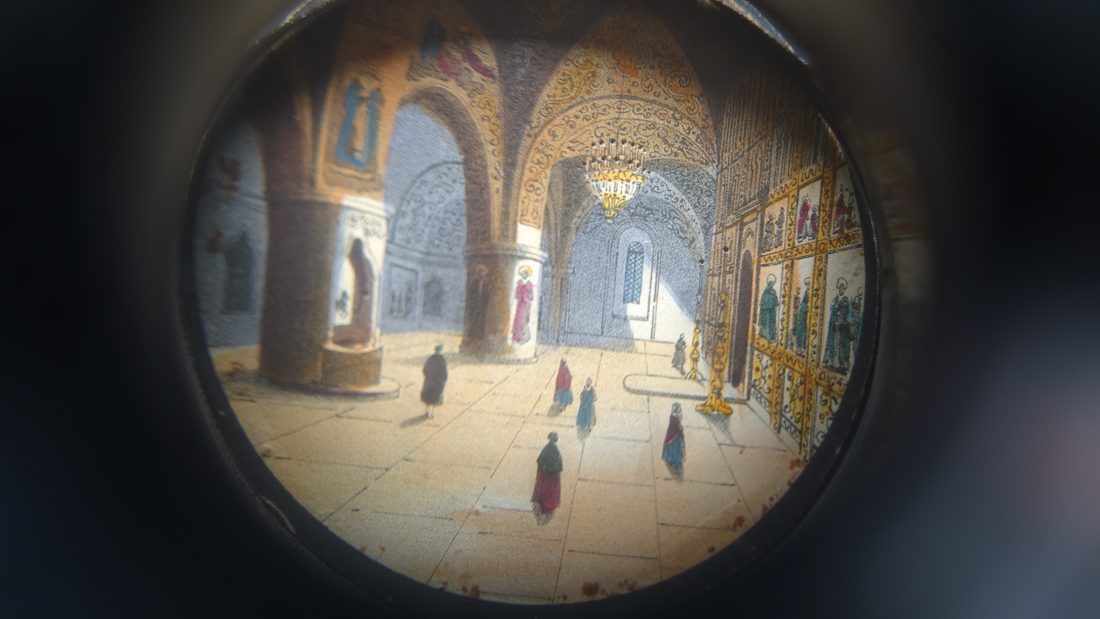
The present example represents the large-format variant of Lefort’s Polyorama Panoptique, distinguished above all by its capacity to accommodate substantially larger framed transparencies than the more frequently encountered medium and small models. From a functional standpoint, the apparatus remains faithful to the core Lefort–Lemaire concept: a compact viewing chamber, optically reduced by a single frontal lens and darkened internally, within which a transparency is held at a fixed plane. The image is “animated” not through mechanical movement, but through the orchestration of light.
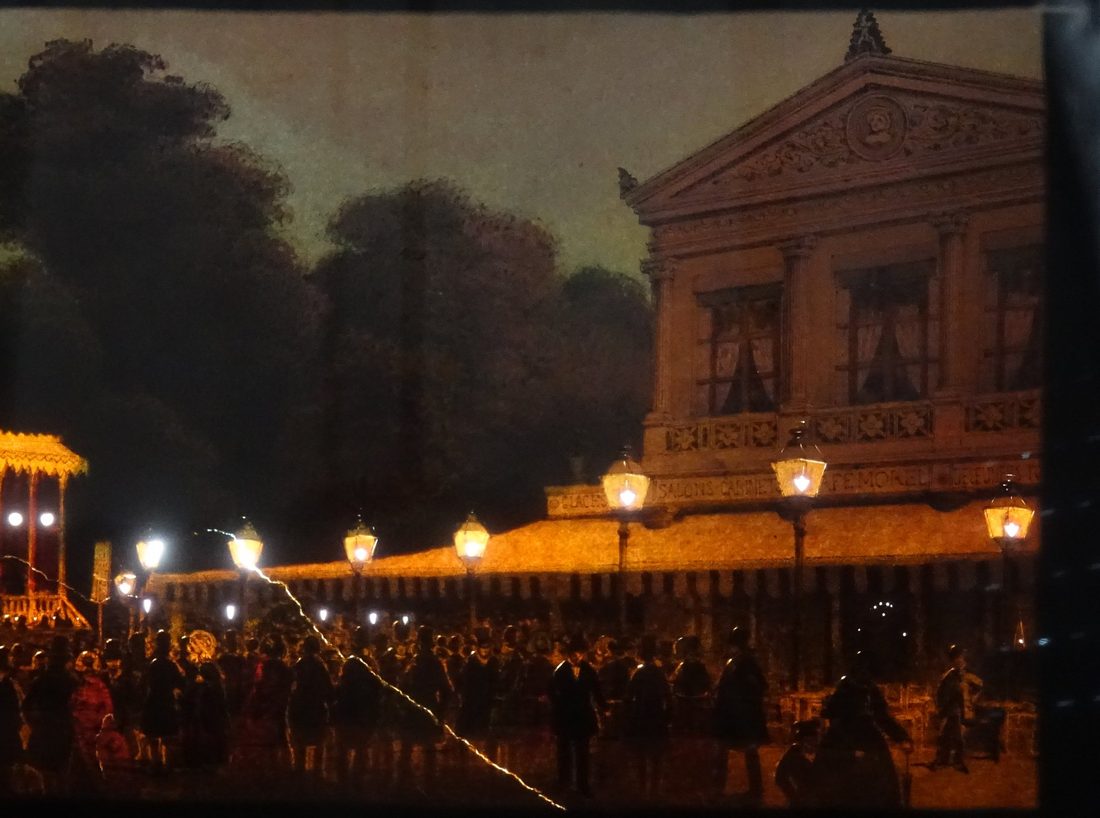
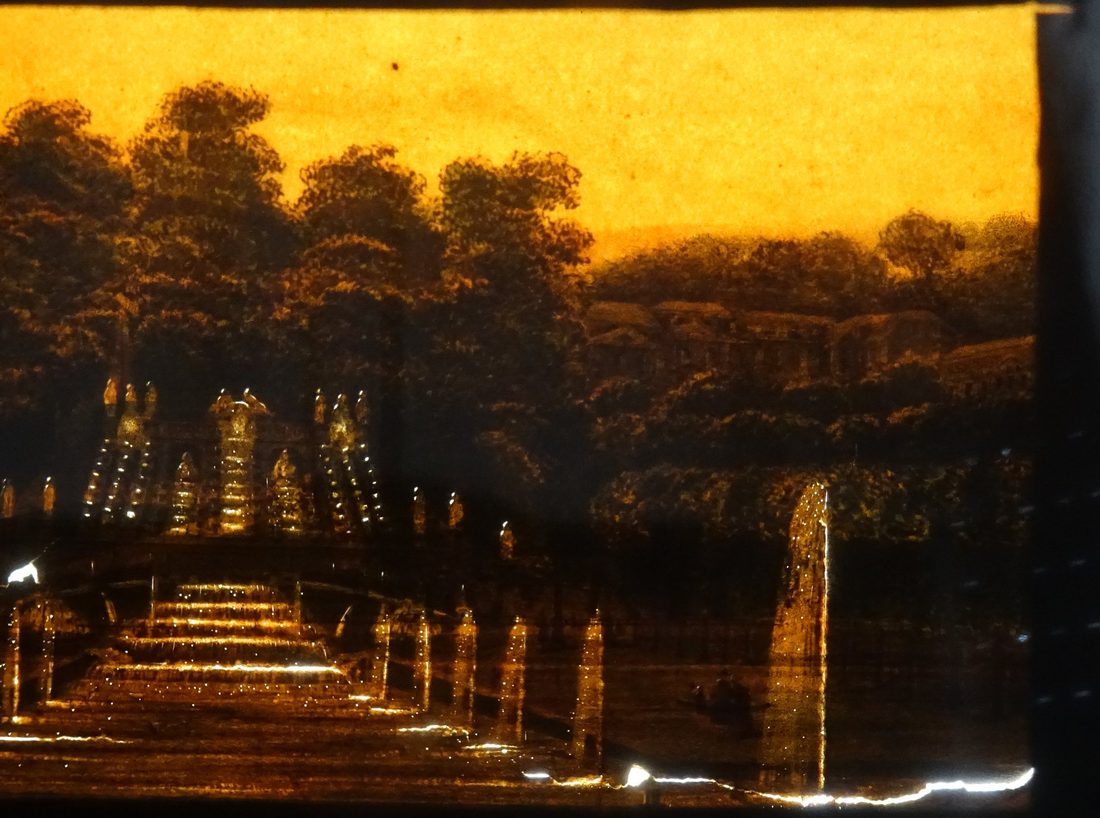
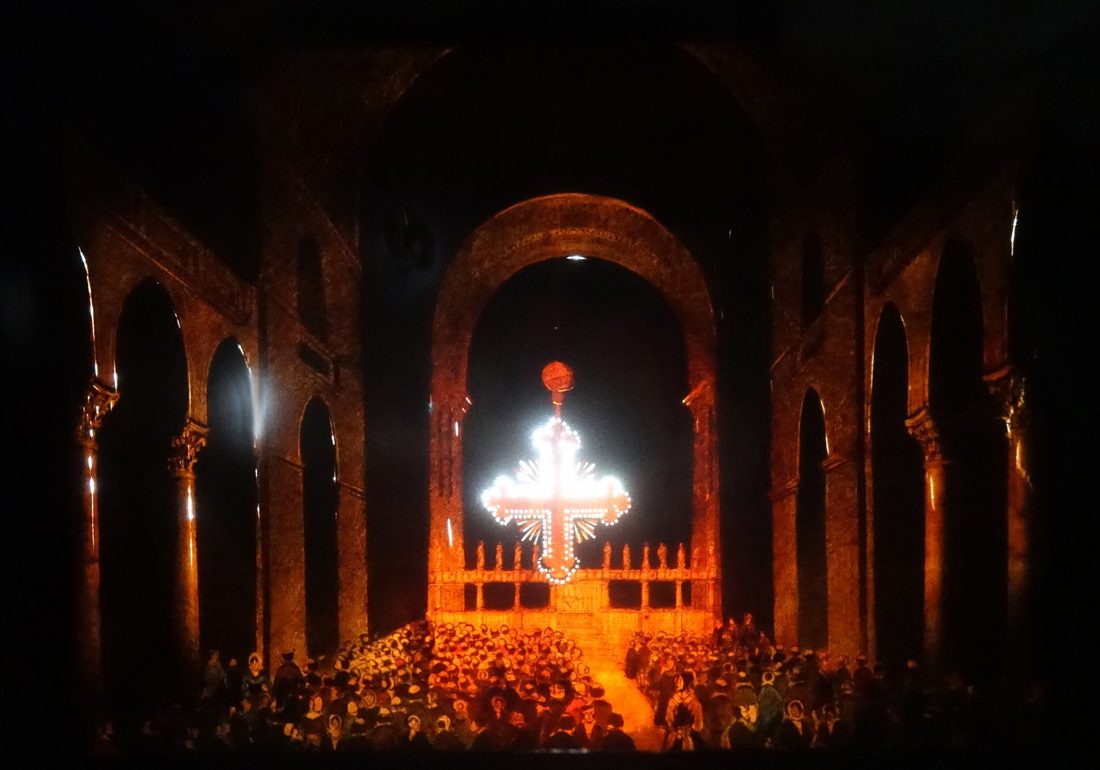
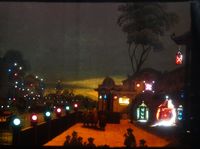
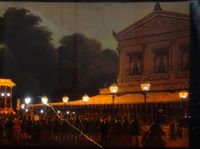
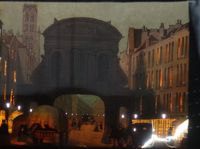
In operation, the “day” aspect is viewed with the lid open, allowing broad reflected light to fall upon the face of the transparency. The “night” aspect emerges when the upper lid is closed to suppress stray reflections and the rear opening is employed to admit a directed light source behind the image. The transformation relies on three material interventions. First, selective cutting or perforation marks the points intended to glow, typically windows, lamps, fireworks, or lanterns. Second, backing papers or translucent membranes modulate the hue and diffusion of the transmitted light. Third, reverse painting and opaque applications suppress or reshape forms between the two states, so that an architectural structure legible by day may dissolve into a luminous silhouette by night, and a neutral surface may become a field of illumination punctuated by coloured points.
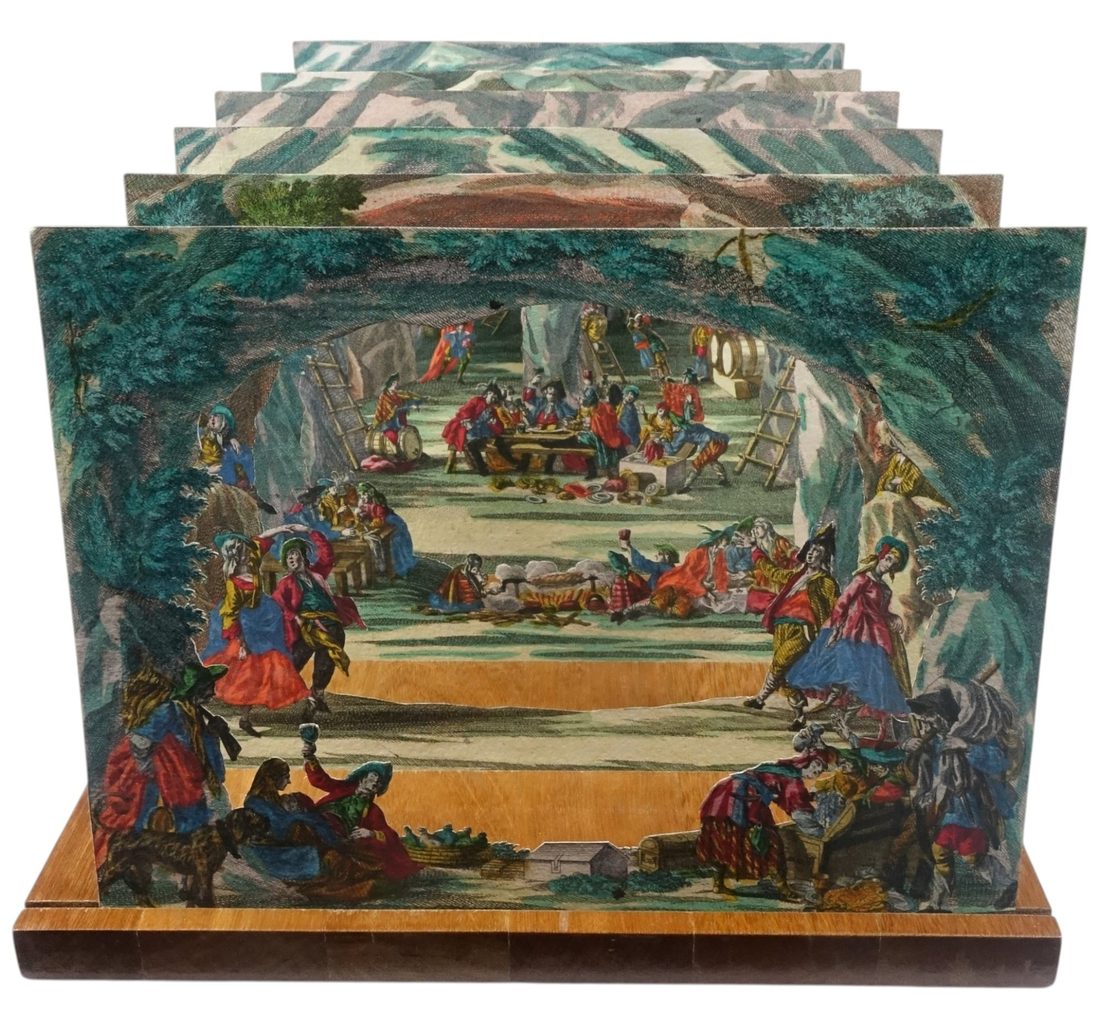
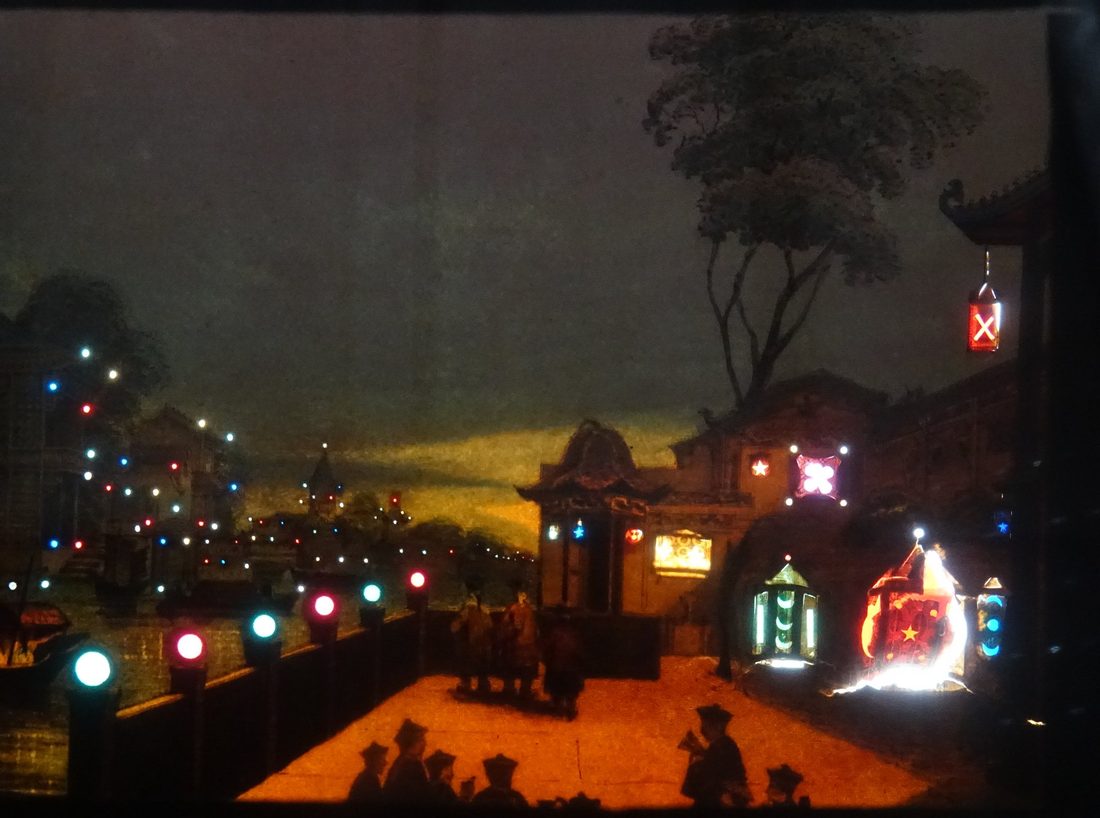
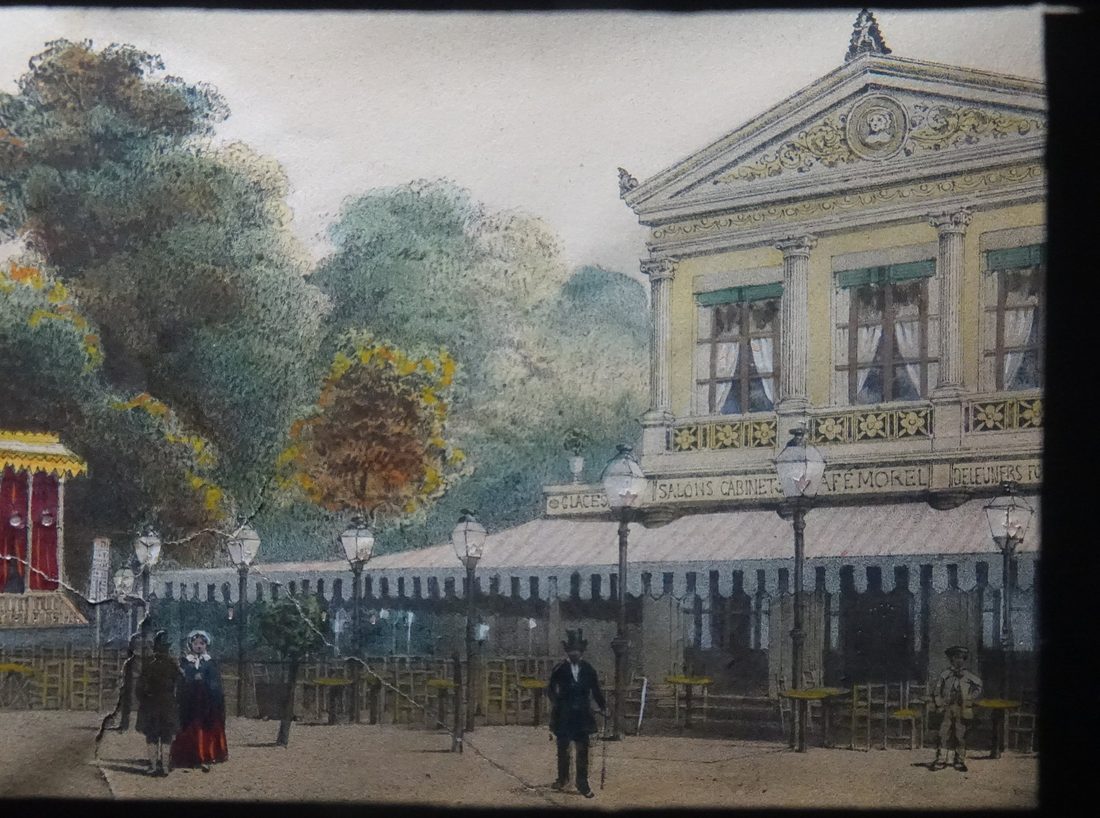
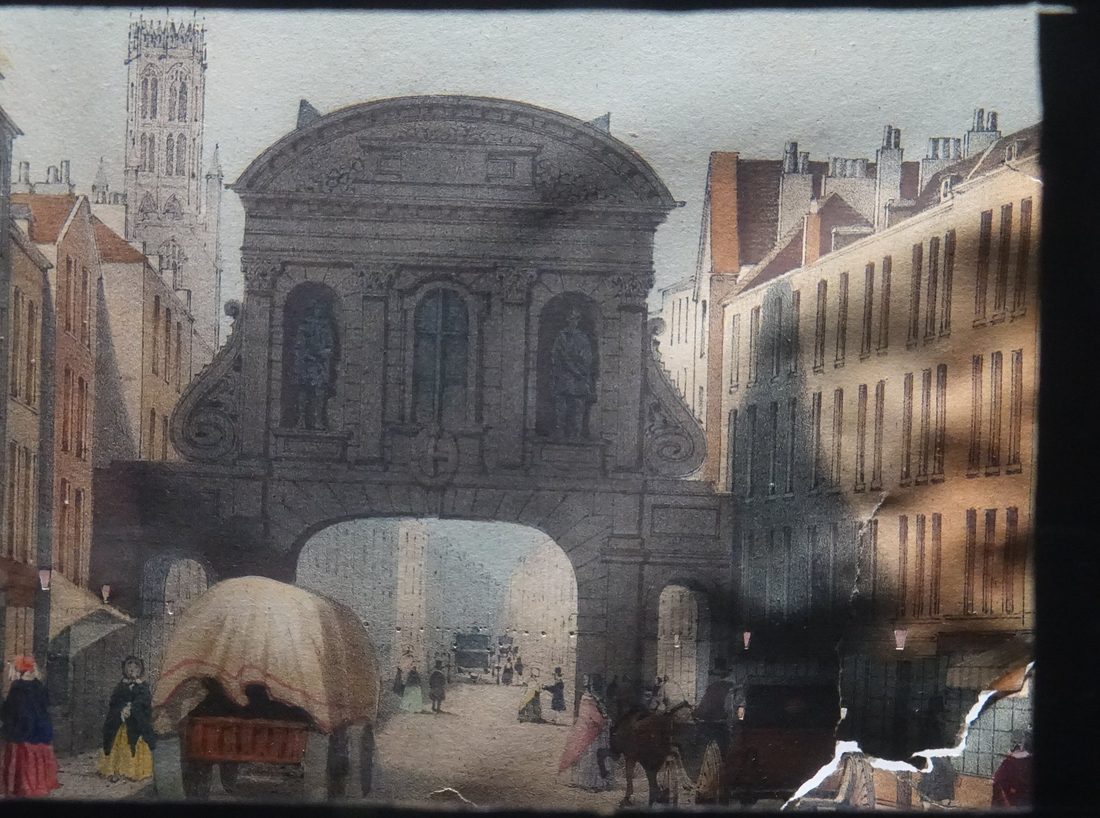
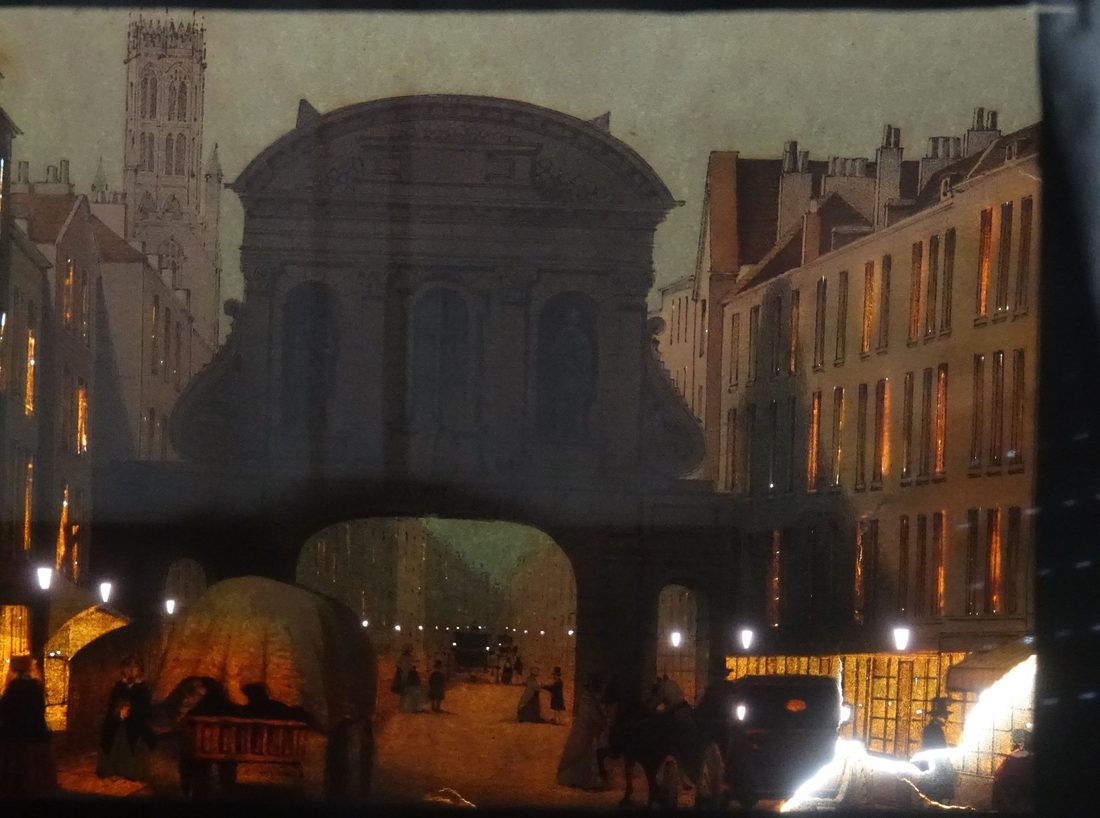
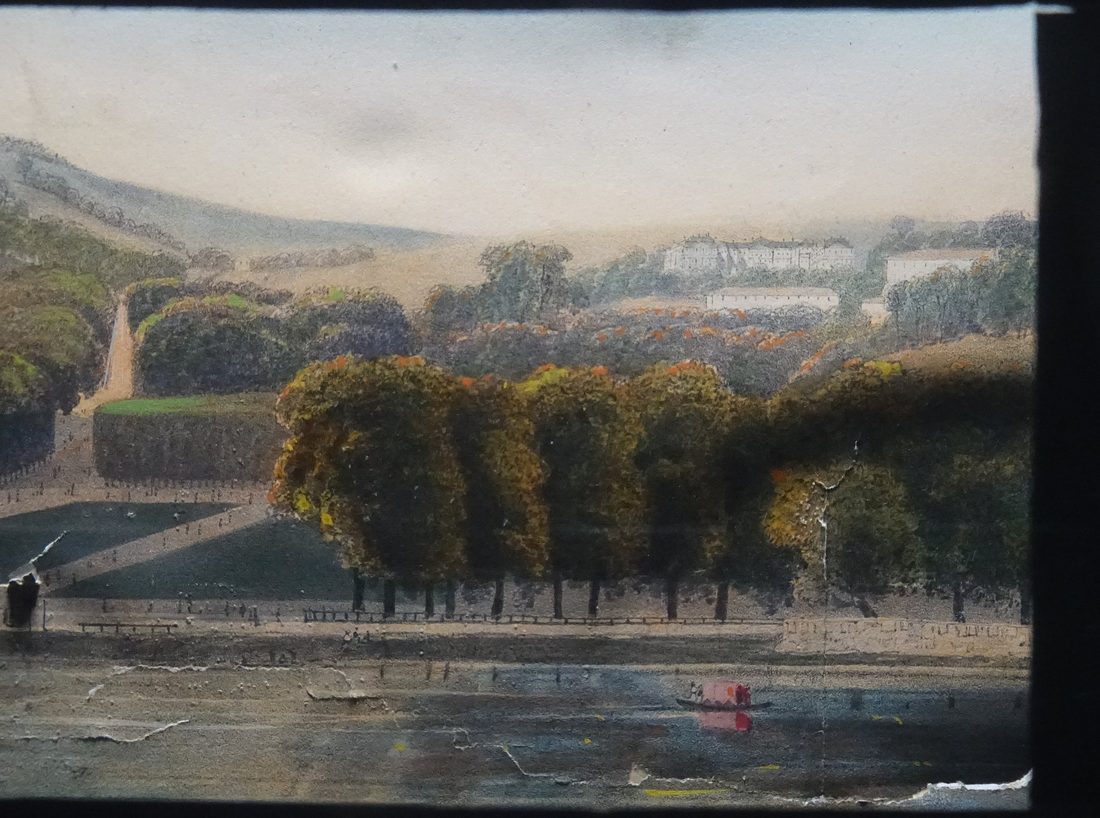
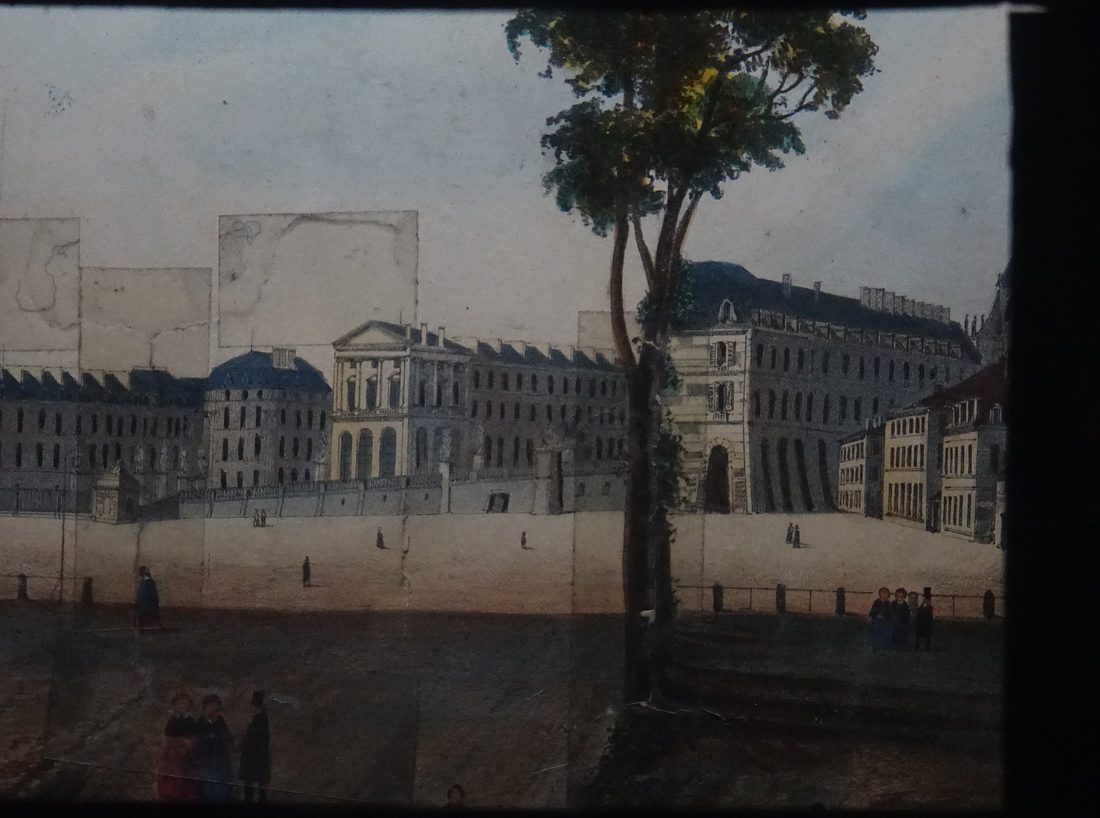
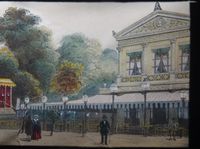
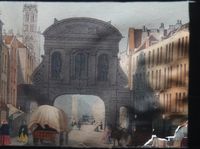
The iconographic programme of the seven views is unusually coherent in its emphasis on metropolitan modernity and nocturnal spectacle. The inclusion of “La Tamise – Le Tunnel (Londres)” is particularly significant: the Thames Tunnel, celebrated as both an engineering marvel and a tourist attraction, constituted an ideal subject for a medium whose entire rhetoric centred on the drama of entry into the illuminated modern world. In a comparable register, Temple Bar (Londres) evokes the historic ceremonial threshold of the City of London, while the Café des Ambassadeurs and the Parc de St. Cloud reflect the mid-century appetite for fashionable leisure spaces, promenades, and the choreography of public illumination. The programme extends beyond Europe into the nineteenth-century imagination of the “exotic night” with Canal de Canton Fête des Lanternes China, where lantern illumination is not merely a pictorial effect but the explicit subject of the view, functioning as a self-referential demonstration of the polyoramic principle.
The Seven Views
“La Tamise – Le Tunnel (Londres)” (very good condition).
A view of Versailles and its fountains at night (framed panel with a glued joint).
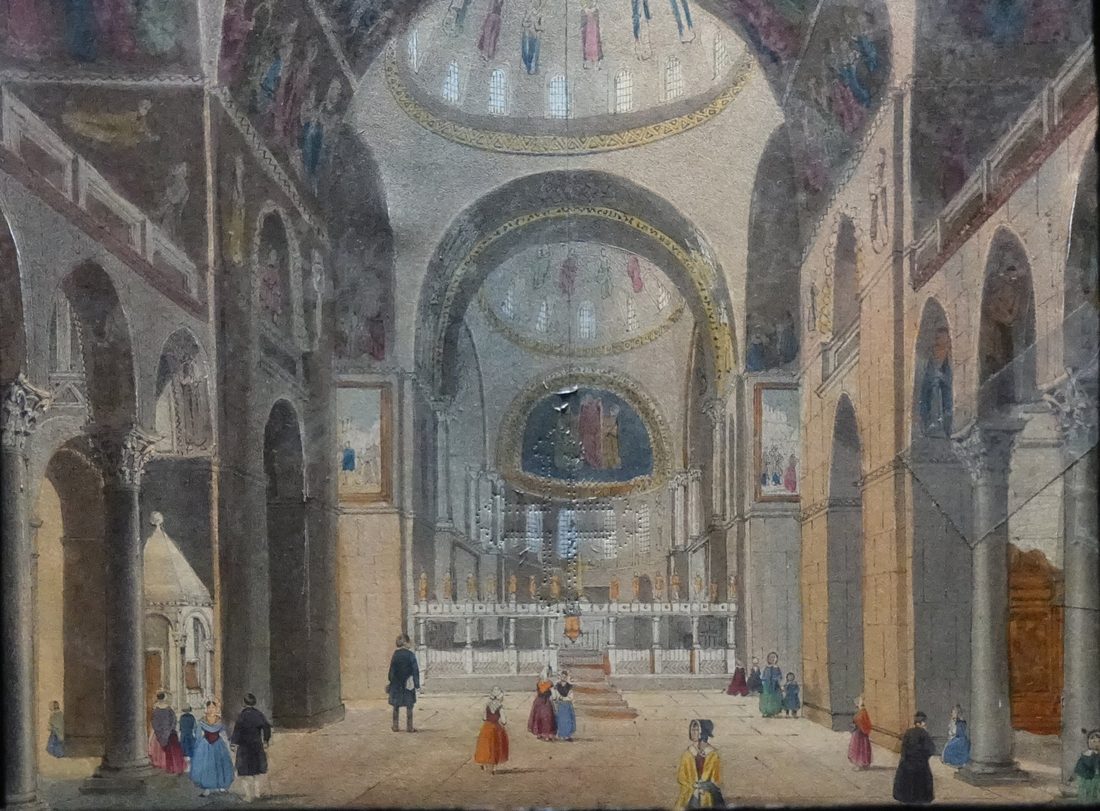
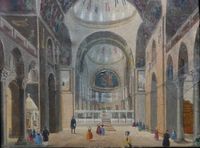
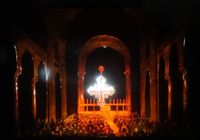
The Cross of Light in the Church of St. Marc (framed panel with a glued joint).
The Café des Ambassadeurs (framed panel with a glued joint).
“Canal de Canton Fête des Lanternes China” (visually very fine, panel with unrestored cuts).
Parc de St. Cloud (panel with unrestored cuts).
Temple Bar (Londres) (panel with unrestored cuts).
The stratification of condition within the set, with one plate notably better preserved and others exhibiting joints or cuts, is entirely consistent with the historical use of such views, which were frequently handled, repeatedly inserted and withdrawn from the viewing slot, and often stored without rigid protective cases.
The Polyorama Panoptique is best understood as a late chapter in a long European history of mediated vision, in which the eighteenth-century guckkasten and its printed optical views evolved into nineteenth-century devices dedicated to the controlled drama of illumination. In the earlier tradition, the illusion of depth and travel depended primarily on perspective, mirror reversal, and lens enlargement. By contrast, the nineteenth-century transforming transparency is an art of temporal sequence, offering not merely a place, but a place in time, day yielding to night, calm to spectacle, ordinary architecture to festive brilliance. The same interest for visual metamorphosis had already been exploited on a monumental scale in Daguerre’s Diorama, and the Polyorama may be understood as a bourgeois domestic analogue that translates public spectacle into a table-top experience.
The object also belongs to the material culture of so-called “scientific toys”, in which entertainment and optical demonstration intersect. The viewer’s manipulation of shutters and apertures is not incidental, it encourages an experiential understanding of the distinction between reflected and transmitted light, and of the ways in which optical information is transformed by illumination. Yet this didactic dimension does not exhaust the object’s significance. The iconography of the transforming views, war, travel, exotic festivity, modern engineering, fashionable cafés, mirrors that of the illustrated press and panoramic entertainments of the period. The polyorama thus participates in a wider economy of images in which novelty arises not only from new subjects, but from new visual regimes, particularly the newly commodified experience of night, gaslight, fireworks, lantern festivals, and the theatrical illumination of monuments.
Within this framework, the extra-large format of the present example acquires genuine collecting importance. Larger views imply higher production costs, more ambitious colouring, and a stronger presence as autonomous “cabinet pictures” when removed from the apparatus. They also presuppose a domestic interior capable of accommodating the viewing ritual, including controlled backlighting, suggesting an upper-bourgeois milieu rather than a purely juvenile toy market.
Pierre-Henri Amand Lefort (active Paris, mid-19th century) was a French manufacturer of optical toys and instruments. His principal contribution was the 1849 patent for the Polyorama Panoptique, described as “une lunette pliante et un filtre optique” designed to create multiple lighting effects. While Lefort secured the invention, it was the optician Lemaire who commercialised it extensively, producing large quantities and exporting them throughout Europe. Beyond the Polyorama, Lefort also experimented with stereoscopes and related devices, though none achieved the same widespread impact. His work belongs to the tradition of Parisian artisans who bridged the worlds of science, pedagogy, and entertainment.
The optician Lemaire is repeatedly identified in the specialist literature as a leading manufacturer who brought the polyorama concept into broad circulation, producing the apparatus in different sizes and marketing it as a fashionable optical amusement. In the framework of nineteenth-century Paris, the optician-manufacturer occupies a role comparable to that of an instrument-maker who straddles scientific legitimacy and popular entertainment: the same workshops and retail environments that supplied lenses and instruments could also supply optical toys whose credibility depended on competent optics and attractive image production.
Conditions: The viewer is, overall, in good, honest condition, with expected wear to the green paper covering at edges and corners. The green bellows appear intact and structurally sound. The wooden ocular panel shows surface wear consistent with handling. The lid and rear illumination elements are present and appear functional.
One view, “La Tamise – Le Tunnel (Londres)”, is in very good condition. Three framed plates show glued joints. Three further plates exhibit unrestored cuts.
References: R. Balzer, Optical Amusements: Magic Lanterns and Other Transforming Images. A Catalog of Popular Entertainments, New York, Harry N. Abrams, 1987; B. Verreycken, Der Guckkasten, Marburg: Jonas Verlag, 2015; Mannoni, Laurent, The Great Art of Light and Shadow: Archaeology of the Cinema, Exeter: University of Exeter Press, 2000.
for