Lorgnette Pittoresque avec vues rondes

| Macro-category | Ancient Games and Pre-cinema |
| Subcategory | Optical Devices |
| Author | LEFORT, Pierre-Henri Amand (inventor) |
| Provenance | France |
| Year | 1850 |
A pocket theatre of light
Rare «Lorgnette Pittoresque» (pocket Polyorama Panoptique) with an exceptional corpus of eighteen circular day-and-night transforming views in three original numbered series-boxes
Lorgnette pittoresque, or pocket Polyorama Panoptique. Paris: ca. 1849-1852. In the tradition of the Polyorama Panoptique patented by Pierre-Henri-Amand Lefort (Paris, 1849); the views issued anonymously in Paris as the registered series Lorgnette pittoresque, and here retailed by the Parisian optician Cam, whose ink stamp survives within one of the boxes (Cam, opticien, 9 rue Bourdaloue, Paris).
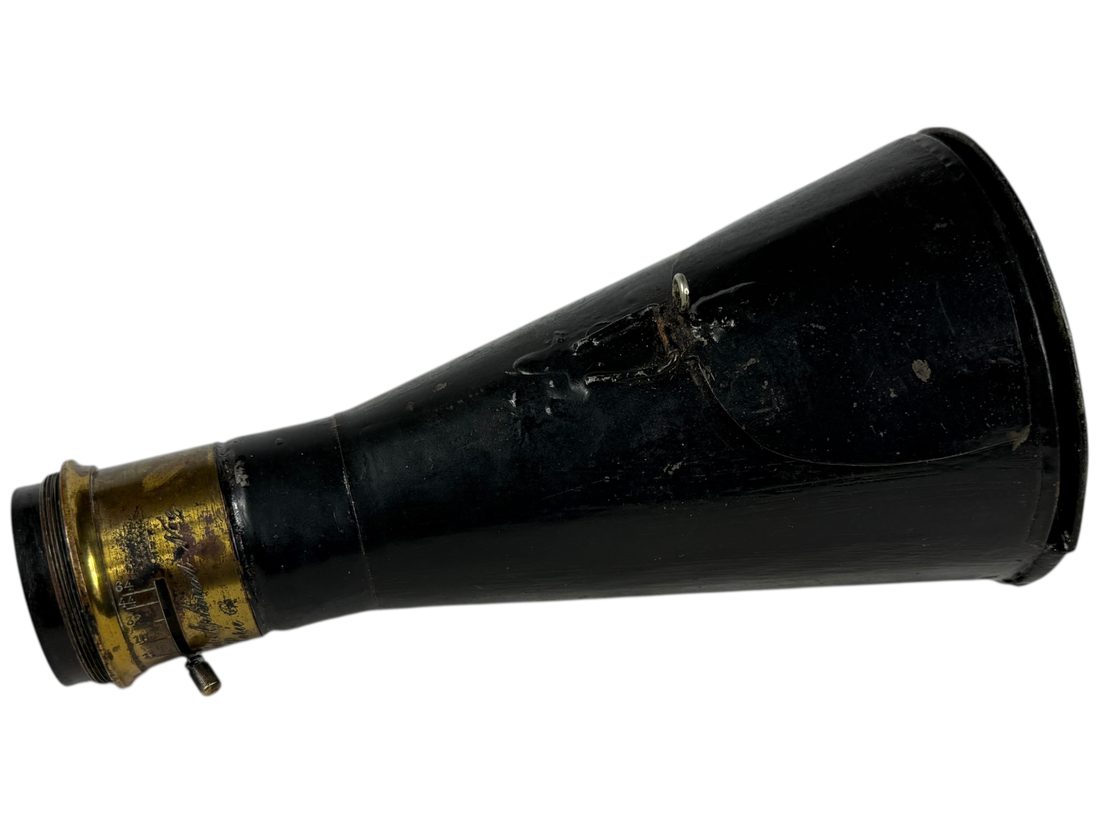
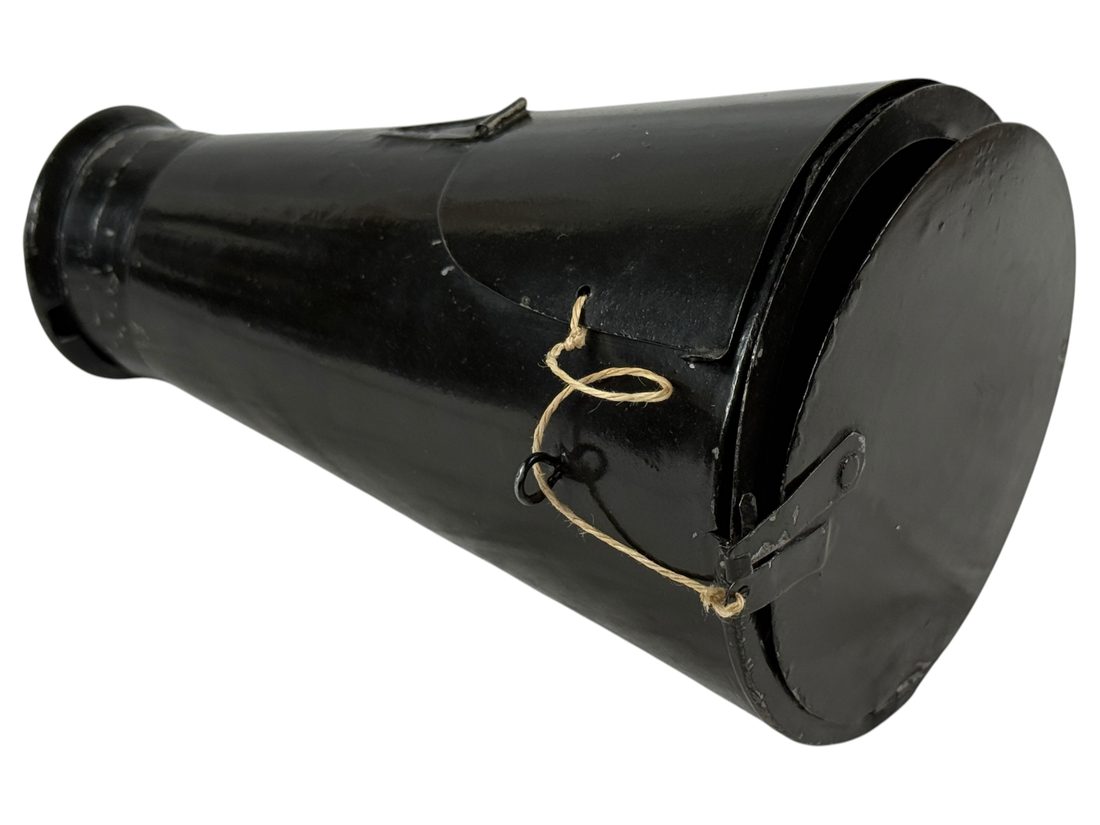
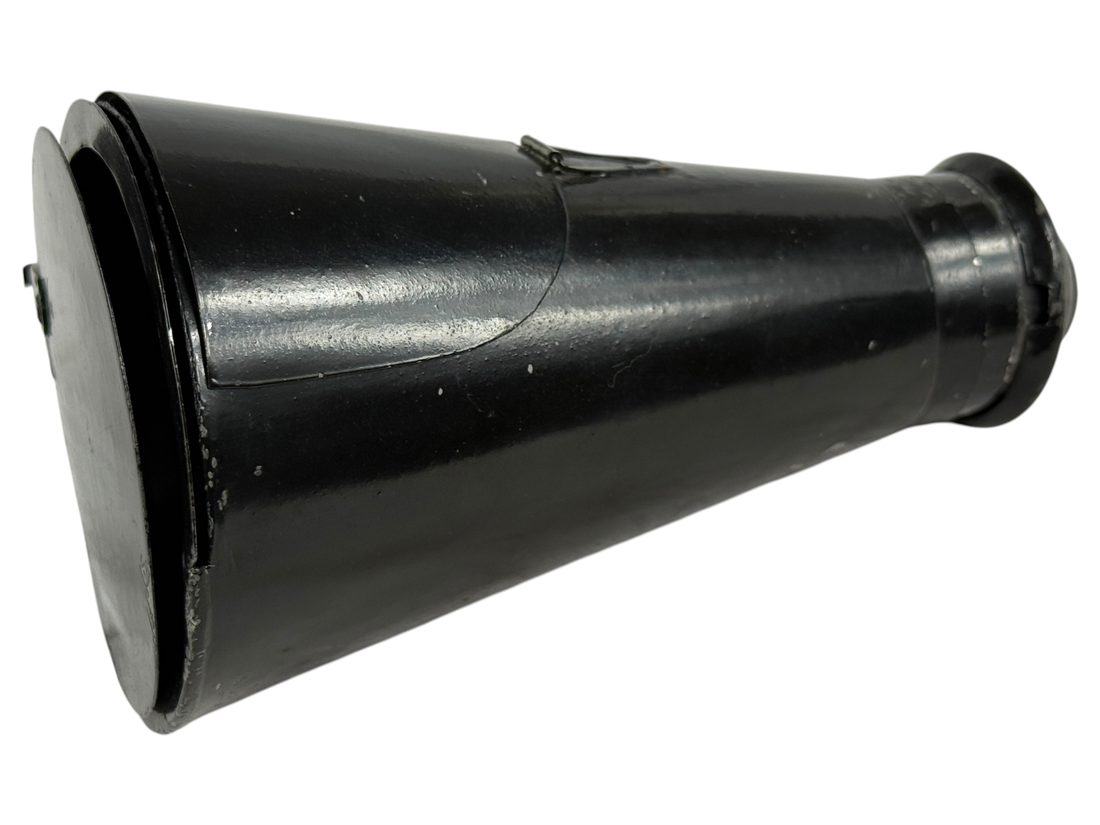
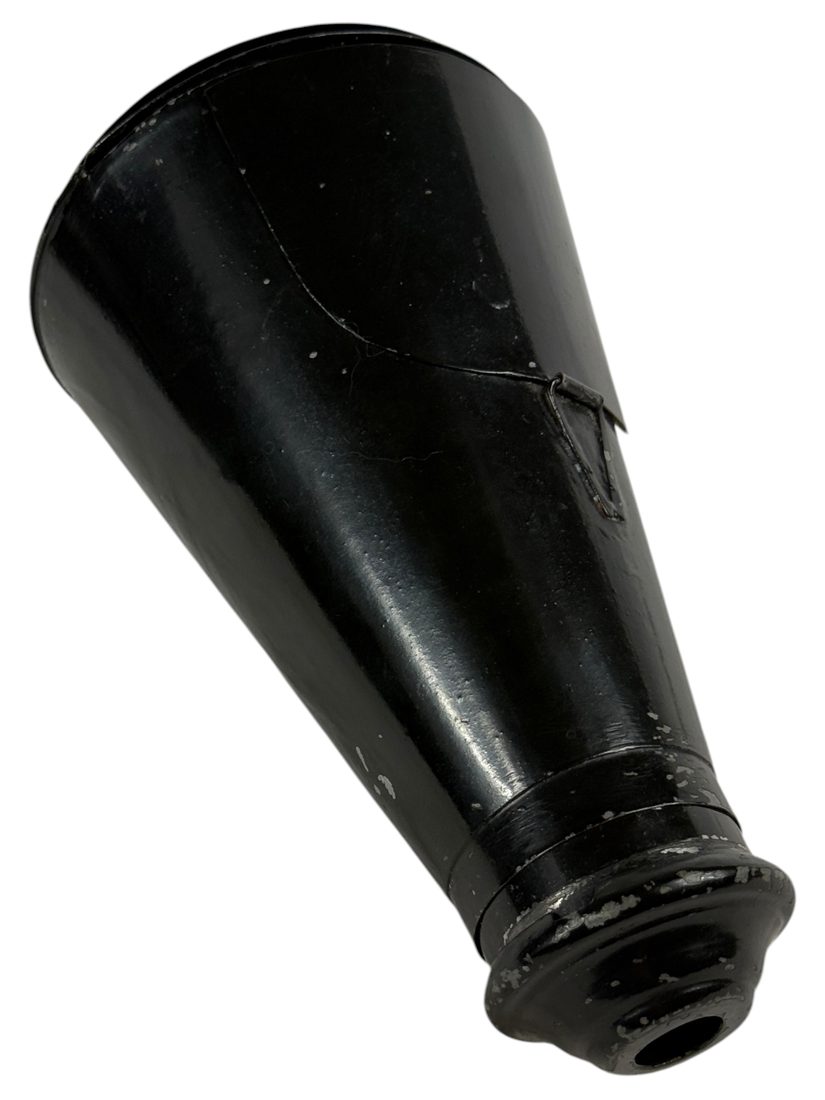
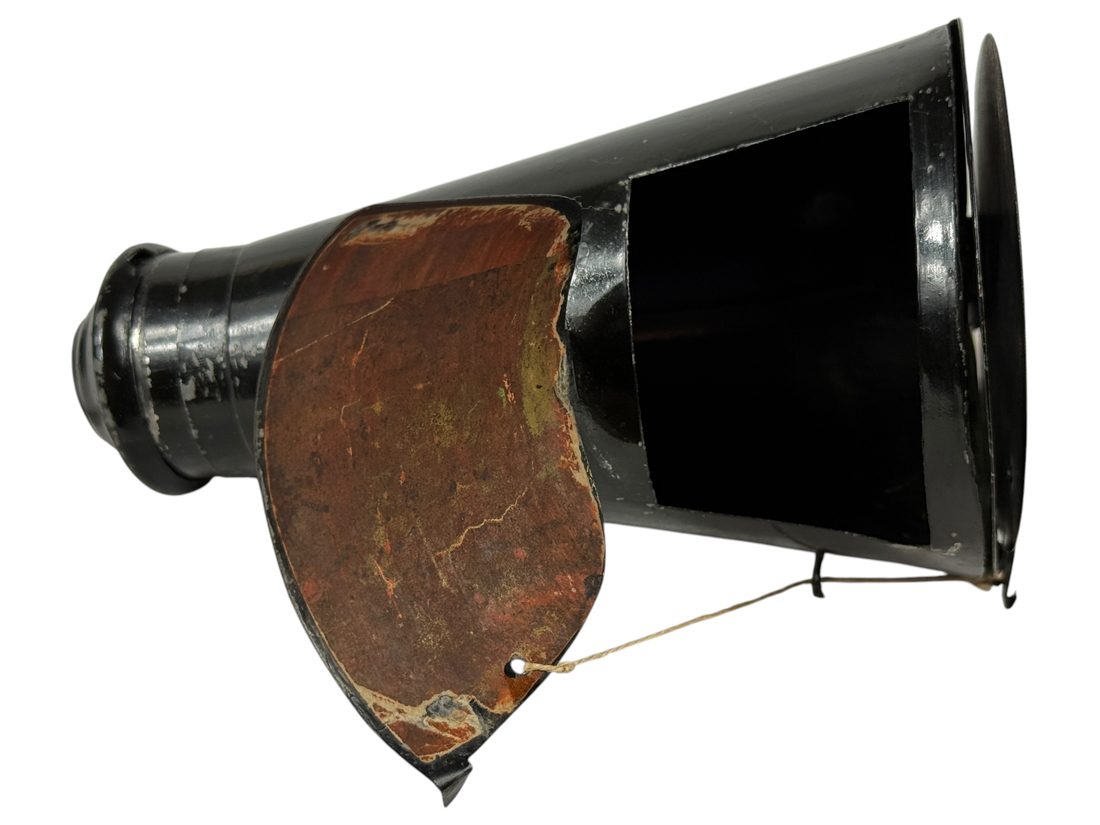
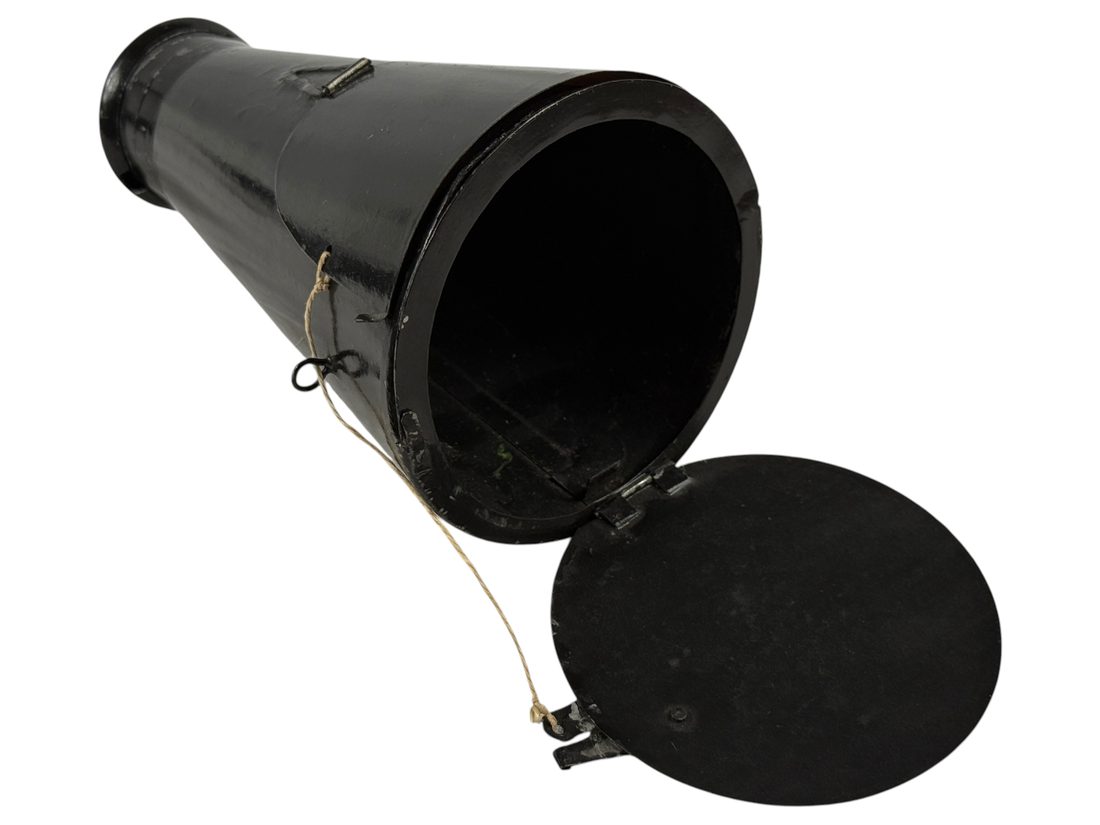
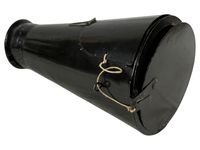
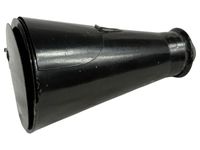
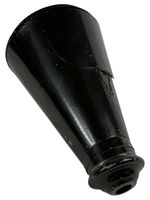
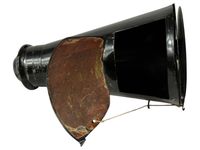
Hand-held monocular viewer with a truncated conical, cornet-shaped body of black-lacquered sheet metal (japanned tin), approximately 160 mm in length, the objective measuring about 40 mm and the front aperture about 80 mm in diameter. The narrow end carries the ocular in a plain metal mount, while the wide front mouth is closed by a flat hinged circular lid secured by a metal catch. A hinged shutter set on the upper surface of the cone opens to admit ambient light onto the face of the view, and a secondary reflective baffle within the mouth, now oxidised to a coppery gold, redirects and modulates that light. The objective is a simple lens of ordinary quality, without engraved maker’s designation, and thus distinct from the corrected high-luminosity objectives found on certain more elaborate examples of the type.
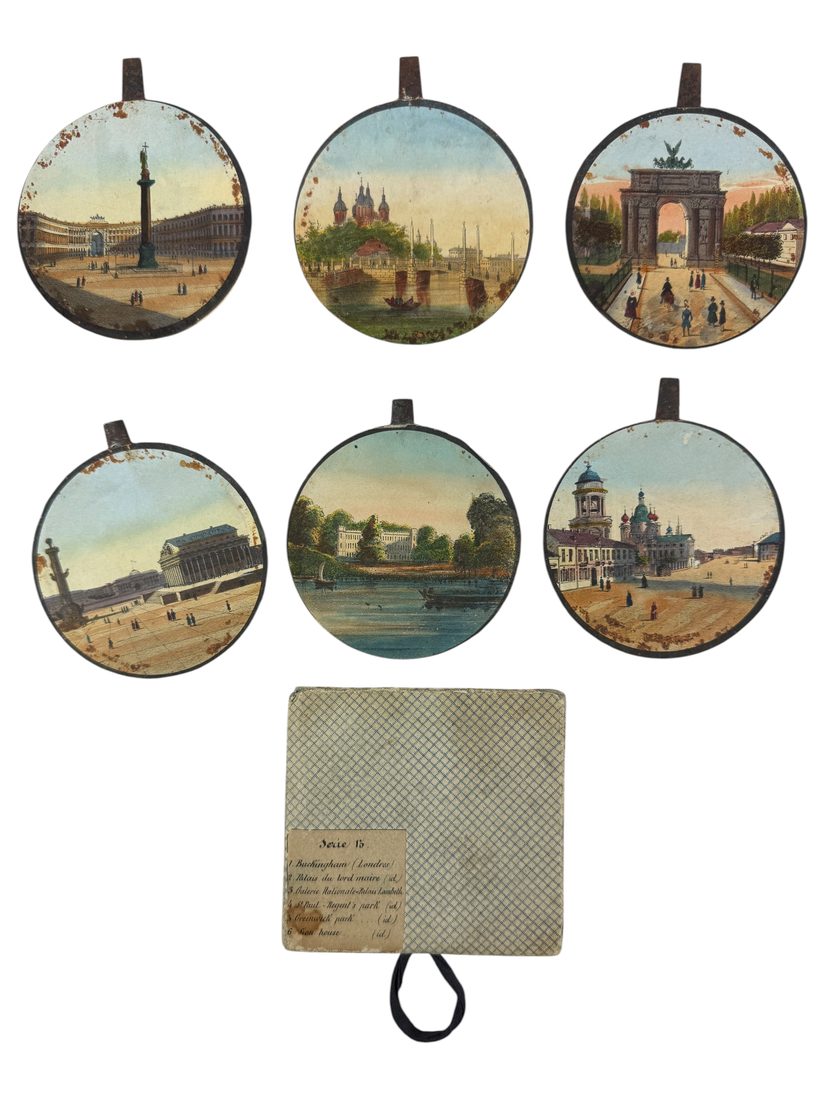
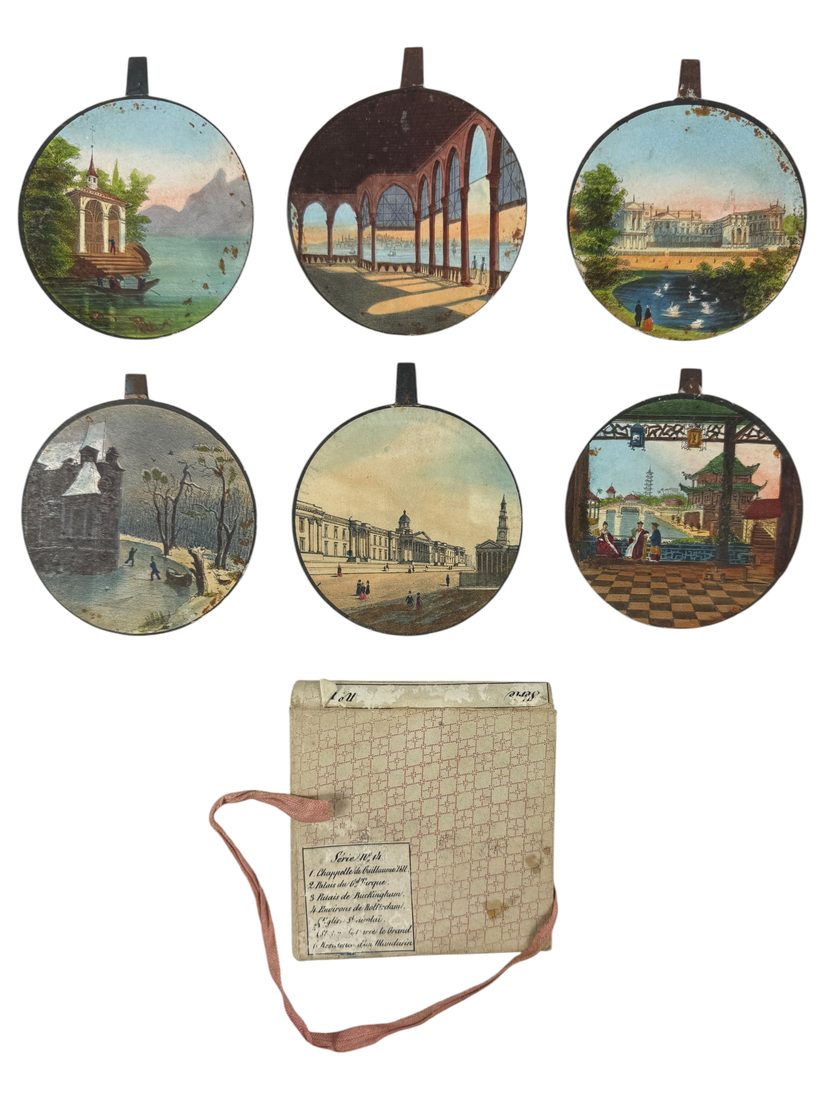
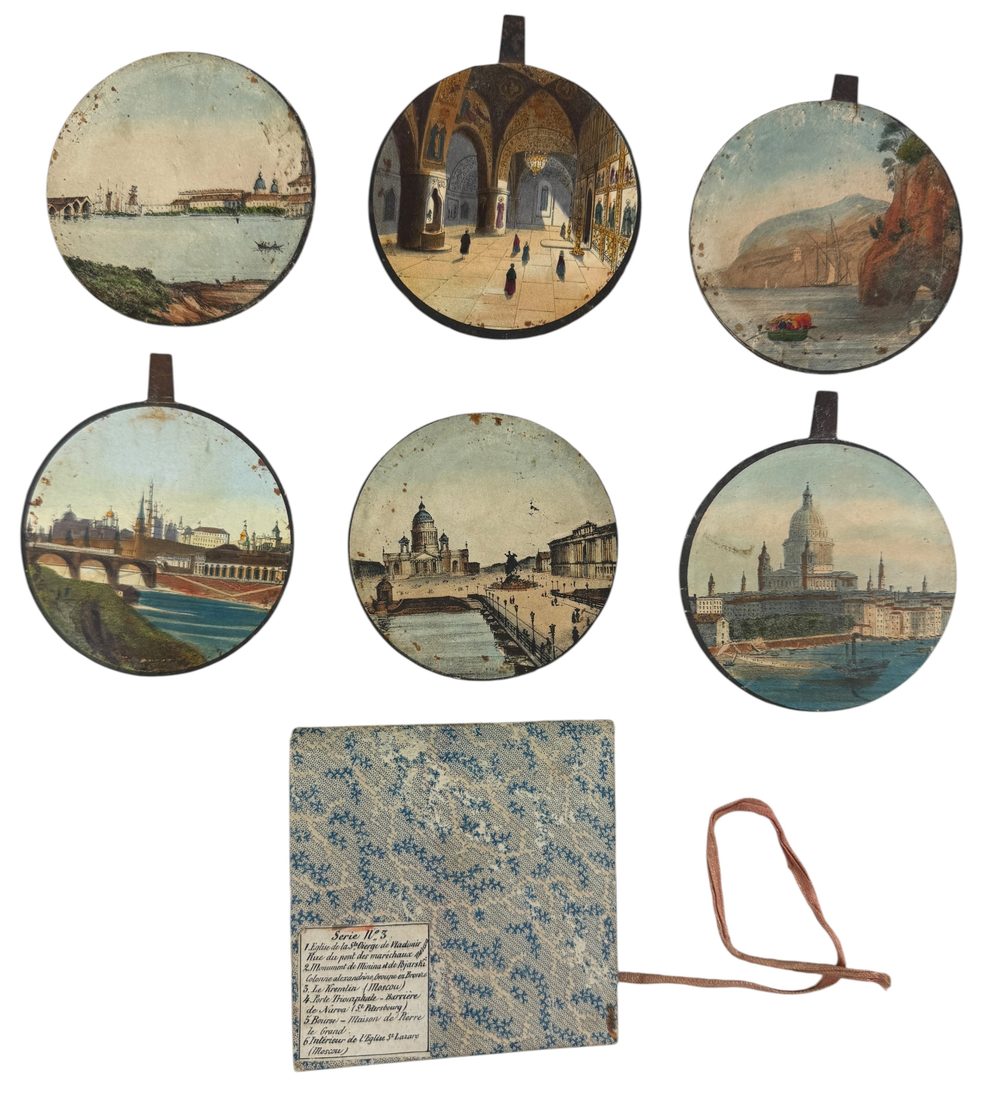
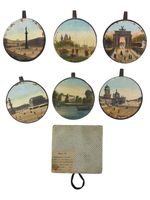
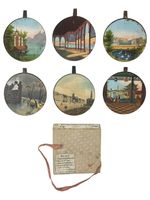
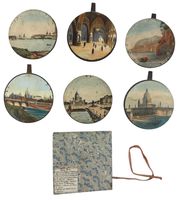
[Together with] Eighteen circular views on card, each furnished with an insertion tab and measuring 80 mm in diameter. They are lithographs finished by hand in watercolour and gouache, constructed in two layers: the front surface bears the daylight scene in opaque pigment, while translucent passages, calibrated thinning and fine perforations in the paper yield, under back-lighting, the secondary nocturnal state, with its lit windows, chandeliers, fires, moonlight and reflections upon water.
The views are arranged in three numbered sets of six, each preserved in its original square cardboard box covered in patterned paper, respectively of blue floral, pink lattice and grey lozenge design, fitted with ribbon or cord ties and bearing an index label, partly printed and partly in manuscript French cursive. One box further retains a printed publisher’s notice in blue lithographic script, «La Lorgnette pittoresque reproduira les Sites et les Monuments les plus remarquables. Des Séries de 6 Tableaux paraîtront successivement. Déjà 90 vues ont été publiées. Déposé.», together with the oval retailer’s stamp of the optician Cam at 9 rue Bourdaloue, Paris.
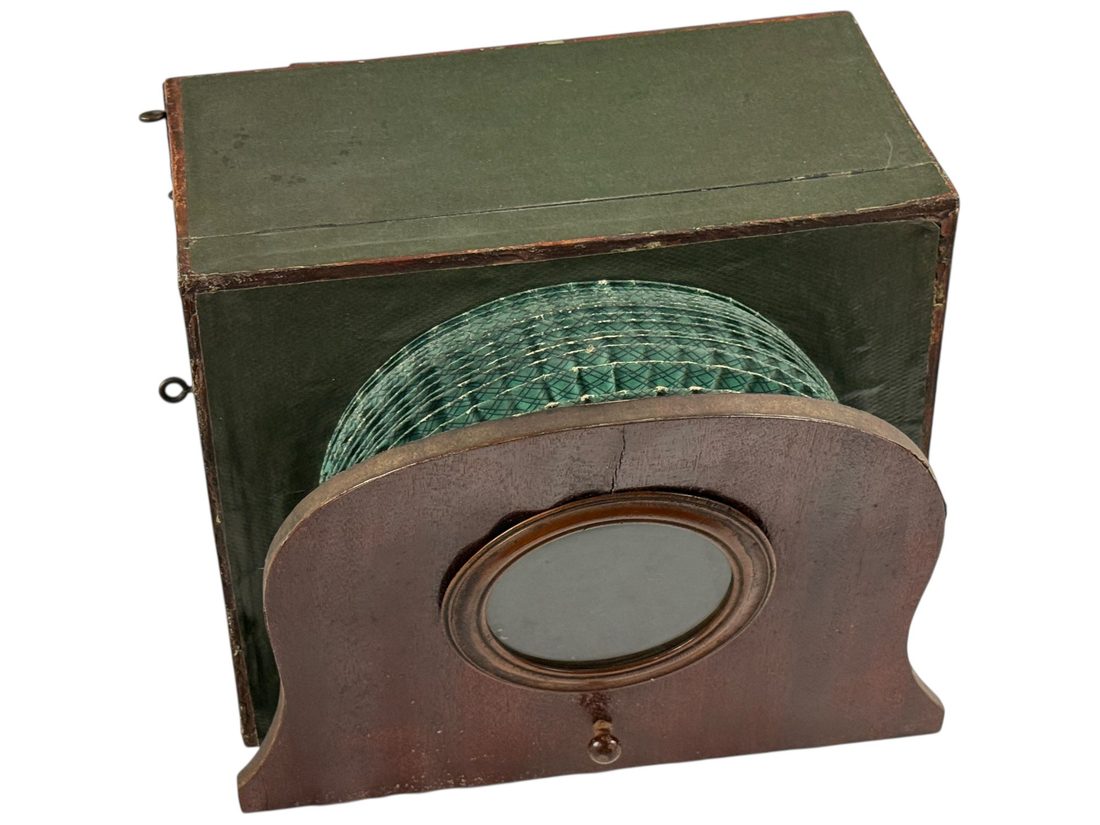
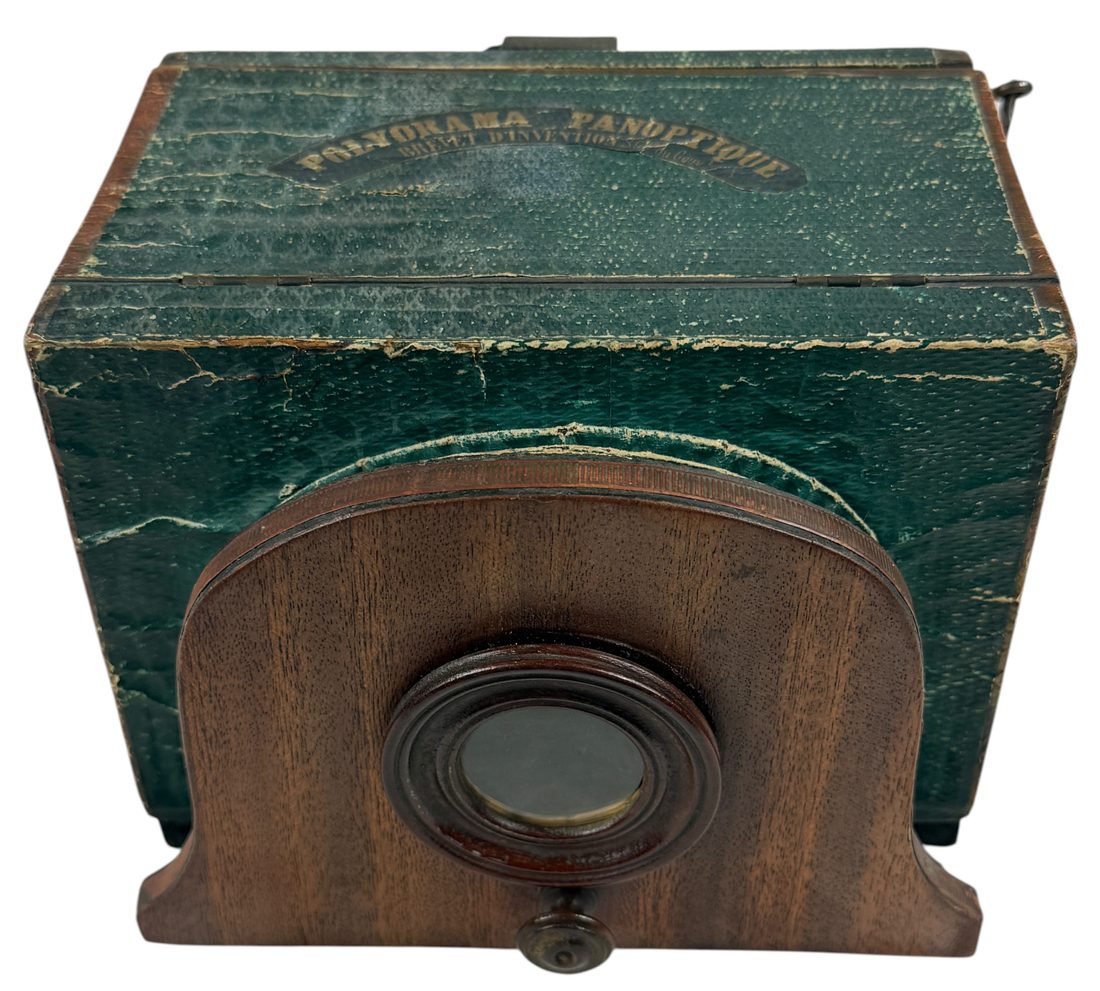
The Lorgnette pittoresque is the rare pocket-sized variant of the celebrated Polyorama Panoptique, the mid-nineteenth-century domestic device that reproduced in miniature the day-and-night transformations of Daguerre’s Diorama. Where the standard Polyorama is a bellows box for rectangular slides, this conical metal viewer takes circular transforming views and is considerably scarcer. The present example is distinguished above all by the breadth of its accompanying corpus: eighteen original hand-coloured views in three numbered series-boxes, preserved with their indices, a printed publisher’s notice and a retailer’s stamp, an unusually rich and well-documented survival for so fragile and portable an object.
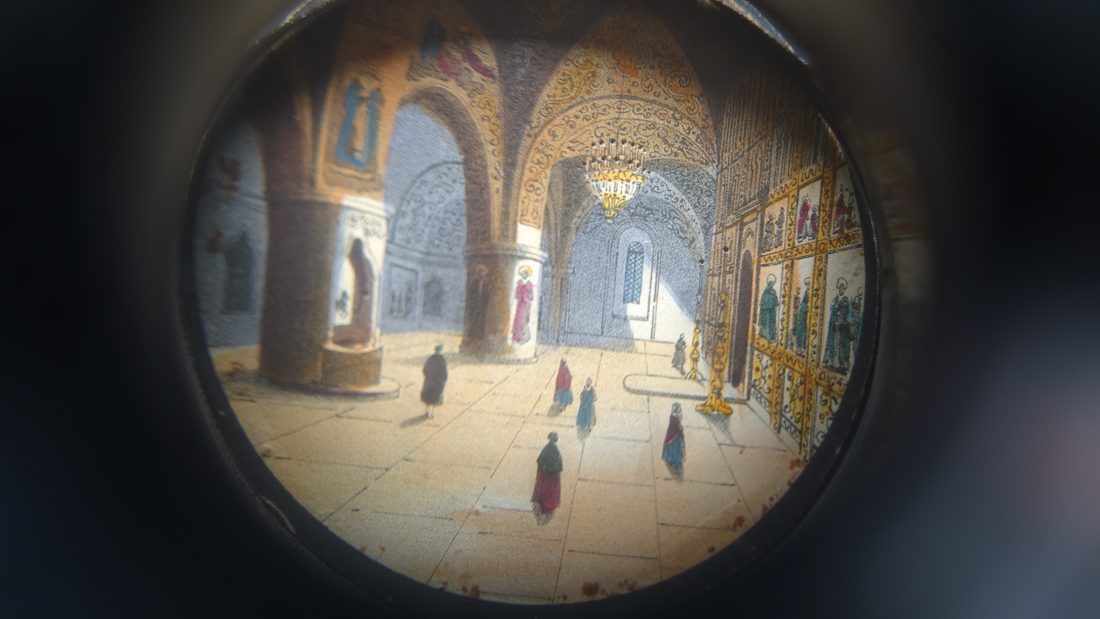
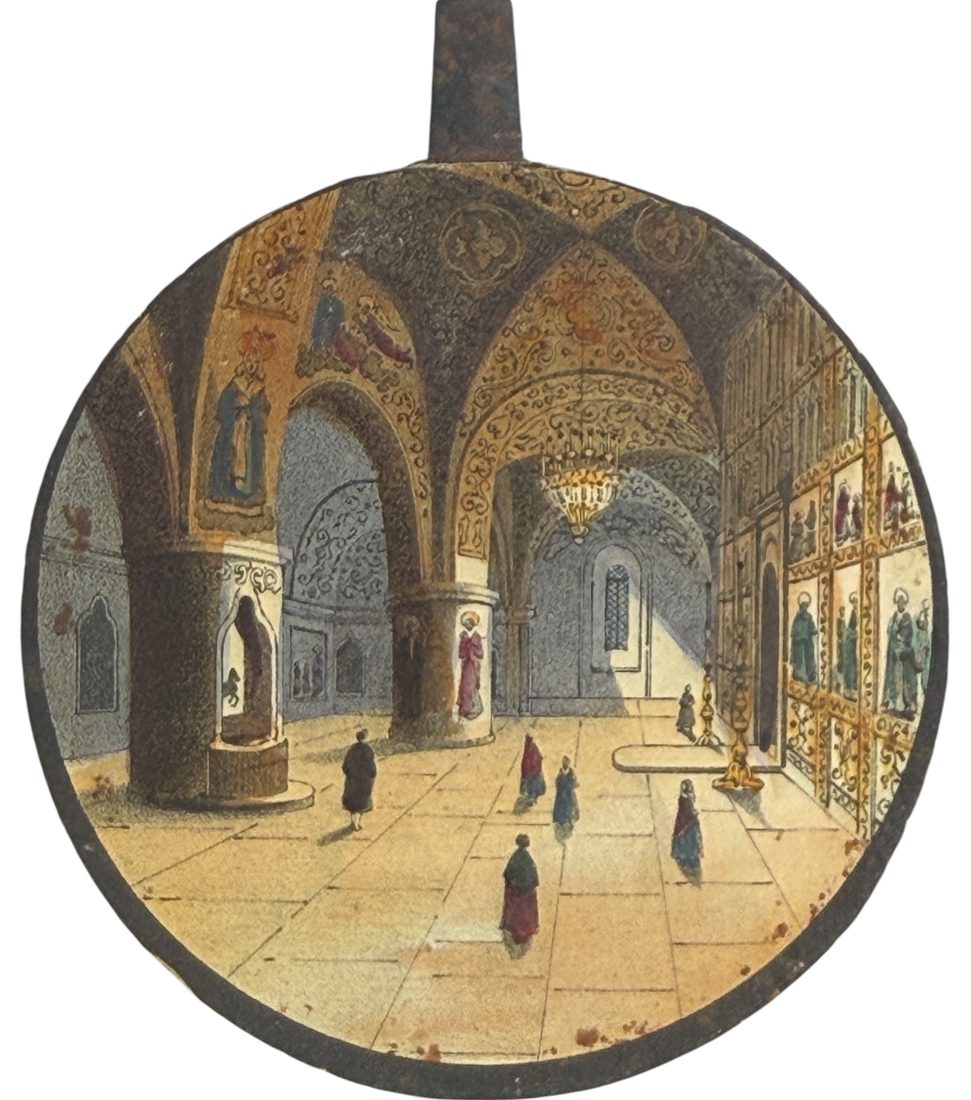
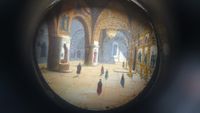
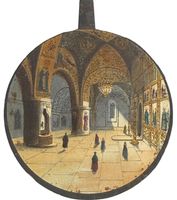
The instrument works on the principle of transforming transparencies, whereby a single image is contrived to yield two distinct states according to the direction of the light. When the upper shutter alone is raised and the scene is lit from the front, the observer, looking through the ocular, perceives the daylight view rendered in surface colour and opaque pigment. When the upper shutter is closed and the hinged rear lid is opened, light enters from behind and passes through the translucent and perforated passages of the paper, so that the same image is transformed into its nocturnal or illuminated state. Photographs taken through the ocular record the transformation with vivid clarity, as when the interior of a Moscow church passes from a serene daytime nave to a night scene ablaze with a lit chandelier and glowing lamps.
The views: a travelogue in three series
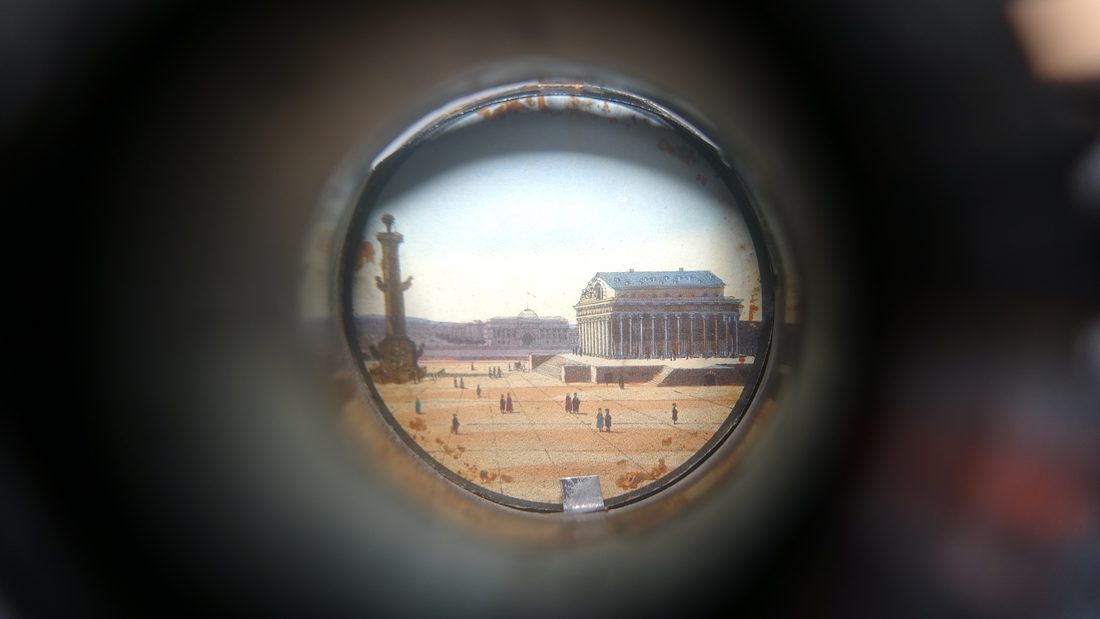
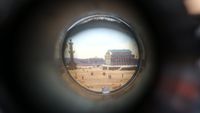
The eighteen views, examined individually, form a rich travelogue dominated by Imperial Russia. The Russian subjects, the largest and most striking group, comprise Palace Square at Saint Petersburg with the Alexander Column, the bronze quadriga of the Narva Triumphal Gate, the Bourse with its rostral columns, a panorama of Moscow with the Kremlin along the river, Saint Isaac’s Cathedral with the equestrian monument to Peter the Great, the domed cathedral seen from the Neva, and the gilded interior of a Moscow church whose night transformation blazes with chandelier and lamps.
Click to Explore the Day/Night Effect
Series 1
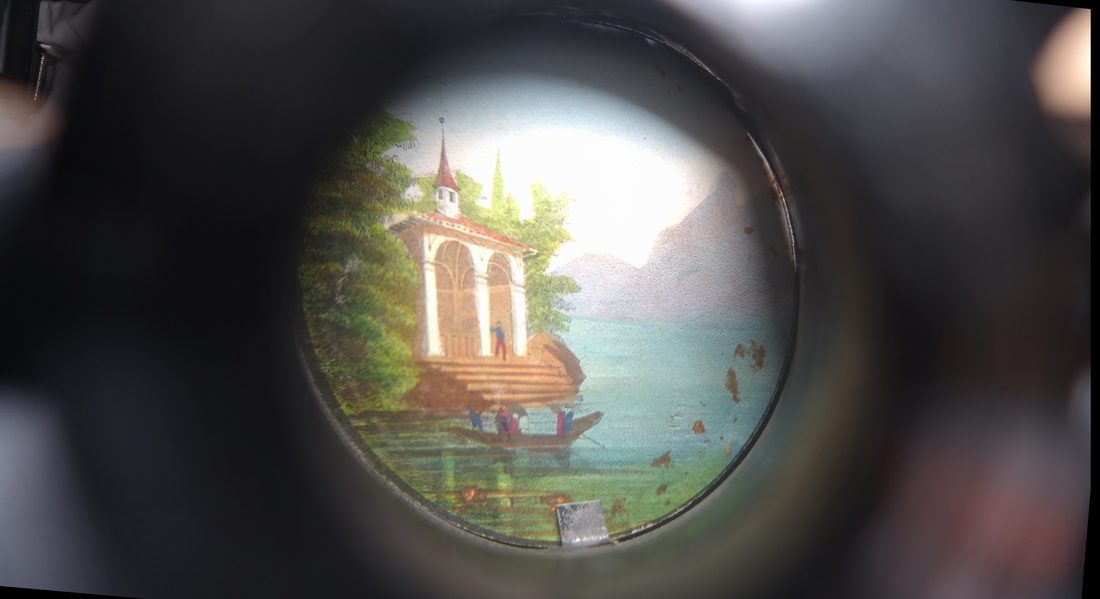
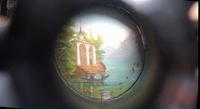
A second and more cosmopolitan group gathers the Chapel of William Tell on the Lake of Lucerne, a glazed iron-and-glass gallery in the manner of the Crystal Palace, Buckingham Palace with its ornamental lake and swans, a wintry northern scene upon a frozen canal, the National Gallery at Trafalgar Square, and a Chinese pavilion with mandarins. A few further picturesque views complete the set, among them a lagoon city seen across the water (Venice?) and a rocky coastal scene with sailing vessels (a Mediterranean or Black Sea shore?). The three boxes retain their original printed and manuscript indices, yet the views, interchangeable by nature, have been rearranged over time and no longer correspond exactly to those lists; the box lettered with the London index, in particular, now holds Russian subjects. The distinction of the ensemble therefore resides not in any single label but in the exceptional number and quality of the surviving transforming views.
Click to Explore the Day/Night Effect
Series 2
The apparatus, its inventor and its Parisian retailer
The Lorgnette pittoresque belongs to the long European tradition of optical mediation that runs from the eighteenth-century peep-show and the vues d’optique, through the illuminated transparencies of the later eighteenth century, to Daguerre’s Diorama, opened in Paris in 1822, which raised the day-and-night transformation to monumental and public scale. The Polyorama Panoptique reduced that spectacle to the dimensions of the drawing room. Its principle derives from a dioramic method patented by the draughtsman Auguste-Louis Régnier in December 1848 and thereafter simplified and perfected by Pierre-Henri-Amand Lefort, whose French patent of 21 February 1849 describes improvements to a portable camera obscura capable of showing two effects within a single picture; the transparent lithographic views are associated with Louis-Stanislas Gadault, and the optician Antoine-Louis Lemaire with the manufacture and diffusion of the apparatus.
Click to Explore the Day/Night Effect
Series 3
The registered series Lorgnette pittoresque appeared in successive sets of six circular views: the Musée Carnavalet preserves a ninth series datable to February 1848 and devoted to the events of the Revolution of that year, evidence that publication was already under way in 1847 and 1848. The printed notice surviving here states that ninety views, that is fifteen series, had by then been published, a figure consistent with the presence of the fifteenth series, while the Palais du Cristal of the London Exhibition of 1851 appears among the subjects. The retailer’s stamp identifies the Parisian optical house Cam, later Maison Cam Opticien at 24 rue de la Paix, recorded at 9 rue Bourdaloue near Notre-Dame-de-Lorette in 1849, shortly before its removal to the boulevard des Italiens and then to the rue de la Paix. Taken together with Lefort’s patent of 1849, the stamp anchors the viewer and its boxes to about 1850, the interchangeable views having been added to over time. Far from a marginal amusement, such devices held a central place in nineteenth-century visual culture, answering the contemporary fascination with light, temporality, travel and urban modernity, and anticipating the sequential, transforming imagery of the cinema.
Conditions: The lorgnette shows wear consistent with nineteenth-century use, including surface abrasion and losses to the black lacquer and oxidation of the metal fittings and of the internal baffle. The simple objective is sound, and the shutters and hinged rear lid retain their structural integrity and function. The views preserve strong hand-colouring and a clear, effective day-and-night transformation, with minor edge wear at the insertion tabs, light surface abrasion and scattered foxing, as is usual for objects of such fragility. The three original boxes are worn but intact, retaining their patterned-paper coverings, their ties, and their printed and manuscript labels, together with the publisher’s notice and the retailer’s stamp. The condition is, overall, notably good for an object of this type, complexity and intended use.
Provenance: From the collection of Jean-Marie Prades, a leading French collector in the field of early photography and pre-cinema; published in Autour d’une collection (collection JMP, 2nd ed., Club Niépce Lumière, 2017), p. 235.
References: R. Balzer, Optical Amusements: Magic Lanterns and Other Transforming Images, Watertown, Mass., published by the author, 1987; G. Füsslin et al., Der Guckkasten: Einblick, Durchblick, Ausblick, Stuttgart, Füsslin Verlag, 1995; L. Mannoni, The Great Art of Light and Shadow: Archaeology of the Cinema, Exeter, University of Exeter Press, 2000; Musée Carnavalet, Paris, La lorgnette pittoresque (9e série), legs Quentin-Bauchart, 1911; La Cinémathèque française, Paris, vues d’optique for the Lorgnette pittoresque and Polyorama panoptique (Lefort).