Presentation of a Highwaymen’s Cave
| Macro-category | Ancient Games and Pre-cinema |
| Subcategory | Diorama |
| Author | Martin Engelbrecht |
| Provenance | Augsburg |
| Publisher / Maker | Martin Engelbrecht |
| Year | 1750 |
the Cavern of the Brigands
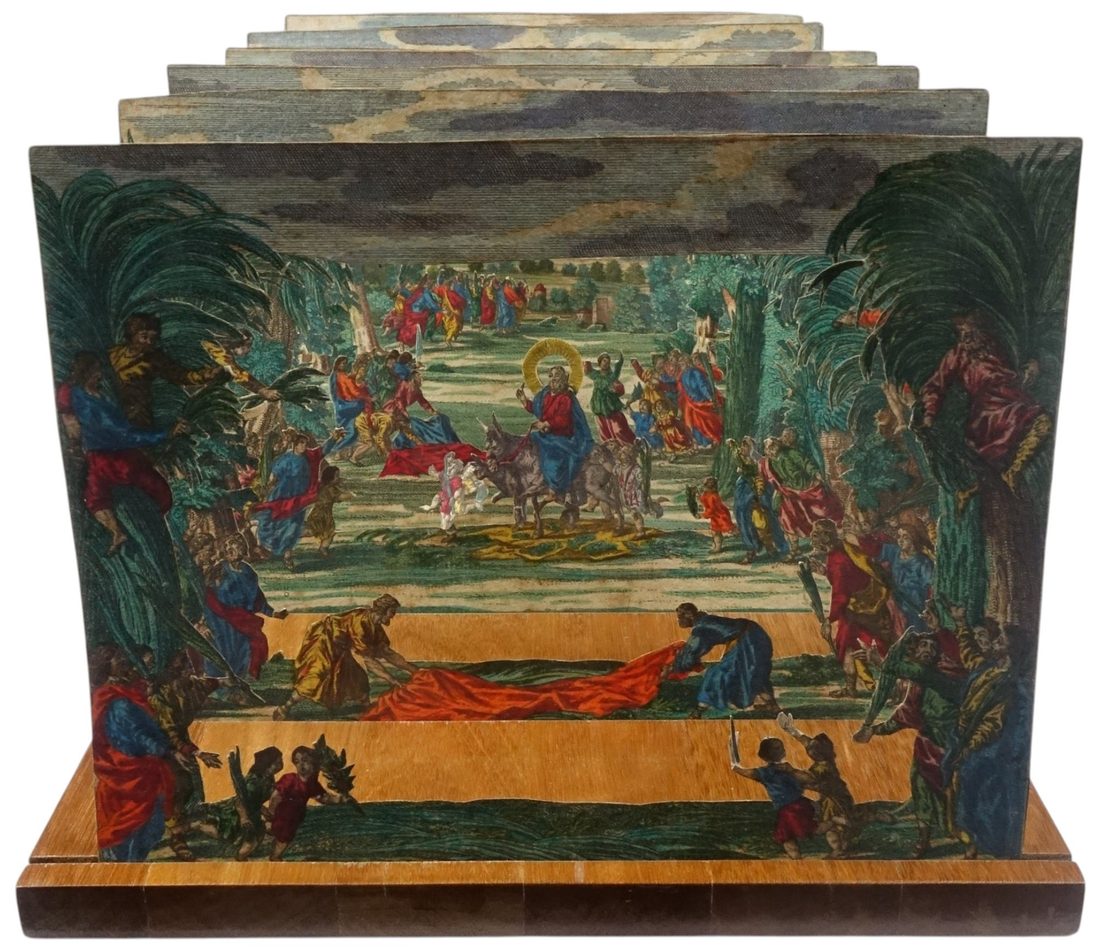
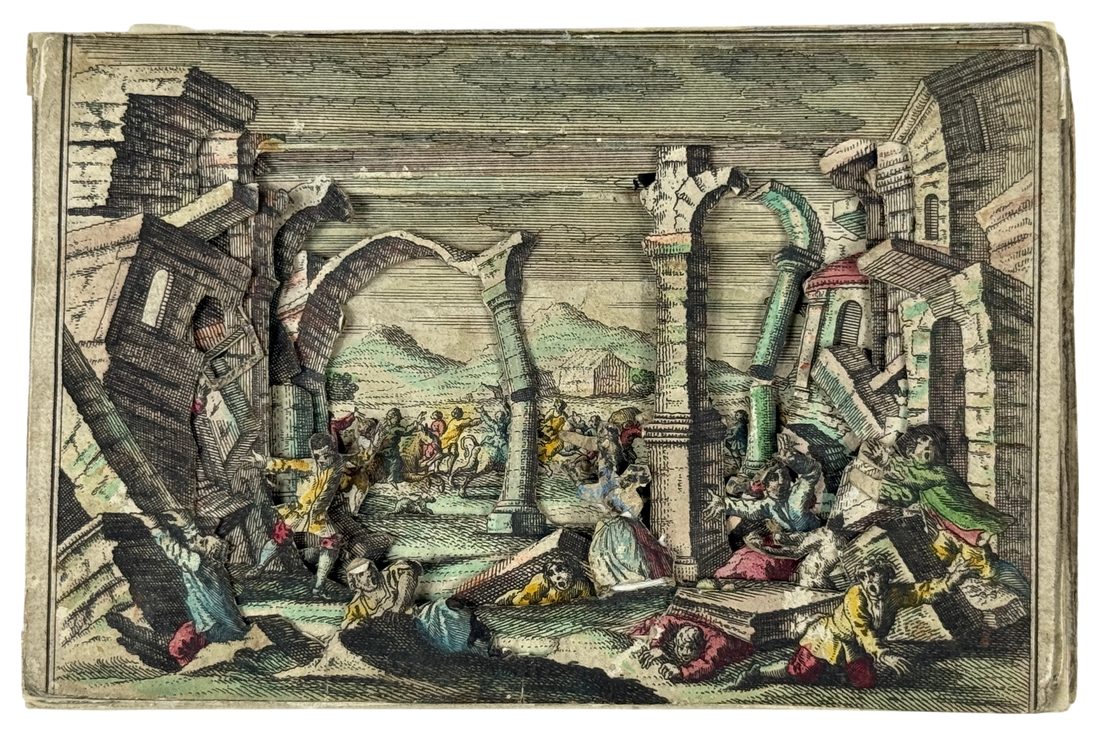
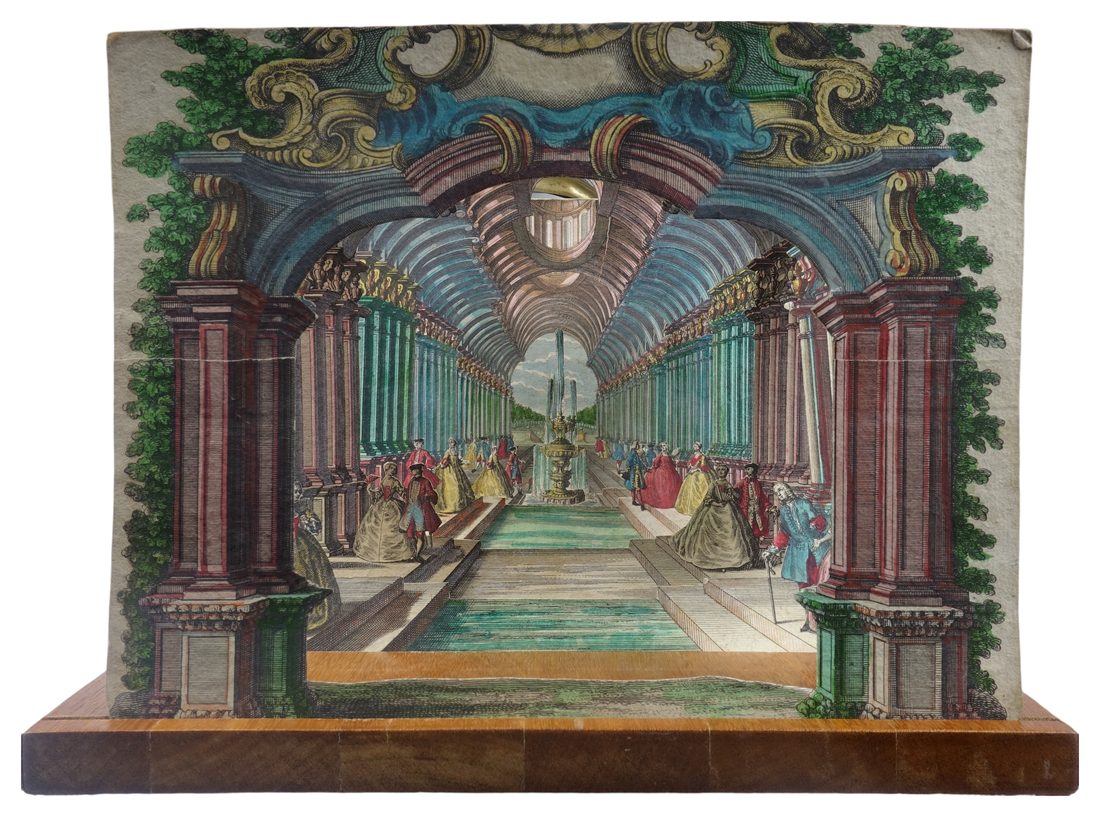
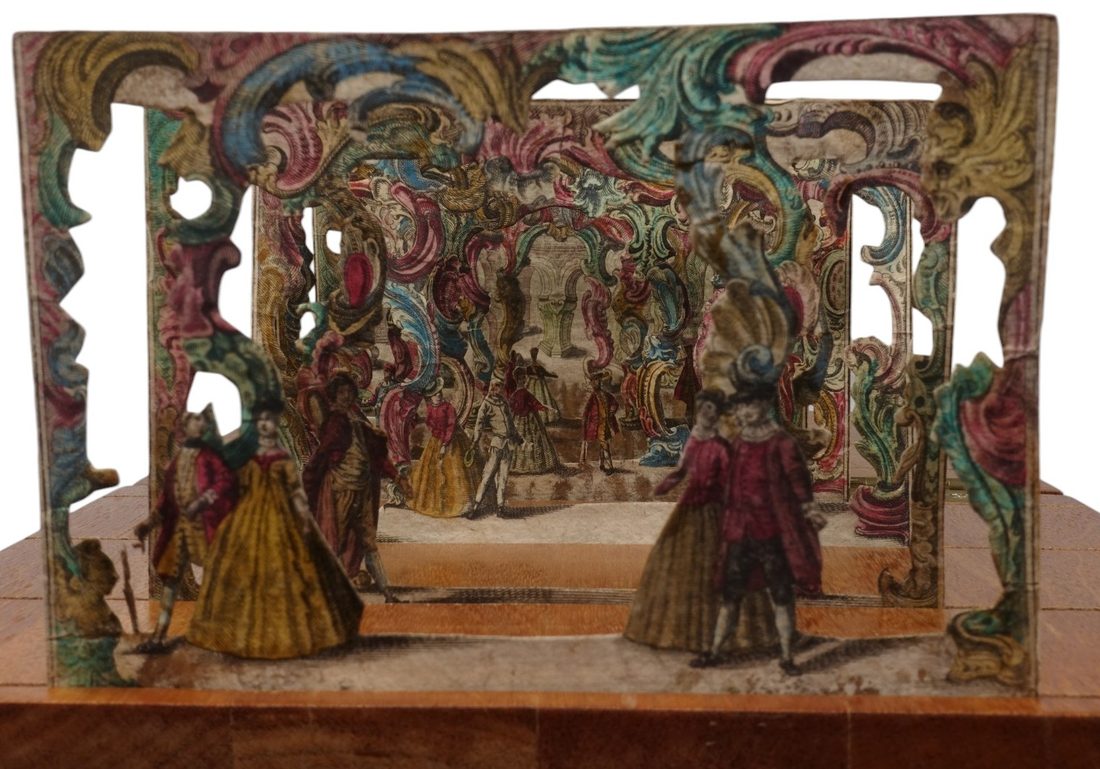
a complete set of the rare 4to Engelbrecht perspective theatre
# 51 of the Milano census
[Diorama]. Wachsmuth, Jeremias (inv. et del.). Praesentation einer Strassen-Rauber Höle (“Presentation of a Highwaymen’s Cave”). Augsburg, Martin Engelbrecht excudit, ca. 1750.
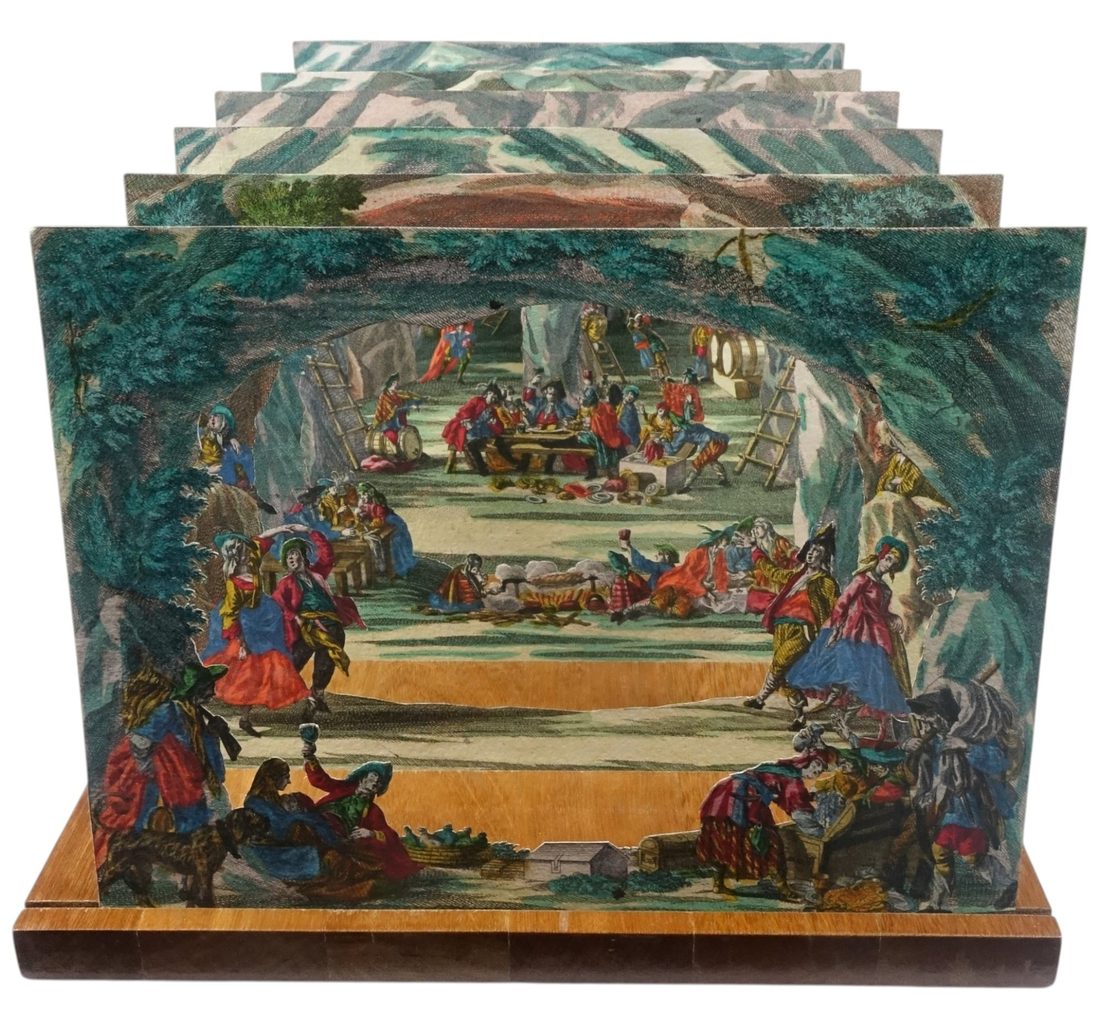
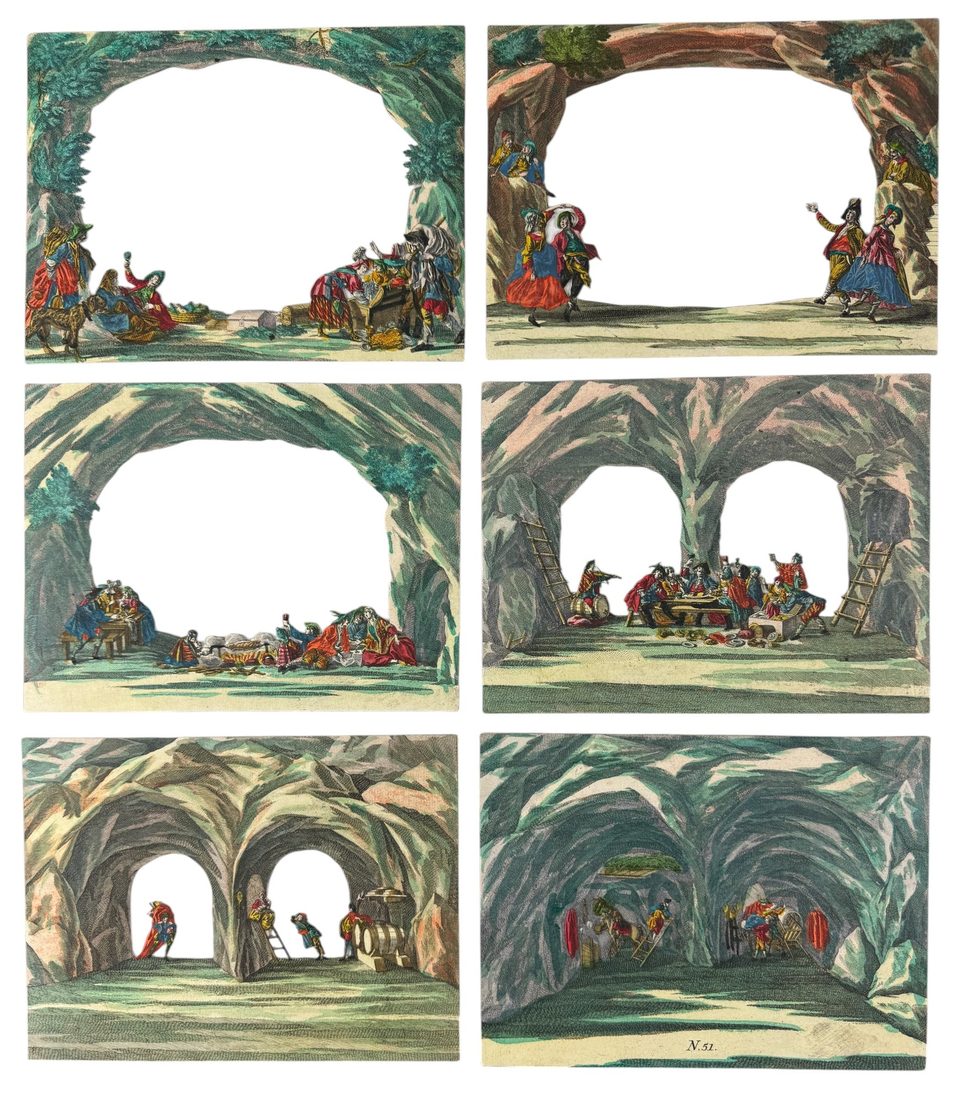
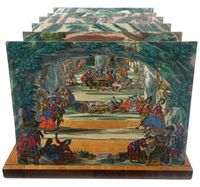
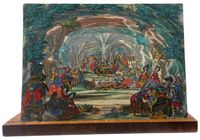
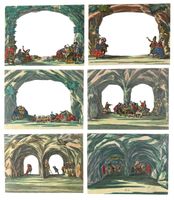
4to perspective theatre (each sheet 210 × 155 mm), complete set of six hand-coloured copper-engraved plates on laid paper, numbered in the engraved sequence 338–343, the final background plate bearing the designation “N. 51” at the lower centre. The first five sheets are cut through their central fields to form arched apertures of progressively diminishing span; the sixth is retained as the closed background scene. Original full hand-colouring in transparent watercolour with selective gouache highlights, designed to be assembled in numerical order within a viewing box or upon a wooden support, generating the layered three-dimensional illusion characteristic of the Engelbrecht workshop.
Engelbrecht’s dioramas were most commonly produced in 8vo format, while those in quarto are exceedingly rare, particularly in perfect condition. Only 67 4to dioramas have been identified as having been produced by Engelbrecht, and the present example is number 51.
“The number of published large-format Engelbrecht perspective theatres is given as 67. Even though we cannot say with certainty that this number is correct, it is nonetheless very likely, as not a single sheet suggests that additional series may have existed” (Milano).
A finely preserved set of the rare quarto Engelbrecht Perspektivtheater devoted to the highwaymen’s cave, registered as no. 51 in Alberto Milano’s census of the Augsburg workshop’s large-format dioramas. The Engelbrecht perspective theatres are among the most ingenious productions in the history of European optical entertainments, converting the engraved sheet into a three-dimensional stage and standing at the threshold between baroque scenography and the pre-cinematic culture of illusion. The present subject, designed by Jeremias Wachsmuth, offers a particularly vivid expression of the bandit iconography fashionable in mid-eighteenth-century popular print, and bears witness to the meeting of perspective theory, popular engraving, and Enlightenment visual curiosity in Augsburg, then one of Europe’s leading centres for coloured prints.
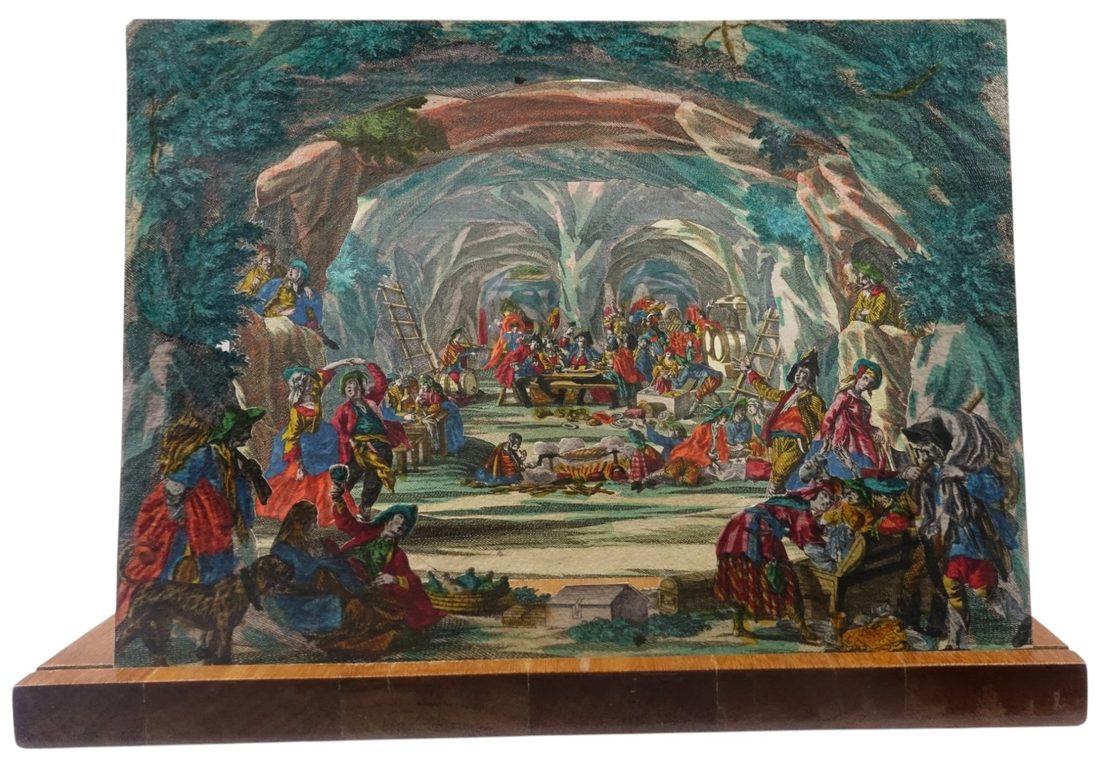
The diorama is conceived as a unified perspectival construction articulated across six successive engraved planes, each plate operating both as an autonomous image and as one stratum of a larger spatial composition.
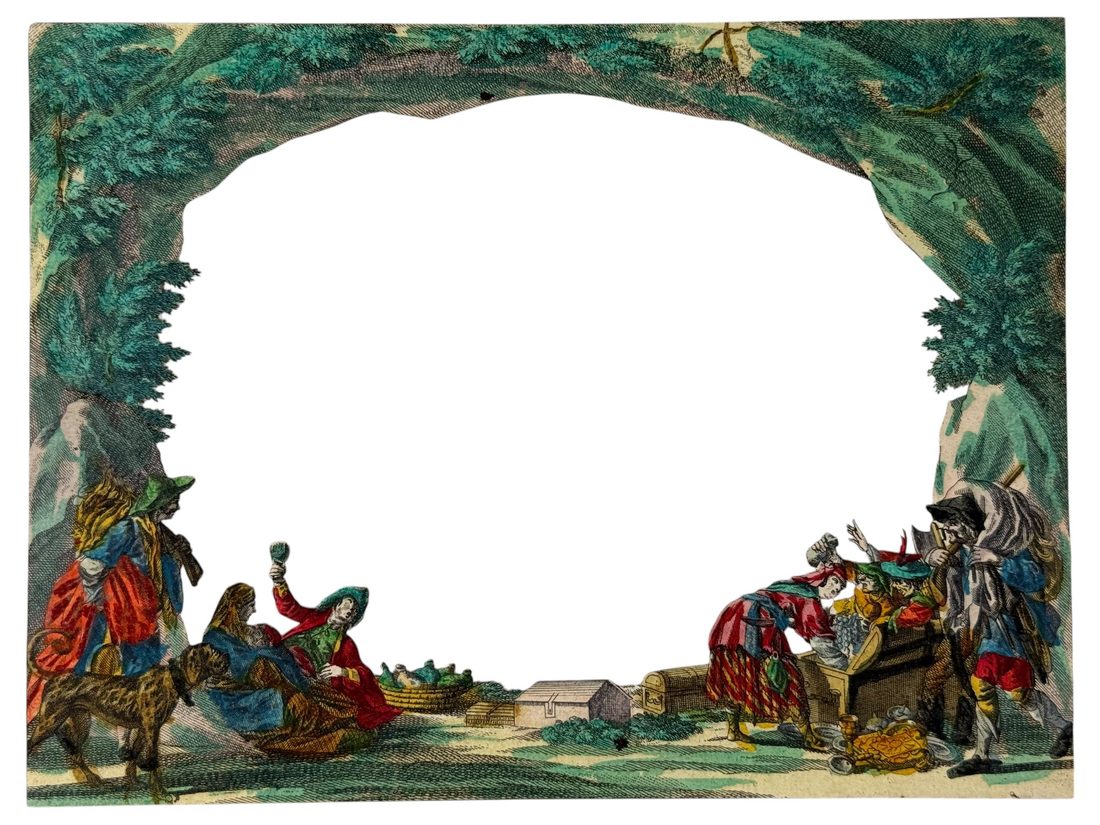
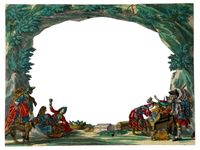
The first sheet (no. 338) forms the front scenic plane, or proscenial flat, at the cave entrance, framed by a broad rocky archway clothed in dense foliage; in the lower corners, groups of brigands, women, and a hunting dog handle the spoils of a recent robbery, sorting sacks, baskets, and a heavy iron-bound coffer overflowing with vessels and coins, while a pair of figures raises cups in a gesture of triumph. The asymmetrical disposition of the figures along the lateral margins leaves the central field entirely free, opening the view towards the deeper chambers of the cavern.
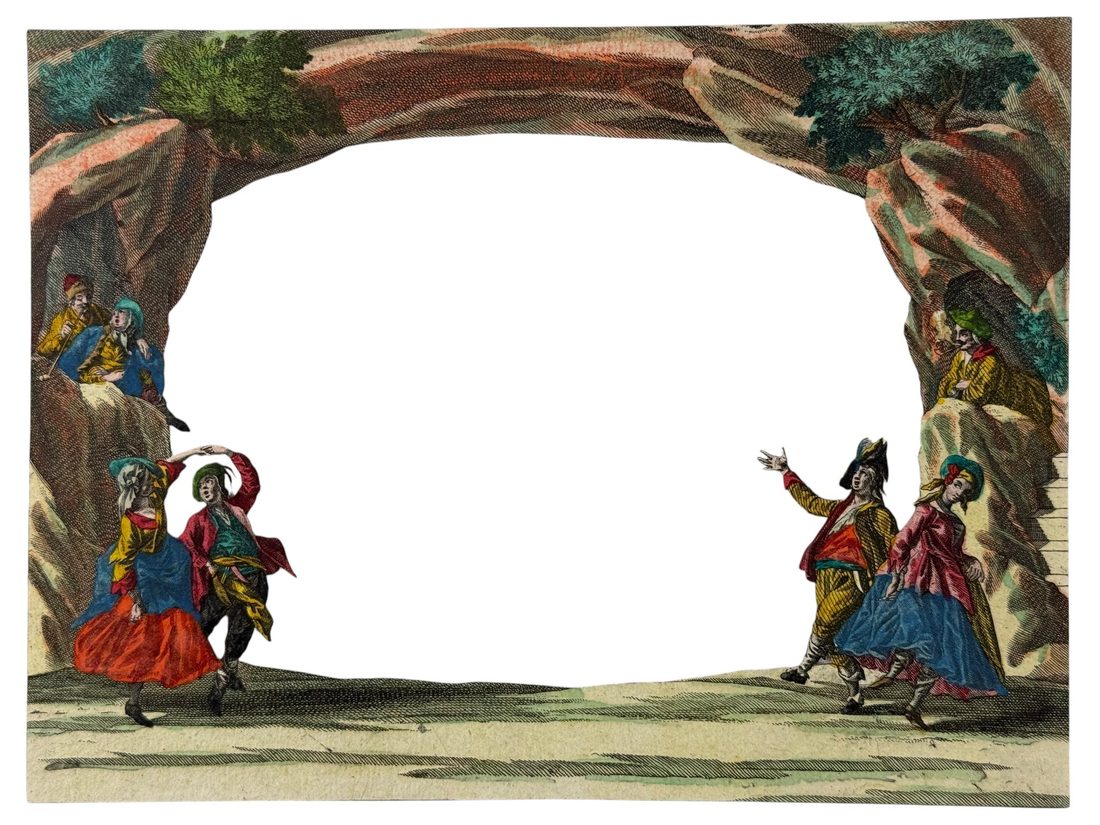
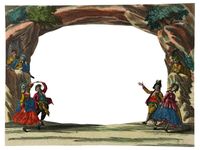
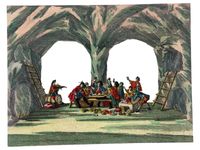
The second sheet (no. 339) advances within the threshold of the grotto. The rocky vault is here rendered in warmer ochre tonalities, and the foliage gives way to bare stone. In the foreground, two couples in fashionable, lightly orientalising costume perform an animated dance, their gestures elegantly arrested; in the upper corners, a violinist and a watchful sentinel observe the scene from rocky ledges. The plane operates as a transitional space between the world outside and the inner sociability of the band.
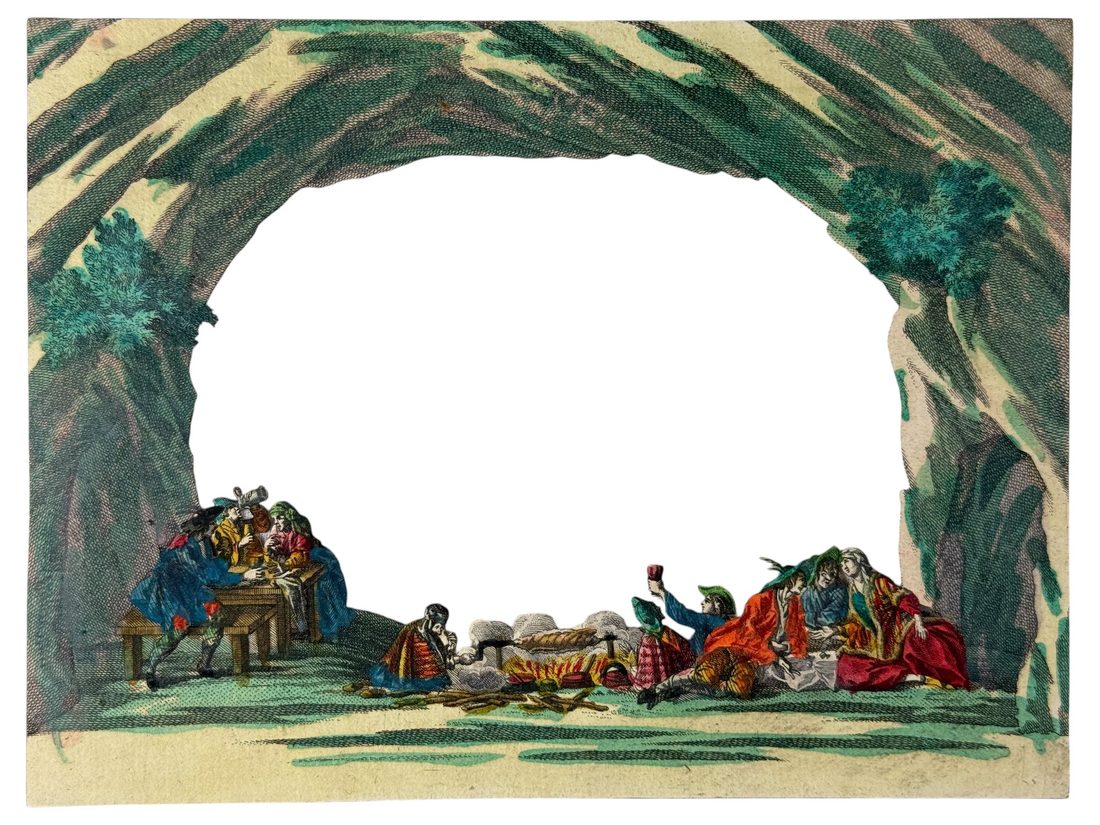
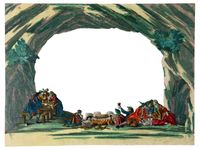
The third sheet (no. 340) introduces the convivial heart of the composition. A semicircular hollow shelters, on the left, two figures seated at a small table laden with vessels, and, on the right, a larger group of bandits and women reclining around a fire and a heap of provisions, one of them raising a cup of wine in salutation. The arrangement, which preserves a wide central opening, transposes the iconography of the pastoral halte and of the genre supper into the unexpected setting of the outlaw cavern.
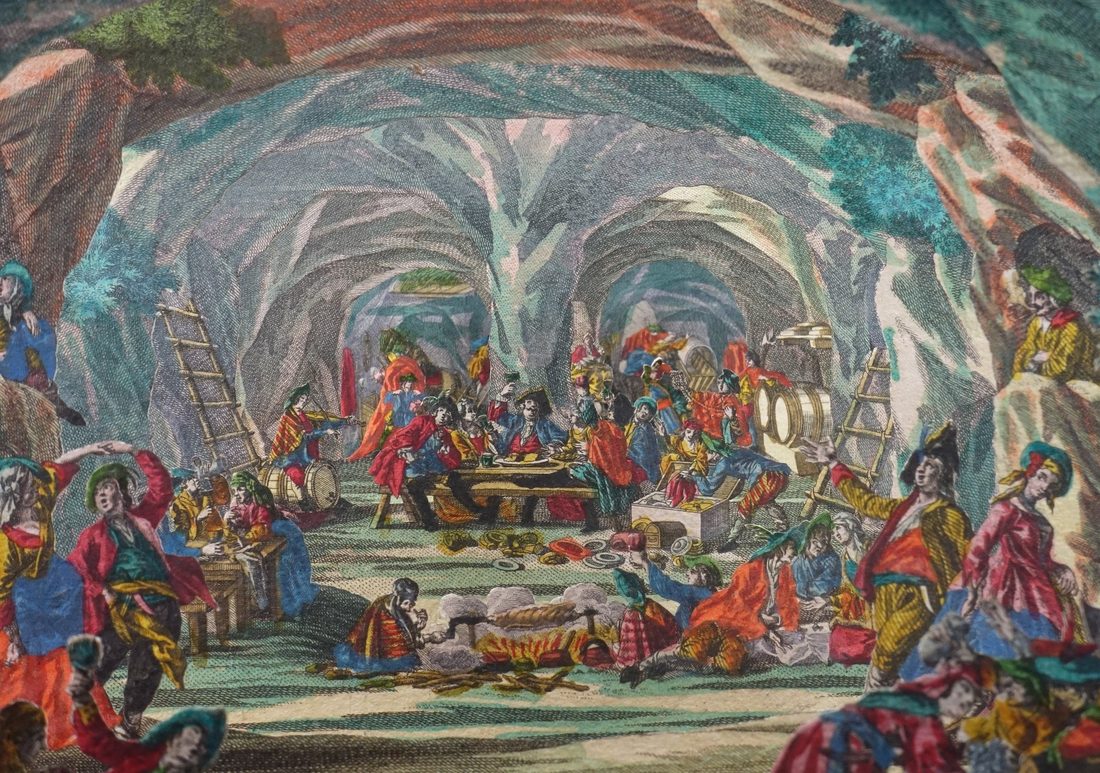
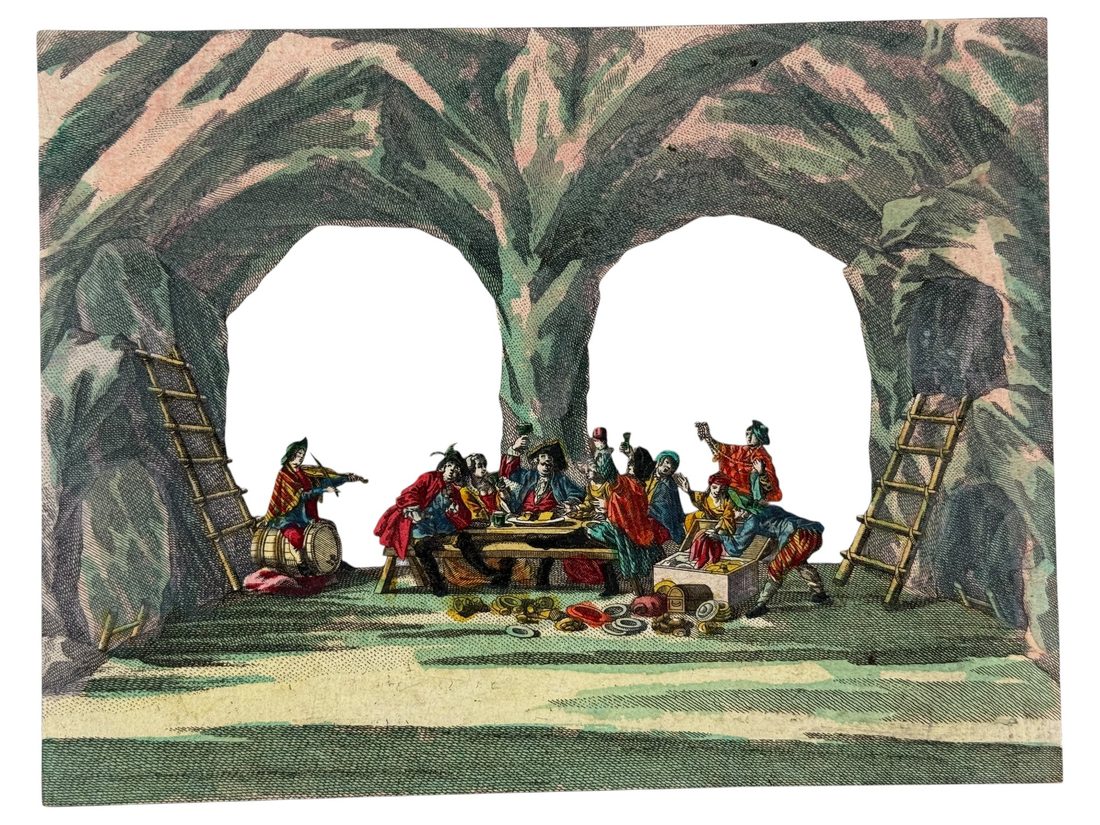
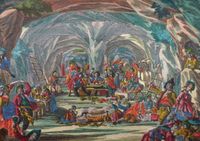
The fourth sheet (no. 341), the most theatrical of the sequence, presents a long banqueting table set beneath a twin-arched vault. At its centre, the captain of the band, distinguished by gesture and costume, presides over an animated feast of brigands and their companions; a violinist seated on a barrel marks the music at the far left, while at the right an open chest discloses a profusion of vases, plates, and coins poured out at the foot of the table. Two ladders rest against the rock faces, evoking the practical economy of a subterranean stronghold. The scene encapsulates the iconographic programme of the diorama, transforming outlaw life into a fully orchestrated theatrical spectacle.
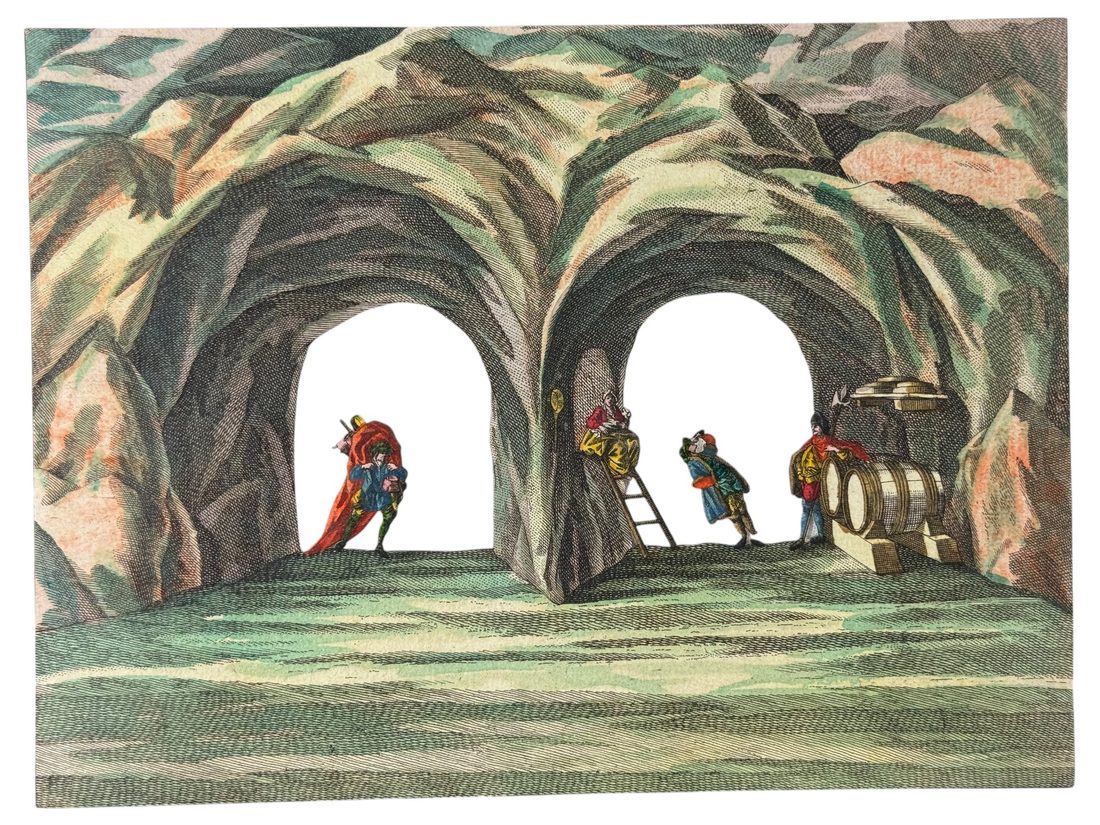
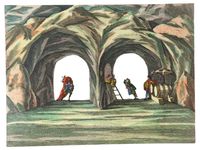
The fifth sheet (no. 342) recedes into the deeper structure of the cavern. The architecture is dominated by two adjacent arched openings, each cut through the sheet, disclosing views towards still further inner chambers. A small group of brigands, occupied with a cask and with the storage of arms and provisions, animates the lower margin; a sentinel cloaked in red guards the left passage, while a man descending a wooden ladder and a comrade tending a great barrel articulate the right. The plane functions both as a narrative episode and as the principal optical conduit, or visual funnel, of the composition.
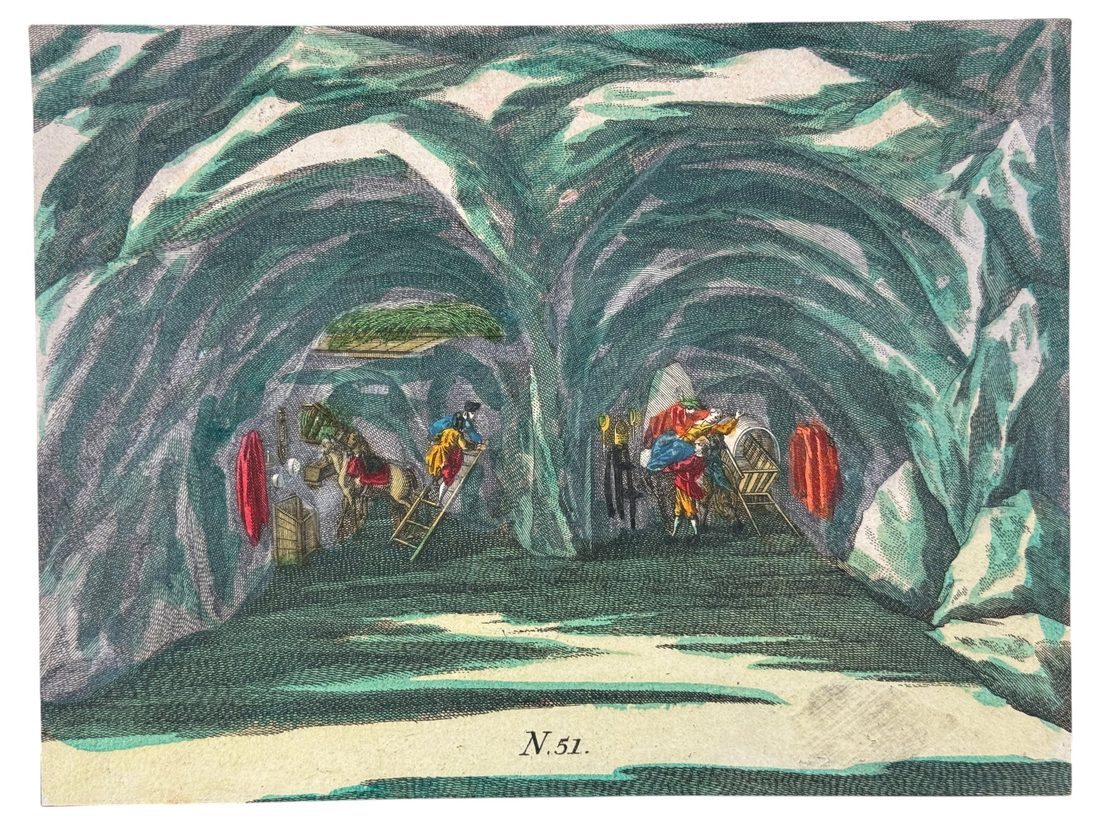
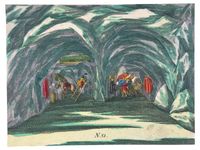
The sixth and final sheet (no. 343), engraved with the designation “N. 51” at the lower centre, closes the perspectival sequence as the uncut background of the deepest hall. A vaulted chamber with two lateral recesses houses, on the left, a packhorse being loaded by a figure on a ladder beside red bales and a strongbox, and, on the right, a group of brigands handling sumptuous textiles, a cage or chest, and weaponry suspended against the rock wall. A small luminous opening in the rear wall admits a glimpse of distant landscape, optically sealing the depth of the construction while reinforcing the sense of a hidden subterranean world communicating, through a single fissure, with the outer world.
The methodological achievement of the device lies in the unified perspectival design from which the six planes derive. The workshop conceived a single coherent recession and then decomposed it into successive engraved leaves, each one partially cut so as to function as a scenic flat, so that, when reassembled in numerical order, the planes recreate the original construction and produce an illusion of depth particularly persuasive under frontal lighting or candlelight.
Engelbrecht’s perspective theatres are inseparable from the intellectual climate of the German Enlightenment in its Augsburg variant, where popular print culture, the science of perspective, and the taste for optical curiosities converged within a single commercial enterprise. The first half of the eighteenth century witnessed the codification of linear perspective in widely diffused treatises, the spread of the camera obscura, the magic lantern, and the perspective box, together with a growing appetite, in noble cabinets as in bourgeois interiors, for visual devices capable of staging the illusion of depth in domestic space. The Augsburg theatres translate this scientific and recreational culture into a printed object, accessible to an international public and intended to be assembled by the collector himself.
Within the discipline of the printed image, the work belongs to a tradition extending from the perspectival experiments of Brunelleschi in early fifteenth-century Florence and from the seventeenth-century peep-show print of the Netherlandish and German tradition. From this earlier matrix the genre passed through the Augsburg and Nuremberg perspectival theatres of the first half of the eighteenth century, and would in turn prepare the ground for the nineteenth-century paper theatre and for the dioramas of Louis Daguerre, first exhibited in Paris in 1822. Engelbrecht’s particular contribution consists in the systematic adoption of the multi-plane structure as a serial publishing programme, and in the elaboration of an entire iconographic repertoire ranging from biblical histories and royal ceremonies to gardens, theatres, military encampments, hunts, and, as in the present case, the picturesque world of bandits.
The choice of the highwaymen’s cave reflects the mid-eighteenth-century fascination with marginal and theatrical figures, anticipating the success that bandit imagery would achieve in literature and stage design from the second half of the century onwards. By transforming the brigand into the protagonist of an optical spectacle, the workshop domesticates a disquieting subject within the controlled space of the cabinet, where the danger of the road is converted into the pleasure of a perspectival illusion. The long-term significance of the genre is twofold, since it consolidates a model of layered visual narrative which would inform nineteenth-century pre-cinematic devices, and it preserves, in printed form, the scenographic vocabulary of the late baroque stage, otherwise largely lost
Martin Engelbrecht (1684–1756) ranks among the most enterprising German engravers and print publishers of his generation. Initially trained as a weaver, he turned to engraving in the orbit of his elder brother Christian and of Johann Andreas Pfeffel, with whom he collaborated in Vienna under imperial patronage in the second decade of the eighteenth century. In 1719 he founded his own publishing house in Augsburg, which, operating under imperial privilege, would rapidly become one of the principal European centres for coloured popular prints, devotional sheets, allegorical series, costume books, and optical novelties. Within an output estimated in several thousand sheets, the Perspektivtheater constitute the most original and technically demanding strand of the production, designed in close partnership with the leading Augsburg draughtsmen of the period, in particular Jeremias Wachsmuth (1711–1771), who supplied the inventions for many of the perspective theatres, the present diorama included. Issued in small, medium, and quarto formats, the series consolidated a paradigm of layered, hand-coloured optical print that would prove decisive for the subsequent history of the medium.
Conditions: Light age toning and minor traces of handling at the margins, consistent with the fragility of the object; the colouring is bright and unrubbed throughout. Overall, a very good copy of a fragile and rarely complete object.
References: A. Milano, Martin Enghelbrecht Persperktivtheater Dioramen, Verklag, Stuttgart, 2016: pp. 32, 94; no. 51; P. Grandi, I Diorami teatrali di Martin Engelbrecht, 2021.
You might also like