Diableries: Seven French Tissue Stereoviews with a Brewster Stereoscope
| Macro-category | Ancient Games and Pre-cinema |
| Subcategory | Optical Devices |
| Provenance | Paris |
| Year | ca. 1860-1870 |
A theatre of hell in 3d!
A dual-illumination stereoscope with seven French tissue Diableries, carrying one signed plate by each of the three modellers so far identified in the genre: Habert 1860, Hennetier, Cougny
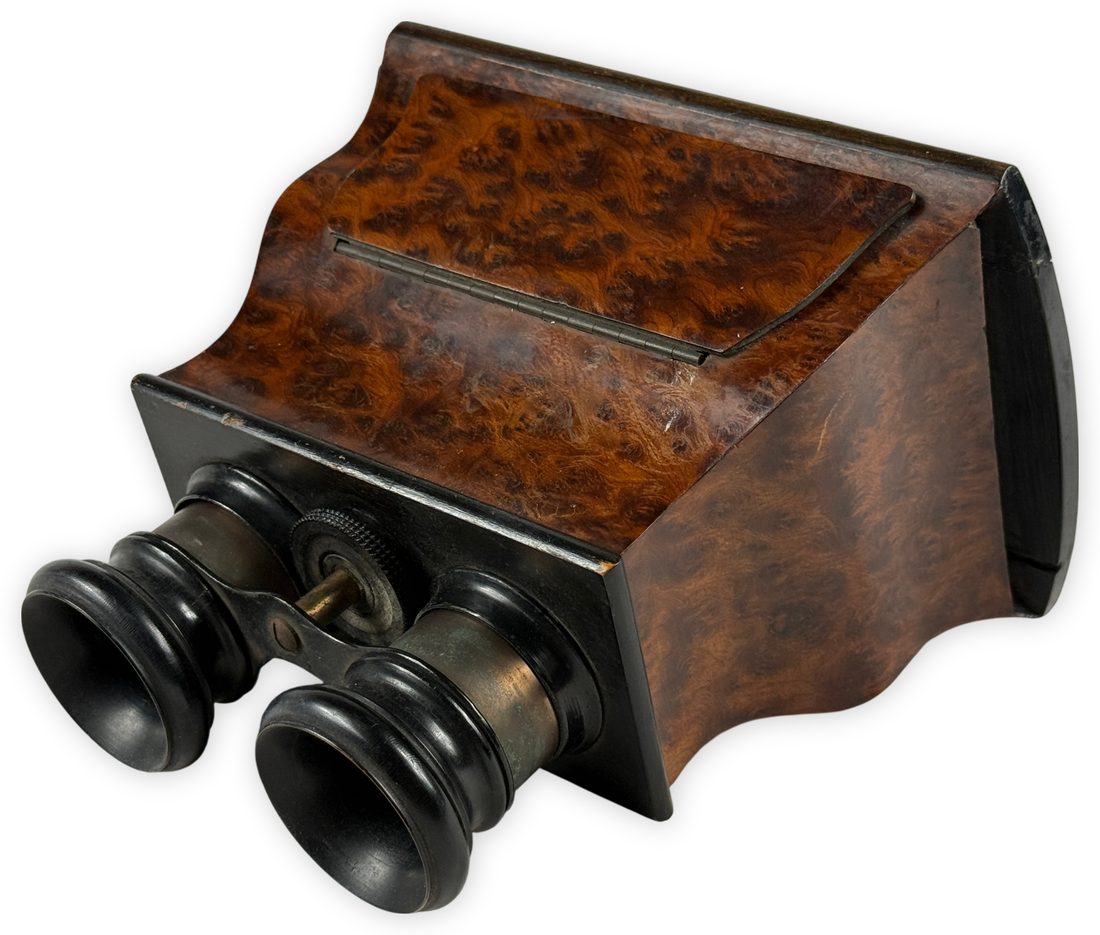
Stereoscope. Lenticular table stereoscope of Brewster type, for opaque, transparent and translucent views, with reflected and transmitted illumination. Unsigned. England or France, third quarter of the nineteenth century, ca. 1860-1875.
[together with]
Seven Diableries. Vues stéréoscopiques transparentes, French tissues. Paris, ca. 1860-1870. Three mounts bear the impressed mark of Adolphe Block, B.K. Photographie Paris, two an unidentified monogram E.L., and two are unmarked. Modelled by Louis Alfred Habert, Pierre Adolphe Hennetier and Louis Edmond Cougny.
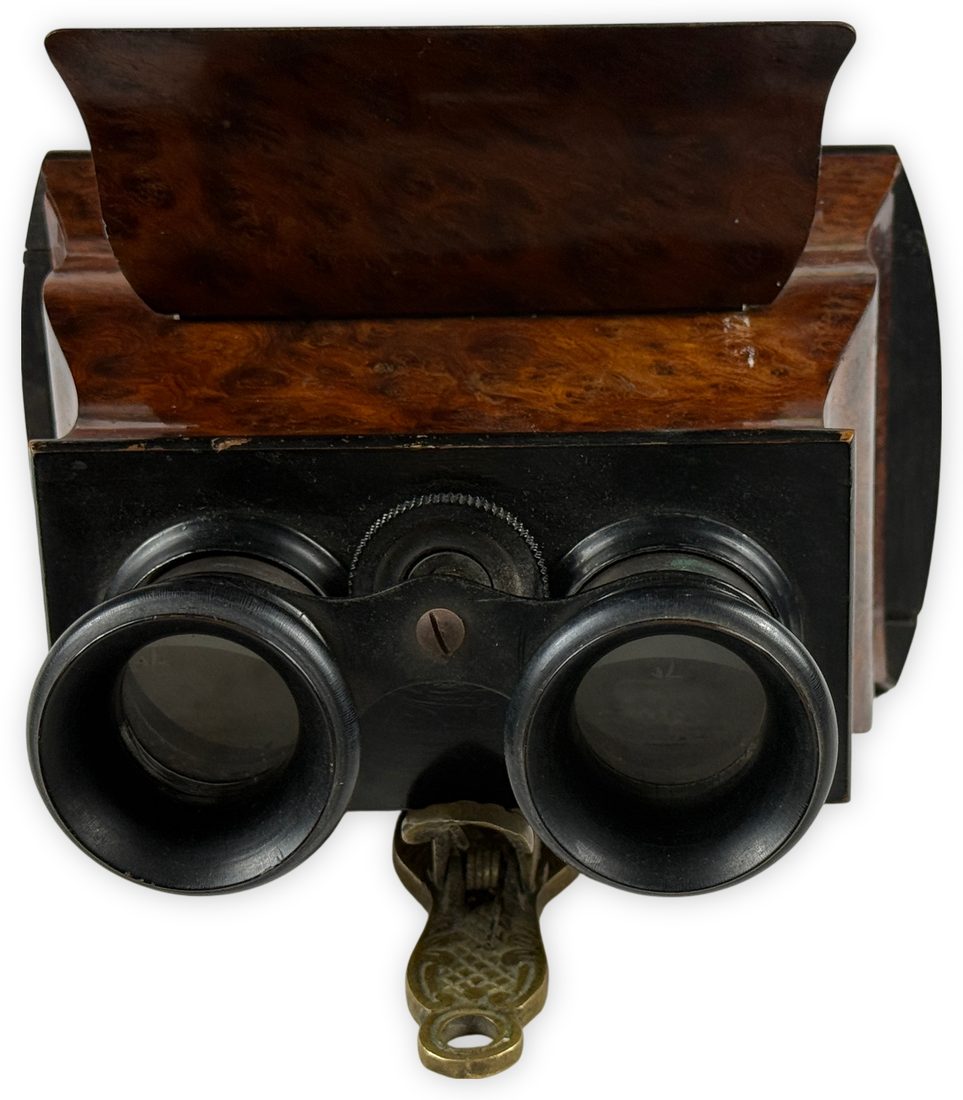
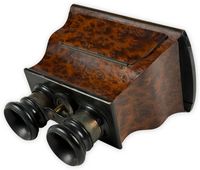
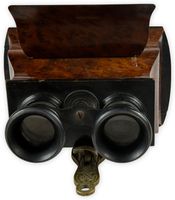
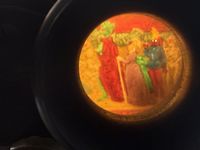
Stereoscope. Truncated wedge-shaped case (rear panel 190 × 110 mm, ocular front 135 × 60 mm, depth 180 mm including the oculars), veneered in figured burr walnut and French-polished, with ebonised upper and lower mouldings and concave shaped sides. Two turned oculars of ebonised wood with flared eyecups (50 mm in diameter) are mounted on metal tubes, linked by a shaped front bridge and governed by a central milled wheel for simultaneous focusing. The domed upper lid, hinged along the front edge and held open by a metal stay, is faced internally with a silvered mirror; the original ground-glass diffusing panel is set into the rear within an ebonised frame secured by four metal bosses, and the card is introduced through a lateral slot towards the rear, sized to the standard stereoscopic mount. Neither signature nor plate nor serial number appears anywhere on the instrument. A printed collection label bearing the manuscript numerals “156/8” in red ink is affixed to the lower left of the rear frame.
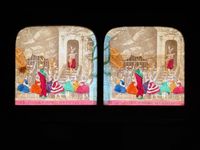
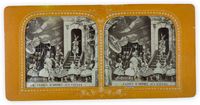
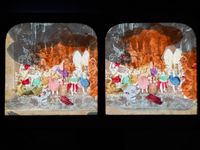
Seven stereoscopic cards (each 170 × 88 mm, the field of each of the two images 70 × 70 mm), albumen prints on very thin paper, hand-coloured on the reverse, pierced and cut, and mounted with an interleaved tissue diffuser between two window mounts; six mounts of plain orange card, the seventh of embossed cream-green card within an ornate frame. Three of the tableaux are signed within the composition, Habert with the date 1860, Hennetier and Cougny. Printed numerals appear on four mounts, Block’s impressed cartouche with its accompanying roundel on three, the monogram E.L. on two, and two mounts are unmarked. Six of the subjects derive from tableaux modelled in clay and the seventh from a painted composition. The seven are drawn from four distinct published series.
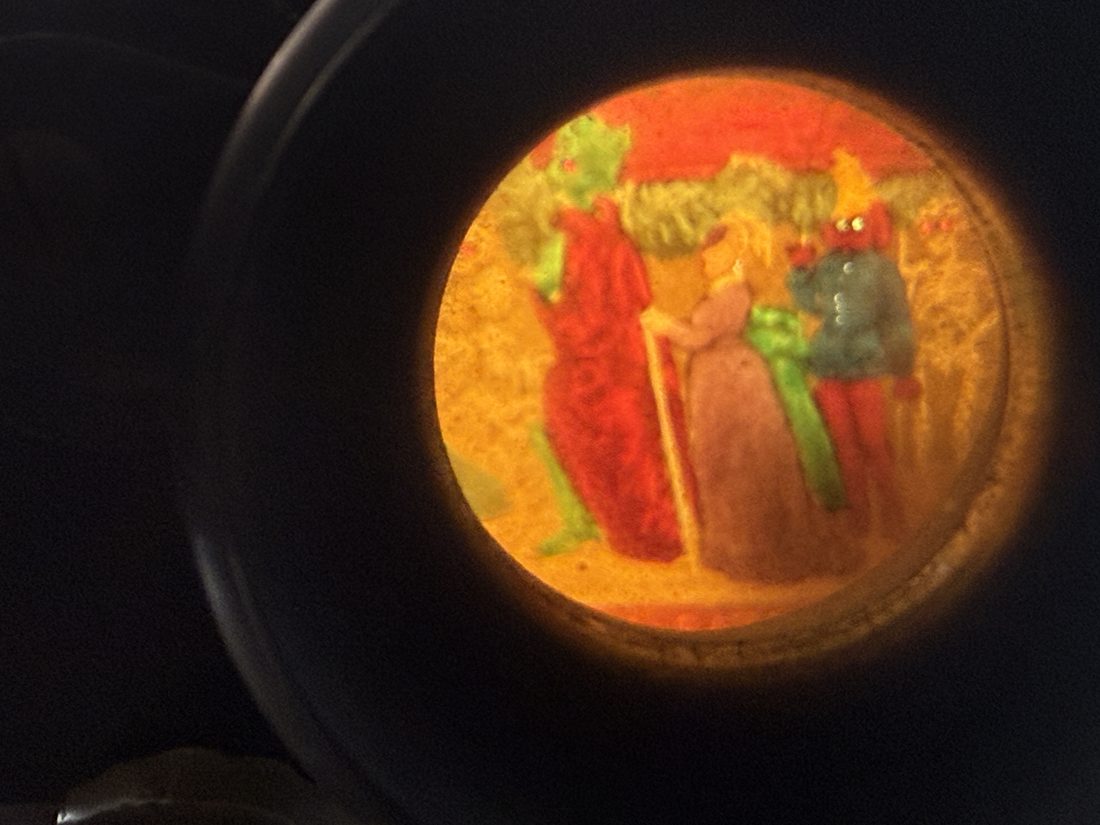
The instrument and the cards belong together by function. The stereoscope is a box viewer built to admit light both from above, through a mirrored lid, and from behind, through a ground-glass screen, together with seven of the French tissue Diableries for which precisely that double capability was required. Under reflected light each card reads as a monochrome photograph of a sculpted tableau; backlit, the same card becomes a coloured nocturne in which the eyes of skeletons and demons burn red through pinpricks while lightning, blades and railings blaze along cuts opened in the paper itself. Three modellers have so far been identified for the genre, the great majority of the tableaux being unsigned, and this group holds a signed plate by each of the three, one of them bearing the date 1860, the earliest date recorded in the Diableries.
The instrument belongs to the family descending from Brewster’s lenticular viewer of 1849, which was from the outset a pyramidal box, blackened within and fitted with a hinged lid for the admission of light. The lid, faced with a mirror, throws light onto views printed on card, which are opaque; the ground-glass panel at the rear allows those printed on thin paper to be read by transmitted light. Instruments combining the two are documented from 1852.
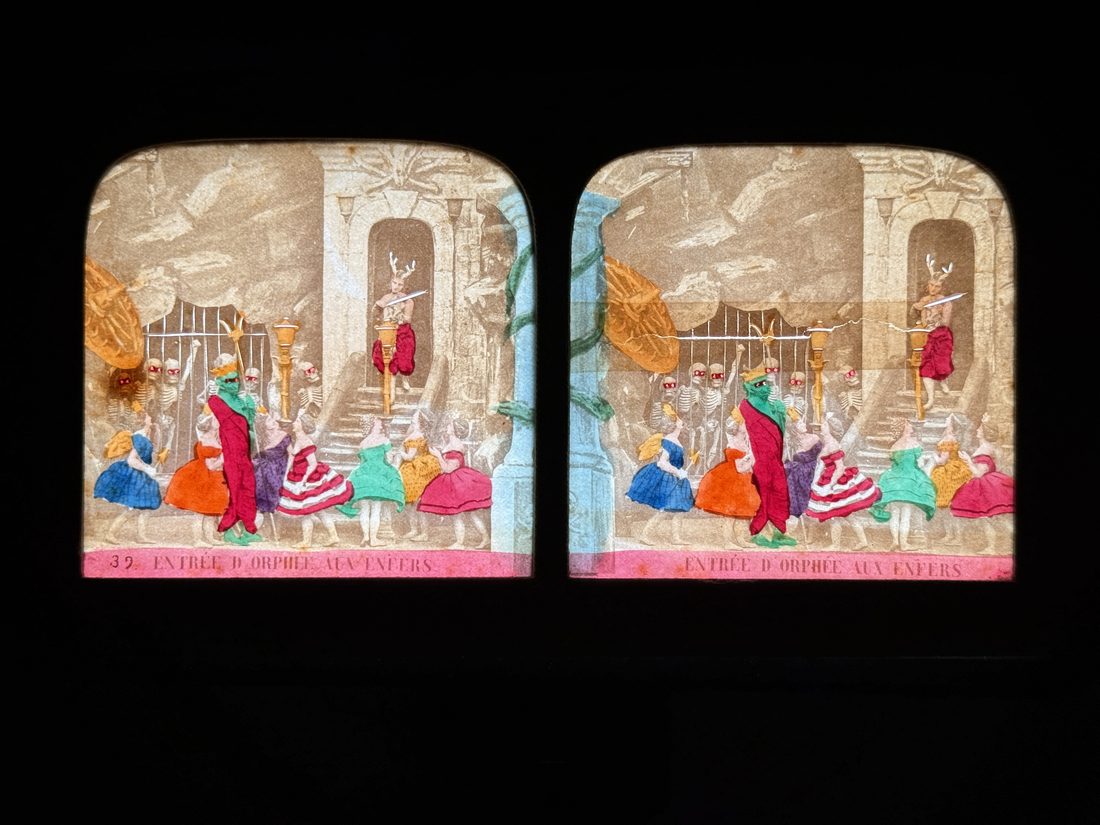
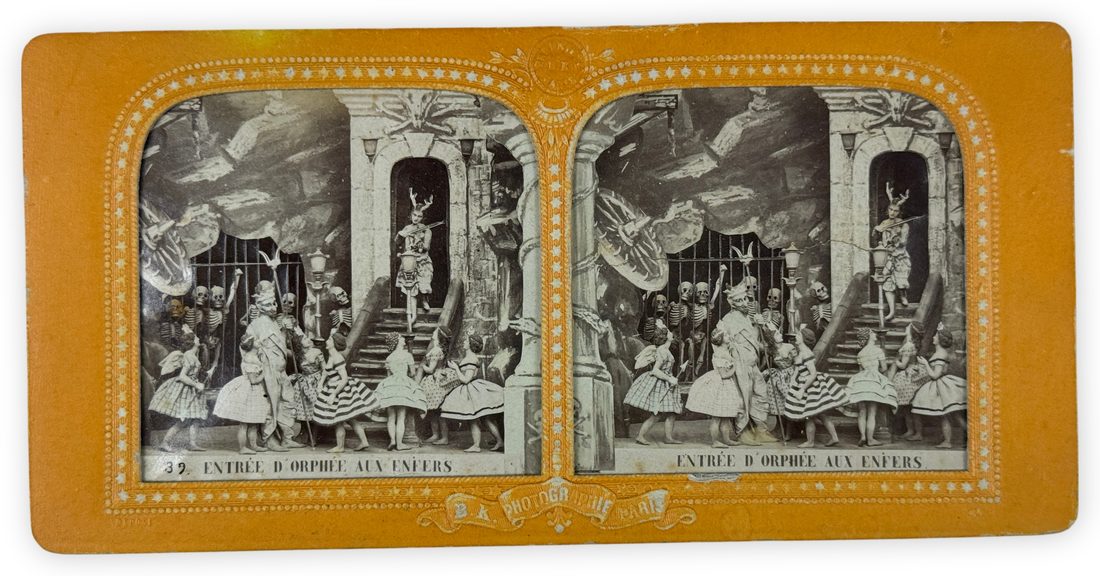
The two states of the image are obtained by governing the light and nothing else. With the upper lid raised, the mirror set into its inner face gathers ambient light and casts it forward onto the recto of the card, and the viewer sees a sepia photograph of a clay tableau, sharply modelled and fused into relief by binocular disparity. With the lid closed and the card lit from behind through the ground glass, the light passes through the thin albumen print and activates the colouring laid on its reverse. The tissue interleaf diffuses the source and conceals the brushwork, so that the colour appears to inhabit the scene rather than to lie upon it, and the worked areas, invisible a moment earlier, ignite.
A French tissue is a laminate of four elements: a window mount at the front, the thin albumen print, the tissue diffuser and a second window mount behind. Highlights are produced by needle perforations which become points of light, jewels and stars; eyes, flames and lamps are pierced and backed with translucent coloured material, identified by laboratory analysis as an animal protein consistent with glue or gelatine, applied as small cut rectangles and, in one instance, in liquid form; further effects are obtained by patches of coloured tissue and by blind embossing for diffused glow.
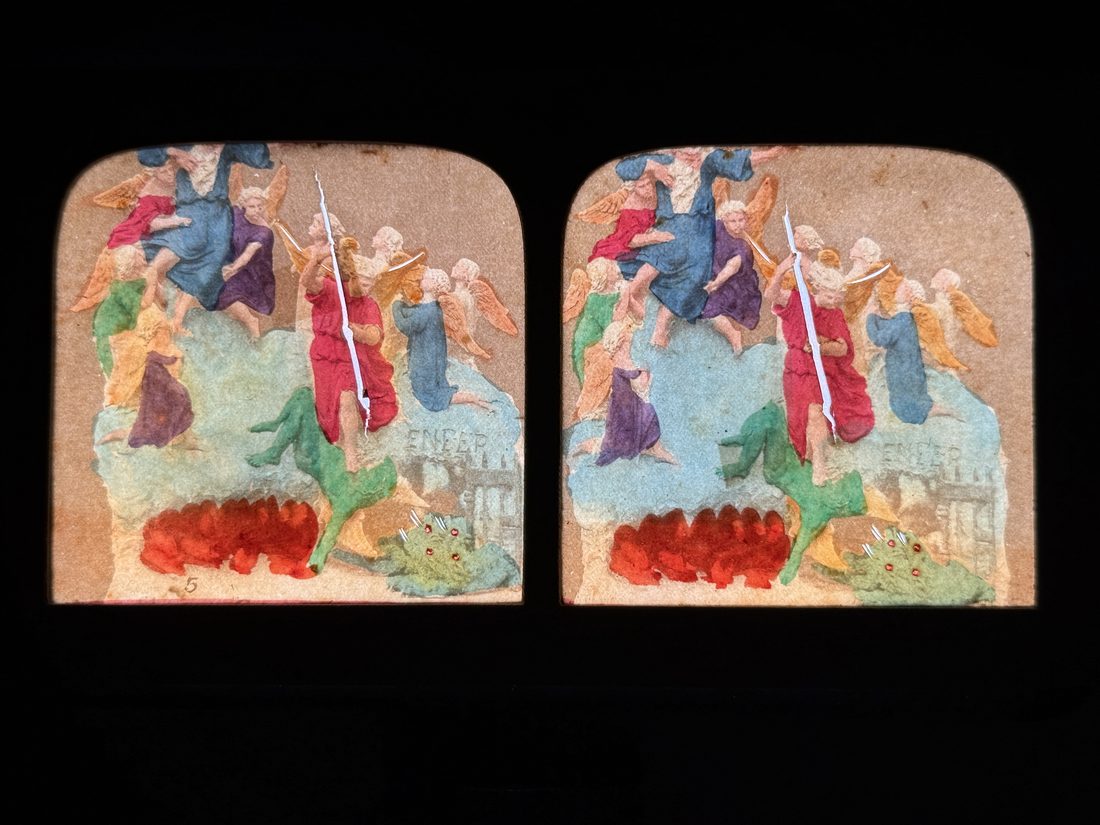
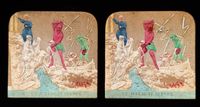
To these must be added a technique easily mistaken for damage, unusually clear in the present group: the long linear cut. A thin slit opened through the print remains invisible under reflected light and becomes, under transmission, a blade of pure white. It serves here for the thunderbolt an angel hurls at the fallen demon, for the illuminated bars of a gate and for the edge of a devil’s sword. Each such line appears identically in both halves of the pair and resolves in depth as an element of the scene; no accidental tear behaves in that way.
The seven views are the following, cited under the series classification of the standard modern reference.
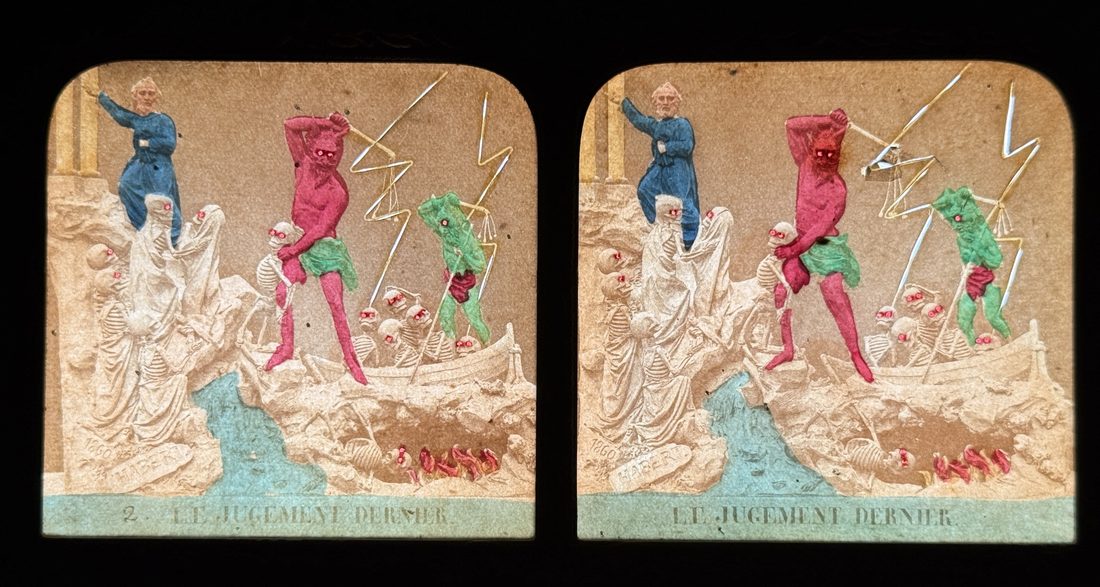
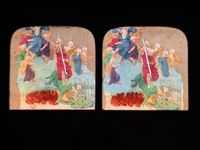
Le Jugement dernier, classified as A2 and numbered 2 on the mount. The most ambitious composition of the group: the resurrection of the dead at the left, the boat of the damned at the right, demons wielding thunderbolts and scales, a prophetic figure gesturing from above. The name Habert and the date 1860 are modelled on the slab at the lower left; four tableaux of the Block series carry that date, the earliest recorded in the genre. Backlit, the eyes of the skeletons kindle, a bed of red flame opens in the pit and the thunderbolts run white. The mount carries the monogram E.L.
Satan chassé du Paradis, classified as A5 and numbered 5, the title supplied in manuscript on the recto and not printed. Ranks of angels upon clouds, an archangel with the lance, and the word ENFER modelled on the rock at the right to name the destination of the fall. The handling is academic and neoclassical, the most sculptural of the seven and the only subject not set in hell. The tableau is signed Cougny at the lower left. A long cut runs the height of the composition in both halves and becomes, in transmission, the lightning cast down upon the demon. Block’s cartouche appears on the mount.
Entrée d’Orphée aux Enfers, classified as A39 and numbered 39. A horned musician plays at the head of the stair, a procession of dancers in crinoline advances below, and behind a grille an entire rank of skeletons presses forward. The perforation of the eyes along that rank is among the most effective in the genre, and a linear cut lights the bars of the grille and the blade at the right. Block’s cartouche and roundel appear on the mount.
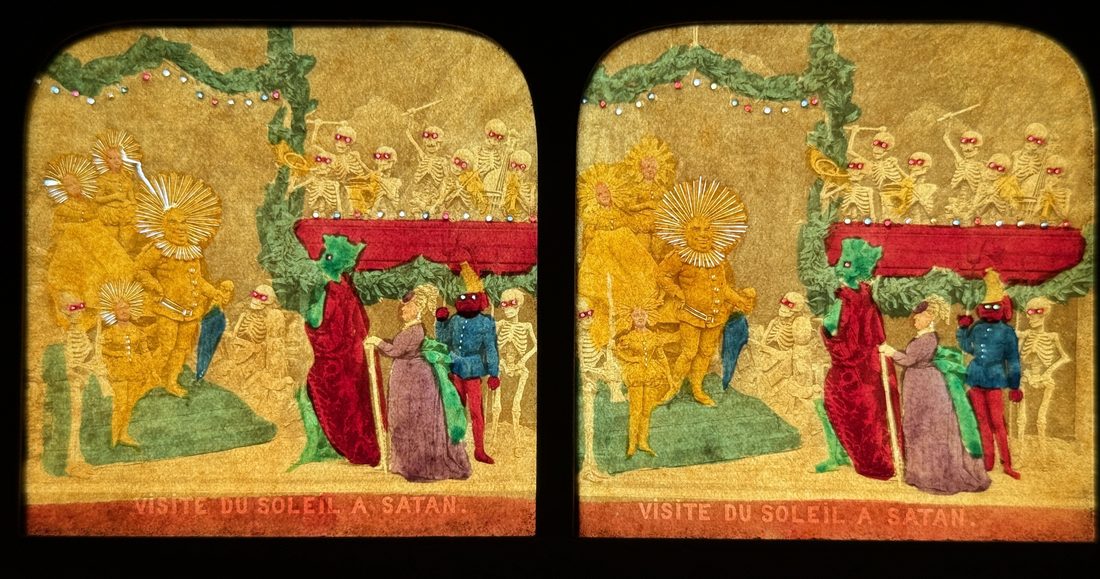
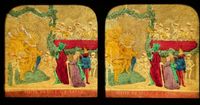
Visite du Soleil à Satan, classified as A48, the mount without printed numeral. The Sun personified, attended by figures crowned with long pierced rays, is received by Satan and his court beneath a loggia occupied by an orchestra of skeleton musicians, a garland and a string of white and red lights running beneath the balcony. The plate carries more perforations than any other in the group, and its nocturnal state is correspondingly the fullest. The mount carries Block’s cartouche and roundel and, at the upper right, the manuscript numeral “25-4”.
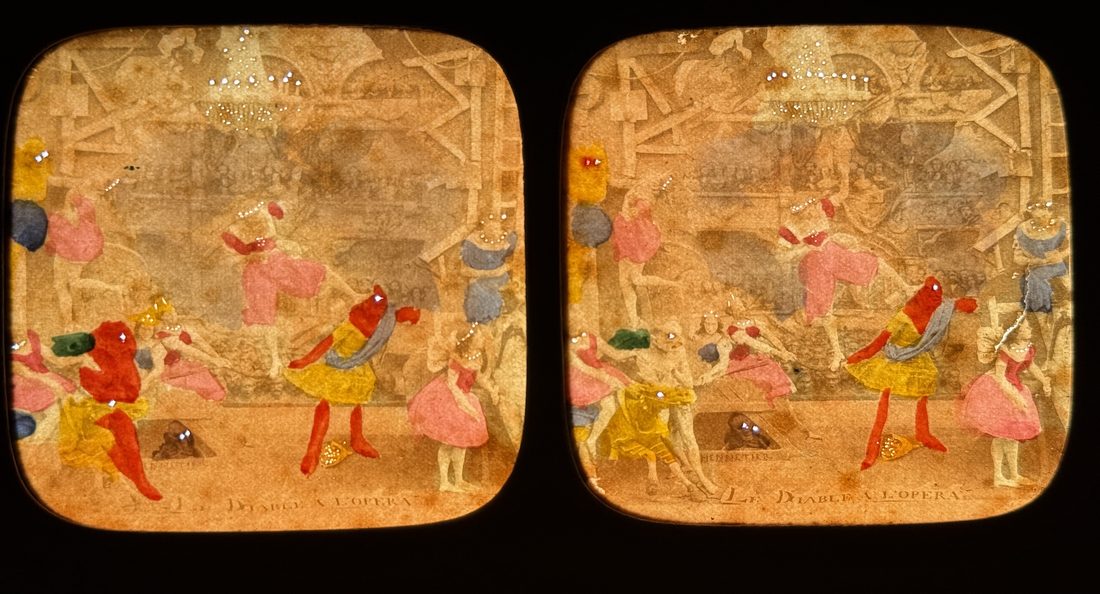
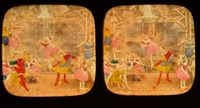
Le Diable à l’Opéra, classified as B5, the mount without printed numeral. The tableau is built as a stage seen from the stalls, with auditorium and boxes crowded behind, a pierced chandelier at the centre, dancers in tutus and a demon in the action; a skull occupies the prompter’s box beside the signature Hennetier modelled into the stage floor. The satire is directed at the world of the ballet and at its audience. This is the single plate on the embossed cream-green mount, which carries the monogram E.L.
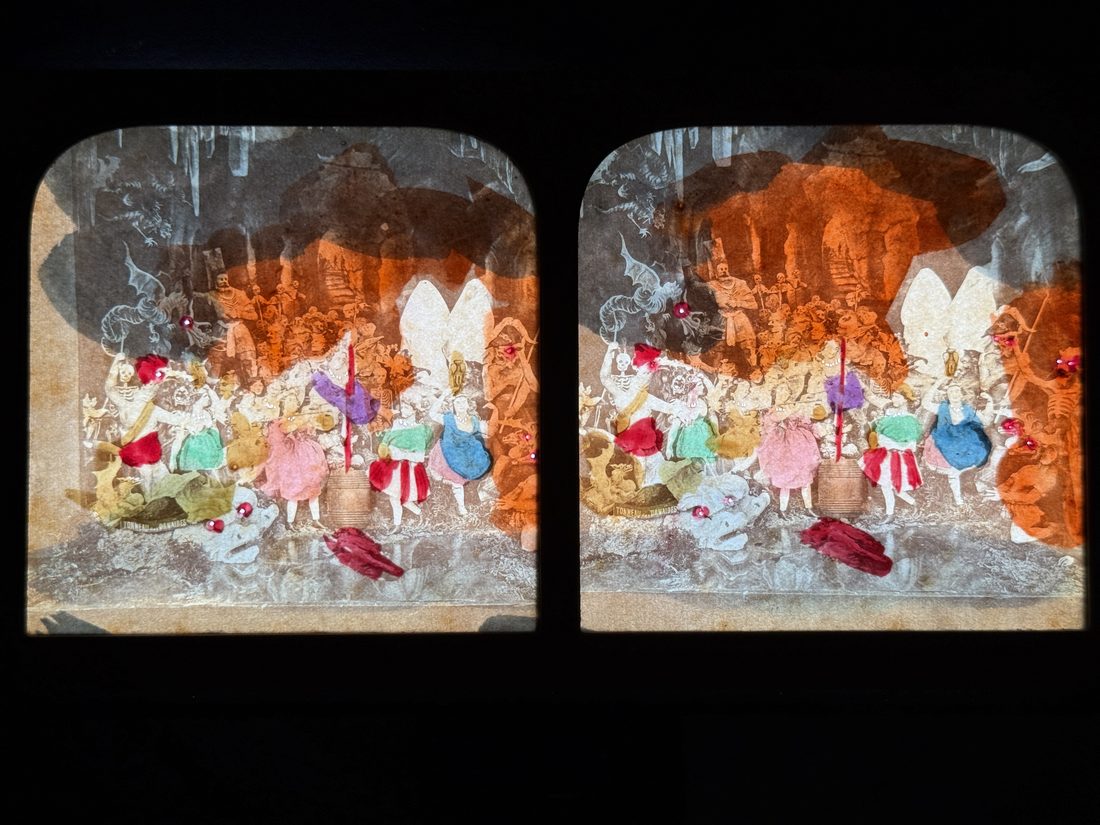
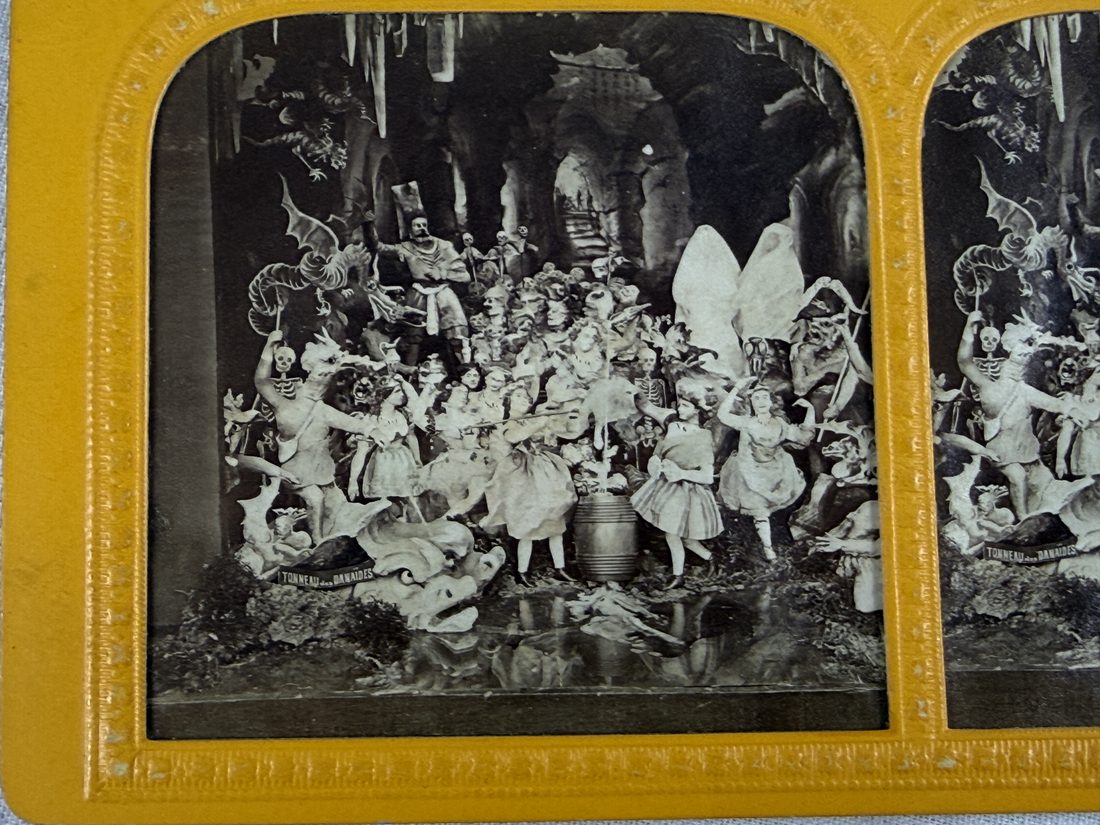
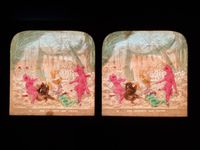
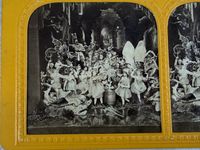
Tonneau des Danaïdes, classified as C6, the mount without printed numeral or publisher’s mark. The myth of the Danaids, condemned to fill a vessel without a bottom, is turned into choral spectacle: a crowd of dancers about the cask, demons and skeletons behind, a winged Satan commanding the scene, the whole mirrored in a pool in the foreground. The title is not printed along the margin but modelled on a placard set within the scene. The scene is staged in greater depth than the others of the group, and the pierced eyes are more numerous.
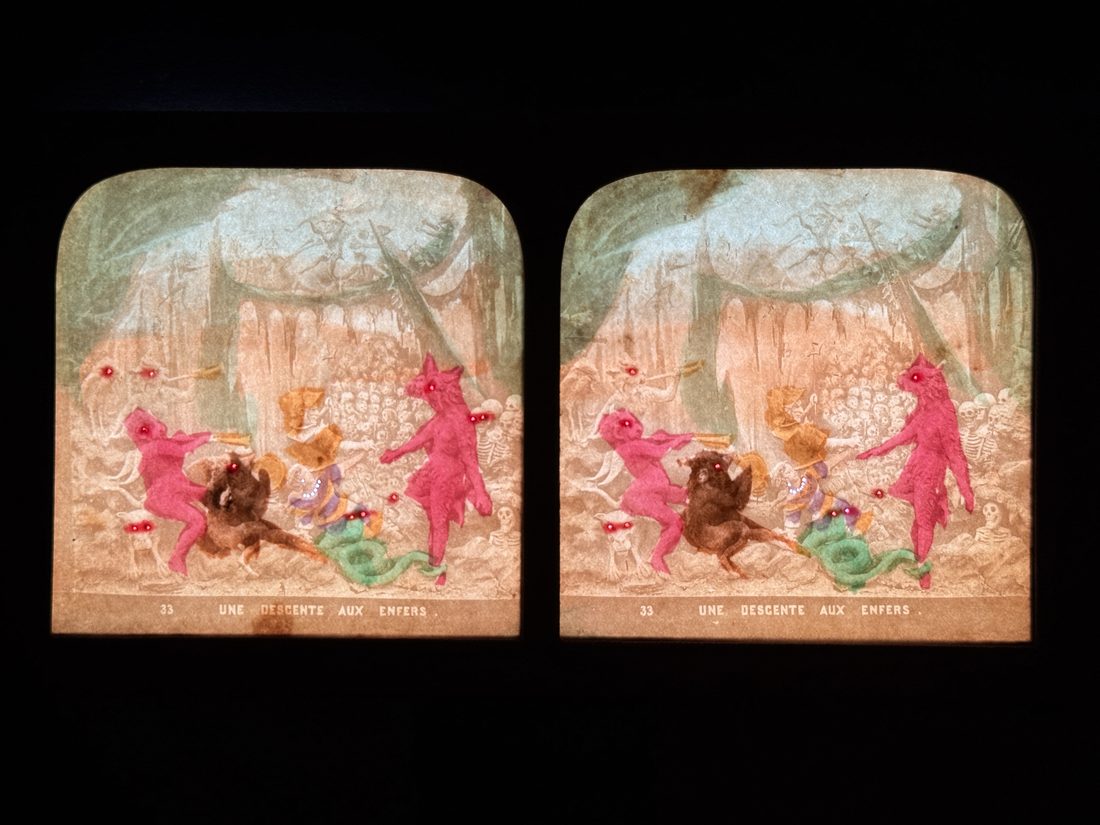
Une Descente aux Enfers, classified as D33 and numbered 33, the mount without publisher’s mark. The most densely populated scene of the group: feline demons, a serpent, a mass of skulls in the depth, figures plunging from above and a damned man in contemporary dress dragged down by devils. The composition is painted rather than modelled, alone among the seven, which accounts for its lower and flatter relief, the stereoscopic effect deriving from a painted pair rather than from a sculpted subject photographed in the round. The title is printed in minute white characters on a dark band, the distinguishing feature of its series.
The Diableries turn hell into a comic and satirical double of contemporary Paris. Their skeletons, devils, satyrs and elegant women are for the most part not tortured: they cook, dance, drink, race, attend the theatre and reproduce the institutions of society. The danse macabre supplies the general iconographic precedent, since animated skeletons had long traversed human ranks and occupations, but the function is here brought up to date. Beyond the reminder of equality before death, these scenes construct a theatrical counter-world in which administration, fashion, spectacle, journalism, the stock exchange, science and Parisian pleasures continue after it. Laughter and craftsmanship together made the criticism saleable, and the modern literature connects the repertory to the corruption and excess of Paris under the Second Empire and to the critique of the authoritarian rule of Napoleon III and of a decadent bourgeoisie.
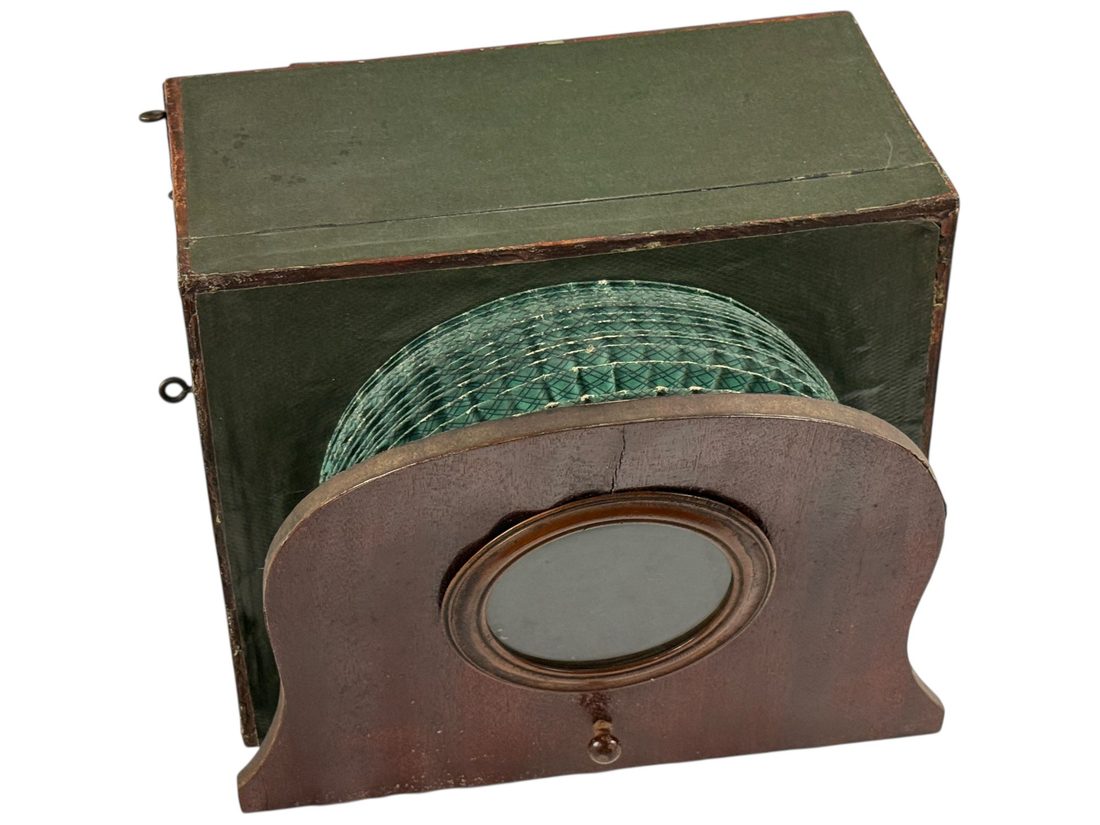
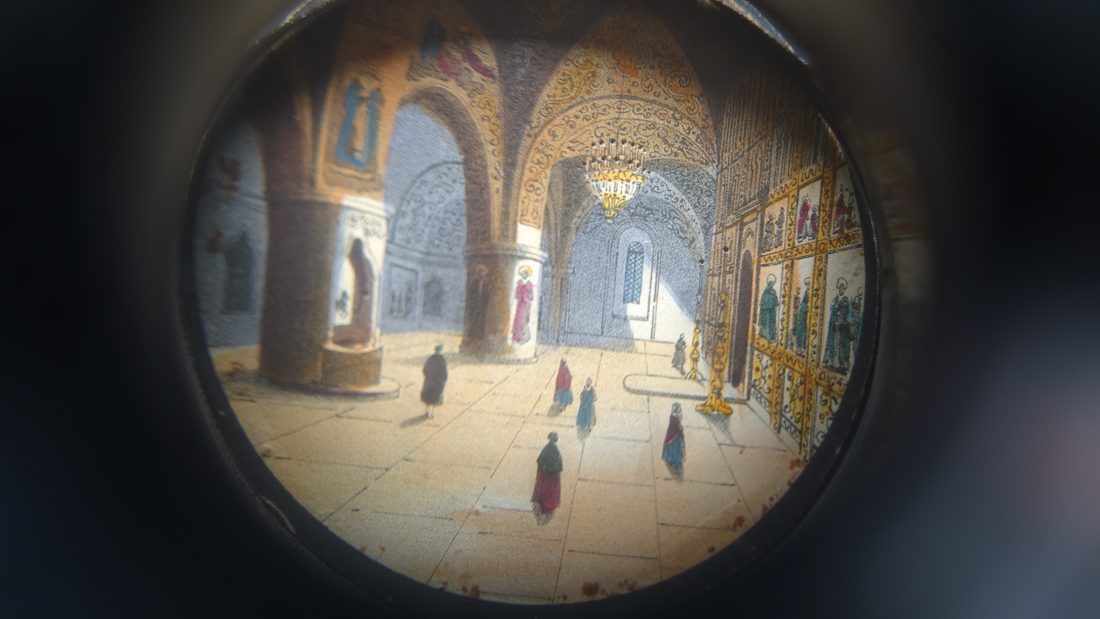
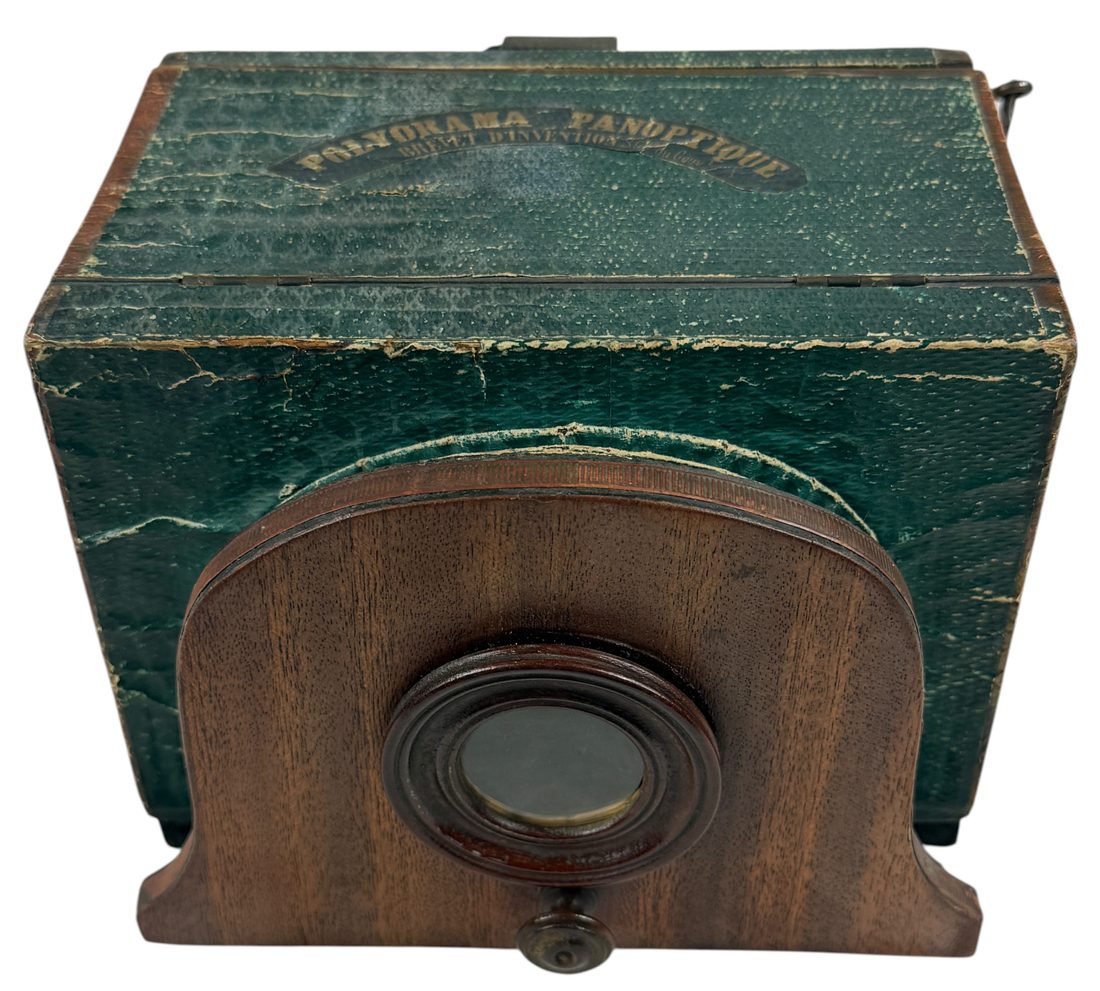
Two genealogies of the pre-cinema meet in this object. From the stereoscope comes binocular fusion, and therefore depth. From the tradition of transparencies, diaphanies, protean prints and the Polyorama Panoptique comes luminous metamorphosis. The Polyorama, a French optical box of the middle of the century, allowed a composite paper view to pass from day to night by the alternation of an upper lid and a rear shutter, its reverse colouring, superimpositions, cut-outs and perforations bringing forth figures, moon, stars and lights that had been invisible; that procedure miniaturised for the drawing room the techniques of Daguerre’s Diorama, with its transparent canvases lit from front and back, and Carlo Ponti extended it to photography in the Megalethoscope of 1862. Dissolving views projected from the magic lantern produced a comparable transition, but a public and temporal one obtained with two images or two lenses, whereas here the metamorphosis is incorporated in a single composite card and takes place privately, inside the box, one spectator at a time.
The stereoscope had by then passed from Wheatstone’s scientific demonstration to the optical toy and the drawing-room object, and the closed Brewster form, which concealed the mechanism, intensified the illusion. Cheap models and luxury table instruments coexisted in the trade, permitting both wide consumption and the display of status, while the act of viewing remained private and individual even as it took place in a social room.
These cards belong to the visual history of the diabolic and the occult, yet they are neither evidence of spiritualist practice nor ritual objects. Photographic ghosts were already an entertainment when these tableaux were modelled, the recipe having been published by Brewster in 1856 and the London Stereoscopic Company having issued The Ghost in the Stereoscope about the same year; spirit photography proper, which claimed to register invisible entities and was invested with mediumistic assertions, begins with William Mumler at Boston in 1862. The Diableries declare, through the frank theatricality of their modelled tableaux, their own fabricated and satirical nature. The chronology is close, the epistemic purpose opposite. The day and night effect nevertheless introduces a dynamic of apparition, and it is this ambivalence, rationally constructed yet perceptually unsettling, that accounts for the joint interest of collectors of pre-cinema, of stereoscopy and of the occult imagination.
The tableaux of the Diableries were modelled in clay upon a table, photographed with a stereoscopic camera and afterwards dismantled or destroyed, a few figures only being kept, which is why the genre survives in its photographs and not in its models. The three modellers so far identified are the following.
Louis Alfred Habert (Paris, 1824-1893) was the most prolific of the modellers, working first with the photographer and publisher François Benjamin Lamiche and afterwards represented by Adolphe Block. He signs, with the date 1860, the tableau of Le Jugement dernier.
Pierre Adolphe Hennetier is documented in the genre from the Block series of 1868, and on documentary evidence in 1871; he was associated with Jules Marinier. He signs Le Diable à l’Opéra. His manner and Habert’s are close though distinguishable, so that attribution on stylistic grounds alone remains the province of those able to compare many examples directly.
Louis Edmond Cougny, born at Nevers on 3 October 1831, trained in Paris under François Jouffroy, declaring himself élève de M. Jouffroy in the Salon livrets, and made his debut at the Universal Exposition of 1855, was awarded a third-class medal in 1876 and a second-class medal in 1877, exhibited for the last time in 1896 and died in Paris on 17 February 1900. He is recorded in the catalogue of artists of the Musée d’Orsay under no. 9465. His participation in the Diableries is reported by the modern literature without documentary support, and the signature on the present plate is direct evidence of it. He signs Satan chassé du Paradis, the one subject of the group handled in a fully academic manner, as might be expected of the only Salon sculptor among the three.
The first series appeared in 1860. Adolphe Block (Paris, 1829-1903), a publisher of stereoscopic views from 1863 whose firm outlived him and continued under the same mark until the First World War, then took over and enlarged the genre. The series of seventy-two numbered subjects issued under his imprint, announced as Soixante-douze Sujets pour le Stéréoscope and running from 1, Les Sept Péchés capitaux, to 72, Les Cocottes chez Satan, is regarded, following May, Pellerin and Fleming, as the finest and the most frequently encountered of all. It was registered for legal deposit in 1868 and again in 1873, and incorporated subjects already issued in 1860; an original box label records twelve cards to the box. The impressed monogram B.K. is Block’s publishing mark and identifies his editorial and photographic role, not the hand of the sculptor. From 1868 Jules Marinier (1823-1898), a competitor, issued comparable views commonly attributed to Hennetier; the stock Block absorbed was that of Lamiche, whose successor he is designated from that year.
The mounts of the present group record two publishers rather than one. Three carry Block’s cartouche. Two, Le Jugement dernier and Le Diable à l’Opéra, carry instead the impressed monogram E.L., and their position within the history of the genre is consistent with a different imprint, the first being the subject of the original campaign of 1860 and the second belonging to a series other than Block’s seventy-two. Two mounts bear no publisher’s mark at all. Since negative, model, print, mount and publisher’s mark may each belong to a different moment, the date modelled in the clay dates the tableau and not the card. Four of the seven belong to the Block series; the remaining three come from three further series for which the standard reference declares neither publisher nor date.
Conditions: The stereoscope is in fine and fully working order. The burr walnut retains good depth of colour, with light surface wear consistent with use; the mirror is silvered and its support and stay are complete; the ground-glass panel is original; the optics are free of chips, separation, fungus and haze, and the focusing operates over its full travel. The collection label at the rear is intact.
The seven cards are in exceptional condition. The mounts are sound, without tears or losses, the reverse colouring is strong throughout, and the transformation effects are undiminished, the perforations and cuts open and clean. Two minor surface marks are noted, neither perforating nor interfering with the view: one on the left image of Visite du Soleil à Satan, and one of about three millimetres on the right image of Le Diable à l’Opéra. No restoration has been observed. Given the fragility of the support, cards preserved in this state are scarce.
The long white line crossing Satan chassé du Paradis and the finer line in Entrée d’Orphée aux Enfers are the luminous cuts described above: they belong to the design of the plates and not to their condition.
Census: Diableries are held by the National Science and Media Museum, Bradford, within the Kodak Collection, where Les Cuisines de Satan, no. 1990-5036/13471, and Bal chez Satan, no. 1990-5036/13473, are catalogued, the latter measuring 87 × 177 × 2 mm and recorded as published by Block, Paris, ca. 1866; and by the Los Angeles County Museum of Art, which holds twenty examples, has published the technical analysis and conservation treatment of the group, and exhibited a selection in 3D: Double Vision, 2018-2019. The corpus of one hundred and eighty-two recorded subjects was brought together from the combined collections of Brian May, Denis Pellerin and Paula Fleming and reproduced in full by the London Stereoscopic Company in 2019, the edition of 2013 having reproduced one hundred and eighty of them; the publishers state that at the time of writing no complete collection of the originals was known. For the apparatus, the comparable example is the Duboscq-Soleil stereoscope in the Museo di Storia della Fisica, University of Padua, cat. no. 684, sent by Jules Duboscq to Francesco Zantedeschi in June 1852, whose hinged lid is lined internally with tinfoil to reflect light onto opaque views and whose rear opening was originally closed by a ground glass, now lost.
References: B. May, D. Pellerin and P. Fleming, Diableries: Stereoscopic Adventures in Hell. The Complete Edition, London: London Stereoscopic Company, 2019; B. May, D. Pellerin and P. Fleming, Diableries: Stereoscopic Adventures in Hell, London: London Stereoscopic Company, 2013; R. A. Schreiber, Classification of Diableries, in Stereo World, vol. 30, no. 4, 2004, pp. 10-20; J. Remise, Diableries: la vie quotidienne chez Satan à la fin du 19e siècle, Paris: Balland, 1978; E. Simonova-Bulat, Conservation Issues of Paper Stereo Transparencies, unpublished capstone paper, Advanced Residency Program in Photograph Conservation, Rochester: George Eastman House, 2003; L. Mannoni, The Great Art of Light and Shadow: Archaeology of the Cinema, Exeter: University of Exeter Press, 2000; R. Balzer, Optical Amusements: Magic Lanterns and Other Transforming Images. A Catalog of Popular Entertainments, Watertown, MA: published by the author, 1987; Journal général de l’imprimerie et de la librairie, deuxième série, vol. IV, Paris, 1860.
You might also like