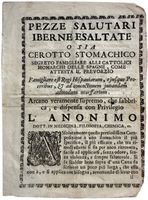
Pezze salutari iberne esaltate o sia Cerotto Stomachico
| Macro-category | Rare Books and Manuscripts |
| Subcategory | Medicine |
| Author | VITALI, BUONAFEDE, called “l’Anonimo” |
| Place of printing | Brescia |
| Publisher / Maker | Giacomo Turlino |
| Year | 1730 |
the apotheosis of the physician-charlatan:
a Brescian broadside for the “stomachic plaster”
of Buonafede Vitali, the “Anonimo” whom Carlo Goldoni
judged worthy of the annals of his century
apparently the only recorded copy
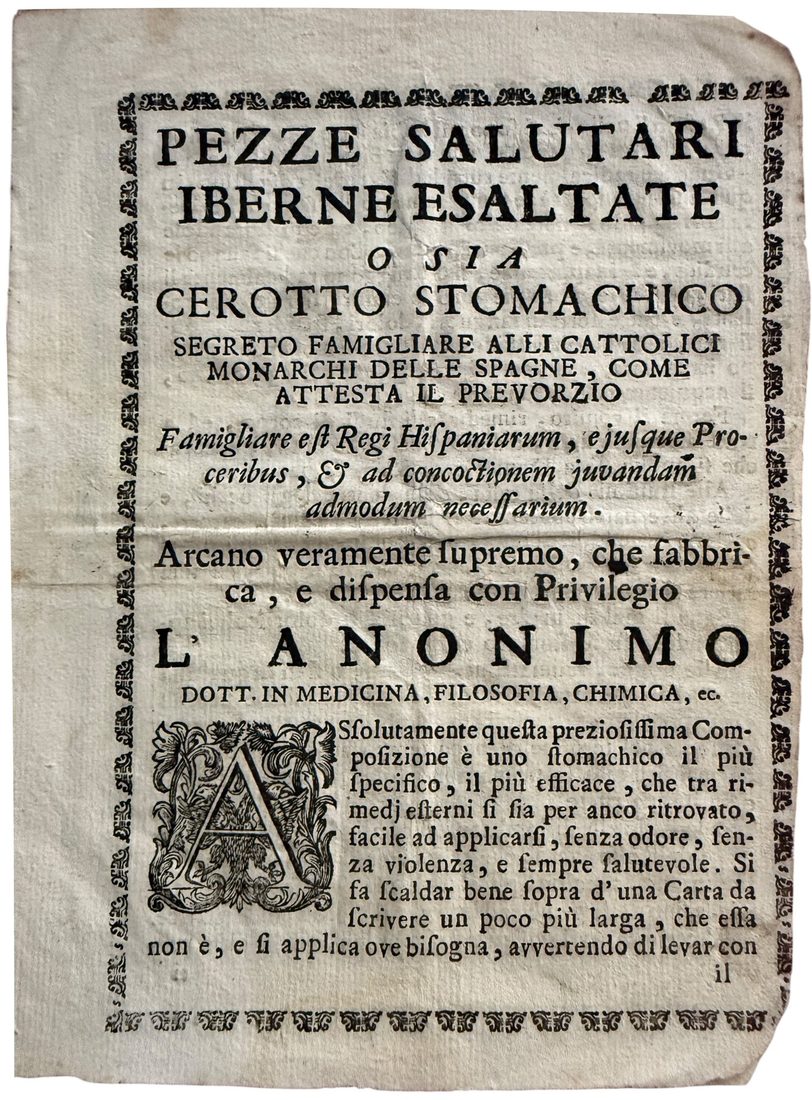
Vitali, Buonafede, called “l’Anonimo”. Pezze salutari iberne esaltate o sia Cerotto Stomachico, segreto famigliare alli Cattolici Monarchi delle Spagne, come attesta il Prevorzio […]. Arcano veramente supremo, che fabbrica, e dispensa con Privilegio L’Anonimo, Dott. in Medicina, Filosofia, Chimica, ecc. In Brescia, Per Giacomo Turlino [con licenza de’ Superiori], s.d. [but ca. 1730].
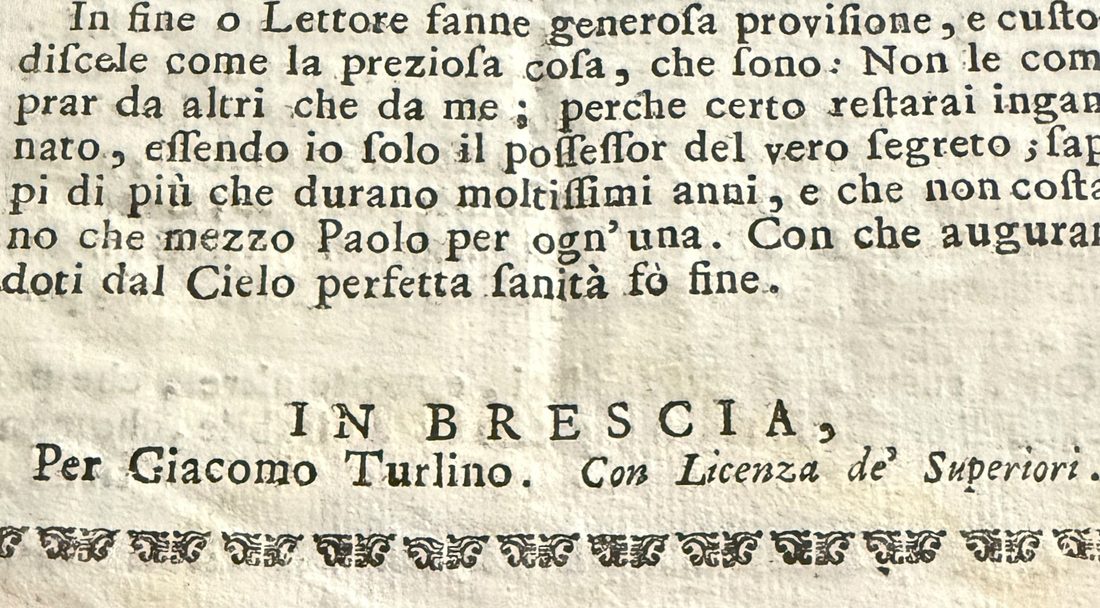
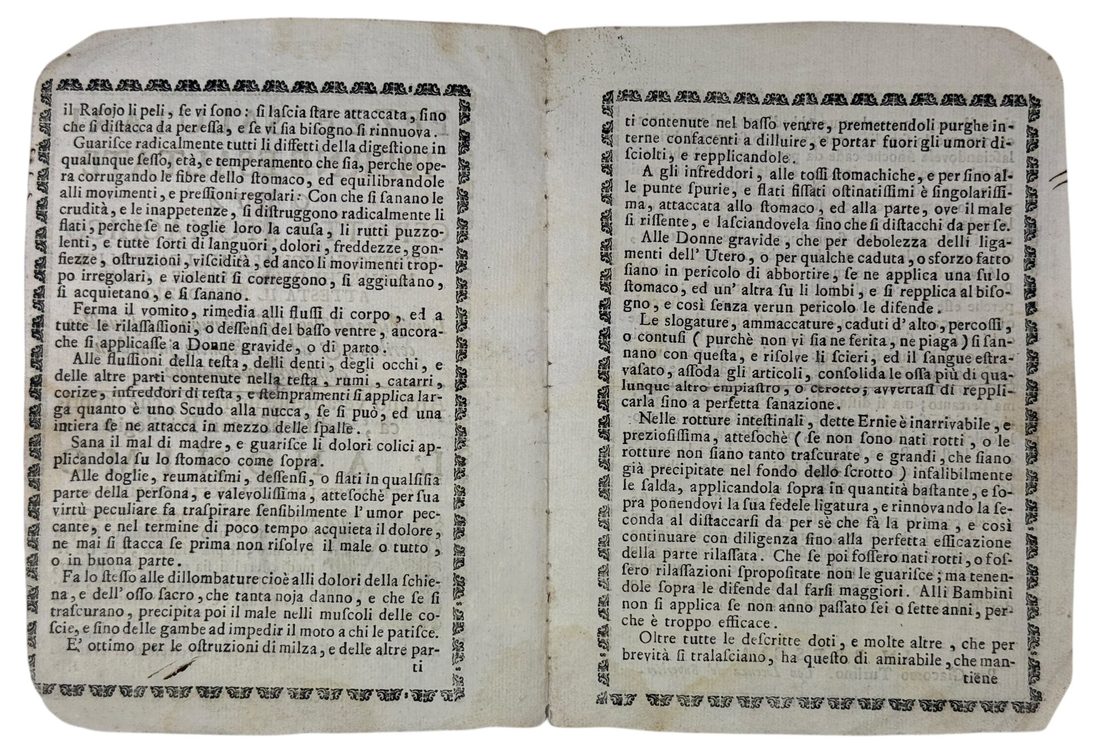
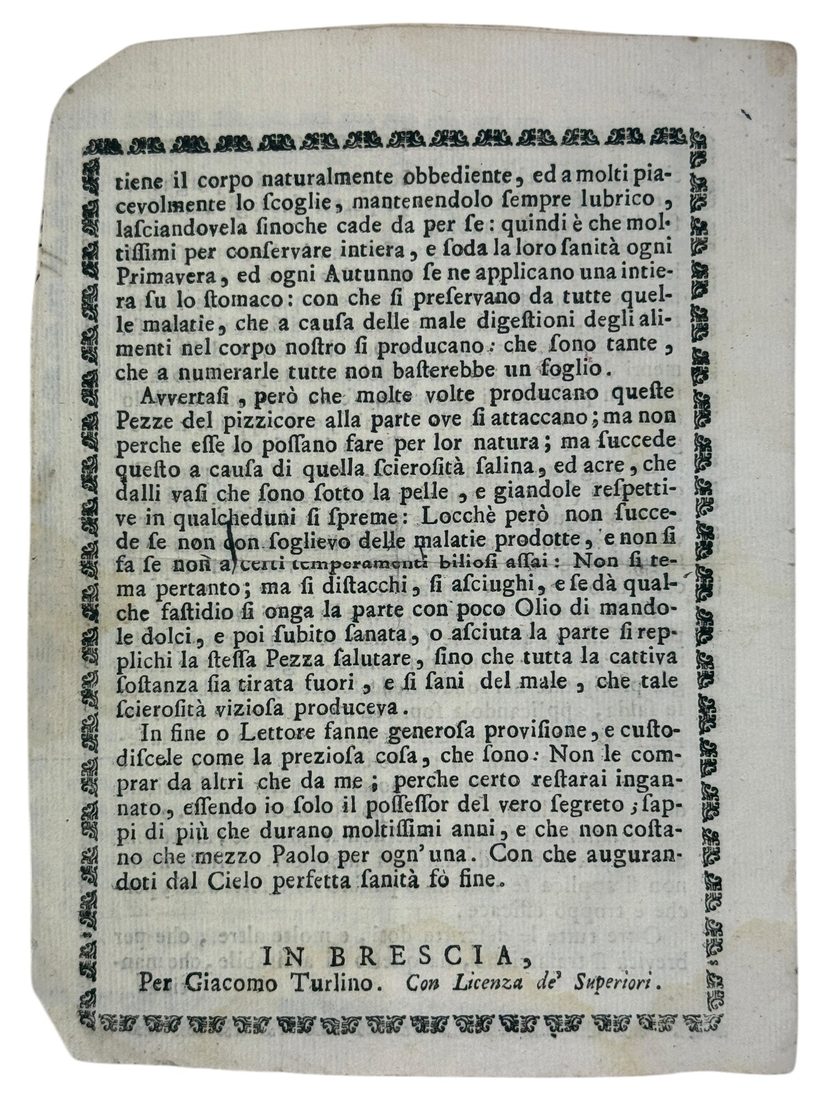
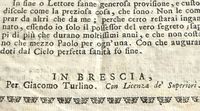
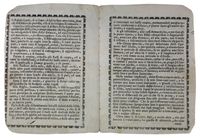
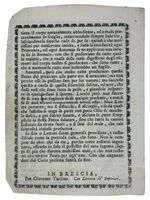
Folio, a single bifolium (a half-sheet folded once into two conjugate leaves), (200 × 150 mm); pp. [4], unbound as issued, disposed as title-incipit (p. 1), central opening (pp. 2–3), and colophon (p. 4); without signatures, foliation, or pagination, as befits its monofascicular, occasional character. Printed in roman and italic types, with the long ‘s’ (ſ) and ligatures usual in early eighteenth-century Italian composition. The text is enclosed within a continuous woodcut border of foliate fleurons, the same band recurring as a rule above the colophon. The title-incipit is set in graduated types, with large display capitals for the title, italic for the Latin motto, and an inhabited woodcut initial ‘A’ (of “Assolutamente”). Colophon at foot of p. 4: “IN BRESCIA, Per Giacomo Turlino. Con Licenza de’ Superiori.”
A hitherto unrecorded eighteenth-century medical broadside, advertising the “stomachic plaster” of the itinerant physician Buonafede Vitali, the celebrated “Anonimo.” It is a rare material witness to the largely vanished genre of the printed advertising sheet, ephemera issued in the public square and seldom preserved. No other example has so far been traced. It belongs at once to the histories of medicine, of the printed ephemeron, of popular performance, and, through Goldoni, of Italian letters.
The sheet is not a treatise but a sustained piece of first-person therapeutic advertising, and its rhetorical architecture unfolds in three movements that occupy, respectively, the title-incipit, the central opening, and the final page.
The first is the laudatory exordium of the title-incipit, comprising the resounding title, the Latin tag of authority, the self-presentation of “L’Anonimo, Dott. in Medicina, Filosofia, Chimica,” and the hyperbolic praise of the “preziosissima composizione,” proclaimed the most specific and efficacious stomachic plaster yet devised among external remedies.The second movement, occupying the inner opening, supplies the directions for use, the plaster being warmed upon a sheet of paper, the abdomen first shaved with a razor where required levar con il rasojo li peli se vi sono (“to remove the hairs with a razor if any are present”), then applied and periodically renewed. There follows the long enumeration of virtues that constitutes the true substance of the genre, in which the advertised indications are deliberately universal: disorders of digestion, languors, pains, chills, swellings, and obstructions; vomiting; pains of the head, teeth, eyes, back, and sacrum; obstructions of the spleen; sprains; the complaints of pregnant women; and hernias. Such all-embracing efficacy is the hallmark of the proprietary secret of the period.
The third movement is the peroration of the final page. Here the reader is urged to lay in a generous provision, and exclusivity is pressed upon him non le comprar da altri che da me (“buy them from none but me”), the author professing himself the sole possessor of the true secret. There follow the assurance of durability and low cost, each at mezzo Paolo and the closing wish for perfetta sanità. The distinctive feature, in method, is not the pharmacology, which is entirely conventional, but the calculated construction of confidence through learned authority, the rhetoric of the unique secret, and guarantees of efficacy and price.
The broadside belongs to the world of early eighteenth-century empirical medicine and to the vigorous culture of the public square, in which licensed and unlicensed healers competed for the same audience. The cerotto stomachico is a topical remedy within the long tradition of resinous plasters of wax, resin, and pitch, well attested across northern Italy and still surviving in Brescian folk therapeutics, the larch-resin pezze salutari di Vallecamonica, a nomenclature on which the title appears knowingly to play.
Within its discipline the sheet occupies the popular and performative pole of medicine, set in deliberate opposition to the university “medici dotti.” Its strategy of legitimation is revealing. The Latin motto, “Familiare est Regi Hispaniarum, ejusque Proceribus, & ad concoctionem juvandam admodum necessarium,” is ascribed on the title-page to “il Prevorzio,” in all probability Joannes Praevotius (Jean Prévost, 1585–1631), author of the highly successful Medicina pauperum, the inexpensive pharmacological vade-mecum repeatedly reprinted throughout the seventeenth and eighteenth centuries, Milan and Venice among its places of issue. To invoke a recognised pharmacological authority, and to dedicate the remedy to the Catholic Monarchs of Spain, was to confer prestige upon an empirical preparation in the face of academic medicine.
Its lasting significance is documentary rather than doctrinal. Precisely because such sheets were printed in small numbers, served as instructions for use, and were then discarded, they survive only by chance, and the present example preserves in concrete form a practice that Vitali’s extant treatises merely justify in theory. It is, moreover, a tangible relic of a figure who entered literary history through Goldoni’s Memorie, and who is today the object of renewed scholarly attention as a paradigmatic case in the historiography of medicine, charlatanism, and the circulation of knowledge.
Buonafede Vitali (1686 – 1745) was a physician, surgeon, and chemist of regular formation who became one of the most singular figures in Italian medicine of the early eighteenth century. Educated at Parma, with experience at Rome and, between 1710 and 1713, in London, where he witnessed the plague and embraced the theory of contagion, he travelled widely through the Baltic lands and the Iberian Peninsula before returning to Italy in 1714 and adopting the programmatic pseudonym “l’Anonimo,” an affirmation that true science is universal and impersonal. He took a degree in chemistry at Bologna in 1719, and in 1724 lectured on chemistry and experimental philosophy at Palermo, where he elaborated his “twelve Arcani”; he subsequently served as protomedico at Verona, and shortly before his death was summoned to a chair at Halle by the King of Prussia.
His deliberate ascent of the mountebank’s stage was an act of protest against learned medicine and of allegiance to the practical medicine of the people, conducted with a full company of comedians drawn from the commedia dell’arte. It is preserved in the celebrated portrait left by Carlo Goldoni, who met him at Milan about 1731–1732 and judged him “a charlatan of a very rare species, whose memory perhaps deserves to be consigned to the annals of the century,” and “a better speaker than writer.”
His printed corpus is otherwise of a learned cast: the Breve trattato della peste (London, 1710); the Lettera […] in difesa della Professione del Salimbanco (1719; reissued Milan, 1732), his apologia for the mountebank’s calling; Le Terme del Masino (Milan, 1734) and Li bagni di Caldiero (Verona, 1746, posthumous), both balneological; and the Lettera […] in materia di malattie contagiose (1743). Against these treatises the present sheet stands as the complementary, ephemeral pole of his activity, the printed instrument of the square that his books were written to defend, and is therefore, within his oeuvre, a document of exceptional illustrative value.
Conditions: Complete, the single bifolium sound and fully legible. Light and even age-toning of the paper, with faint scattered foxing; the natural central fold of the bifolium; some show-through of the impression. Light marginal trimming not affecting the woodcut border or the text. A good and functionally intact example of a fugitive sheet whose survival in any condition is in itself remarkable.
Reference: M. Ferraro, Buonafede Vitali detto l’Anonimo. Ciarlataneria e medicina nell’Italia del primo Settecento, doctoral dissertation, 2012; G. Cosmacini, Ciarlataneria e medicina. Cure, maschere, ciarle, Milano: Raffaello Cortina, 1998; C. Goldoni, Mémoires de M. Goldoni, pour servir à l’histoire de sa vie, et à celle de son théâtre, Paris : Veuve Duchesne, 1787.
Census: Not in OPAC SBN (ICCU); not in OCLC/WorldCat; no institutional holding of this sheet has been traced, and it appears to survive in the present copy alone.