Dissertatio de Medicina ad Certitudinem Mathematicam evehenda
| Macro-category | Rare Books and Manuscripts |
| Subcategory | Medicine |
| Author | Gaukes, Yvo |
| Place of printing | Amstelædami |
| Publisher / Maker | R. & G. Wetstenios |
| Year | 1712 |
Descartes against Newton in the sickroom:
a Frisian physician’s attempt to demonstrate medicine more geometrico
an untrimmed copy - no auction record in the last 80 years
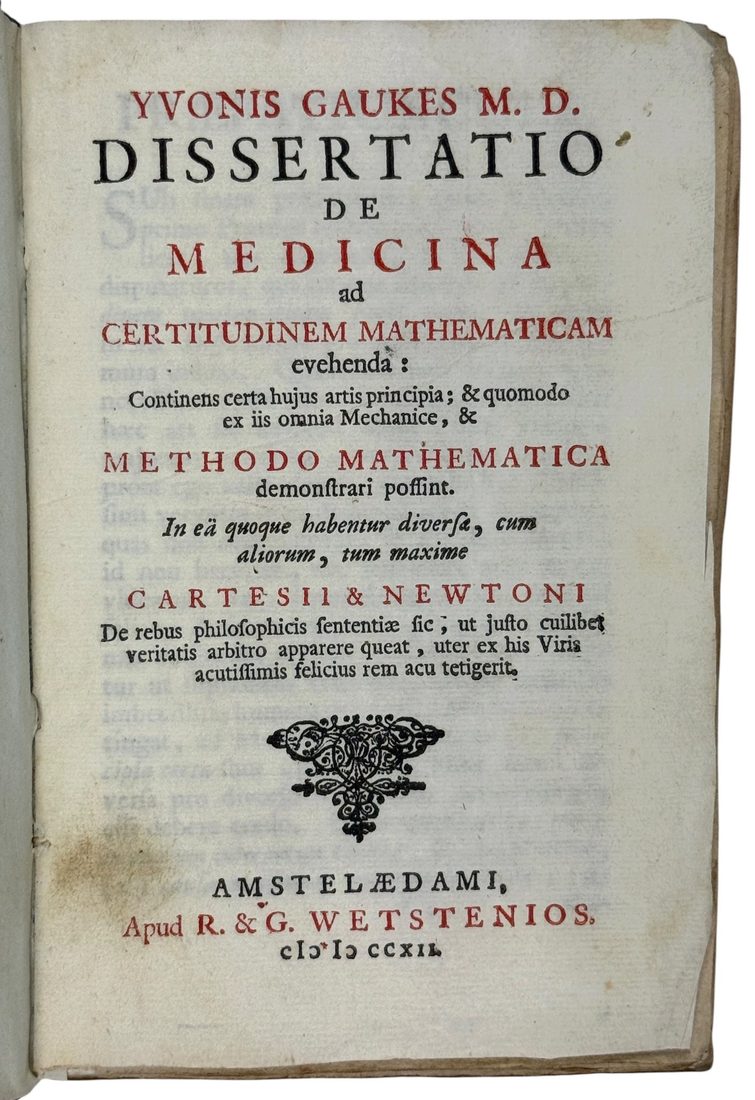
Gaukes, Yvo. Yvonis Gaukes M. D. Dissertatio de Medicina ad Certitudinem Mathematicam evehenda: continens certa hujus artis principia; & quomodo ex iis omnia Mechanice, & Methodo Mathematica demonstrari possint. In eâ quoque habentur diversa, cum aliorum, tum maxime Cartesii & Newtoni de rebus philosophicis sententiae, sic; ut justo cuilibet veritatis arbitro apparere queat, uter ex his Viris acutissimis felicius rem acu tetigerit. Amstelædami: apud R. & G. Wetstenios, 1712.
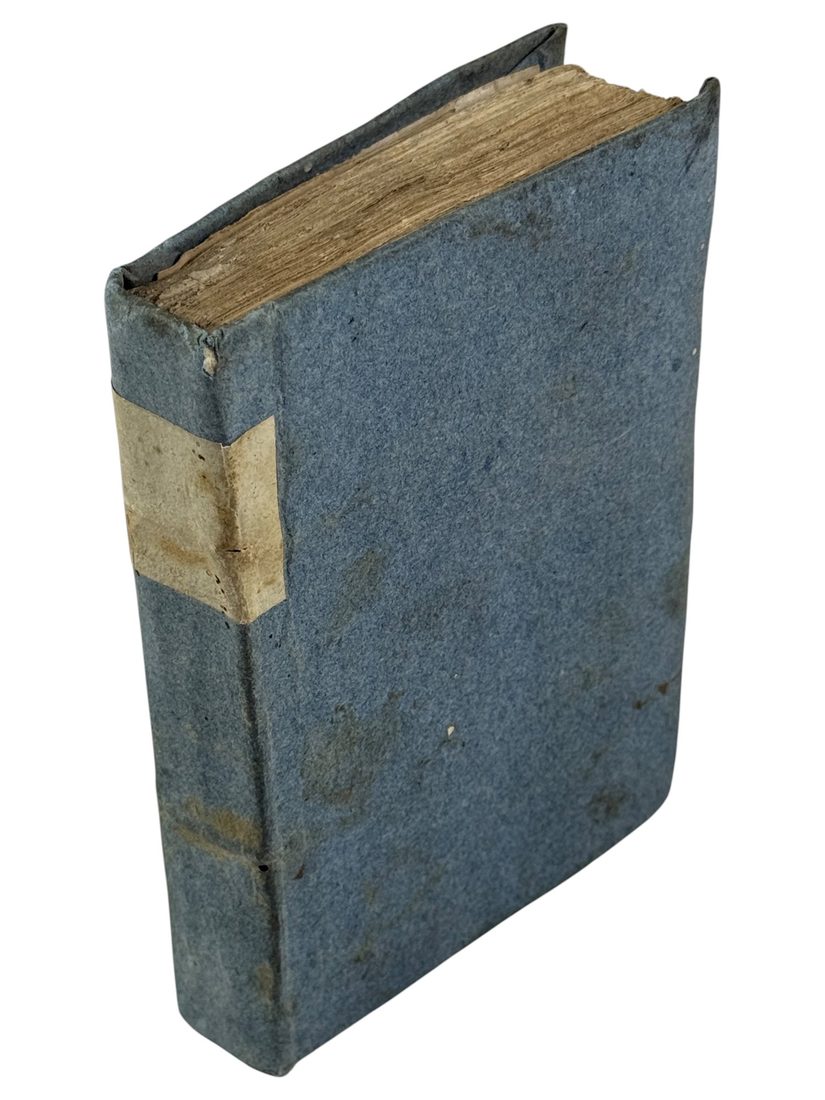
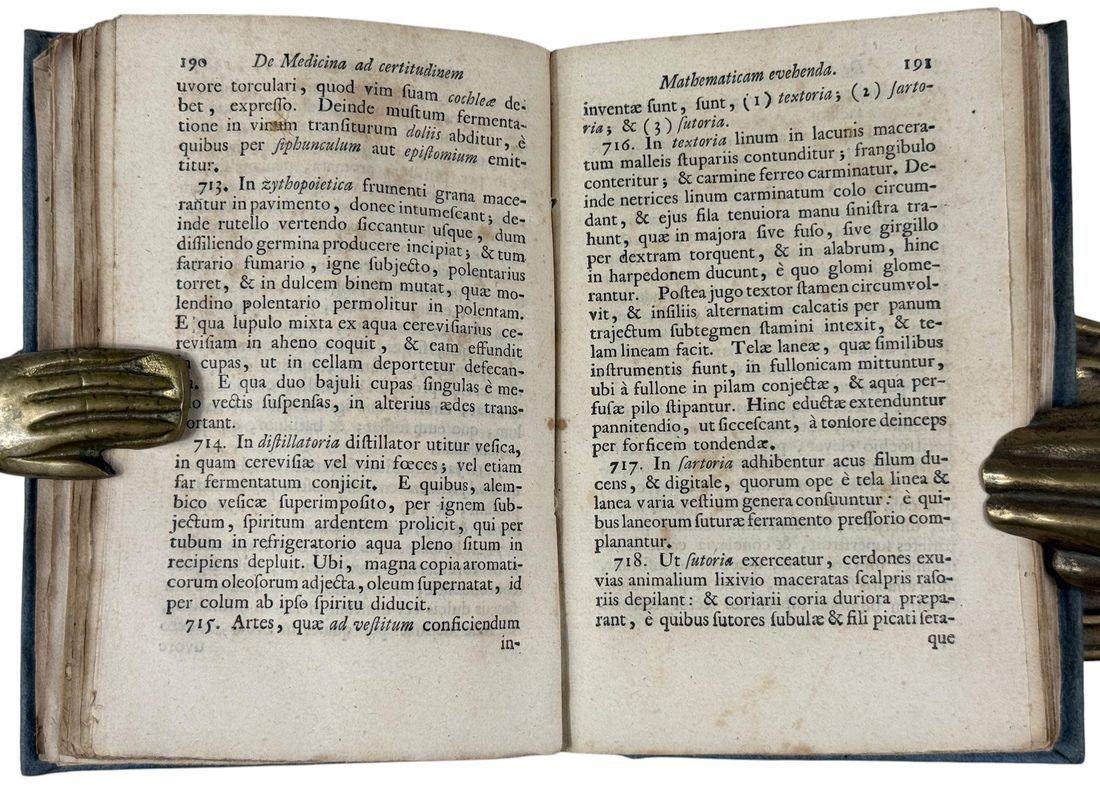
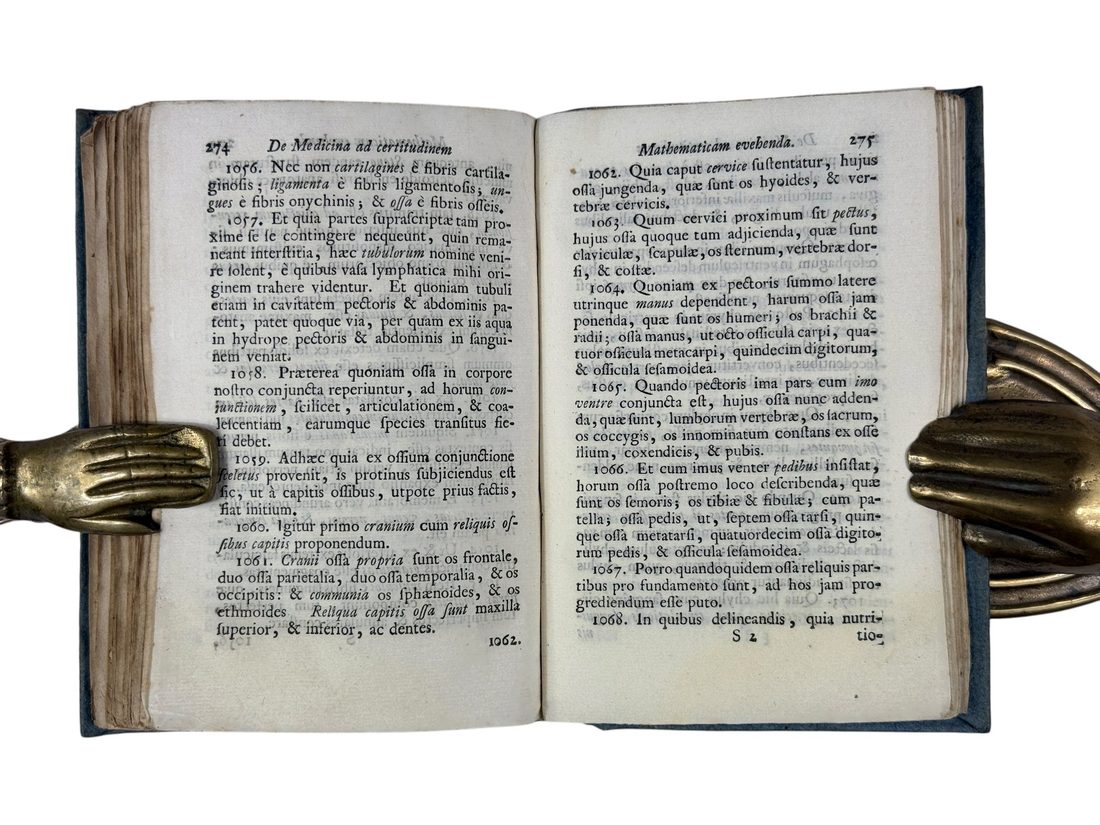
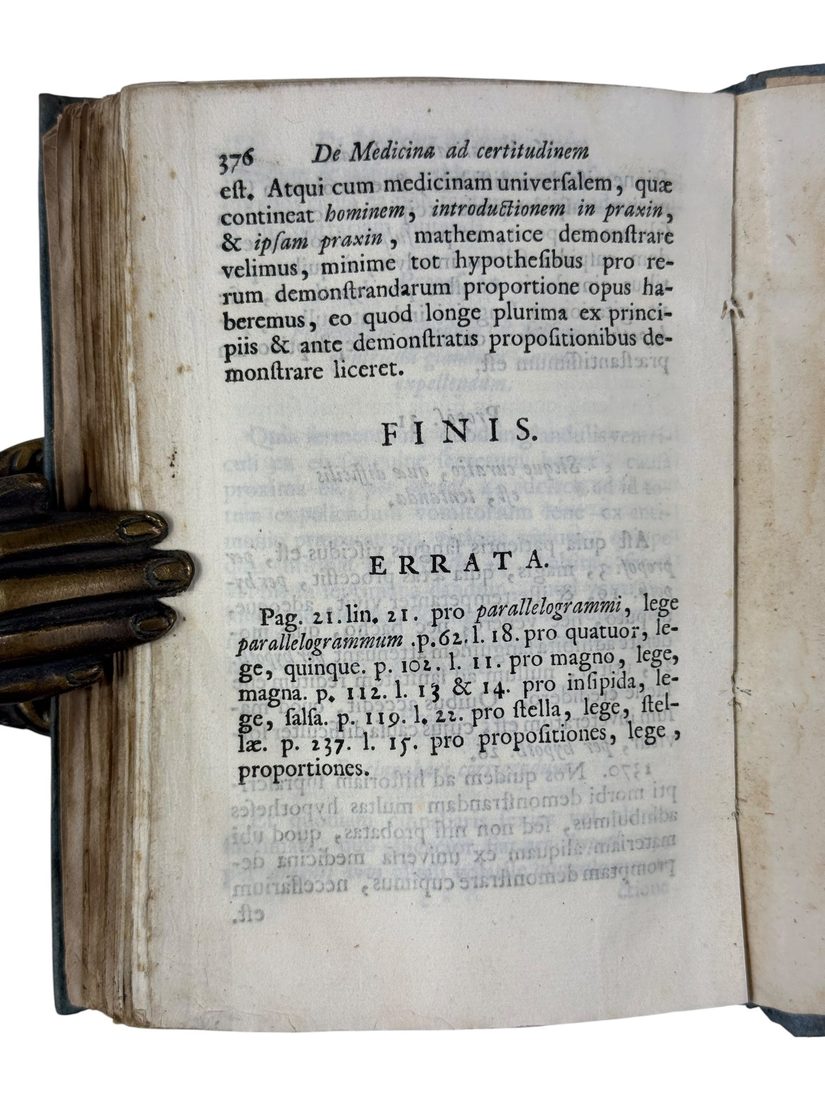
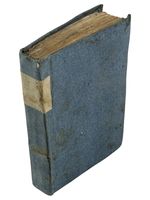
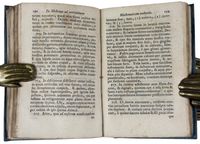
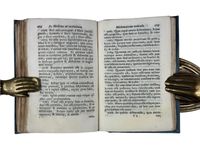
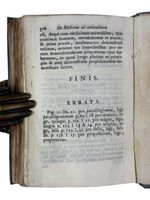
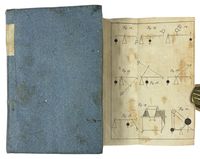
8vo (155 × 105 mm), contemporary blue paper boards (carta azzurra) over limp pasteboard, spine plain with traces of a paper lettering-label, edges uncut and untrimmed; pp. [6], 376, with four folding leaves of plates. Title printed in red and black, the principal words in roman capitals, with a typographic head-ornament above the imprint; text in roman with italic, ornamental woodcut initials, closing with FINIS and a terminal ERRATA. The four folding plates comprise one letterpress synoptic table, the Diatyposis opusculi, bound after the title page, and three engraved copperplates of geometrical and mechanical figures bound at the end. Signature: *⁴(-*4) A–Z⁸ 2A⁴.
First and only edition of the principal theoretical work of the Frisian physician Yvo Gaukes, an ambitious endeavour to refound medicine as a demonstrative science endowed with mathematical certainty. Composed more geometrico and articulated through definitions, axioms, postulates and theorems keyed to a large folding synoptic table, the treatise ranks among the most thoroughgoing expressions of early eighteenth-century iatromathematics in its Cartesian, rather than Newtonian, register. Its title-page programme, expressly weighing the natural-philosophical opinions of Descartes and Newton, makes the volume a vivid witness to the methodological crisis of medicine between the two paradigms.
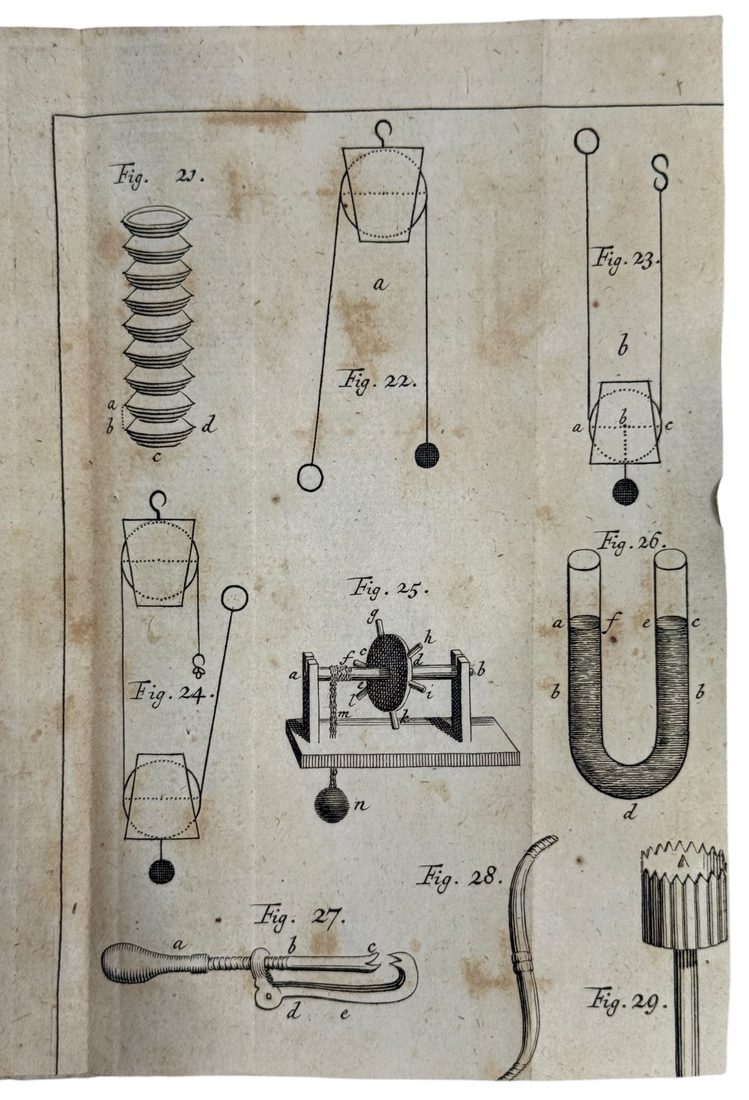
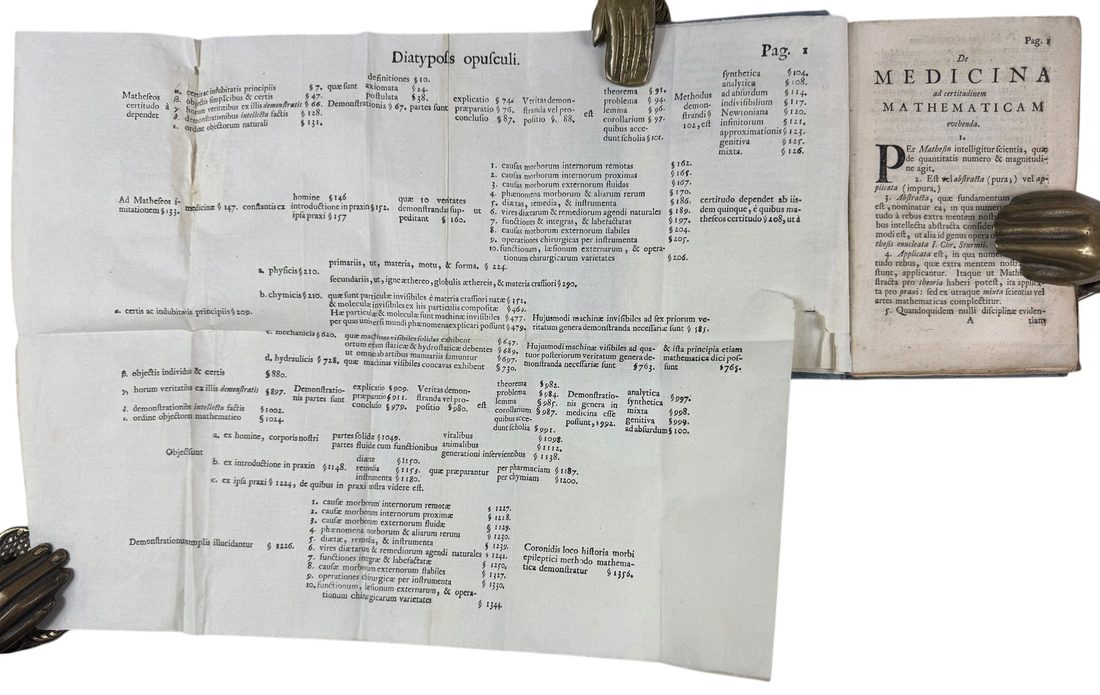
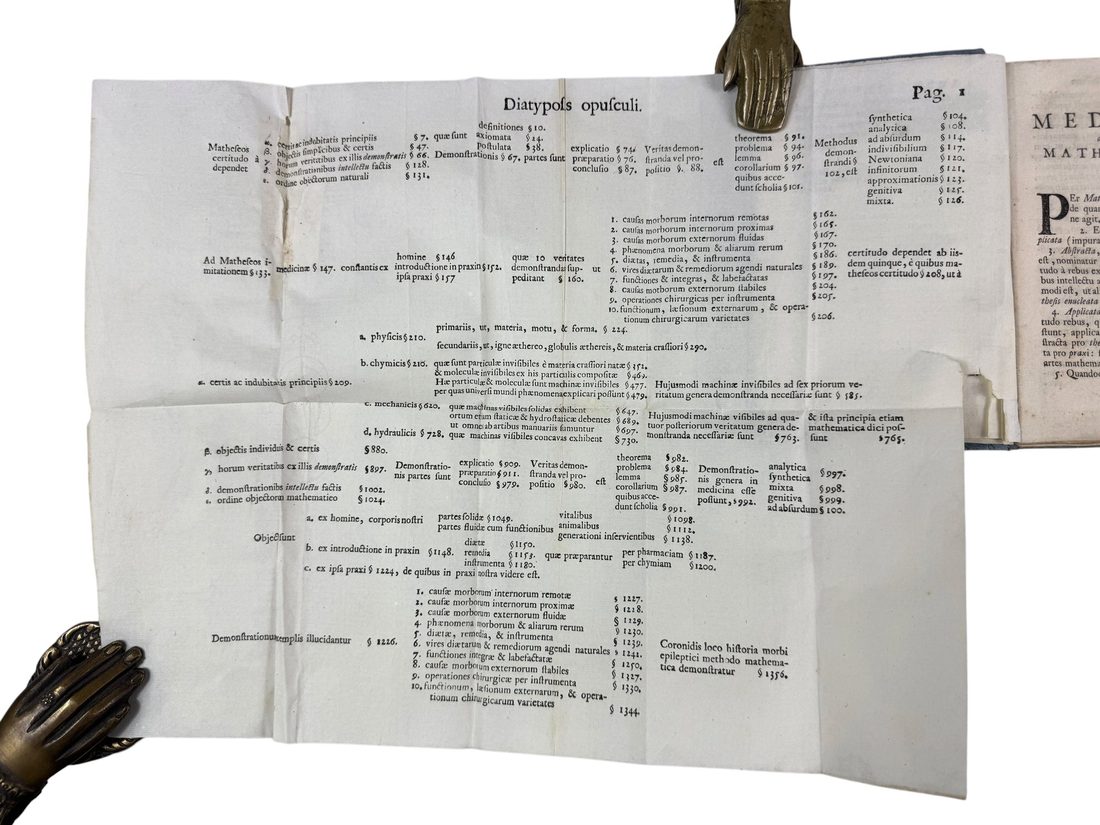
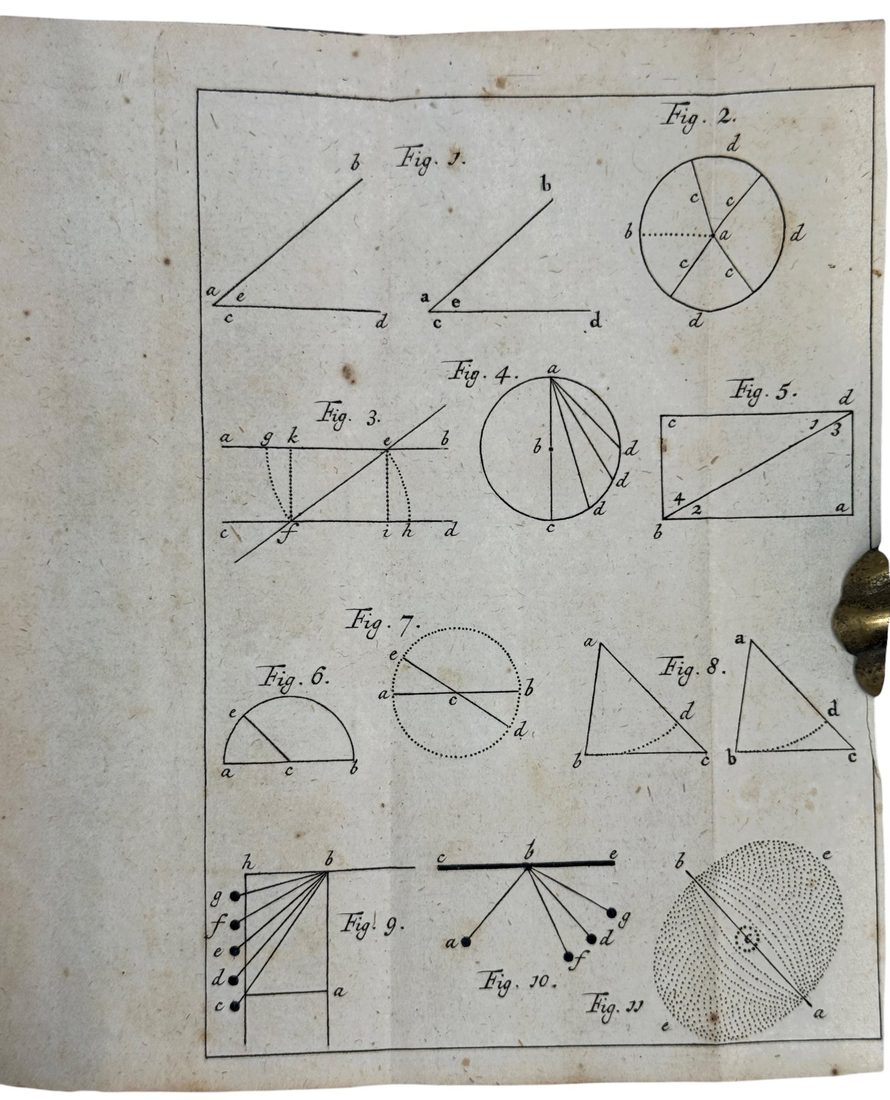
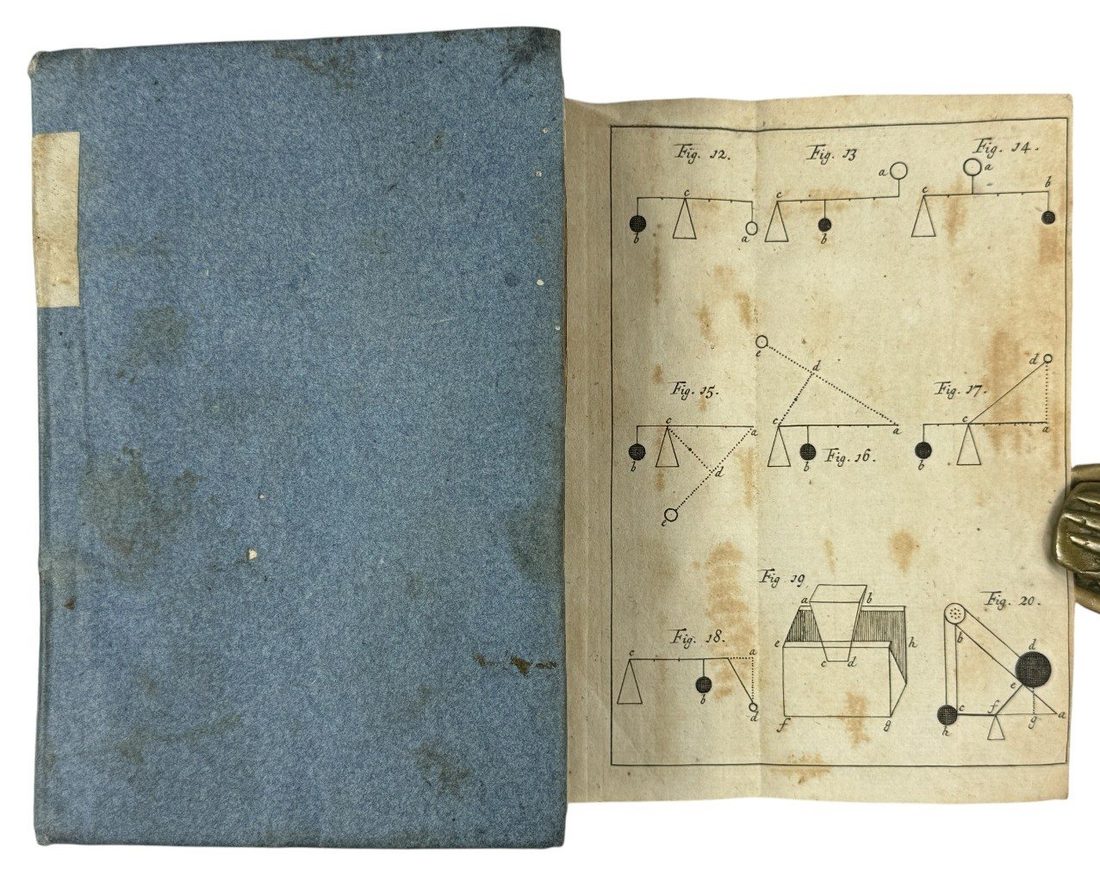
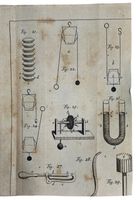
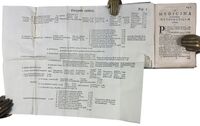
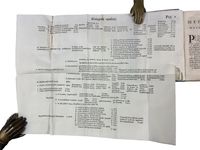
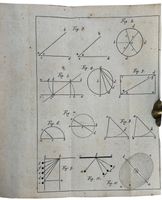
The physical organisation of the volume mirrors its method. The whole demonstrative sequence is mapped by the folding Diatyposis opusculi, a letterpress tree-diagram bound after the title that refers the reader, branch by branch, to the relevant numbered paragraphs, while the three engraved plates supply the geometrical and mechanical apparatus to which the propositions continually appeal: the first (Fig. 1–11) sets out elementary geometry, with angles, circles, triangles, parallelograms, point-constructions and spherical projections; the second (Fig. 12–20) turns to statics and mechanics, with balances and levers bearing weights, a triangulated diagram, a prism in perspective and a pulley with an inclined plane; the third (Fig. 21–29) gathers a stacked column of lenses, pulley-and-weight systems, a toothed-wheel machine, a U-tube charged with liquid, and hooked and serrated surgical instruments.
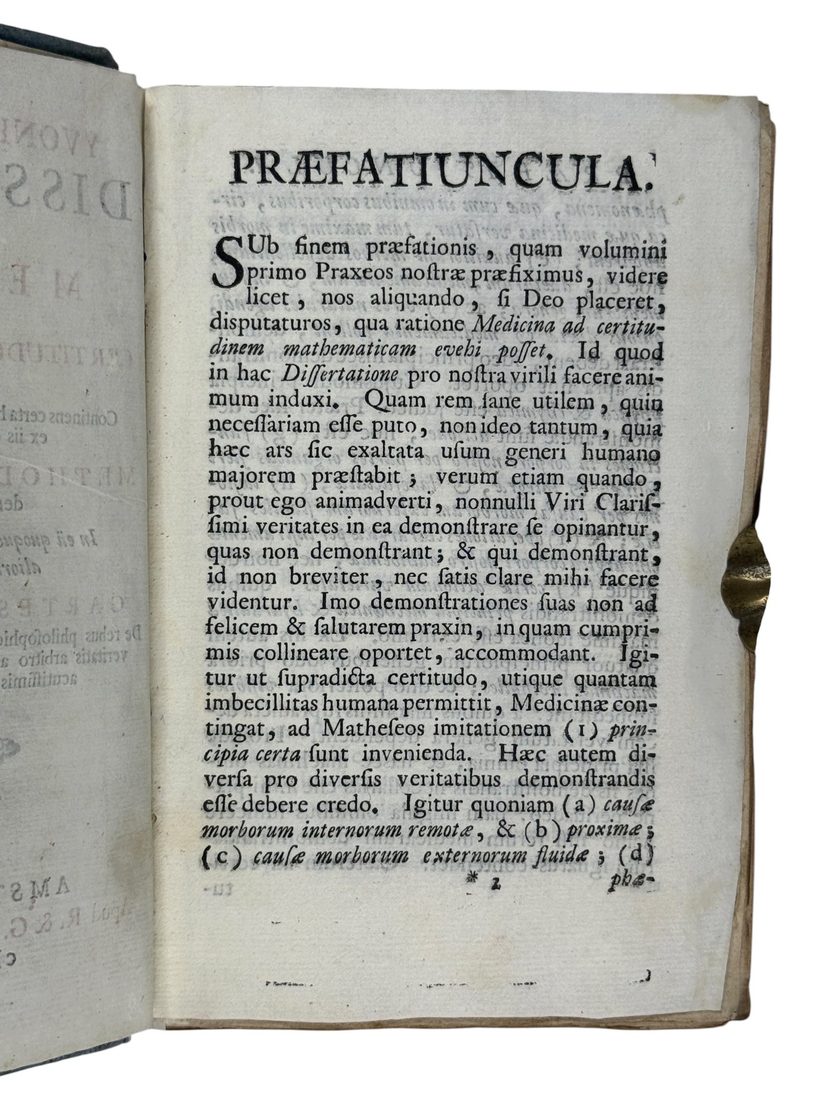
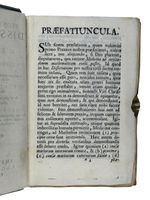
The text itself is constructed as a single deductive edifice. After a brief Praefatiuncula, in which Gaukes recalls that the present enquiry fulfils a promise made at the close of the preface to the first volume of his Praxis, it unfolds across more than thirteen hundred numbered paragraphs, opening with a definition of mathematics as a science and advancing through the apparatus of definitions, axioms, postulates, theorems, problems, lemmas, corollaries and scholia.
Gaukes makes medical certainty depend upon five principal conditions: certain and indubitable principles; simple and certain objects; truths demonstrated from those principles; demonstrations carried out by the intellect; and the natural order of objects. He then surveys the methods of demonstration available to the physician, namely the synthetic, the analytic, that by reduction to the absurd, that by indivisibles, the Newtonian, that by infinites, that by approximation, the genitival and the mixed, before grounding the whole upon four demonstrative pillars: physics, chemistry, mechanics and hydraulics. From these he claims to deduce the classes of medical truth set out in the synoptic table: the remote and proximate causes of internal diseases, the fluid causes of external diseases, morbid phenomena, regimens, remedies and instruments, the powers of remedies and their natural modes of action, intact and impaired functions, the stable causes of external diseases, surgical operations and the varieties of lesions.
The distinctive feature of the work is thus less any single clinical result than the attempt to reduce medicine in its entirety to a deductive machine, a geometry applied to the living body, in which first principles are held to be already available and inferences proceed with formal rigour. The intention is made explicit at the close, where the author argues (p. 376, immediately before the FINIS) that to demonstrate universal medicine mathematically one need not multiply hypotheses, since the greater part may be deduced from principles and propositions already established. Tellingly, the synoptic table culminates in a historia morbi epileptici methodo mathematica demonstratur (§ 1356): Gaukes applies his method to the history of a single pathological case, epilepsy, the subject of his own inaugural dissertation of 1695, thereby transforming clinical narrative into ordered demonstration.
The Dissertatio belongs to the iatromechanical and iatromathematical current that, between the late seventeenth and early eighteenth centuries, sought to explain the animal body in mechanical terms and to endow medicine with the demonstrative certainty of mathematics. Its particular interest lies in its decidedly Cartesian cast. Where the British iatromechanists Archibald Pitcairne and James Keill anchored medical quantification in measurement and observation, Gaukes pursued a deductive mathesis, deriving the sizes and shapes of the corpuscular constituents of the humours from largely philosophical considerations and making them the foundation of a mechanical pathology and therapeutics. The title-page confrontation of Descartes and Newton, inviting the impartial judge to decide which of the two acute minds had the more felicitously hit the mark, is therefore no mere commercial flourish but a genuine register of the moment when mechanical medicine could still be inflected in a Cartesian, a Newtonian, an experimental or a rationalist sense. As was customary for Cartesian authors of the German-Dutch borderlands, the work was issued from the international book trade of Amsterdam, where it could reach a learned readership across Europe.
The treatise provoked an almost immediate response in the Dubitatio medica de methodo docendi medicinam mathematica, defended at Basel in 1714 under the presidency of Theodor Zwinger III. Its contemporary reception was in part severe: the reviewer in the Acta Eruditorum conceded the attempt but observed that the author’s demonstrations had little more than the name in common with mathematical ones, while Johann Bernoulli is reported to have found in the work nothing mathematical save the title.
Yvo Gaukes (Latin Yvonis; also Ivo; c. 1660 – 1738) was a physician of Cartesian formation active at Emden, in East Frisia (Ostfriesland), a German-speaking region closely bound, academically and commercially, to the universities and presses of the Dutch Republic. His corpus, recorded principally in the Allgemeine Encyclopädie der Wissenschaften und Künste, opens with an inaugural Disputatio medica de epilepsia (1695) and is dominated by his practical works: the Praxis chirurgico-medica, founded on twenty-six years of personal experience and issued at Groningen (1700), Amsterdam (Johannes Wolters, 1708) and Naples (1727), together with several vernacular Dutch tracts, among them writings on scabies and on the ‘sleeping sickness’ of Stolwijk. To these he added an Introductio in praxim medicinae et chirurgiae universalem (Groningen, 1721) and, late in life, the apologetic Innocentia Cartesii defensa contra cl. A. Driessenium (Groningen: Jacob Sipkes, 1735), a defence of Descartes against the charge of atheism levelled by the Groningen theologian Antonius Driessen, in which the author is styled ‘med. dr. et phil. lect.’. He is also credited with popularising the Species Lignorum, a decoction of woods related to guaiacum, in the treatment of syphilis. Within this output the Dissertatio of 1712 occupies a singular place, the theoretical and methodological keystone of a career otherwise devoted to surgical and clinical practice, and the explicit philosophical foundation of the programme announced in the Praxis.
Conditions: A genuine, unsophisticated copy in its original blue paper boards, with ample untrimmed margins. The title page shows light wear to the upper outer margin and a faint old dampstain or shadow at the foot; the folding synoptic table (Diatyposis opusculi) bears pronounced folds, minor marginal losses and a small tear towards the right edge. The text-block is otherwise clean and well preserved, and the terminal ERRATA leaf is present.
References: S. Guidi, Data vs. Mathesis: Contrasting Epistemologies in Some Mechanizations and Quantifications of Medicine, in The Quantification of Life and Health from the Sixteenth to the Nineteenth Century: Intersections of Medicine and Philosophy, Cham: Palgrave Macmillan, 2022; Bodies of Inference: Christian Wolff’s Epistemology of the Life Sciences and Medicine, in Perspectives on Science, vol. 24, no. 3, Cambridge, Mass.: MIT Press, 2016, pp. 361; Acta Eruditorum, Leipzig, 1713 (review of the Dissertatio); Wellcome Collection, London, copy EPB/A/24165, digital record b3302019x.