Chirurgia e Graeco in Latinum conversa


| Macro-category | Rare Books and Manuscripts |
| Subcategory | Medicine |
| Author | GUIDI, Guido (Vidus Vidius) |
| Place of printing | Paris |
| Publisher / Maker | Pierre Gaultier |
| Year | 1544 |
first edition
from Byzantine surgical codices to renaissance print culture:
the rebirth of ancient surgery
«the finest textbook of surgery to be printed in the sixteenth century»
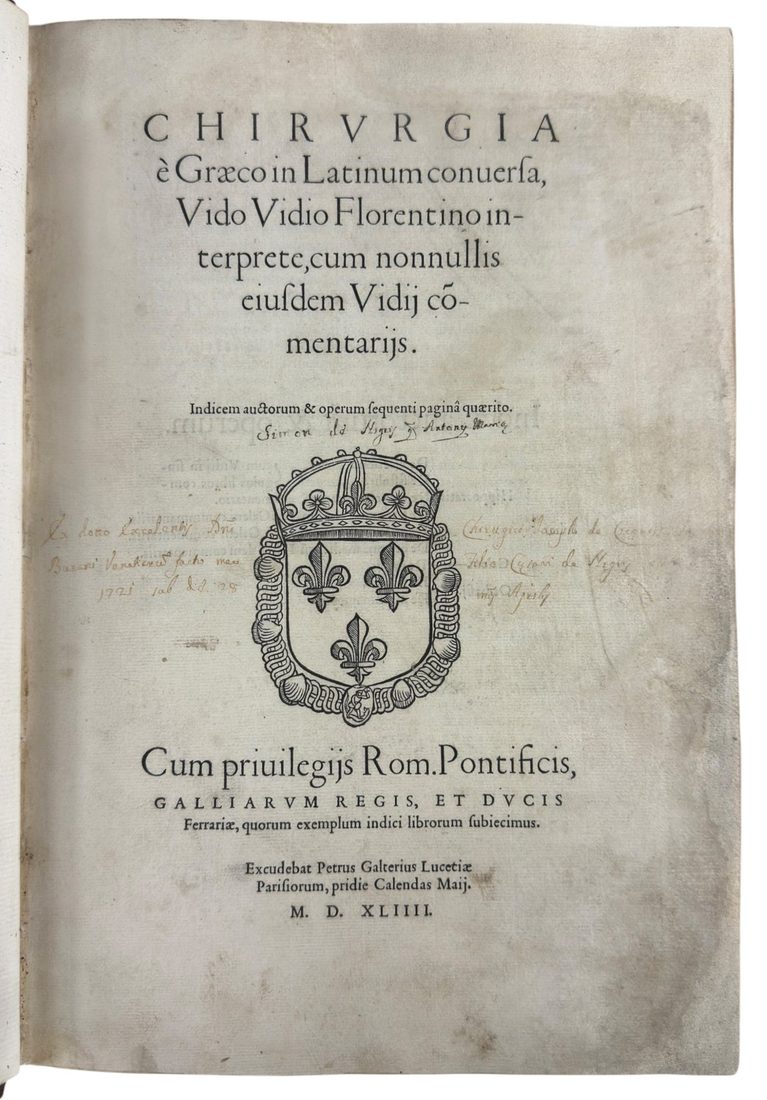
Guidi, Guido (Vidus Vidius). Chirurgia è Graeco in Latinum conversa, Vido Vidio Florentino interprete, cum nonnullis eiusdem Vidii commentariis. Paris, Pierre Gaultier, 1544.
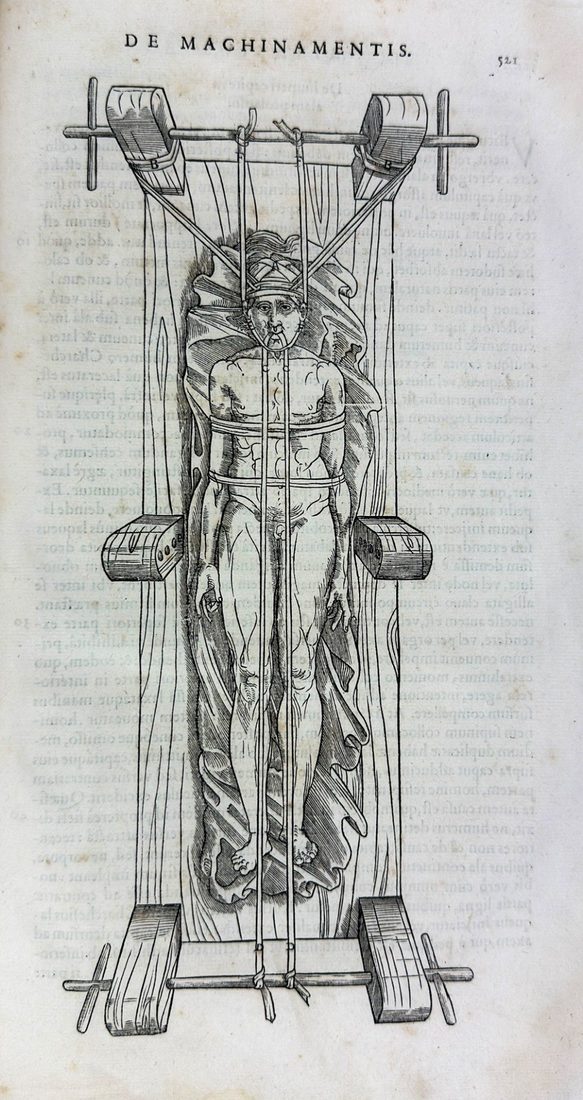
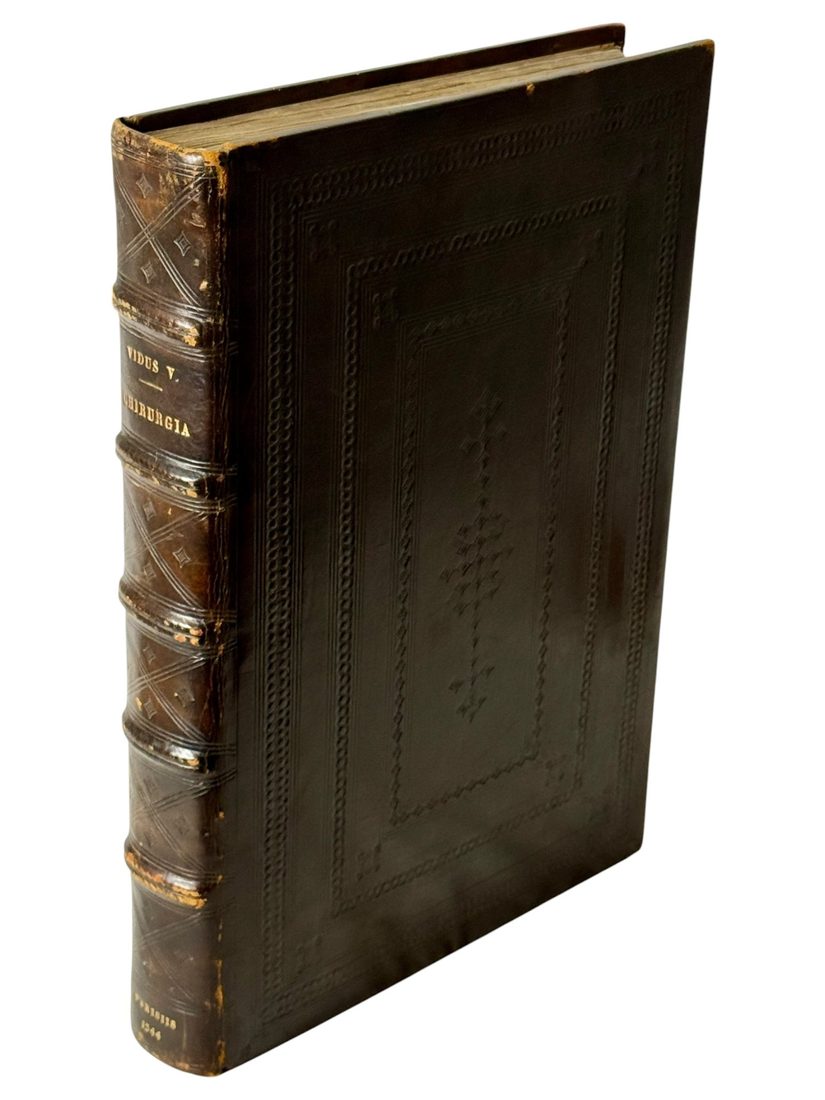
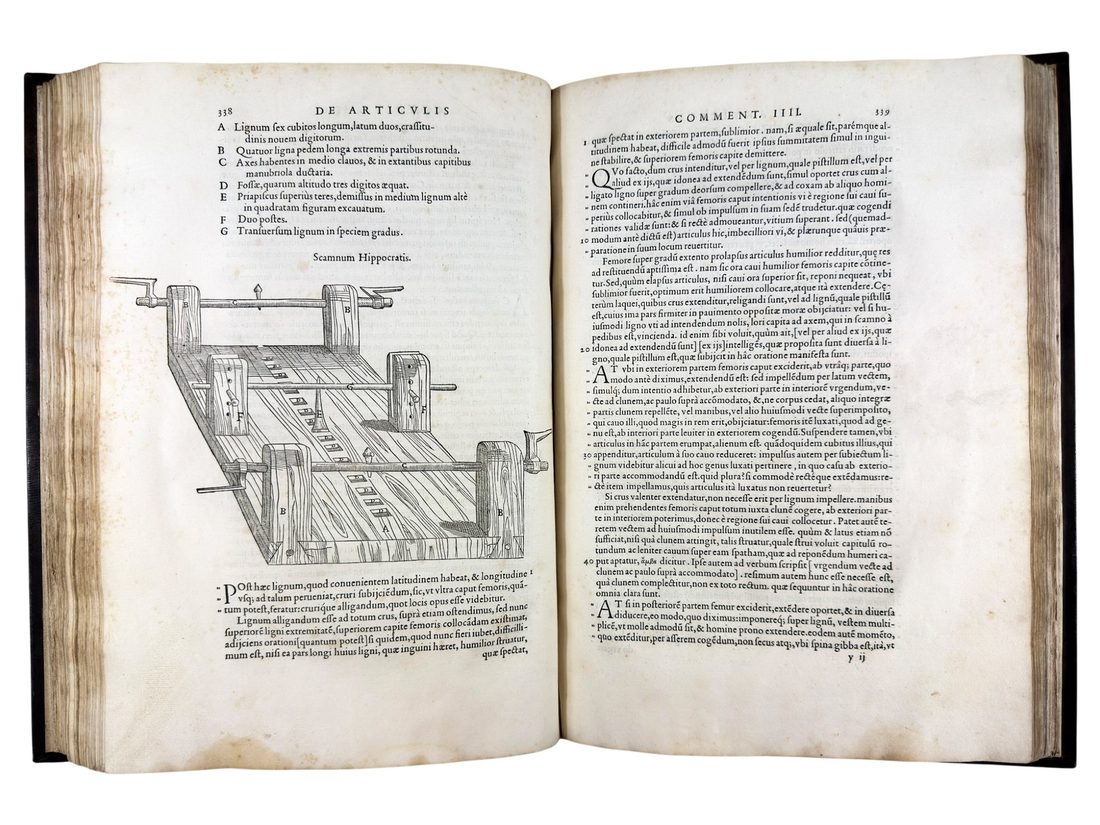
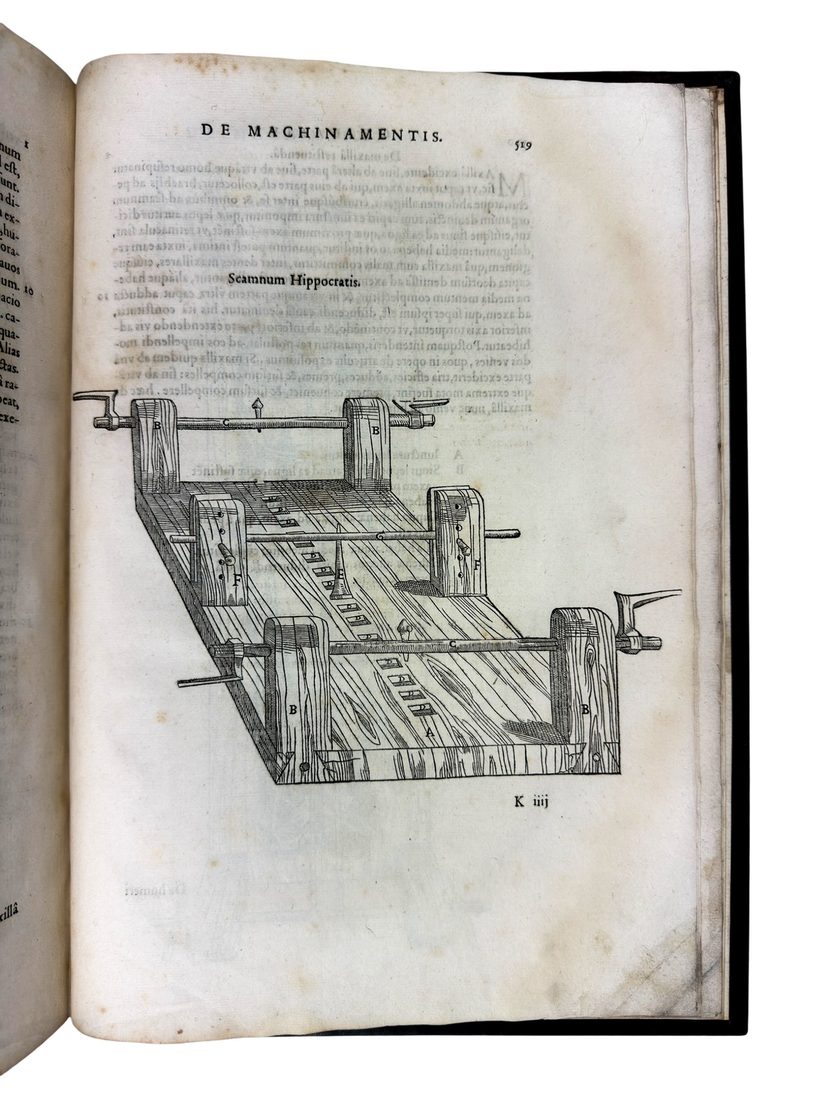
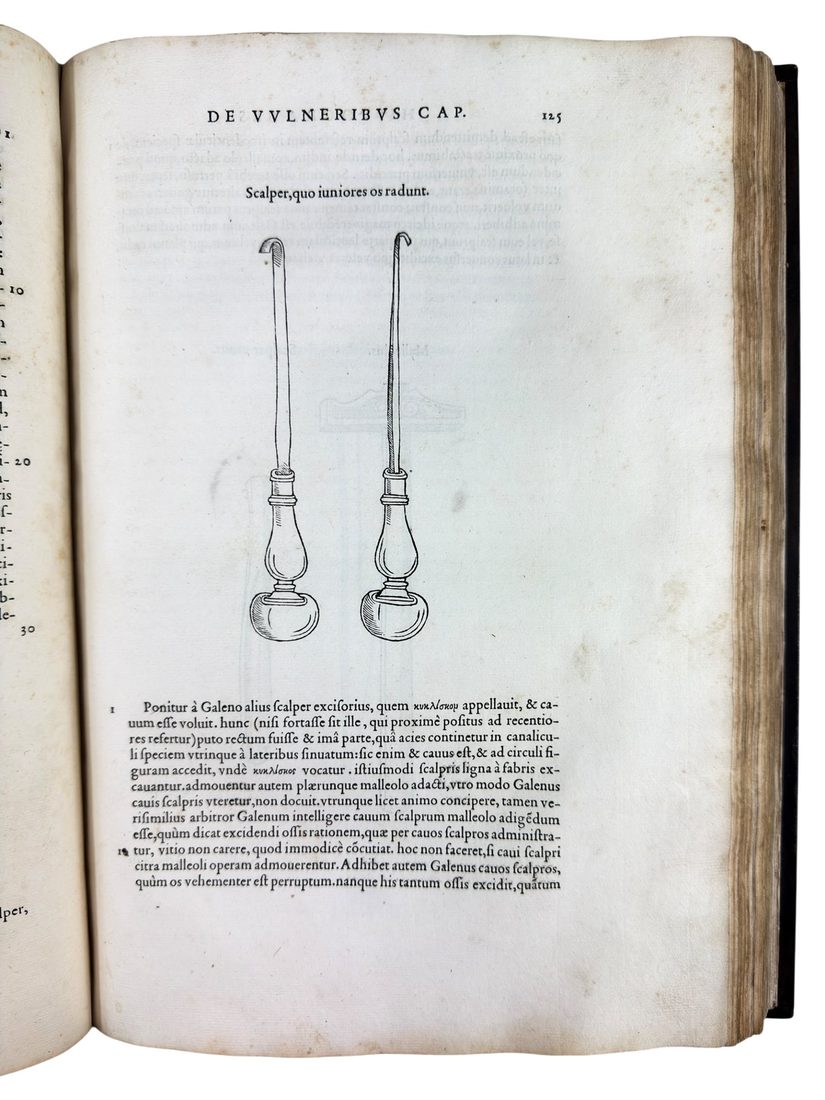
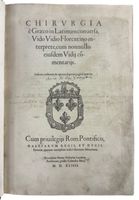
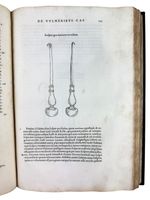
Folio (355 × 241 mm), full italian blind-tooled calf signed “Giuseppe Ferrari BC. Modena”, pp. [36], 533 [1]. Title printed in large Roman capitals with a woodcut of the royal arms of France enclosed within the collar of the Order of Saint‑Michel on the title‑page. The edition is also known with a different title page bearing the printer’s device of Pierre Gaultier; the two versions are generally interpreted as variant states within the same 1544 edition. The text is printed in Roman type with passages in Greek and decorated with ornamental initials. Signature: aa⁸ bb¹⁰; a–z⁸ A–I⁸ K–L⁶. The volume contains 210 woodcut illustrations, including approximately 30 full‑page images showing surgical instruments, orthopaedic apparatus, traction devices, medical procedures, and bandaging techniques.
This work constitutes the first edition of Guido Guidi’s Latin translation and commentary on a collection of Greek surgical texts fundamental to the classical medical tradition. It represents one of the earliest Renaissance efforts to restore the corpus of ancient operative medicine to the Latin scholarly world. The volume brings together surgical writings attributed primarily to Hippocrates, Galen, and Oribasius, preserved in Byzantine manuscript tradition and made accessible to Western physicians through Guidi’s translation and commentary. A distinctive feature of the book is its extensive illustration programme. The woodcuts provide detailed visual explanations of surgical techniques, instruments, and mechanical devices. By combining philological scholarship with practical surgical instruction and visual demonstration, the Chirurgia became one of the most influential surgical books of the sixteenth century and contributed significantly to the revival of classical surgical knowledge in early modern European medicine.
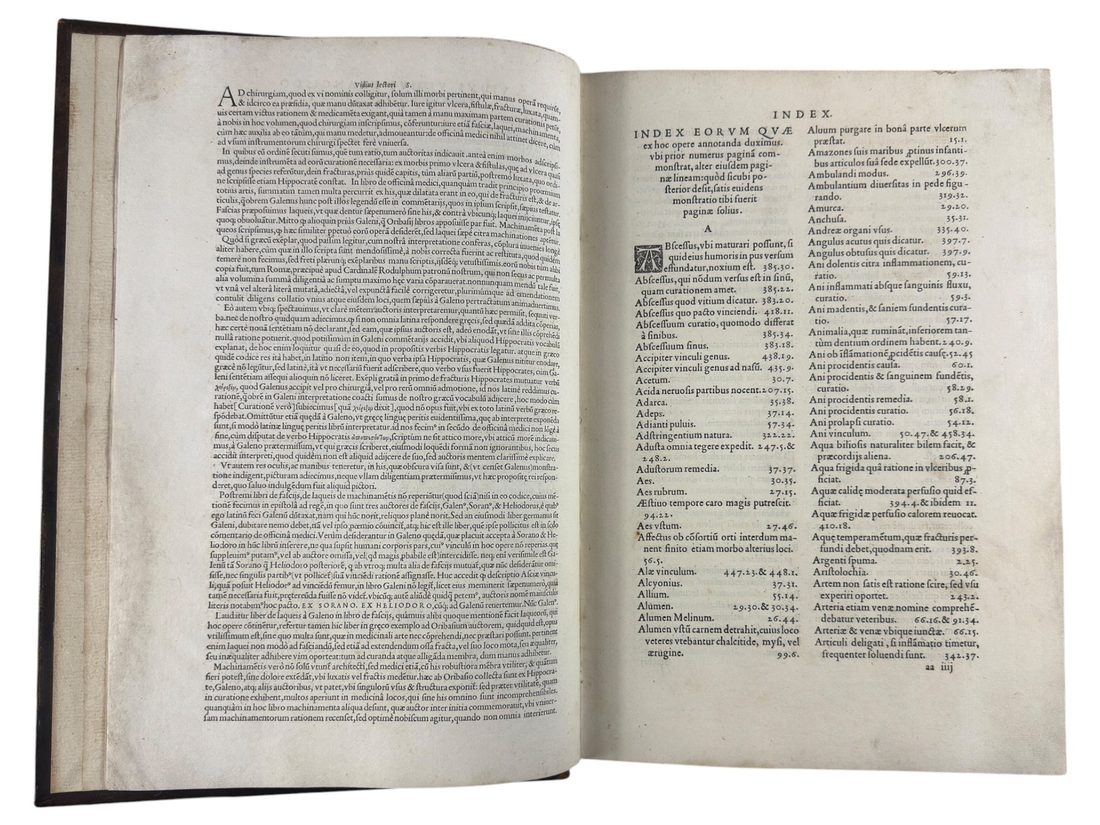
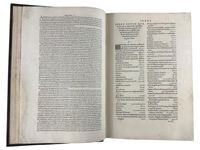
The internal organisation of the work follows the sequence indicated in the Index auctorum & operum, printed among the preliminary leaves. This index identifies the principal Greek authorities translated and commented upon in the volume and serves as a guide to the structure of the surgical corpus assembled by Guidi.
The book begins with a group of surgical treatises attributed to Hippocrates:
- De ulceribus
- De fistulis
- De vulneribus capitis
These texts address the treatment of wounds, ulcers, fistulas, and injuries to the head and form an essential part of the Hippocratic surgical tradition.
The Hippocratic material is followed by two major treatises dealing with fractures and joint injuries:
- De fracturis
- De articulis
Both texts are accompanied by detailed commentaries by Galen, three on the first and four on the second. In these commentaries Galen analyses the causes of fractures and dislocations and explains the mechanical principles used to treat them.
Another Hippocratic text, De officina medici, concludes this section. It describes the organisation of the medical workshop and discusses the instruments and procedures required for surgical practice.
The volume also incorporates works by later Greek medical writers:
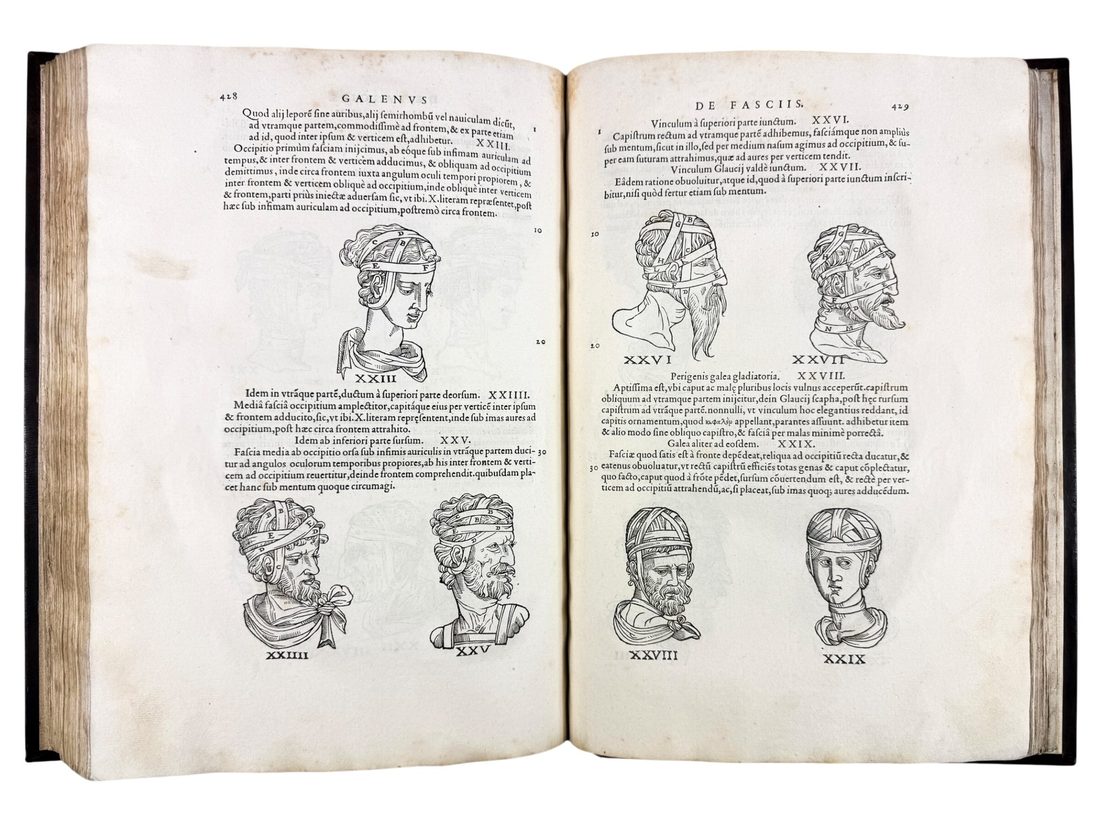
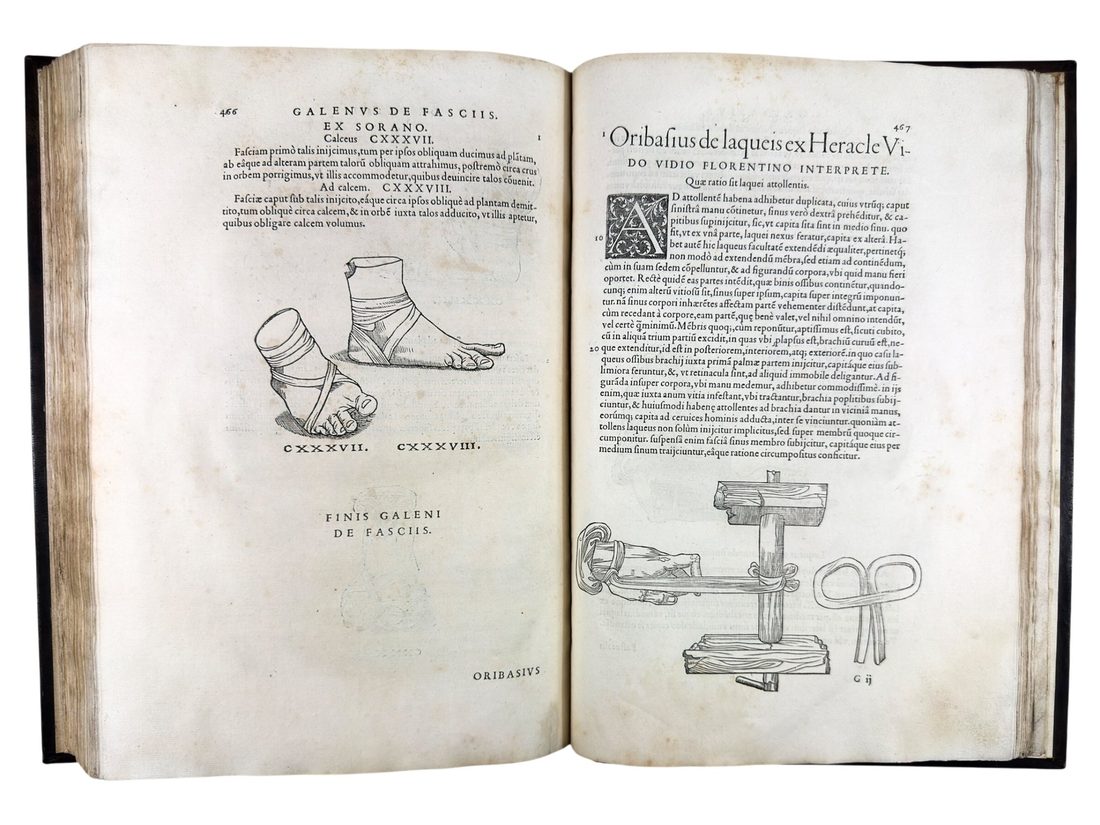
- Galen’s De fasciis, devoted to the theory and practice of surgical bandaging
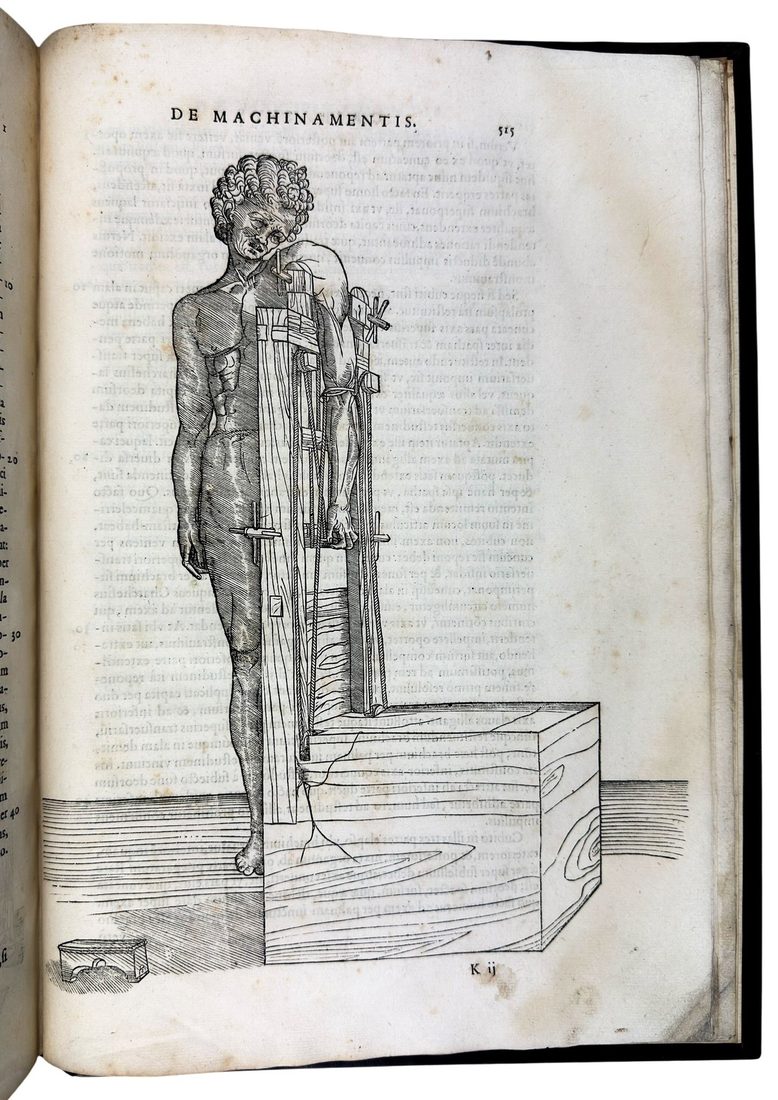
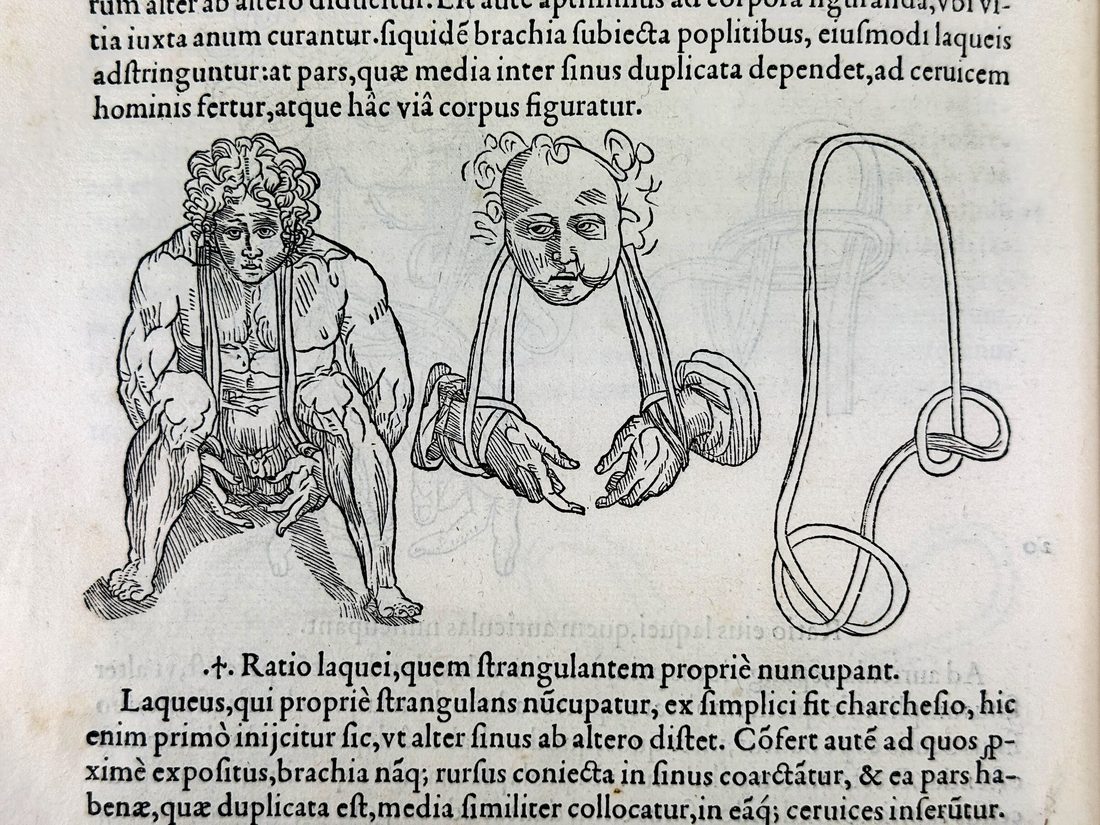
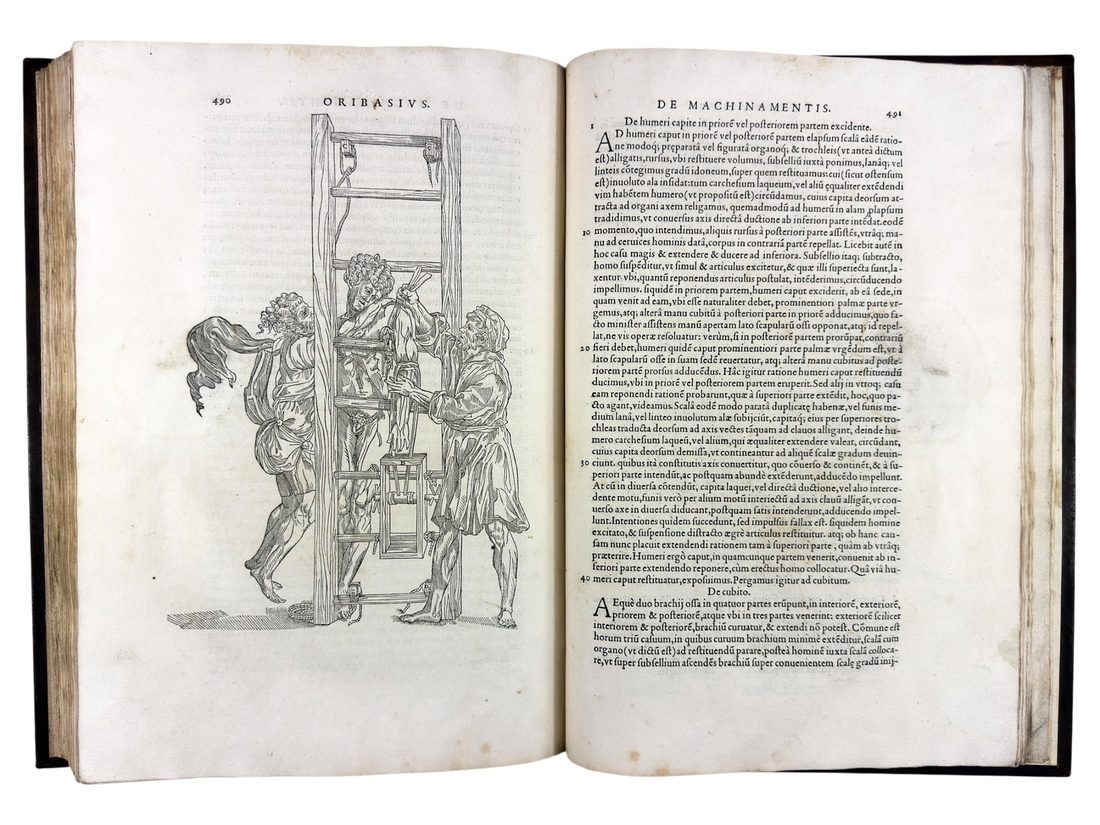
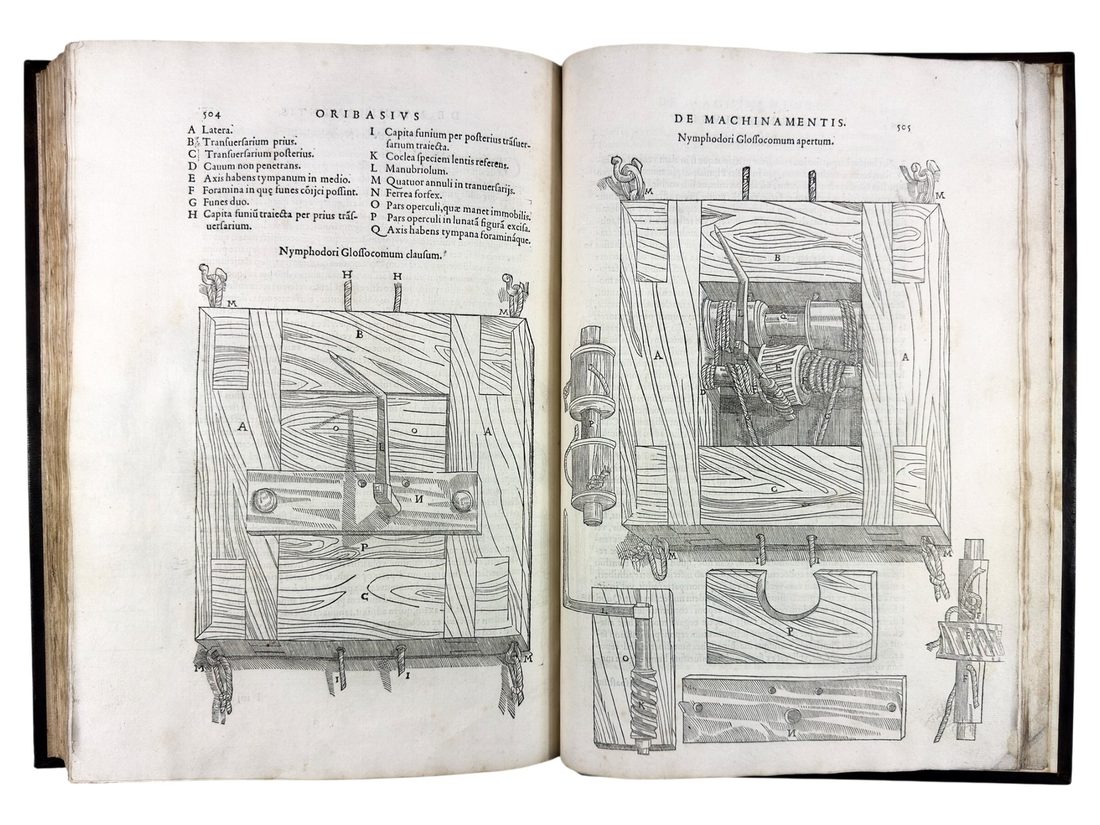
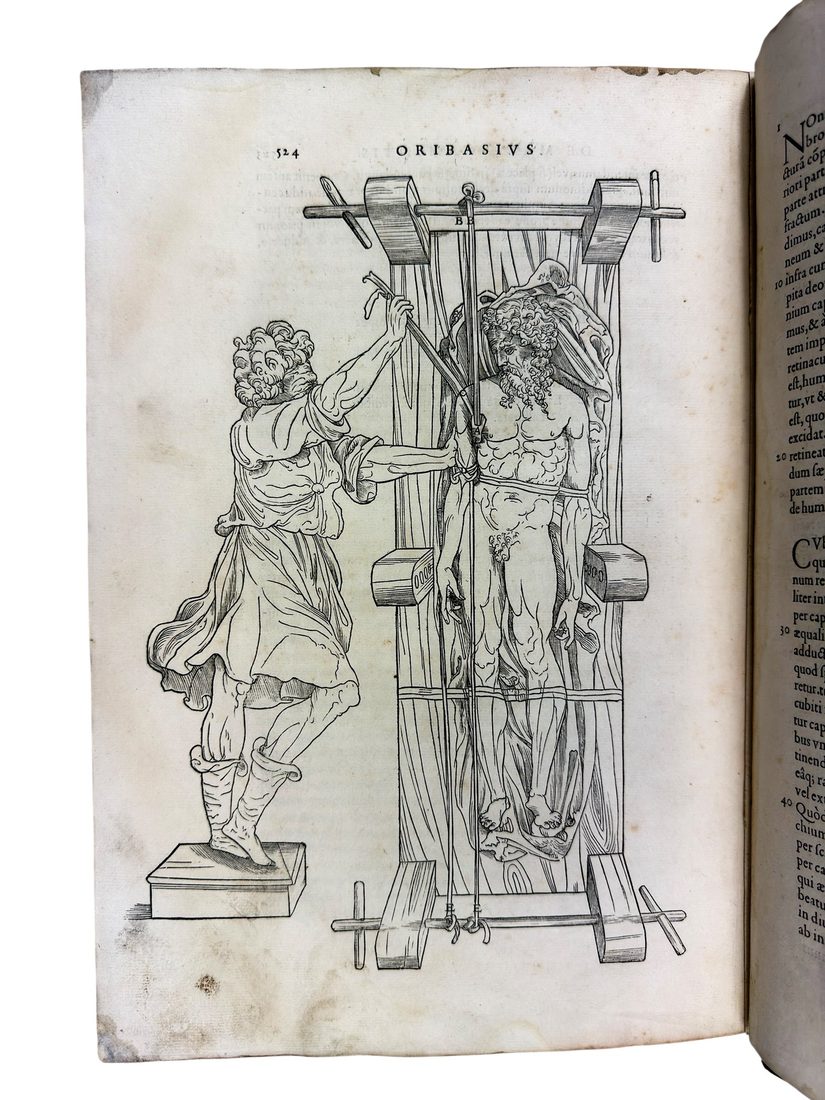
- Oribasius’ De laqueis and De machinamentis, which describe mechanical devices used in the treatment of fractures and dislocations
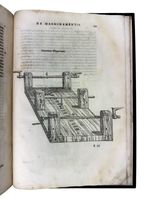
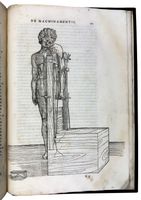
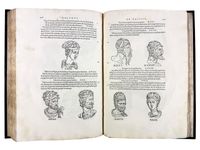
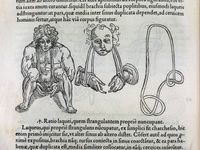
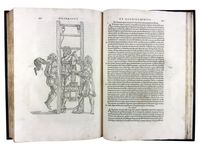
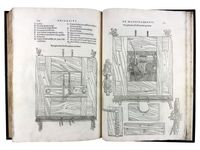
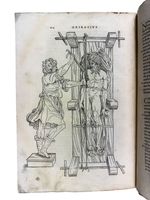
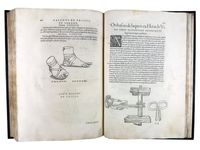
The illustrations play a central role in explaining these texts. Among the most striking images are those accompanying the chapters of De machinamentis. They depict elaborate traction machines in which the patient is suspended within a wooden framework while assistants apply controlled tension through ropes and pulleys in order to realign bones or correct spinal deformities. Other illustrations accompany Galen’s De fasciis, showing heads and limbs wrapped with different types of bandages and demonstrating the correct direction and tension of each wrapping technique. These figures constitute one of the earliest visual guides to surgical bandaging. Additional plates illustrate procedures for reducing dislocated joints and correcting spinal curvature, frequently showing assistants applying traction to the patient’s body. Through these images the work transforms the ancient textual tradition of surgery into a practical visual manual.
“One year after the publication of Vesalius’s book on anatomy, Guido Guidi (1500–1569), an Italian physician practicing in Paris, made an outstanding contribution to the literature of surgery… “ (Lefanu).
“One the most beautiful science book of the Renaiccence with woodcut illustrations [that] have never been equalled in this field” (Norman).
The Chirurgia must be understood within the broader Renaissance movement devoted to recovering the original Greek texts of ancient science and medicine. From the late fifteenth century onward, humanist scholars and physicians actively sought Greek manuscripts that had survived primarily through Byzantine transmission. Among the figures involved in this scholarly movement was Janus Lascaris, whose activities were instrumental in bringing Greek texts to Italy and making them accessible to Western scholars.
The textual and visual materials employed by Guidi ultimately derive from a tenth-century illustrated Greek surgical manuscript traditionally associated with the Byzantine physician Nicetas. Now preserved in the Biblioteca Medicea Laurenziana in Florence, this manuscript represents the earliest surviving illustrated surgical codex. Its images and technical descriptions transmit a surgical tradition that ultimately reaches back to Hellenistic medical practice and proved fundamental to the Renaissance recovery of ancient operative techniques.
Guidi’s work therefore represents more than a translation. It forms part of a broader intellectual effort to recover ancient medical knowledge through philological study of Greek sources. The Paris edition of 1544 marks the culmination of a long process of transmission linking classical Greek medicine, Byzantine manuscript culture, and Renaissance humanist scholarship.
The cultural environment of the French court played a decisive role in the production of the work. Francis I actively encouraged the importation of Italian scholars, artists, and physicians in order to promote humanist learning in France. Guidi served the king as physician and was appointed professor of medicine at the newly founded Collège Royal, later the Collège de France, where scholarship, artistic production, and scientific inquiry developed within a context of royal patronage.
The publication of the Chirurgia belongs to the broader transformation of medicine during the sixteenth century. While Vesalius’s De humani corporis fabrica (1543) advanced anatomical knowledge through direct observation, Guidi’s work revived the operative techniques preserved in classical Greek sources and presented them in a systematic and visually intelligible form. The book thus contributed significantly to the renewal of surgical practice grounded in the authority of ancient medical literature.
The illustrations of the Chirurgia are generally associated with the artistic environment of the School of Fontainebleau, which flourished at the court of Francis I. Earlier scholars attributed the drawings to the Italian artist Francesco Primaticcio, while more recent research suggests that they were probably produced within the circle of Francesco Salviati, whose style influenced many artists working at the French court.
Regardless of their precise attribution, the drawings originated in a sophisticated artistic milieu and were subsequently translated into woodcuts for the printed edition. Their clarity and technical precision made them highly influential. Ambroise Paré reused several of these images in his own surgical writings, and comparable visual models appeared in the surgical illustrations associated with Charles Estienne. This later diffusion confirms the authority and importance of the visual programme created for Guidi’s work.
Guido Guidi (1509–1569), known in Latin as Vidus Vidius, was a Florentine physician and medical humanist of the sixteenth century. Invited to France by Francis I, he served as royal physician and became professor of medicine at the newly founded Collège Royal (later the Collège de France). During his years in Paris he prepared the Latin translation of an illustrated Greek surgical manuscript that formed the basis of the Chirurgia, the work upon which his reputation chiefly rests. After returning to Italy he continued his academic career and was appointed professor of philosophy and medicine at the University of Pisa. Guidi also contributed to anatomical research, describing structures later known as the Vidian nerve, Vidian canal, and Vidian artery, elements of the neurovascular system of the pterygoid canal in the sphenoid bone. Although only a small number of his works were printed during his lifetime, the Chirurgia remains the principal expression of his scholarly activity and secured his place in the history of Renaissance surgery.
Conditions: Ancient restoration at right margins of few opening leaves. Light marks of use and few watermarks along the text. The illustrated leaves appear generally clean and well preserved. Overall, a good copy of a rare and important first edition.
Provenance: 1. Presentation handwritten inscription at title page Ex dono eccellentissimo domini Chirugico Josephi de Creoneis Burani facto meo Filio Caesaris de Nigris anno 1721 sub Die 28 mensis Aprilis (“Given by the most excellent Mr. Giuseppe de Creoni, surgeon, at Burano, to my son Cesare de Nigris, on 28 April 1731.”. 2. Ex libris blindtooled stamp at title page.
References: W. R. Lefanu, Notable Medical Books from the Lilly Library Indiana University, Bloomington: Indiana University Press, 1976, pp. 30–31; J. M. Norman, The Haskell F. Norman Library of Science & Medicine, San Francisco: Jeremy Norman & Co., Inc., 1991, vol. I, p. 346, no. 954; Christie’s, The Haskell F. Norman Library of Science and Medicine. Part I: The Middle Ages and the Renaissance, New York: Christie’s, 18 March 1998, p. 148, no. 143; Heirs of Hippocrates, no. 263; Wellcome, A Catalogue of Printed Books in the Wellcome Historical Medical Library, London: Wellcome Institute for the History of Medicine, 1962–2006, vol. I, no. 6596; L. Choulant, History and Bibliography of Anatomic Illustration, New York: Hafner, 1945, pp. 211–212; B. Dibner, Heralds of Science, Norwalk: Burndy Library, 1955, no. 118; R. J. Durling, A Catalogue of Sixteenth Century Printed Books in the National Library of Medicine, Bethesda: National Library of Medicine, 1967, p. 267, no. 2204; H. Cushing, Bio-Bibliography of Andreas Vesalius, New York: Schuman, 1943, no. G445; W. Osler, Bibliotheca Osleriana, Oxford: Clarendon Press, 1929, no. 155; R. B. Mortimer, French Sixteenth Century Books, Cambridge: Harvard College Library, 1964, no. 542.