Viennese Pattern Deck
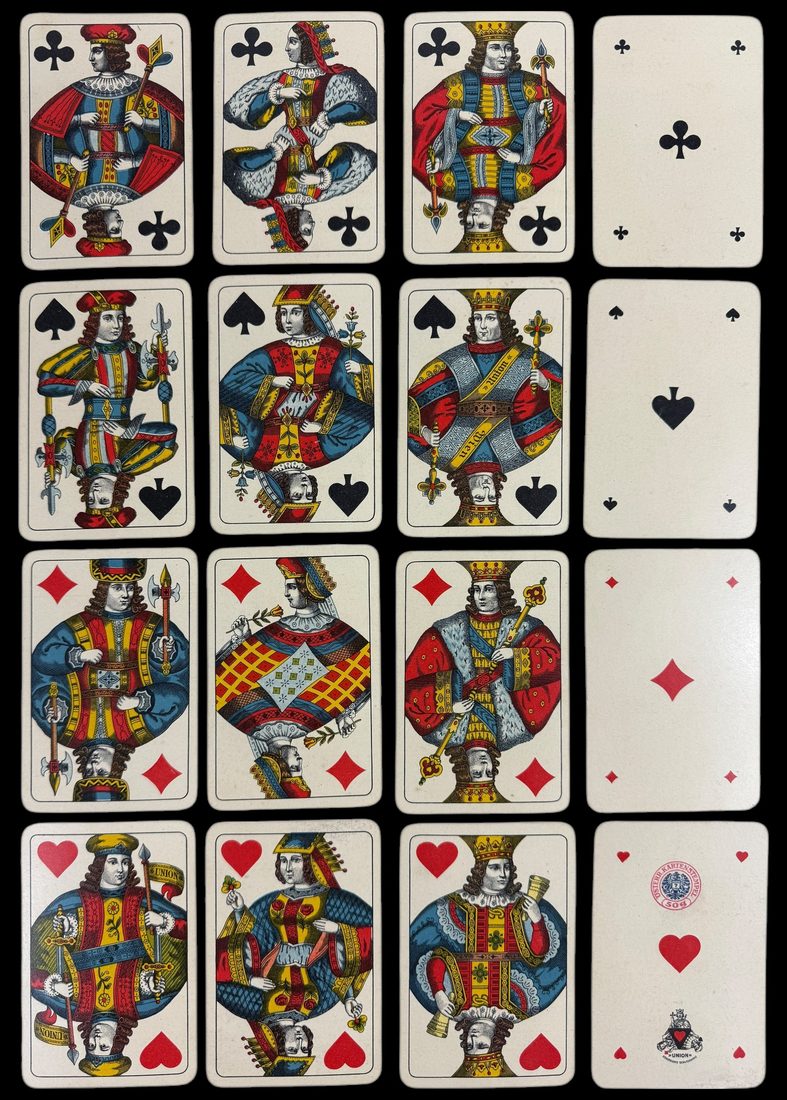
| Macro-category | Playing Cards and Tarot |
| Subcategory | Historical Playing Cards |
| Author | Anonymous |
| Year | 1930 |
Early 20th century Austrian Deck:
the “Later Vienna Pattern E”
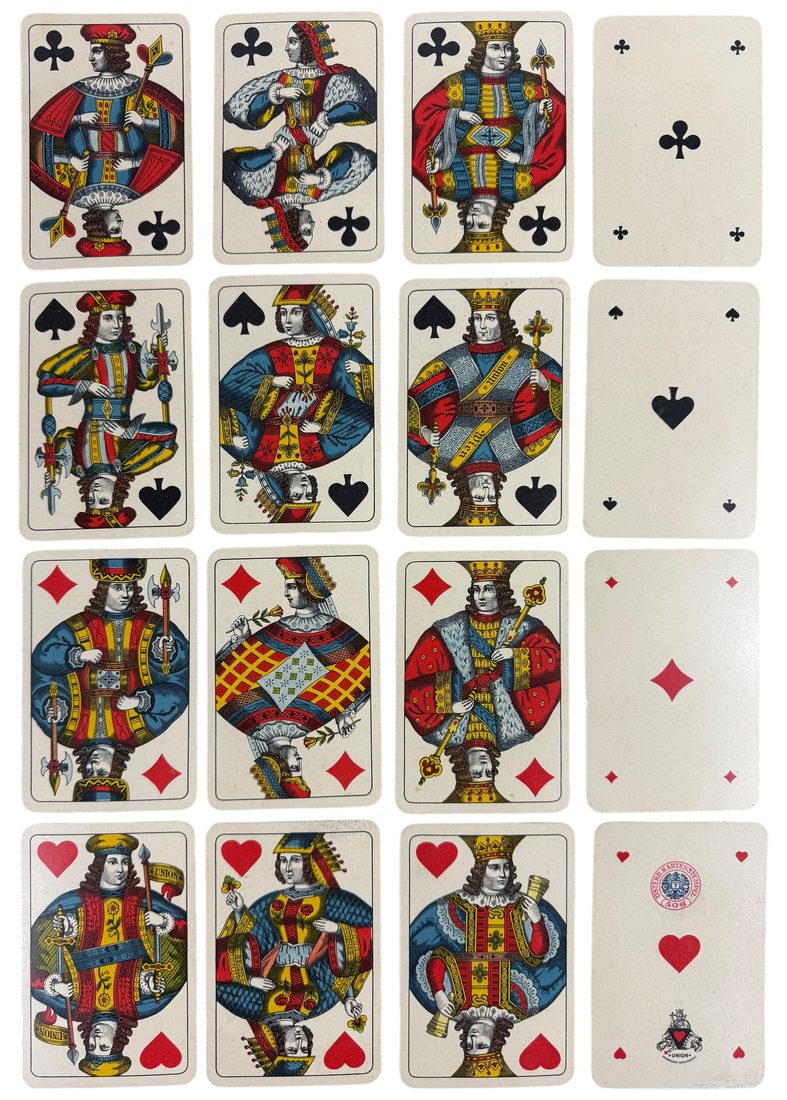
Playing Cards. Vienna Later Pattern Type E. Vienna, Union, 1930.
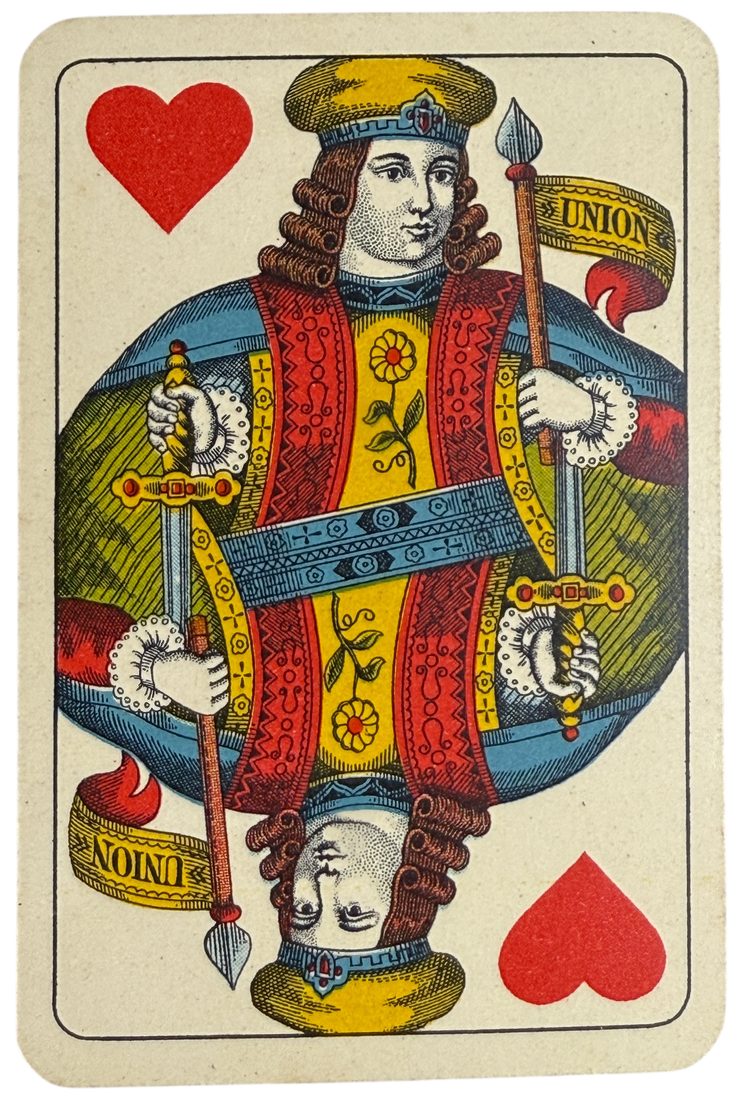
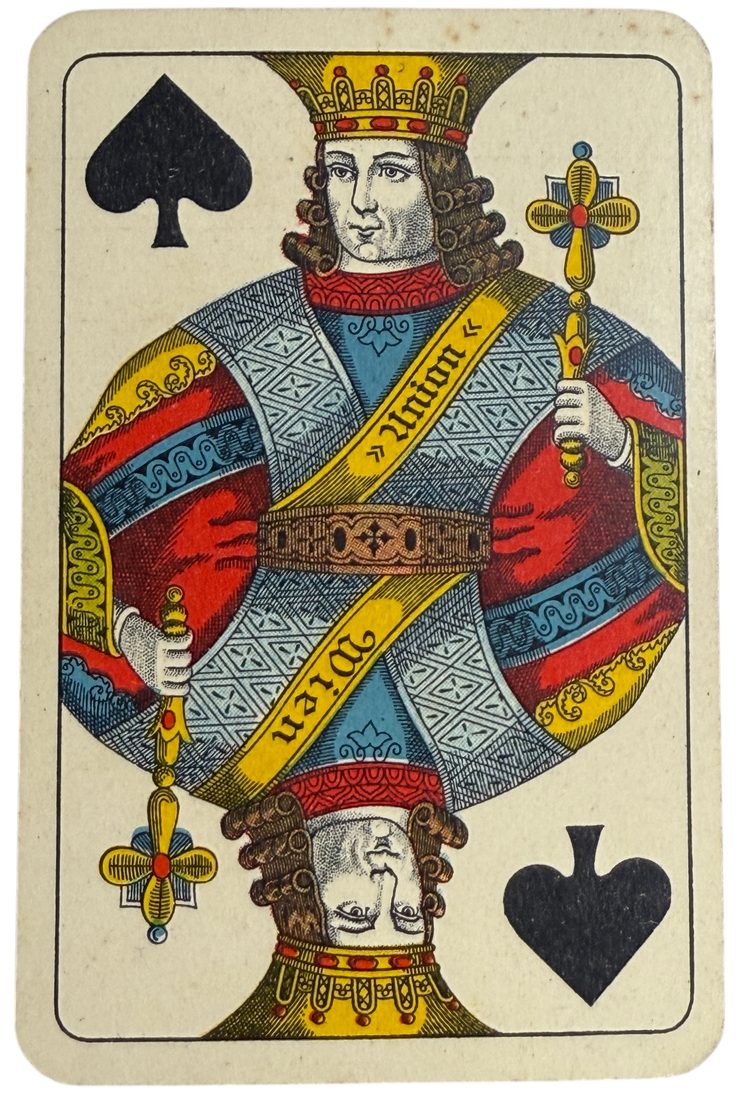
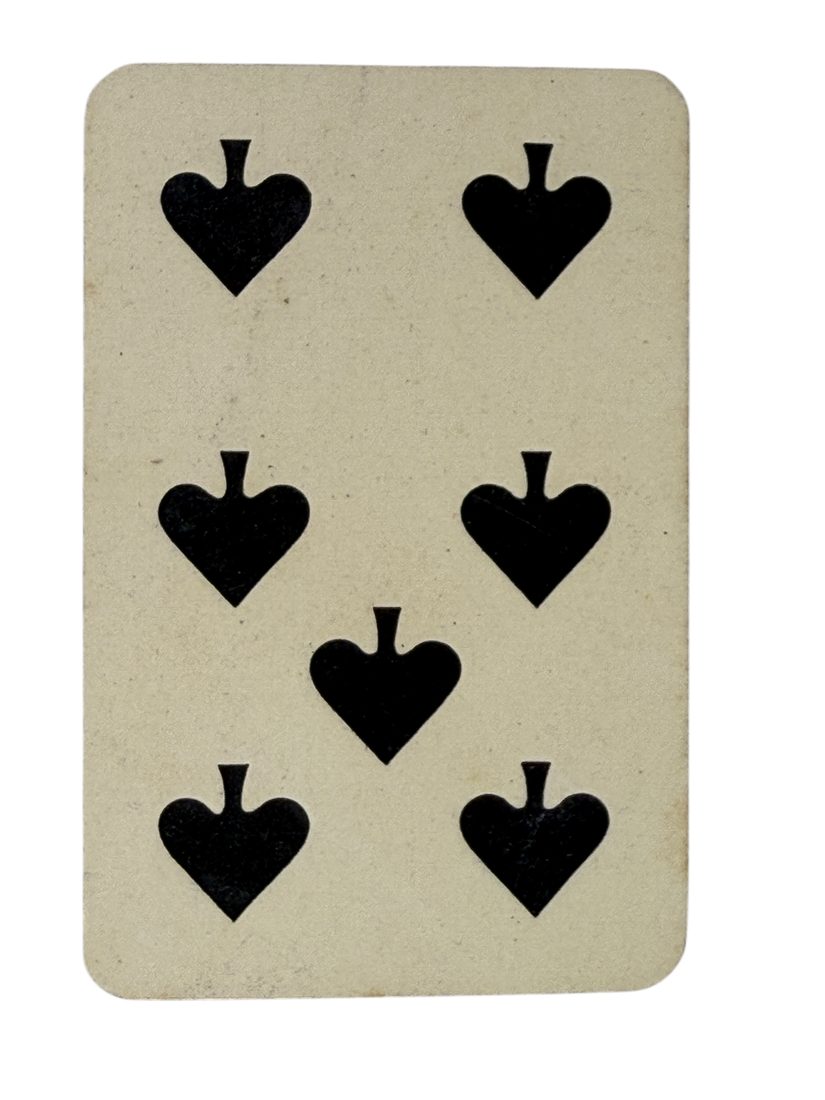
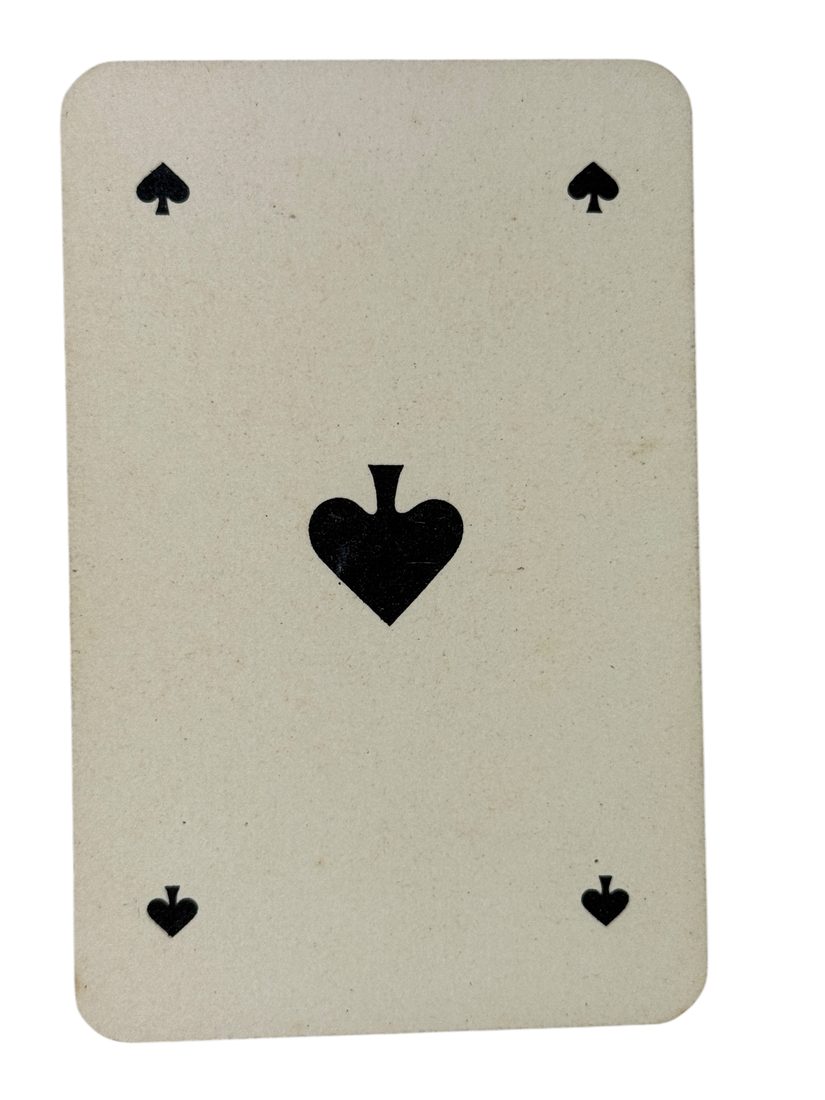
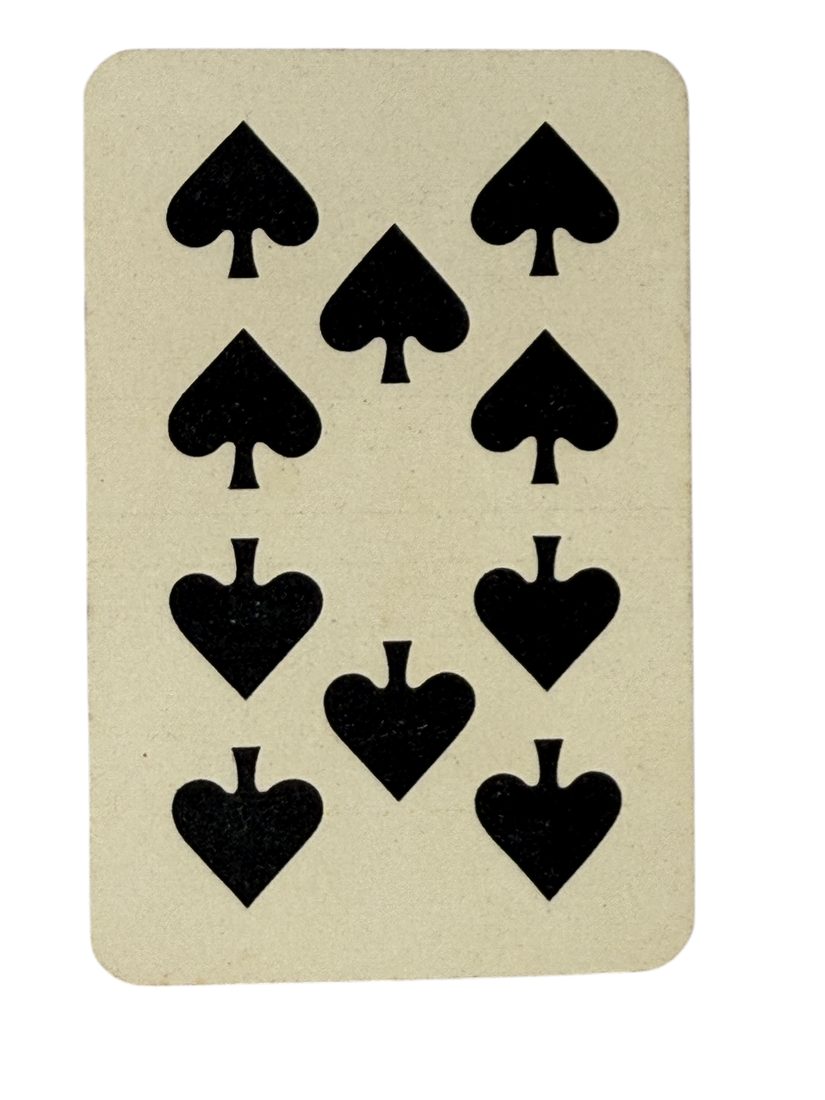
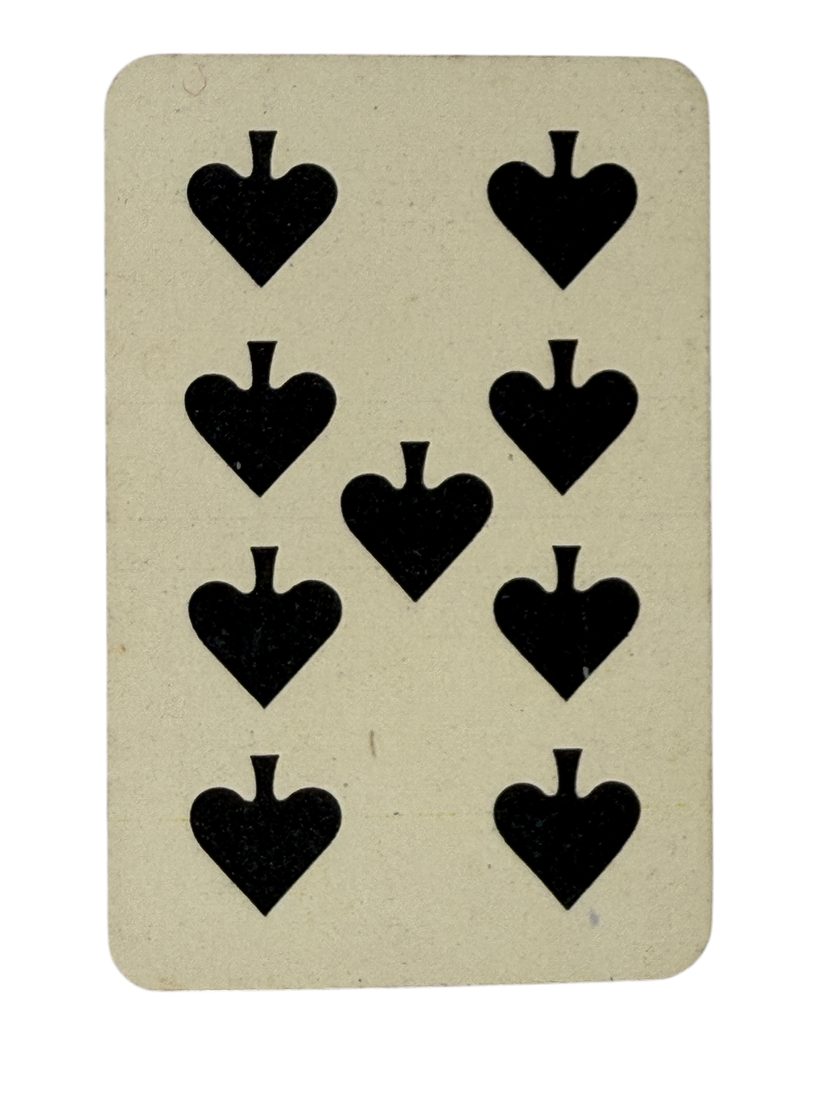
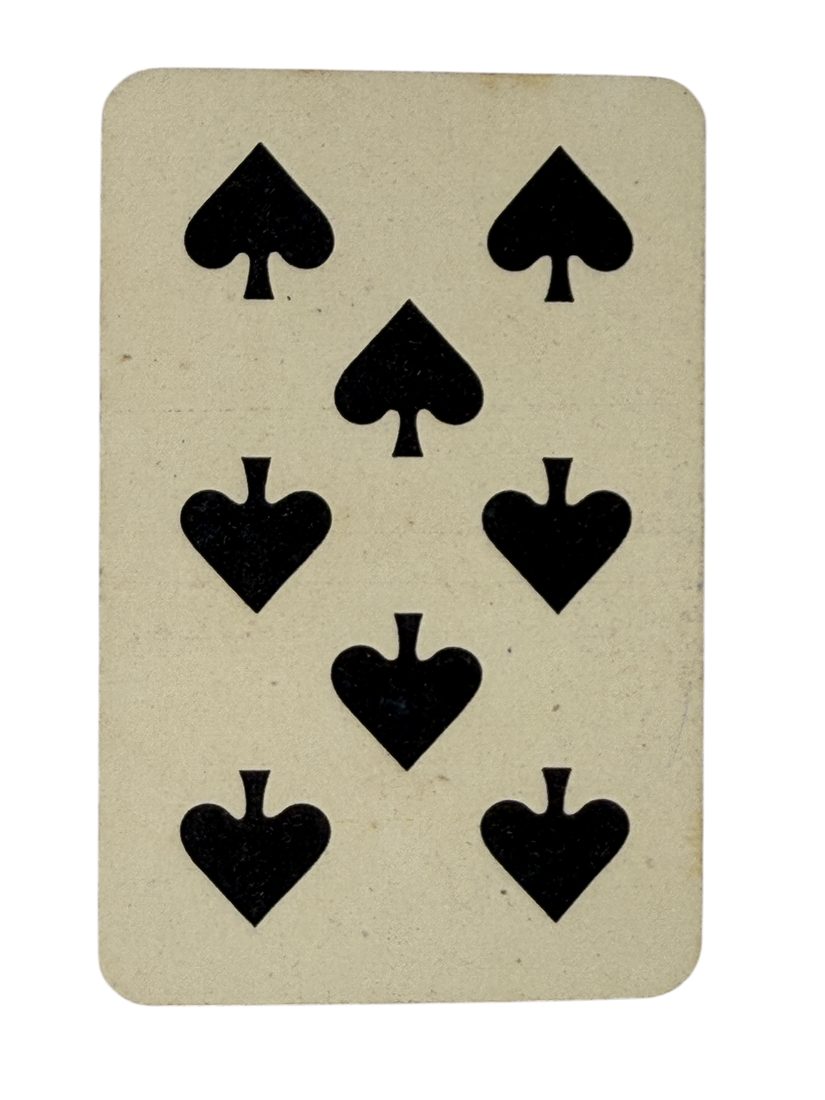
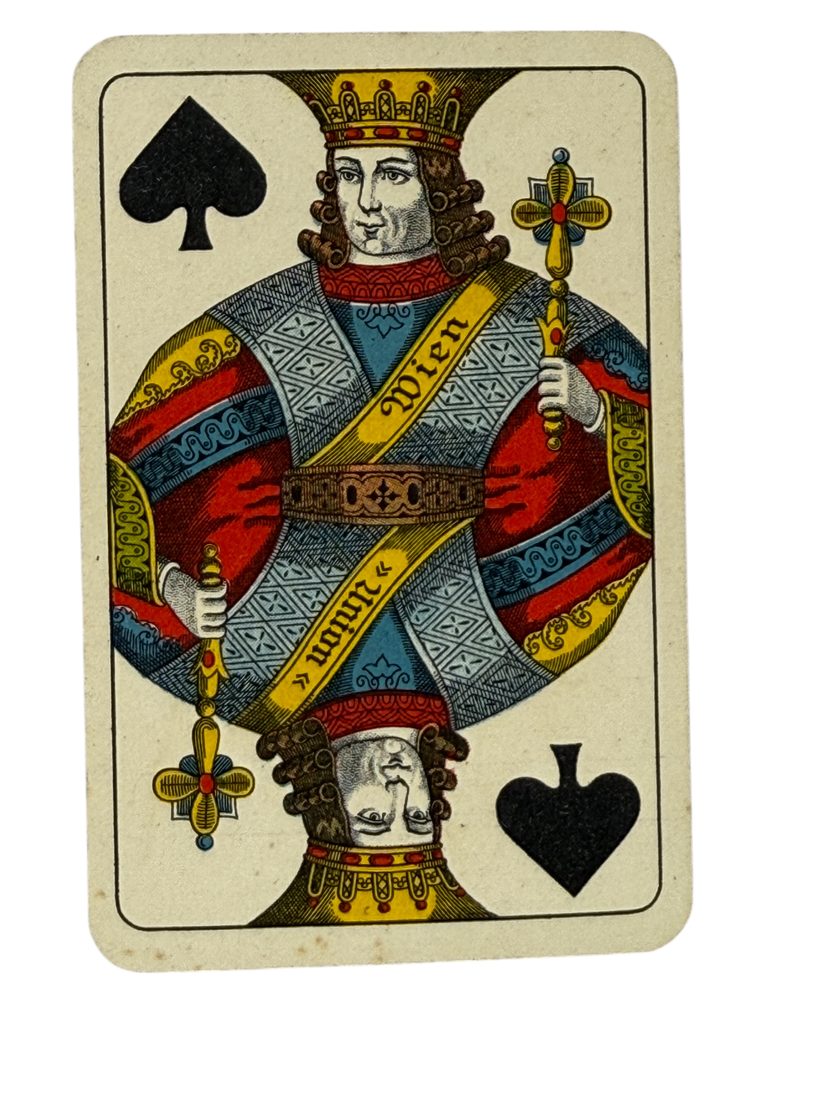
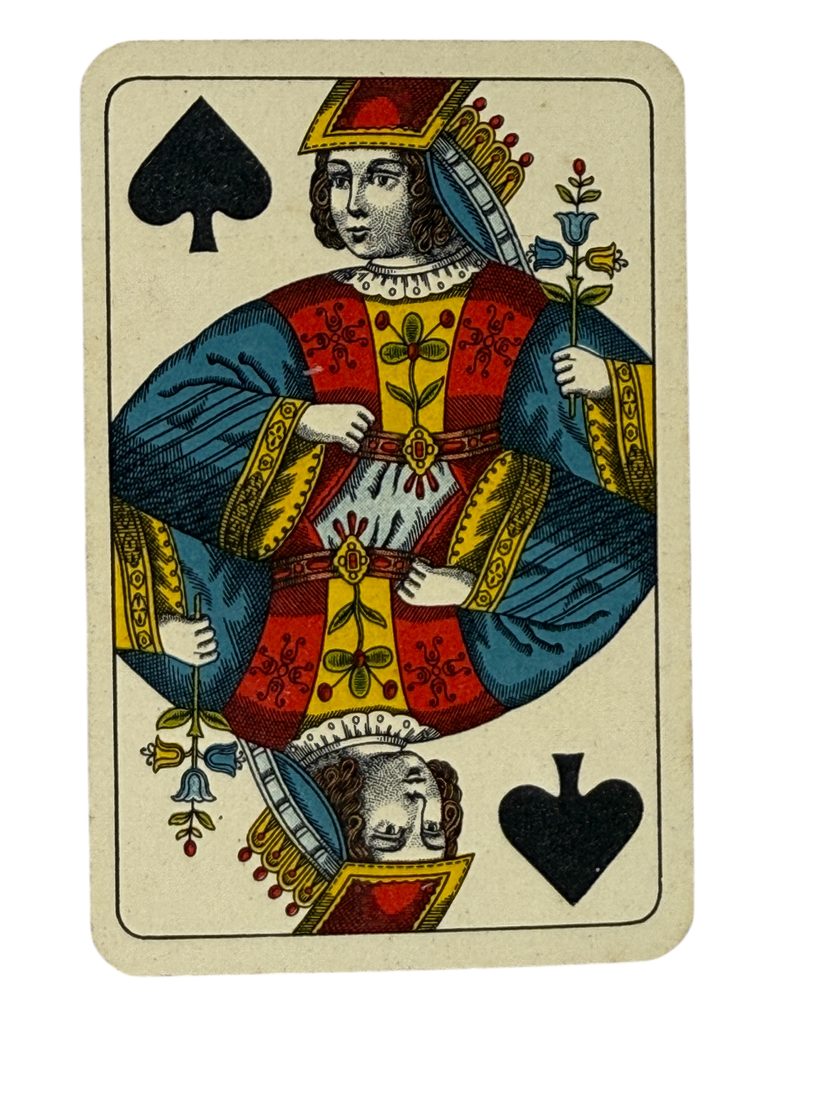
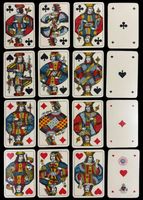
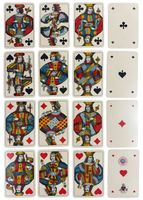
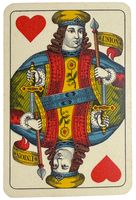
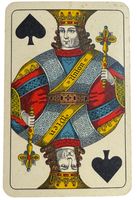
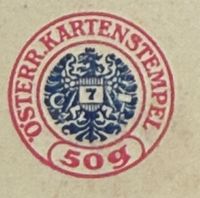
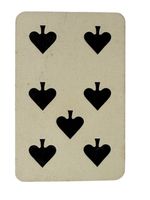
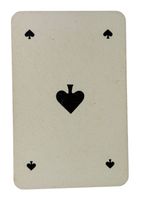
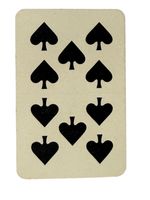
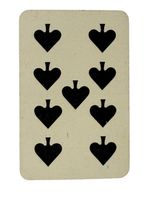
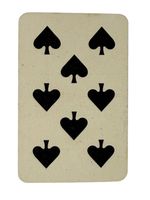
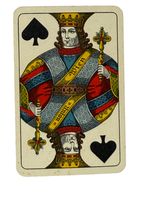
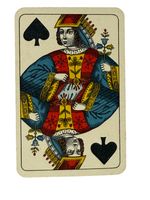
Complete deck (100 x 64 mm), comprising 32 chromolithography playing cards arranged in four suits of 8 cards each, consisting of Ace, Queen, and King, plus the pip cards from 7 to 10 for the game of Piquet; the court cards are double-ended without a central dividing line, featuring the characteristic truncated crowns and distinctive Viennese design elements. The Ace of Hearts bears the tax stamp and the printer’s mark “Union”; the King of Spades displays a sash inscribed “Wien” and “Union”; the Jack of Hearts holds a flag bearing the word “Union.” The reverse of the cards features a black and red pattern decoration.
This deck constitutes a representative example of the Vienna Pattern Type E with the enhanced design of the early 20th century.
Its principal iconographic traits include:
- Kings crowned with large headgear truncated at the card’s upper edge; three of the Kings hold scepters while the King of Hearts bears a scroll (often mistaken for a fan at first glance).
- Queens predominantly presented full-faced, except for the Jack-and-Queen of Clubs and Queen of Diamonds shown in profile. They hold flowers or, in the case of the Queen of Clubs, a leaf or fan.
- Jacks wearing caps (Spades and Diamonds sport a flap), each armed with various weapons such as halberds, lances with pennants naming the place of manufacture, or batons.
- Manufacturer’s name typically appears on a sash held by the King of Spades.
The style is geometric and symmetrical, fully double-ended, in keeping with the Viennese tradition that emerged in the mid-19th century. The coloration is vibrant yet precise, reflecting the refined steel-engraving and lithographic methods established in Austrian playing-card production at the time.
By the late 18th century, the Habsburg Empire—centered in Austria—had become a prolific region for the manufacturing of playing cards. Beginning around 1784, figures like Aloys and Johann Norbert Hofmann introduced large-scale production in Vienna. They popularized a variation of the portrait d’Allemagne (IPCS #62), distinguished by court figures filling most of the card space and showcasing crowns truncated at the edges.
In the mid-19th century, Viennese engravers such as Josef Sürch, Josef Neumayer, and Johann Wenzel Zinke refined these designs into what are known as Vienna patterns. The “Type A” (IPCS #107) evolved with standardized imagery, while Zinke’s more naturalistic approach (1857) and subsequent work by Sürch in the 1860s led to an updated suite of patterns collectively labeled “Type E.” Steel engraving, introduced around the 1850s, greatly influenced the crisp lines and detailed ornamentation of these decks.
By 1890, when this deck was produced in Ganz (by Ferdinand Pittner), the Viennese playing-card tradition was flourishing. The city’s card makers regularly included on their designs personal banners, sashes, or pennants naming the manufacturer—an early form of branding. The aesthetic remained popular for over a century, further influenced in the early 20th century by Jugendstil (Art Nouveau), yet always retaining the essential Viennese court arrangement.
The proliferation of such decks speaks to the significant role playing cards occupied in social leisure, both in aristocratic circles and the burgeoning middle class. Vienna, renowned for its cultural production in music, art, and literature, also became a hub for the printing and export of finely engraved playing cards.
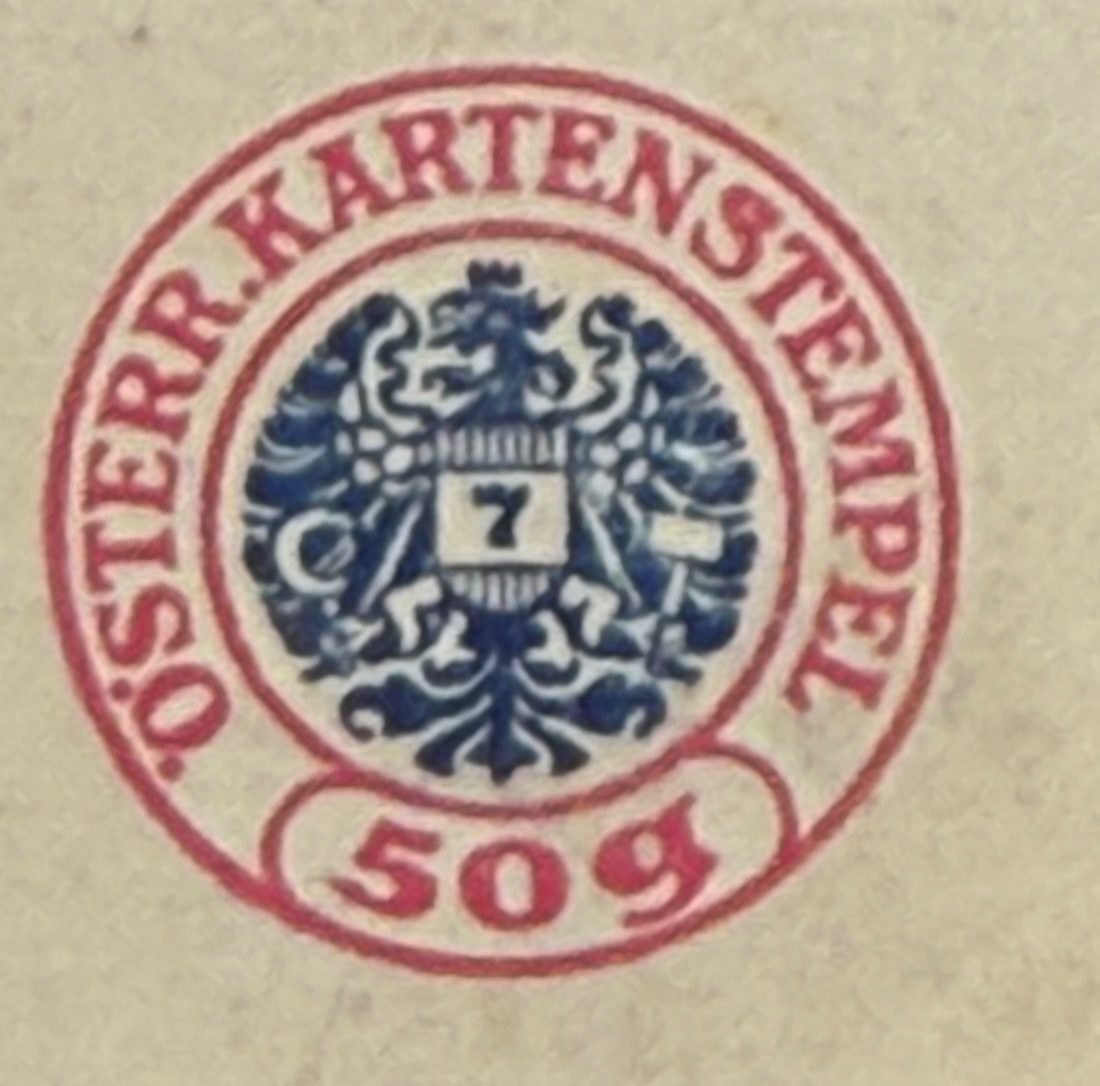
Provenance: Tax stamp on the Ace of Hearts: this stamp was in use in Austria from 1920 to 1934. The text is “Österr. Kartenstempel,” the eagle has a sickle and a hammer in its claws, and the value is in Groschen (“g”) or Schilling (“S”). The value of 50 Groschen applies to a deck of up to 36 cards, neither lacquered nor washable.
Conditions: Unused.
References: K. Reisinger, Von Lyon nach Wien, Die Entstehung des Wiener Bildes, Wien 2000; Kathleen Wowk, Playing Cards of the World, Lutterworth press, 1983, pp. 58-59; Sylvia Mann, Collecting Playing Cards, Arco, pp. 96-108; Sylvia Mann, All cards on the table, Verlag, 1980, no. 161-163.