Portuguese Pattern Deck

| Macro-category | Playing Cards and Tarot |
| Subcategory | Historical Playing Cards |
| Author | Anonymous |
| Year | 1875 |
complete hand painted deck printed in Belgium for the Brazilian market:
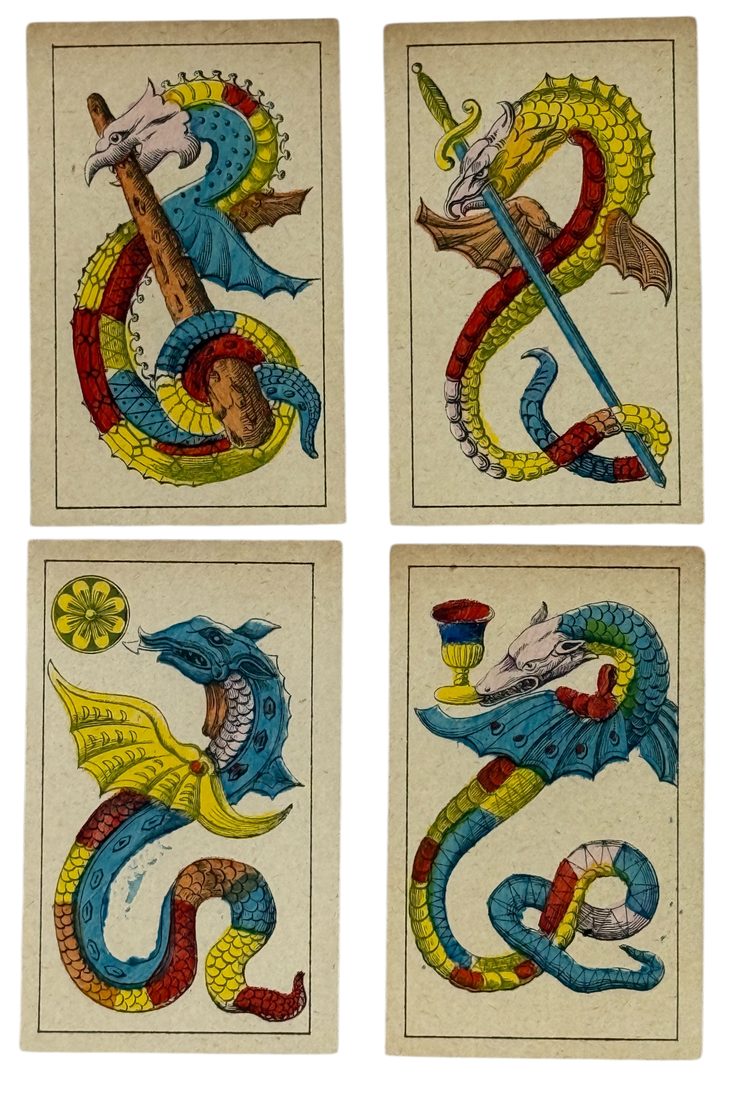
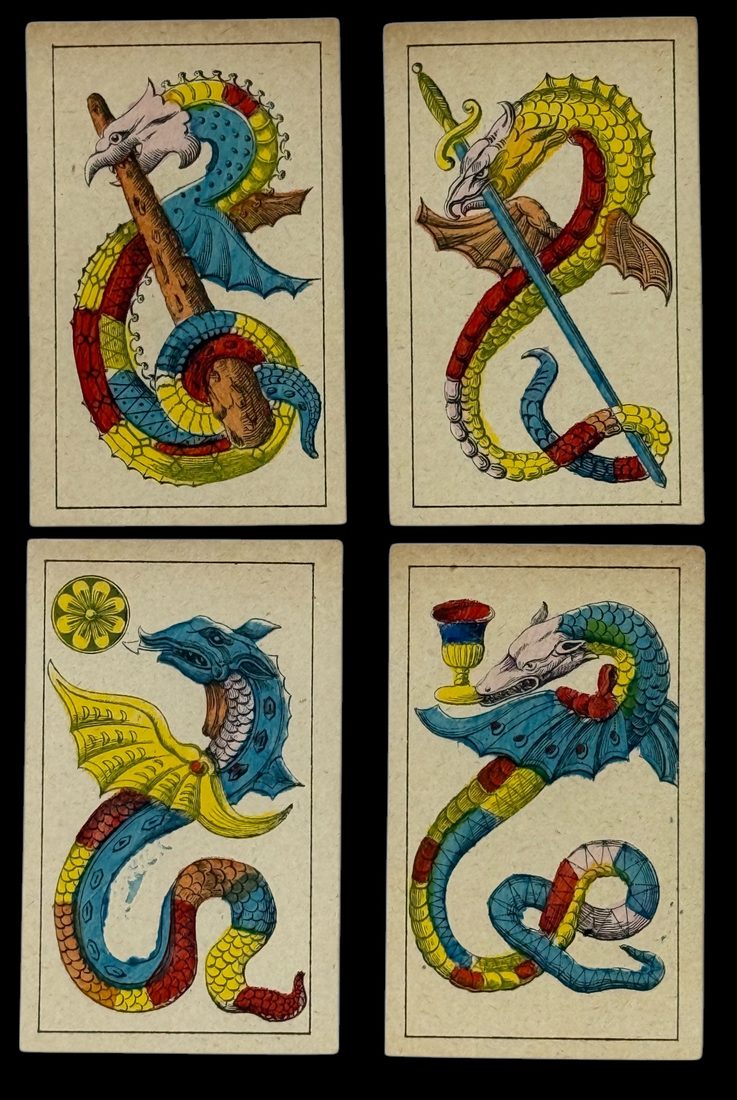
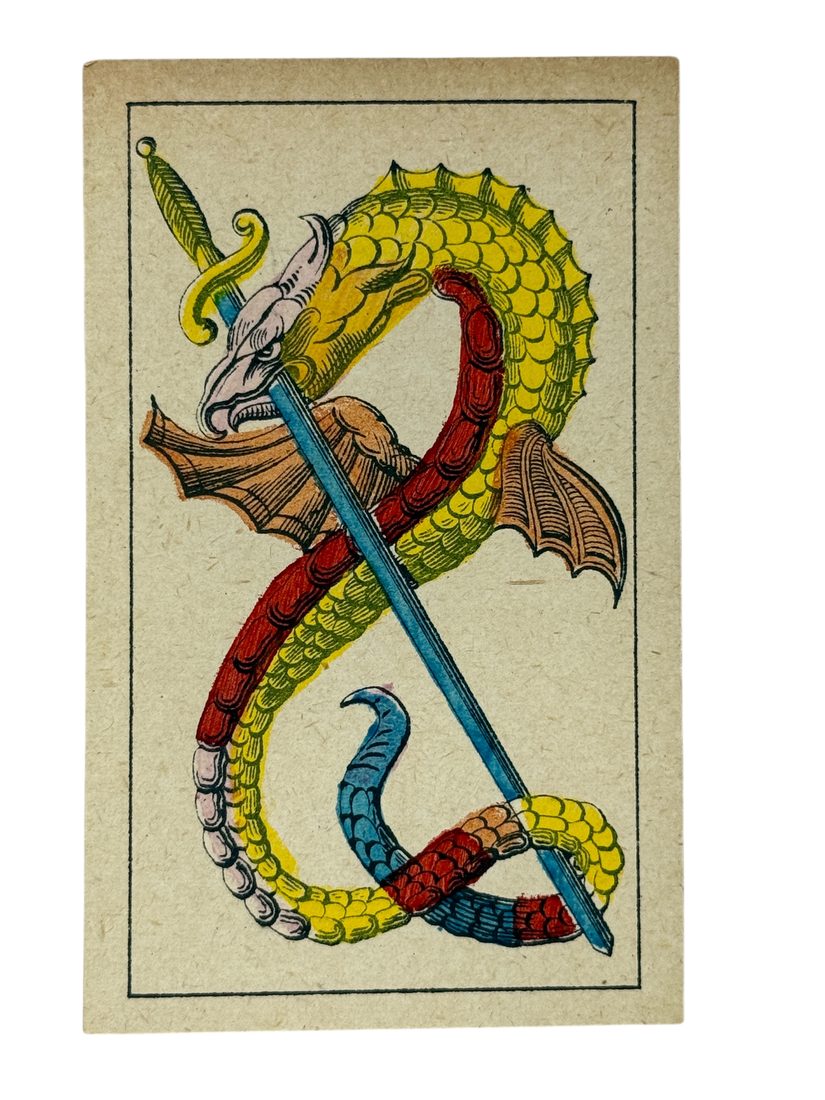
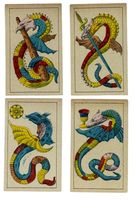
the dragon aces “Later Portuguese Pattern”
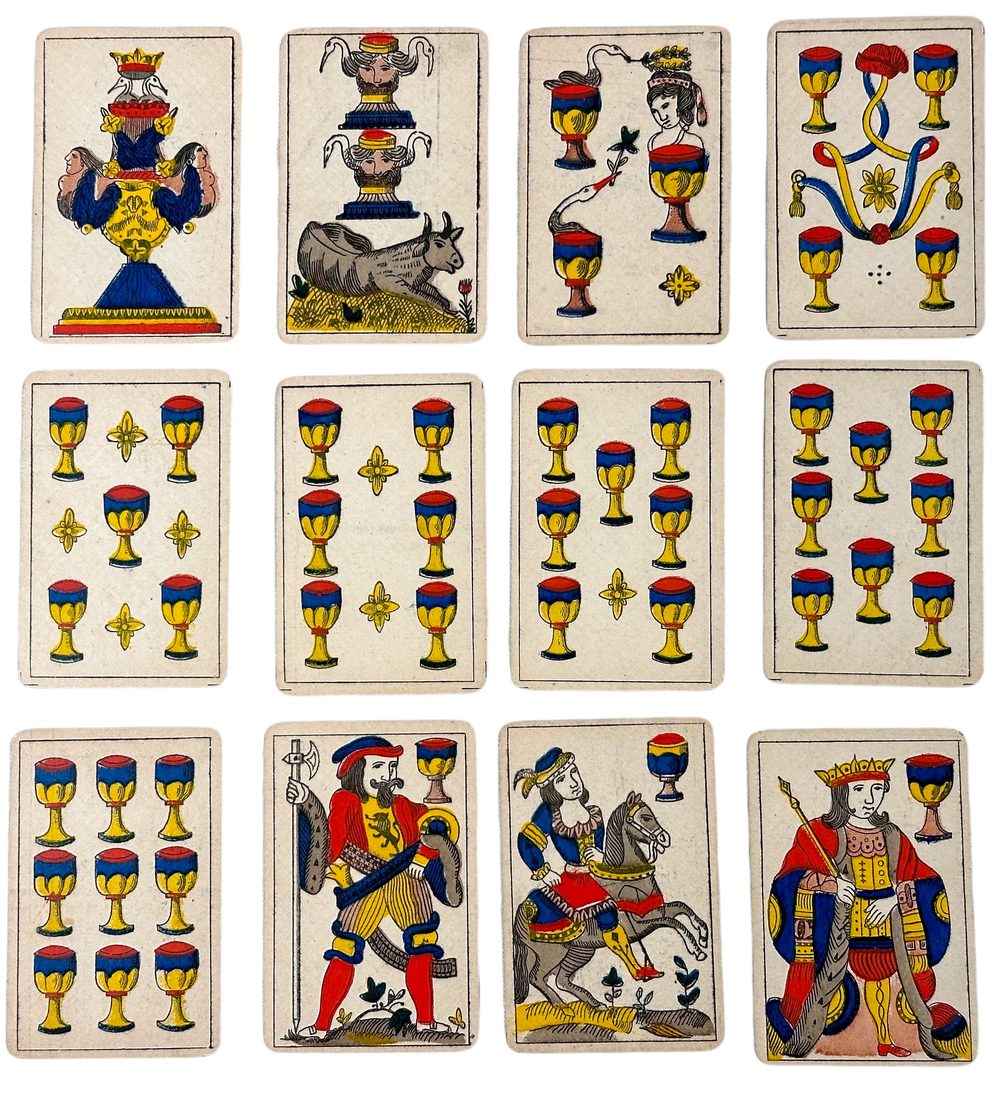
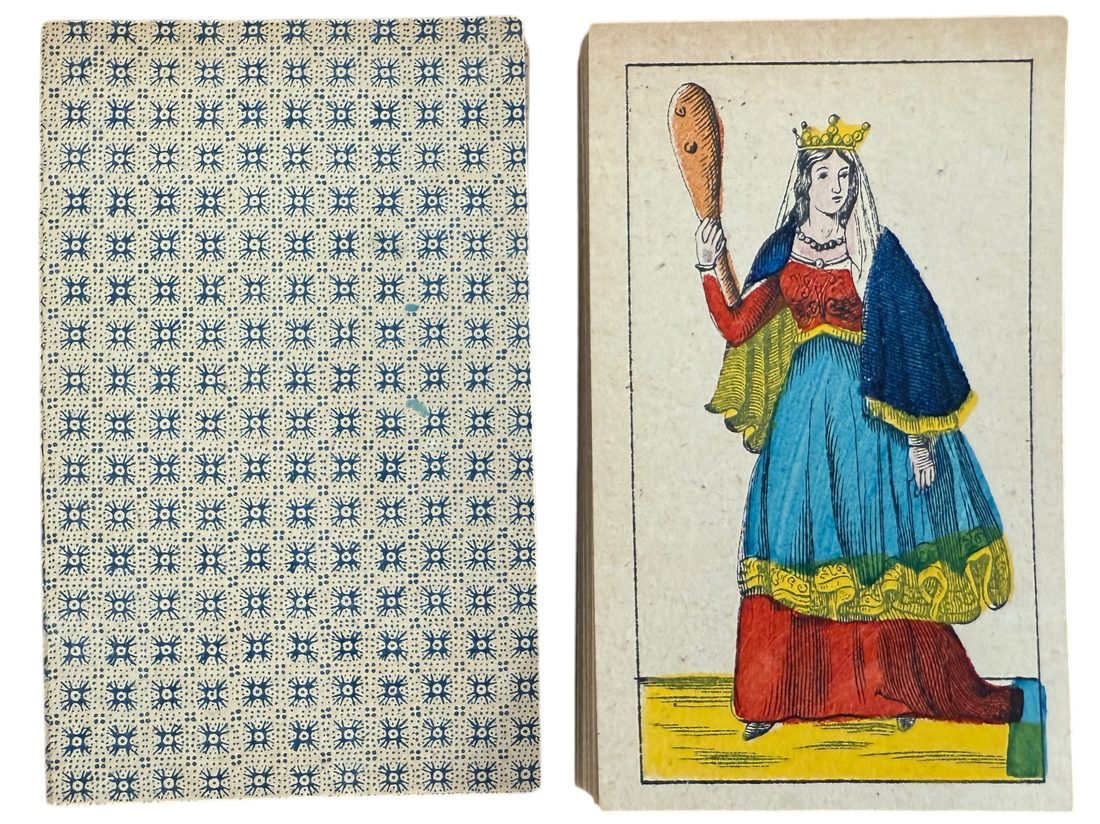
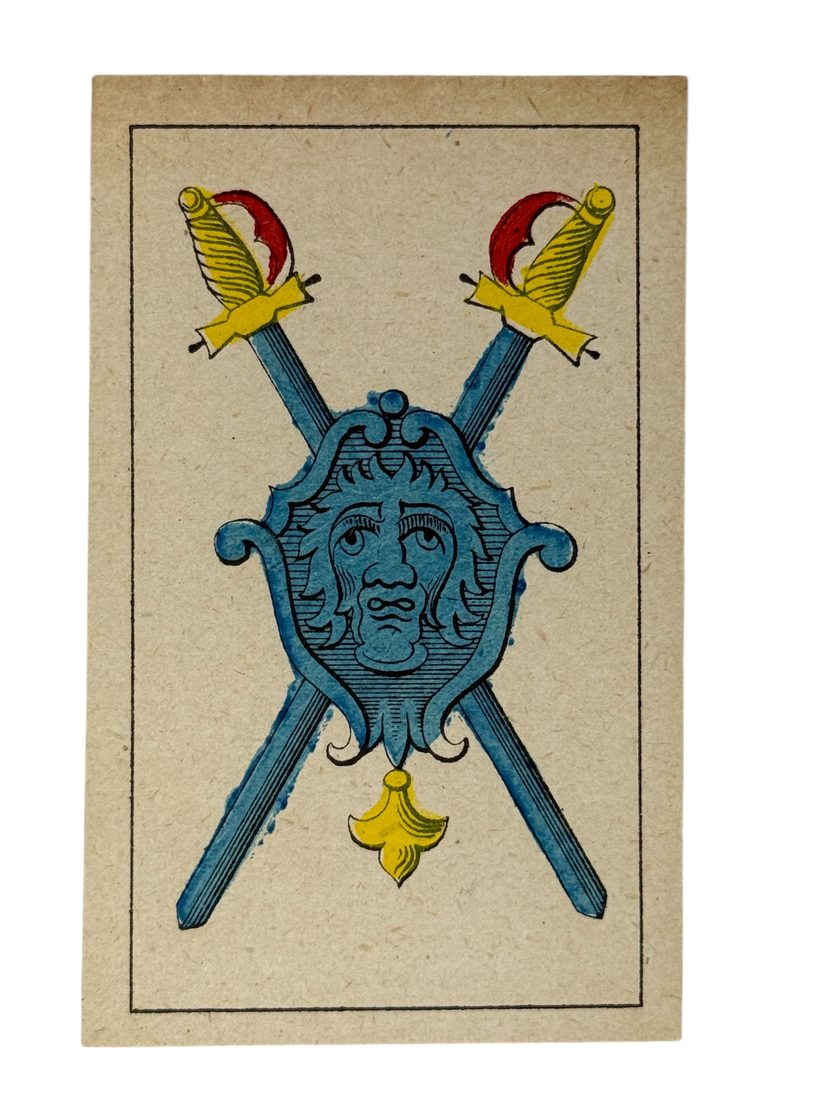
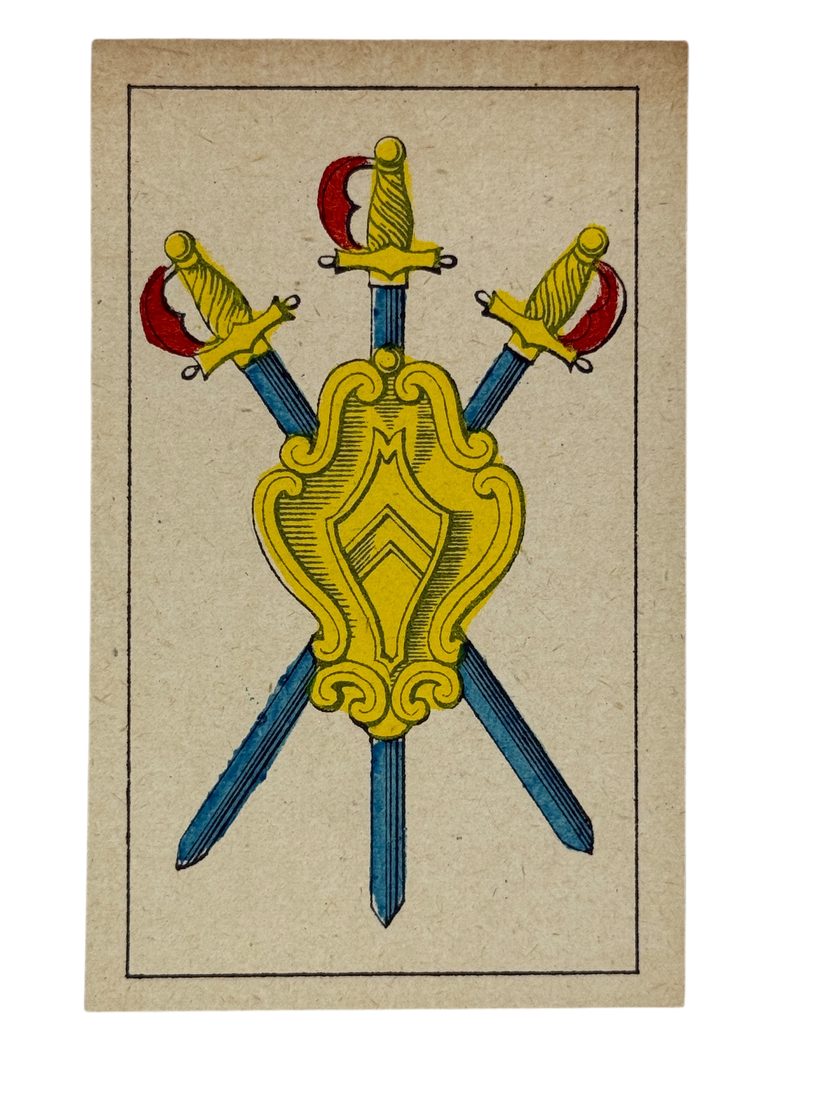
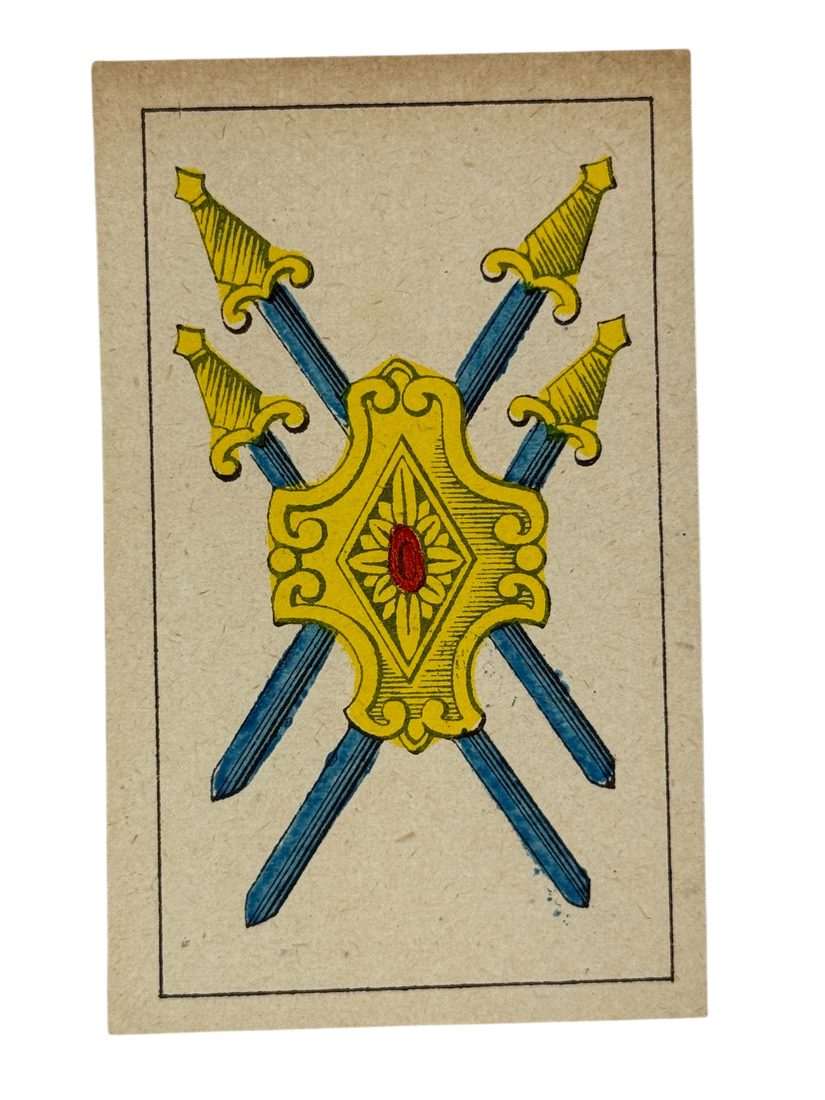
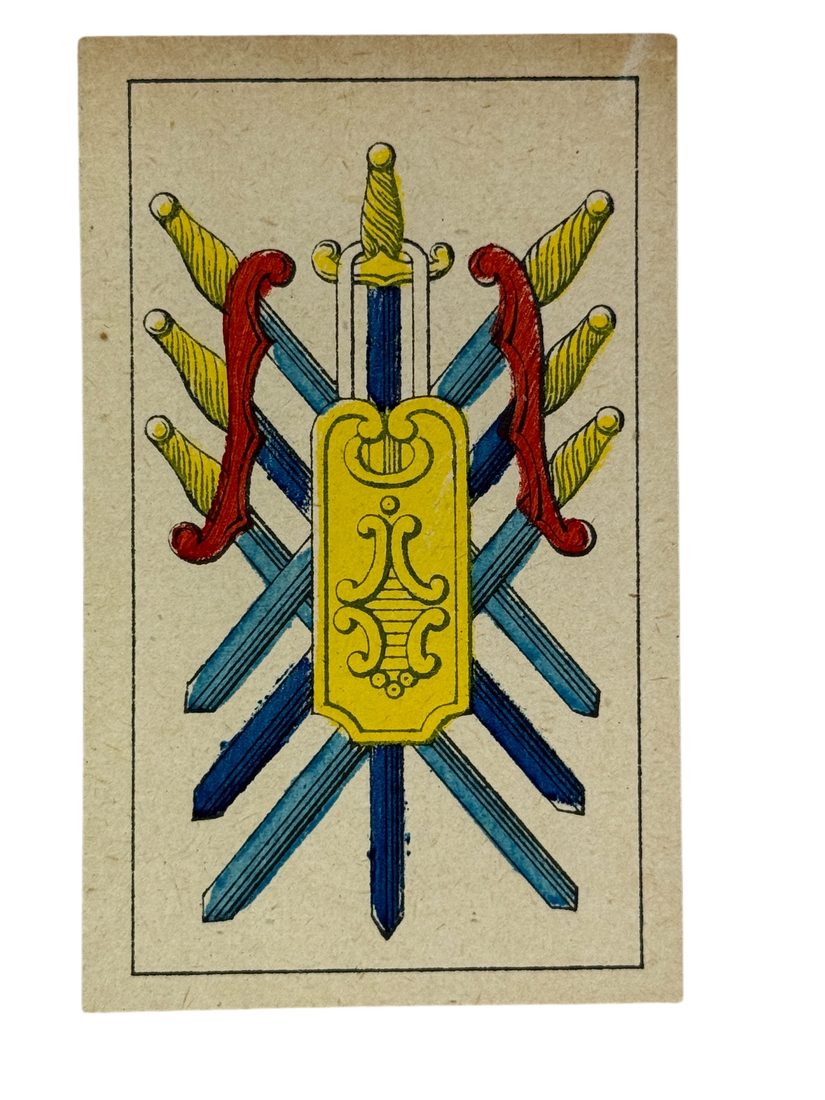
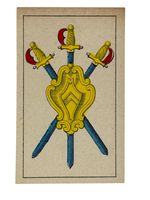
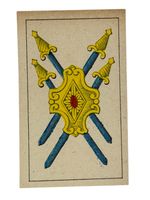
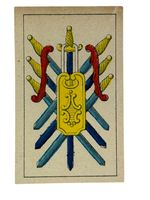
Playing card. Later Portuguese pattern. Turnhout, Mesmaekers Frères, 1875.
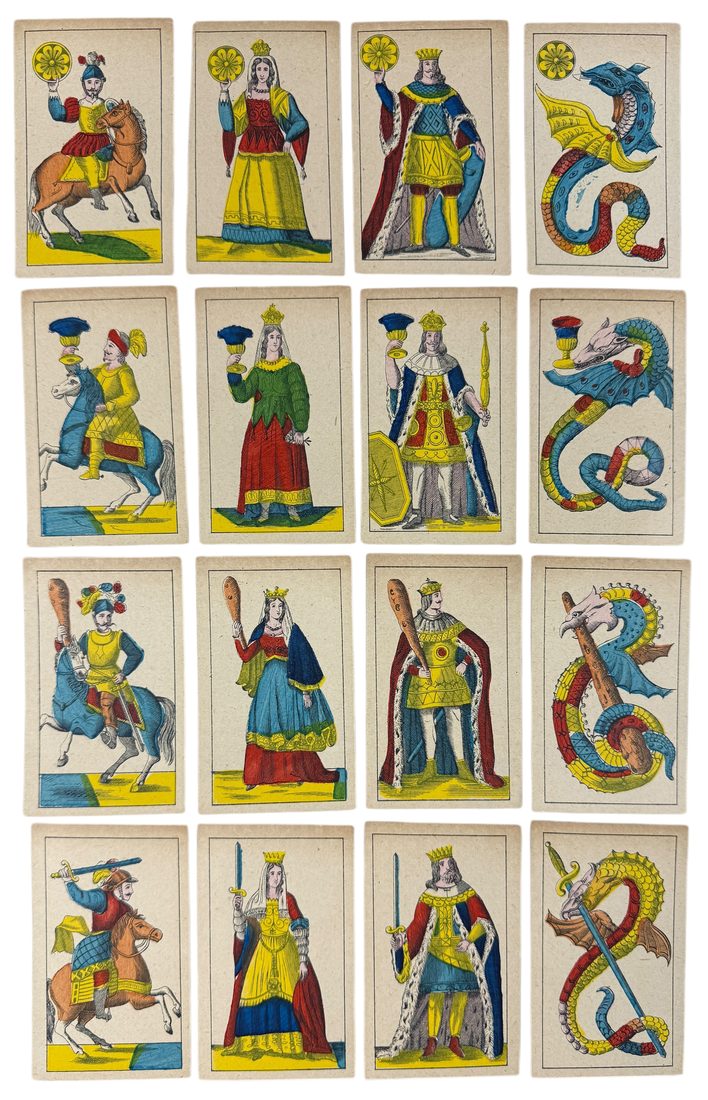
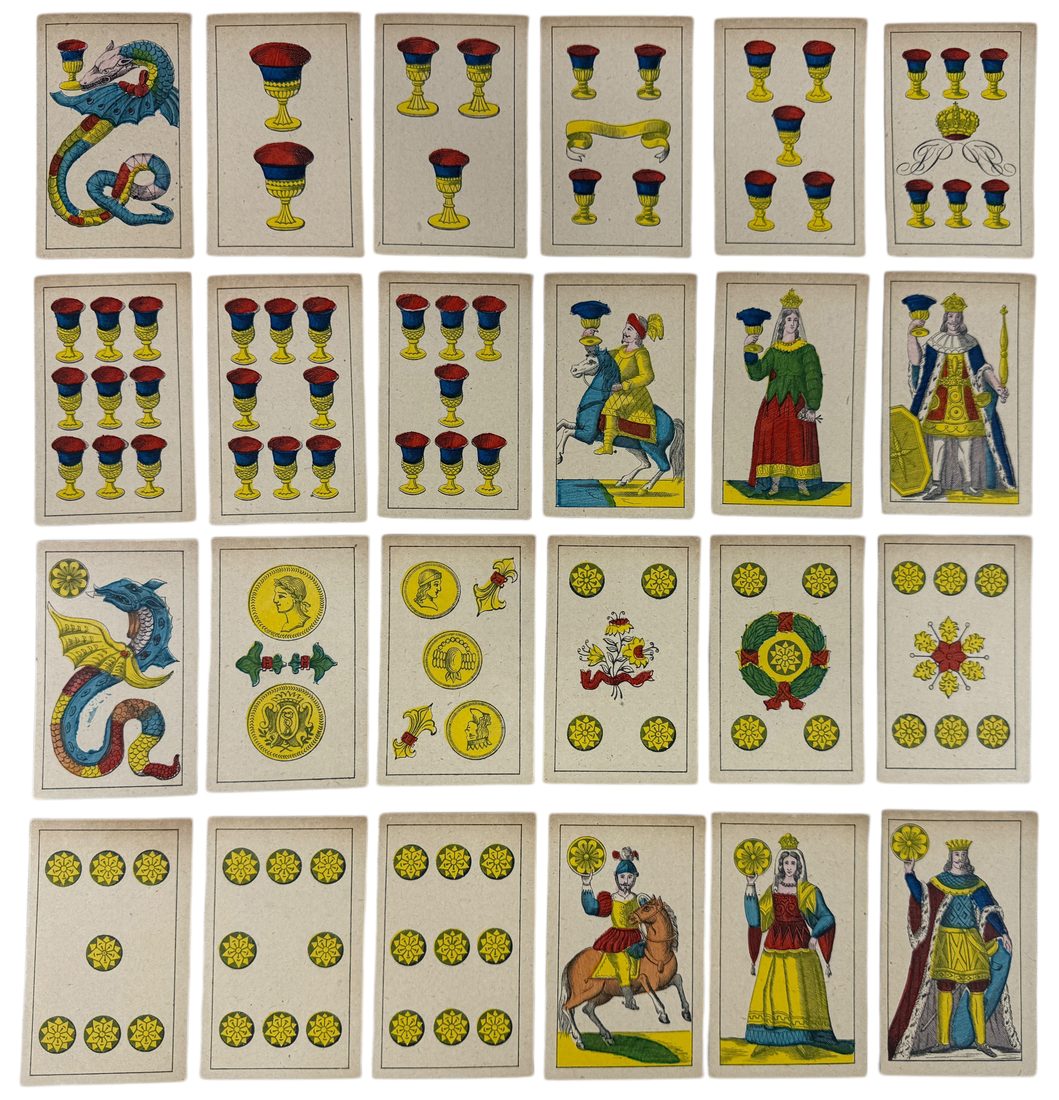
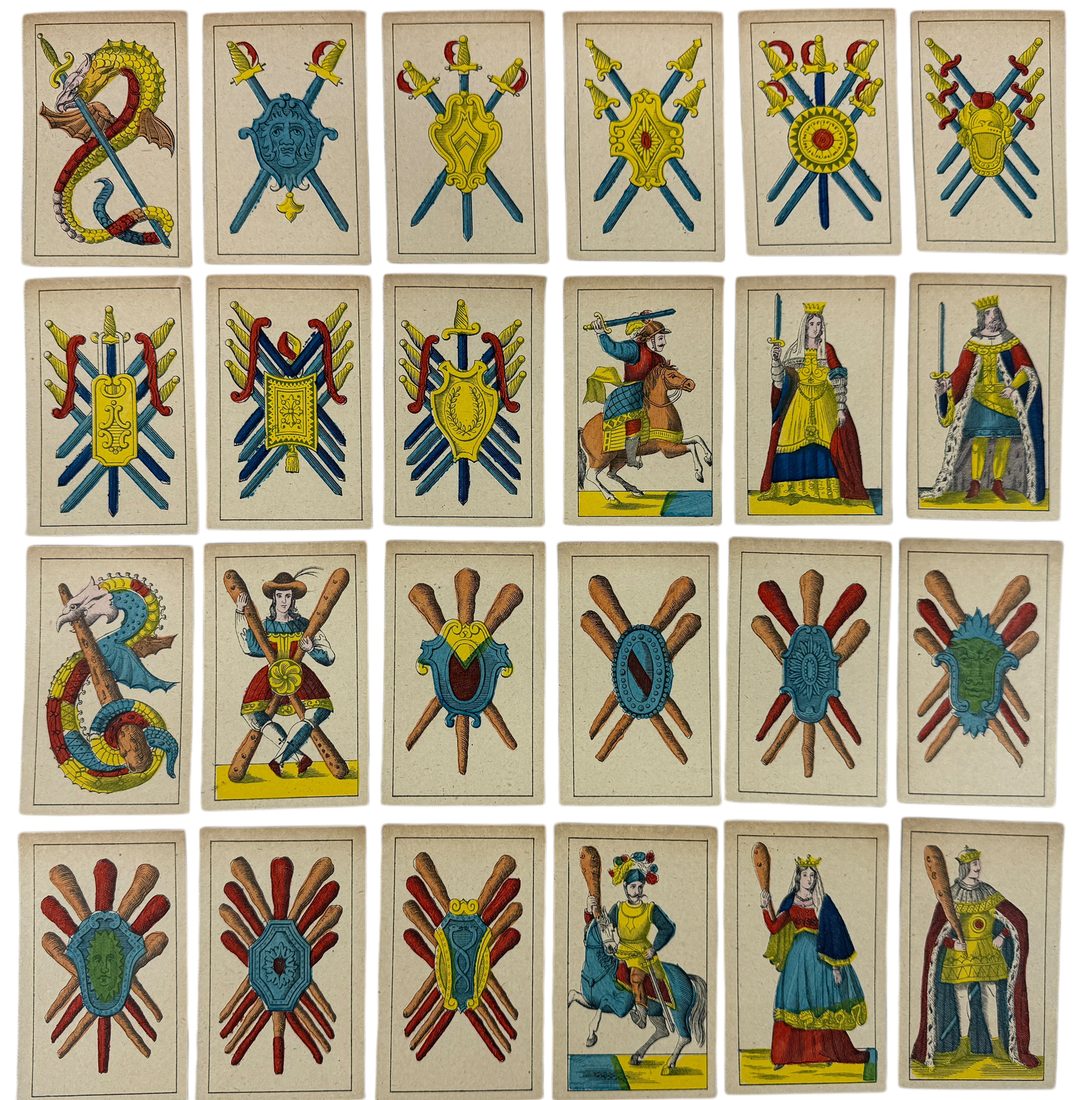
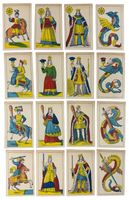
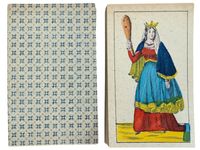
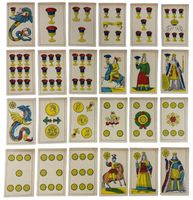
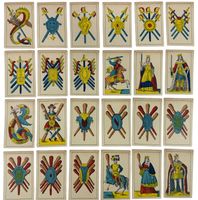
48 cards (85 x 65.2 mm), stencil hand-painted woodcuts with dragon aces, backs with overall pattern of suns, spots and dots, blue on white, straight corners.
The defining characteristics of the Portuguese playing card pattern include, distinguishing it from the Spanish and Italian styles, several notable features:
• Aces illustrated with dragons or serpents.
• Court figures depicted in theatrical attire, reflecting Portuguese artistic influences.
• Kings portrayed in a standing posture, in contrast to early Iberian decks.
• Sotas presented as female pages, thereby reinforcing the distinctiveness of Portuguese card design.
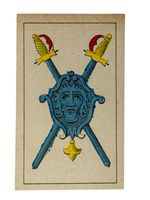
• The suits of swords and clubs rendered as trophies accompanied by shields, while coins frequently appear as intricate rosettes.
• A standard deck comprises 48 cards, notably omitting the tens.
During the late 19th and early 20th centuries, Belgian manufacturers—especially those based in Turnhout—played a pivotal role in producing Portuguese playing cards. This was particularly true for exports to Brazil, where historical ties, Portuguese cultural influence, and the enduring popularity of traditional Iberian card games drove significant demand.
The most significant differences between Portuguese-manufactured and Belgian-manufactured Portuguese decks, as exemplified by the deck presented here, include:
• The depiction of the sota (female). In traditional Portuguese decks, the sota does not wear a crown and holds a subordinate rank to the knight; in contrast, Belgian-produced versions for export frequently portray the sota as a crowned queen.
• The absence of the small dog traditionally shown at the feet of the Queen of clubs in Belgian versions.
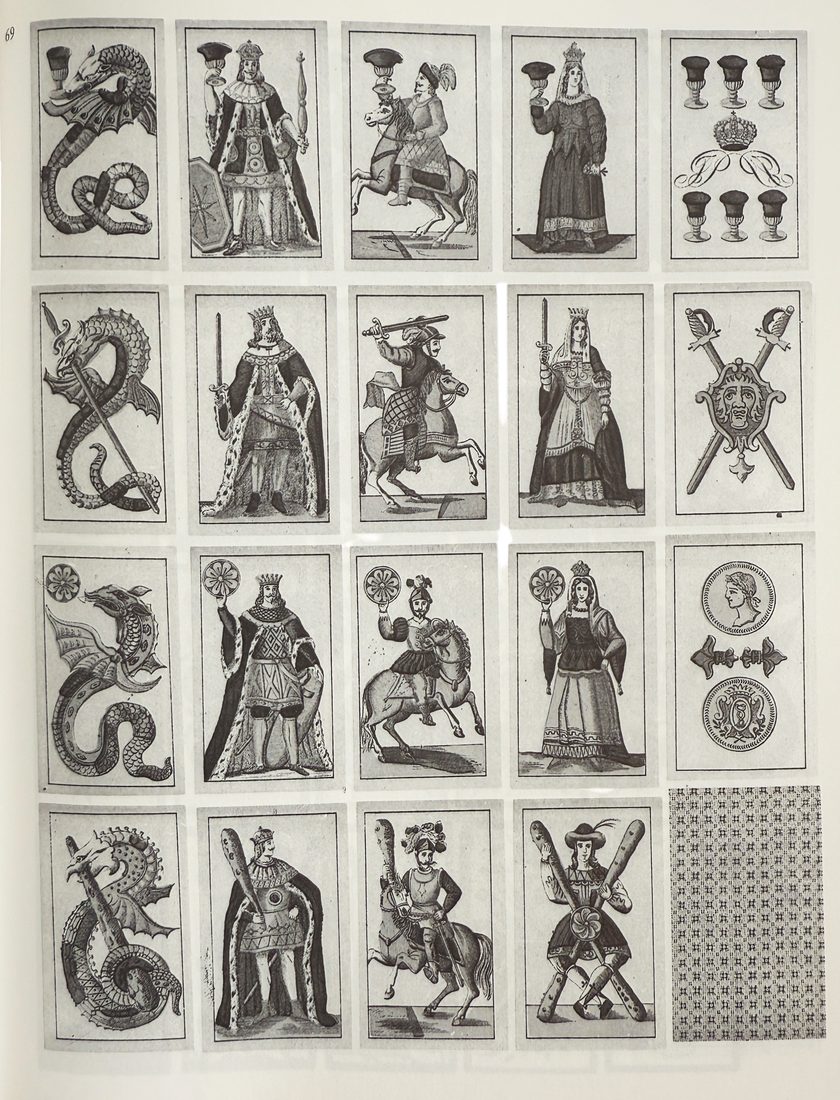
• The inclusion of a monogram on the six of cups, emulating the emblem of the Real Fábrica de Lisboa, despite these decks being manufactured outside Portugal.
• The use of lithographic contouring and stencil-based coloration by Belgian producers, particularly Mesmaekers Frères, which refined the visual aesthetic of Portuguese-style cards.
• Distinctive back designs on many decks intended for the Brazilian market, such as diagonal red lines forming a rhomboidal pattern.
Portuguese playing cards possess a complex and fascinating history, deeply intertwined with Iberian and broader European card-making traditions, with their origins tracing back to the late 15th or early 16th century.
Originating from Spanish models, Portuguese cards featured the distinctive suits of cups, swords, coins, and clubs, similar to their Spanish counterparts. These cards gained prominence in Portugal and subsequently spread to southern Italy, Malta, the Spanish Netherlands, and even as far as Peru, owing to Portugal's extensive maritime trade routes. Unlike in Spain, where they never achieved widespread popularity, Portuguese cards met with greater success in these regions, bolstered by Portugal’s global expeditions and colonial enterprises. Notably, they exerted considerable influence on card games in India and Japan, particularly contributing to the development of karuta.
In 1769, the Real Fábrica de Cartas de Jogar was established in Lisbon with the explicit aim of centralizing the production of playing cards within Portugal. This government-controlled manufactory introduced several notable changes to the traditional Portuguese card design, including:
• The elimination of numerical indices.
• The adoption of standing kings, aligning with the Spanish tradition rather than the seated kings characteristic of earlier Portuguese decks.
The factory subsequently flourished and became an integral component of the Impressão Régia (“Royal Printing House”), marking an era of increased standardization and state-controlled production of playing cards.
By approximately 1870, the production of playing cards within Portugal came to an end. From that juncture onward, most Portuguese-style cards were manufactured abroad, primarily in Belgium and Germany, where foreign producers introduced further modifications to the deck's appearance and composition.
The decline of the traditional Portuguese pattern accelerated in the 19th century, largely due to the increasing dominance of the French card model. This shift was driven by France’s cultural influence, expanding trade networks, and the widespread adoption of standardized card decks favoring the French suit system—as the French card model, with its hearts, diamonds, clubs, and spades, became increasingly prevalent.
This transition also influenced the nomenclature of suits: Portuguese names for the traditional suits were retained but reassigned to their French counterparts (e.g., copas for hearts). Similarly, Portuguese court cards—kings (reis), knights (cavaleiros), and pages (sotas)—were adapted into the French system, with the unique peculiarity that the queen was frequently identified with the sota, a traditionally female figure in Portuguese decks, rather than with the knight.
The evolution of Portuguese playing cards stands as a testament to centuries of cultural exchange and adaptation. While originally rooted in Spanish models, Portuguese decks acquired distinctive characteristics, particularly through their diffusion across Europe, Africa, Asia, and the Americas. The Belgian production era of the 19th century further refined and modified these cards, especially for export markets. Although the traditional Portuguese playing card pattern is now largely extinct, its legacy persists in regional tarots, such as the Sicilian tarot, and in select Asian card games that trace their origins to Portuguese designs.
Mesmaekers Frères, founded in 1859 in Turnhout, Belgium, quickly established itself as one of the foremost manufacturers of playing cards in the region. The company was born from the collaboration between Gustaaf Mesmaekers and Louis-François Moentack, whose partnership laid the foundation for a legacy in high-quality card production.
Over the decades, Mesmaekers Frères developed a diverse product range that reflected both innovation and a deep respect for traditional card-making. Their production encompassed:
- Portuguese-Style Cards: Notably, these decks featured distinctive dragon aces and were produced approximately between 1875 and 1900.
- Great Mogul Playing Cards: Crafted with French suits, these decks highlighted the company's ability to merge classic design with unique thematic elements.
- Spanish-Style Cards: Specifically designed for export markets, these decks underscored Mesmaekers Frères’ commitment to international trade.
In addition to standard playing cards, the company ventured into specialized deck production. A striking example of this is the “Jeu des Alliés” (Allies Game) produced in 1945, which intriguingly featured Hitler as the joker—a testament to the company’s willingness to engage with contemporary themes and events.
Mesmaekers Frères not only catered to local demand but also built a robust international presence. Their export initiatives included supplying decks to markets in Brazil and manufacturing packaging for distributors such as Forbes, Forbes & Campbell. The publication of detailed trade catalogs for Spanish playing cards further highlights the company’s expansive commercial reach
Conditions: Perfectly preserved.
Reference: Kathleen Wowk, Playing Cards of the World, Lutterworth press, 1983, pp. 31-32; F. A. Fournier, Los Naipes, Museo Fournier, Vitoria,1882, p. 105-9; Sylvia Mann, Collecting Playing cards, Arco Publications, 1966, p. 56; Sylvia Mann, All cards on the table, Verlag, 1980, no. 69 (describing the deck here presented).
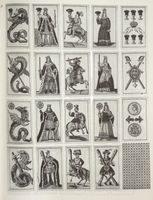
S. Mann, All cards on the table, no. 69