Jeu de l'Aluette (Cartes des Pêcheurs)
| Macro-category | Playing Cards and Tarot |
| Subcategory | Historical Playing Cards |
| Provenance | Paris |
| Publisher / Maker | H. Pussey |
| Year | 1880 |
complete xix century hand coloured deck
for the French “Jeu de l’Aluette”
the only French game played with the Spanish card suite
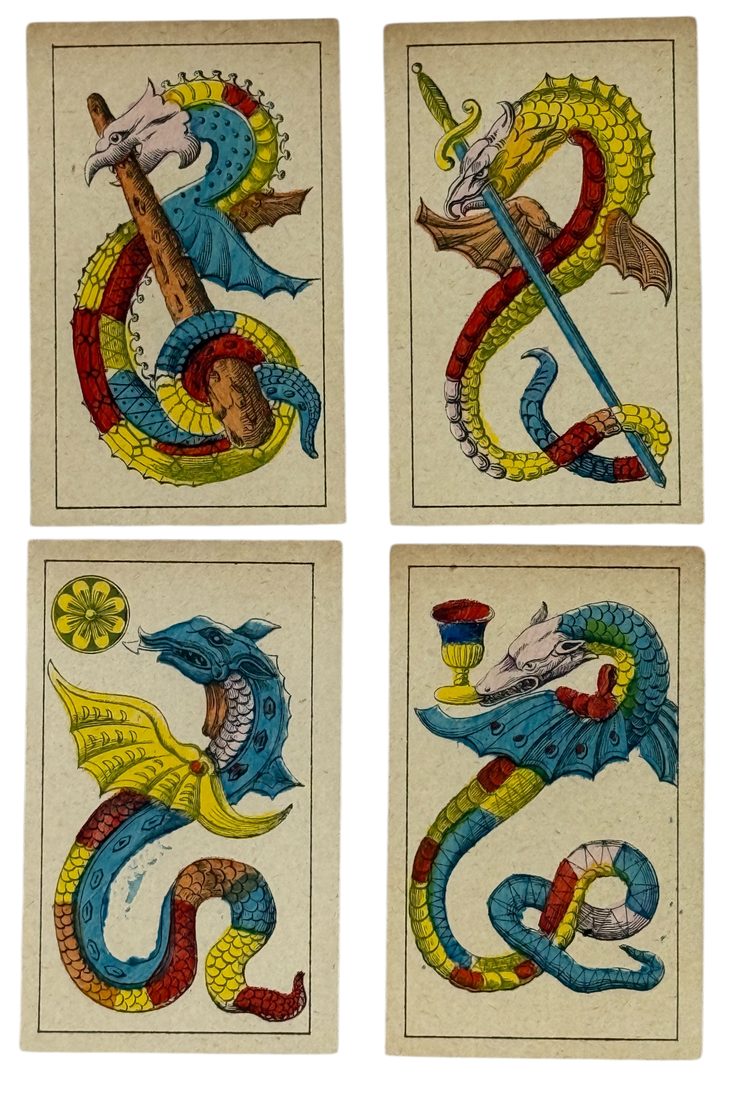
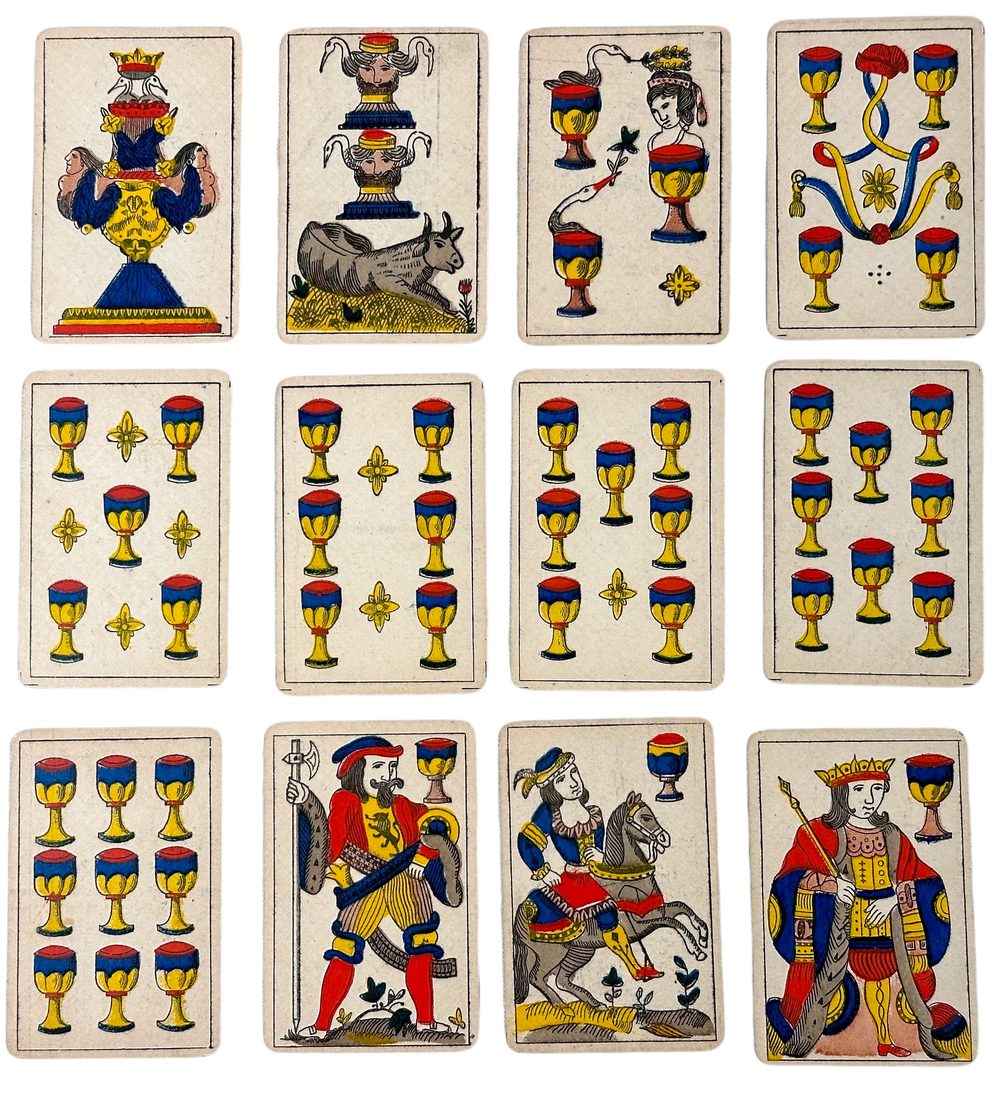
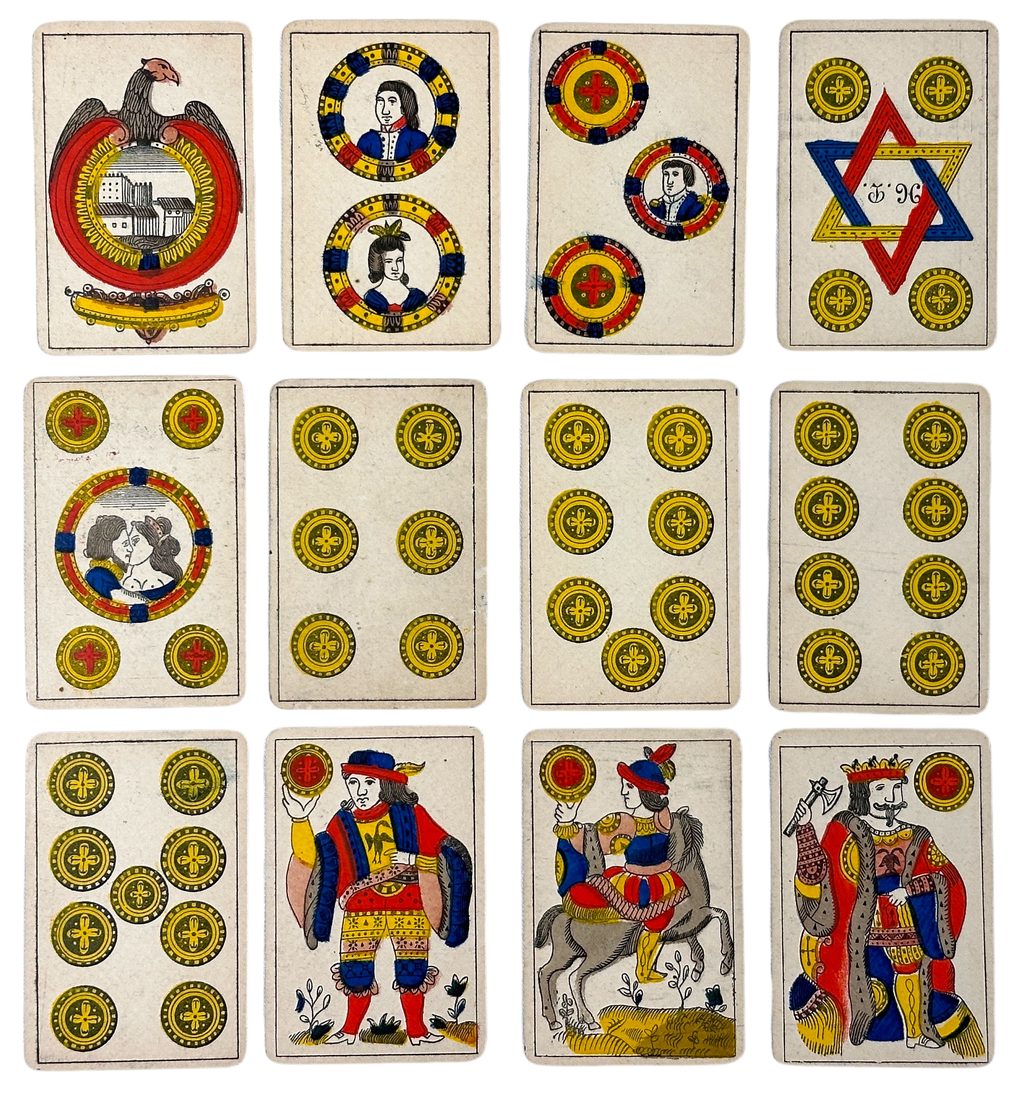
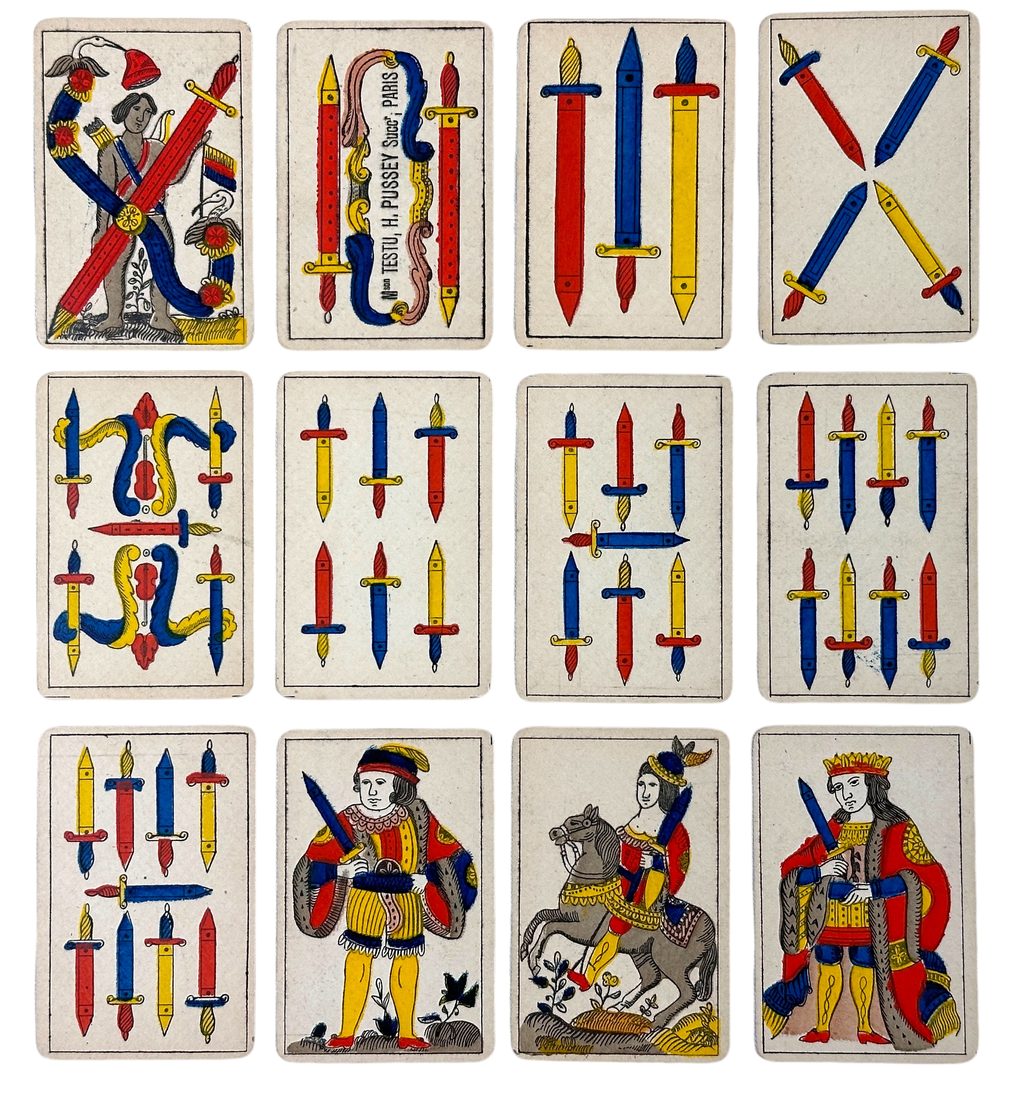
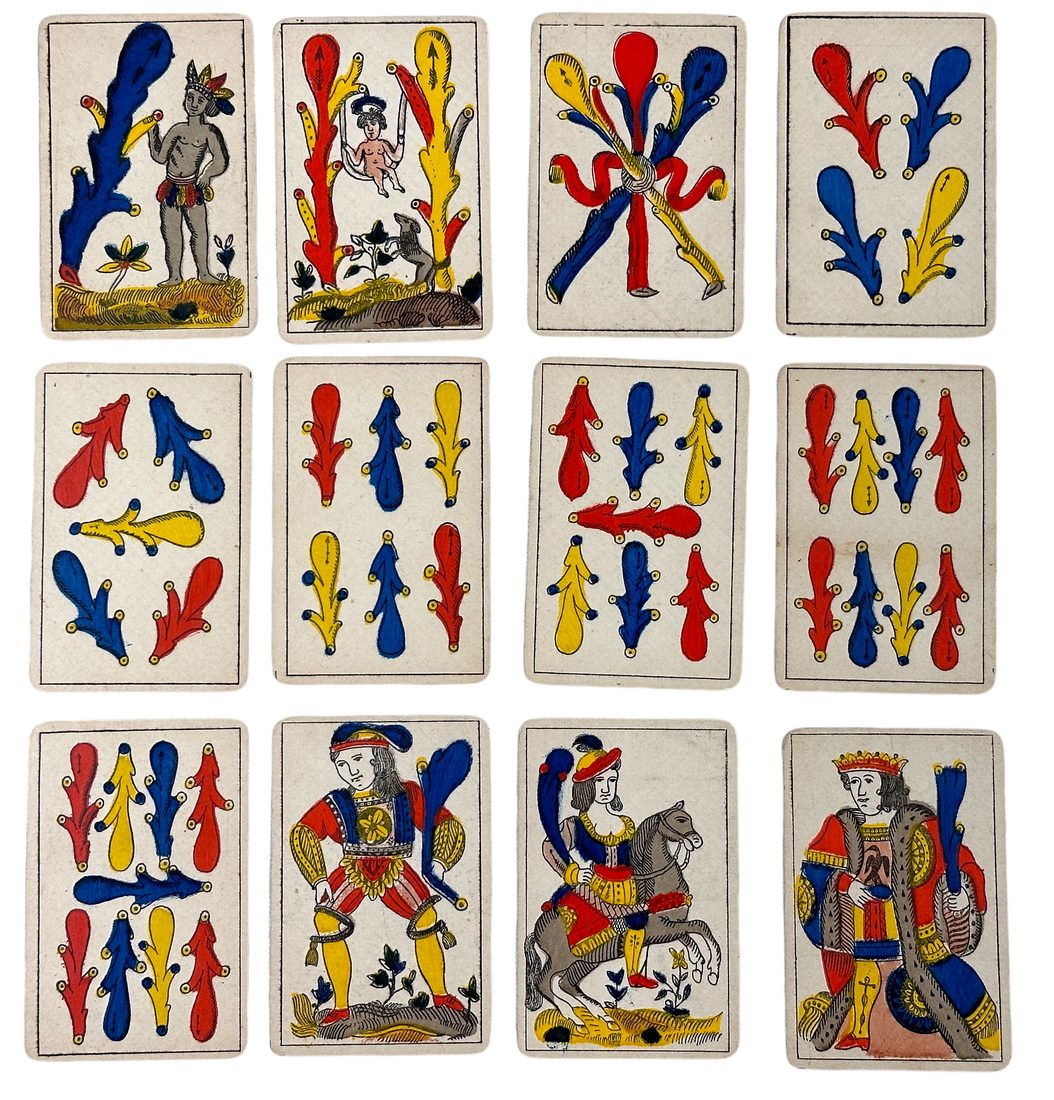
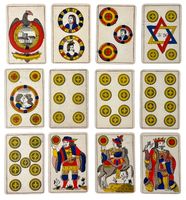
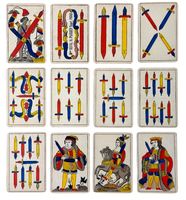
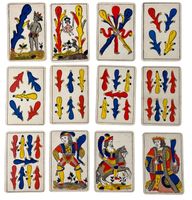
Card Deck, Jeu de l’Aluette or Cartes des Pêcheurs. Paris: H. Pussey, 1880.
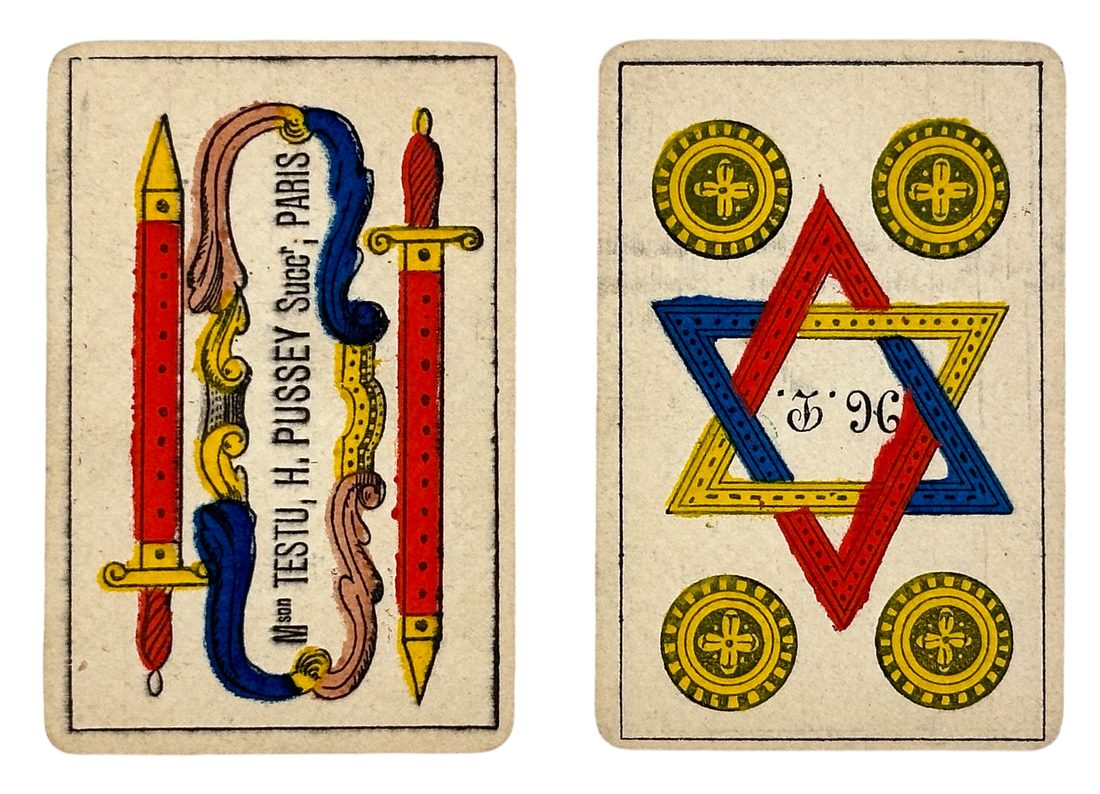
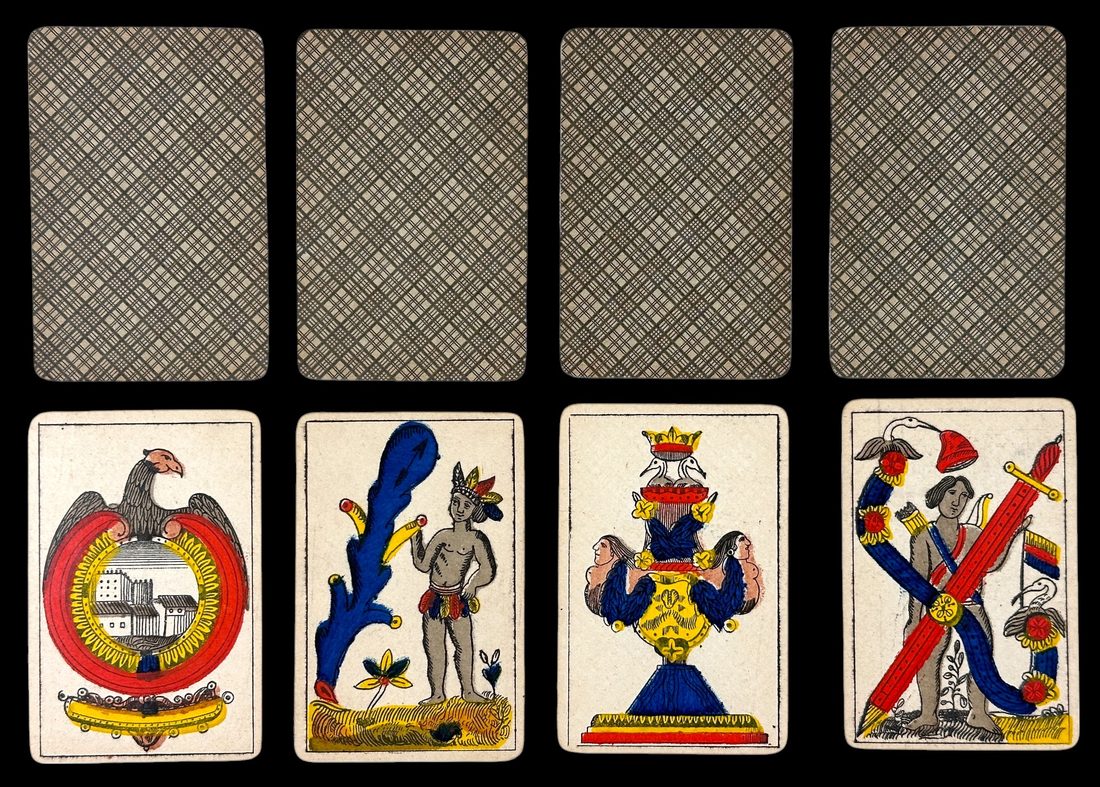
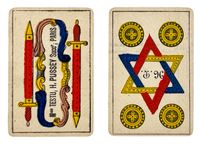
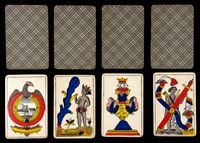
Complete deck (8,3 x 5,3 cm), 48 cards with xylographic impression featuring the typical Italian/Spanish four suits, hand-coloured with the support of stencils, printed on thick cardboard, back of the card embellished with brown tartan patterns, round corners. 2 of swords with Mson Testu, H. Pussey Succr Paris, 4 of coins with monogram H.P.
The deck is hand-coloured with the aid of stencils, as was customary for hand-painting playing card decks in the past. The stencil is a thin sheet of pasteboard, parchment, or metal, in which outlines and general forms of the figures are cut out, allowing the colour to be applied onto cardboard or paper. By passing a brush charged with colour over the stencil, the pigment enters the cut-out lines and imparts the design to the material beneath. The pips, or common cards, usually require only one colour, either red or black, whereas the têtes, or court cards, call for multiple colours.
The Aluette, jeu de la vache, la vache (game of the cow) or Cartes des Pêcheurs is an ancient card game played in western France.
It is a trick-taking game, practiced by four players – two against two – using forty-eight cards with Italian/Spanish suits. It is played with codified signs that allow partners to communicate information about their cards during the game.
The oldest form of the word “aluette” is “luette,” and the game is mentioned three times by Rabelais in his work: once in Pantagruel (1532), then in Gargantua (1534), and finally in the Cinquième livre.
The Aluette is traditionally practiced in rural and coastal areas between the Gironde and the Loire estuary, in the departments of Vendée and Loire-Atlantique, Bretagne, and Saint-Pierre et Miquelon.
«Dans tonte la Bretagne on editait le portrait de Paris; toutefois, quelques cartiers du littoral, tels que Jean Bernard, Et Brest, Jacques Stot, it Saint-Malo, et Ozannet, a Lorient editaient aussi des cartes a ensergnes espagnoles pour les jeux d'aluette tres en houneur pres des matelots et des pecheurs.» (D’Allemagne, cit.)
The origin of the rules of the game of Aluette remains uncertain, and two different hypotheses exist:
The game came from Spain and was brought to France by Spanish sailors in western French ports (though, curiously, it seems to have disappeared from Spain without leaving any trace), or more likely, the game was born in the West of France, employing the only deck that existed in the 16th century, the Spanish/Italian, which persisted despite the widespread conversion to French suits completed in the 18th century.
Main Rules:
The four suits (CUPS, SWORDS, MONEY, BATONS or CLUBS) have the same strength and there is no Atout (Trump).
The forty-eight cards, from highest to lowest, fall into four categories:
The “Luettes ”:
- Monsieur (3 of Money)
- Madame (3 of Chalices)
- Le borgne (2 of Money)
- La vache (2 of Chalice)
The “Doubles”:
- Grand Neuf (9 of Chalices)
- Petit Neuf (9 of Money)
- Deux de chêne (2 of Batons)
- Deux d'écrit (2 of Swords)
16 Figures (court cards): as (Aces), Rois (Kings), Dames or Cavalières (Queens or Knights), Valets (Knave)
24 Cartes Faibles (les «Bigailles») (weak cards ): from 9 to 3 (except the 3 of Money, the 3 of Chalice, the 9 of Chalice and the 9 of Money).
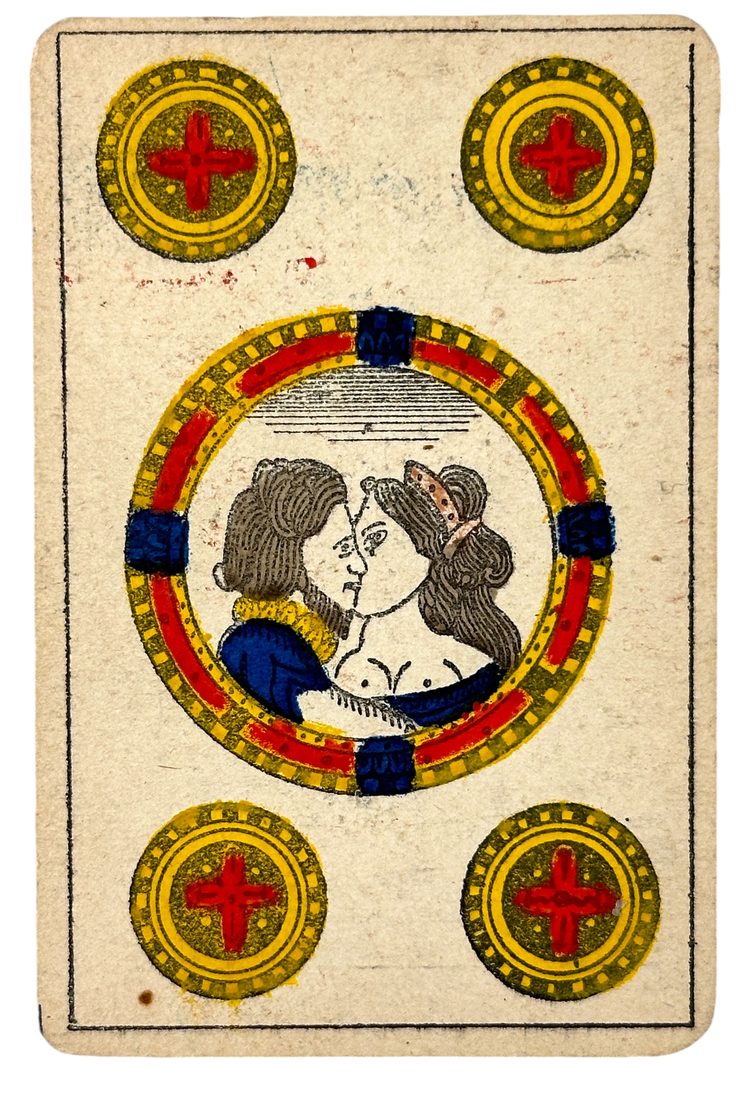
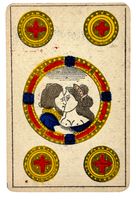
The 5 of Money is called “bise-dur”, without the card having any particular value, representing a couple kissing or embracing.
Henry Pussey was a successor to E. Testu, who had established a reputation for high-quality playing cards in France. He produced playing cards in Paris between 1880 and 1890, after which he sold the manufacturing division of his business to B.P. Grimaud. Pussey’s playing cards typically featured refined designs, intricate patterns, and precise engraving. He continued the tradition of crafting decks that appealed to both the upper classes and the general public, offering a variety of styles, including traditional French suits and specialized thematic decks.
Pussey’s playing cards were renowned for their craftsmanship and artistic detail, differentiating them from more industrially produced alternatives. He is best known for his Sybille des Salons and double-ended standard packs. This Aluette deck closely resembles that produced by Avril & Cie (Cary coll., FRA 172), who had, during the 1860s, also styled themselves “Successor to Testu”.
Note on European cards Suite.
Moving across Europe it was possible to find three varieties of the four-suit pack: (1) The Italian and Spanish variety (almost identical); (2) the Germanic variety; (3) the French variety.
- ITALY AND SPAIN
- CUPS. (Equivalent to our 'Hearts.")
- SWORDS. (Equivalent to our 'Spades.)
- MONEY- Denari in Italy; Oros, i.e. gold pieces, in Spain (Equivalent to our 'Diamonds'.)
- BATONS or CLUBS. (Equivalent to our 'Clubs.")
- GERMANIC NATIONS
- HEARTS.
- ACORNS. (Perhaps equivalent to our 'Spades.")
- BELLS, i.e., hawk-bells. (Perhaps equivalent to our
- '"Diamonds.")
- LEAVES. (Perhaps equivalent to our 'Clubs
- FRANCE
- COEUR, a heart. (Our 'Hearts.)
- PIQUE, a pike. (Our 'Spades.)
- CARREAU, a paving tile. (Our 'Diamonds.)
- TREFLE, a trefoil a clover-leaf. (Our 'Clubs.)
Conditions: Two pip cards with a couple of minor brown spots or marks, 6 of coins with slight surface damage to one long edge, overall good conditions.
Provenance: Dudley Ollis’ collection: Dudley Ollis was member of the International Playing Card Society and it’s considered the most important English private collection of playing cards. Ollis formed his collection over more than 50 years, and it includes rarities such as a set of English cards printed with the musical notation and lyrics from The Beggar’s Opera
References: W. Gurney Benham, History of the Pack and Explanations of Its Many Secrets, Read Books, 2019; Henry Rene D'Allemagne, Antique Playing Cards: A Pictorial Treasury, I:108-sq, 1996; Catherine Perry Hargrave, A History of playing cards, Dover publications, 2021; Henry Rene D'Allemagne, Les cartes à jouer du XIV au XX siècle, Paris : Librairie Hachette, 1906.
Henry Rene D'Allemagne, Antique Playing Cards: A Pictorial Treasury, I, 205
Henry Rene D'Allemagne, Antique Playing Cards: A Pictorial Treasury, II, 106