Valet de Trèfle au portrait de Guyenne
| Macro-category | Playing Cards and Tarot |
| Subcategory | Historical Playing Cards |
| Author | DUROUCHAIL, Pierre |
| Provenance | Bordeaux |
| Publisher / Maker | Pierre Durouchail, “À l’Espérance” |
| Year | ca. 1795 |
The Bordeaux knave and the sign of Hope:
Pierre Durouchail’s Valet de Trèfle in the portrait de Guyenne,
a cardmaker’s signature from the last years
of the French regional patterns
Durouchail, Pierre. Valet de Trèfle au portrait de Guyenne. Bordeaux: Pierre Durouchail [“À l’Espérance”], ca. 1795.
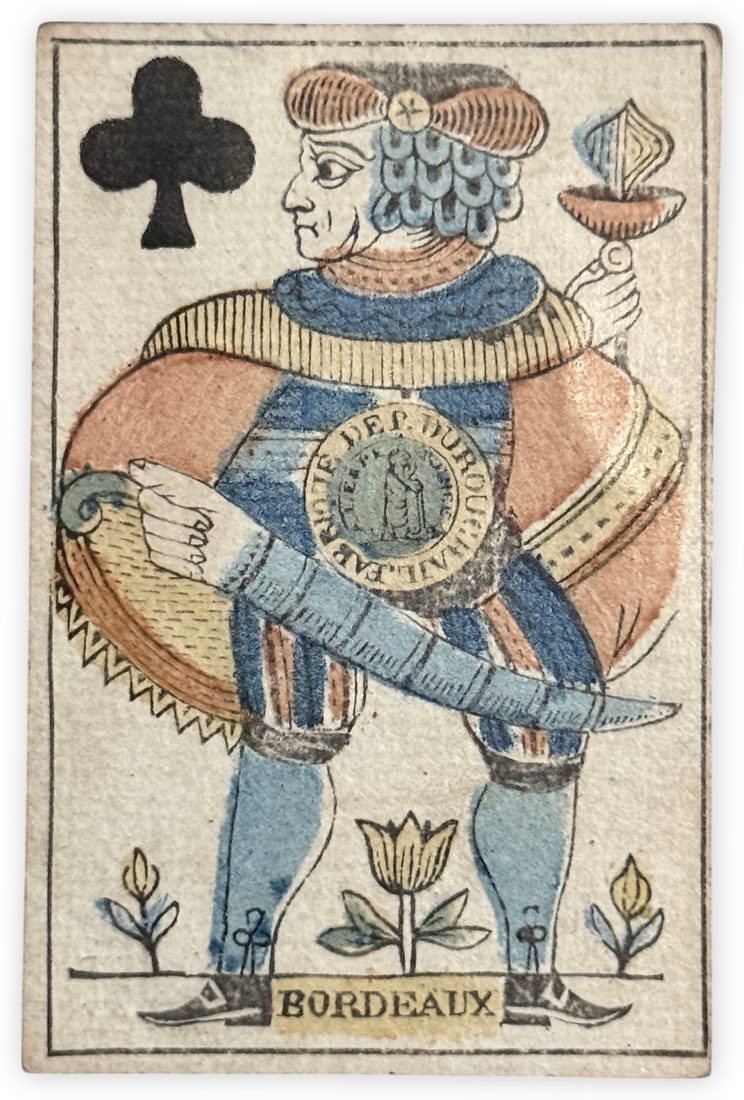
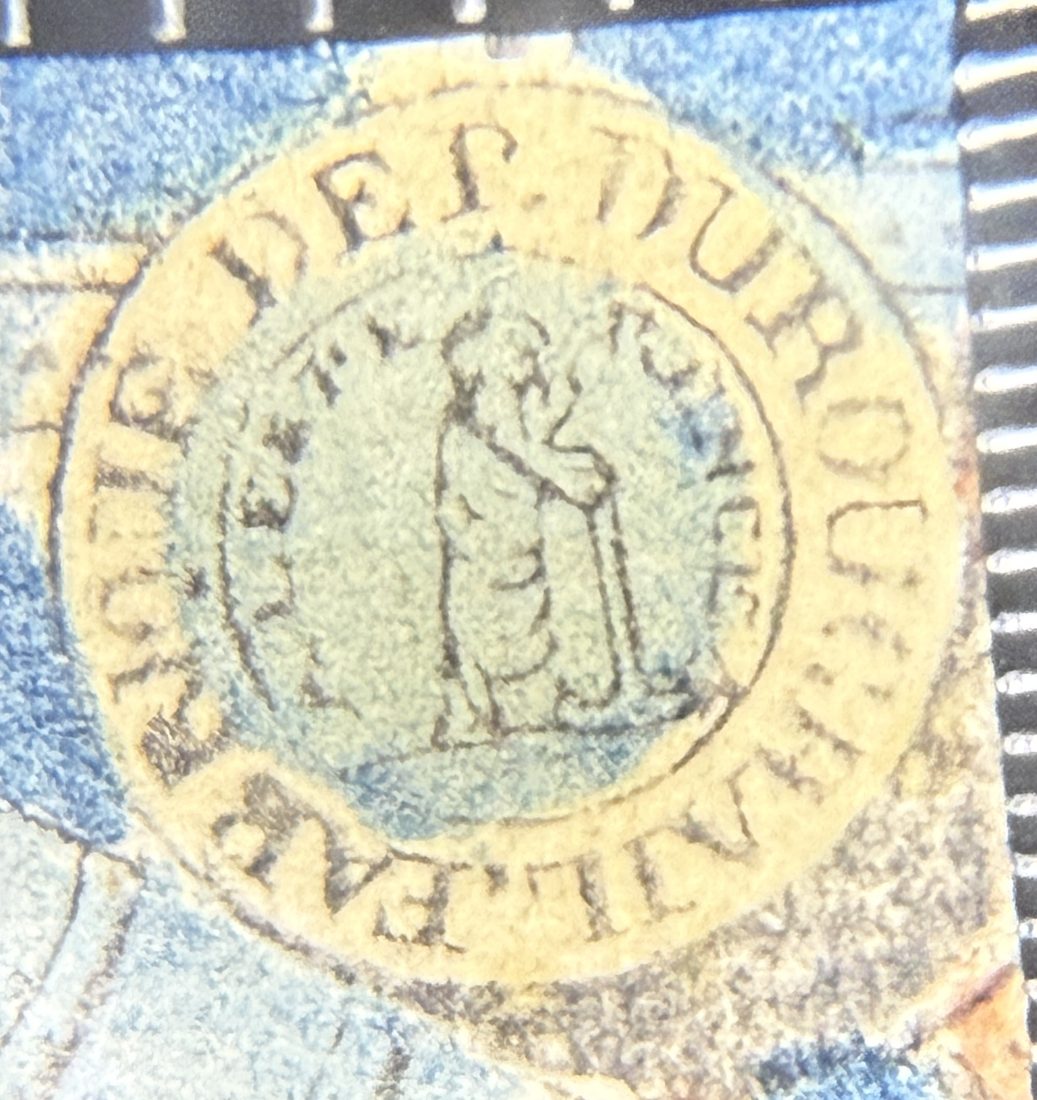
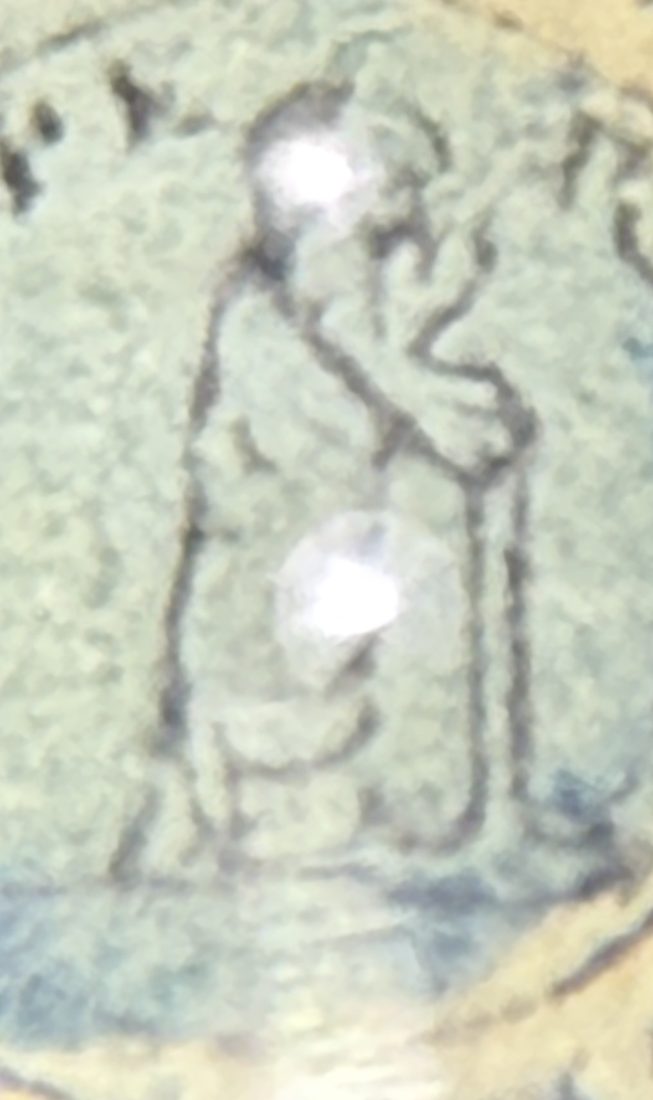
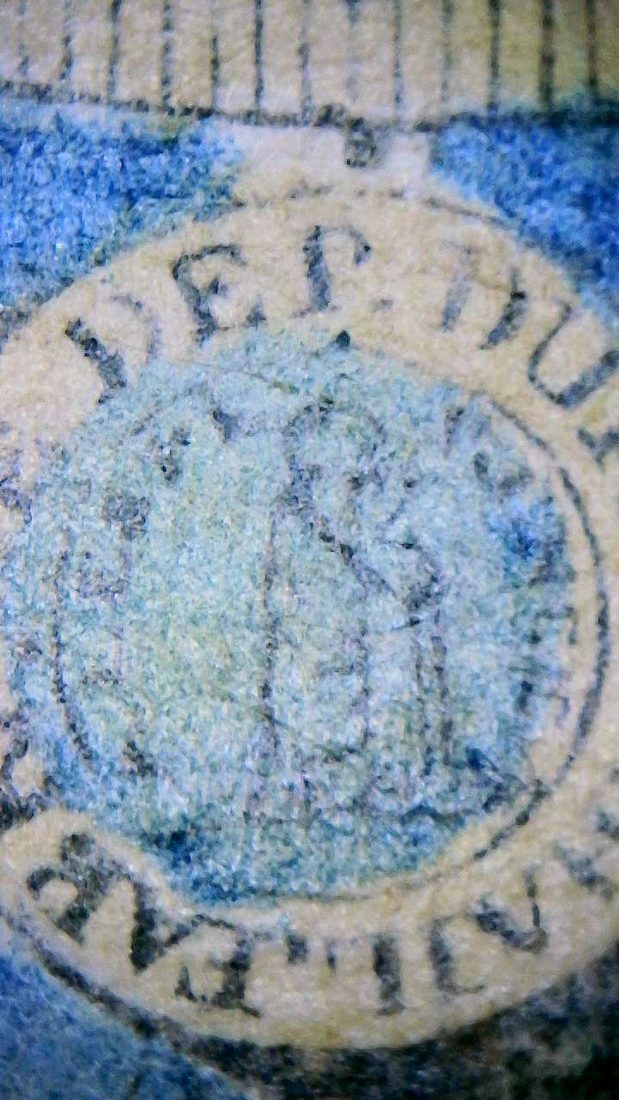
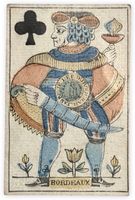
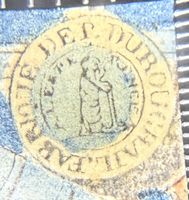
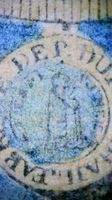
1/1 card, Valet de Trèfle (Jack of Clubs), originally from a French-suited pack; 85 × 55 mm; woodcut printed in black and coloured by stencil (pochoir) in red, dark blue, pale blue, yellow ochre and black on white pasteboard; square corners; verso blank. Portrait de Guyenne pattern, Bordeaux type: single-ended, full-length figure in profile to the left, club suit-sign at upper left, within a single ruled border. Cartouche at the foot of the figure lettered BORDEAUX. On the chest a round medallion, cut in the same block as the figure, with the legend FABRIQUE DE P. DUROUCHAIL enclosing a standing figure of Hope leaning on her anchor and the inner legend [À] L’ESPÉRANCE. No tax stamp; watermark not examined.
This is the signed card of a Bordeaux pack in the portrait de Guyenne, the regional pattern of south-western France. The cardmaker Pierre Durouchail placed his name and his shop sign, “À l’Espérance”, in a medallion on the valet’s chest. Durouchail, a native of the Périgord, is known as a wood-engraver active in Bordeaux from 1795 and later in Paris; the present card records him as a cartier, in the years before a single official design replaced the regional patterns around 1810.
The valet de trèfle of the Guyenne pattern stands in profile, wearing a padded roll hat set with a small jewel over tight, scale-like curls, with a broad striped collar across his shoulders. In his raised hand he holds a footed cup from which rises a stylised flame; with the other he grips the scrolled hilt of a long curved sabre that crosses his body, while a great round cloak with a zig-zag edge spreads behind him. A tulip grows between his feet, and the name of the city is lettered in a cartouche on the ground line.
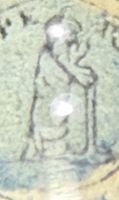
The design follows the Guyenne court cards cut for Bordeaux in 1746, known from the mould preserved in the Archives départementales de la Gironde. Here the figure is reversed, and two details have changed. The chequered panel on the valet’s chest has given way to the maker’s medallion, and the two small fleurs-de-lis that flank his feet on the 1746 mould have become budding plants, in keeping with the removal of royal emblems from French playing cards after 1793.
Left, the valet de trèfle of the Bordeaux mould of 1746, after d’Allemagne (1906); right, the present card, reversed, with the maker’s medallion on the chest and budding plants in place of the fleurs-de-lis.
Within the lettered ring of the medallion stands Hope, draped, her hand resting on the shaft of her anchor, surrounded by the words of the shop sign. Emblem and legend reproduce in miniature the signboard under which the maker traded.
The stencil colouring is laid in soft brick red for the cloak and cup, deep blue for the tunic, a paler blue for the stockings and sabre, and yellow ochre for the collar and the flowers. The blue runs slightly over the medallion, as is usual in stencil work.
From 1701 the French card tax was bound to official woodblocks, and each region kept its own court-card design, so that the authorities could recognise where a pack had been made. The portrait de Guyenne was the pattern of Bordeaux, Agen and the south-west. Closely related to the neighbouring Languedoc design, it received a new official mould at Bordeaux in 1746. The pattern preserves archaic features found in other French regions and in England: an axe-bearing king of spades, a king of hearts with a harp, four queens holding flowers and three valets with voluminous sleeves.
The Revolution abolished the tax on playing cards in 1791, yet cardmakers continued to print the regional designs, which during 1793-95 were stripped of crowns, sceptres and fleurs-de-lis. Napoleon’s administration restored central control: in 1808 David was commissioned to design a single national pattern, the regional designs, the portrait de Guyenne among them, were given up around 1810, and in 1813 the official portrait engraved by Gatteaux, derived from the Paris pattern, became the national standard.
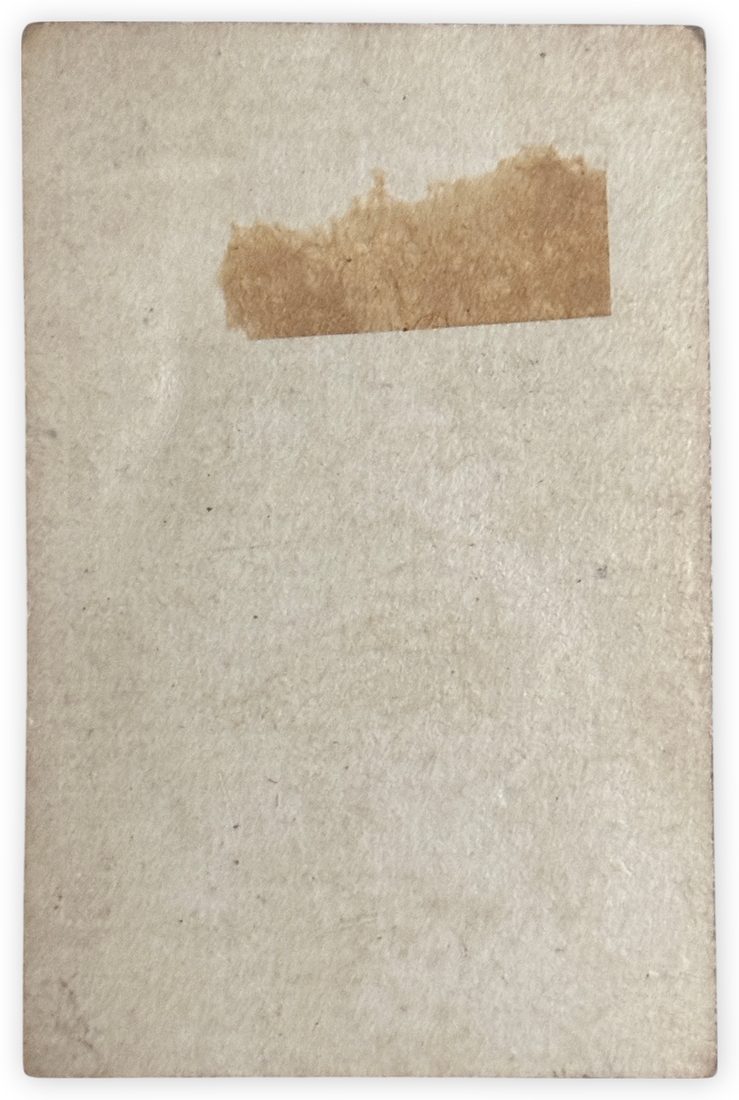
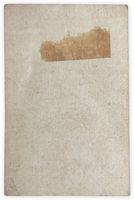
The present card belongs to this final phase of the regional tradition: in place of an official mark, the valet carries the name and emblem of a private maker. Its plain white back is typical of French cards of the period.
Pierre Durouchail was a native of Agonac, in the Périgord north of Périgueux, where the family name appears in the parish registers from at least the 1690s. A wood-engraver by trade, he was working in Bordeaux by 1795, cutting typographic ornaments and images reproduced by polytypage, and he published there a large woodcut broadside of twenty-four circular portraits, Portraits ressemblans, gravés d’après les médailles authentiques, de N. S. Jésus-Christ, et des principaux hérétiques…. He later settled in Paris as a wood-engraver in the rue des Grands-Augustins, where in the 1820s he perfected, with the Marquis de Paroy, a process of stereotype printing.
In Bordeaux Durouchail also made playing cards, under the sign “À l’Espérance”. Cutting woodblocks and printing coloured images for a popular market was the everyday work of a provincial cartier. No other card bearing his name is recorded in public collections.
Conditions: Fresh, bright stencil colouring and a strong impression. Light handling and faint surface soiling, mainly at the upper margin. The verso shows the brown residue of a paper hinge from former mounting, otherwise clean. A very good example.
References: H.-R. d’Allemagne, Les cartes à jouer du XIVe au XXe siècle, Paris: Hachette, 1906, vol. I, pp. 124 ff.; A. Nicolaï, Histoire de la carte à jouer en Guienne, avec étude-préface sur les maîtres-cartiers de Guienne, Bordeaux: Feret et Fils, 1911; F. M. O’Donoghue, Catalogue of the Collection of Playing Cards Bequeathed to the Trustees of the British Museum by the Late Lady Charlotte Schreiber, London: British Museum, 1901, p. 55, no. 65; T. Depaulis, Les cartes de la Révolution: cartes à jouer et propagande, Issy-les-Moulineaux: Musée français de la Carte à jouer, 1989; T. Depaulis, Pattern Sheet 112: Paris Pattern, International Playing-Card Society, 2018; Bibliothèque nationale de France, Département des Estampes, [Cartes de tête issues de jeux au portrait de Guyenne], 1700-1750, BOITE FOL-KH-383 (3,72); The World of Playing Cards, Guyenne Pattern, Portrait de Guyenne, https://wopc.co.uk/france/guyenne-pattern.