Transformation Playing Cards: Beatrice, or the Fracas
| Macro-category | Playing Cards and Tarot |
| Subcategory | Transformation Playing Cards |
| Author | Anonymous |
| Provenance | London |
| Publisher / Maker | Rudolph Ackermann |
| Year | January 1819 |
rare first edition, first issue, uncut of one of the most artistic and imaginative transformation decks from a traditional Viennese tale
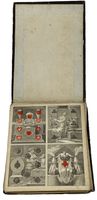
Beatrice, or the Fracas, London: Rudolph Ackermann, 1817-1818.
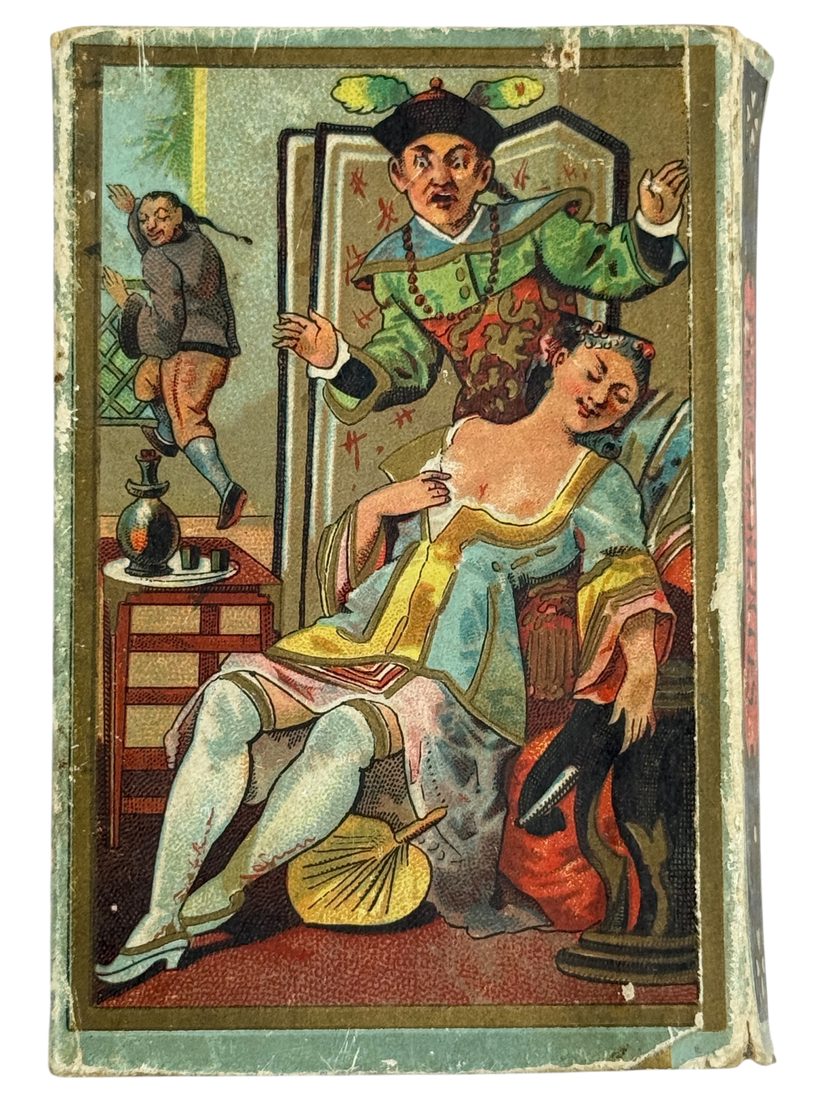
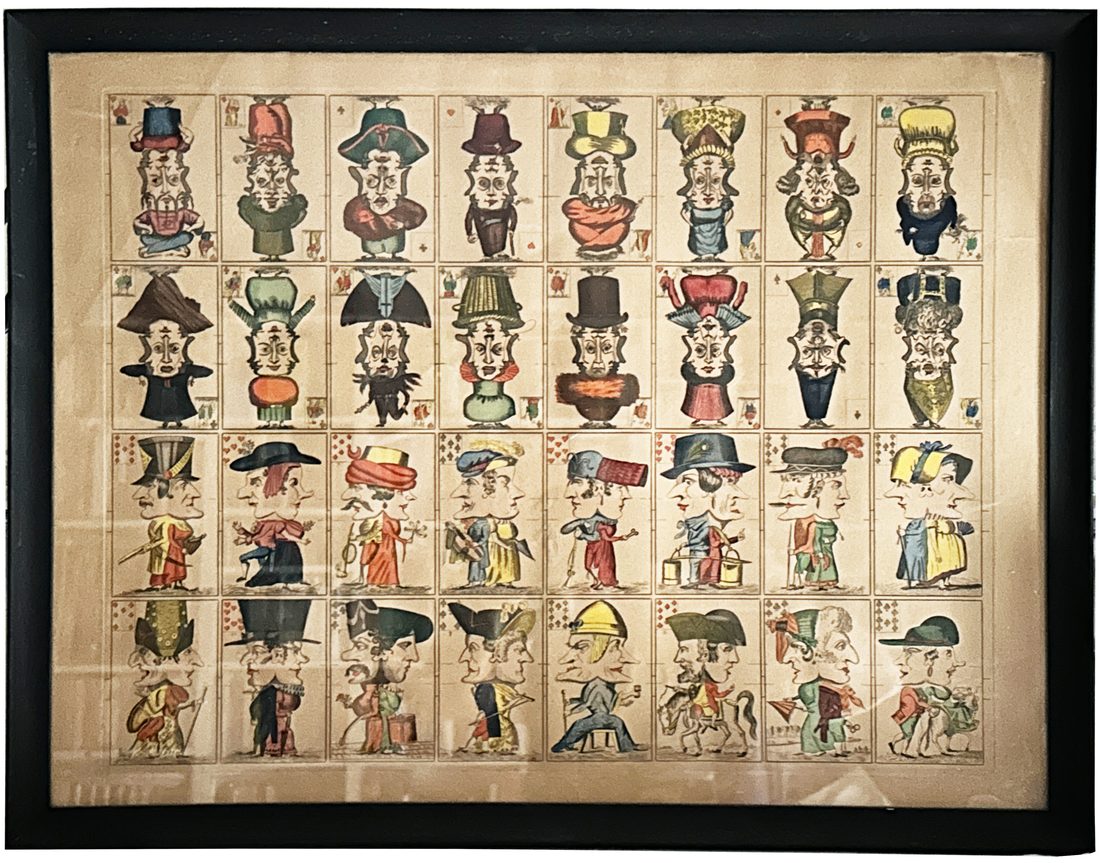
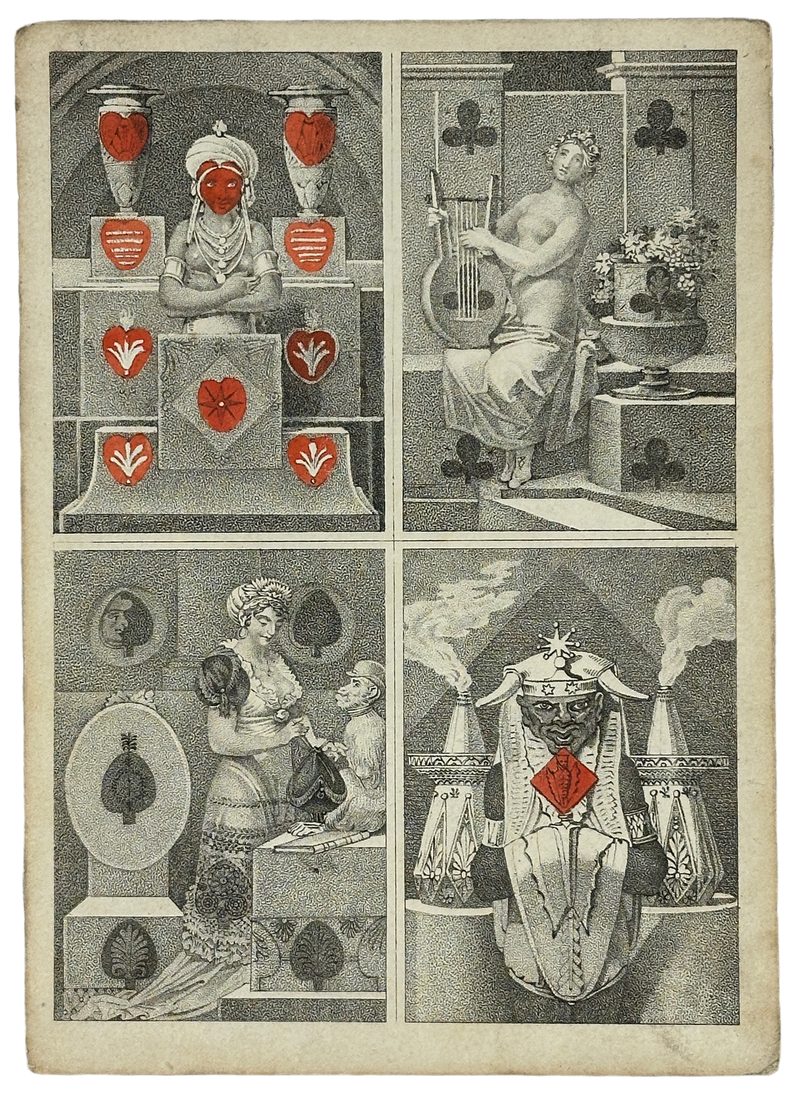
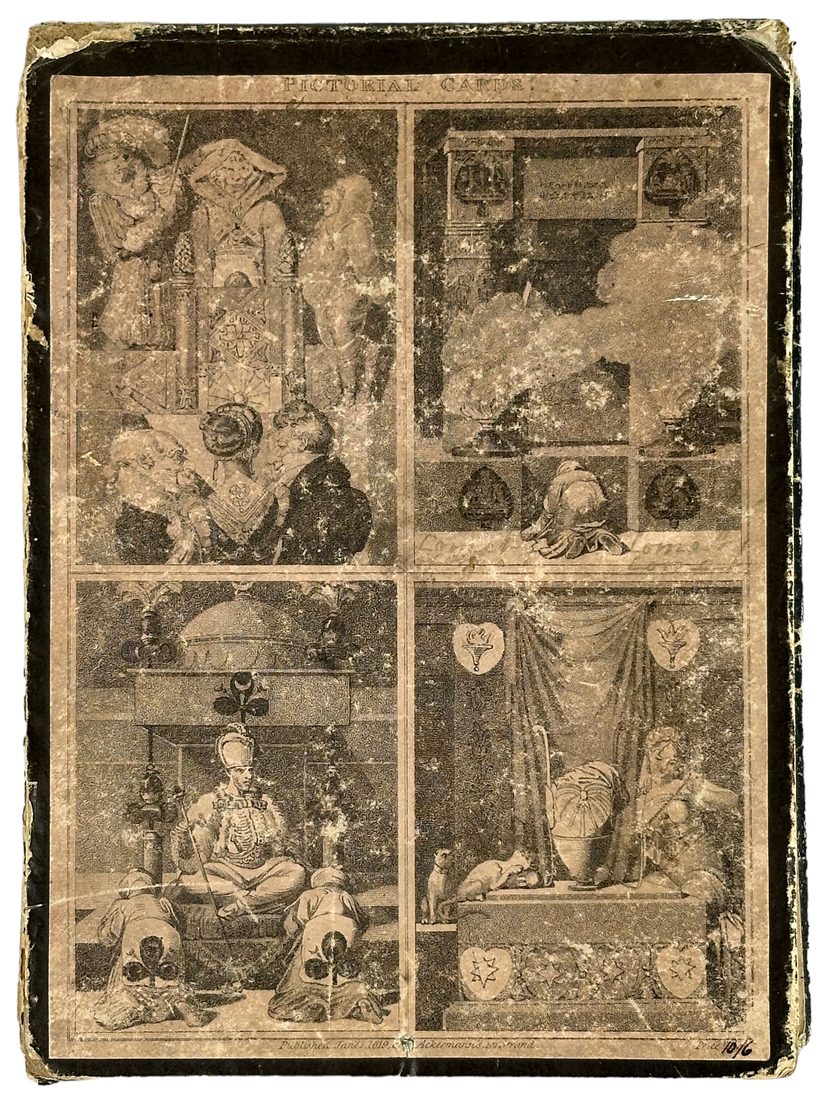
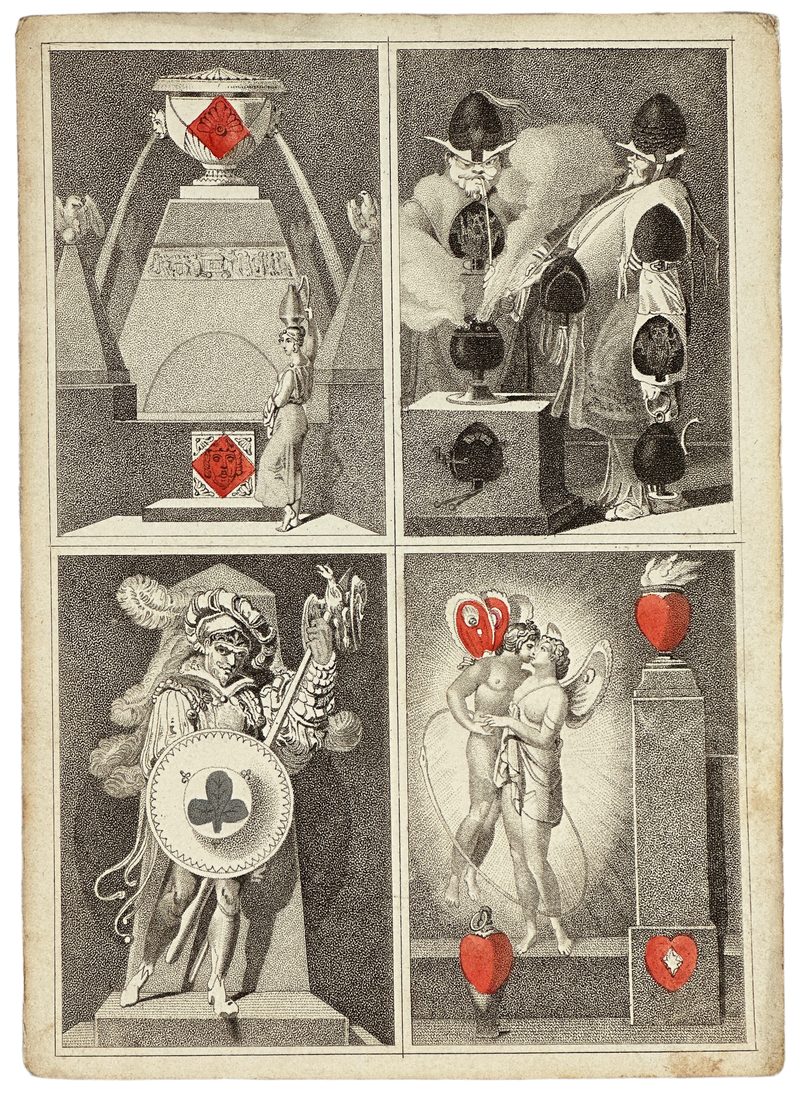
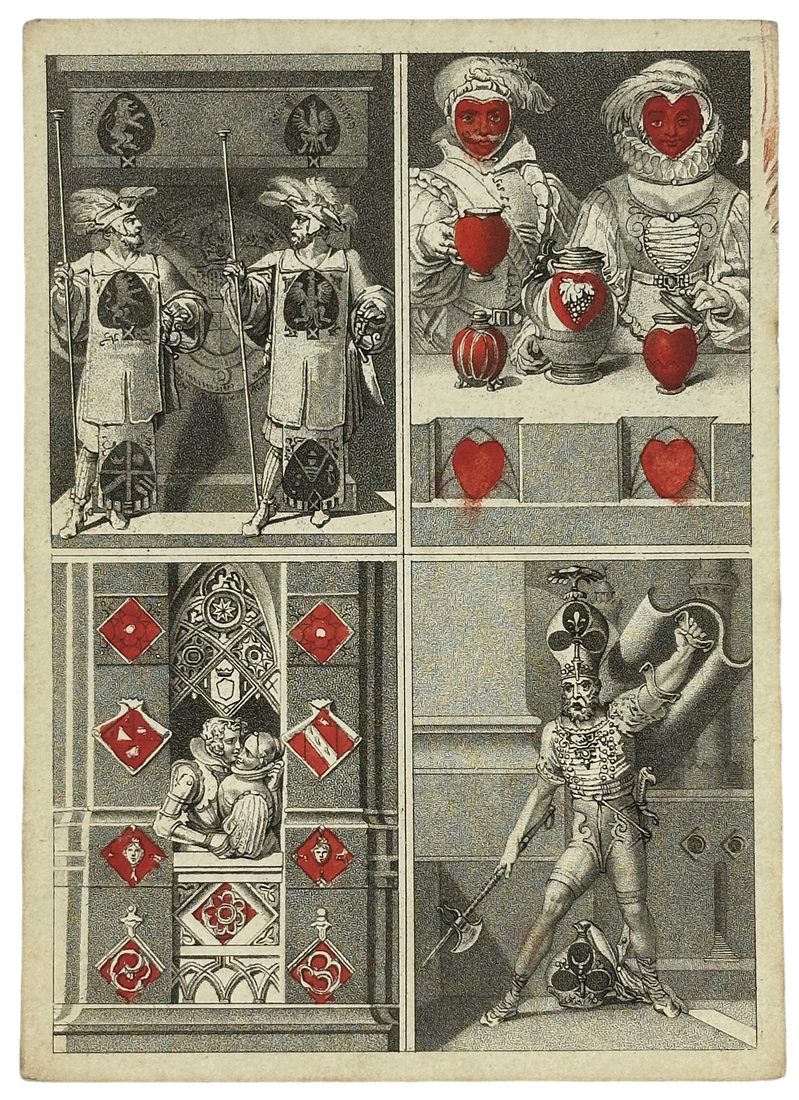
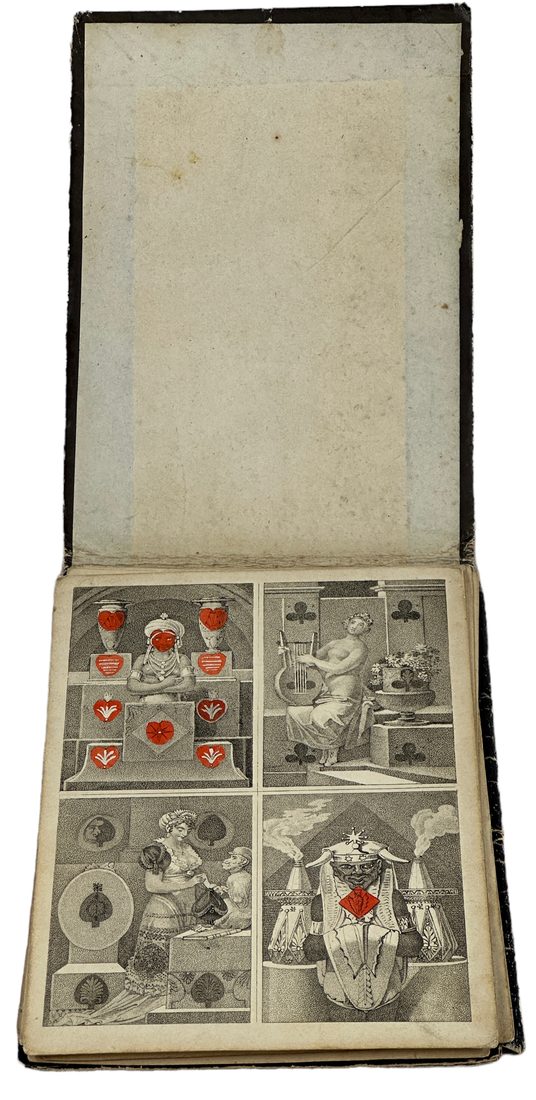
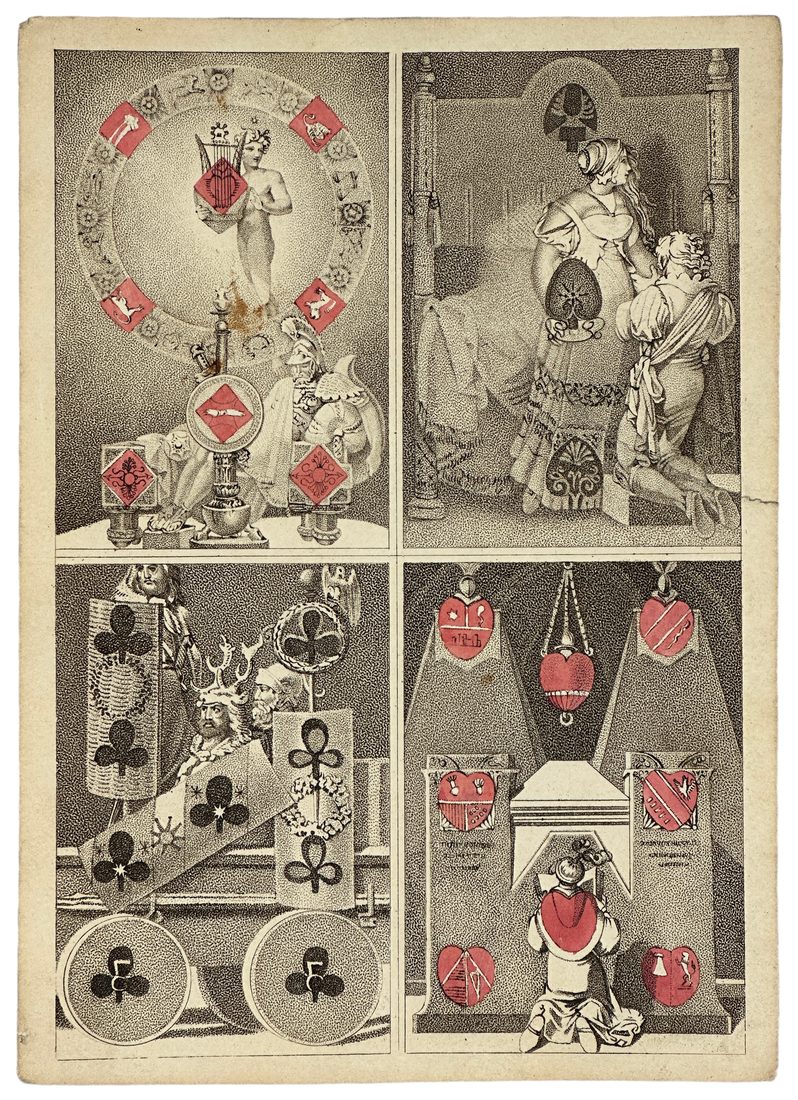
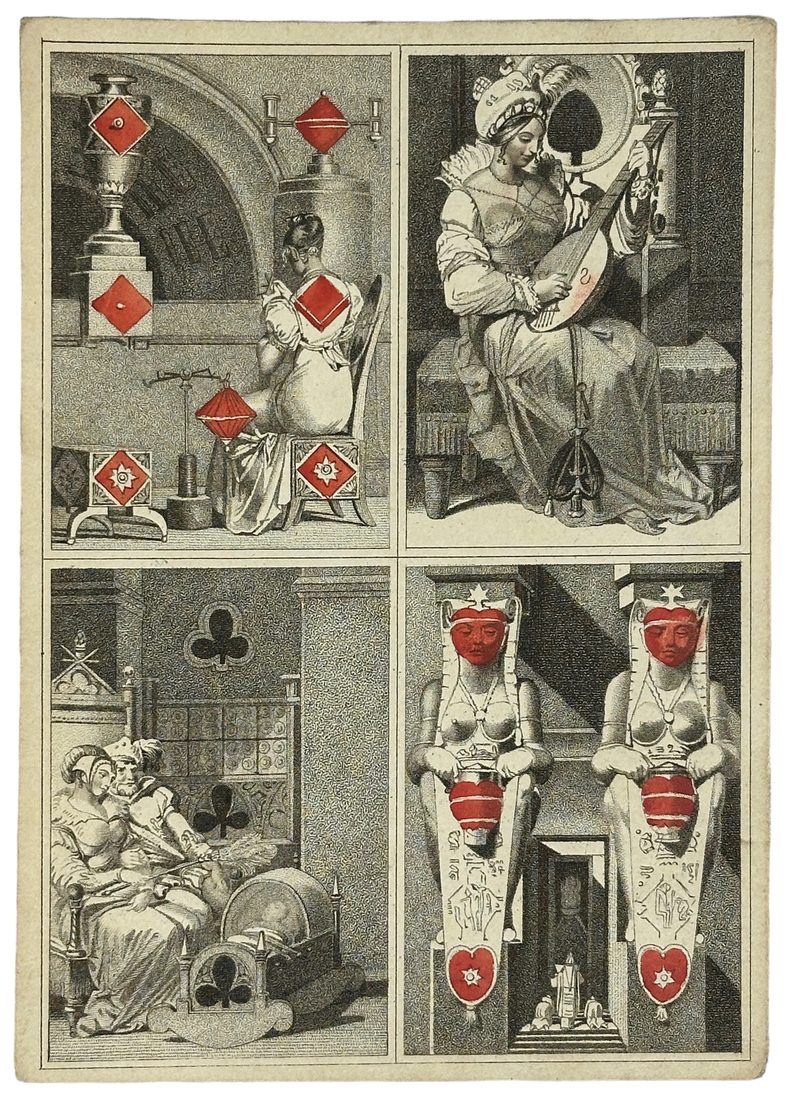
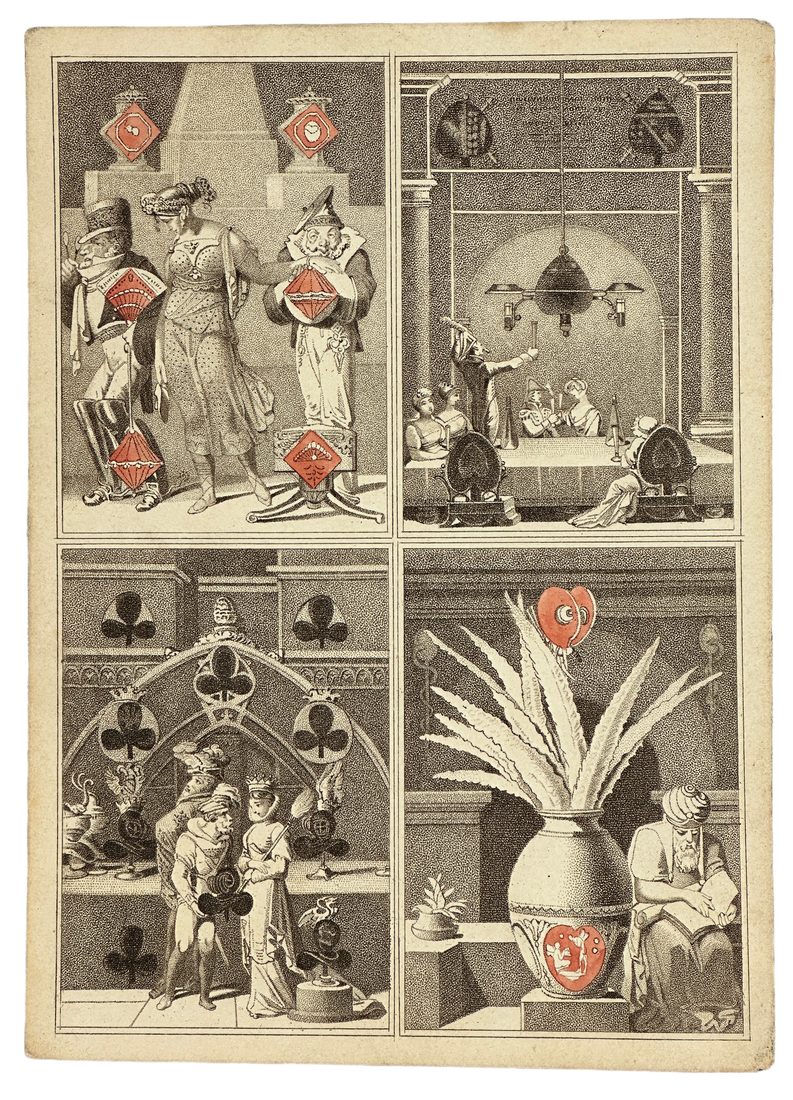
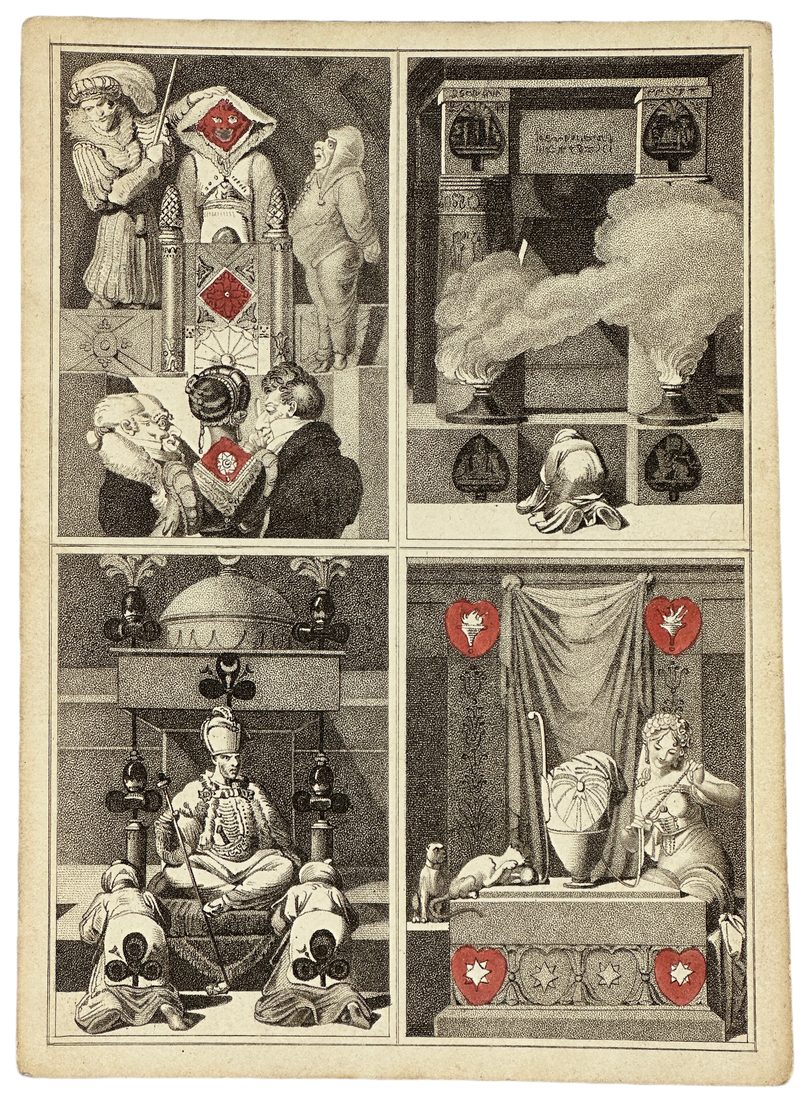
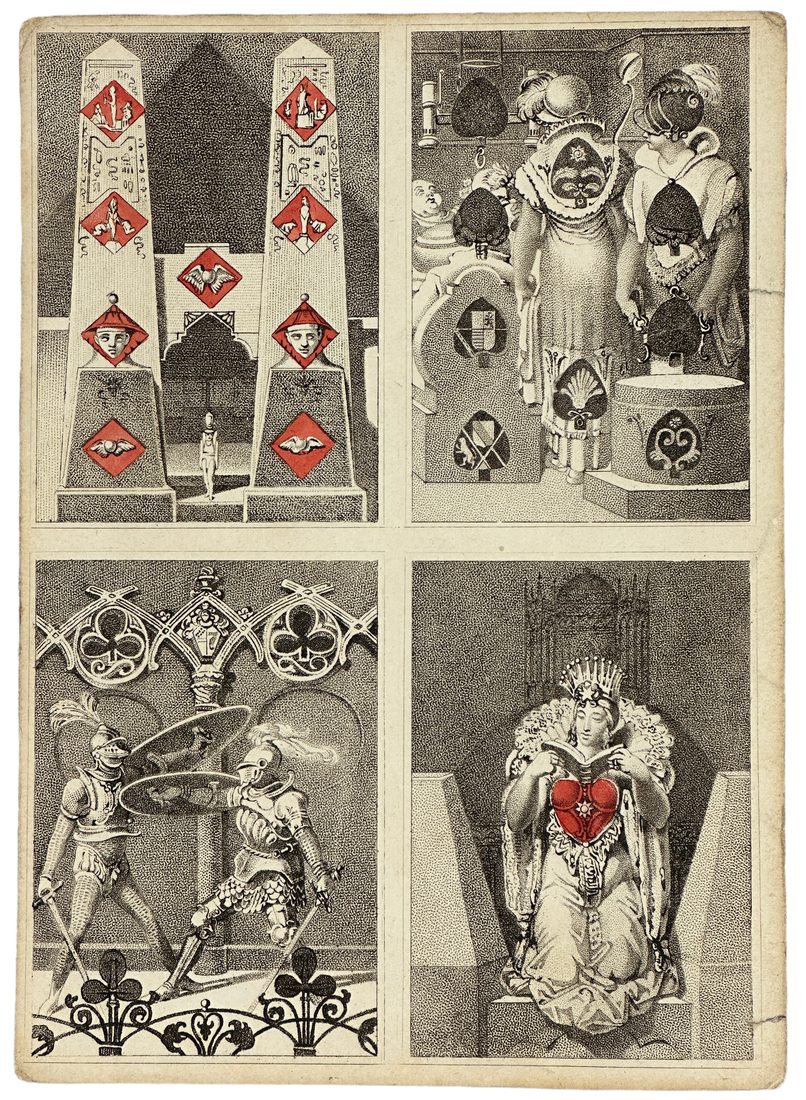
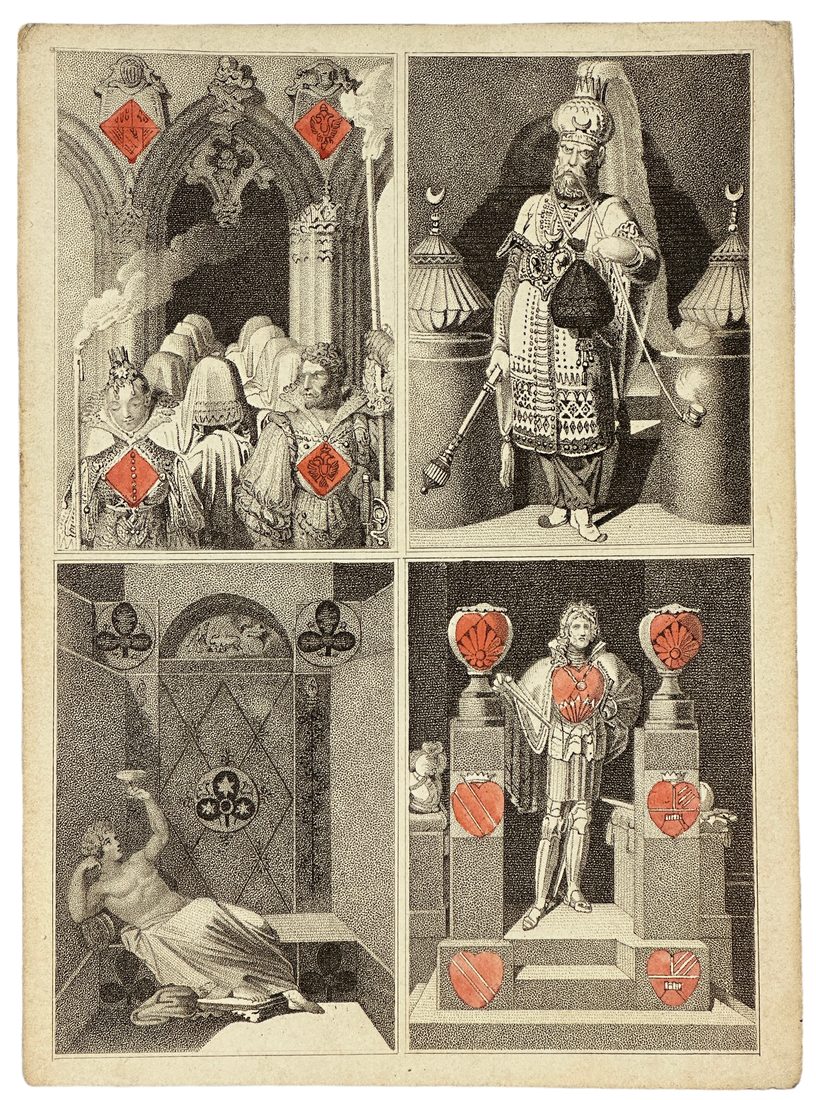
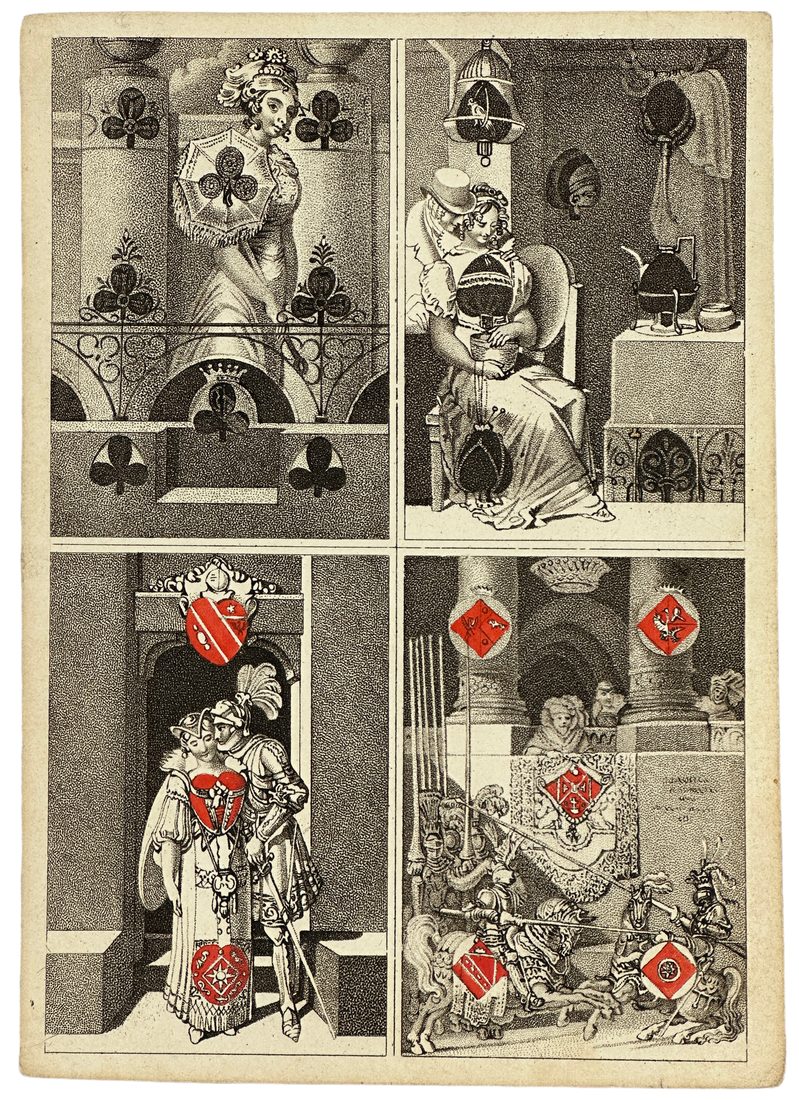
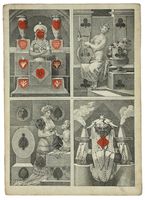
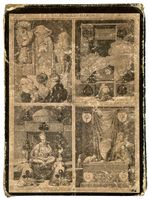
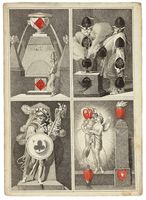
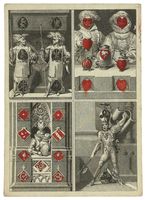
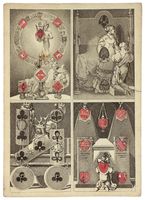
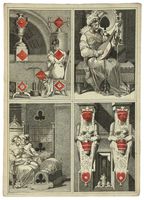
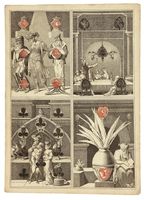
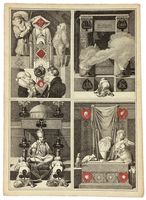
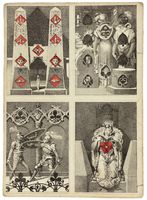
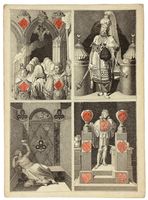
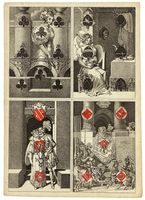
Complete uncut pack of 52 playing cards (9 x 7 cm), on 13 stipple engraved plates on thin card as issued (20 x 14,5 cm), each depicting four playing cards with French suites. Full-length court cards with contemporary hand-colouring, red suits with stencilled suit signs, pip cards transformed. Plates contained together in original portfolio with stiff front and back covers (worn), front cover with one of the plates reproduced as a paper label (faded). Pictorial Cards title at head, and imprint at foot dated Jany 1 1819, printed price to lower right overwritten in early ink manuscript “10/6”, faint ink manuscript signature at centre of front cover.
Jeu à transformation (Transformation Game) is the name given to a particular kind of decks of cards, printed for the first time in Germany at the start of the XIX century, in which the suit signs form part of the humorous, dramatic, or artistic design.
The original drawings for the cards of the Beatrice, or the Fracas deck were made by an artist of Vienna, H. F. Müller, with an exotic design depicting classical Romans, Greeks, and Turks.
As Albert Field describes:
“The cards appeared in a monthly magazine called Repository of Arts, Literature, Commerce, Manufactures, Fashions and Politics, four cards to a tipped-in plate with the number and date of issue at the bottom of the plate. In the upper right corner above the cards are the numbers of the plate and the volume. The watermark on the paper is dated 1818.
In the first four issues of the magazine, parts of a short story, “Beatrice, or the Fracas” were printed. The descriptions given of the scene on each card stated that the first four spade cards printed were illustrations of scenes in the story.
However, other cards in the spade suit do not seem to fit with the story.”
“The subjects of the pip cards are rather exotic, with many processions, high priests and sepulchral scenes, the courts depicting historical figures, often of warlike character (they are known both with plain background and with decorative background):
the kings are a Roman general (hearts), a crowned king (spades), a Turkish monarch (diamonds) and Alexander the Great (clubs).” (Mann, op.cit.)
The cards were not issued in playable form but were commonly cut up for use, and therefore rarely survived intact in their original uncut plates.
Before the official monthly publication in the repository, a first issue was published, to which the present deck belongs.
“The cards were also published on brown cardboard watermarked 1817 in a portfolio with stiff front and back covers and no binding. Since these plates do not have the numbers in the upper right corners, they must have been printed before the plates were used for the magazine, as numbers could not be removed from an engraved plate but could easily be added later. The date of the watermark is consistent with this deduction.” (Field)
After Ackermann’s version, at least three other editions of the deck were printed, in Austria, France, and America.
The Austrian edition is identified by the name and address of the publisher appearing at the base of the King of Hearts, Zu finden in Wien bey H.F. Müller Kunsthandler, and by the suit figures printed with no background, probably from a modified set of the original Müller plates.
The French edition of the “Beatrice” pack was published in Paris by Gide fils, rue St. Marc No. 20. The designs are the same, but the plates are new, and the face cards are like the Viennese version. On the 3 of diamonds in the lower left corner (and in mirror image in the lower right) are the inscriptions “Pérée Sp”. These cards were titled “Cartes Boufonnés.”
In 1833 a fourth “Beatrice” version, published by C. Bartlett in New York City, was called “Pictorial Playing Cards”. The cards, probably copied from the English edition but on new plates, included full backgrounds. Bartlett provided a thirty-six-page booklet containing the story that Ackermann printed.
Conditions: Light marks of use on a few cards, but overall in remarkable condition for a very rare deck in its original uncut first issue, within its original portfolio.
Provenance: Dudley Ollis’ collection: Dudley Ollis was member of the International Playing Card Society and it’s considered the most important English private collection of playing cards. Ollis formed his collection over more than 50 years, and it includes rarities such as a set of English cards printed with the musical notation and lyrics from The Beggar’s Opera.
References: Albert Field, Transformation Playing Cards, U.S. Games Systems, 1987, 22: `One of the most artistic and imaginative transformation packs`; Ortiz-Patino collection p.72; Catherine Perry Hargrave, A History of playing cards, Dover publications, 2021, p. 146; Kathleen Wowk. Playing Cards of the World , Lutterworth press, 1983, p. 38; Wynne, Marjorie G., and A. Hyatt Mayor, The Art of the Playing Card, The Yale University Library Gazette 47, no. 3 (1973): 137–84; Sylvia Mann, Collecting Playing cards, Arco Publications, 1966, p. 168; Sylvia Man, All Cards on the Table, Verlag, 1990; Schreiber, German, 249, 332 and 339 (For H. F. Müller biography); Berry, Playing-Cards of the World [255].