Jeu de Grotesque
| Macro-category | Playing Cards and Tarot |
| Subcategory | Transformation Playing Cards |
| Author | Anonymous |
| Provenance | France |
| Publisher / Maker | Anonymous |
| Year | 1800 |
A Grotesque Vision of Piquet: The “Léger-de-Main” Deck
and the Birth of the French Caricatural Card
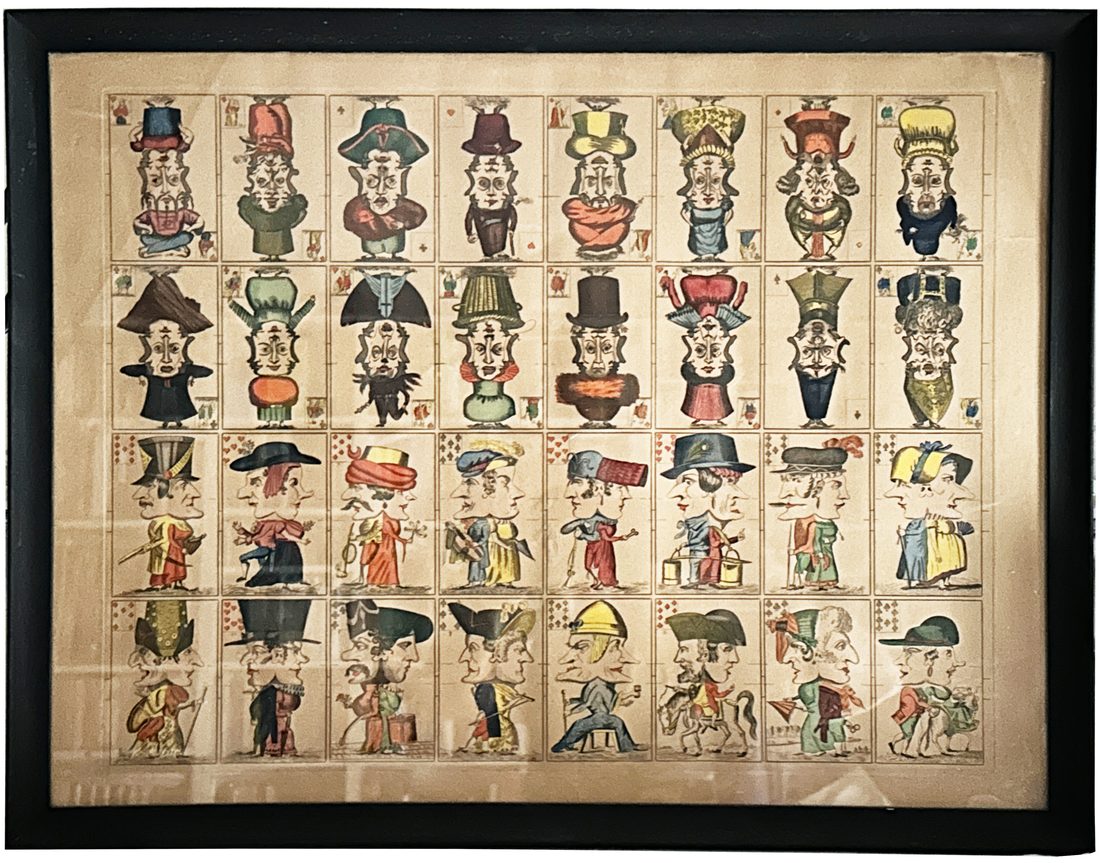
Léger-de-Main - Jeu Grotesque, France, ca. 1800.
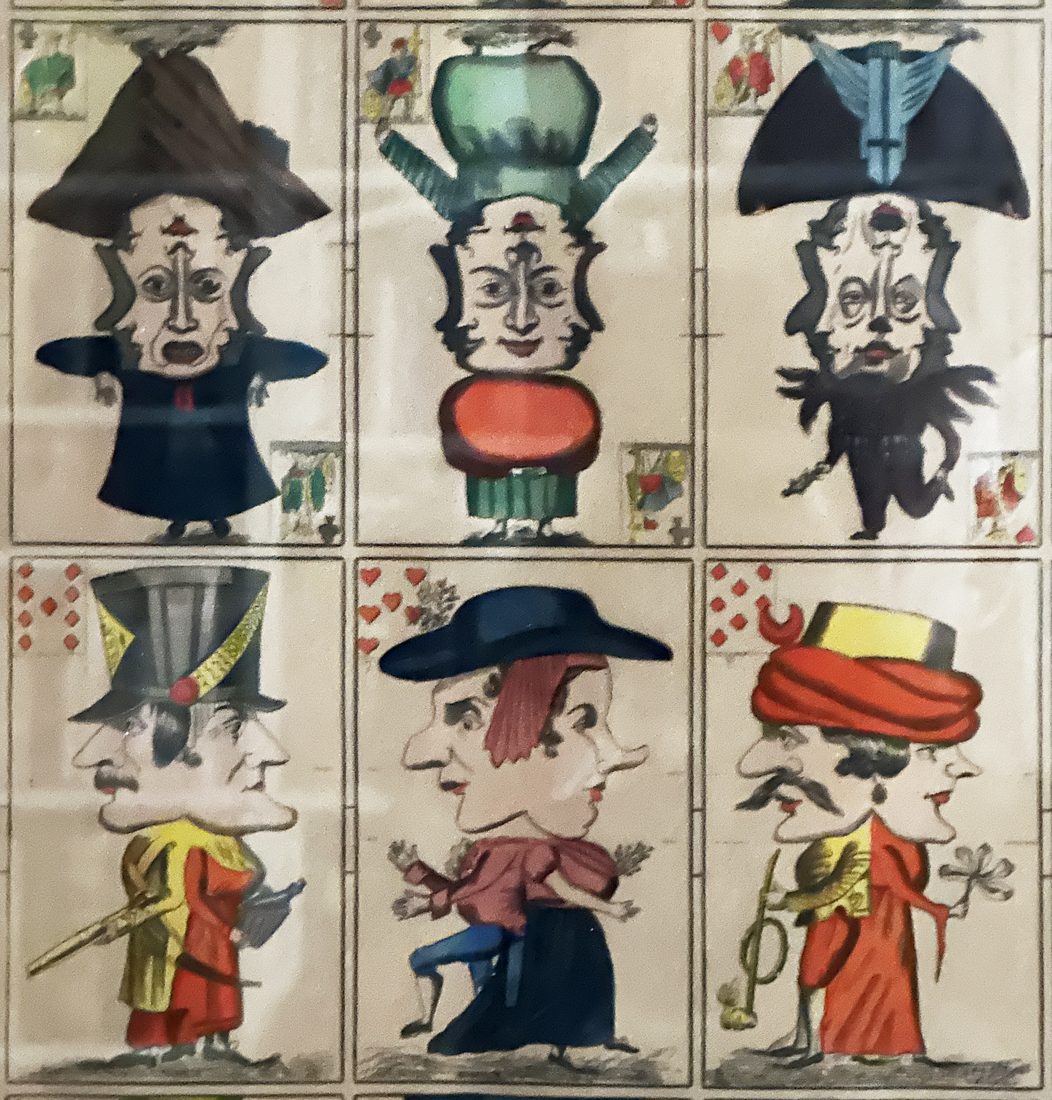
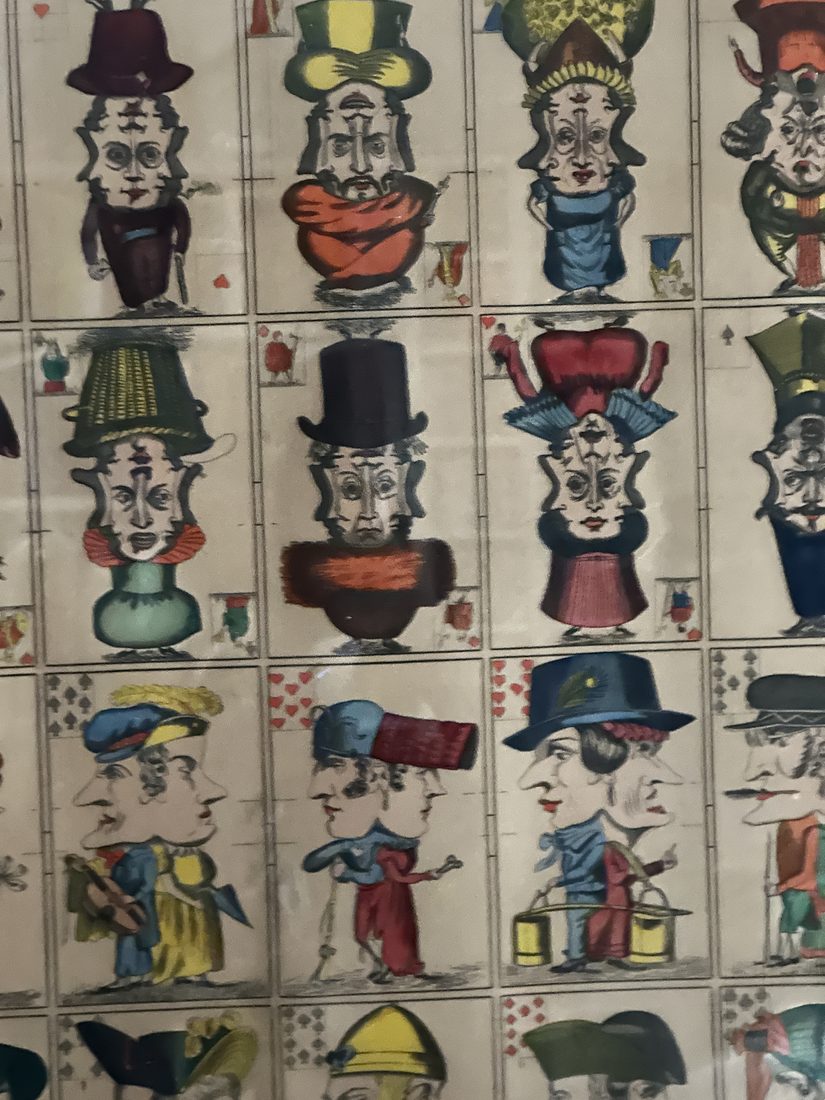
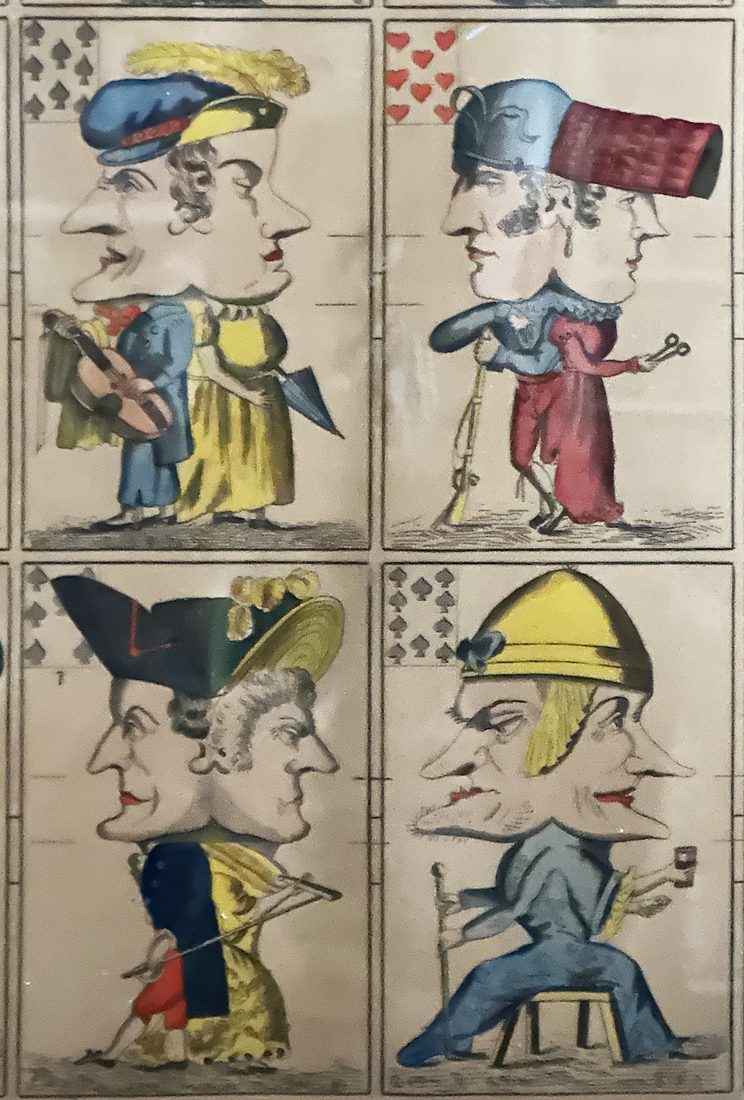
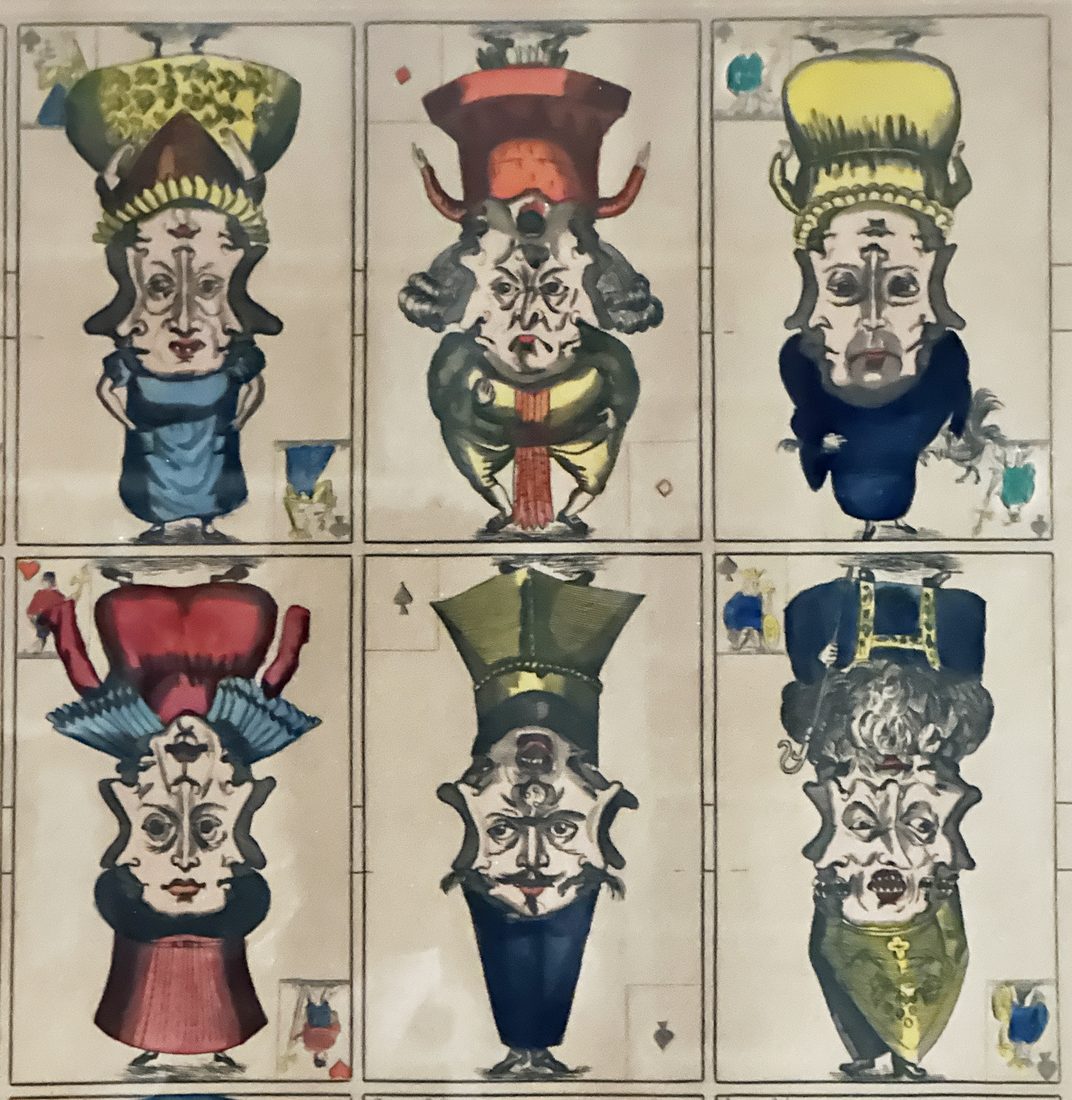
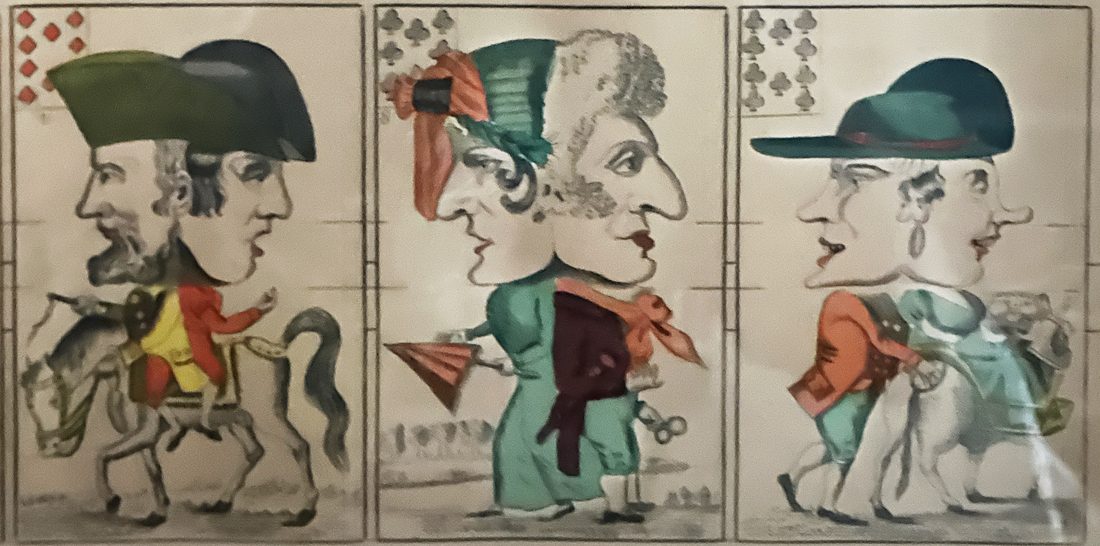
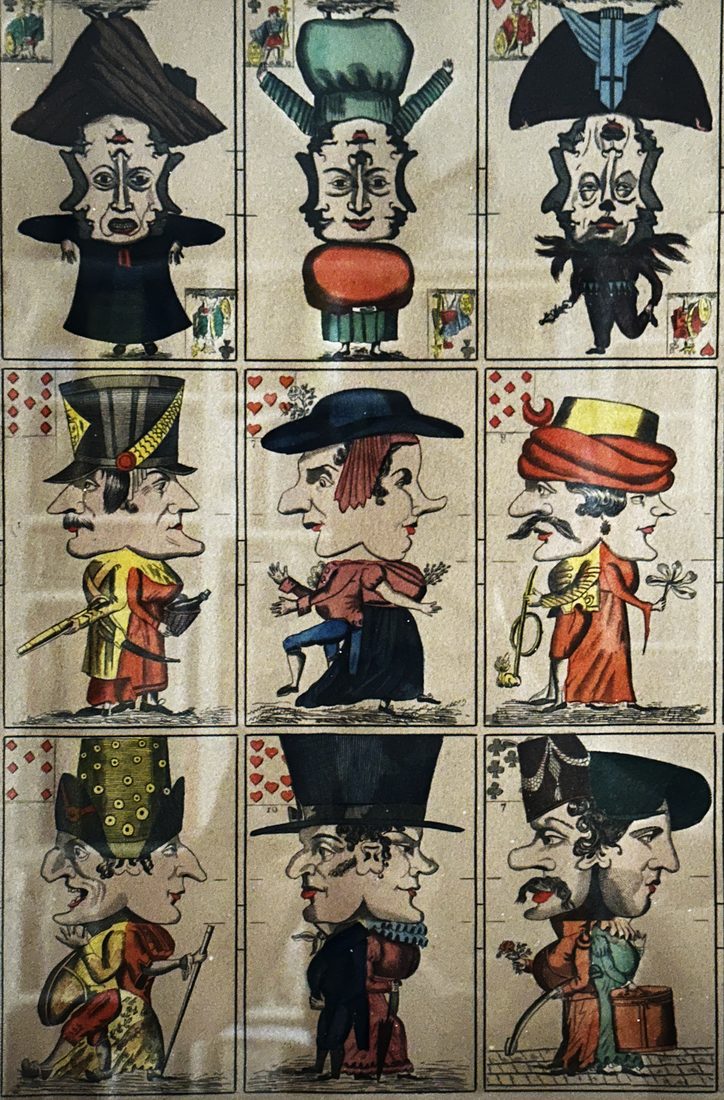
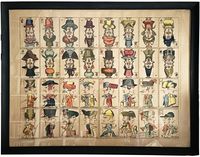
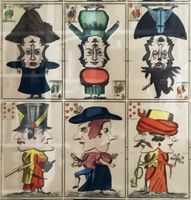
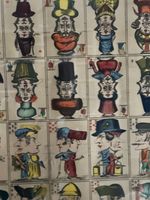
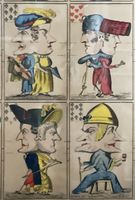
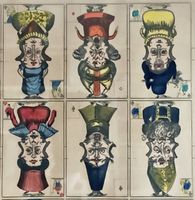
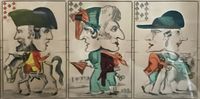
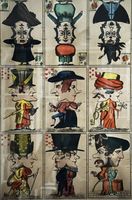
32/32 cards (each ca. 105 × 70 mm) printed from woodblocks on laid paper, hand-coloured with watercolour and gouache in yellow, red, blue, and green. Complete uncut sheet (660 × 500 mm), mounted within a wooden frame under glass. The sheet presents eight horizontal rows of four cards each, arranged for a 32-card piquet deck (A, K, Q, J, 10–7). Each card bears a grotesque caricature: the court cards are vertically reversible, showing distinct faces when inverted, while the pip cards portray couples joined at the back, their profiles forming composite or bifacial heads. Suits (hearts, diamonds, clubs, spades) appear in small conventional cartouches at the upper corners. No tax stamp is visible, which—together with stylistic evidence and paper quality—suggests an early pre-Napoleonic production, probably c. 1795–1805.
This rare uncut sheet of Léger-de-Main or Jeu Grotesque represents one of the earliest examples of satirical “cartes à rire,” an innovative and humorous reinterpretation of traditional French playing cards. Conceived for the 32-card piquet format, the deck replaces ordinary courts and numerals with grotesque anthropomorphic heads whose orientation reveals multiple characters. The witty fusion of optical illusion and social caricature exemplifies the playful experimentation of late-18th-century French popular imagery. Its preservation as a complete, uncut sheet is of exceptional rarity and bibliographical significance.
The structure adheres to the French piquet pack, using eight cards per suit: ace and seven through king. The four suits are identifiable through the corner indices—hearts, diamonds, clubs, and spades—each paired with caricatural figures reflecting contemporary costume types. The aces and court cards are designed with a vertical reversibility: viewed one way, a king or queen may appear as a soldier or burgher; inverted, the same outlines transform into another face. The pip cards (7–10) feature double-headed compositions, typically depicting male and female profiles fused at the nape, yielding a comic hybrid suggestive of moral satire. Stylistically, the exaggerated facial geometry, tiny torsos, and heavy outlines derive from late 18th-century caricature traditions akin to those of James Gillray and French contemporaries in popular engraving. The colouring, applied by stencil or free brush, enhances the grotesque contrast of dress and physiognomy. The sheet preserves its full margins, with light fold marks consistent with storage prior to framing. No inscription appears, confirming that this sheet likely circulated as a humorous print or demonstration model for a jeux de société rather than as a cut deck in use.
The Jeu Grotesque belongs to the flourishing genre of cartes à rire that appeared in France around the turn of the 19th century, when traditional playing cards inspired a host of satirical and educational variations—botanical, musical, moral, or social. This development paralleled the broader diffusion of caricature through lithography and wood engraving in post-Revolutionary France, where satirical prints mocked the pretensions of the aristocracy and the newly emergent bourgeoisie alike. Such decks were both amusement and commentary: the Léger-de-Main (“sleight of hand”) title plays on illusion, suggesting both conjuring tricks and visual transformation, while “Jeu Grotesque” emphasizes distortion and wit. The reversible or composite faces demonstrate a fascination with metamorphosis and optical ambiguity, anticipating later visual jokes and double-image caricatures popularized in the mid-nineteenth century. These hybrid games, balancing entertainment and visual pun, embody the Enlightenment’s transition toward bourgeois leisure culture and the democratization of print humour. A comparable later issue, Le Jeu des Binettes published by B.P. Grimaud in Paris in the later 19th century, perpetuated the same idea of grotesque reversible portraits, confirming the longevity of this visual trope.
Conditions: Perfectly preserved.
References: K. Wowk. Playing Cards of the World , Lutterworth press, 1983, p. 66; C. Perry Hargrave, A History of playing cards, Dover publications, 2021, p. 71; A. A. F. FOURNIER. Los Naipes, Museo Fournier, Vitoria : Heraclio Fournier S.A., 1982, [322], p. 141. Il. col. p. 14; H. R. D'Allemagne, Les cartes à jouer du XIV au XX siècle, Paris, Librairie Hachette, 1906.