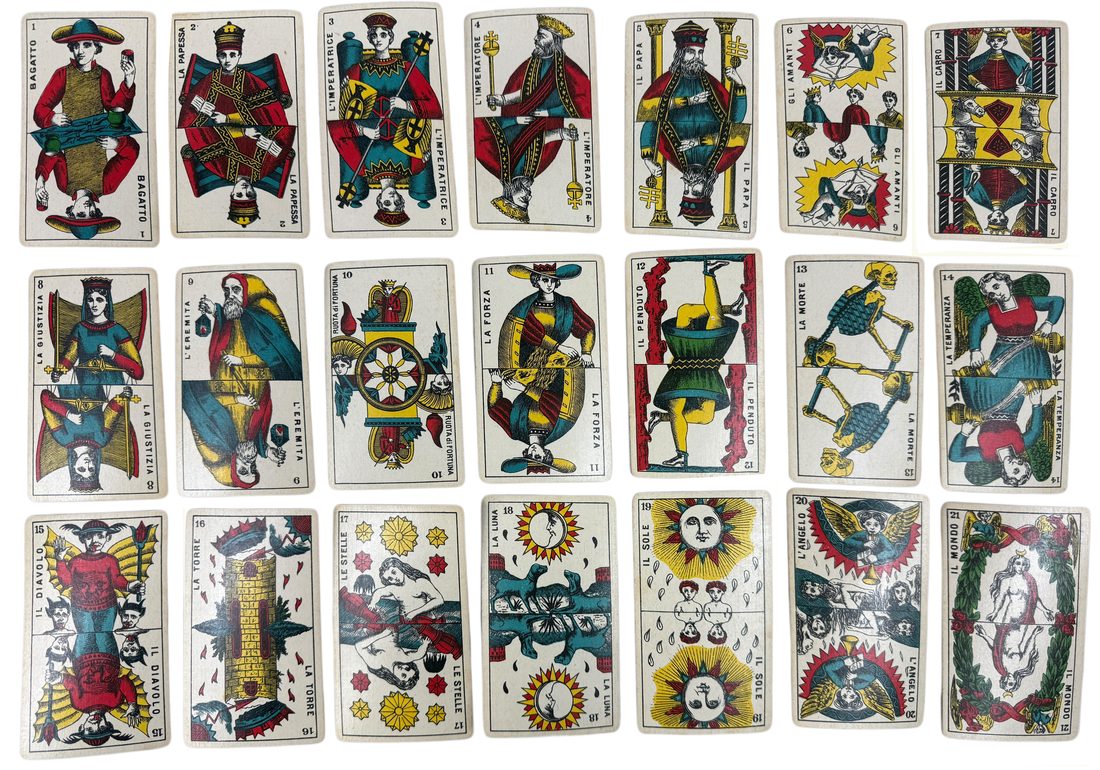
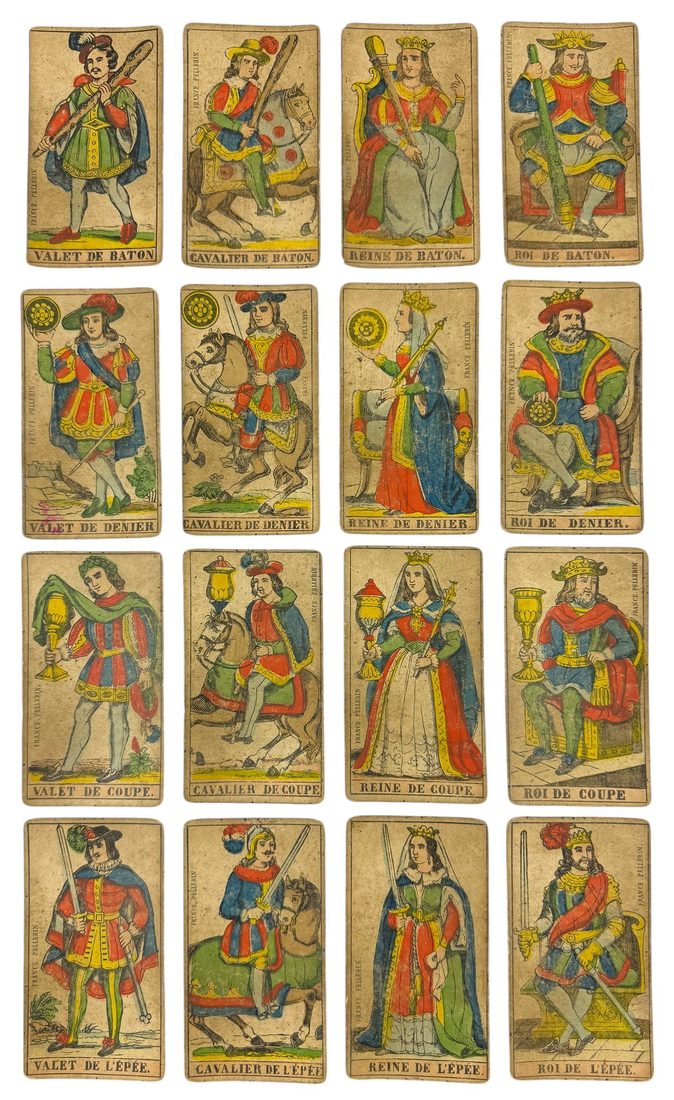
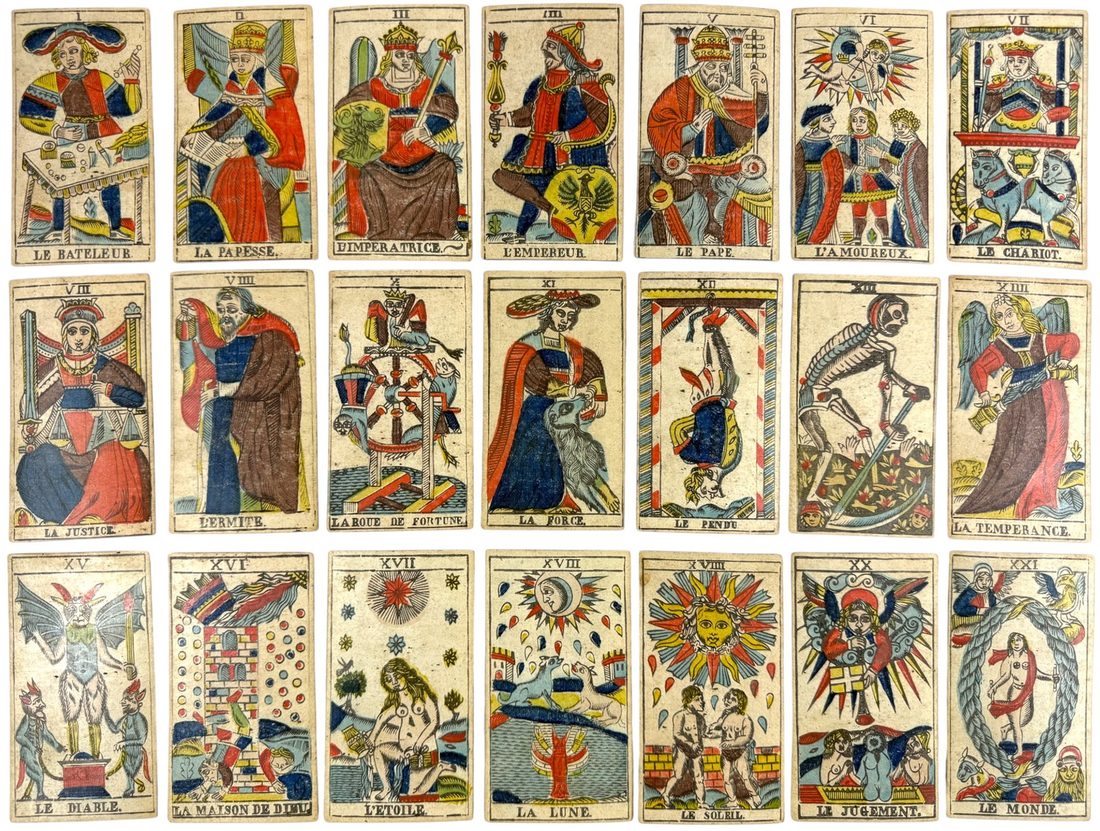
Minchiate Fiorentine ("Carte da Giuoco Toscane")
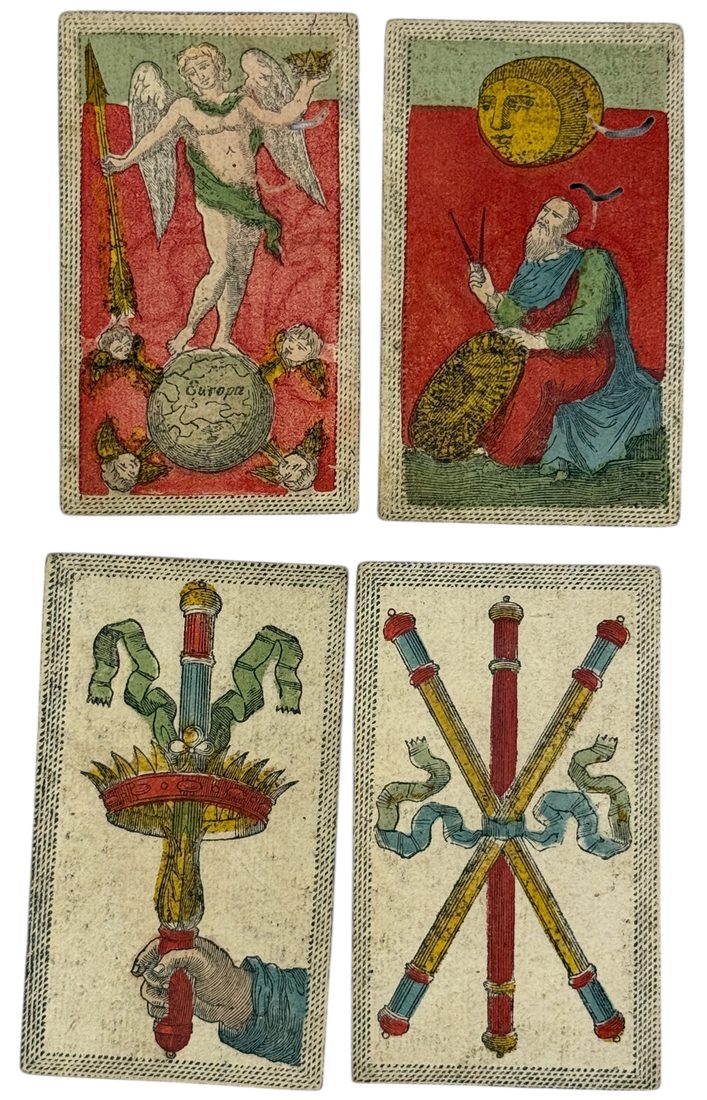
| Macro-category | Playing Cards and Tarot |
| Subcategory | Tarot |
| Author | Anonymous |
| Year | 1820 |
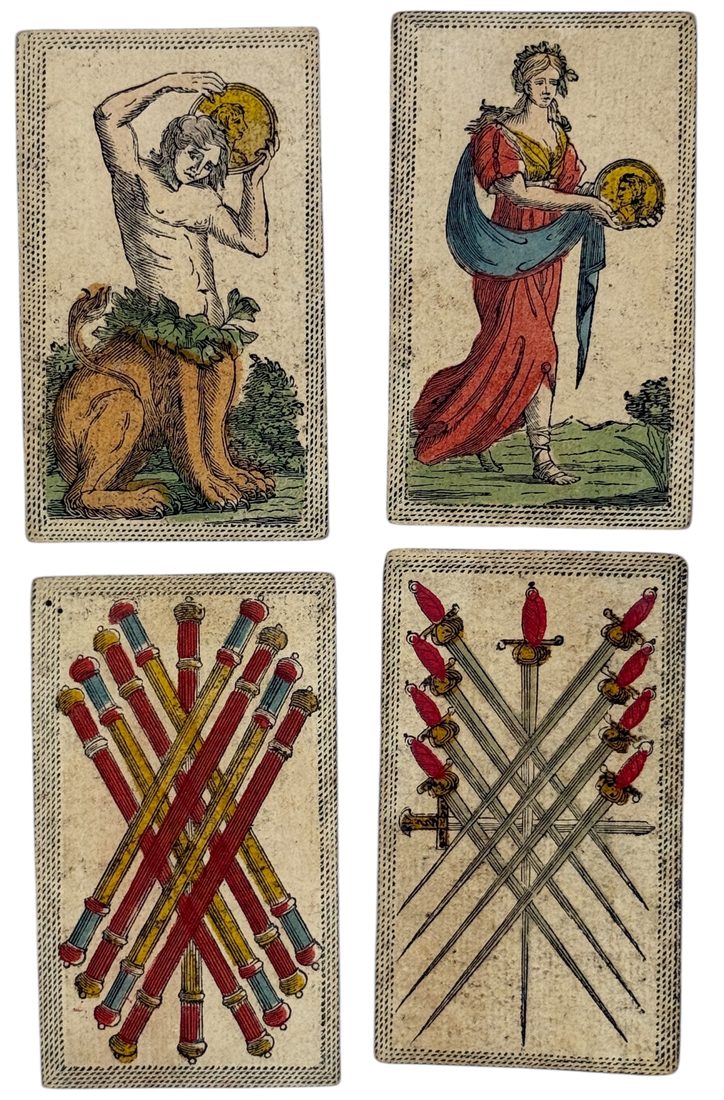
rare 19th century hand-painted deck of “minchiate Fiorentine”
A game derived from tarot and originating
In Florence in the 16th century
Minchiate Fiorentine. Florence, c. 1820.
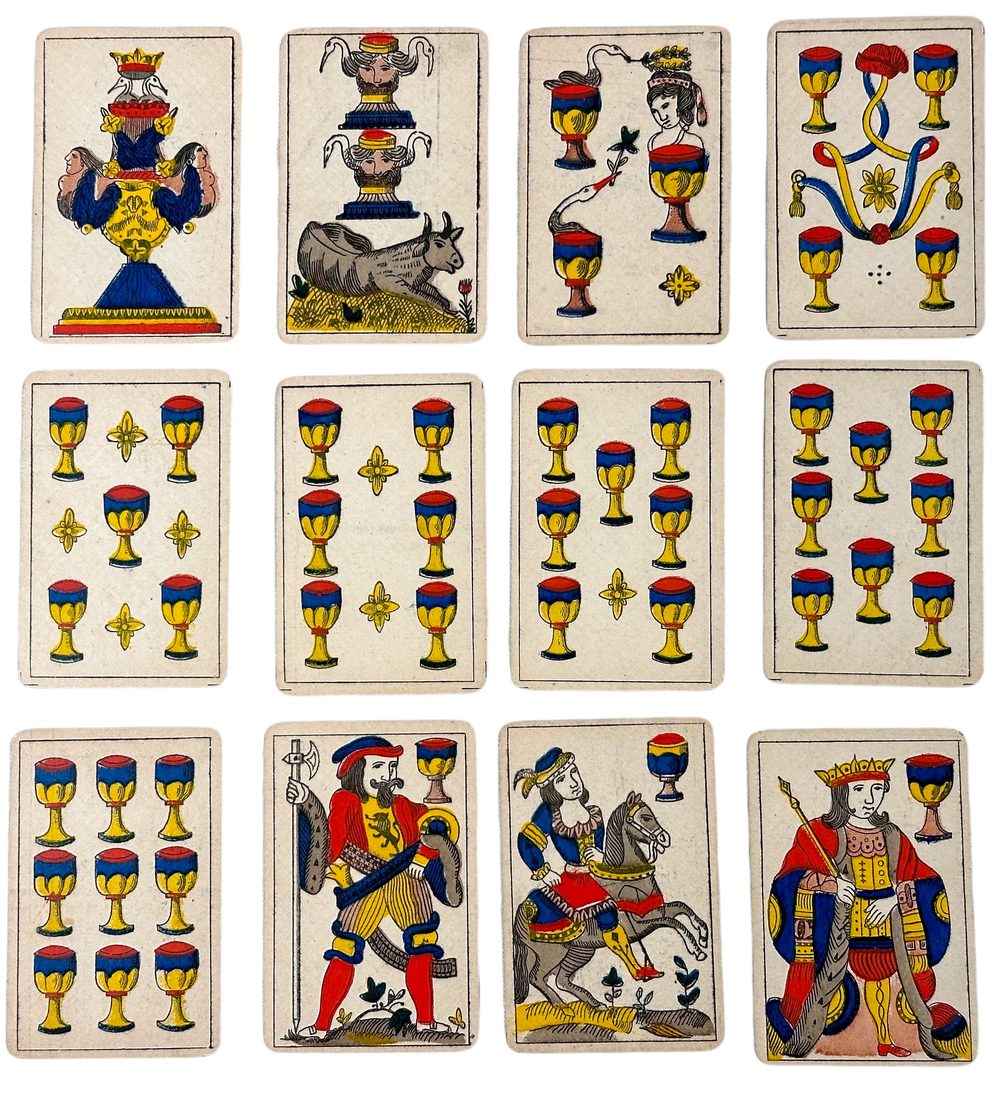
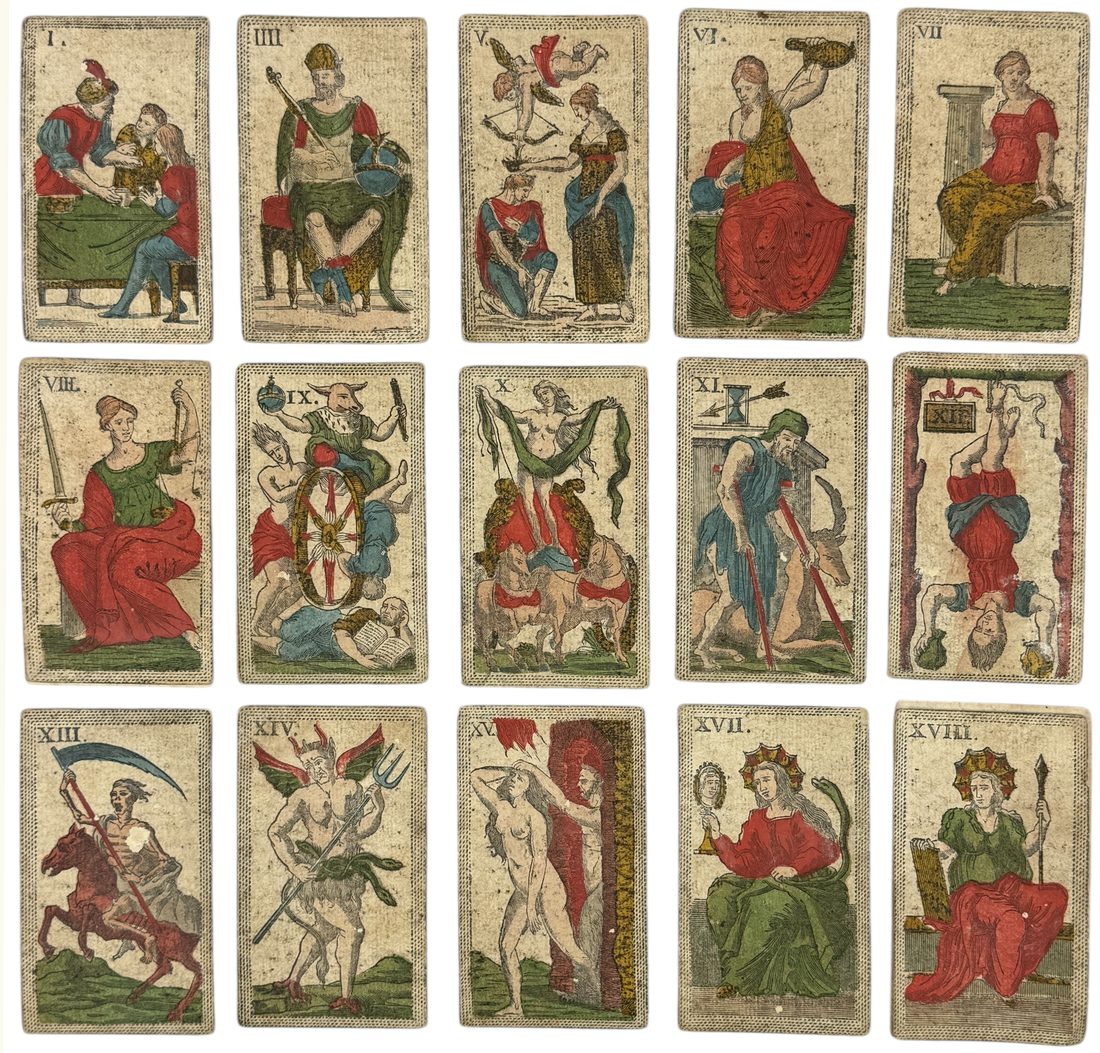
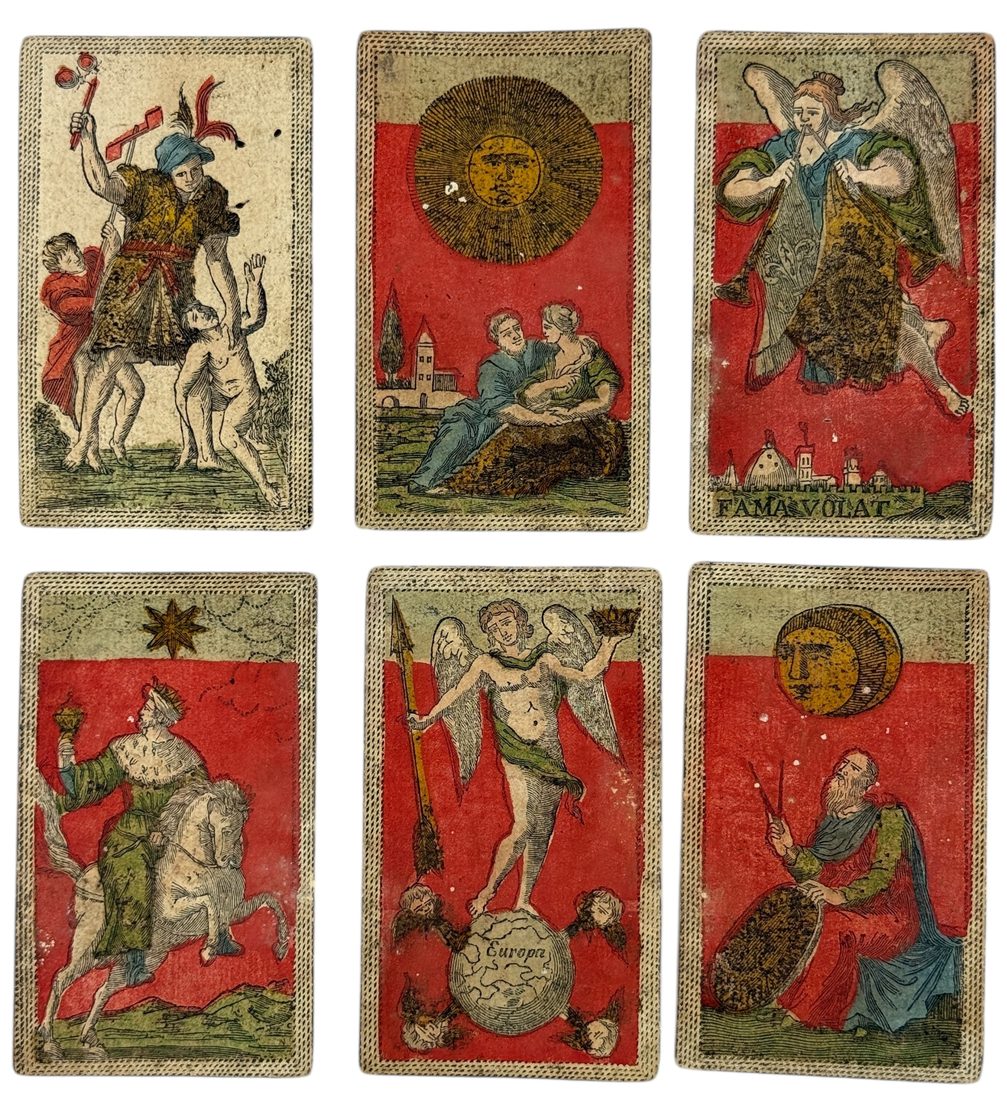
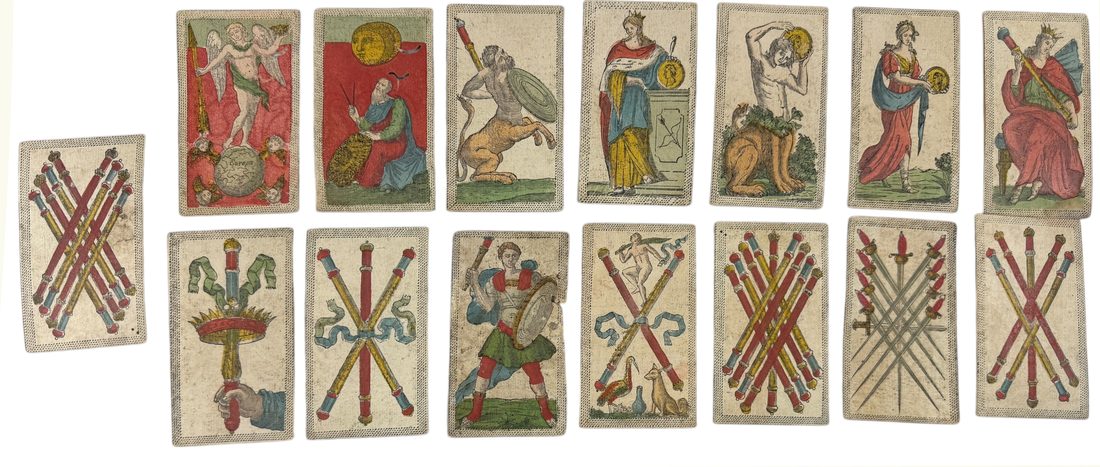
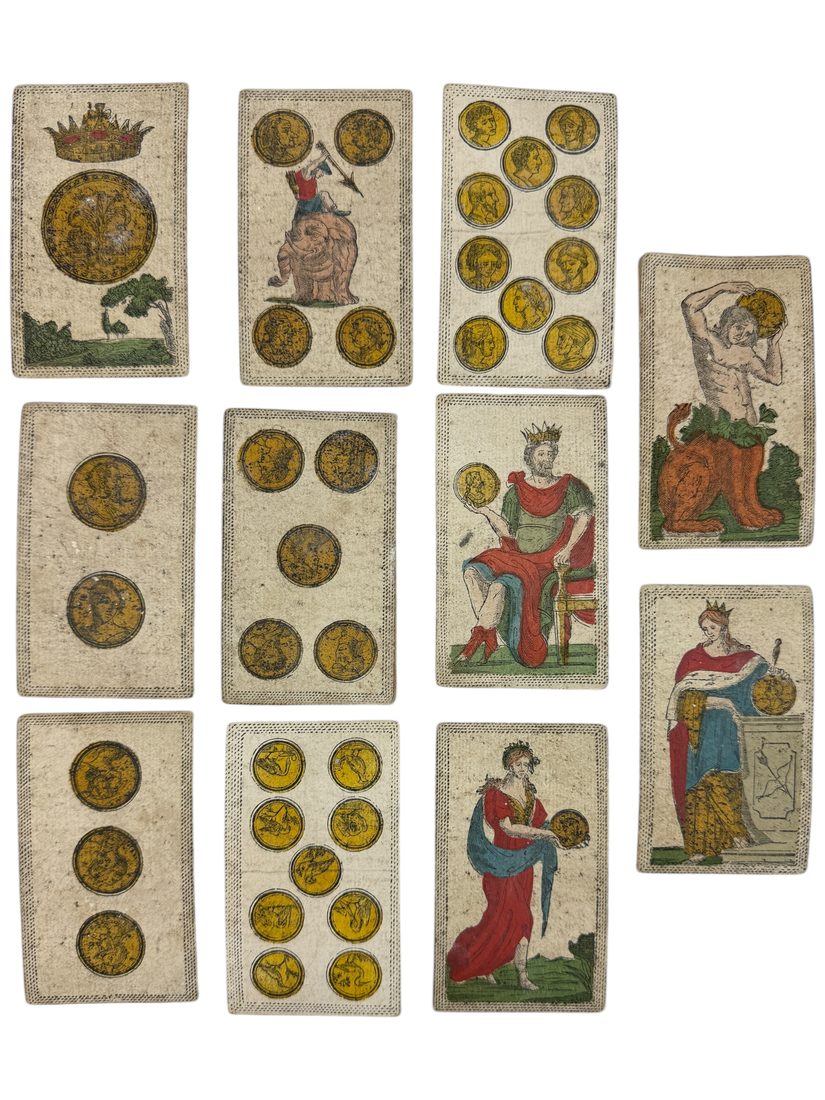
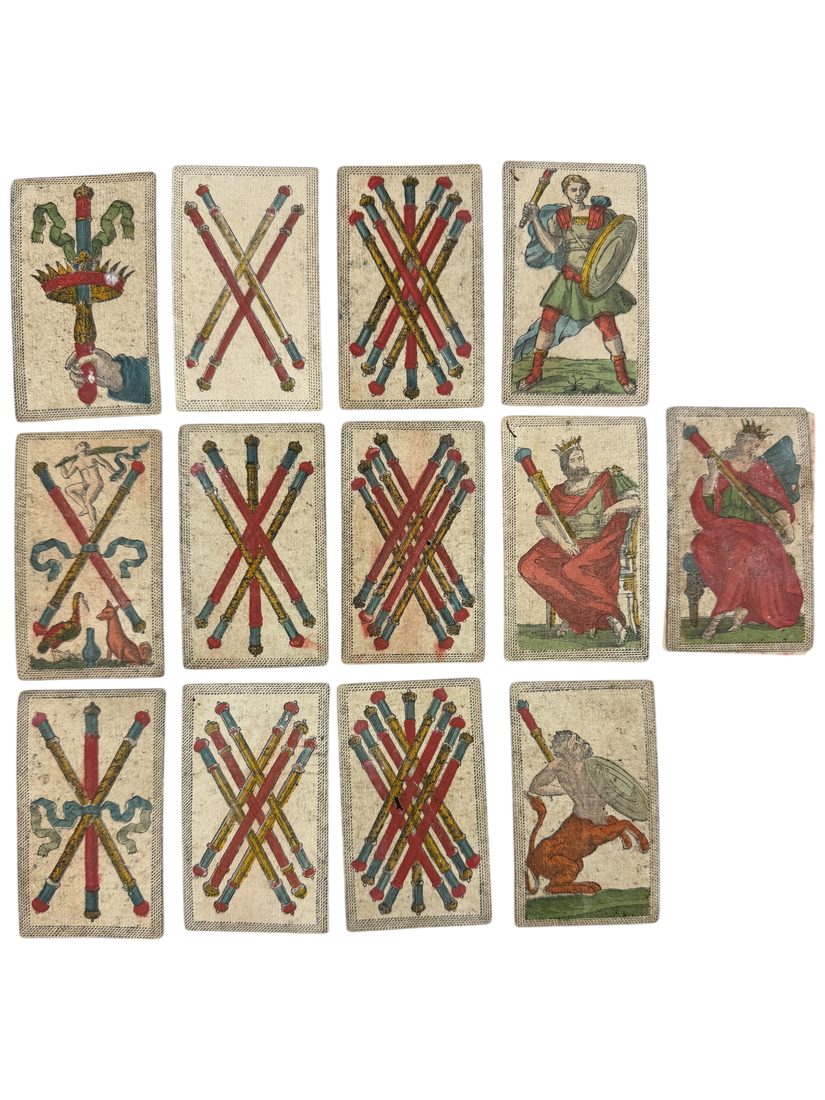
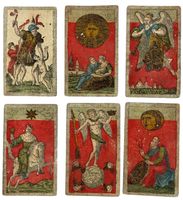
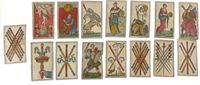
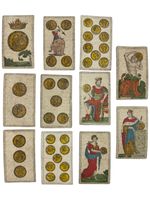
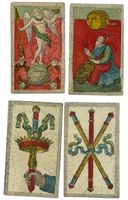
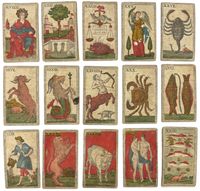
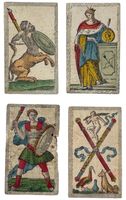
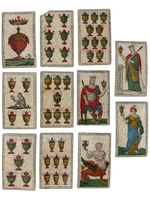
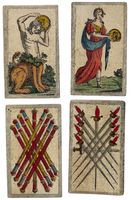
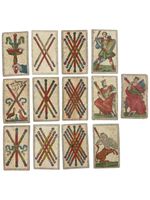
83/97 carte [97 x 57 mm], metal engraving plates stencil colored by hand. The deck is composed as follows: 11 of 14 cards from the suit of Coins are present, with numbers 6, 7, and 8 missing; 12 of 14 cards from the suit of Swords, missing 2 and 10; 14 of 15 cards from Clubs, missing the 10; and 11 of 14 cards from Cups, with 2, 3, and 9 absent. All 6 unnumbered trumps are present, while 30 of the 35 numbered trumps remain, with numbers 2, 3, 16, 20, and 21 missing. Eight cards exhibit a slightly different back, possibly indicating that they originate from another deck..
The cards have dotted borders, as if in imitation of the borders on earlier cards that were formed by the edges of the paper, on which the back design was printed, folding over the front margins of the cards.
The designs are traditional minchiate, rendered with more detail and finesse than many of the other decks of the time.
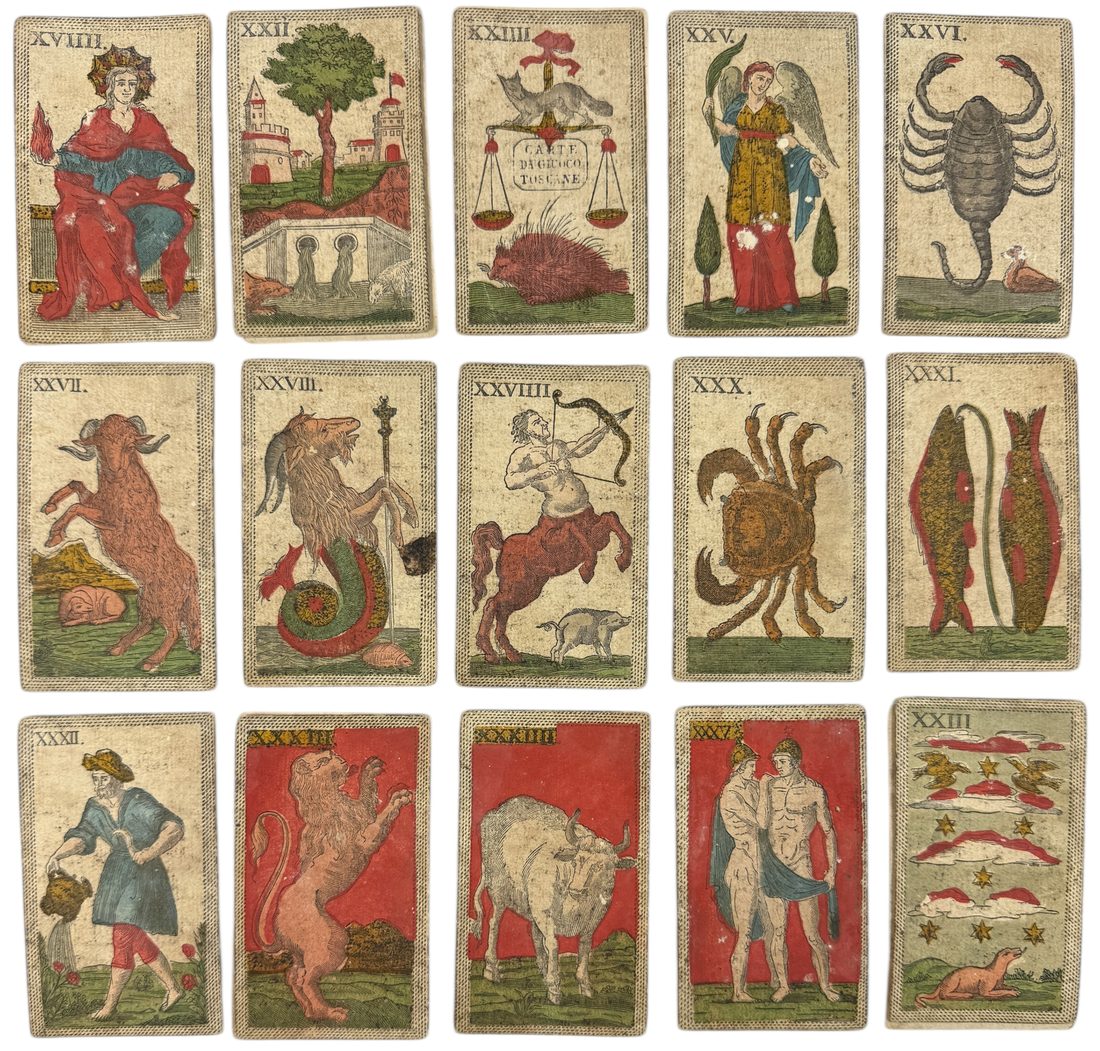
The tax stamp on card XXIIII Libra “carte da giuoco toscane”.
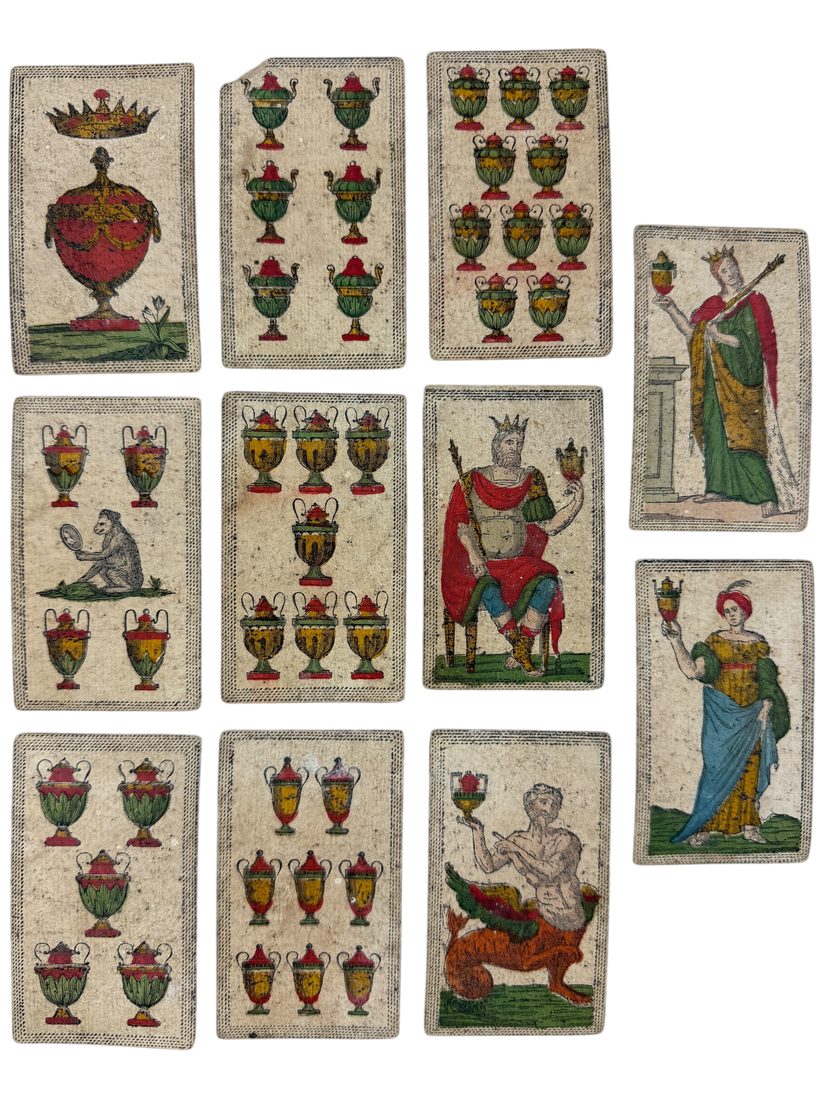
A clear distinction between the Florentine Minchiate and the Bolognese Minchiate can be seen in some specific cards: On the 4 of Coins of the Minchiate produced in Bologna, instead of the characteristic figure of an elephant typical of the Minchiate of Florence, there is a scroll with the inscription “carte fine” and the manufacturer's sign. On the 3 of Cups of the Minchiate of Florence, there is the figure of a probable lion; on those of Bologna, there is still the inscription “CARTE FINE IN BOLOGNA” or just “CARTE FINE.” On the 4 of Cups of the Minchiate in Florence, there is the figure of a little monkey looking at himself in the mirror; on those of Bologna, there is a drawing of the manufacturer's sign. Another indication of origin is the watermark representing a lily, symbol of Florence.
Tuscany was among the first European states to introduce a tax on playing cards, as early as 1636. Initially, the system operated through a monopoly, with licensed vendors affixing a stamp to one card of each deck. This arrangement was abolished in 1781 by Pietro Leopoldo, who introduced a state-issued stamp bearing the monogram A.G. (Amministrazione Granducale) and the inscription "BOLLO DELLE CARTE DI TOSCANA". Following the restoration of the Grand Duchy in 1814 and the enactment of the 1816 law, this tax was reinstated, requiring the fiscal stamp to be applied specifically to card XXIV (Libra) in Minchiate decks. Until 1860, when Tuscany was annexed to the Kingdom of Sardinia and the unification of Italy commenced, the Grand Ducal stamp remained in use, bearing the inscription "Carte di Toscana" or "Carte da giuoco toscane", as seen on the present deck.
Tarot is a deck of playing cards whose origin dates back to the mid-15th century in northern Italy.
The oldest mention of tarot cards in Florence is in a letter from 1440 in which Giusto Giusti declares that he gave Sigismondo Pandolfo Malatesta two decks of triumphs (the name by which tarot cards were initially known) produced in Florence. A later mention is a Provisione [Decree] of the municipality of Florence dated 10 December 1450, which lists them among the permitted games. The earliest printed account of the game of tarot is given in a small volume, Dialogo dei Giuochi che nelle Vegghie Sanesi si usano di fare. Del materiale intronato. All'illustrissima et eccellentissima Signora Donna Isabella de' Medici Orsina Duchessa di Bracciano. Appresso Bertano. In Venetia, 1572.
One of the oldest and most attractive of the original Italian tarot decks is the Florentine Minchiate tarot, dating from the early 1500s. It uses a deck of cards similar to the tarot but extended with additional allegorical and symbolic images; of all the European tarot cards, the Florentine Minchiate contains the greatest number of cards—a total of 97.
In addition to most of the traditional 22 trumps, the deck includes the twelve signs of the zodiac, the four virtues, and the four elements. The first 35 trumps are numbered in Roman numerals, the remaining six are unnumbered, and all are unnamed. The first four trumps are known as Papi and were not given separate identities until a later date.
Following on, unnumbered, are: The Star, The Moon, The Sun, The Angel, The World, The Fool.
In detail, the 41 Trumps are:
Card # | Description | Card # | Description |
I | The Juggler or Mountebank | XXI | Water |
II | The Grand Duke | XXII | Earth |
III | The Western Emperor | XXIII | Air |
IIII | The Eastern Emperor | XXIIII | Libra, The Balance or The Scales |
V | The Lovers | XXV | Virgo, The Virgin |
VI | Temperance | XXVI | Scorpio, The Scorpion |
VII | Force or Fortitude | XXVII | Aries, The Ram |
VIII | Justice | XXVIII | Capricornus, The Goat |
VIIII | The Wheel of Fortune | XXVIIII | Sagittarius, The Archer |
X | The Chariot | XXX | Cancer, The Crab |
XI | Time | XXXI | Pisces, The Fishes |
XII | The Hanged Man | XXXII | Aquarius, The Water Carrier |
XIII | Death | XXXIII | Leo, The Lion |
XIIII | The Devil | XXXIIII | Taurus, The Bull |
XV | The Tower | XXXV | Gemini, The Twins |
XVI | Hope | The Star | |
XVII | Prudence | The Moon | |
XVIII | Faith | The Sun | |
XVIIII | Charity | The World | |
XX | Fire | The Last Judgment | |
The Fool |
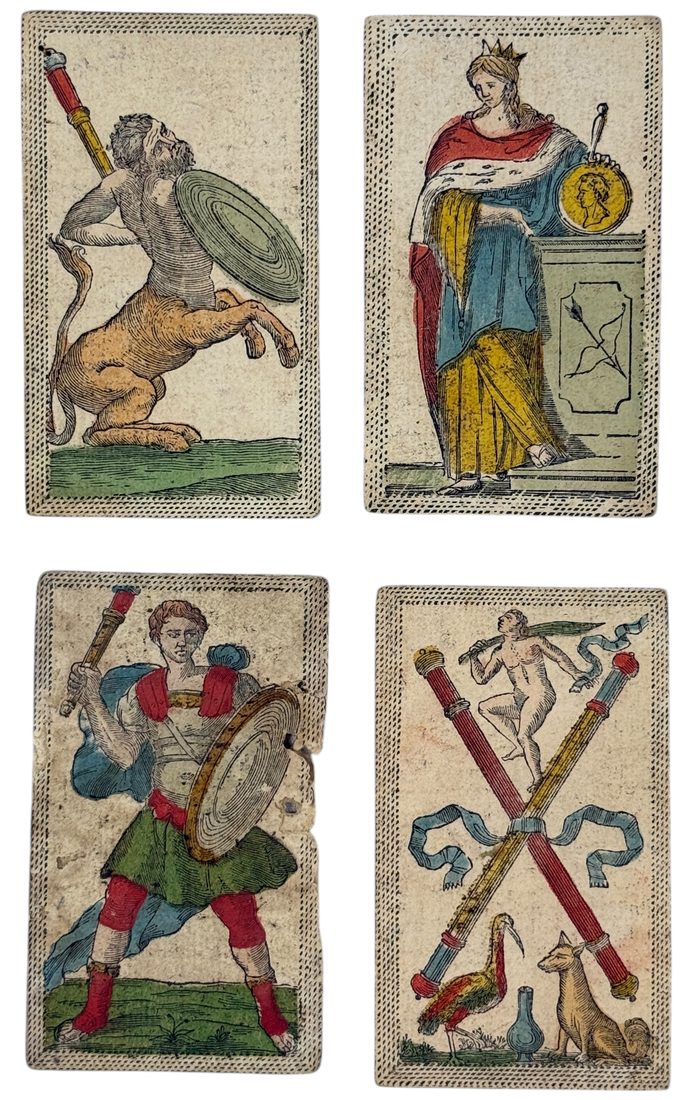
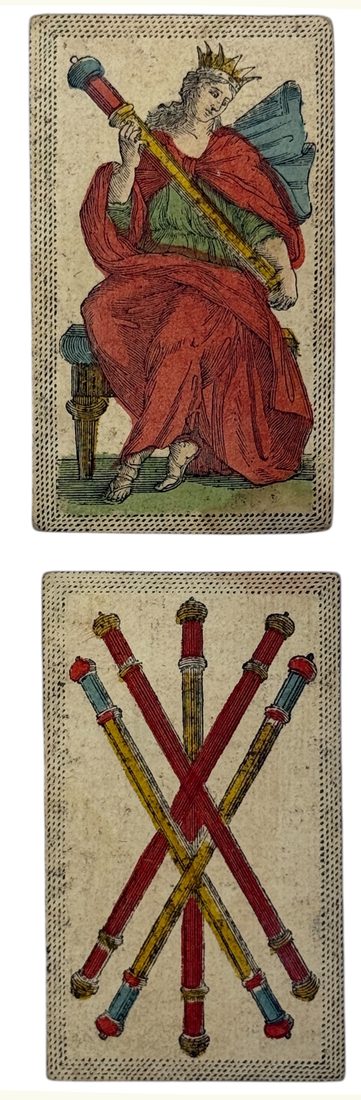
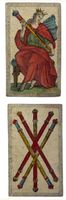
The Minchiate tarot cards are smaller than the Piedmont cards. They bear Italo/Spanish suits, characterized by the swords on the sword suit, which are straight, long, and slim, crossing each other to form a delicate trellis design, rather than the curved and large-sized swords on the purely Italian suits. Also, the batons are shown as clubs.
Other novelties of this popular tarot lie in the court and number cards. The knights of cups and coins are depicted as half-human, half-dragon-like creatures, and those of swords and clubs as centaurs.
The jacks of swords and clubs are aggressive young men, while those of cups and coins depict young females.
On many of the number cards, small vignettes of animals can be seen, some of which seem to portray old European folk tales. For instance, on the two of batons there is a fox and a stork, reminiscent of a story by Aesop in which a fox invited a stork to dinner, but as the food was served on flat plates, the stork could not pick up the food. Later, the stork in turn invited the fox to dinner. This time the food was served in long pitchers. Naturally, the stork with her long beak could reach the food, but the ill-equipped fox had to go hungry.
During the 17th century, the Minchiate tarot spread to Genoa where it was known as Ganellini and to Sicily where it was called Gallerini. It became less popular in Sicily during the 18th century although it was produced in Florence and Rome until the second half of the 19th century. Unfortunately, this beautiful tarot is now no longer produced, with the last known example dated 1929. This 1929 edition is identical to 16th-century tarots except that it no longer has turnover edges but features a border of dots. Although the maker's name rarely appears on Minchiate packs, most of them were manufactured in Florence, Bologna, and later, Genoa.
The term Minchiate derives from a dialect word which means "stupid," "silly," but also "nonsense," and which in turn derives from the Latin mencla, the vulgar form of mentula, a term indicating the male genital organ.
Conditions: Few marks of use; a good, despite incomplete, deck.
Provenance; tax stamp on card XXIIII Libra “Carte da GIUOCO TOSCANE”.
References: S. R. Kaplan, The Encyclopaedia of Tarots, Vol. II, pp. 257,267; Schreiber, Catalogue of the collection of playing cards bequeathed to the British Museum by Lady Charlotte Schreiber, Italian, 53; Schreiber, Playing Cards of Various Ages and Countries selected from the collection of Lady Charlotte Schreiber, III, pl. 90; Kathleen Wowk, Playing Cards of The World, Lutterworth Press, 1983, pp. 133-134; Sylvia Mann, All Cards are on the table - Alle Karten Auf Den Tisch, Deutsches Spielkarten-Museum Leinfelden-Echterding, 1990, Vol II, 214; Catherine Perry Hargrave, A History of playing cards, Dover publications, 2021, pp. 227 – 231.
Kaplan, p.267