Gassmann Tarot
| Macro-category | Playing Cards and Tarot |
| Subcategory | Tarot |
| Author | Gassmann |
| Provenance | Geneva |
| Publisher / Maker | François Gassmann |
| Year | 1850 - 1870 |
an accomplished Swiss expression of the Marseille canon
the complete Tarot de Marseille de type ii
of François Gassmann, cartier a Geneve
Tarot de Marseille, Type II. Geneva (Switzerland): François Gassmann, ca. 1850–1870.
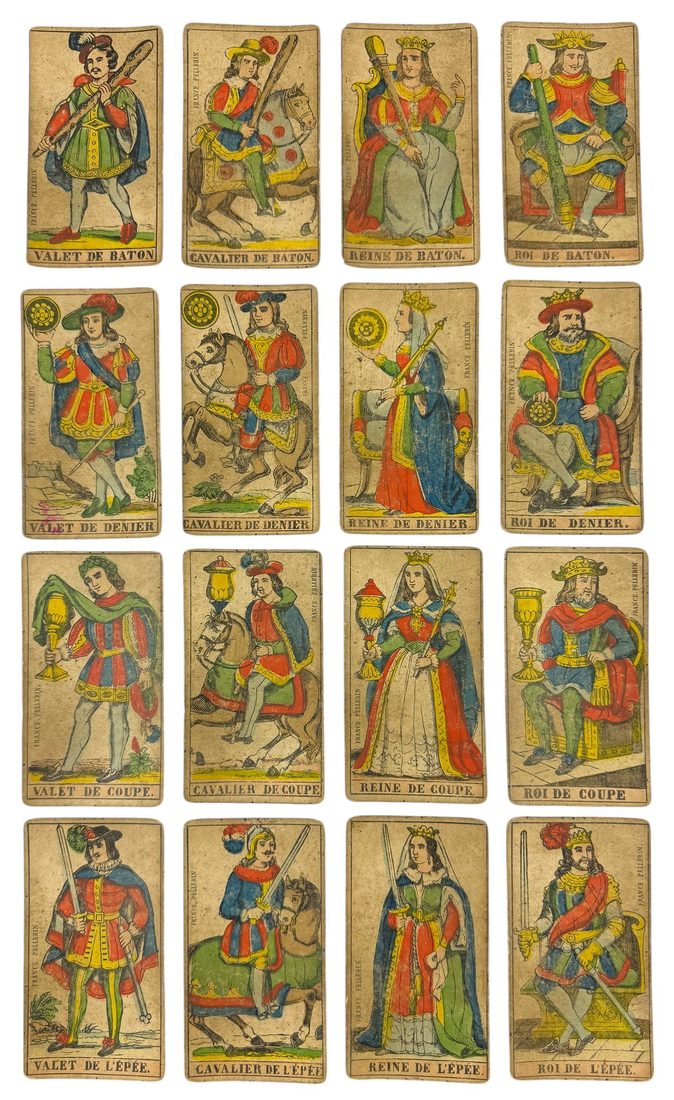
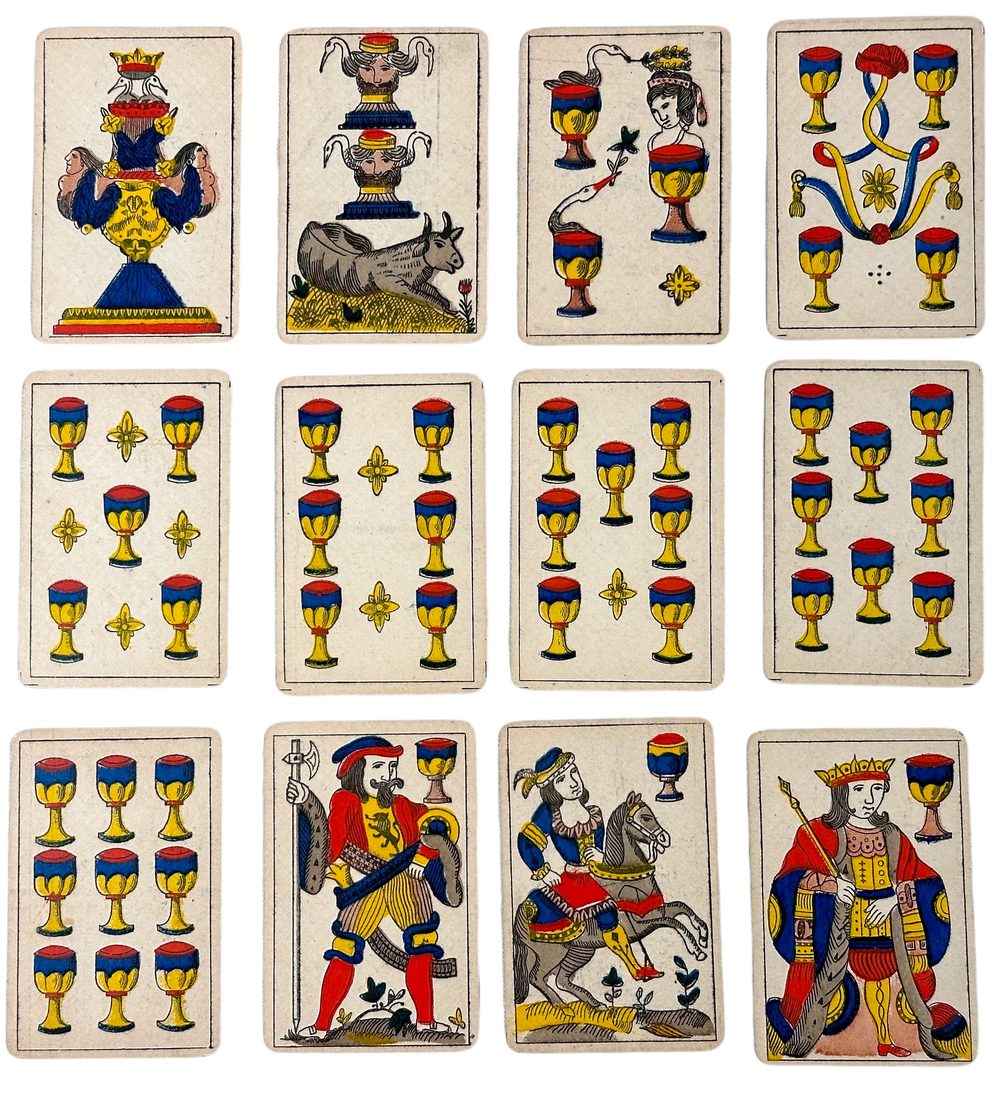
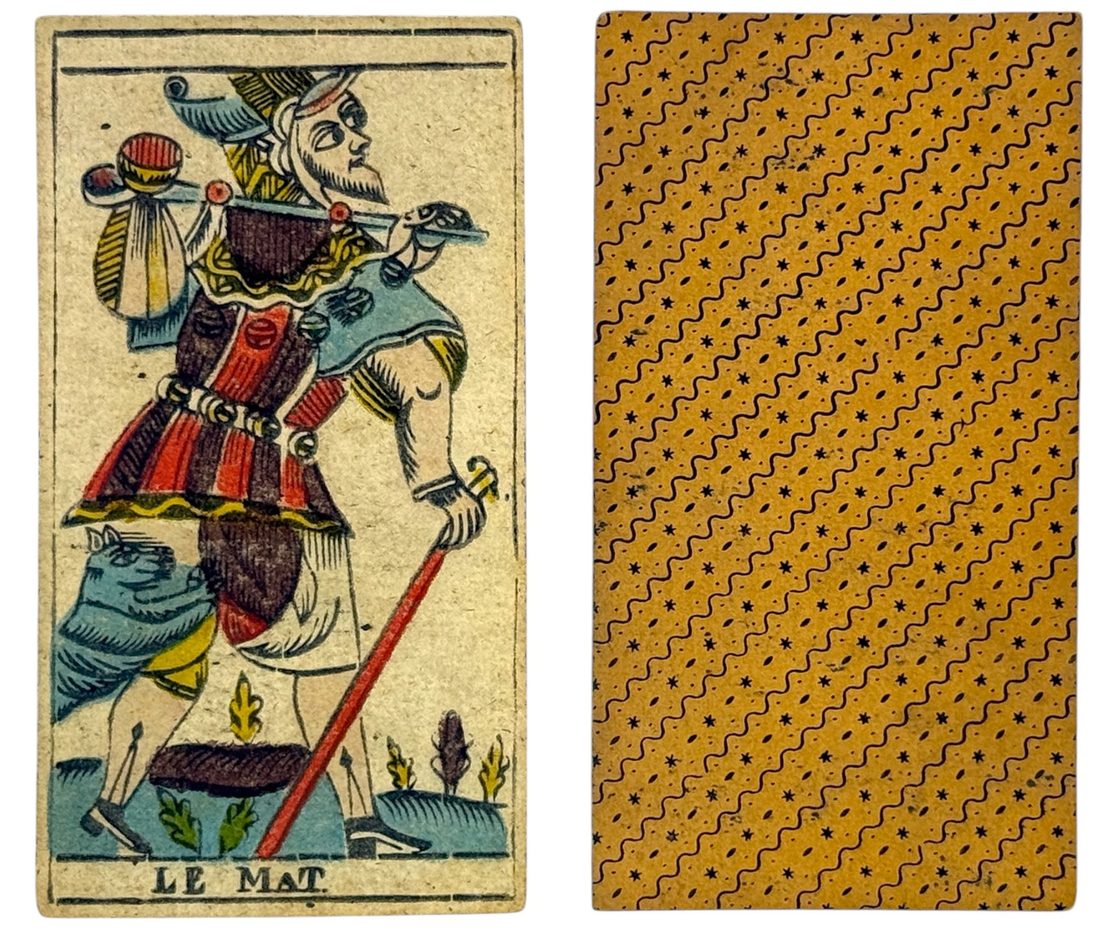
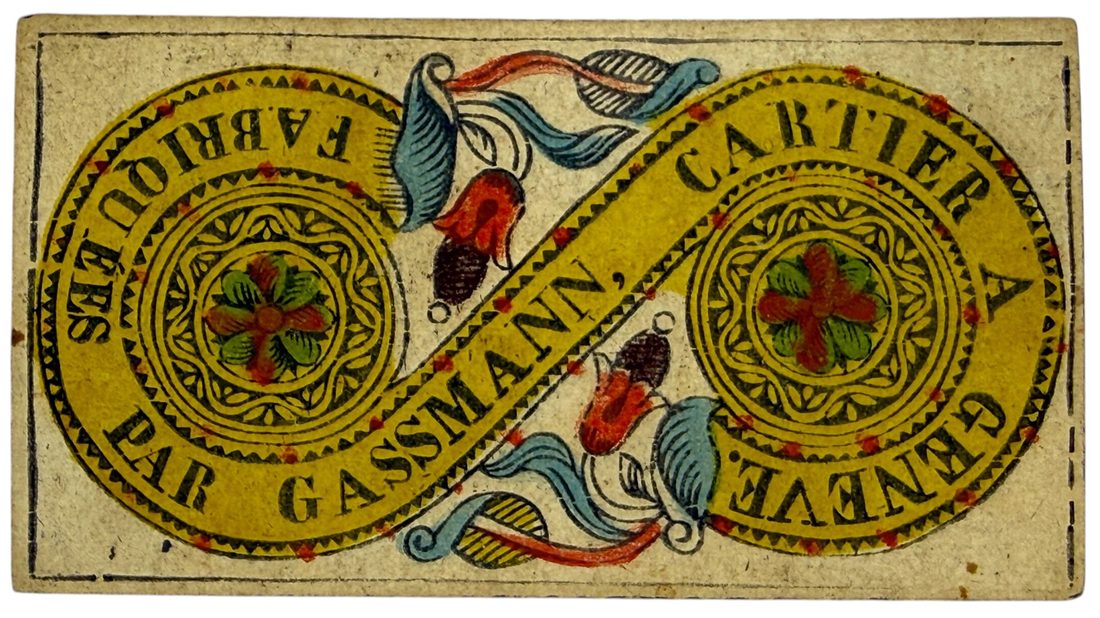
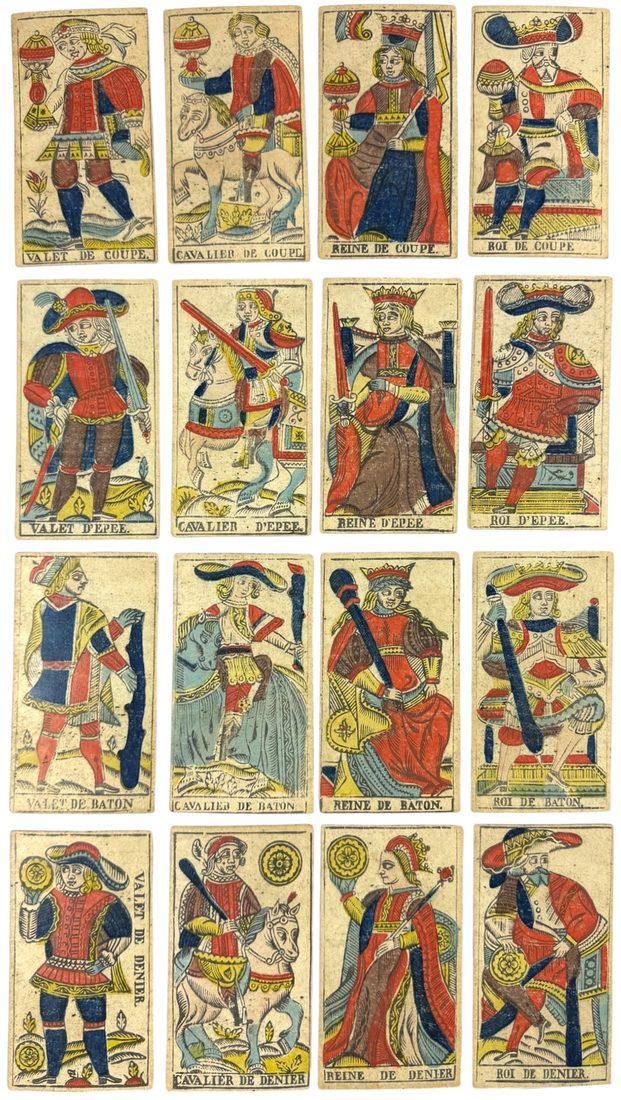
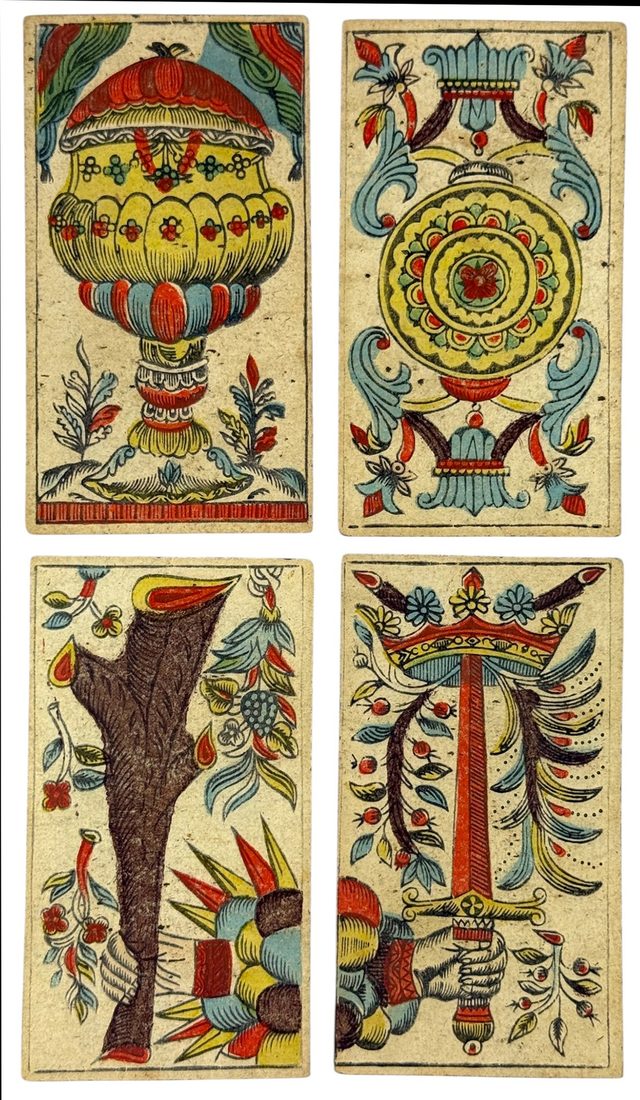
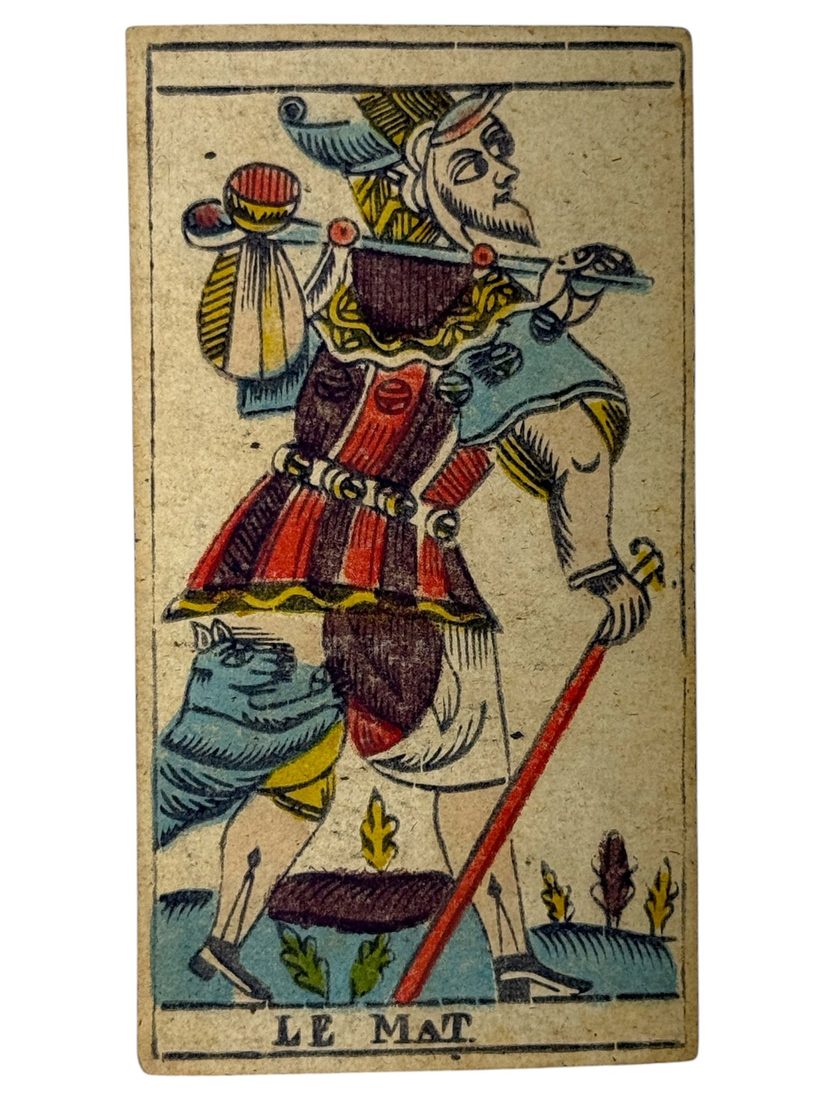
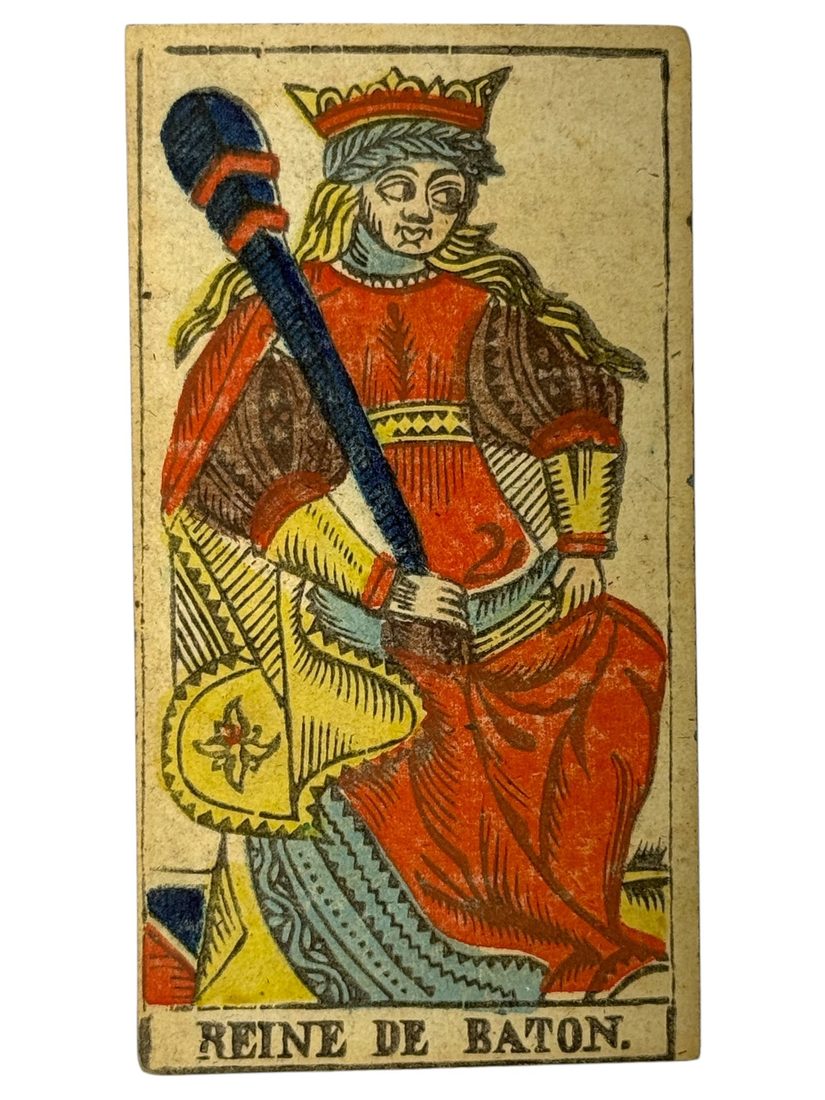
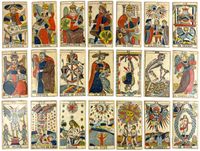
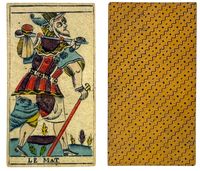
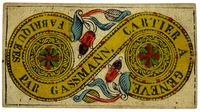
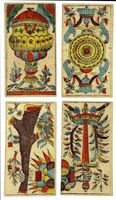
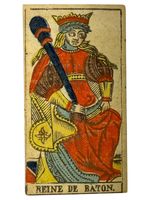
78/78 tarot cards (115 × 62 mm), printed from woodblocks and stencil-coloured (pochoir). Cards on composite pasteboard of laminated sheets, with square corners and two indices. Backs decorated with a repeating pattern of diagonal undulating lines and alternating six-pointed starlets and droplets in black on an ochre-yellow ground. Italian suits: Bâtons, Épées, Coupes, Deniers. Court cards are single-ended and comprise Roi, Reine, Cavalier, and Valet, with French designations in a framed cartouche at the lower edge. Twenty-two trumps numbered I–XXI in Roman numerals, plus the unnumbered Le Mat. On the Two of Coins appears the maker’s signature within a sinuous S-scroll cartouche reading Fabriquees par Gassmann. Cartier a Geneve [sic], flanked by tulips and two medallions filled with quatrefoil rosettes. A further epigraphic element distinguishes the Four of Coins, whose central medallion bears the Roman capital ”R” surmounted by a five-pointed crown, enclosed within a baroque frame from which issue two crossed rods with red finials. No fiscal stamp is present on the aces, a feature consistent with post-1865 issues of the workshop.
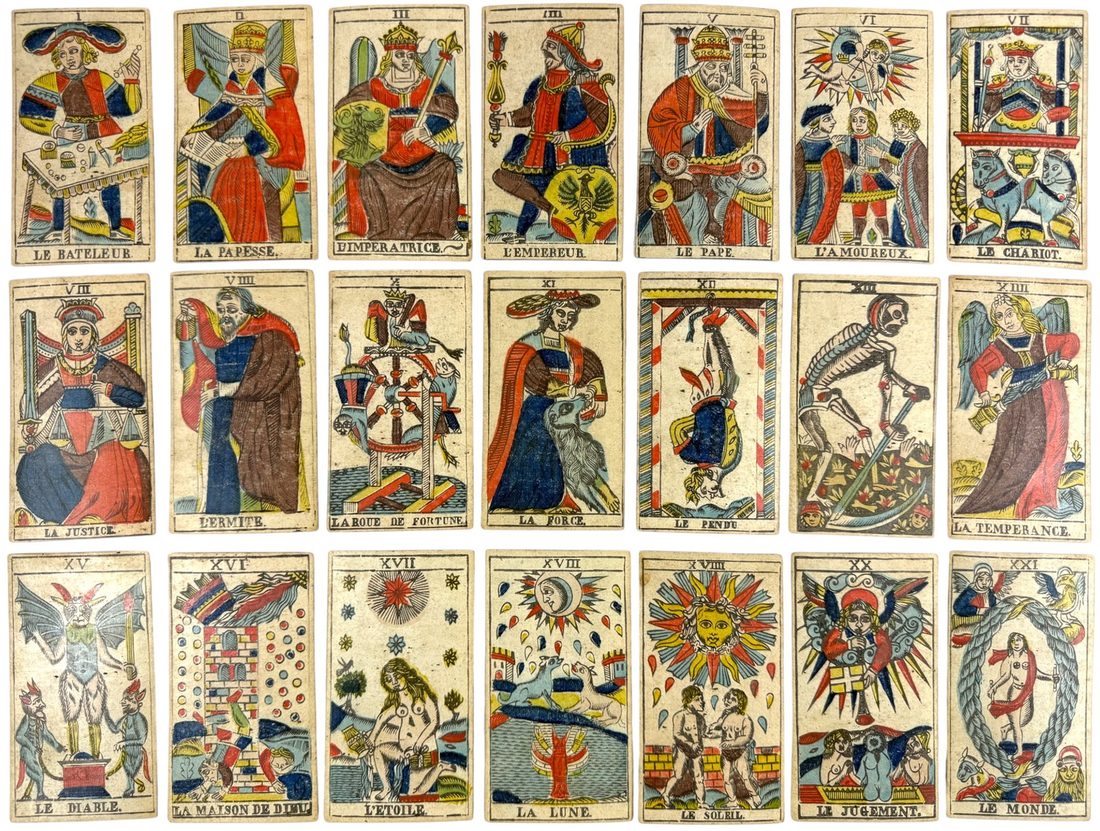
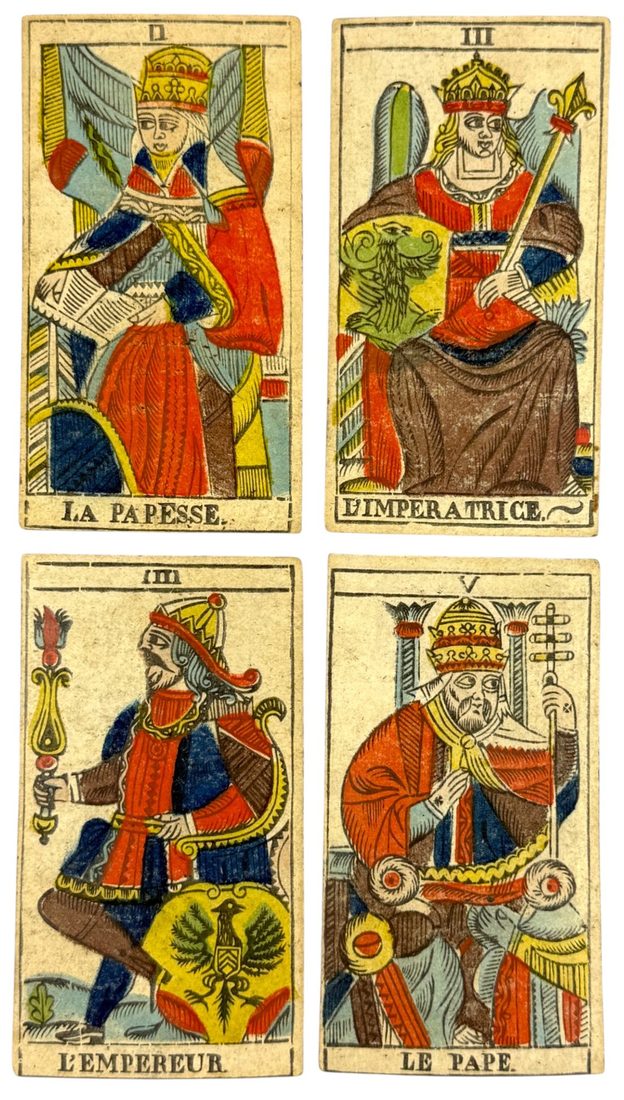
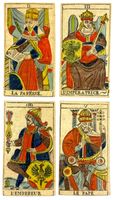
A complete and finely preserved example of the Tarot de Marseille in its Type II redaction, issued by François Gassmann at his Geneva workshop in the mature phase of his activity. The deck represents the foremost Swiss francophone expression of the Marseille canon, strictly observing its ecclesiastical iconography, La Papesse and Le Pape, rather than the Juno/Jupiter substitution characteristic of the Besançon variant.
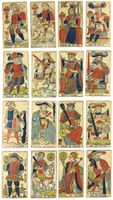
The pack adheres to the canonical structure of the Tarot de Marseille, comprising fifty-six suited cards and twenty-two trumps. The suits follow the Italian system proper to the Marseille tradition, and the court hierarchy preserves the French nomenclature customary in Swiss francophone production.
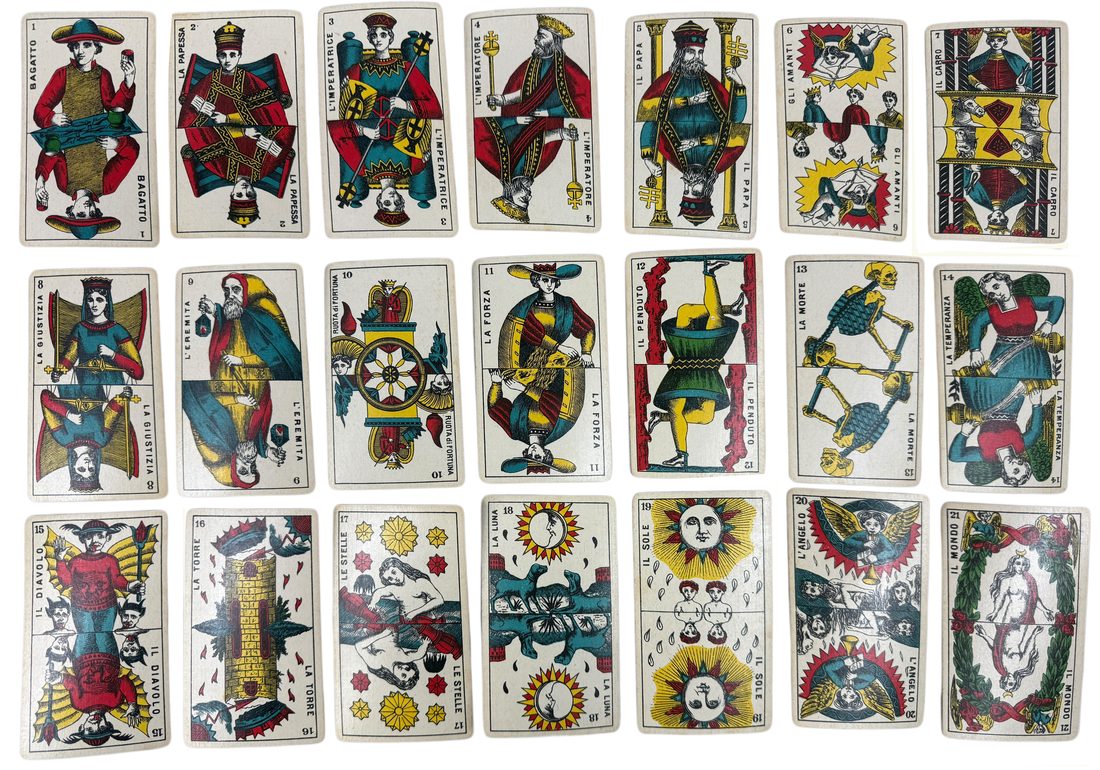
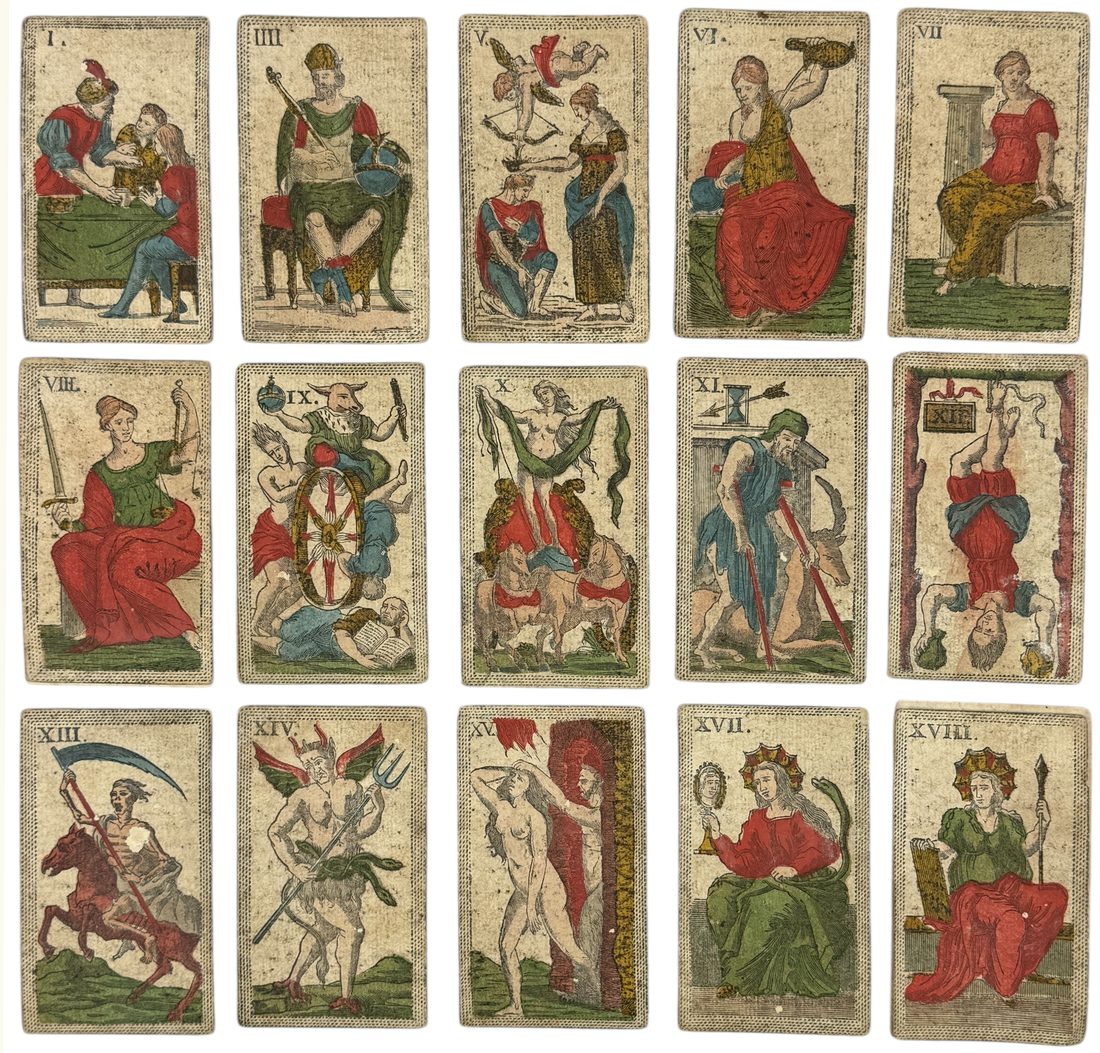
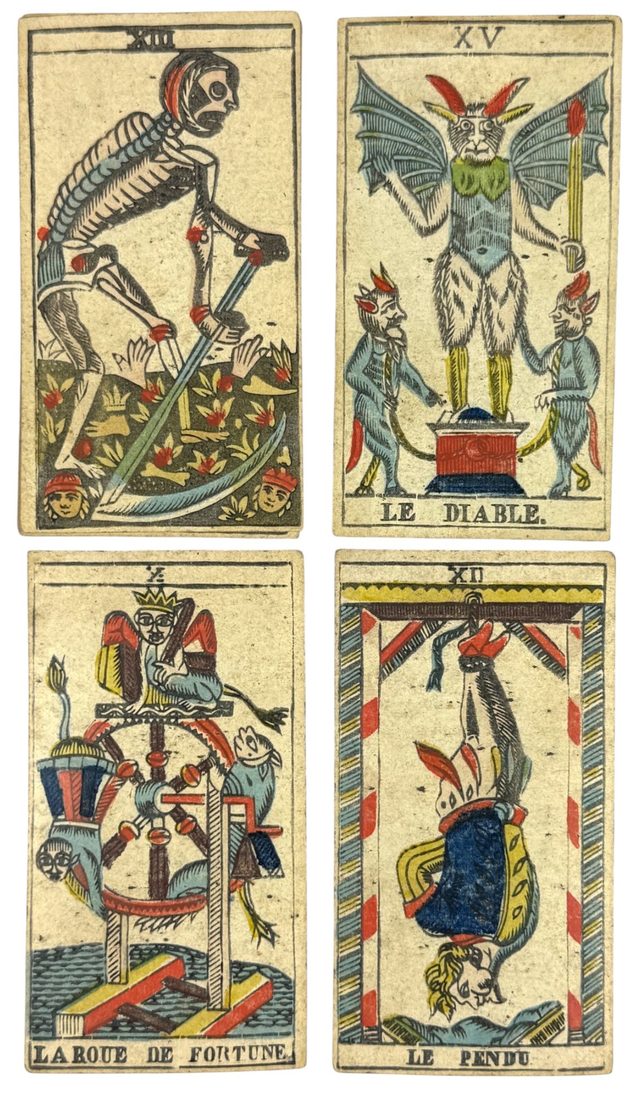
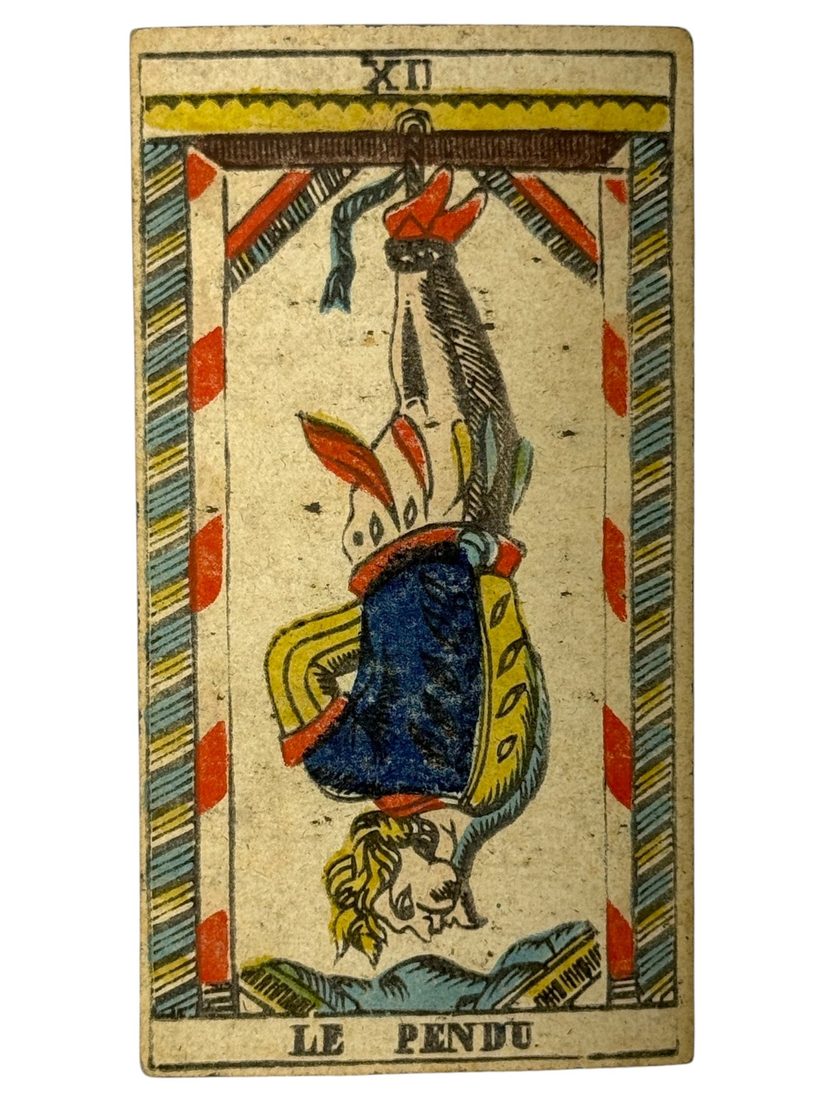
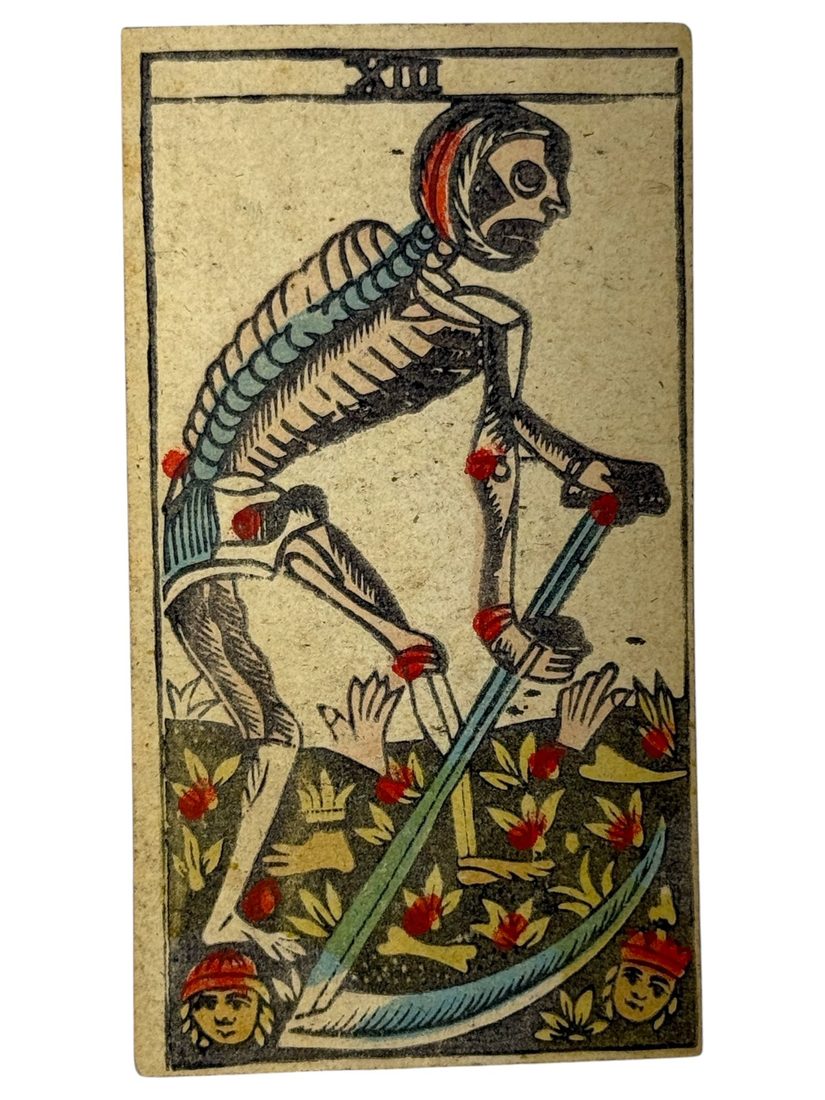
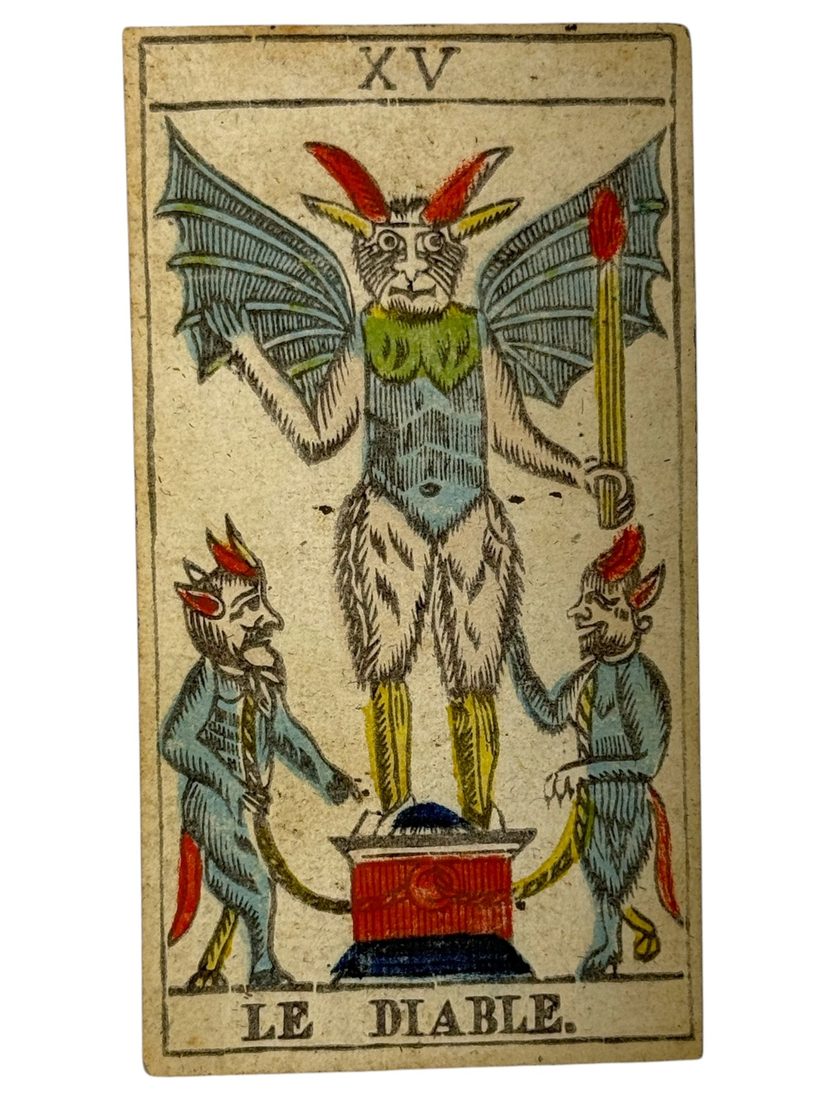
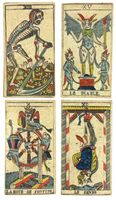
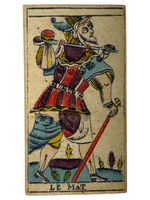
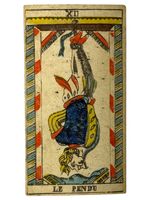
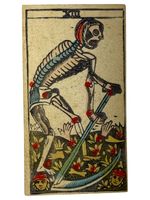
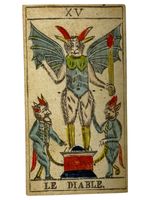
The twenty-two trumps observe the canonical sequence: I Le Bateleur, II La Papesse, III L’Imperatrice, IIII L’Empereur, V Le Pape, VI L’Amoureux, VII Le Chariot, VIII La Justice, VIIII L’Ermite, X La Roue de Fortune, XI La Force, XII Le Pendu, XIII (untitled), XIIII La Temperance, XV Le Diable, XVI La Maison de Dieu, XVII L’Etoile, XVIII La Lune, XVIIII Le Soleil, XX Le Jugement, XXI Le Monde, and Le Mat. The deck conforms diagnostically to Tarot de Marseille Type II as codified by Dummett and Depaulis: the Devil bears reduced wings and no secondary face upon the belly; the Moon is rendered in crescent profile; the World displays a dancing nude female figure within an oval wreath encircled by the four evangelical emblems. La Maison de Dieu is struck by coloured droplets, L’Etoile shows a seated female pouring water beneath a large central star surrounded by five minor stars, and La Roue de Fortune presents a crowned sphinx-figure enthroned above the wheel, flanked by ascending and descending simian creatures.
The pip cards are executed with the ornamental density characteristic of the Gassmann engraving. The Two of Cups, in particular, deserves notice: two bulbous goblets flank a vegetal caduceus surmounted by a crowned floral urn and attended by two dolphin-like fish, with a crowned heart-shield, cornucopias and a radiant sun-burst at the base. Such elaboration, together with the “R” monogram on the Four of Coins, distinguishes the Gassmann production from sparer French prototypes and constitutes a firm diagnostic criterion for the workshop. The identity of the “R” remains an open question in the scholarly literature: it has been variously interpreted as the initial of an engraver, a partner, a sponsor, or a successor associated with the mature phase of the workshop, but no documentary evidence has yet resolved the matter.
The present deck belongs to the francophone Swiss Tarot de Marseille tradition which, from the second half of the eighteenth century, flourished along an axis comprising Geneva, Lausanne, Fribourg, Neuchâtel, and Basel. Inheriting the iconographic type codified around 1760 by Nicolas Conver of Marseille, this regional school grew in close dialogue with the Marseille and Lyon workshops while retaining an independent stylistic personality, distinct from the Besançon line. The Gassmann production represents its principal Genevan expression, characterised by the ornamental elaboration of the pip cards and by a vivid polychromy.
Throughout the nineteenth century, the taxation of playing cards in Switzerland remained a cantonal prerogative; the Canton of Geneva required decks to bear its heraldic seal upon the aces. The absence of such stamping on the present deck suggests either an issue destined for export or a relaxation of the practice in the later years of the workshop’s activity. Papiers d’enveloppe are documented for intermediate issues around 1865.
François Gassmann (1792–1870) conducted his Geneva workshop from circa 1820 until his death, inheriting the craft from his father, Johann Georg Gassmann (circa 1766–1825), who had established the family’s cardmaking activity around 1800 and is documented as a principal exponent of the Genevan Dauphiné pattern. Under François, the workshop extended its range to the Tarot de Marseille, becoming the leading Genevan source for such packs throughout the middle decades of the century. The Gassmann dynasty occupied a central position within the network of Swiss francophone cardmakers, alongside the Burdel of Fribourg, the Vachet of Lausanne, the Rochias of Neuchâtel, and, later, the Schaffhausen firm of J. Müller & Co. The orthographic form Gassmann, with double N, clearly legible on the signature cartouche of the present specimen, corresponds to the formally correct family name and supersedes a persistent secondary-literature reading of Gassman. The fate of the workshop after 1870 remains only partially documented; certain very late issues (circa 1890) appear to have been pulled from the original woodblocks by a successor.
Condition: Light marks of use, traces of foxing on Le Mat and a few further cards overall, a very good state of preservation.
References: S. R. Kaplan, The Encyclopedia of Tarot, vol. I, Stamford (CT): U.S. Games Systems, 1978, p. 163; T. Depaulis, W. Haas, J. McLeod, Schweizer Spielkarten 2: Das Tarockspiel in der Schweiz, Tarocke des 18. und 19. Jahrhunderts, Schaffhausen: Museum zu Allerheiligen, 2004; M. Dummett, The Game of Tarot: From Ferrara to Salt Lake City, London: Duckworth, 1980; W. Haas, Der Freiburger Spielkartenmacher Alphonse Favre, in Freiburger Geschichtsblätter, 1994; B. Eberhard, Die Spielkartensteuer in der Schweiz/La taxe sur les cartes à jouer, Schaffhausen: Cartophilia Helvetica, 2012; IPCS, Pattern Sheet PS-7 Swiss Tarot; Warburg Institute, London, Bilderatlas Mnemosyne, panels 50–51.