King of Spades “David”, old Rouen type
| Macro-category | Playing Cards and Tarot |
| Subcategory | Historical Playing Cards |
| Author | Anonymous |
| Provenance | Northern France or the Low Countries |
| Year | 18th century |
A king who never bowed to Paris
the frontal David of the old Rouen type,
with raised fleur-de-lys sceptre and harp in hand
A single court card, eighteenth century
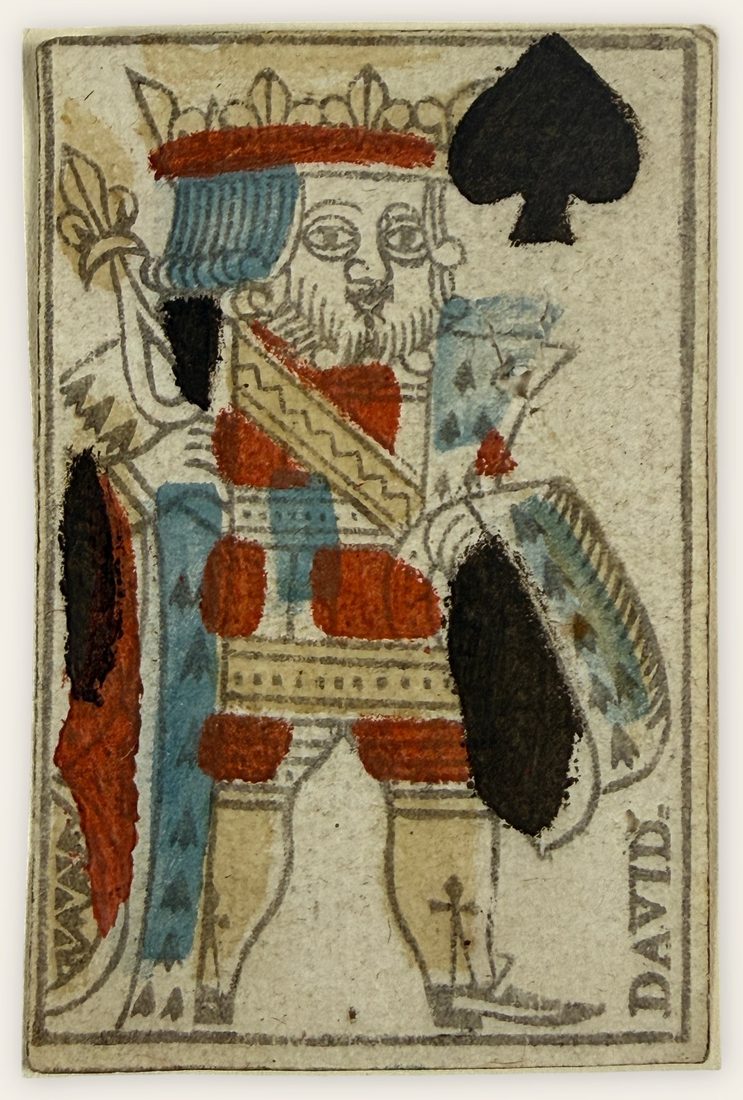
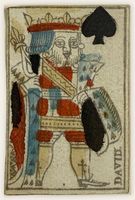
King of Spades “David”, old Rouen type. Northern France or the Low Countries: maker unidentified, eighteenth century.
1/1 card, King of Spades, from a French-suited pack of 32 or 52 cards (85 × 55 mm); woodcut printed in grey-black on pasteboard, stencil-coloured (pochoir) in vermilion, light blue, ochre and black; verso plain, without tarotage or manuscript notes; full-length, single-ended figure within a double-ruled frame; spade suit-sign at upper right; name “DAVID” printed vertically in roman capitals at lower right, reading upwards; a small device in the form of an anchor surmounted by a cross cut into the block on the king’s left leg, above the shoe. No maker’s name, tax stamp or paraph.
The King of Spades, recto.
This King of Spades preserves an older form of King David than the one used by the Paris workshops of the eighteenth century. The Paris workshops of the eighteenth century show him almost frontally, resting on a harp set at his feet; here he stands stiffly, raises a fleur-de-lys sceptre and holds the harp at his side, as in the cards that the Rouen maker Charles Dubois produced about 1659 for the Flemish market. The card is a later survival of that Rouen image, cut in a broad popular style.
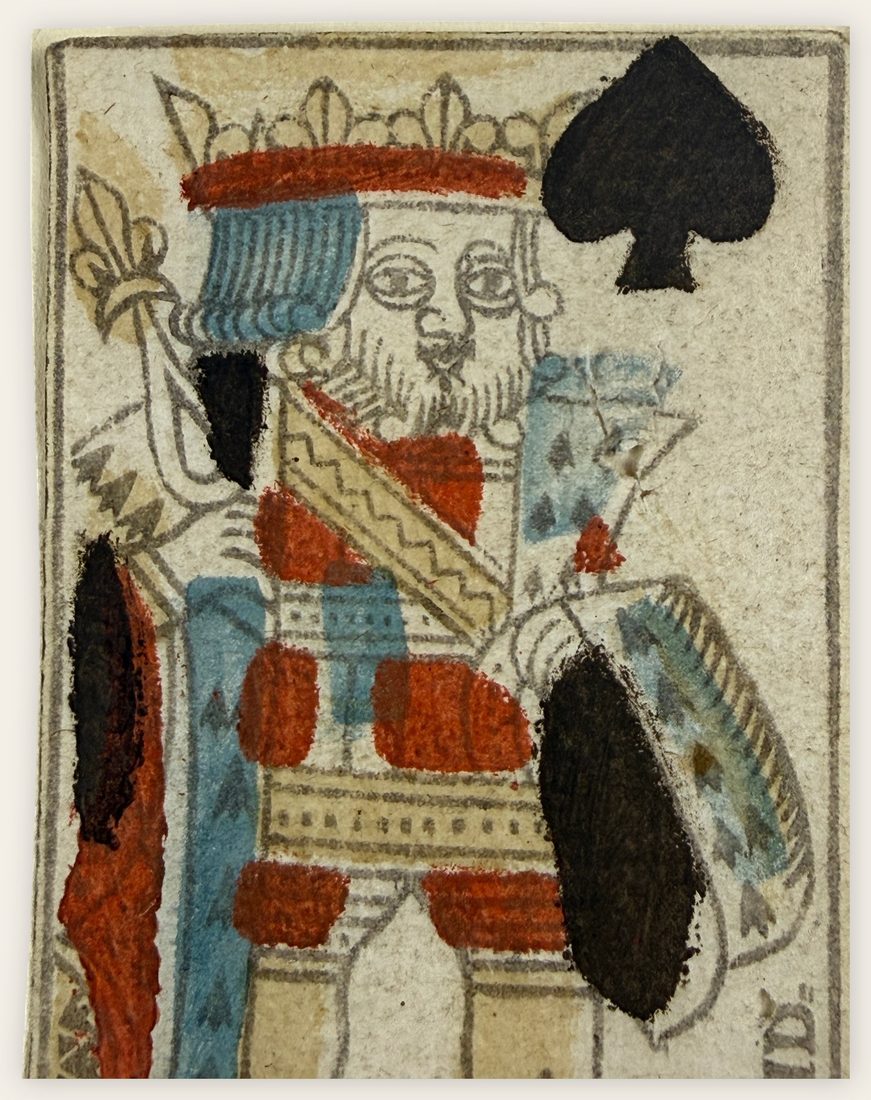
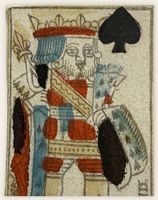
The bearded king faces the viewer, crowned with an open crown of fleurons over a red cap band, his long hair coloured blue. In his right hand he raises a tall sceptre topped by a fleur-de-lys; a diagonal sash with zigzag ornament crosses his chest, and his mantle is lined with ermine tails. With his left hand he holds a harp by its neck, the strings rendered by the hatching of the frame. A zigzag ermine border fills the lower left corner. The cutting is simple and angular, with almond eyes, a schematic beard and limbs reduced to blocks of colour. The stencils are laid with visible misregistration, and the black is applied in thick, opaque patches over parts of the harp and the mantle.
Detail: the crown, the fleur-de-lys sceptre, the zigzag sash and the harp.
Name and attribute come first. Only two patterns name their kings consistently, the Paris pattern and the Flemish pattern made at Rouen for the Low Countries, known as Rouen I; in both the King of Spades is David, and in both his attribute is the harp. In the Guyenne pattern, whose earliest packs still carry names of the Paris type, the harp passes to the King of Hearts and the King of Spades carries an axe. The composition separates the card from the standard eighteenth-century Paris figure. In the Paris packs of the eighteenth century, from those of Jean Chalumet (1719-1746) to the packs made for the colonies by Lachapelle and Mandrou (1750-1789), David is shown almost frontally, his head slightly turned, in a wide black-bordered mantle, his short sceptre held low, the harp at lower left and the name at upper right. The present card follows a different scheme, with the sceptre raised on the left, the harp held on the right and the name set low. This is the arrangement of the King of Spades in the Rouen I pack of Charles Dubois, about 1659, where David stands with his body to the front and his head turned, holding the fleur-de-lys sceptre upright on the left and resting his hand on the harp on the right. The style points the same way: the stiff pose and the rigid cutting belong to this older Rouen tradition; the eighteenth-century Paris blocks have more supple figures.
Left: King of Spades “david”, Charles Dubois, Rouen, ca. 1659 (Paris, Bibliothèque nationale de France, Réserve KH-34 (B, 33)). Right: the present card.
The Rouen I or Flemish pattern was one of the export patterns made at Rouen from the sixteenth century, apparently designed for what are now Belgium and the Netherlands; its kings are drawn from the Nine Worthies, almost as in the Paris pattern. In the seventeenth and eighteenth centuries it was also made in Amsterdam and later in Brussels, by Sarton about 1740, Bodet about 1750 and Keusters about 1770-1800; it became double-ended at the end of the eighteenth century and lost its names after 1800. A comparable survival existed within France. After the tax reform of 1701 imposed new blocks on the Paris pattern, the older design persisted in Normandy, the North and Alsace as the so-called Provincial Variant; Normandy and the North were aligned on Paris from 1745-1746, while the Strasbourg makers kept the old design until late in the century.
The card may therefore come from northern France or from the Low Countries. The single-ended figure, the printed name and the woodcut and stencil technique agree with an eighteenth-century date, before the Flemish pattern turned double-ended and lost its names. The fleur-de-lys on the sceptre excludes the years 1793-1795, when crowns, fleurs-de-lis and sceptres were banned from French playing cards; after the Terror the sources record the return of crowns and sceptres, but not of the fleur-de-lis.
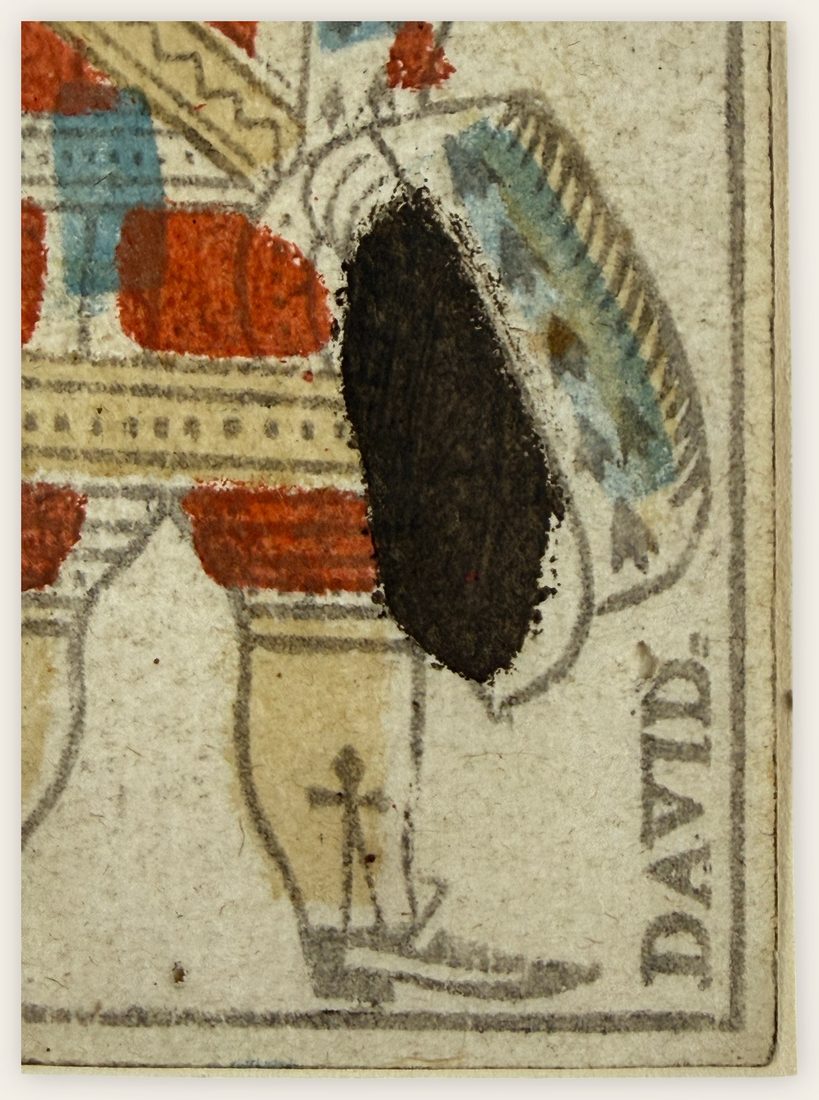
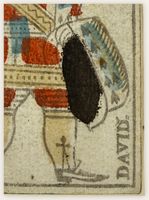
The maker is not identified. In the Paris pattern the cardmaker’s name was printed on the Jack of Clubs, and frequently at the foot of the other courts; in the Dubois pack the name CHARLE DUBOIS appears on the Jack of Spades. No name appears on this king. The only clue is the small anchor surmounted by a cross cut into the block on the king’s left leg, which may be a workshop sign, a block-cutter’s mark or a control mark.
Detail: the anchor surmounted by a cross on the king’s left leg, and the name DAVID.
Conditions: Small surface abrasion with a short crease at the top of the harp, beside the king’s left hand; light soiling and scattered foxing, mostly on the verso; corners slightly rounded through handling. The printed frame is complete on all four sides and the colours are fresh. Very good.
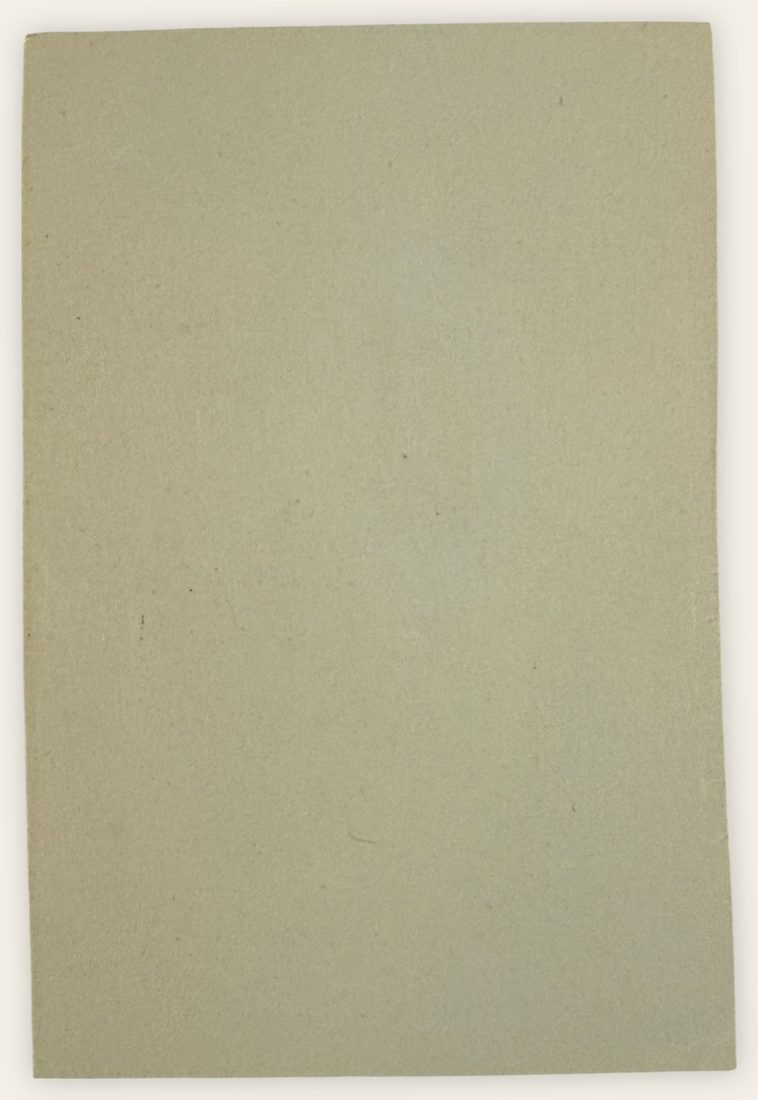
The plain verso.
References: H.-R. d’Allemagne, Les cartes à jouer du XIVe au XXe siècle, 2 vols., Paris: Hachette, 1906; J. Berry, The history of the Paris pattern, in The Playing-Card, XIII, 1984, pp. 1-23; J.-P. Seguin, Les cartes à jouer au portrait de Paris de 1701 à 1778, Paris: Le Vieux Papier; Issy-les-Moulineaux: Musée français de la carte à jouer, 1989; Th. Depaulis, Les cartes à jouer au “portrait de Paris” avant 1701, Paris: Le Vieux Papier; Issy-les-Moulineaux: Musée français de la carte à jouer, 1991; Th. Depaulis, Essai de généalogie du portrait de Paris, in The Playing-Card, XXIII, 1995, pp. 62-74; Th. Depaulis, Paris pattern, International Playing-Card Society, Pattern Sheet 112, 2018; International Playing-Card Society, Flanders or Flemish pattern, Pattern Sheet 49. For comparison: Paris, Bibliothèque nationale de France, Département des Estampes, Réserve KH-34 (B, 33), Charles Dubois, Rouen, ca. 1659, and Réserve Pet. Fol. KH-205 (14), Jean Chalumet, Paris, 1719-1746.