Jeu de l'Aluette
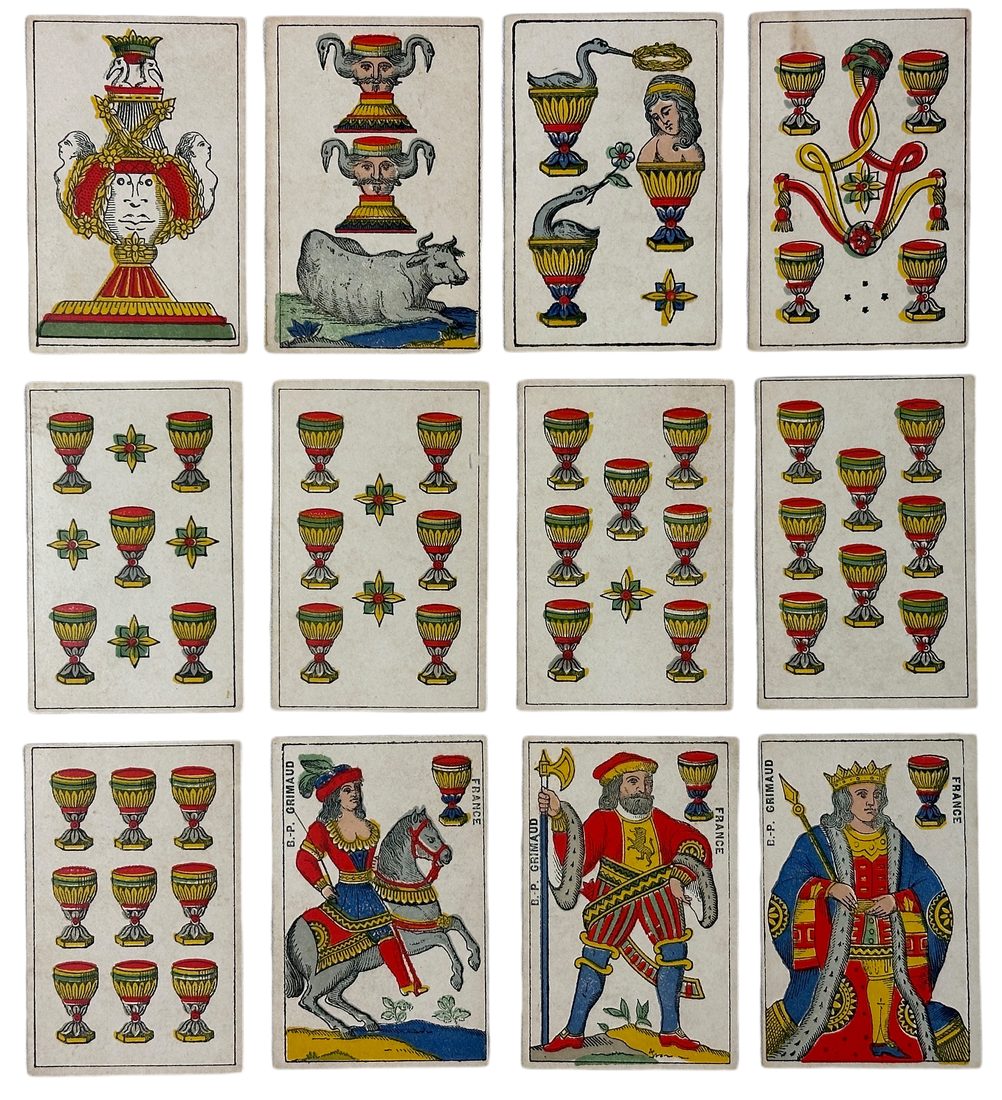
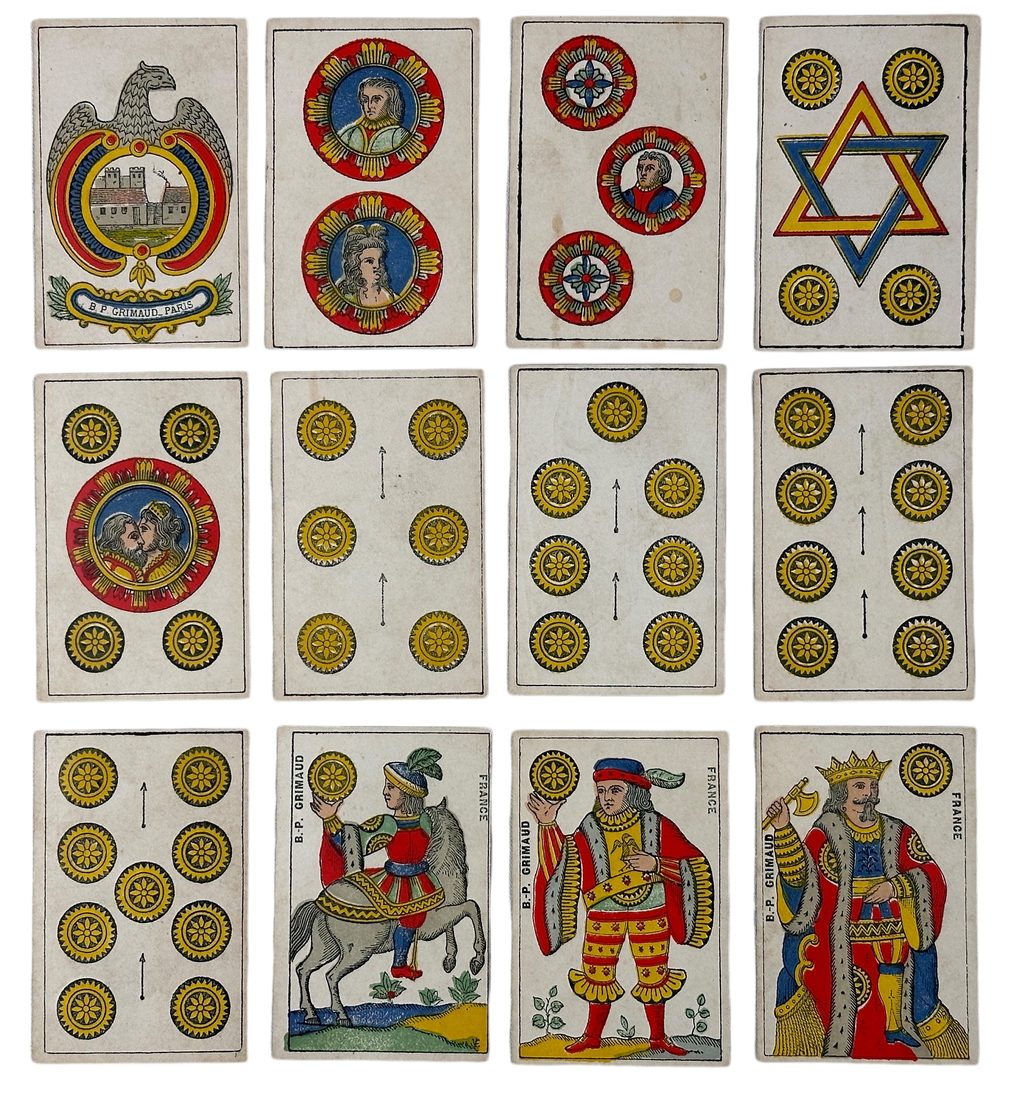
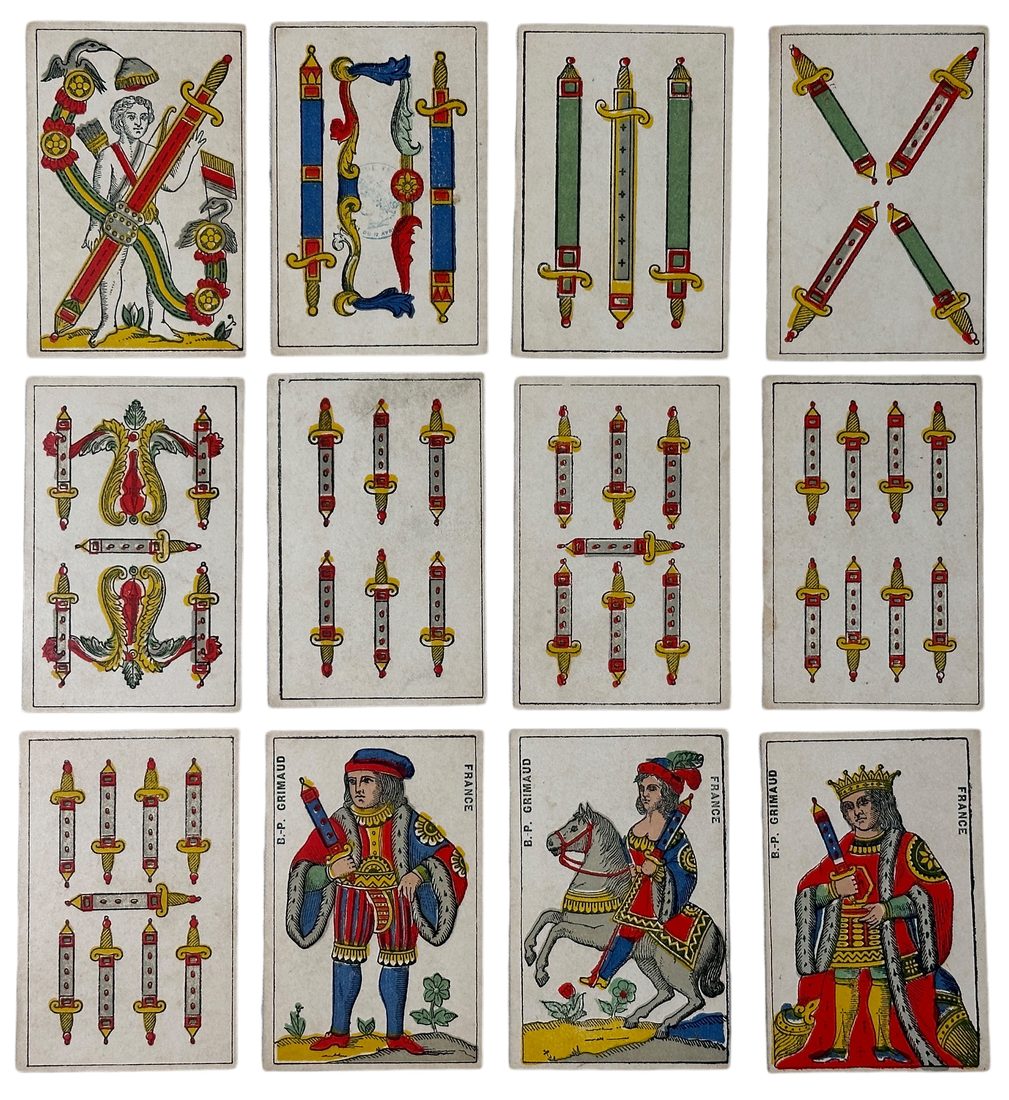
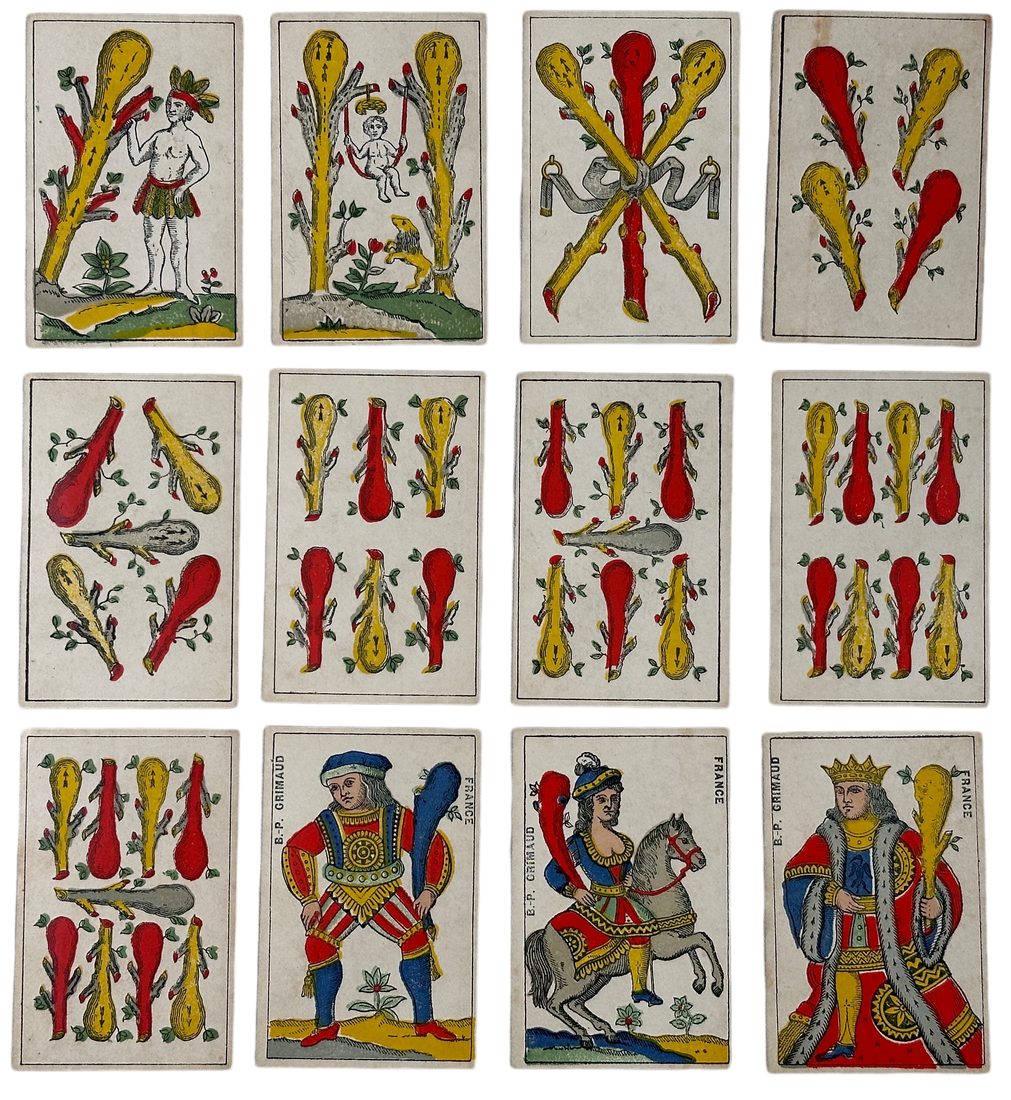
| Macro-category | Playing Cards and Tarot |
| Subcategory | Historical Playing Cards |
| Provenance | Paris |
| Publisher / Maker | Grimaud |
| Year | 1890 |
complete 19th century hand coloured Deck
for the French “Jeu de l’Aluette”
the only French game played with the Spanish card suite
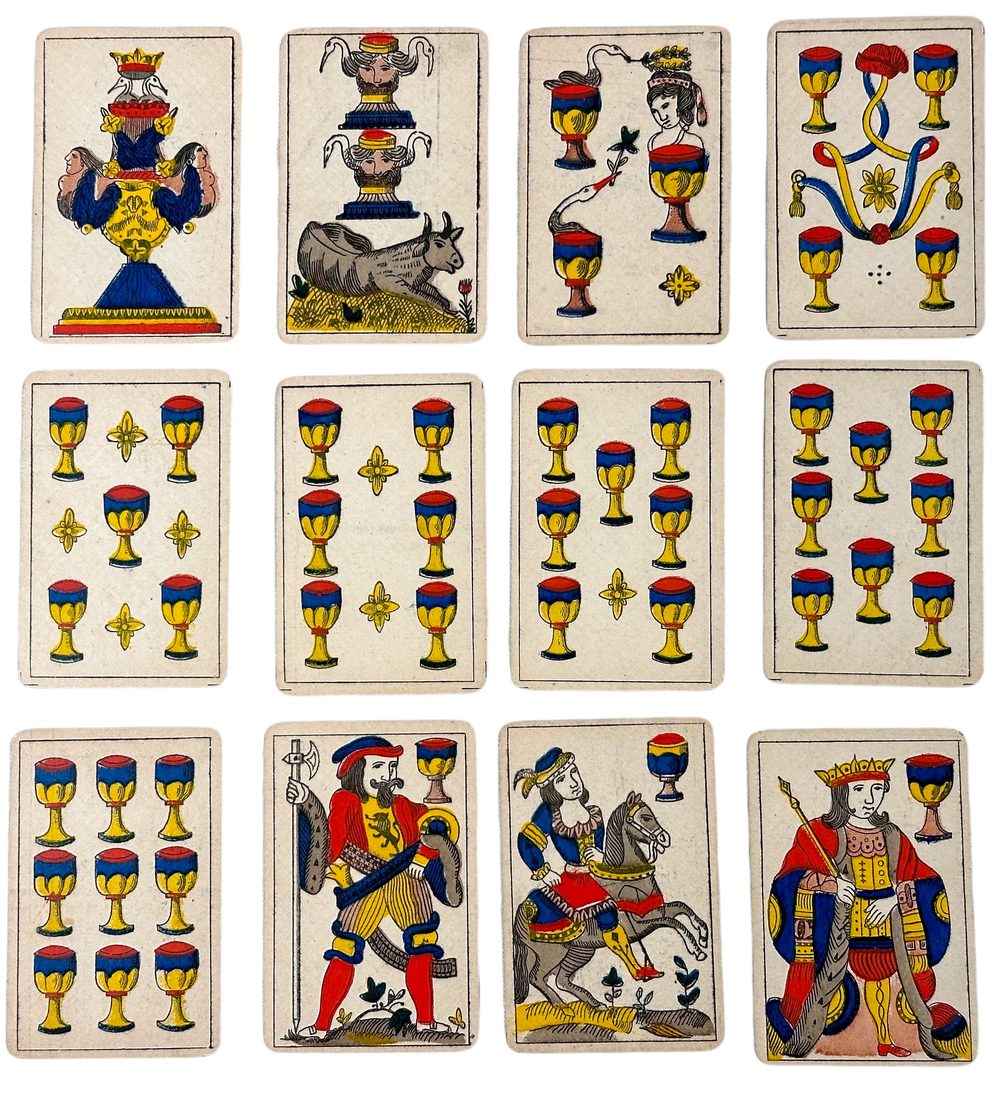
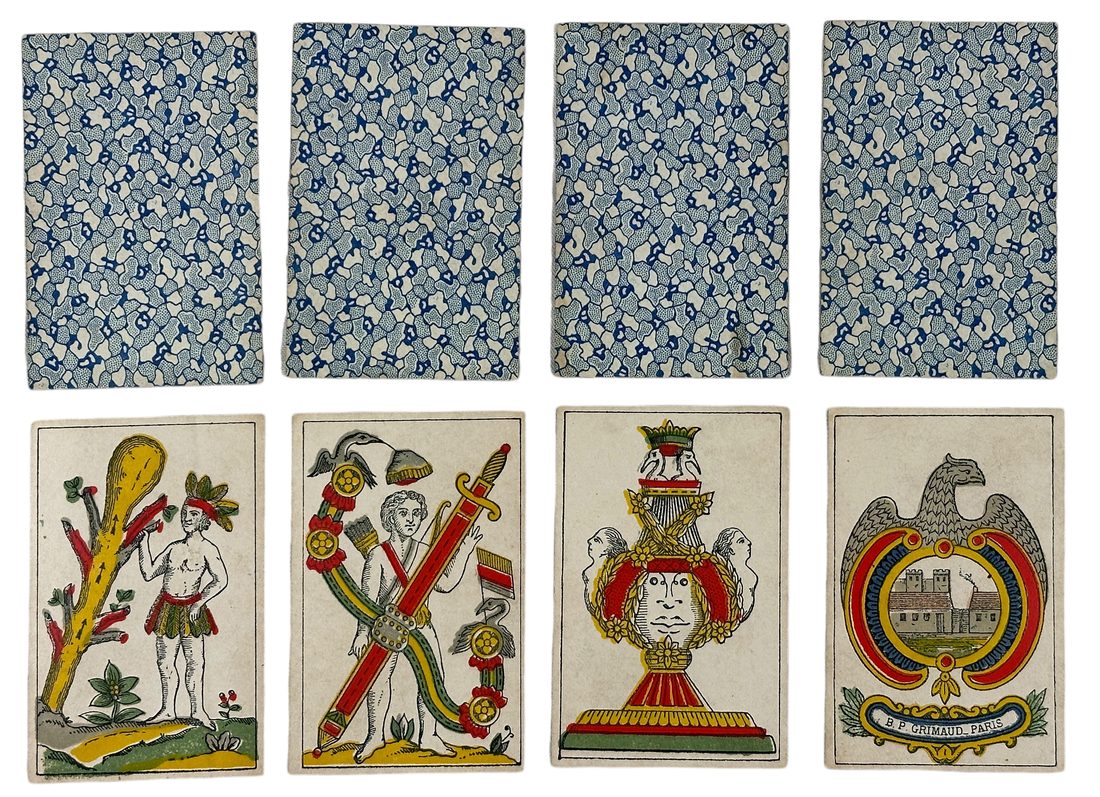
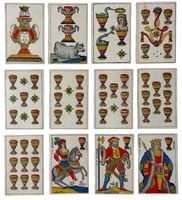
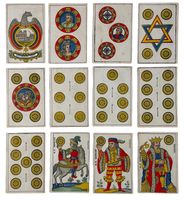
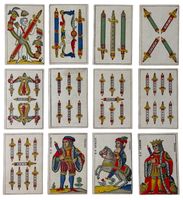
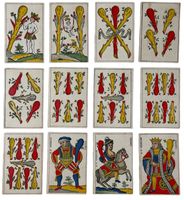
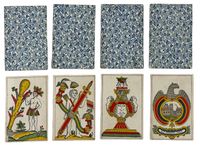
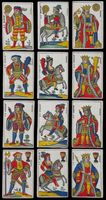
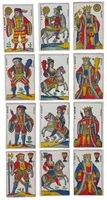
Card Deck, Jeu de l’Aluette or Cartes des Pêcheurs. Paris B.P. Grimaud ca. 1890.
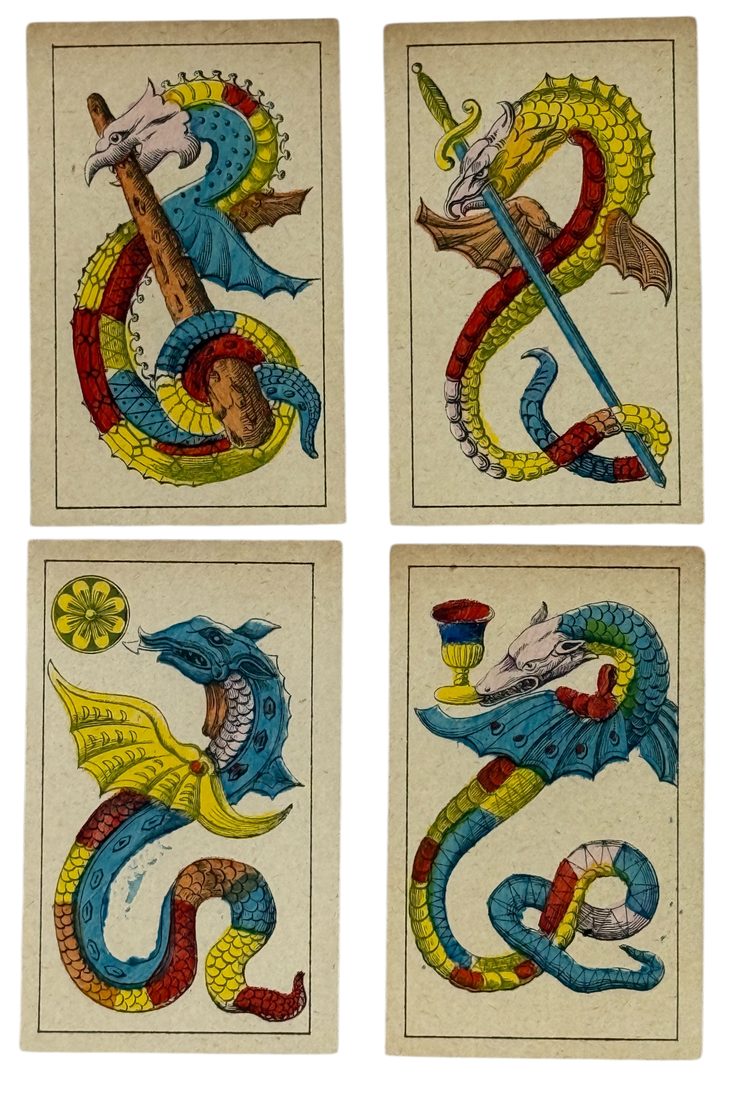
Complete deck (8,7 x 5,6 cm), 48 cards with xylographic impression with typical Italian/Spanish four suites, handcoloured with support of stencils, printed on thick cardboard, back of the card embellished with blue pattern patterns, square corners.
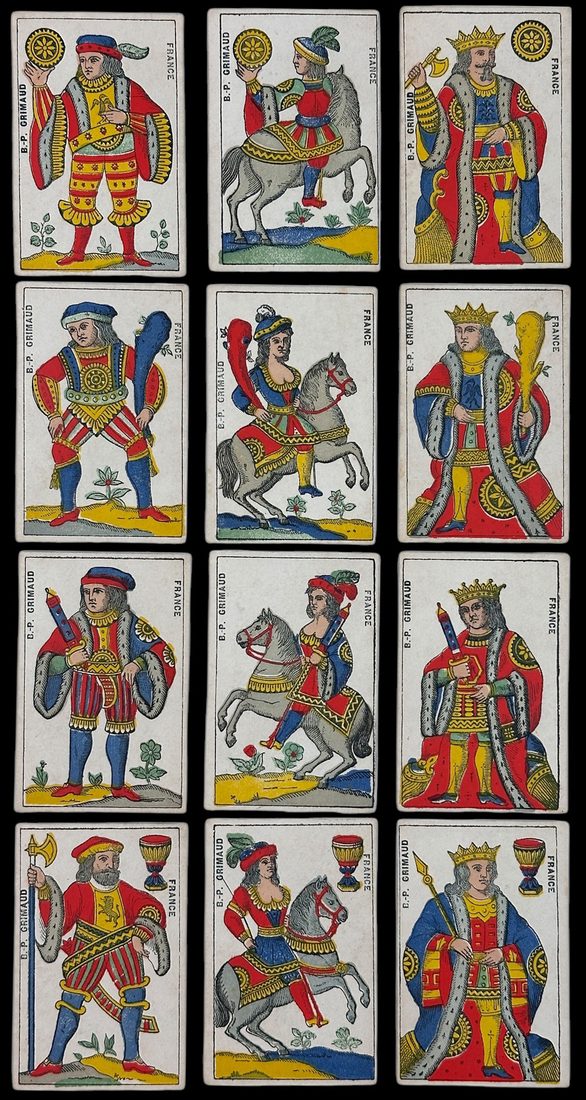
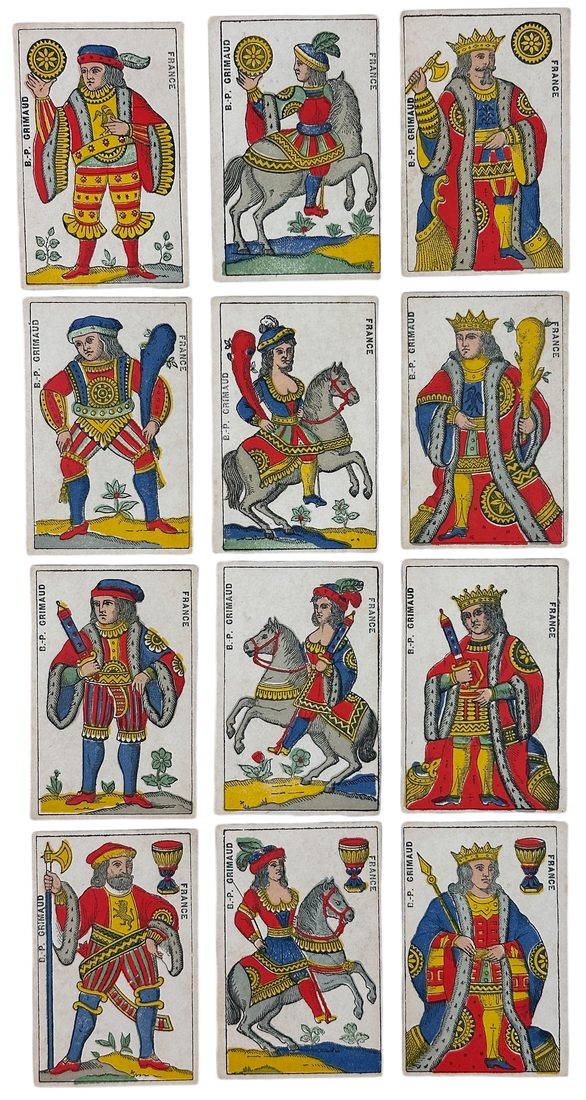
On Ace of coins B.P GRIMAUD, PARIS, on Court Cards B-P- Grimaud France.
The deck is hand coloured with the support of stencils, as it was usual for hand painting playing card deck in the past. The stencil is a thin sheet of pasteboard, parchment, or metal, in which outlines, and general forms of the figures are cut out, for the purpose of being stencilled on cardboard or paper.
By passing a brush charged with colour over the stencil, the colour enters the cut-out lines and imparts the figure to the material beneath. The pips, or common cards, usually require only one colour, either red or black, but the têtes, or court cards, require many colours.
The Aluette, jeu de la vache, la vache (game of the cow) or Cartes des Pêcheurs is an ancient card game played in the western France.
It is a Trick-Taking Game, practiced by four people – two against two – with forty-eight cards with Italian/Spanish suits. It is played with codified signs, which allow teammates to communicate information about their cards during the game.
The oldest form of the word “aluette” is “luette”, and the game is mentioned three times by Rabelais in his work: once in Pantagruel (1532) then in Gargantua (1534), finally in the Cinquième livre.
The Aluette is traditionally practiced in rural and coastal areas between the Gironde and the Loire estuary, in the departments of Vendée and Loire-Atlantique, Bretagne and Saint-Pierre et Miquelon.
«Dans tonte la Bretagne on editait le portrait de Paris; toutefois, quelques cartiers du littoral, tels que Jean Bernard, Et Brest, Jacques Stot, it Saint-Malo, et Ozannet, a Lorient editaient aussi des cartes a ensergnes espagnoles pour les jeux d'aluette tres en houneur pres des matelots et des pecheurs.» (D’Allemagne, cit.)
The origin of the rules of the game of Aluette remains unknown and two different hypotesis stands:
The game came from Spain and was brought to France by Spanish sailors in western French ports (but curiously the game would have disappeared from Spain without leaving any trace), or more likely the game was born in the West of France using the only deck existing in XVI century, the Spanish/Italian, resisting to the generalized conversion to French suits which was completed in the 18th century.
Main Rules:
The four suits (CUPS, SWORDS, MONEY, BATONS or CLUBS) have the same strength and there is no Atout (Trump).
The forty-eight cards, from highest to lowest, fall into four categories:
The “Luettes ”:
- Monsieur (3 of Money)
- Madame (3 of Chalices)
- Le borgne (2 of Money)
- La vache (2 of Chalice)
The “Doubles”:
- Grand Neuf (9 of Chalices)
- Petit Neuf (9 of Money)
- Deux de chêne (2 of Batons)
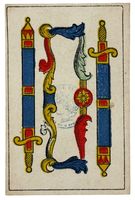
- Deux d'écrit (2 of Swords)
16 Figures (court cards): as (Aces), Rois (Kings), Dames or Cavalières (Queens or Knights), Valets (Knave)
24 Cartes Faibles (les «Bigailles») (weak cards ): from 9 to 3 (except the 3 of Money, the 3 of Chalice, the 9 of Chalice and the 9 of Money).
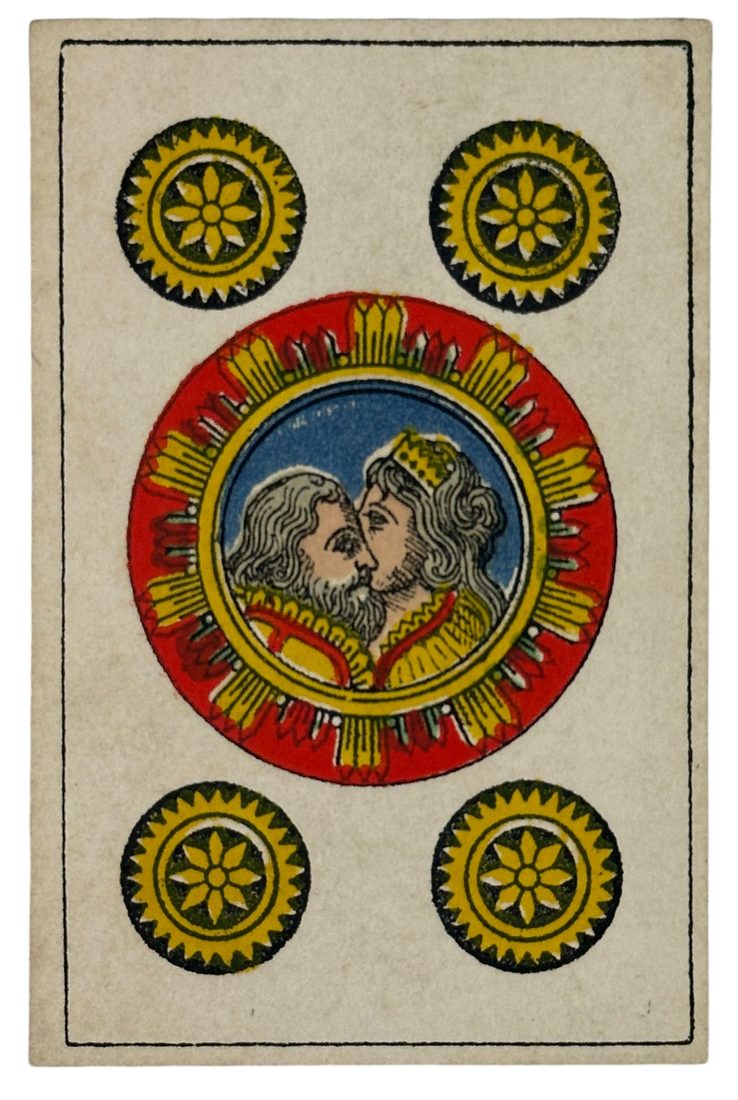
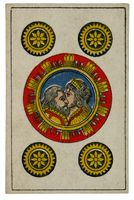
The 5 of Money is called “bise-dur”, without the card having any particular value, representing a couple kissing or embracing.
“Playing cards were invented in Imperial China, and specimens have been found dating back as early the ninth century, during the Tang Dynasty (618-907). Female players were some of the most frequent participants, and the first known book on cards, called Yezi Gexi (presumably written in the 860s) was originally written by a Tang era woman, subsequently undergoing additions by other Chinese scholars.
By the eleventh century, playing cards could be found throughout the Asian continent. During the Ming Dynasty (1368-1644), characters from novels such as the Water Margin were widely featured on the faces of playing cards.
Playing cards first entered Europe in the early fourteenth century, probably from Egypt, with suits (sets of cards with matching designs) very similar to the tarot suits of Swords, Staves, Cups and Coins (also known as disks or pentacles). The first documentary evidence of card playing' is a document written in Vitoria-Gasteiz (now Spain) in 1334, in which the Knights of the Band' (a Spanish military order who wore a red sash across their torso) were categorically prohibited from playing cards.
Regarding France, in 1392, in the register of the Chambre des Comptes of Charles VI of France, there is an entry of the royal treasurer of moneys paid one Jacquemin Gringonneur, painter, for three games of cards 'in gold and diverse colours, ornamented with many devices, for the diversion of our lord, the King.' Seventeen of these strange old painted cards survive in the Bibliothèque Nationale at Paris.
In 1423 the Franciscan friar, Saint Bernard of Siena, in a famous sermon at Bologna, stated that playing cards were the invention of the devil. They increased rapidly in popularity after this statement. Other divines favoured the same theory, with similar consequences. A hundred and fifty years after St. Bernard's fiery outburst the Elizabethan puritan, John Northbrooke, in a treatise against gambling and theatregoing, published in 1576 or 1579, definitely asserted that playing cards were invented by the devil 'that he might the easier bring in Ydolatrie among men?
The earliest known playing cards in Europe seem to have been cards of the Italian variety, afterwards known as “Tarocchini'” or “Tarots.”
Moving across Europe it was possible to find three varieties of the four-suit pack: (1) The Italian and Spanish variety (almost identical); (2) the Germanic variety; (3) the French variety.
- ITALY AND SPAIN
- CUPS. (Equivalent to our 'Hearts.")
- SWORDS. (Equivalent to our 'Spades.)
- MONEY- Denari in Italy; Oros, i.e. gold pieces, in Spain (Equivalent to our 'Diamonds'.)
- BATONS or CLUBS. (Equivalent to our 'Clubs.")
- GERMANIC NATIONS
- HEARTS.
- ACORNS. (Perhaps equivalent to our 'Spades.")
- BELLS, i.e., hawk-bells. (Perhaps equivalent to our
- '"Diamonds.")
- LEAVES. (Perhaps equivalent to our 'Clubs
- FRANCE
- COEUR, a heart. (Our 'Hearts.)
- PIQUE, a pike. (Our 'Spades.)
- CARREAU, a paving tile. (Our 'Diamonds.)
- TREFLE, a trefoil a clover-leaf. (Our 'Clubs.)
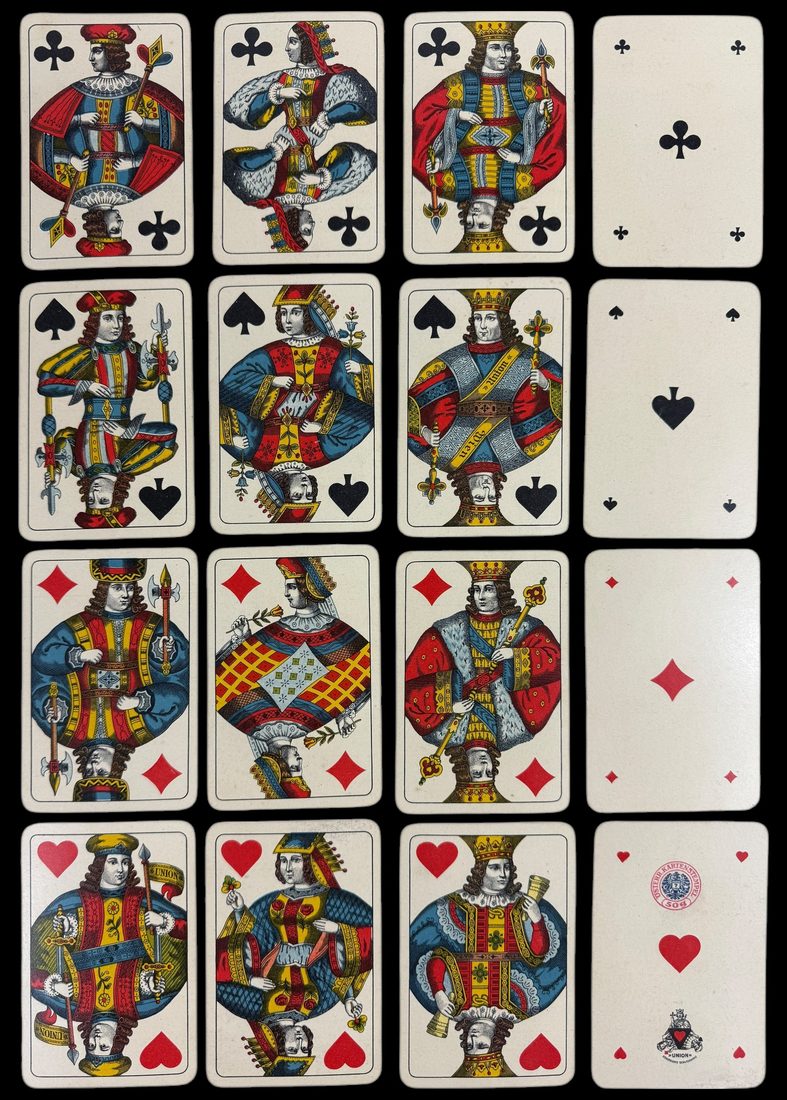
France quickly became the chief card-manufacturing nation, but the real stroke of genius that the French came up with was to divide the four suits into two red and two black, with simplified and clearer symbols. This meant that playing cards could be produced with stencils, a hundred times more quickly than using the traditional techniques of wood-cutting and engraving. With improved processes in manufacturing paper, and the development of better printing processes, including Gutenberg's printing press (1440), the slower and more costly traditional woodcut techniques previously done by hand were replaced with a much more efficient production. For sheer practical reasons, the Germans lost their earlier dominance in the playing card market, as the French decks and their suits spread all over Europe, giving us the designs as we know them today.
Throughout the 15th and 16th centuries the French cards, made in most of the chief towns of France, were the best in Europe, and during the 17th and 18th centuries the card-making trade--though greatly harassed by Government restrictions and exactions-continued to be of great importance. French cards were exported to England, Italy, Spain, Switzerland and most of the European countries[…]
One interesting feature of the French dominance of playing cards in this time is the attention given to court cards.
In the late 1500s French manufacturers began giving the court cards names from famous literary epics such as the Bible and other classics.
It is from this era that the custom developed of associating specific court cards with famous names, the more well-known and commonly accepted ones for the Kings being King David (Spades), Alexander the Great (Clubs), Charlemagne (Hearts), and Julius Caesar (Diamonds), representing the four empires of Jews, Greeks, Franks, and Romans.
Notable characters ascribed to the Queens include the Greek goddess Pallas Athena (Spades), Judith (Hearts), Jacob's wife Rachel (Diamonds), and Argine (Clubs). The Knaves were commonly designated as La Hire (Hearts), Charlemagne’s knight Ogier (Spades), Hector the hero of Troy (Diamonds), and King Arthur's knight Lancelot (Clubs).
The common postures, clothing, and accessories that we expect in a modern deck of playing cards today find their roots in characters like these, but we cannot be certain how these details originated, since there was much diversity of clothing, weapons, and accessories depicted in the French decks of this time. But eventually standardisation began to happen, and this was accelerated in the 1700s when taxing on playing cards was introduced. With France divided into nine regions for this purpose, manufacturers within each region were ordered to use a standardised design unique to their region. But it was only when playing cards emigrated to England that a common design really began to dominate the playing card industry[…] “[GURNEY, Op. cit.]
Conditions: Very good conditions.
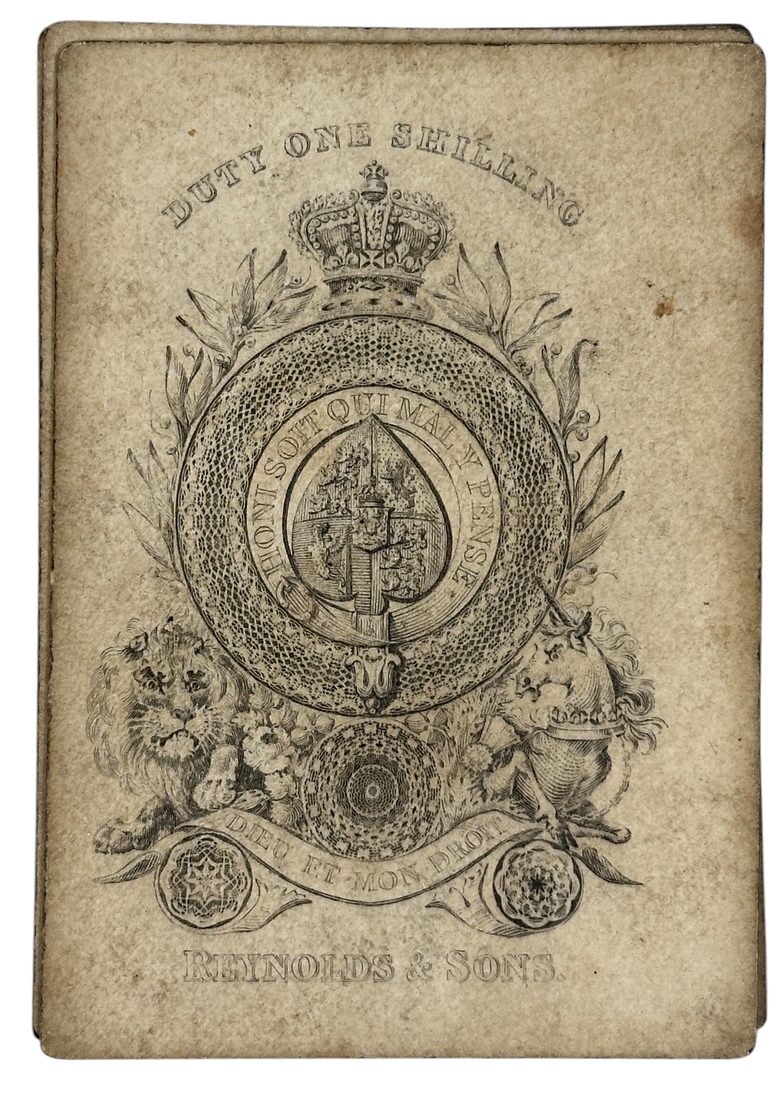
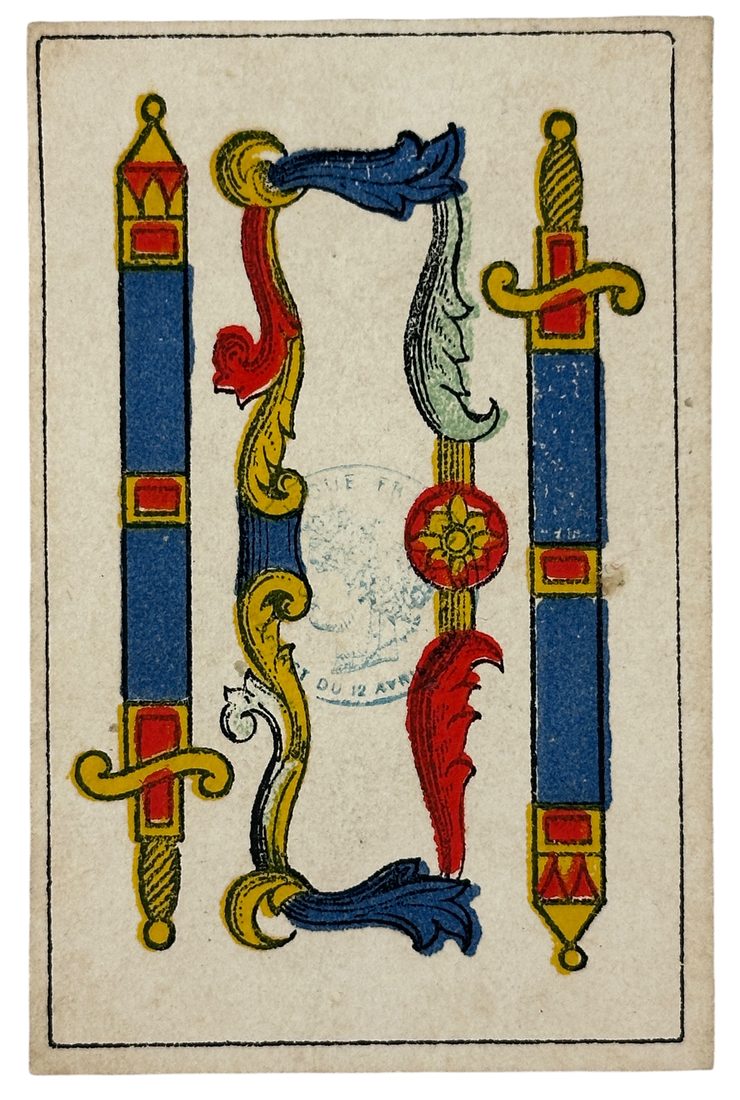
Provenance: On two of swords tax stamp “Avril 12 1890 République Français”, used in France from 1890 to 1917; Playing Card stamps showed the tax was paid on playing cards, where placed when the deck was marketed, not printed, and in the country of use, not in the country of printing.
References: W. Gurney Benham, History of the Pack and Explanations of Its Many Secrets, Read Books, 2019; Henry Rene D'Allemagne, Antique Playing Cards: A Pictorial Treasury, I:108-sq, 1996; Catherine Perry Hargrave, A History of playing cards, Dover publications, 2021; Henry Rene D'Allemagne, Les cartes à jouer du XIV au XX siècle, Paris : Librairie Hachette, 1906.
Henry Rene D'Allemagne, Antique Playing Cards: A Pictorial Treasury, I, 205
Henry Rene D'Allemagne, Antique Playing Cards: A Pictorial Treasury, II, 106