Early De La Rue "Old Frizzle"
| Macro-category | Playing Cards and Tarot |
| Subcategory | Historical Playing Cards |
| Author | De La Rue & Co |
| Year | 1832 |
early De La Rue “Old Frizzle” deck with original case
[Playing cards]. Standard English Playing Cards, “Old Frizzle”. London, De La Rue & Co., by His Majesty’s Royal Letters Patent, circa 1832–1835.
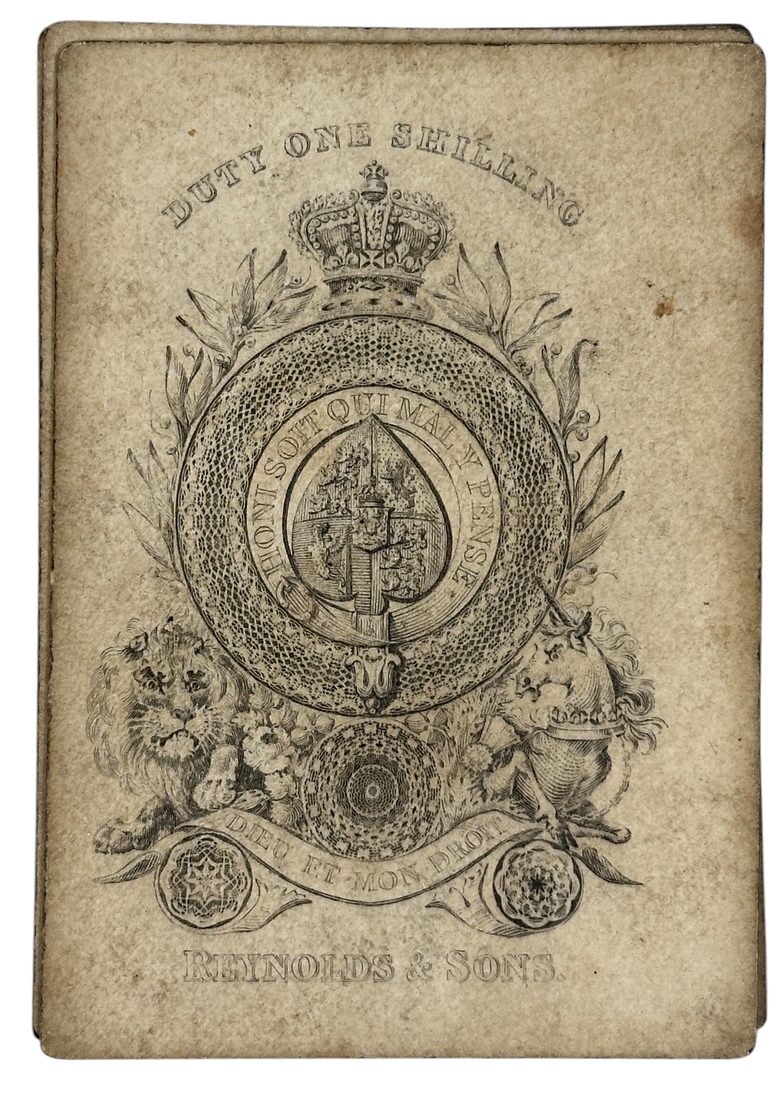
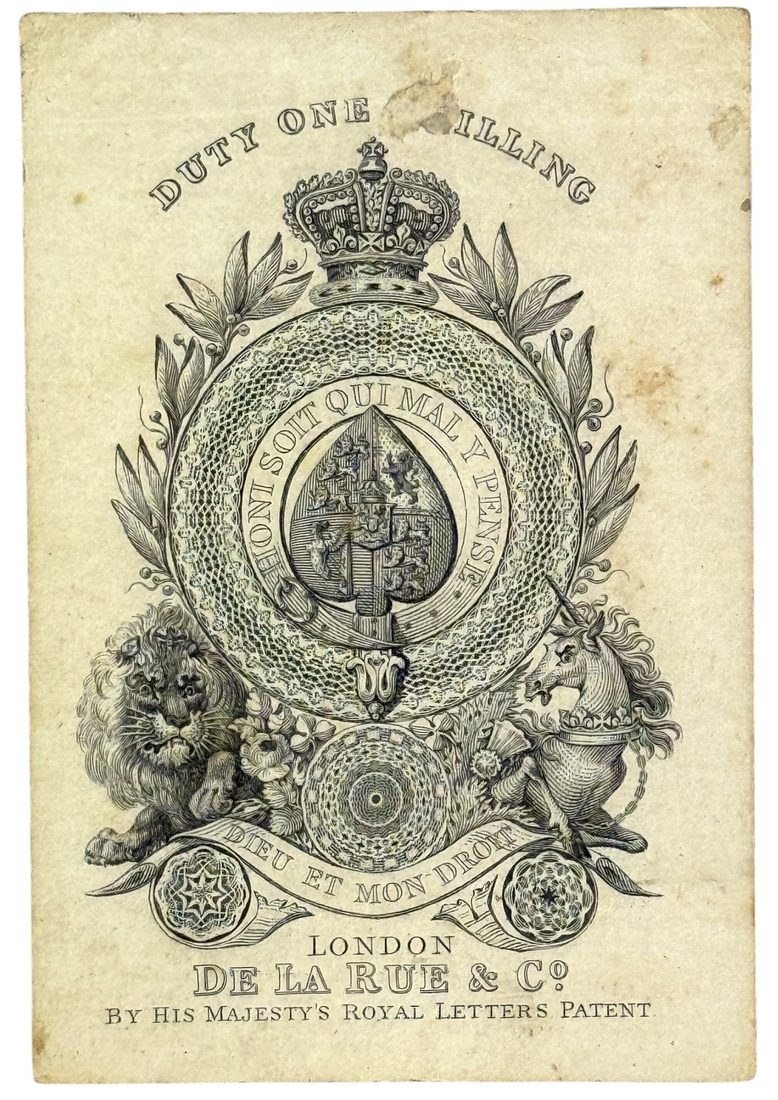
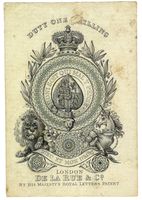
52/52 playing cards (95 × 65 mm), printed from woodblocks and finished with hand-applied stencil colouring in red, blue, yellow, and black. Single-ended court cards in the standard English pattern. The Ace of Spades is engraved with the official fiscal emblem “Duty One Shilling”, bearing the royal arms within the Garter and the inscription “De La Rue & Co., by His Majesty’s Royal Letters Patent”.
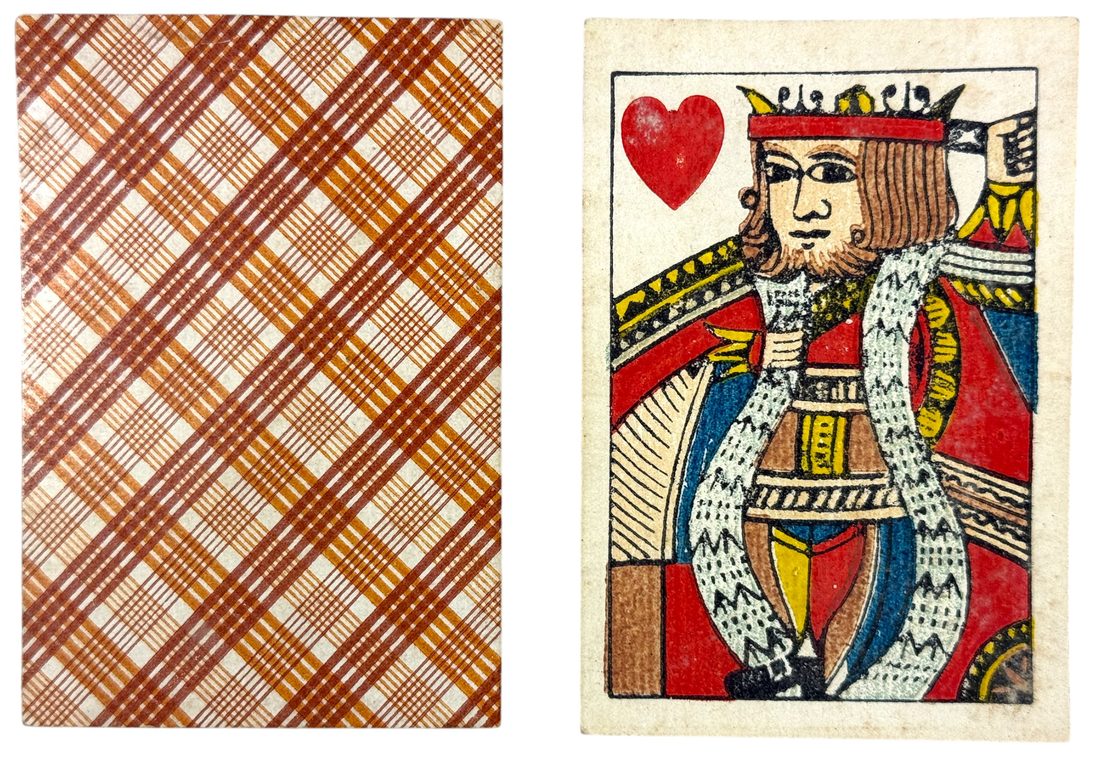
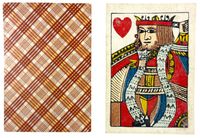
Cards with square corners, printed on stout card. Backs with a repeating diagonal lattice pattern in orange and yellow, executed in a simple geometric scheme characteristic of early, non-standardised English card backs of the 1830s.
Housed in the original card case, of rectangular form, covered in brown paper with a subtle embossed ornamental pattern, constructed as a two-part sliding box.
No indices. No die numbers. Pattern conforms to the “English standard” codified before 1840 (IPCS #48).
A refined and complete example of an early nineteenth-century English playing-card deck produced by De La Rue at the outset of the new fiscal regime governing card manufacture, preserved with its original case. The pack belongs to the earliest phase of the “Old Frizzle” duty ace (Berry A7), immediately following its registration in 1832, and retains characteristic features such as single-ended courts, absence of indices, and hand-stencilled colouring. Its preservation, together with its original case and early geometric back, places it among the first generation of regulated English packs.
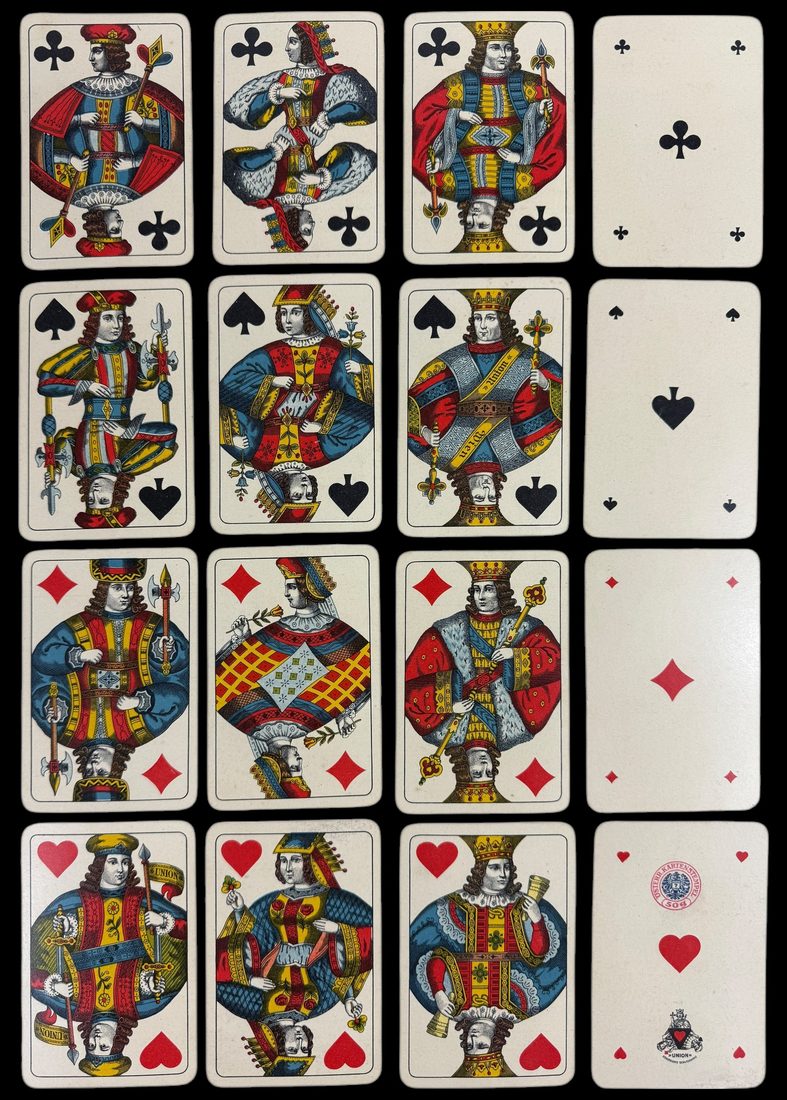
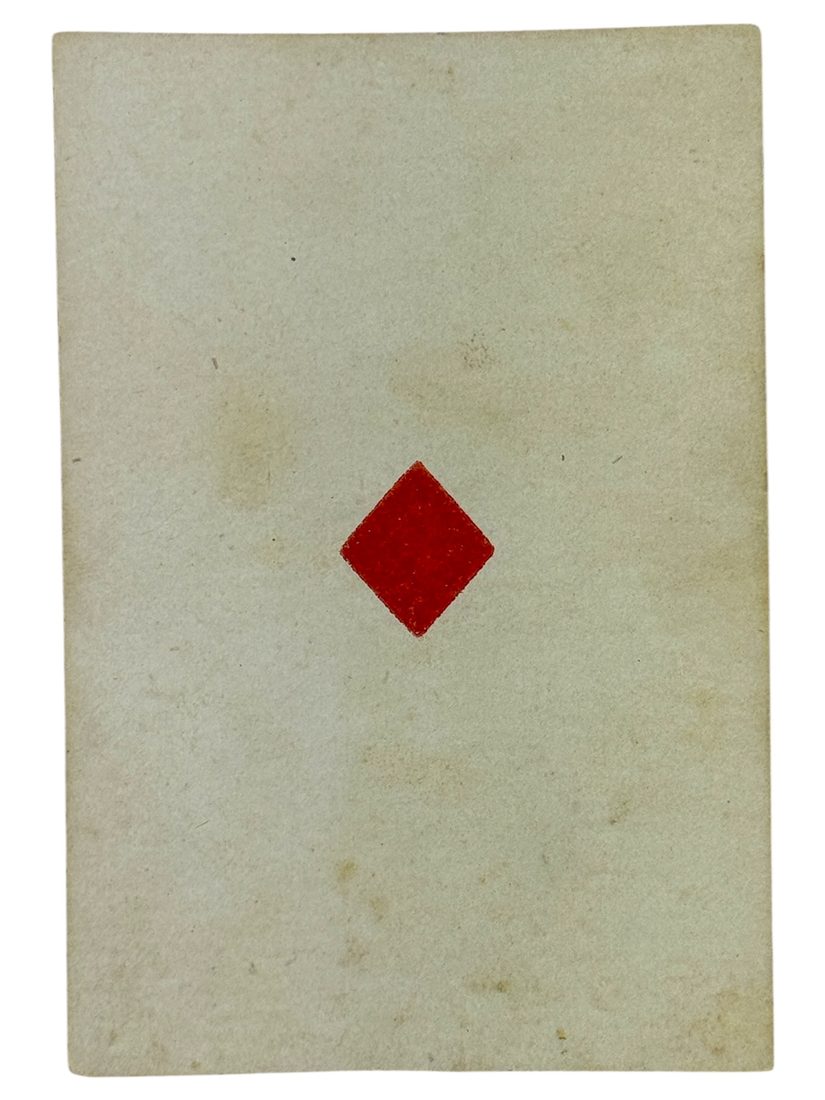
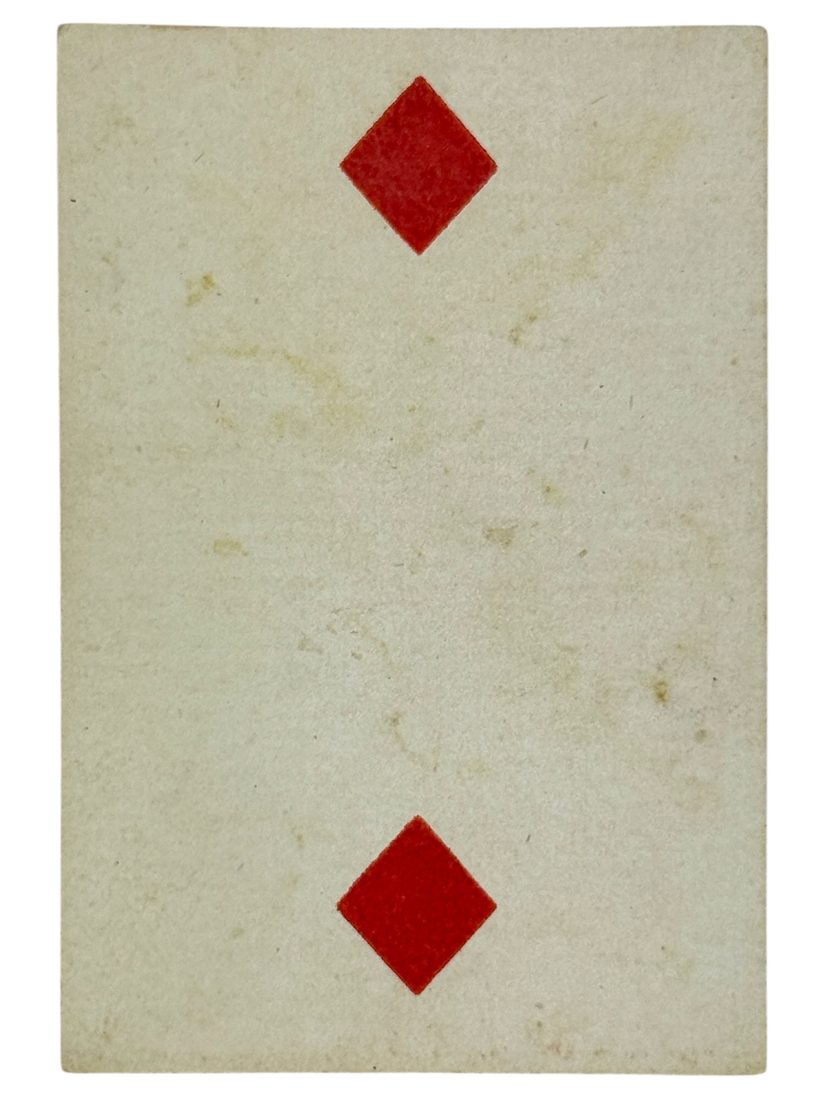
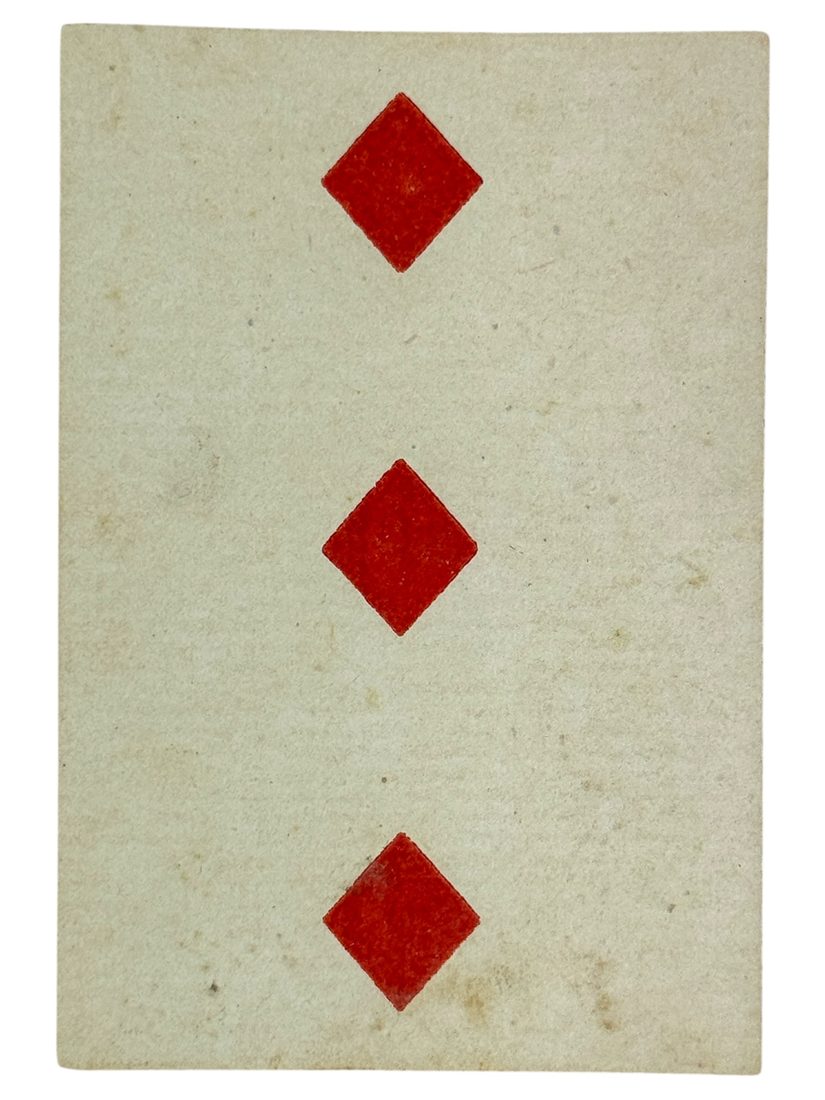
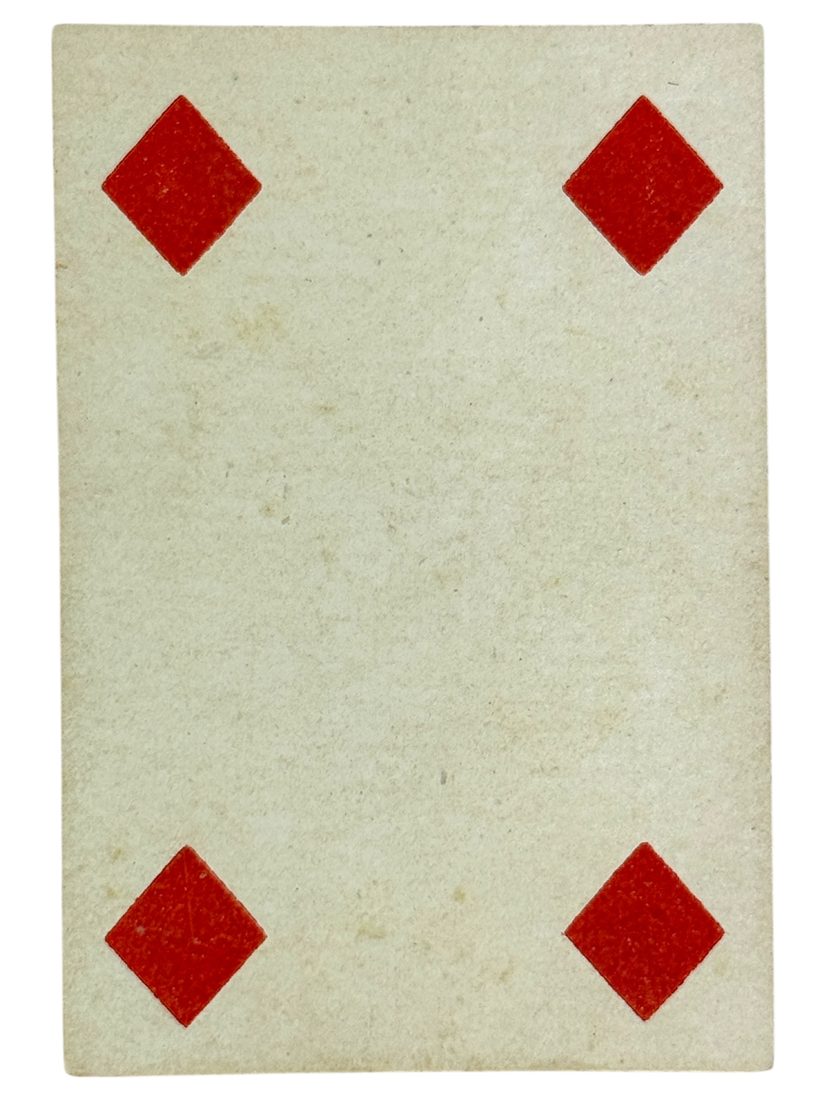
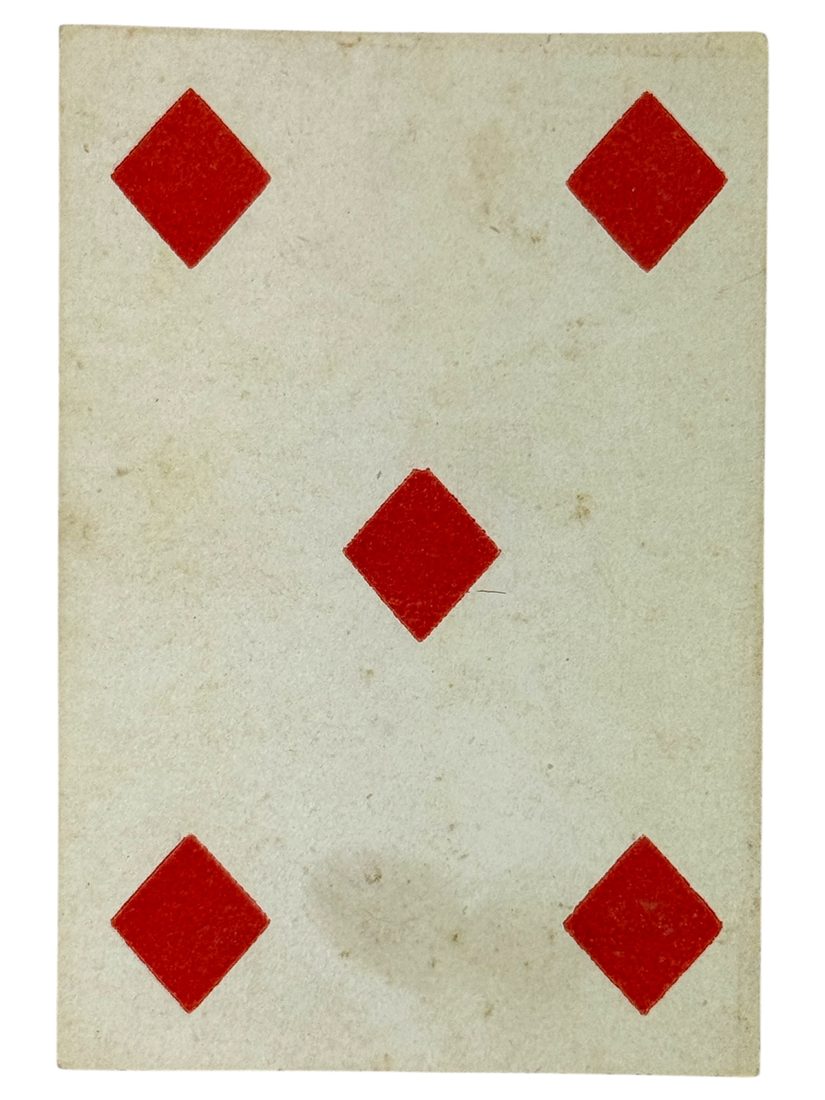
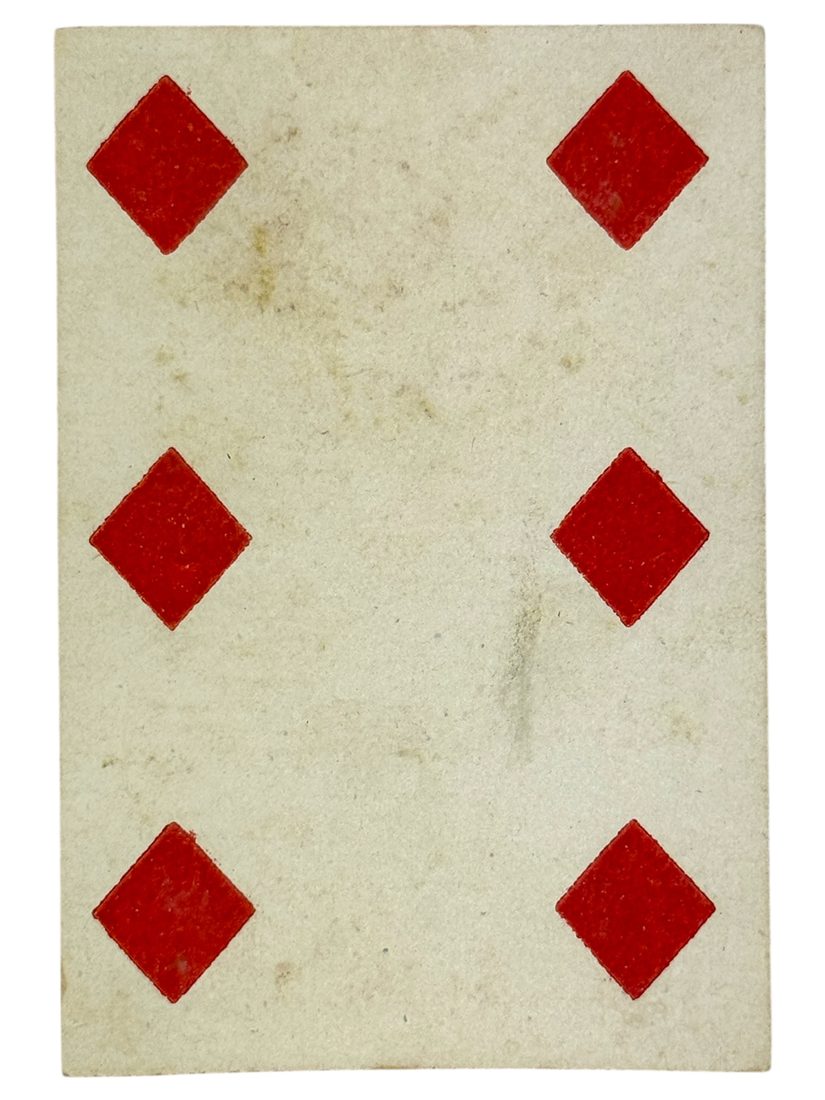
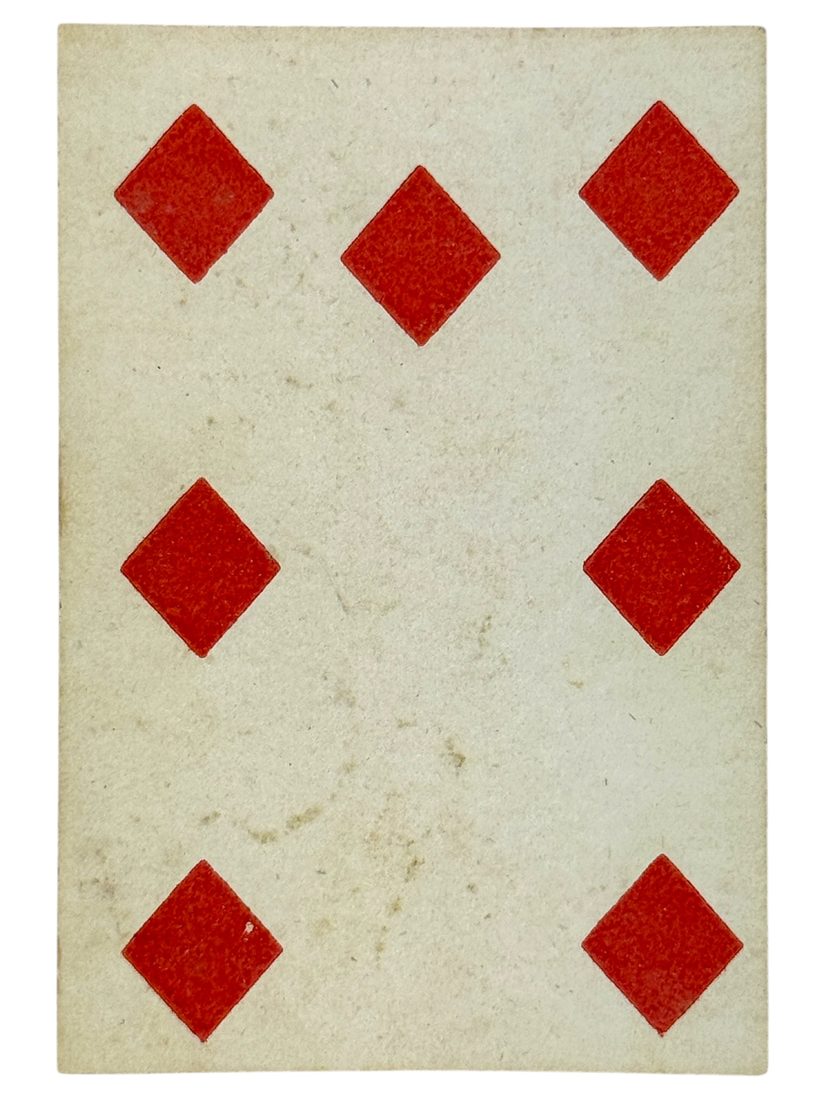
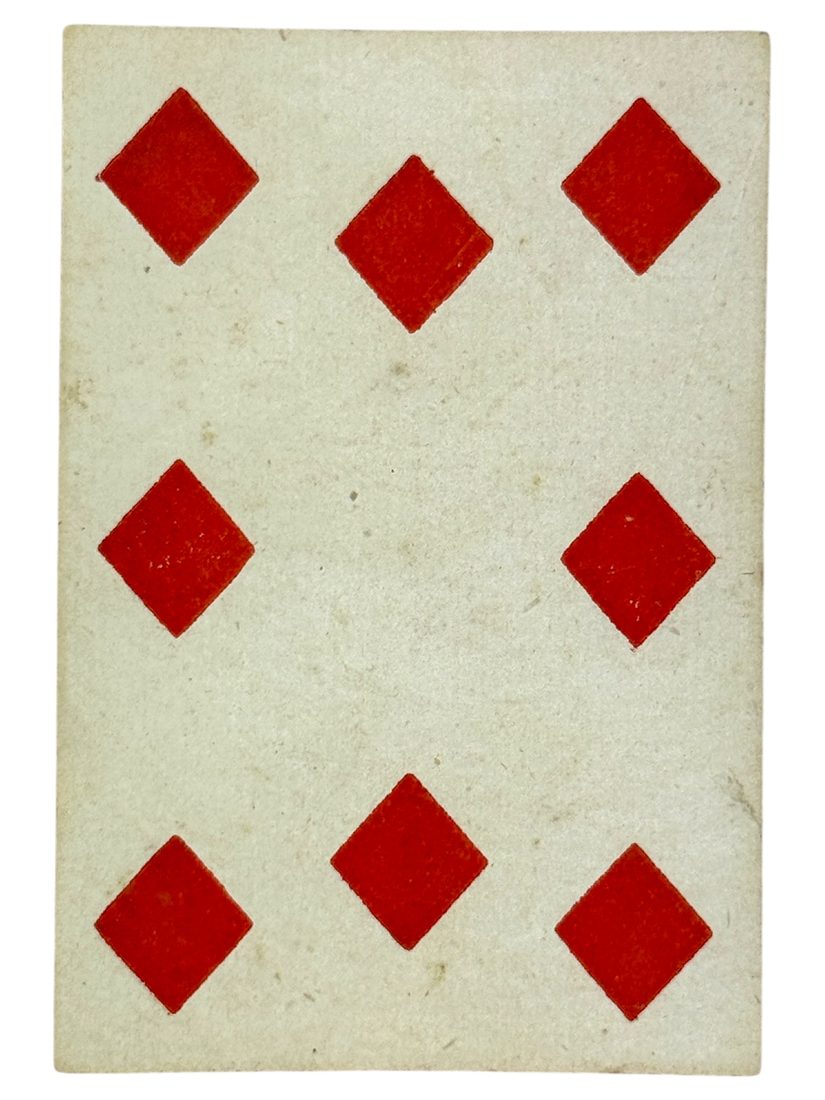
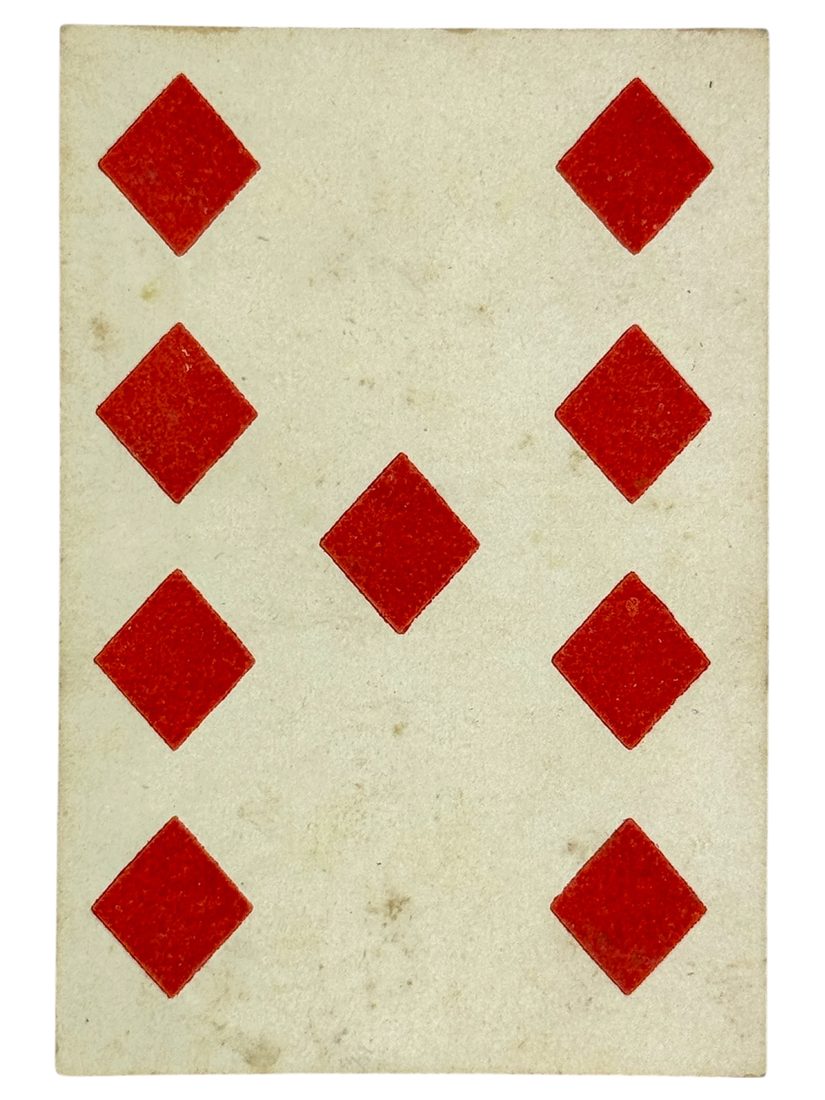
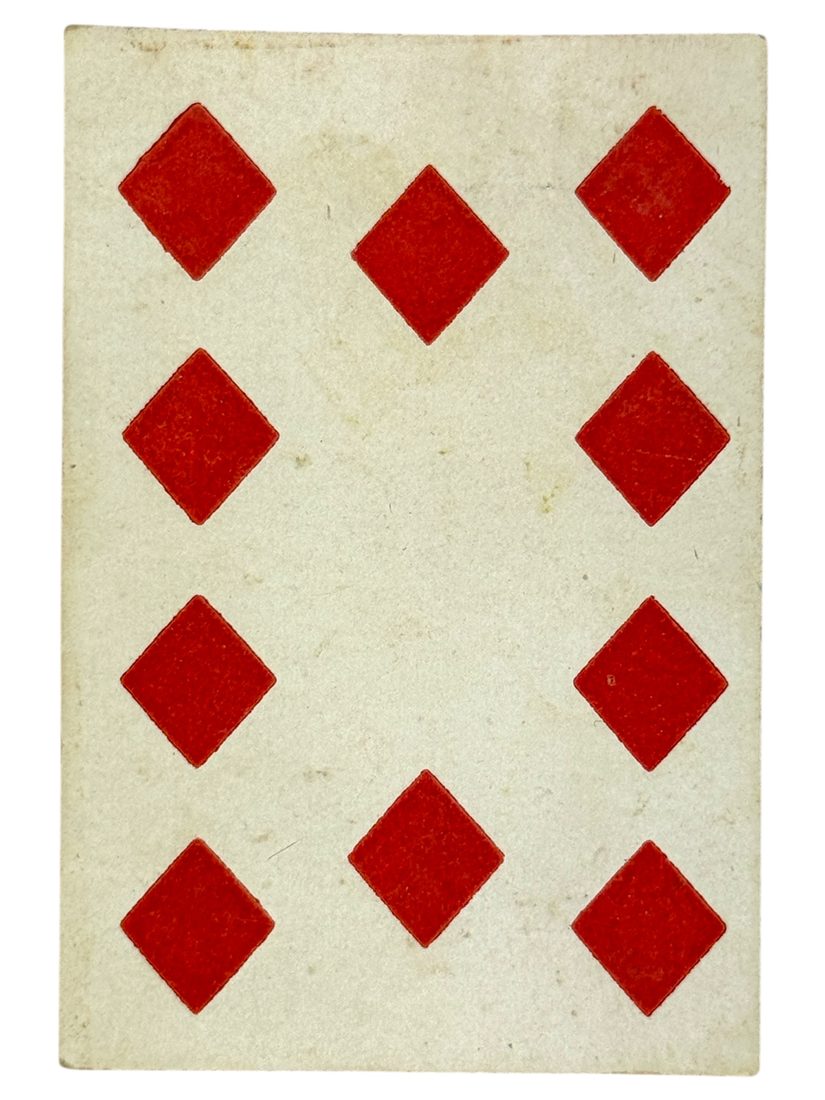
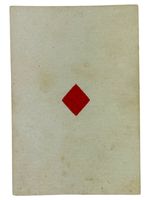
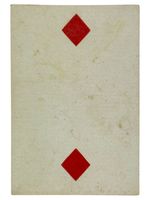
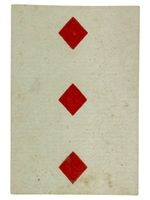
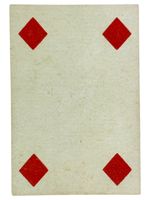
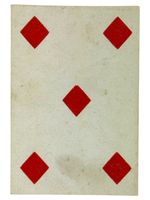
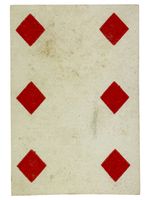
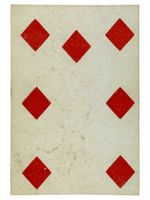
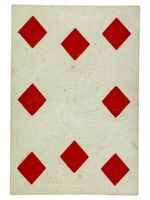
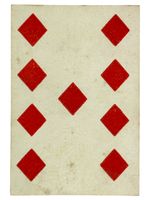
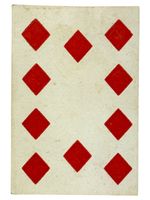
The deck comprises the four standard suits of thirteen cards each: Hearts, Diamonds, Clubs, and Spades. The pip cards are clearly arranged and typographically restrained, reflecting the functional clarity typical of English playing cards of the period.
The court cards follow the established English pattern derived from earlier French prototypes, progressively standardised through repetition and adaptation. Executed in bold woodcut and enriched with stencil-applied primary colours, they display stylised costumes articulated through strong linear construction and flat chromatic fields. The figures remain single-ended, preserving a traditional format later replaced by double-ended courts during the nineteenth century.
The King of Hearts presents the well-known “Suicide King” motif, in which the sword appears to pierce the monarch’s head. This feature results from progressive simplification of earlier continental models in which the weapon was originally held behind the head, illustrating the conservative transmission of iconographic forms in playing card design.
The Ace of Spades constitutes the visual and regulatory centre of the deck. The engraving displays the crowned royal arms encircled by the Garter motto Honi soit qui mal y pense, flanked by the lion and unicorn supporters, and surmounted by Dieu et mon droit. The composition is enclosed within the characteristic textured circular device conventionally known as the “Old Frizzle”.
This type of duty ace is formally classified by John Berry as Type A7. The specific variant bearing the inscription “De La Rue & Co., by His Majesty’s Royal Letters Patent” is recorded in Berry’s study as registered on 24 August 1832. This date refers to the registration of the plate rather than to the production of individual packs.
The absence of die numbers, combined with the early character of the stencil colouring and the simplicity of the geometric back design, places the present deck within the earliest phase of De La Rue’s production under the new fiscal system. The pack may therefore be attributed to the first generation of A7 decks, most plausibly dating between 1832 and 1835.
As mandated by law, the Ace of Spades was supplied by the Stamp Office rather than printed by the manufacturer, serving both as proof of tax payment and as a visible assertion of state authority.
The present deck belongs to a pivotal moment in the history of British playing cards, defined by the reform of card taxation introduced in 1828. Prior to this reform, manufacturers retained a degree of autonomy in the design of the Ace of Spades, which functioned as the fiscal card. The new legislation fundamentally altered this system by centralising the production of the Ace of Spades under the authority of the Stamp Office. From this point onward, the Ace of Spades ceased to be merely a decorative or identifying element and became an official fiscal instrument, inserted into each pack as proof of duty payment. This measure significantly reduced counterfeiting while simultaneously imposing a uniform visual standard across all manufacturers.
Despite this increased regulation, production techniques remained rooted in earlier traditions. As the present deck demonstrates, woodblock printing and hand-applied stencil colouring continued to be employed during the early decades of the nineteenth century. The result is a hybrid object, in which state-imposed standardisation coexists with artisanal methods of manufacture.
The absence of indices and the persistence of single-ended courts further confirm the early date of the pack. These features belong to a design tradition that would soon be modified by practical innovations, particularly the introduction of corner indices and double-ended figures, which improved usability during play.
The deck thus occupies a transitional position between two phases of playing card history: the earlier world of relatively independent, craft-based production, and the later, increasingly industrial and standardised system that would come to dominate the nineteenth century.
De La Rue & Co. was among the most important British producers of playing cards and security printing in the nineteenth century. Established in London, the firm rapidly became a leading manufacturer within the regulated environment created by the Stamp Office reforms.
By the early 1830s, De La Rue was already producing high-quality packs that combined technical precision with adherence to official fiscal requirements. The present deck belongs to this early phase of production.
Conditions: Light to moderate wear consistent with use. Minor soiling and occasional staining, particularly visible on the Ace of Spades. The original case shows abrasions, edge losses, and partial splitting at the joints, but remains structurally intact.
Provenance: Ace of Spades with “Duty One Shilling” fiscal stamp (Berry type A7, “Old Frizzle”).
Reference: J. Berry, Taxation on Playing-Cards in England from 1711 to 1960, IPCS Papers, no. 3, 2001; S. Mann, All Cards on the Table, Verlag, 1990, p. 128; K. Wowk, Playing Cards of the World, Lutterworth Press, 1983, pp. 90-92; S. Mann, Collecting Playing Cards, Arco Publications, 1966, pp. 65-66; C. P. Hargrave, A History of Playing Cards, Dover Publications, 2021, p. 186.