Cartes au portrait de Provence: three master cardmakers of one street
| Macro-category | Playing Cards and Tarot |
| Subcategory | Historical Playing Cards |
| Author | Benoist and Etienne Lajus, Alexandre Lionnet |
| Provenance | Montpellier |
| Year | ca. 1730 |
of Benoist Lajus the literature records one card. here is the second:
fifty-two cards at the portrait de Provence naming three master
cardmakers of the rue de la Barralerie at Montpellier,
whose backs were afterwards taken up
for dockets, notes and reading letters, two of them dated 1780
Cartes au portrait de Provence. Montpellier: ca 1730.
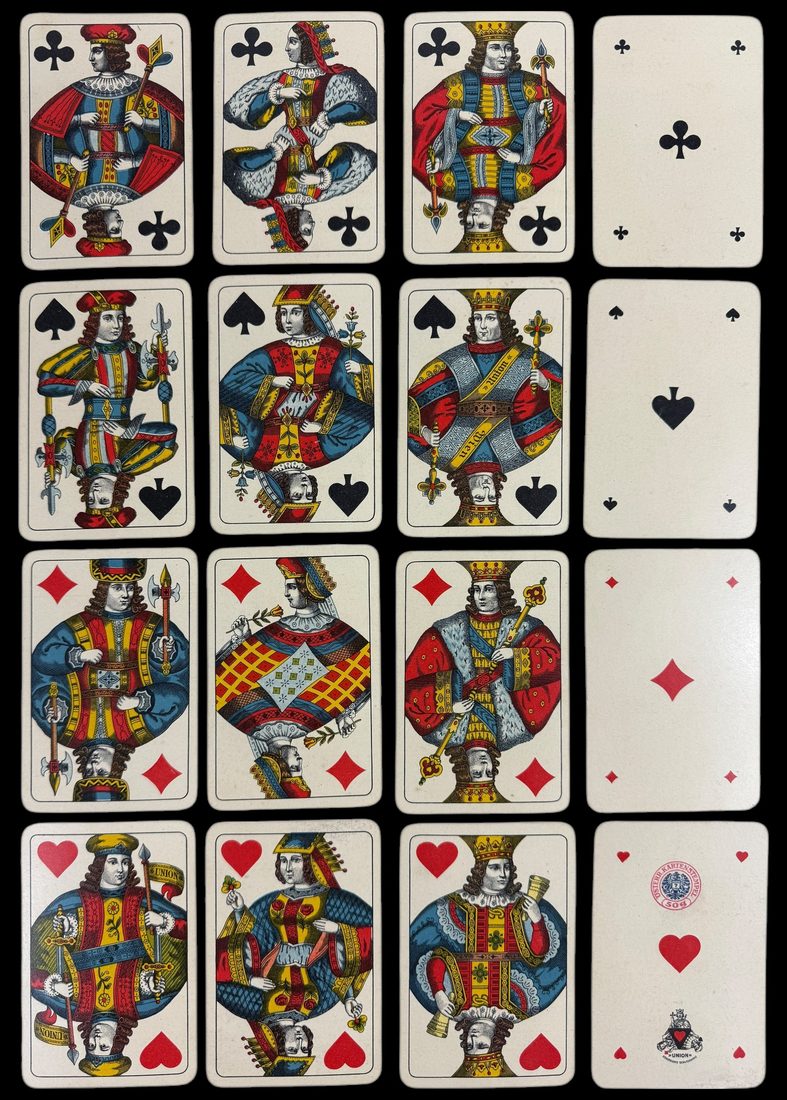
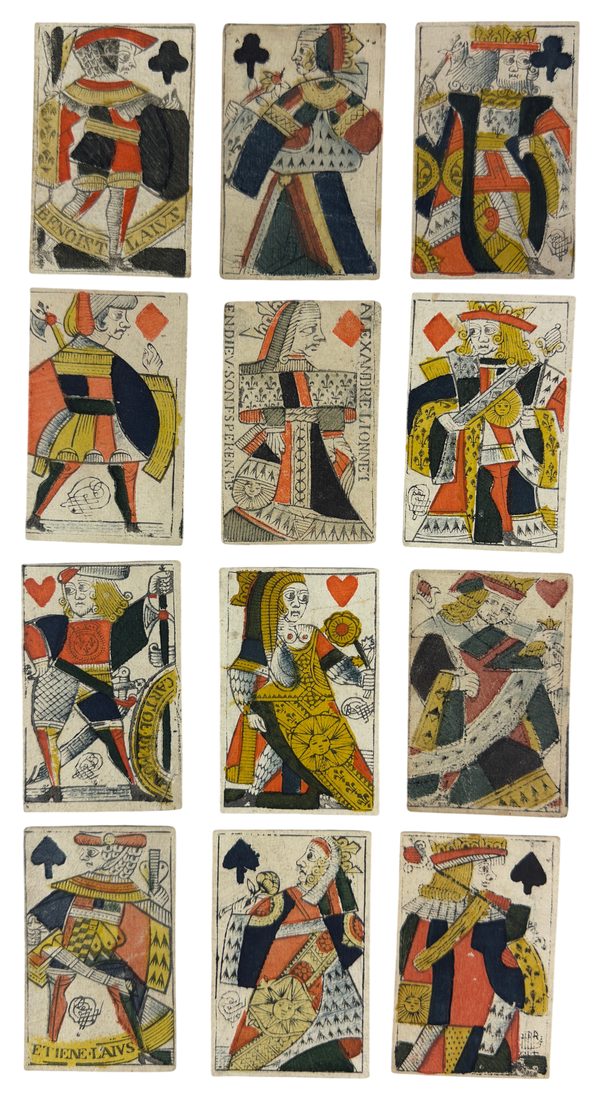
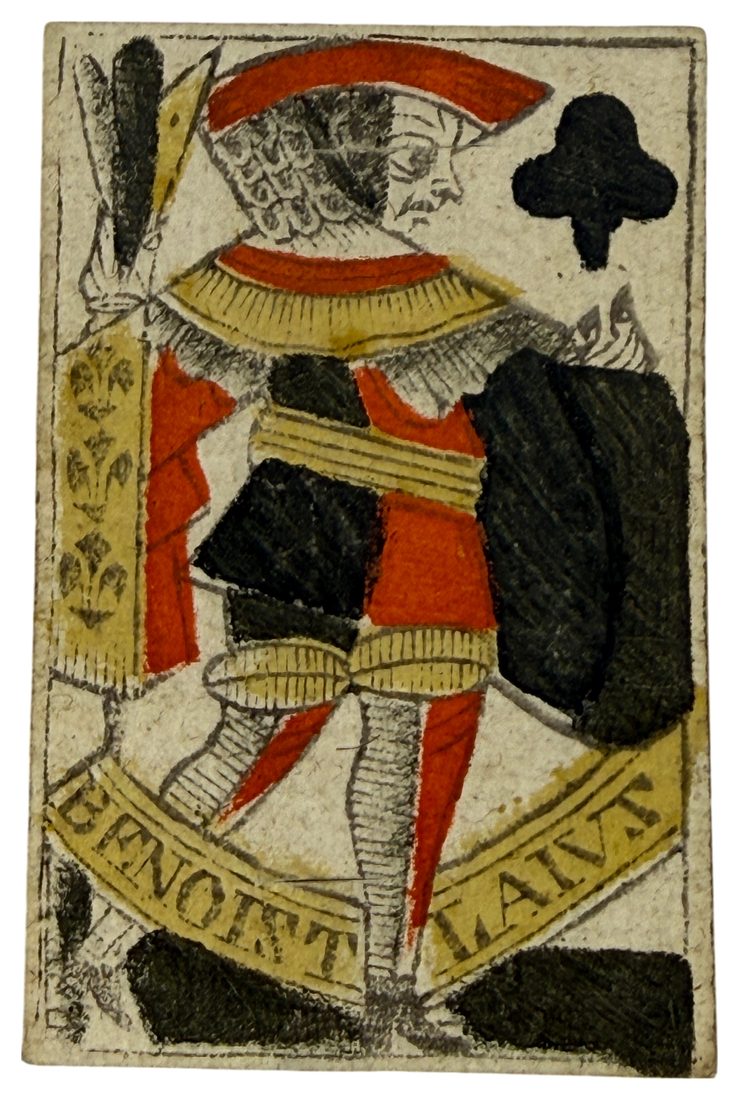
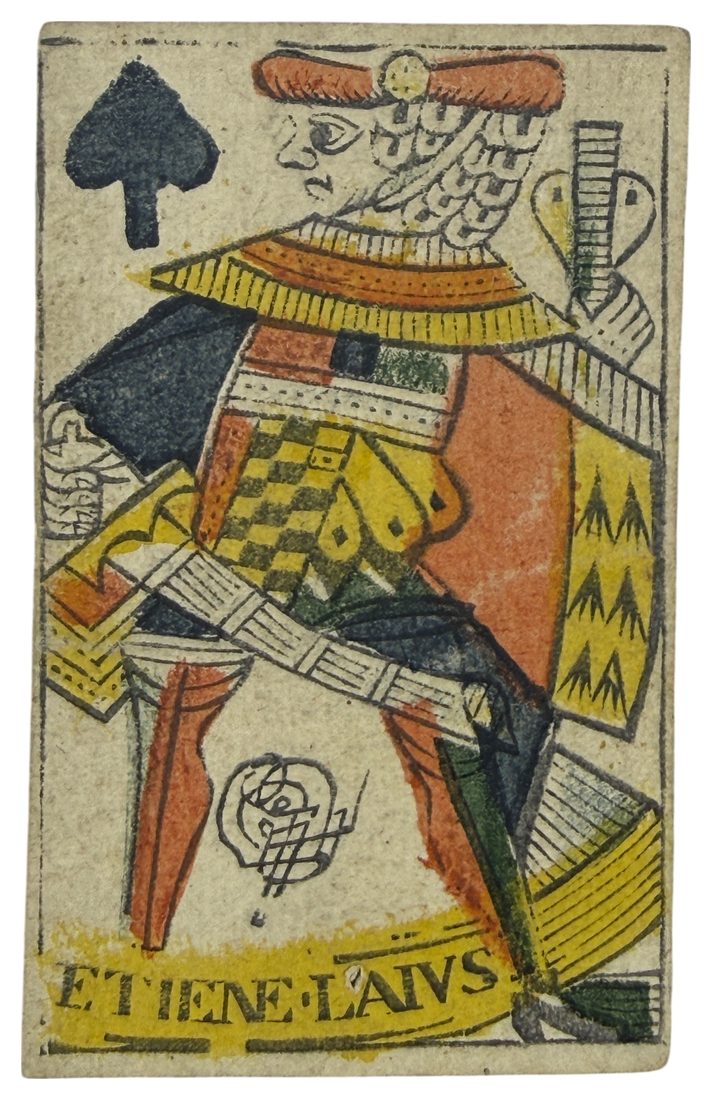
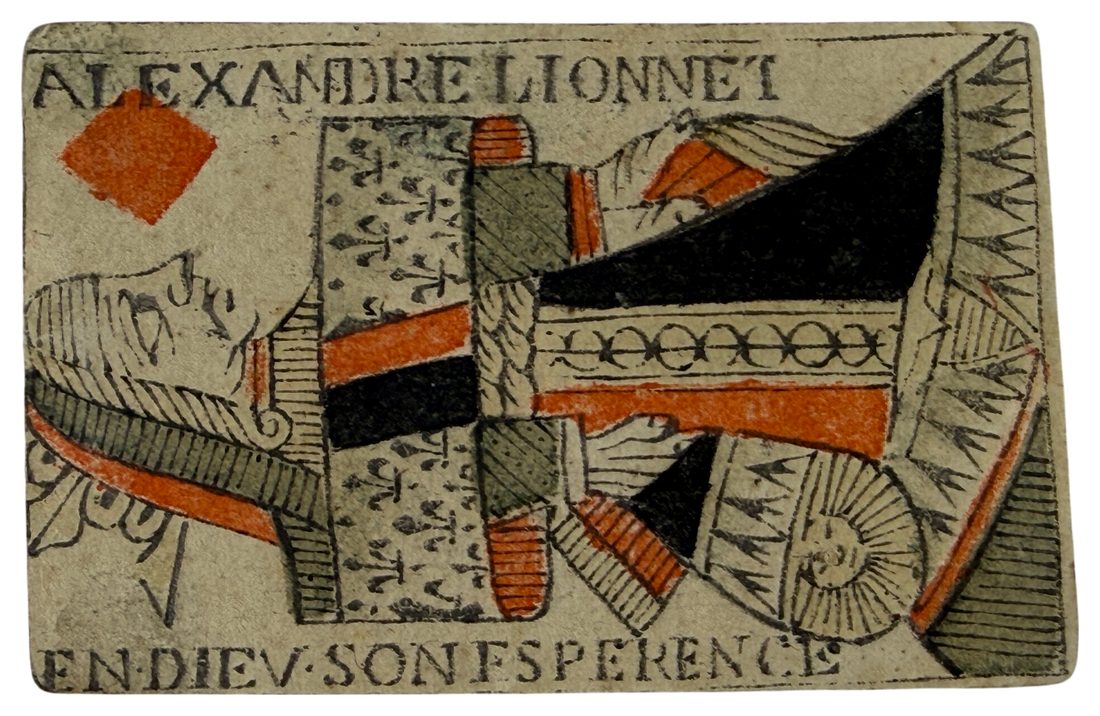
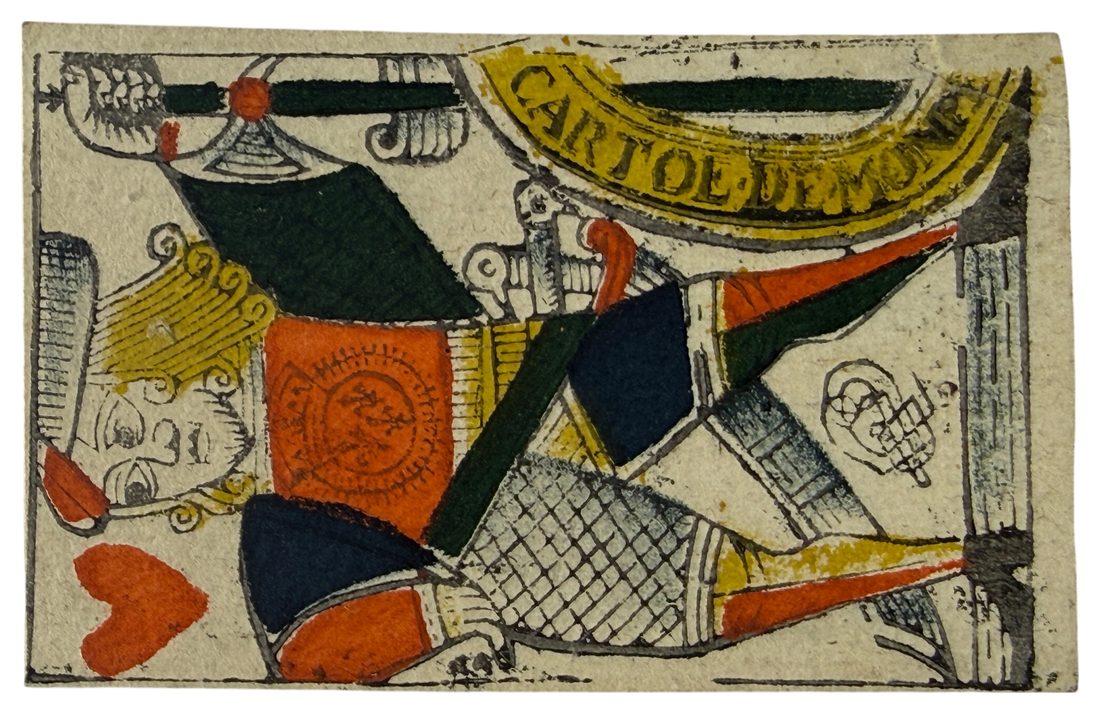
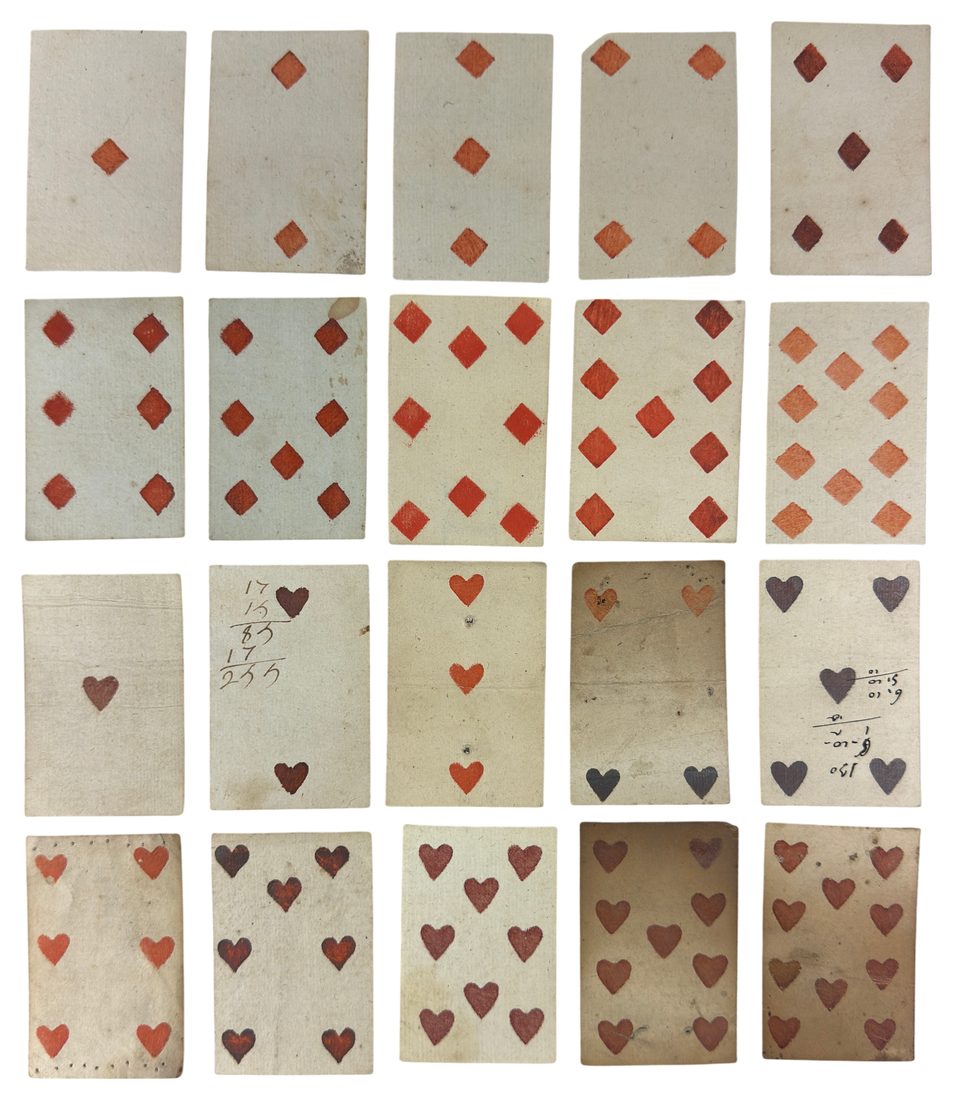
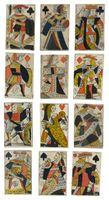
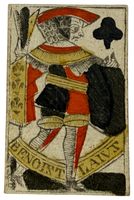
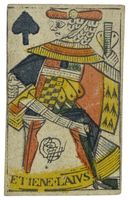
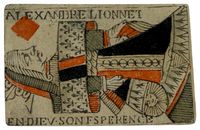
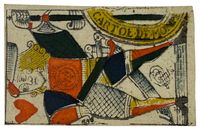
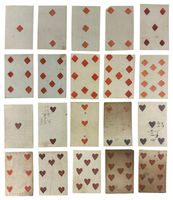
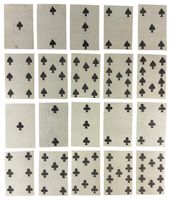
Fifty-two cards (76 × 50 to 82 × 52 mm), woodblocks on laid paper laminated into pasteboard, hand-coloured by stencil (au pochoir), from more than one workshop of the town. Four carry legends: BENOIST LAIVS on the jack of clubs, the card upon which the privileges of the trade obliged every master of Montpellier to set his name under penalty of confiscation and a fine of ten livres; ETIENE·LAIVS, his brother and master cardmaker at Montpellier in the same years, on the jack of spades; CARTOL . DE . MONPE[LIER] on a circular scroll on the jack of hearts; and ALEXANDRE LIONNET, with the motto EN·DIEV·SON ESPERENCE, down the sides of the queen of diamonds. Two cards left the workshop with the colour wrongly laid, the four of hearts with two of its pips in red and two in black, and the five of hearts with all five in black. Twenty of the cards were afterwards put to other uses: sixteen served as slips, labels and notes in several hands, two of them dated June 1780, and four carry the large stencilled letters of a bureau typographique.
Of Benoist Lajus, master cardmaker of Montpellier, the scholarly literature records one card. When Prosper Falgairolle published the cardmakers of Montpellier and Nîmes in 1904, having gone through the communal registers and the departmental archives and collected the cards himself, he could recover of the whole eighteenth-century cardmaking of the town three sets of court figures, those of Antoine Bonnier, Fulcrand Bouscarel and Alexandre Lionnet, and two single cards, one of Bernard Bouscarel and one of Benoit Lajus. That single card, a jack of hearts from his own collection, reproduced on plate II of his monograph, has stood alone for a hundred and twenty-two years. The jack of clubs of the present group is the second, and it carries the maker’s name in the place the law required it.
Nor is that the only thing here worth the attention of a student of the pattern. The four lettered cards name three master cardmakers of a single street at Montpellier, and beside them stand the traces of what became of such cards when they left the gaming table: sixteen backs taken up as slips, labels and notes, four more lettered for the compartmented cases of a bureau typographique. What has survived is the scrap paper of daily work, law dockets and weighing notes among it, gathered from the presses of one street and one generation.
The measure of the rarity can be given exactly. No second card of Benoist Lajus has been described since 1904. The Bibliothèque nationale de France, whose Estampes hold, through the Marteau, Merlin, Lacroix, Wiener and d’Allemagne collections, the largest gathering of the pattern that can be interrogated, preserves of the Montpellier production of these years nine court cards, and they are catalogued under the name of his brother Etienne together with Benoit Deschamps. The British Museum holds one Montpellier pack, of Lionet, catalogued by O’Donoghue in 1901 among the cards bequeathed by Lady Charlotte Schreiber; it entered the Museum in 1896 and is absent from Willshire’s catalogue of 1876, which records no Montpellier cards at all. The Victoria and Albert Museum, whose online catalogue of playing cards records more than two thousand items, has none under his name. The Cary Collection of Playing Cards at Yale has seven Montpellier entries and no Lajus among them, four of the seven catalogued with reference to Falgairolle’s monograph. Sylvia Mann’s All Cards on the Table, the standard catalogue of the standardised patterns of the world, chose for the portrait de Provence itself a Montpellier pack of Lionet; neither its index of makers nor the consolidated index of The Playing-Card for the years 1972 to 1997 records a Lajus in any spelling. The only other cards of the name recorded anywhere are a few loose ones catalogued without illustration by Thierry Depaulis in 2019 and one unillustrated entry at the Mucem.
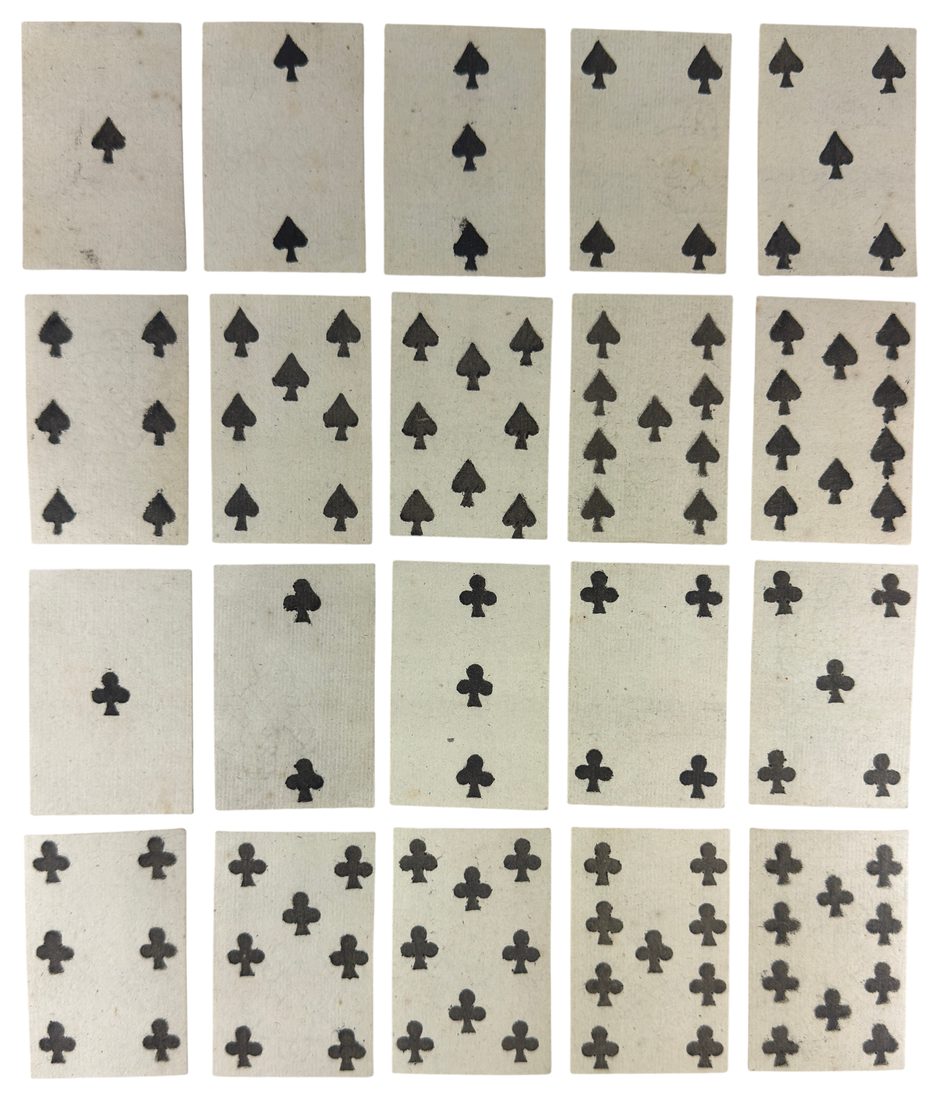
Fifty-two cards: hearts, diamonds, clubs and spades, each running from ace to ten with three court cards, valet, dame and roi. They are trimmed by hand and vary from 76 × 50 to 82 × 52 mm, an interval which by itself covers the standards of several Montpellier shops, Falgairolle giving 78 × 50 for the cards he examined, the Paris group 79 × 51 and Mann’s Lionet pack 76 × 49. The corners are square, one card excepted, the four of diamonds, whose upper corner is cut away obliquely.
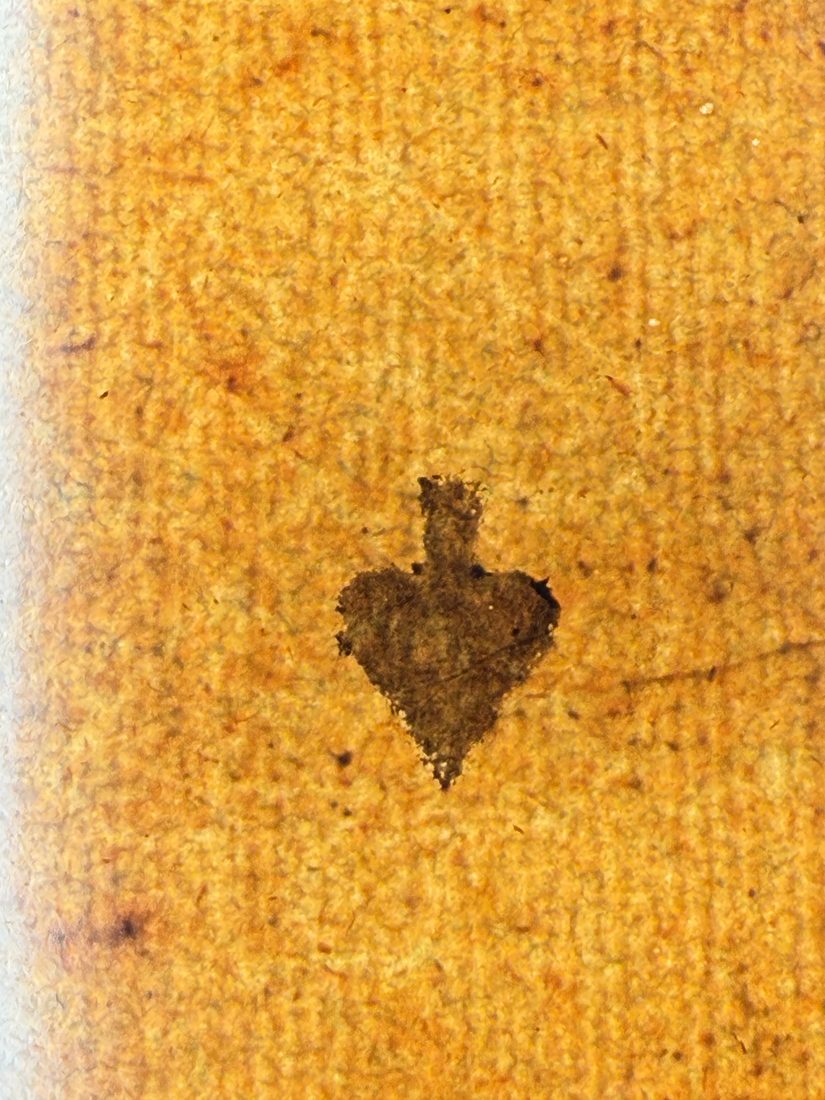
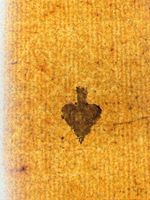
The outlines are printed from woodblocks and the colour is laid by hand through stencils, in orange-red, yellow, a dark navy blue, a pale blue-grey, a dark green and black, within firm black contours; the impression is slightly irregular and the washes overlap, disclosing manual application throughout. The support is period laid paper laminated into pasteboard, the standard construction of the trade, and varies in tone from card to card. Under transmitted light the paper discloses its laid structure, the laid lines clearly legible, together with a watermark in the form of a fleur-de-lis, observed on the ace and on the two of spades. The Montpellier workshops printed from moulds of thirty figures to the sheet, which accounts for the small format.
The pip cards carry no indices, no numerals and no ornament beyond the suit signs. The court cards are single-ended, full-length, enclosed within a fine border line, and are not named. The four legends stand in the places the pattern reserved for lettering: a ribbon banner between the legs of each of the two black jacks, the circular scroll at the right of the jack of hearts, where the close of the legend runs off the trimmed edge, and the two side borders of the queen of diamonds.
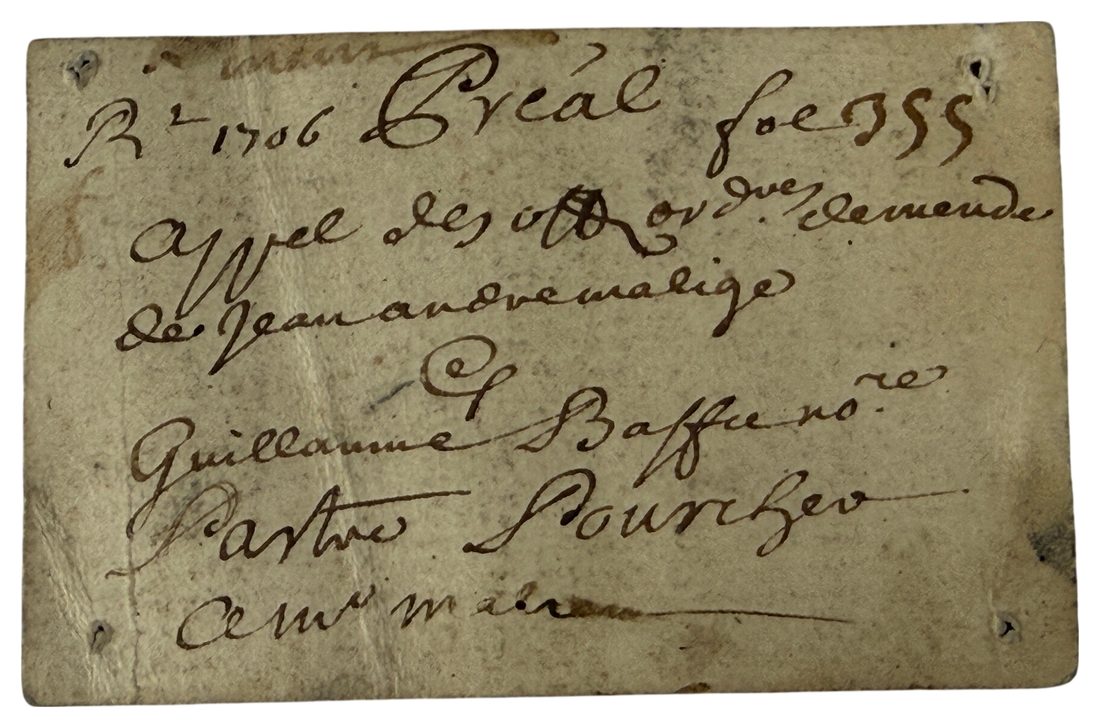
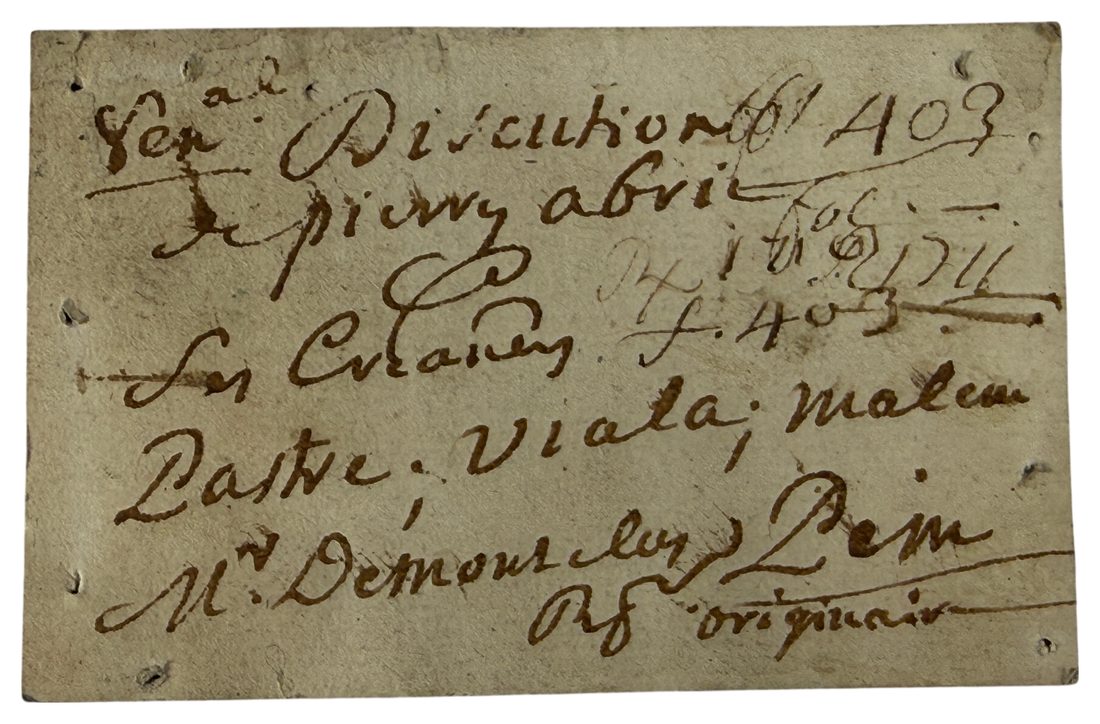
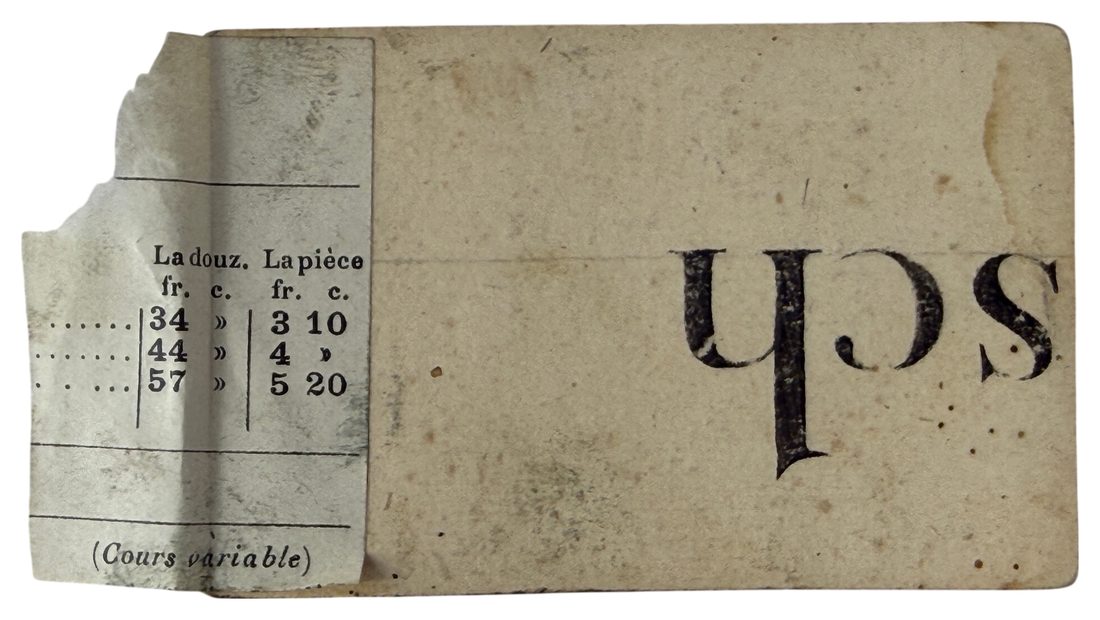
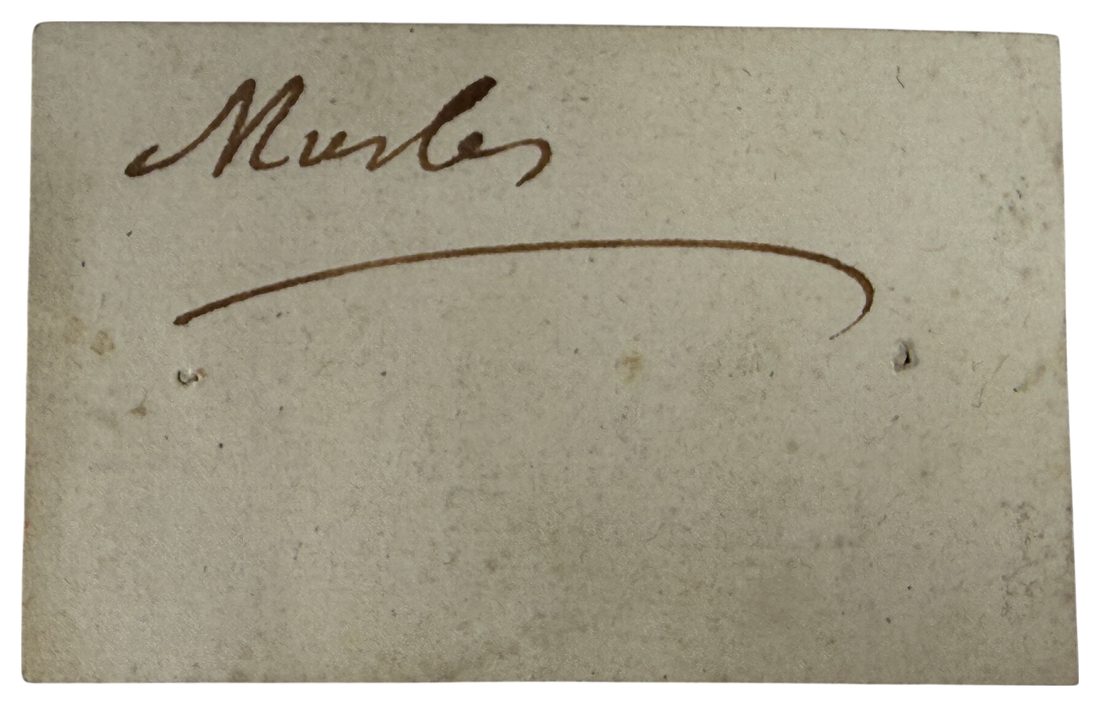
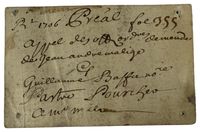
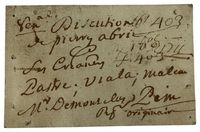
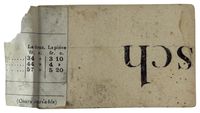
The backs are plain, without printed ornament or tarotage, and twenty of them carry the traces of later use. Sixteen were taken up as slips, labels and notes, thirteen of them with their inscriptions still legible, in several eighteenth-century hands: the four name slips are each pierced twice at mid-height, two docket labels are pierced along their short edges for sewing, and one card was folded and pierced through both halves. Four bear large roman letters of a bureau typographique, stencilled in black on a pencilled base line and set sideways at one end of the card: L, H, a lower-case h followed by a raised point, and the group sch. To the last adheres, upside down to the letters, a fragment of a later printed price list. Two pip cards, the two and the five of hearts, carry arithmetical workings in ink upon their faces.
The cards follow the portrait de Provence in every particular of their figures. The king of hearts holds a small and oddly crowned bird; the king of clubs is armed with a hafted weapon whose head is drawn as a central point flanked by two volutes, an archaism of the same order as the weapon the king of hearts still carries in the English pattern, where it became the sword of the so-called suicide king; the king of diamonds carries an exceedingly thin sceptre ending in a large floret; the king of spades is seen in profile with the emblem of his dignity over his shoulder. The queen of hearts, the principal diagnostic of the pattern, wears beneath her garments an armour of superimposed scales visible at the arm and at the leg, her body thrown violently back upon the left leg, and raises a large sunflower to her face; the queens of clubs and of spades raise a smaller flower; the queen of diamonds wears a gown whose cylindrical sleeves enclose the arms as within a wide ring. The jack of hearts alone is seen frontally, one fist upon the hip, leaning upon a halberd; the jacks of clubs and of spades have plaited hair; the jack of diamonds is seen from behind, in a justaucorps with wide floating sleeves and a headdress of cloth rolled several times upon itself. A smiling sun recurs as a large motif set within panels upon the garments of both kings and queens of the black suits and of the queen of hearts, and forms the finial of the sceptre of the king of diamonds. A circular medallion worked with dense cross-hatching appears upon the breast of the jack of hearts, and the same device recurs, smaller, upon the ground line of most of the other courts. Triangular sprigs imitating ermine run along the borders and the cuffs. The drawing is robust yet controlled, privileging flowing outline and flat planes of colour over modelling, in a manner deliberately remote from the refinement of Parisian production.
Three master cardmakers are named here, and they are three of the very few whose names survive at all. The Lajus were a dynasty of the rue de la Barralerie: Antoine, cartier, buried at the Grands Carmes in 1699, and after him both his sons, Etienne and Benoist, masters in their turn, the one signing the jack of spades of this group and the other the jack of clubs. Alexandre Lionnet was the largest producer in the town: in 1769 he drew a hundred and sixty-six reams of paper for two million four hundred and ninety thousand cards, more than any other maker of Montpellier, and it is a Lionnet pack that Sylvia Mann chose to stand for the portrait de Provence in the standard catalogue of the world’s patterns, and a Lionnet pack that is the only Montpellier pack in the British Museum. The two houses lived a few doors apart, and on 23 September 1731 Etienne Lajus and Alexandre Lionnet stood together as confrères at the blessing of the marriage of a third cardmaker of the same street, Maurice Maton, to Elisabeth Gasc, the daughter of a fourth. Their cards came to rest in the same bundle.
No public collection can show as much upon one table. At Paris the nine Montpellier court cards catalogued under Etienne Lajus lie in one box and the forty-three cards of Alexandre Lionnet in another; of Benoist Lajus the great collections hold nothing at all. Here the three names stand upon four cards of one group of fifty-two, with the name of the town upon a fifth position, the circular scroll of the jack of hearts.
That cards of different shops should be indistinguishable at a glance follows from the way they were made. At the re-imposition of the card duties in 1701 the farmer imposed upon every master of the region the pattern most widely used in the country, and it held until 1779; a reference sheet of the Montpellier mould was lodged with the police registry in 1752. What the pattern left to the maker was the lettering, a few square centimetres of banner and scroll, and nothing else. Falgairolle states the consequence exactly: the costume and the attitude of the figures are the same in all the Montpellier packs that escaped destruction, because the régie of the cards had fixed a uniform mould in order to prevent fraud, and the packs differ in their names and their mottoes alone. Forty-eight of these cards are therefore silent, and the four that speak name the men who made them.
The cards answer to the Montpellier production of these years at every point of comparison. The jack of spades lettered ETIENE·LAIVS and the jack of hearts with its circular scroll find their exact counterparts, card for card, among the nine Montpellier court cards of the Marteau collection at Paris, and the queen of diamonds answers line for line to the Lionnet queen there and in the plate d’Allemagne engraved after Falgairolle’s own Lionnet cards, the two legends running down the two sides exactly as they do here. The circular scroll of the jack of hearts shows how little of the design belonged to the maker, for in the card Falgairolle reproduced it carries the maker’s name, BENOIST LAIVS, and here it carries the name of the town. The blocks are those of one town and one generation, and the hands that stencilled them worked fast: two cards left the workshop with the colour wrongly laid, the four of hearts with two pips in red and two in black, and the five of hearts with all five in black.
Card making was not tolerated at Montpellier for the greater part of the seventeenth century, and the city bought its cards from Toulouse. The suspension of the duties in 1671 brought cardmakers to settle there; the earliest known is Guillaume Marsilliac, whose marriage at Montpellier is recorded on 26 November 1675. By 1693 the manufacture was lucrative enough for the hospital of Montpellier to petition for the privilege of it; five masters were at work in 1750, and the presses of the town issued about two hundred and seven thousand piquet packs in the year 1769. The same design served Aix, Marseille, Toulon, Avignon, Nîmes and Montpellier alike. Sylvia Mann sets out its descent: “Although Provence was an area of prolific card-making from the 15th century (particularly Avignon [...]) it was once again cards imported from Lyons in the 17th century, which formed the basis of the designs of the official 18th century pattern, which survived until 1779 without change.” Its details were nonetheless retouched from 1755.
Fiscal control in the first decades of the century fell upon the wrapper and upon the maker’s signature rather than upon the cards themselves; only under the royal declaration of 21 October 1746 was the paper to be deposited at the farmer’s bureau and stamped before use. No such stamp is present here. Relations with the farmers were poor and grew worse. In 1749 the masters had to petition to recover paper left six months at the bureau to be stamped, for want of which the sizing, and with it the manufacture, had stopped; and in 1769 Fulcrand Bouscarel, one of the principal makers of the town, fled his creditors and the régie, first to Avignon and then to Corsica.
The afterlife of these cards belongs to a phenomenon as characteristic of the French Ancien Régime as the cards themselves. In an economy in which paper remained costly and scarce, the stout pasteboard of a used pack, printed upon one face and blank upon the other, was too good to discard, and it was carried off to serve as a writing support in offices, schools, shops and libraries. The uses are well documented and various: bibliographical slips, the catalogue completed at the Bibliothèque Mazarine in 1751 by Pierre Desmarais running to some forty to fifty thousand cards; billets de confiance during the monetary crisis of 1791 and 1792; ration and military tokens; visiting and trade cards; the types of the bureau typographique, those compartmented pinewood cases holding thousands of playing cards, each bearing upon its blank verso a letter, a syllable or a mark of punctuation, which served printers and schoolmasters as a reusable font for the teaching of reading, spelling and pronunciation; and, in judicial and notarial practice, labels serving to identify files and document pouches.
These cards carry the evidence of several of those uses, and in quantity. Sixteen of the backs were written upon, and one of the uses among them, the docket label of a law suit with its register and folio, is attested in the same quarter: Falgairolle gathered a number of Languedoc cards serving as labels upon manuscript registers, and every one of the nine Montpellier court cards of the Marteau collection at the Bibliothèque nationale carries a manuscript name upon its verso, read here upon the library’s digitisation, among them M. Boivier, M. Alibert, M. Roure and the place-names Pendières, Les Huttes, Achon and Cambies. Four further backs carry the large stencilled letters held in the compartmented cases of a bureau typographique, and that use too is attested for this very pattern: Falgairolle observed of the Montpellier cards he examined that their untarotted backs bear letters forming incomplete words; the complete Lionet pack Sylvia Mann chose to represent the portrait de Provence is described in the same terms, its backs plain white with stencilled part words and manuscript guides for students of typography; six of the seven Montpellier entries in the Cary Collection at Yale describe their backs as plain with stencilled letters; and Thierry Depaulis catalogued several such groups in the Letellier sale of 2019. Twenty of the fifty-two cards, that is, were still at work after the game was over.
The dichotomy is what gives such objects their documentary weight: the recto was subject to fiscal and iconographic control and is identical across a whole province, while the verso was free, and became the place where an ordinary working life left its mark.
Benoist Lajus belonged to the second generation of a family of Montpellier cardmakers. His father, Antoine Lajus, cartier, married to Marie Alabri, was buried at the Grands Carmes on 15 September 1699, having died the day before at the age of fifty-three; his widow still held a house in the Barralerie at the compoix of 1738. Both his sons followed the trade. Benoist, born about 1674, married Marguerite Fabre at Montpellier on 16 February 1706; a daughter, Marie, was born on 29 September 1707, and a son was born and died in 1715. In 1738 he held a house in the rue de la Barrallerie, a second at the petite Place, a vine at Figairolles and another at Puechmirol. The burial act of 10 October 1756 records him as having died the day before, aged eighty-two, described no longer as cartier but as bourgeois. His brother Etienne, whose name stands upon the jack of spades of this group, married three times, in 1709, in 1712 and in 1729, and is recorded as a master cardmaker at Montpellier in the last of those years. An Estienne Laius, cartier of the rue Barralerie, is recorded upon a surviving printed wrapper as cardmaker to the duc de Verneuil, natural son of Henri IV and lieutenant general of Languedoc from 1666 until his death in 1682.
That so well documented a family should have left almost nothing is in part an accident of the archives: documents concerning the cardmakers of Montpellier are scarce until the middle of the eighteenth century and become abundant only from 1751, when the card duties were assigned to the École militaire. Several of the Montpellier cardmakers held houses in the rue de la Barralerie, Lajus among them in 1738; the site of their workshops is not recorded.
A pack of forty-eight Spanish-suited cards has been attributed to this maker in the collecting literature. The attribution rests upon no collection, inventory number or provenance; the single authority it cites, Mann’s catalogue of 1990, records no Lajus in its index of makers; and the only card of Lajus documented anywhere is French-suited. It is noted here for completeness and carries no evidential weight.
Condition: Fifty-two cards, the four suits complete from ace to ten with their three courts, without duplicate or lack. The impressions are strong and legible and the stencil colouring is well preserved, with good saturation. The cards show the general wear of use: minor edge chipping and softening, occasional short creases, light surface abrasion, and light foxing and localised staining to some backs; the vertices of the queen of diamonds and of the jack of spades are visibly rounded by handling, and one card with a blank back was folded and pierced through both halves. The manuscript inscriptions, the pin holes and the stencilled letters are original features of the later uses and not damage. Distinct from these, and later than all of them, one card carries an adhering fragment of a printed price list in francs and centimes, therefore later than 1795, headed La douz. and La pièce with the note Cours variable: an accretion, from a wrapper, a lining or a repair. No restoration or retouching is apparent: an unrestored survival with genuine patina.
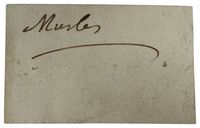
Provenance: The cards carry their own provenance upon their backs, and the words that can be placed point to Languedoc. Sixteen were reused by several hands. Three are docket labels of law suits, two of them pierced for sewing to their bundles, each citing a register and folio, two with the years legible, 1706 and 1742: an appeal of Jean André Malige; a summons of Pierre Michel against several parties, one of them noble; and the proceedings of the creditors of Pierre Abril against his estate, Viala among them. A fourth labels the register of a notary of 1539, François de Bellegarde. Four carry a single name above a flourish: Murles, M. LaRoque, Mlle Gaillarde, and one not certainly read. One is an entry of the compoix kind, six quartes at the Maladriers bordered by the béal, the mill leat, and by Deleuse, apothecary; one is the opening of a letter; one an addition of sums in livres. Two, in one hand, are weighing notes of 5 and 12 June 1780, gross, tare and net in pounds of sixteen ounces, for the accounts of Antoine Astier and of Giraud. The produce, written coulon, was probably silk cocoons, from land worked on half-shares. The years 1539, 1706 and 1742 are those of the acts cited; June 1780 is the only date of writing: the cards were still in use some two generations after they were printed. No modern collection is recorded.
References: P. Falgairolle, Recherches sur les cartiers et les cartes à jouer à Montpellier et à Nîmes avant 1790, Nîmes: Debroas-Duplan, 1904, 25 pp. and 10 plates, nine numbered and one unnumbered, pp. 6-7, 10, 12-14, 20 and pl. II (BnF 8-LI15-54); P. Falgairolle, Les Cartes à jouer à Montpellier au XVIIIe siècle d’après des documents inédits, Nîmes: Debroas-Duplan, 1901, 9 pp.; H. R. d’Allemagne, Les cartes à jouer du XIVe au XXe siècle, Paris: Hachette, 1906, I, pp. 99 and 119-122, and II, pp. 363-371, Fabrication des cartes à Montpellier, and Table alphabétique des maîtres cartiers de France, s.v. Lajus (Antoine), Lajus (Benoit), Lajus (Etienne); S. Mann, All Cards on the Table, Leinfelden-Echterdingen: Deutsches Spielkarten-Museum, and Marburg: Jonas Verlag, 1990, I, no. 174, and II, p. 194; T. Depaulis, Cartes à jouer: collection Letellier, sale catalogue, Paris: Ader, 1 July 2019, lots 199 and 201; [L. Dumas], La Bibliotèque des enfans, Paris: P. Simon and P. Witte, 1732-1733; J. P. Seguin and C. de Jandin, Cinq siècles de cartes à jouer en France, exhibition catalogue, Bibliothèque nationale, Galerie Mansart, September-October 1963, Paris: Le Vieux Papier, fascicule 205, 1963, pp. 42-43; J. P. Seguin, C. de Jandin and M. T. Gourdon, La carte à jouer: donation faite à la Bibliothèque nationale par Monsieur Paul Marteau, Paris: Bibliothèque nationale, 1967, p. 10, nos. 64, 67, 69, 72-73; F. O’Donoghue, Catalogue of the collection of playing cards bequeathed to the Trustees of the British Museum by the late Lady Charlotte Schreiber, London: British Museum, 1901, p. 55, no. 66; W. H. Willshire, A Descriptive Catalogue of Playing and Other Cards in the British Museum, London: British Museum, 1876; R. Mesuret, La carte à jouer en Languedoc des origines à 1800, exhibition catalogue, Toulouse: Musée Paul-Dupuy, 1971; J. Berry, Playing-cards of the World: Catalogue of the Collection of the Worshipful Company of Makers of Playing Cards and Cards Owned by Guildhall Library, City of London, London: privately printed, 1995; C. P. Hargrave, A History of Playing Cards and a Bibliography of Cards and Gaming, New York: Dover, 1966; K. Wowk, Playing Cards of the World: A Collector’s Guide, Guildford: Lutterworth, 1983; The World of Playing Cards, s.v. Provence pattern.
Census: Paris, Bibliothèque nationale de France, Estampes et photographie: BOITE FOL-KH-383 (2, 49), nine court cards from packs at the portrait de Provence by Etienne Lajus and Benoit Deschamps, Montpellier, between 1700 and 1729, 7.9 × 5.1 cm, formerly Paul Marteau, the backs white with manuscript inscriptions in brown ink, containing the counterparts of the jack of spades and the jack of hearts of the present pack; the printed catalogue of 1967 registers this group at no. 67, reading the signature as Etienne Lans and dating it 1690-1700, the attribution to Etienne Lajus having been made by the library in 2014. BOITE FOL-KH-383 (2, 51), forty-three cards by Alexandre Lionnet, 1721-1751, containing the counterpart of the queen of diamonds; RESERVE KH-34 (3, 33), twelve court cards by Lionnet, formerly Romain Merlin; RESERVE KH-34 (3, 34), thirteen cards by Gervais of Montpellier, 1700-1750; eleven court cards by Fulcrand Bouscarel and a further thirty-two attributed to him. London, British Museum, 1896,0501.611.1-52, Schreiber collection, French 66: a complete pack of fifty-two by Lionet of Montpellier, hand-coloured woodcut, backs plain, 71 × 48 mm, described by the curator as without names upon the court cards and very coarsely executed. New Haven, Beinecke Library, Cary Collection of Playing Cards: seven Montpellier entries, none of them Lajus, among them FRA130, a complete Montpellier pack of fifty-two, 74 × 51 mm, its backs plain with stencilled letters. The exemplar chosen to represent the pattern in Mann 1990, no. 174, inv. 4148/60: a complete pack of fifty-two signed Lionet of Montpellier, catalogued there as ca. 1770, the maker given as Lionet (ca. 1750-72) without further identification, woodcut and stencil-coloured, 7.6 × 4.9 cm, with Lionet inverted upon the king of diamonds and Montpellier upon the jack of clubs, and the backs bearing stencilled part words and manuscript guides for students of typography. At the Mucem, Marseille, one further entry carries the name: inv. 1950.9.536, acquired in 1950, catalogued as a jeu de cartes with Lajus Benoit as its maker, in coloured woodcut and measuring 8 by 5 cm; the record assigns it no place, no date and no inscription, and it is unillustrated. Apart from that single entry, no pack and no card signed by Benoist Lajus has been traced in the public collections that can be interrogated.