Vue d'optique: SS. Giovanni e Paolo, Venice



| Macro-category | Ancient Games and Pre-cinema |
| Subcategory | Vue d'Optique |
| Author | Anonymous |
| Provenance | Bassano del Grappa |
| Publisher / Maker | Remondini |
| Year | 1750-1780 |
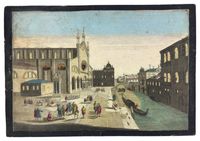
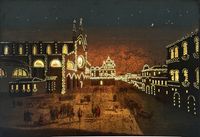
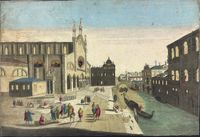
the campo by daylight, the campo by candlelight
a Venetian transformation view,
pricked and lined for the optical box, after Marieschi
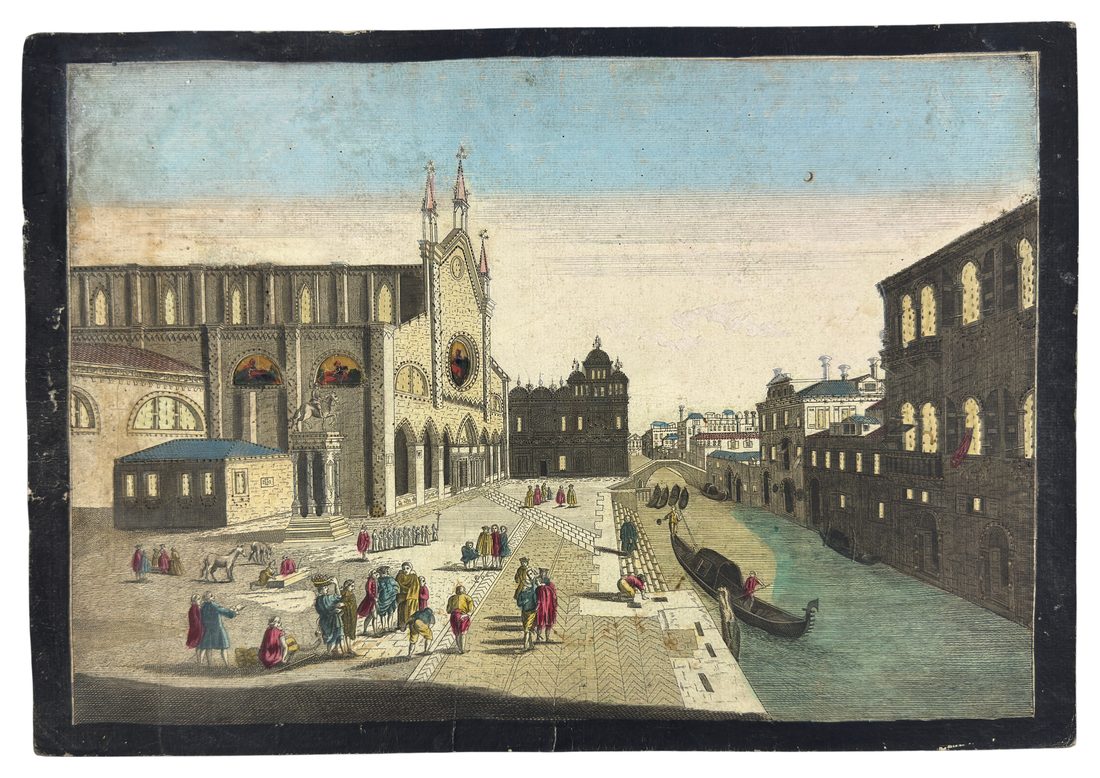
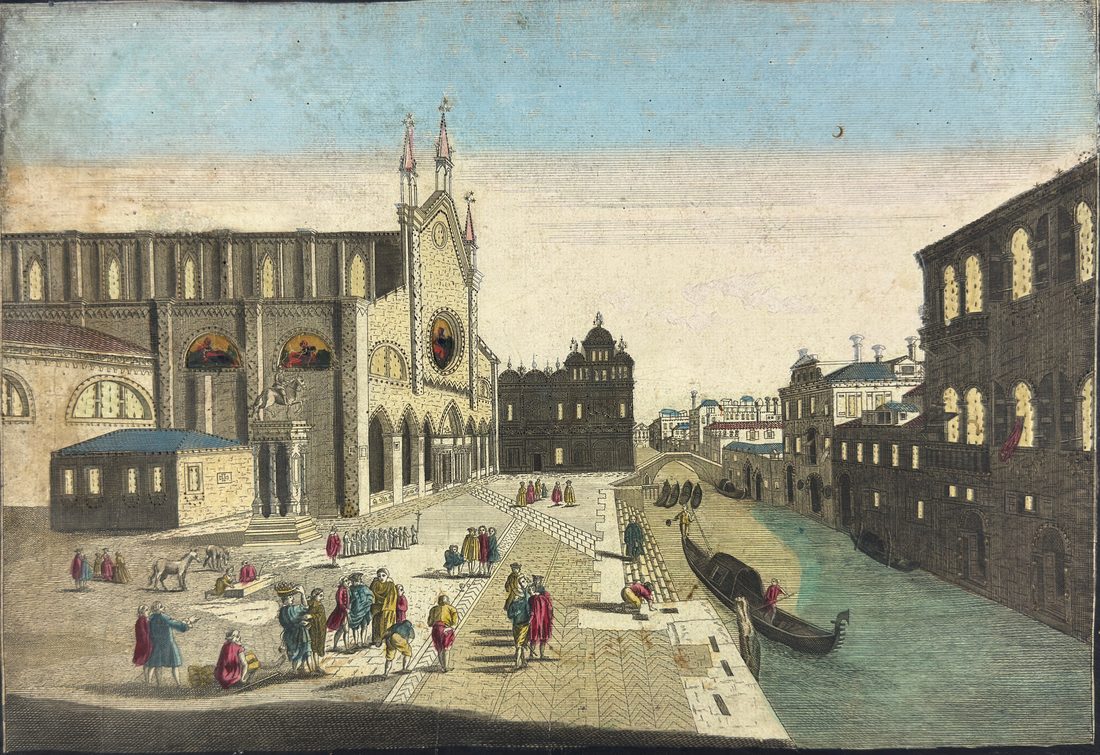
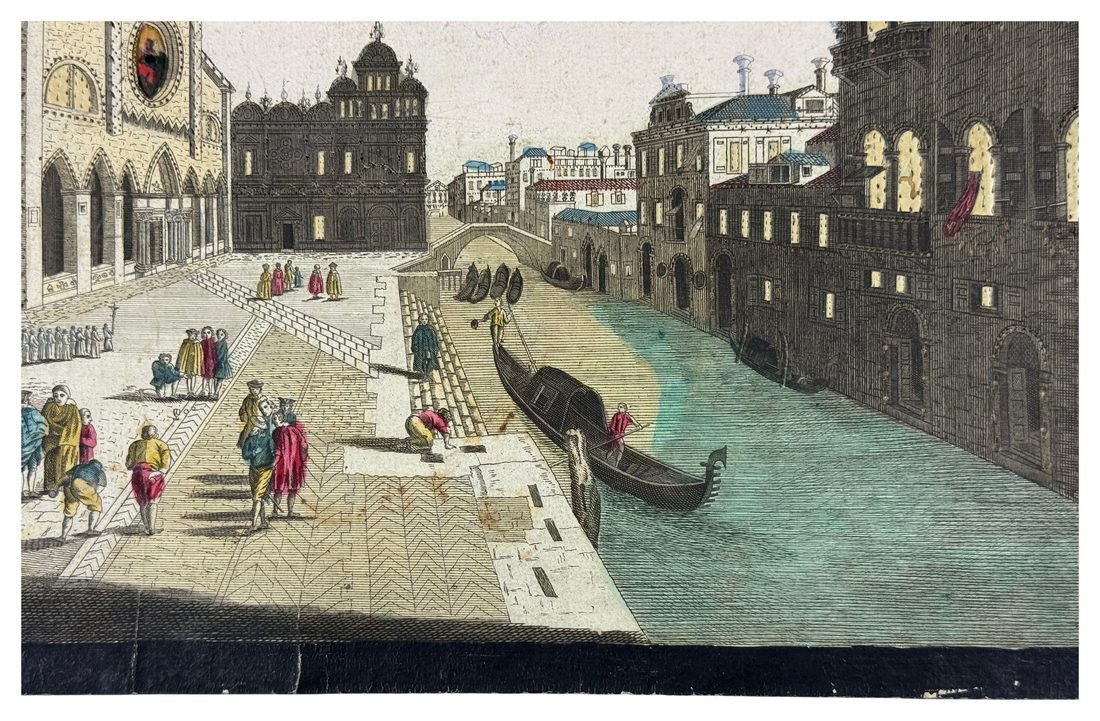
[Vue d’optique]. Prospectus Ecclesiae St: Joannis et Pauli Venetiarum. Vûe Prospetive de l’Eglise de St. Jean et St. Paul a Venise. Bassano del Grappa: Remondini, ca. 1750-1780. After Michele Marieschi, Magnificentiores Selectioresque Urbis Venetiarum Prospectus, Venice, 1741, plate 15.
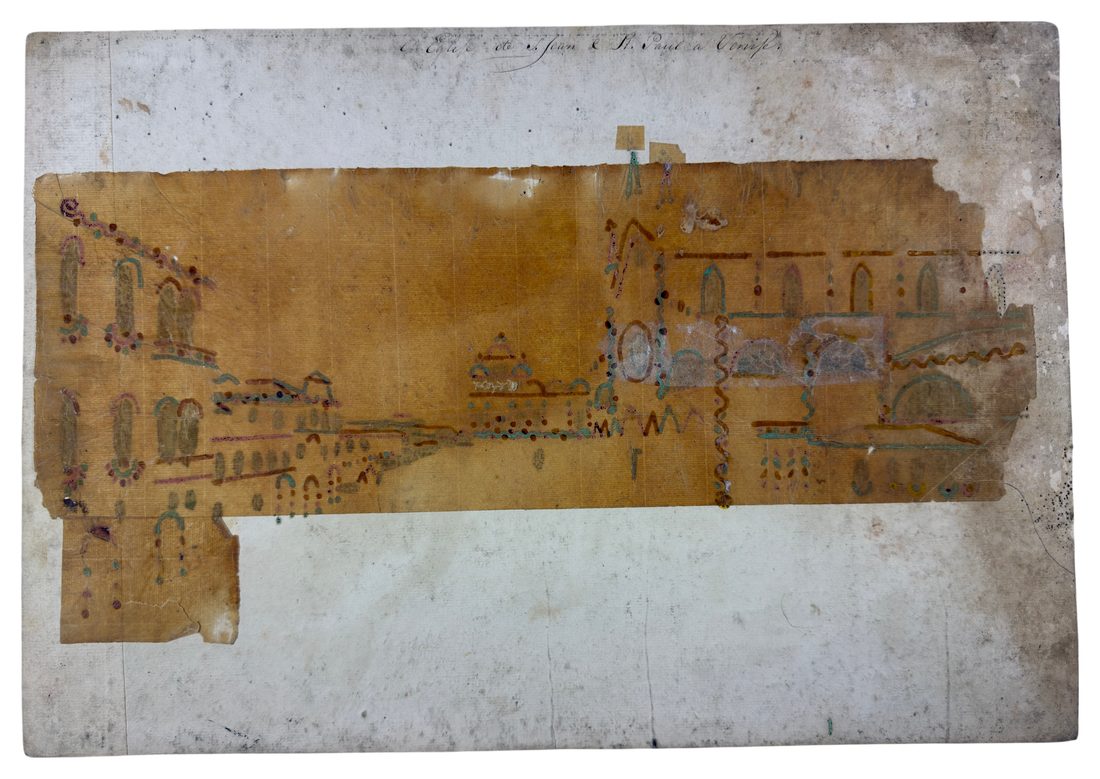
Single sheet, etching and engraving on laid paper, engraved field (410 × 280 mm), with contemporary hand-colouring in watercolour and gouache, the sheet subsequently pricked, cut and lined on the verso for day and night viewing in an optical box. A black gouache border some 15 mm wide is painted directly onto the sheet on all four sides, bringing the overall dimensions to 445 × 310 mm. The sheet is trimmed to the platemark, with the loss of the letterpress caption, and laid down on a stiff card support; examination under raking light along the four trimmed margins reveals no residue of the caption, neither letter terminals nor any trace of the framing rule. A manuscript title in an eighteenth-century French cursive hand is inscribed in ink across the upper verso, L’Eglise de S. Jean & St. Paul a Venise. No watermark is legible, the card support preventing examination by transmitted light.
A Venetian optical view carried to the most demanding form the genre attained, the transformation piece that turns from day to night as the light is moved from front to back. Beneath the workmanship lies a reversed copy of Michele Marieschi’s Campo dei Santi Giovanni e Paolo of 1741, one of the twenty-one plates of the 1741 series, here remade for the optical box. The pricking, the blade work and the painted linings are the labour of the transformation maker, not of the engraver, and the illumination they produce exists nowhere on the printed plate. Fragile by construction and handled by candlelight, such sheets seldom come down entire, with the pricking unbroken and the coloured linings still in place.
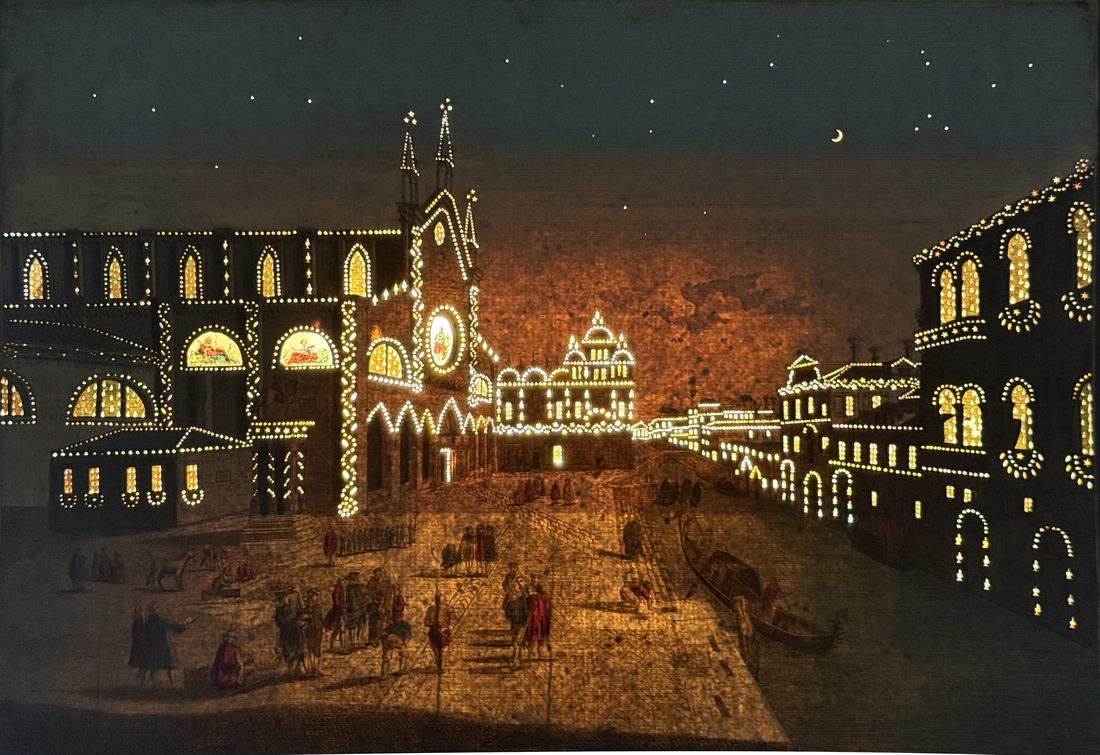
Click to access Night/Day simulation
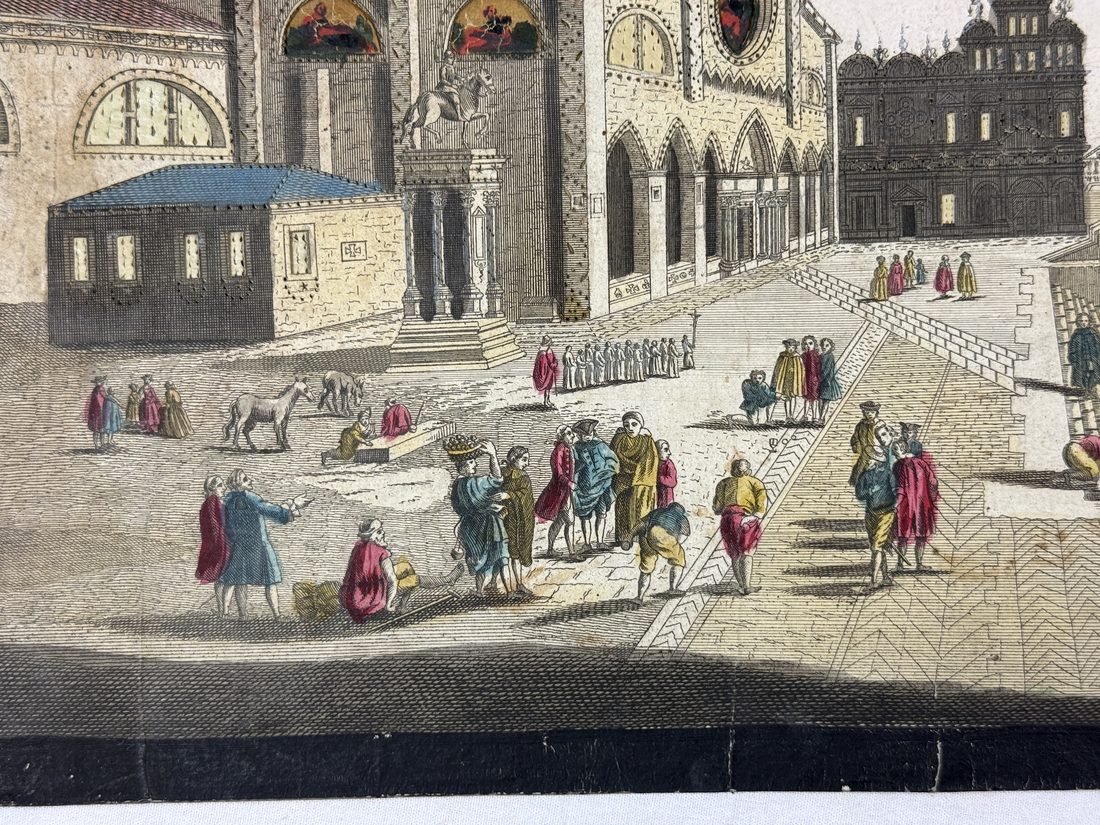
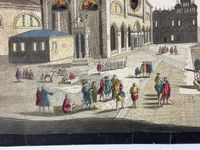
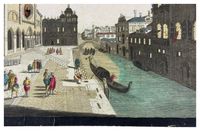
The view looks across the Campo dei Santi Giovanni e Paolo, one of the largest campo in Venice and, after Piazza San Marco, the most monumental of its squares. Reading the sheet from left to right one meets the flank and then the Gothic front of the Dominican basilica, burial church of the doges; Verrocchio’s equestrian monument to Bartolomeo Colleoni, left unfinished at his death and cast by Alessandro Leopardi, unveiled in 1496 upon its high pedestal; the marble front of the Scuola Grande di San Marco with the illusionistic perspectives of the Lombardo; and, at the right, the Rio dei Mendicanti with its bridge and fondamenta, moored gondolas and a gondolier at his oar. Market people, porters, a horse and an ass, a file of small figures crossing the middle ground and patricians in tabarro and tricorne animate the campo.
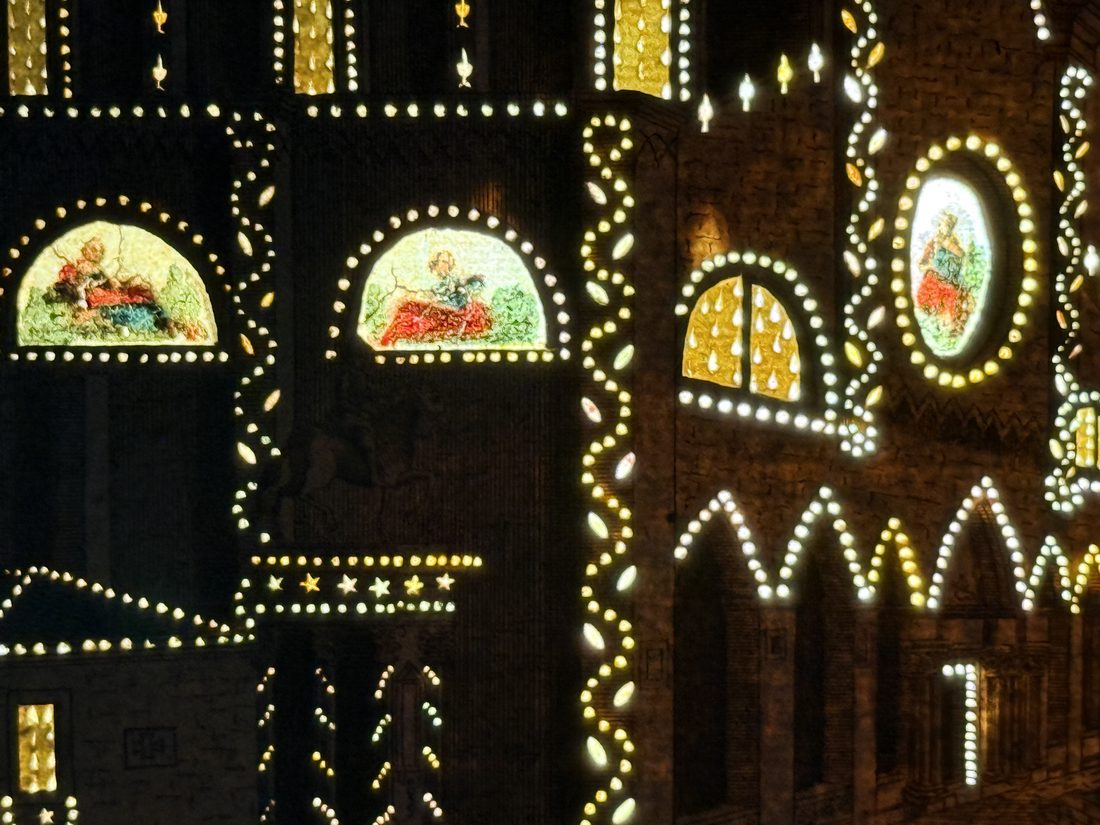
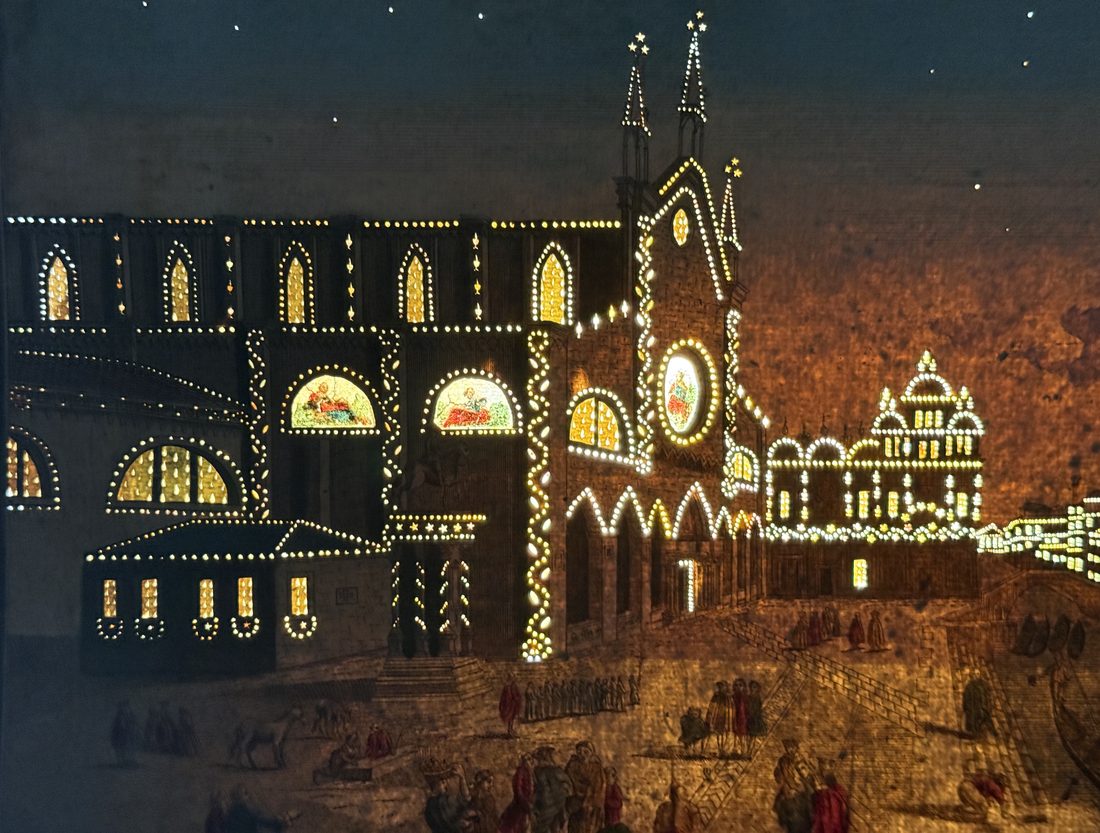
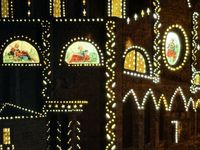
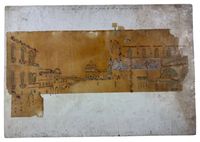
The sheet has been worked for transmitted light. Many thousands of pin pricks run in files along the architectural contours, following cornices, pointed arches, gables, pinnacles, the rose window of the basilica, the crowning members of the Scuola Grande and the arcades of the palace at the right; further pricking in the sky forms a crescent moon and constellations of stars. The larger openings, windows, portals, single and paired lights, are cut through with a blade. The pricking is graduated in density, closer in the passages that recede towards the vanishing point and more open in the foreground, as the practice of the craft prescribed. The verso is lined with oiled paper and tissue, brush-painted in blue, rose, orange and brown over the pricked passages, with patches of coloured tissue applied behind the areas intended to glow. Among these are the two figured lunettes above the lateral portals of the Scuola Grande and the figured oval of the church front, which read as polychrome glass when the sheet is lit from behind.
In reflected light the sheet reads as a daytime view beneath a blue sky. Set against a light source it becomes a night piece. The pricked contours ignite into files of lamps that trace the whole architectural scene, the cut windows glow through their coloured linings, the lunettes and the oval of the church front burn as though glazed, a crescent moon and stars rise in a darkened sky, and a reddish flush spreads along the horizon from the tinted paper behind.
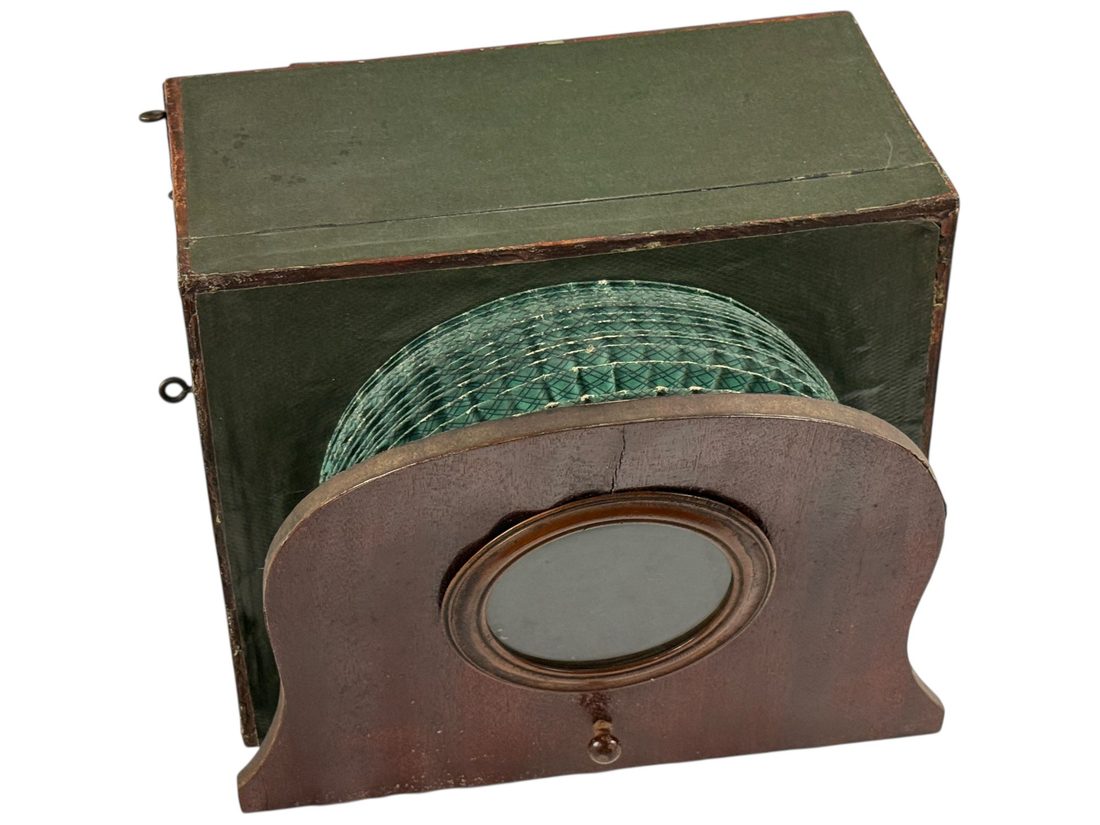
The genre existed for the apparatus. Optical views were made to be seen in a zograscope, which combines a convex lens with a diagonal mirror, or in the closed optical box of the itinerant showman, known in the Veneto as the mondo nuovo. The wide format, the forced central perspective and the strong contrasted colouring follow from that machine rather than from taste.
This sheet was prepared for such use rather than for a portfolio. The letterpress was trimmed away and replaced by the painted black border, which raised contrast within the darkened box and masked the edges; the title was written on the verso because views of this kind were kept in piles and drawn out one at a time, so that the useful identification lay on the back.
The illumination is not engraved. The plate carries an ordinary daylight view, and the moon, the stars and every one of the lamps were opened with the point of a needle by the transformation maker; Marieschi’s sky is a daylight sky of modelled cloud and carries neither. The night is thus an effect of the trade, and not the record of a Venetian festival.
The optical view belongs to the eighteenth-century culture of visual entertainment, poised between the fairground and the drawing room. On one side stood the showman with his box, who in Venice carried the mondo nuovo first through the squares and afterwards into the salons of the prosperous; on the other the zograscope, a piece of optical furniture for the educated household. The genre arose between London and Paris about the middle of the eighteenth century, flourished in the second half of it and died away in the first decades of the nineteenth, and was produced in four principal centres, Paris, London, Augsburg and Bassano del Grappa. Its dependence upon the apparatus fixes its lower limit, for the optical box with lens and mirror is of probable French origin and spread through Europe in the first half of the eighteenth century, while the English type is documented from the middle of the 1740s and the name zograscope first appears in a catalogue of George Adams the elder in 1753.
The transformation view is the most exacting branch of the genre, and its manufacture is described in a printed treatise of the period. Edme-Gilles Guyot advises that such views may be made more agreeable by cutting the prints away, or leaving them transparent, at those places susceptible of being luminous, such as glazing, conflagrations and illuminations. He prescribes interchangeable varnished frames for the box, one very transparent for objects supposed lit by day, a second tinted blue for night, a third of a reddish colour to give a natural tone of fire to prints representing conflagrations or illuminations; and he directs that the holes be pierced with punches of graduated size, the larger for the nearer objects and the smaller for the distances, and set closer in those parts which tend towards the point of sight. That illuminations should figure in his list beside glazing, skies, waters and conflagrations indicates how far the lit façade was a repertory effect of the craft.
The same material principle, colouring applied to the verso combined with pricking and read alternately in reflected and transmitted light, was still current in Venice a century afterwards, in the plates made for the megalethoscope patented by Carlo Ponti at Venice in 1862, albumen prints heightened with colour on the back, pricked for luminous effects and mounted upon a curved wooden frame. The supports differ entirely and no workshop connects the two, but the same principle reappears in Daguerre’s diorama and in the polyorama panoptique of the following century.
Optical views overwhelmingly favoured spaces offering powerful orthogonals for the lens to exaggerate, the Piazza San Marco, the Grand Canal, the Bacino. The Campo dei Santi Giovanni e Paolo is a more enclosed and laterally organised space, and its selection is accordingly less typical of the canonical Venetian viewpoints.
The composition is Michele Marieschi’s. Plate 15 of the Magnificentiores Selectioresque Urbis Venetiarum Prospectus (Venice, 1741) supplies the whole of it, down to the two men in the foreground with one gesturing with outstretched arm, the horse and pale animal at the foot of the monument, the file of small figures beyond, the gondolier at the fondamenta and the herringbone paving. The view is here laterally reversed with respect to the model. The plate, however, is not Marieschi’s: his sky, an elaborate structure of modelled cloud, is reduced to a uniform horizontal ruling, and the burin is regular where his is painterly.
The publisher is the Remondini house of Bassano del Grappa. Their impression of the plate carries a bilingual caption, in Latin and in French, together with the letter and numeral at the lower left that mark Remondini views; its proportions and its framing, with the same broad band of sky above the spires, are those of the present sheet, and the manuscript title on the verso answers to the French limb of that caption.
The Remondini were the largest popular print house in eighteenth-century Italy, publishing for export on a European scale through the itinerant pedlars of the Tesino valley. Their catalogues record about a hundred optical views in 1772 and close to three hundred by 1817, two hundred of them views of Italian cities. Captions in Latin and in French were printed for the foreign trade, so that the inscription on the verso is the note of a French-speaking owner rather than a mark of Parisian origin.
The subject was current elsewhere in the trade. Daumont issued it in the rue Saint-Martin, and Boydell and Sayer in London in 1749.
The layered construction of print, oiled lining, coloured tissues and support is integral to the object and is the substance of its technique. Removal of the support, which alone would permit examination for a watermark, is not advised.
Condition: Very well preserved overall. Light abrasions at the margins, not affecting the printed image. Traces of handling consistent with an object made to be pricked, cut, lined and used by candlelight. On the verso the oiled paper lining is abraded and wanting over part of its area, as is usual in sheets that were worked by lamplight; this concerns the backing alone and does not touch the printed surface, which is unaffected. The hand-colouring remains fresh, the pricking and the cutting are intact throughout, and the day and night effect is perfectly preserved, both states reading in full.
References: C. J. Kaldenbach, “Perspective Views”, in Print Quarterly, II, 2, June 1985, pp. 87-104; E. G. Guyot, Nouvelles récréations physiques et mathématiques, nouvelle édition, Paris: chez l’Auteur et Gueffier, 1774, third volume, sixth part, pp. 42-43; S.von Kapff, Guckkastenbilder aus dem Augsburger Verlag von Georg Balthasar Probst, 1732-1801: perspective views, vues d’optique. Gesamtkatalog, Weissenhorn: Anton H. Konrad, 2010; F. Mauroner, Michiel Marieschi, in The Print Collector’s Quarterly, XXVII, 2, April 1940, pp. 178-215, the catalogue of the etchings forming the second part, no. 13; D. Succi, Michiel Marieschi: catalogo ragionato dell’opera incisa, Turin: Umberto Allemandi, 1987, no. 8.
Comparanda: Rijksmuseum, Amsterdam, RP-P-2009-808, the Remondini impression of the present plate; RP-P-1921-723 and RP-P-1925-1315, the Daumont edition, Paris; RP-P-1932-454, the Boydell and Sayer edition, London, 1749; RP-P-OB-39.126 and RP-P-1941-475, Marieschi. The Metropolitan Museum of Art, New York, Marieschi, Magnificentiores Selectioresque Urbis Venetiarum Prospectus, 1741. Getty Research Institute, Los Angeles, Nekes Collection of Optical Devices, Prints, and Games, 93.R.118, subseries I.B, Pricked vues d’optique, 1740-1810. Cinémathèque française, Paris, AP-94-727, published at Augsburg by Martin Engelbrecht; AP-94-969 and AP-94-968, plates for the megalethoscope patented by Carlo Ponti at Venice in 1862.