Praesentation eines schönen Spaziergang mit einer Fontaine (“Presentation of a Beautiful Promenade with a Fountain”)
| Macro-category | Ancient Games and Pre-cinema |
| Subcategory | Diorama |
| Author | Engelbrecht, Martin |
| Provenance | Augsburg |
| Publisher / Maker | Martin Engelbrecht |
| Year | 1732-1733 |
where it all began
the opening subject of the rare 4to Engelbrecht perspective theatres,
# 1 of the Milano census, complete with its proscenium
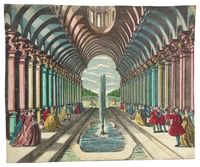
[Diorama]. Wachsmuth, Jeremias (inv. et del.). Praesentation eines schönen Spaziergang mit einer Fontaine (“Presentation of a Beautiful Promenade with a Fountain”). Augsburg, Martin Engelbrecht excudit, ca. 1732-1733.
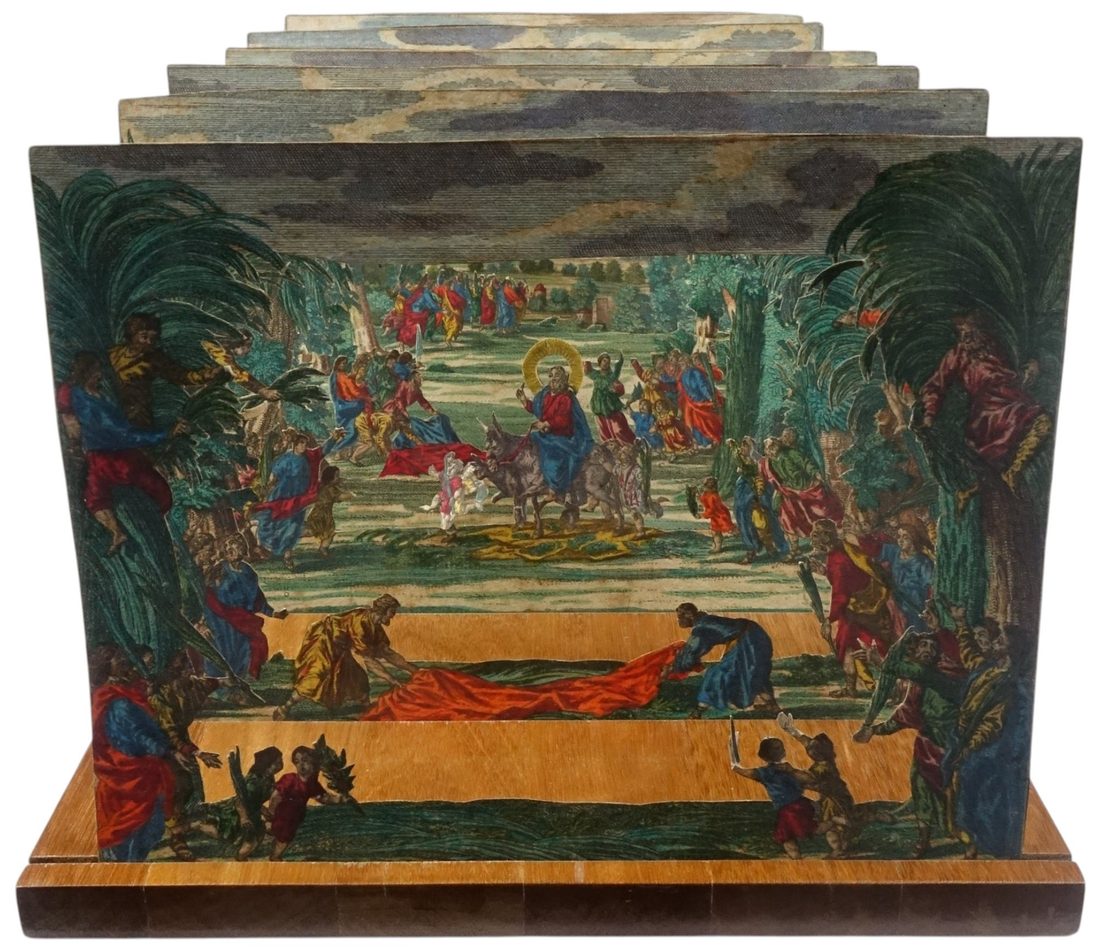
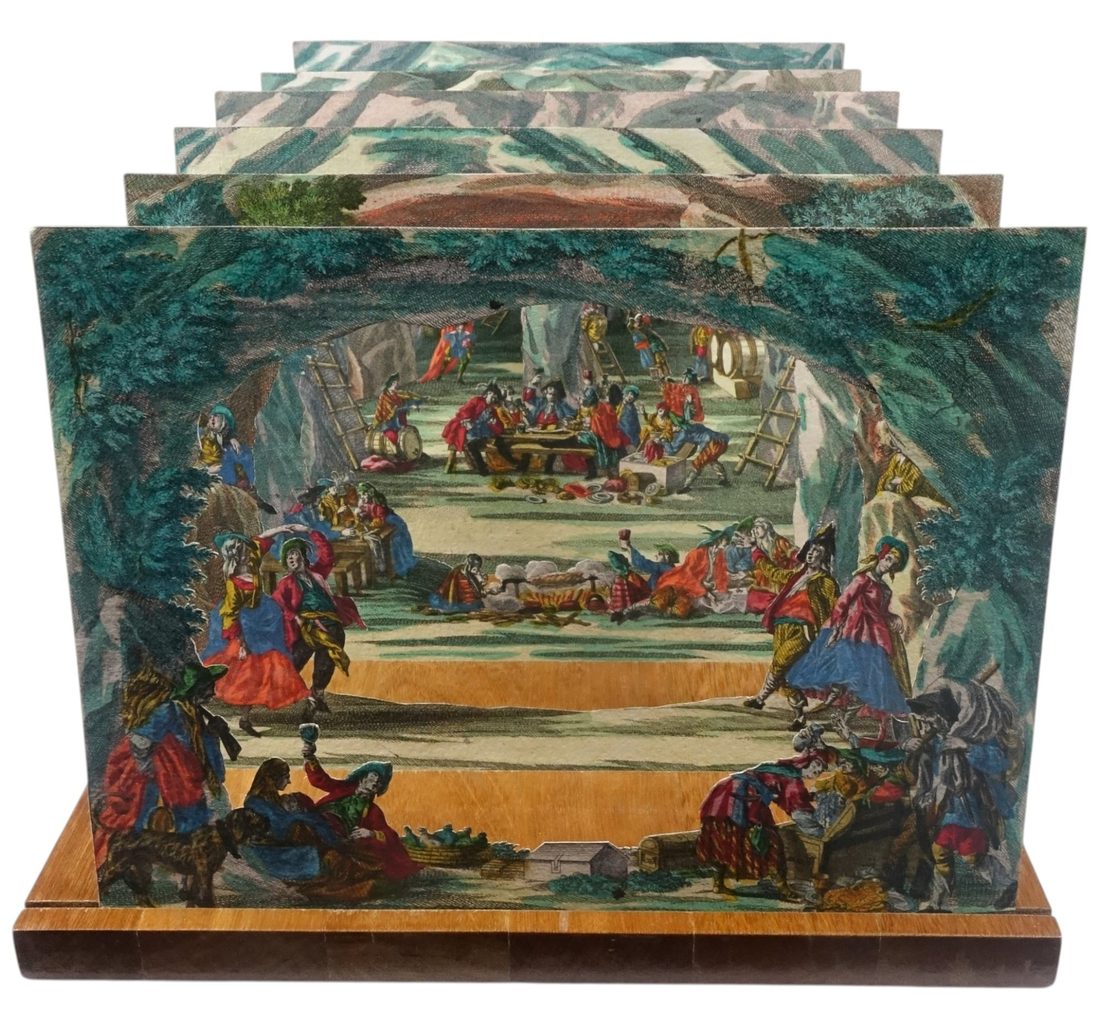
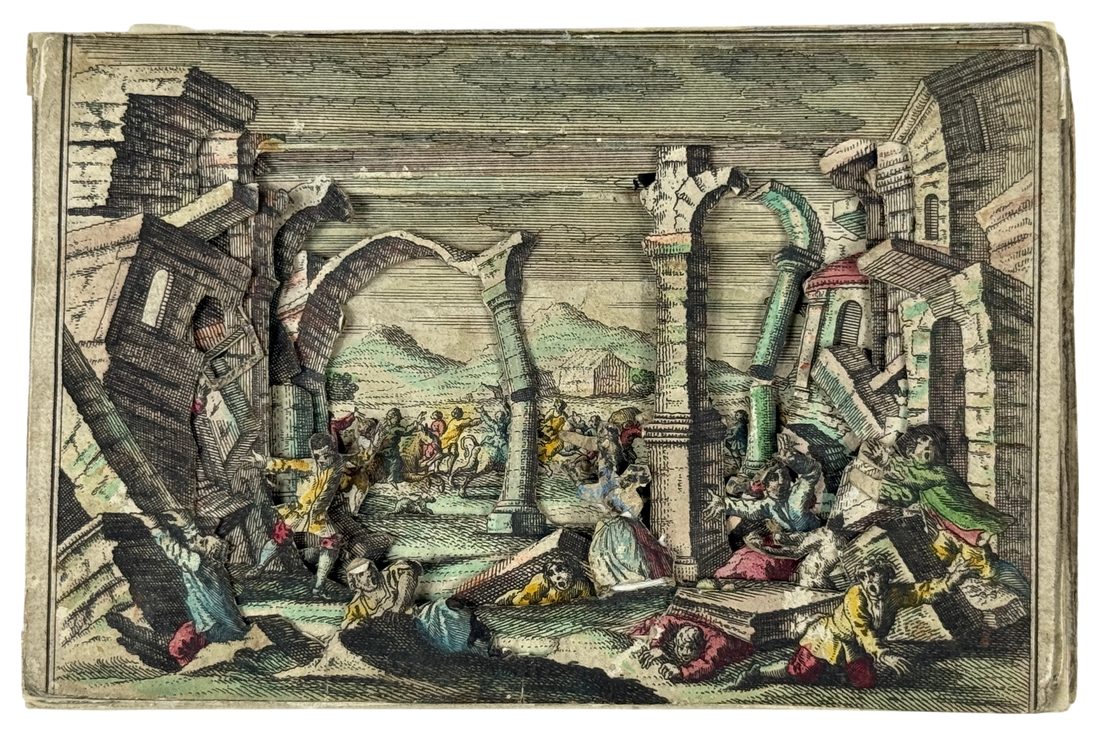
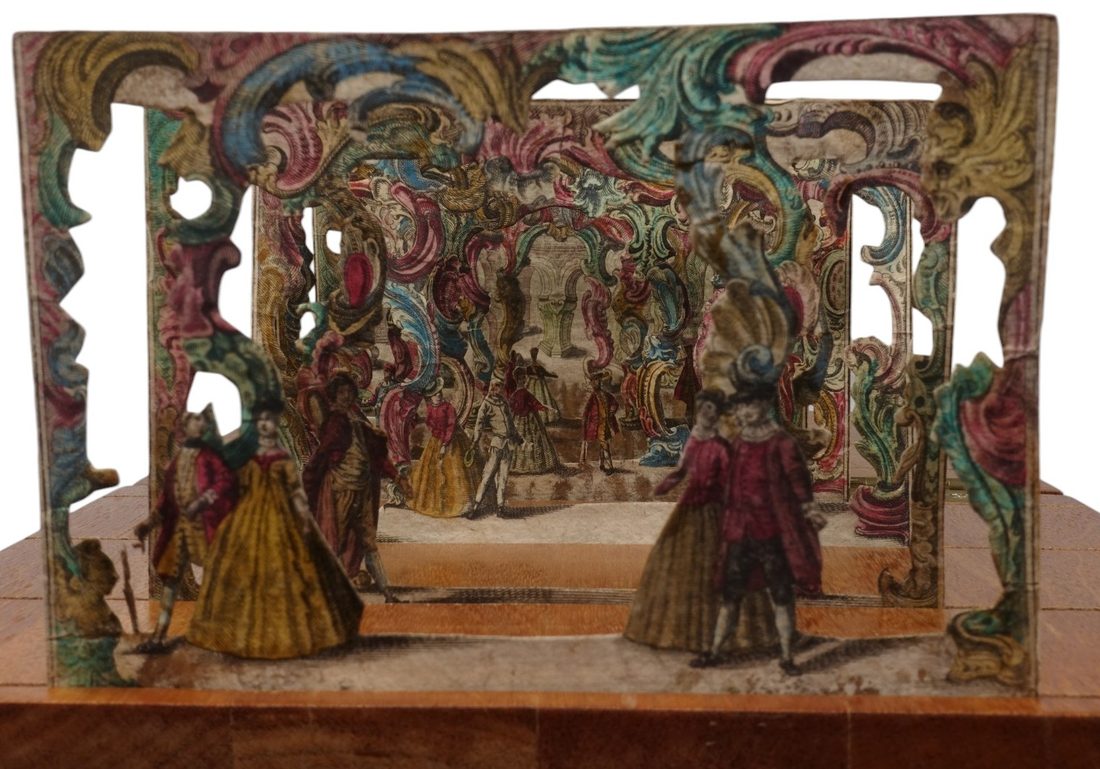
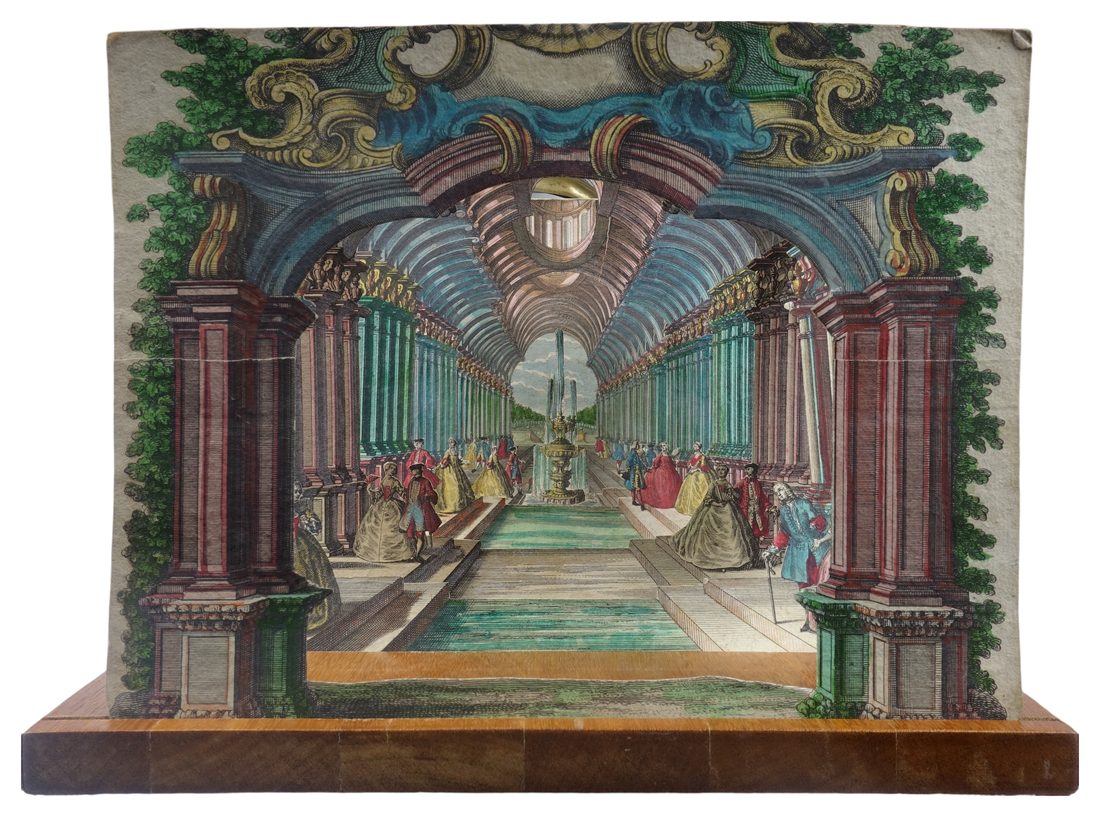
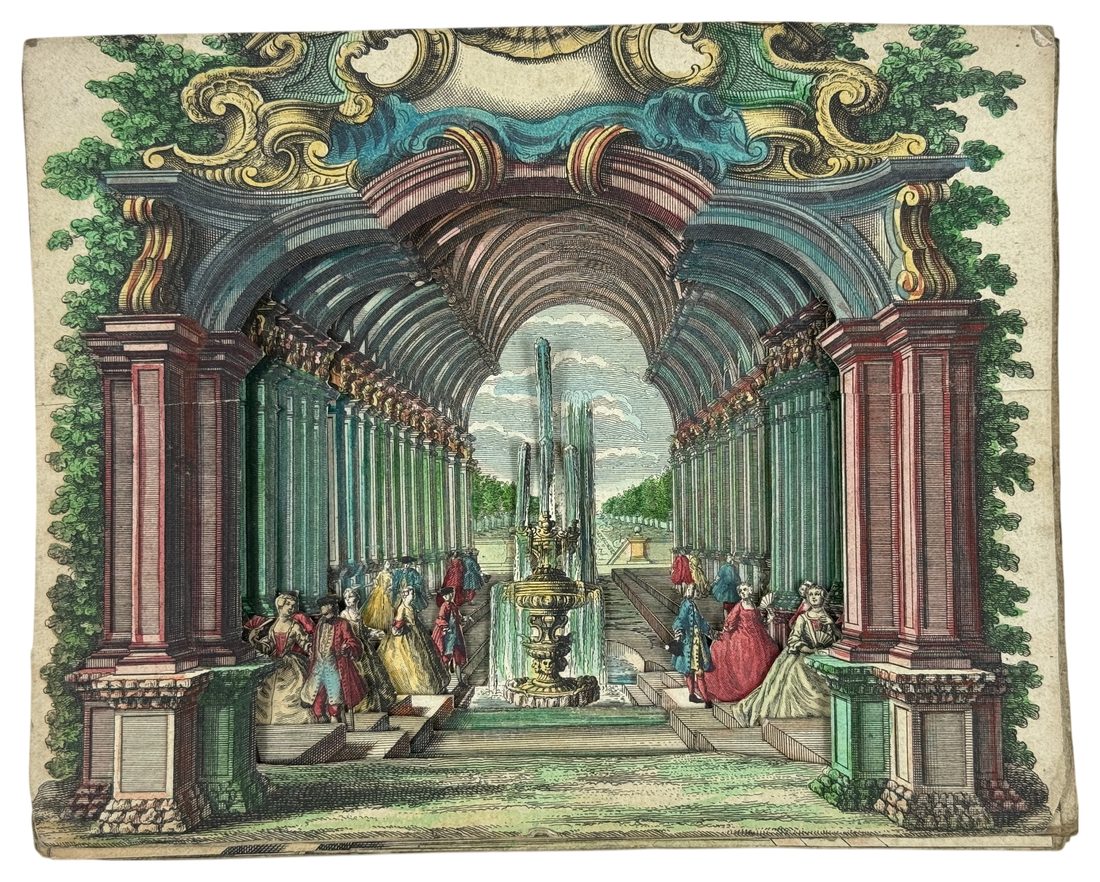
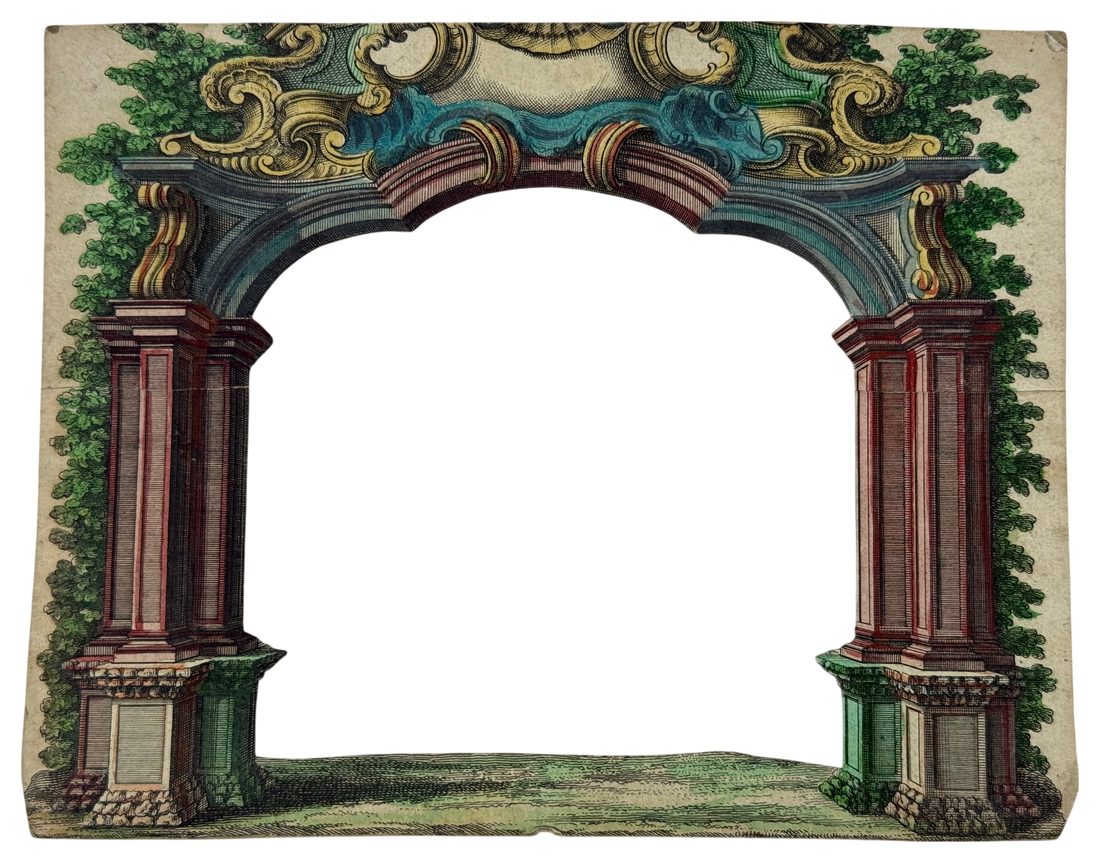
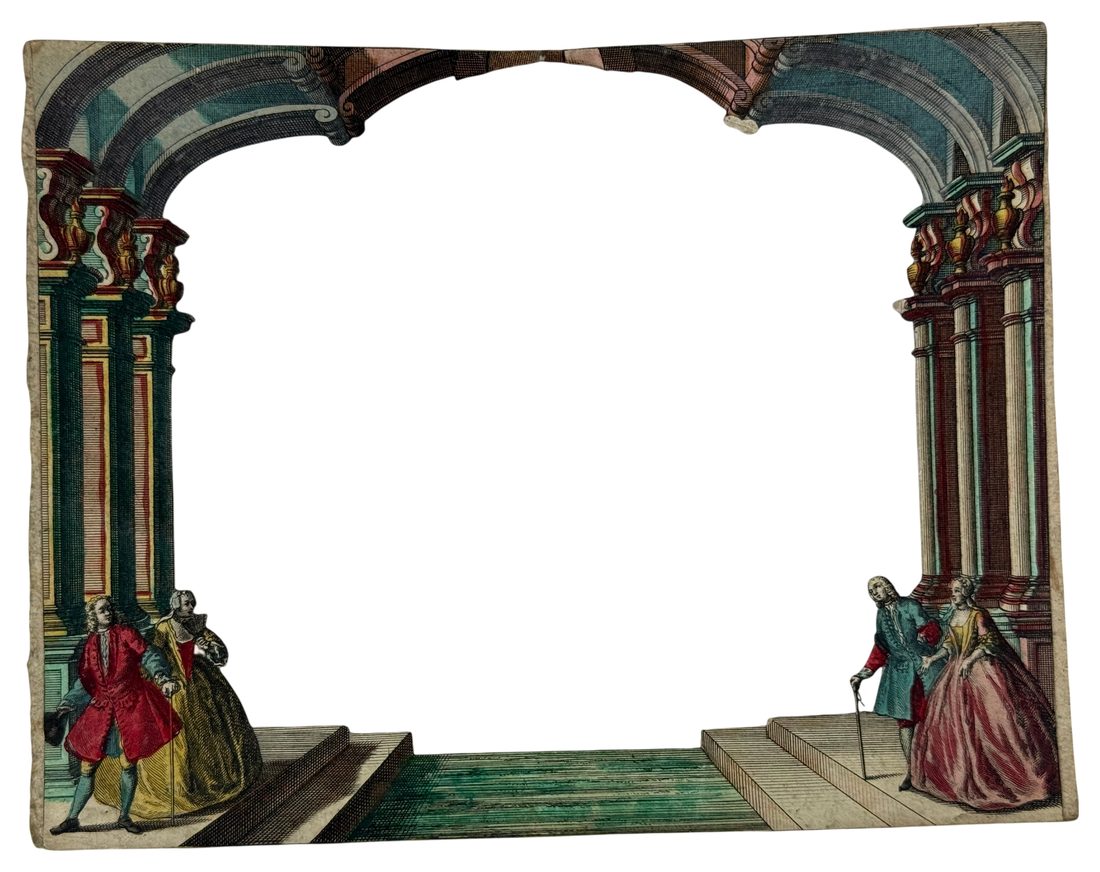
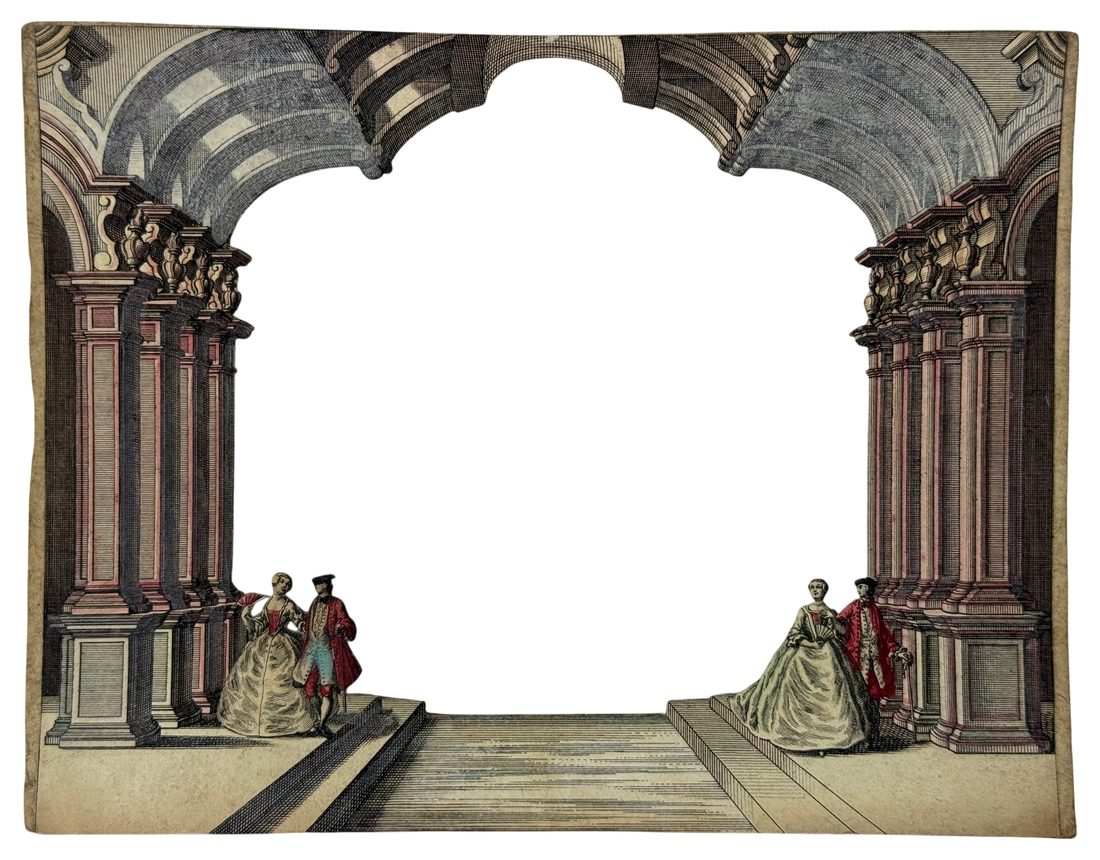
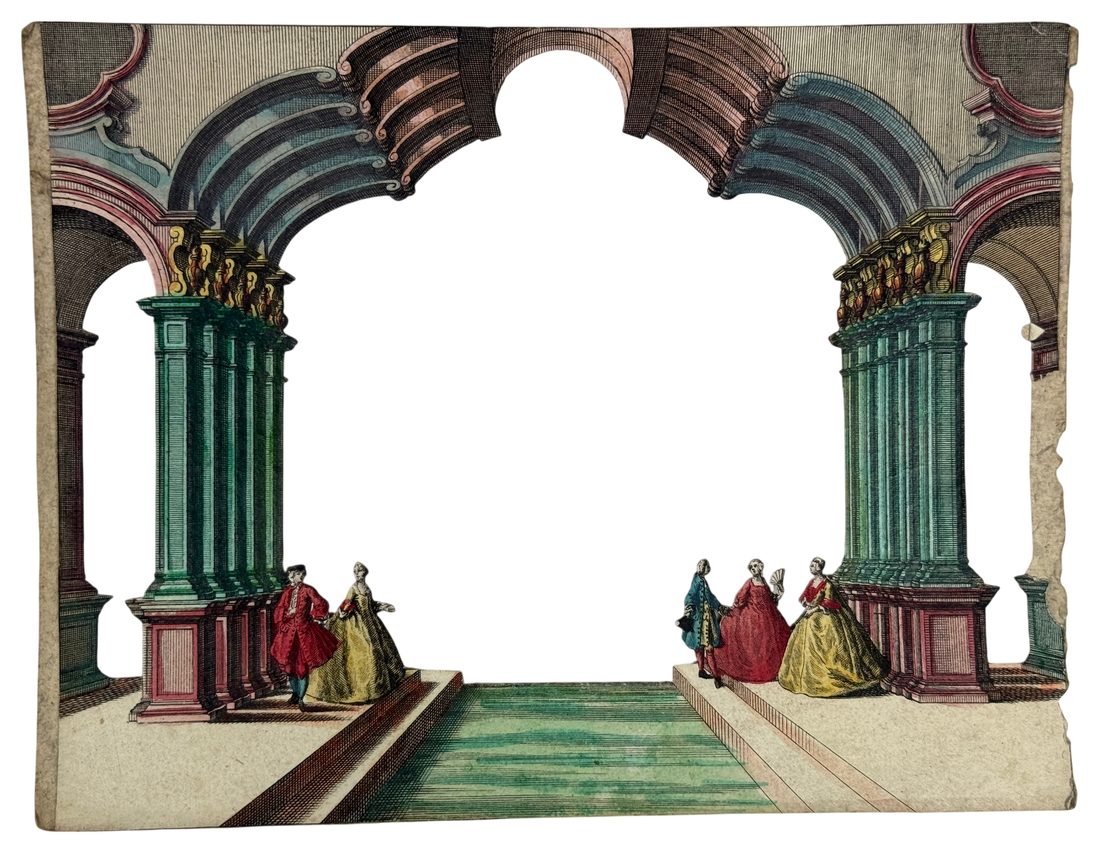
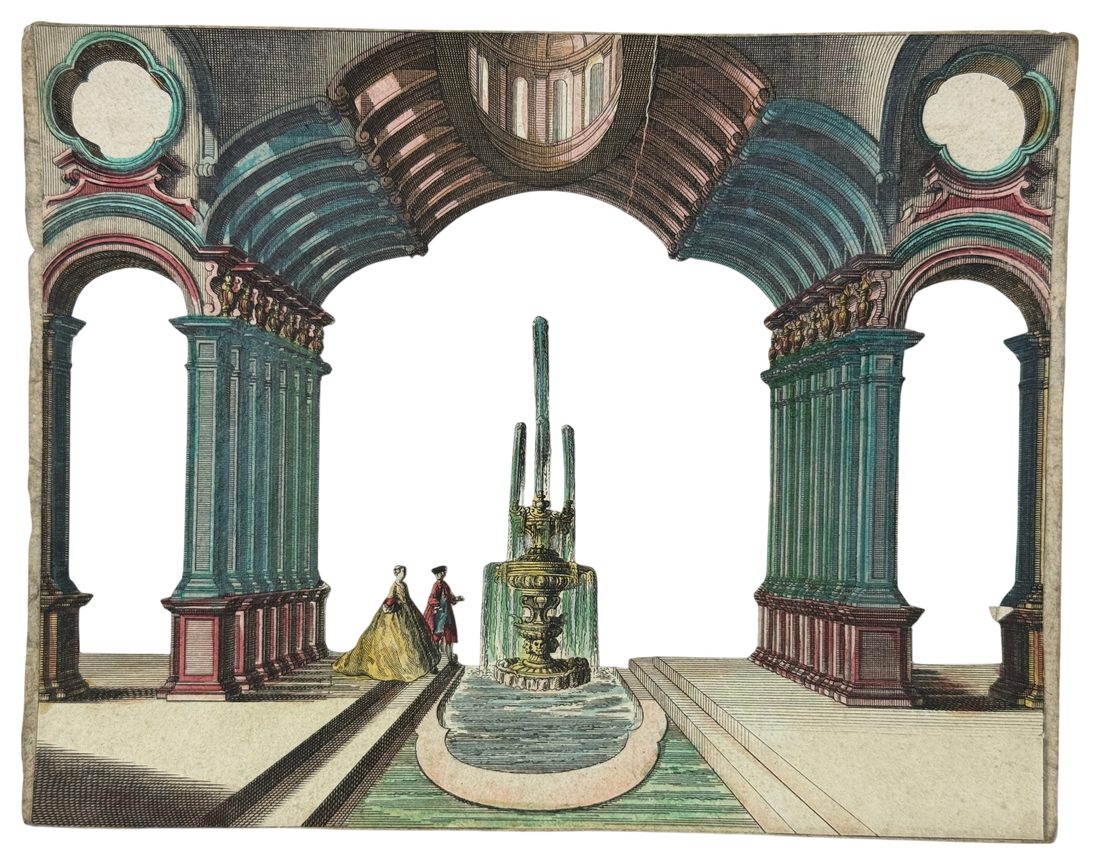
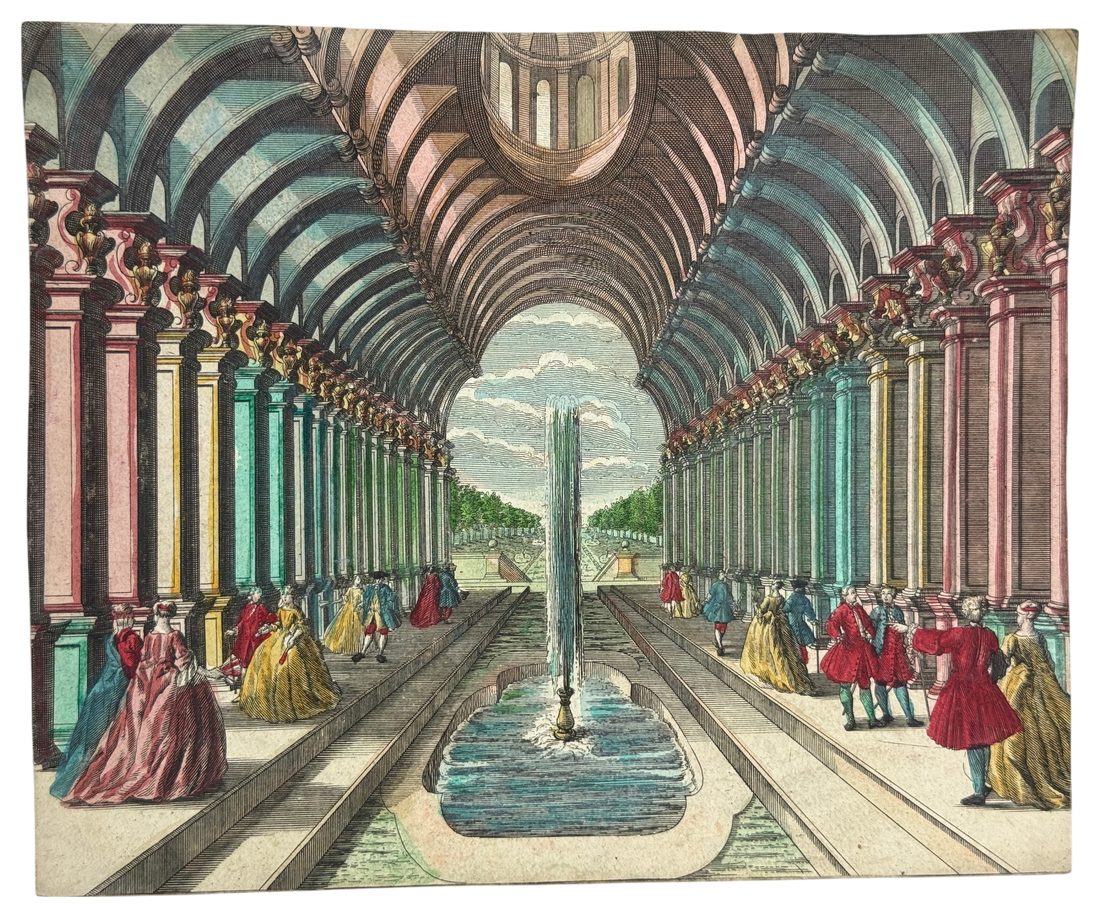
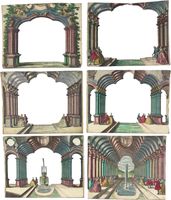
4to perspective theatre (each sheet 205 × 170 mm, uniform throughout), complete six-sheet viewing sequence of hand-coloured etched copper plates with burin work, laid down on stout card and cut by hand, the first sheet forming the proscenium, the second to the fifth cut through their central fields to form arched apertures of progressively diminishing span, the sixth retained as the closed background scene. Original hand-colouring in transparent watercolour with selective gouache highlights and gilt touches upon the capitals and the fountain, applied in the publisher’s workshop before sale, the sheets being designed for assembly in numerical order within a viewing box or upon a grooved wooden support, so as to generate the layered three-dimensional illusion characteristic of the Engelbrecht workshop.
Throughout the quarto production the plates carried a consecutive sheet number at the head, so that the correct order could be verified by the ascending sequence, and the present series occupies numbers one to six of a run that would eventually extend to four hundred and fifty-five. On this set the engraved lettering has been lost to the trimming that preceded mounting, and no number or subscription is now legible on the recto of any plate. The order is instead preserved on the versos, which carry sequence numbers written in pencil in an early hand, together with the descriptive title and old collection number in Dutch, “Zaal met pylaren en fontein N 22”, on the verso of the background sheet.
Engelbrecht’s perspective theatres were most commonly issued in 8vo, while those in quarto are exceedingly rare, and rarer still complete and with the proscenium preserved. Only sixty-seven quarto series have been identified, and the present one is the first of them. “The number of published large-format Engelbrecht perspective theatres is given as 67. Even though we cannot say with certainty that this number is correct, it is nonetheless very likely, as not a single sheet suggests that additional series may have existed” (Milano).
This is the inaugural subject of Martin Engelbrecht’s large-format perspective theatres: number one both in the publisher’s own sequence and in Alberto Milano’s standard census, its plates occupying the opening positions of a continuous run of engraved sheets that would eventually reach four hundred and fifty-five. The most recent quantitative study of the corpus assigns it to 1732 or 1733, at the very outset of Jeremias Wachsmuth’s collaboration with the house. Complete as a viewing sequence, in fresh publisher’s colouring, and of a subject of which no institutional example has been traced, it is the first object of a genre that the nineteenth century would inherit.
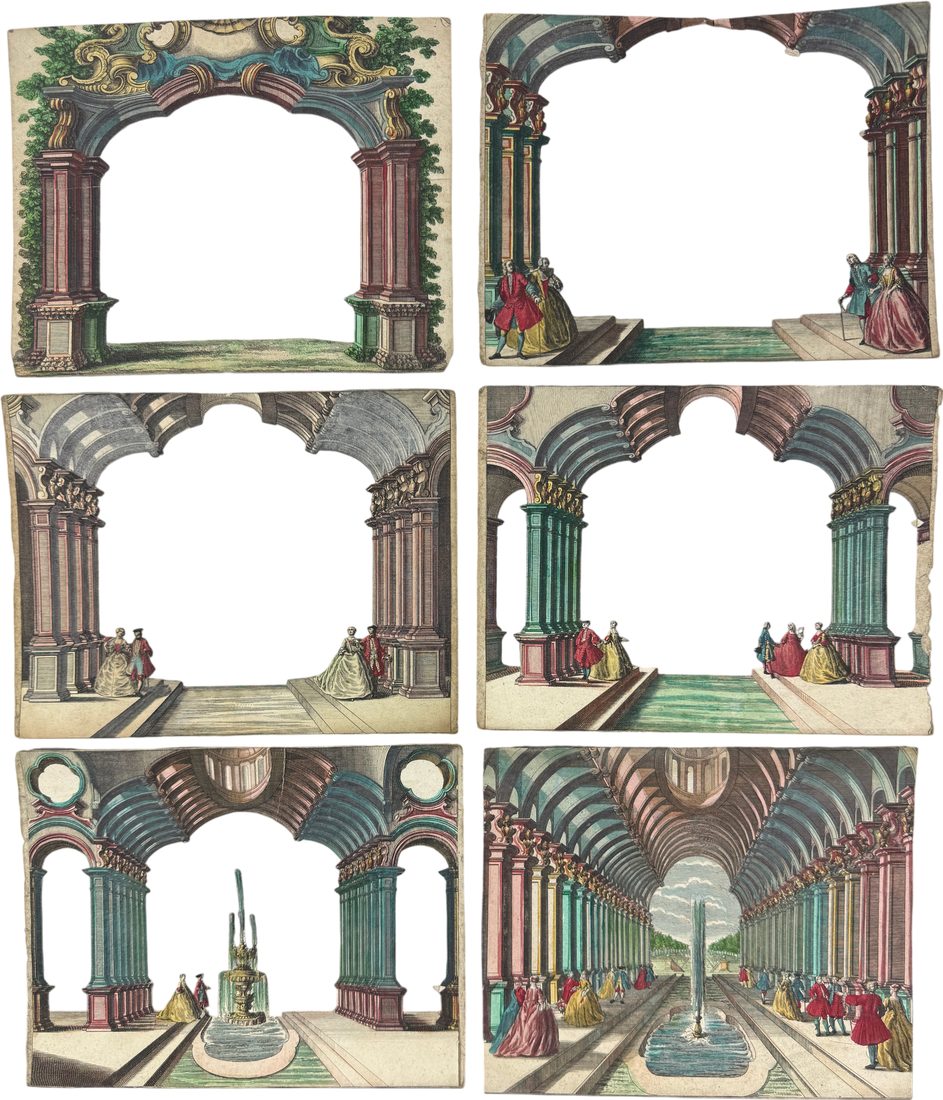
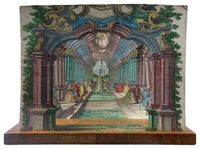
The diorama is conceived as a single unified perspectival construction decomposed across six successive engraved planes, each plate operating both as an autonomous image and as one stratum of a larger spatial composition. The workshop designed one coherent recession and then divided it into successive leaves, cutting each so that it would function as a scenic flat. Reassembled in numerical order and spaced apart in the grooves of a viewing box, the planes recreate the original construction and yield an illusion of depth particularly persuasive under frontal lighting or candlelight. The sheets were observed through a single aperture, in the closed box normally by means of a magnifying lens and an inclined mirror, while a tissue frame above diffused daylight or candlelight across the assembled scene.
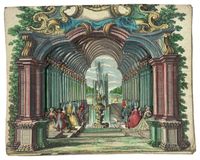
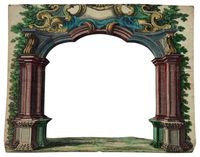
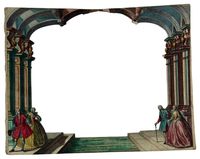
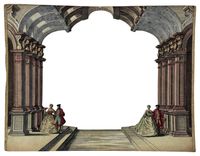
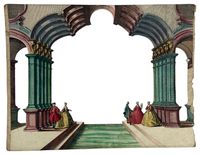
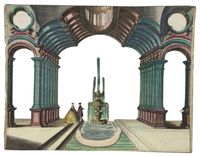
The first sheet presents a wide arch carried upon paired pilasters set on high plinths, surmounted by a rocaille cartouche of yellow volutes and blue drapery, and flanked by dense masses of trellised foliage above a narrow strip of lawn. The central field is entirely excised, the plate functioning purely as a scenic frame. The second opens a vaulted bay upon twin columns with gilt vase capitals, two couples in court dress disposed at the lateral extremities above short flights of steps, and the first stretch of the axial water channel. The third repeats the structure beneath a grey vault, with two further couples in the dress of the seventeen-thirties and forties. The fourth presents a colonnaded bay with turquoise shafts and gilt capitals, a couple at the left and a group of three at the right. The fifth, the narrowest aperture of the sequence, is articulated by a triple arch with trefoil oculi in the spandrels and a dome above the crossing, and is cut around a great three-jet fountain rising from a lobed basin at the centre. The sixth and final sheet, uncut, presents the whole gallery in steep central perspective: a double file of polychrome columns in recession, barrel vaults with rocaille ribs, a dome above the central bay, and, upon the axis, the jet of the fountain silhouetted against an opening onto a formal garden with clipped avenue and parterre, the two flanks animated by numerous promenading figures.
The apertures narrow plane by plane. The first is almost nothing but frame, and each successive plane occupies a greater share of the field until the sixth, which is solid and closes the view. This progressive constriction is the mechanism by which the eye is drawn along the axis, and it is handled here with unusual clarity, for the subject is itself an axial recession: a colonnaded promenade whose repeated element, the column and the arch, returns at every plane upon a diminishing scale, so that the viewer measures the depth upon the repetition. At the far end, the three jets of the fifth plane and the single jet of the background give the vanishing point a material form, beyond which the garden vista opens, and the constructed interior appears to communicate with a real landscape.
The subject is a courtly passeggio and nothing further. No event is narrated and no scriptural episode staged. In a series whose later subjects would range across biblical histories, royal ceremonies, masked balls, hunts, mines, trades, military encampments and the Lisbon earthquake, this absence of narrative is itself the argument. A perspective theatre has a single subject, depth obtained by lamination, and a story impedes its demonstration by directing attention to the content. An architectural corridor peopled with figures at leisure is the ideal demonstrator, and it is the natural choice with which to open a series founded upon that principle.
Engelbrecht’s perspective theatres belong to the intellectual climate of the German Enlightenment in its Augsburg variant, where popular print culture, the science of perspective and the taste for optical curiosity converged within a single commercial enterprise. The first half of the eighteenth century saw the codification of linear perspective in widely diffused treatises, the spread of the camera obscura, the magic lantern and the perspective box, and a growing appetite, in noble cabinets as in prosperous bourgeois interiors, for devices capable of staging the illusion of depth within domestic space. The Augsburg theatres translated that culture into a printed object, distributed to an international public and intended for assembly by the purchaser himself.
The scenographic descent of the genre is documented rather than merely probable, and by a direct route. About 1730 Engelbrecht himself re-engraved and published at Augsburg the eight scenes invented by Pietro Righini (1683-1742), a pupil of Ferdinando Galli Bibiena, for Frugoni and Vinci’s Medo at the Teatro Ducale of Parma in 1728, issuing them as Theatralische Veränderungen vorgestellt in einer zu Mayland gehaltenen Opera; a complete set survives at the Deutsches Theatermuseum in Munich, signed in the plate Pietro Righini inv. e del. and Mart. Engelbrecht excud. A. V. The house had therefore the Italian baroque stage before its eyes, in its own workshop and over its own imprint, a few years before the perspective theatres began. The structural borrowings may be identified severally: the proscenium arch, the recession by parallel planes, the paired wings, the perspectival splay towards the backdrop, and the single vanishing point which presupposes the royal box. The architectural repertory of porticoes, columns, loggias, coffered vaults, sculptural ornament, hedges and fountains is that of the late baroque Italian stage, here preserved in printed form where so much of the painted scenery has perished.
One distinction should be maintained which the trade habitually blurs. The cut, multi-plane perspective theatre is not the flat single-sheet optical view, the Guckkastenblatt or vue d’optique, which is larger, invariably horizontal, commonly topographical, and viewed lying flat within a zograscope through a lens and an inclined mirror. Augsburg entered that second market only from about 1765, through Georg Balthasar Probst, the Kaiserlich Franziskische Akademie and a small number of others, by which time Engelbrecht had been dead for a decade. Optical views bearing his address do exist, but the flat single sheet was never his ground: he worked a generation earlier and in a distinct class of product, of which he was the serial founder.
The perspective theatres were held among prosperous Europeans of the mid-century to be extravagant, diverting and instructive furnishings for their houses and residences. Paper peepshows are popularly taken for children’s toys, but Engelbrecht’s were most likely intended for adults, especially of the middle and upper classes. Alongside this domestic use ran the itinerant one, the Guckkästner travelling with box and magic lantern to display distant worlds to a paying popular audience, though Engelbrecht’s theatres, smaller and private, are to be distinguished from the great fairground boxes. In the longer history of the medium the genre is recognised as the model upon which the nineteenth-century paper peepshow was formed, and as a significant document in the prehistory of cinema, on the understanding that a continuity of technique is not the same thing as a direct genealogy.
Martin Engelbrecht (Augsburg, 16 September 1684 to 18 January 1756) was among the most productive German engravers and print publishers of his generation.
The son of a Farbenhändler, a dealer in pigments, he was apprenticed as an engraver in Augsburg to Gabriel Ehinger. In 1711 he entered the Augsburg publishing house founded by his elder brother Christian Engelbrecht (1672-1735) together with Johann Andreas Pfeffel, coming in as his brother’s partner upon Pfeffel’s withdrawal and directing the house alone only after Christian’s death in 1735. He obtained an imperial privilege in 1719, renewed in 1729 and again in 1739, and sat upon the inner council of the city from 1743. His firm offered the largest and most varied stock of popular prints in Augsburg, then among the foremost European centres of decorative engraving. Within an output running to several thousand sheets, the Perspektivtheater constitute the most original and technically exacting strand of the production, and the works for which he is chiefly remembered. Through the eighteenth century the genre is documented almost entirely from his house and its successors, though that privilege protected his own plates against piracy and conferred no monopoly upon the form, which other publishers would take up in the eighteen-twenties, in Vienna, London and Paris.
The inventions were supplied by two Augsburg draughtsmen. Jeremias Wachsmuth (1711-1771) entered the workshop in 1731 and signed the early large-format series inv. et del., the present subject among them. Johann David Nessenthaler (1717-1766) worked for the house from 1737, and series attributable to him begin only at the forty-fifth, so that he has no part in this one. Both men were inventors and draughtsmen, the engraving being executed within the workshop under Engelbrecht’s direction. After Engelbrecht’s death the firm was continued by his heirs, and his copperplates remained in use well into the nineteenth century.
Conditions: Surviving sets are frequently damaged or incomplete, and recorded losses affect every position in the sequence. The present one is complete in all its layers, from the proscenium to the backdrop. The six plates are uniform in size, paper, mount and colouring, and belong beyond question to a single set. Old tear with loss to the right margin of the fourth plate; small marginal losses and handling creases elsewhere; light and even toning of the card. The colouring is fresh and unrubbed, the cut-out tracery intact and without splitting of the laminate. The engraved lettering at the edges was lost when the sheets were trimmed for mounting. A very good copy of a fragile and rarely complete object, presently displayed upon a modern grooved wooden stand; no original viewing box accompanies it.
Provenance: Early Netherlandish ownership, attested by the descriptive title and old collection number written in an early Dutch hand upon the verso of the background sheet, “Zaal met pylaren en fontein N 22”, and by the pencil sequence numbers on the versos of the remaining plates. The number twenty-two is an old order number within a collection and not the publisher’s series designation: the twenty-second series of the large format is the Praesentation der Italiänischen Comoedianten, recorded in the Nekes Collection at the Getty Research Institute as series no. 22 with sheets 137 to 142. Manuscript Dutch titles and collection numbers of this kind are documented upon Engelbrecht sets that circulated in the Low Countries.
References: A. Milano, Martin Engelbrecht. Perspektivtheater, Dioramen, Stuttgart, Füsslin Verlag, 2016: p. 30, no. 1, plates pp. 33-35; A. C. Hübler, Simple mathematical function for more accurate dating of 18th-century printed perspective sheets, in npj Heritage Science, 13, art. 552, 31 October 2025; F. Schott, Der Augsburger Kupferstecher und Kunstverleger Martin Engelbrecht und seine Nachfolger, Augsburg, Schlosser, 1924; G. Füsslin et al., Der Guckkasten. Einblick, Durchblick, Ausblick, Stuttgart, Füsslin Verlag, 1995; T. Ganz, Die Welt im Kasten. Von der Camera obscura zur Audiovision, Zürich, Verlag Neue Zürcher Zeitung, 1994; R. Hyde, Paper Peepshows. The Jacqueline and Jonathan Gestetner Collection, Woodbridge, Antique Collectors’ Club, 2015; B. M. Stafford and F. Terpak, Devices of Wonder. From the World in a Box to Images on a Screen, Los Angeles, Getty Research Institute, 2001; La camera dei sortilegi. Autoritratto di una società nei diorami teatrali del ’700, exhibition directed by G. Strehler, research and catalogue by S. Vitali Angrisani and A. Milano, Milan, Electa, 1987.