Perspectivische Vorstellung eines Erdbebens ("Perspective Representation of an Earthquake")
| Macro-category | Ancient Games and Pre-cinema |
| Subcategory | Diorama |
| Author | Engelbrecht, Martin |
| Provenance | Augsburg |
| Publisher / Maker | Martin Engelbrecht |
| Year | 1756 |
The Earth Opens
Martin Engelbrecht Diorama #7 F in 8vo
A Complete Set of the Perspective Theatre of an Earthquake
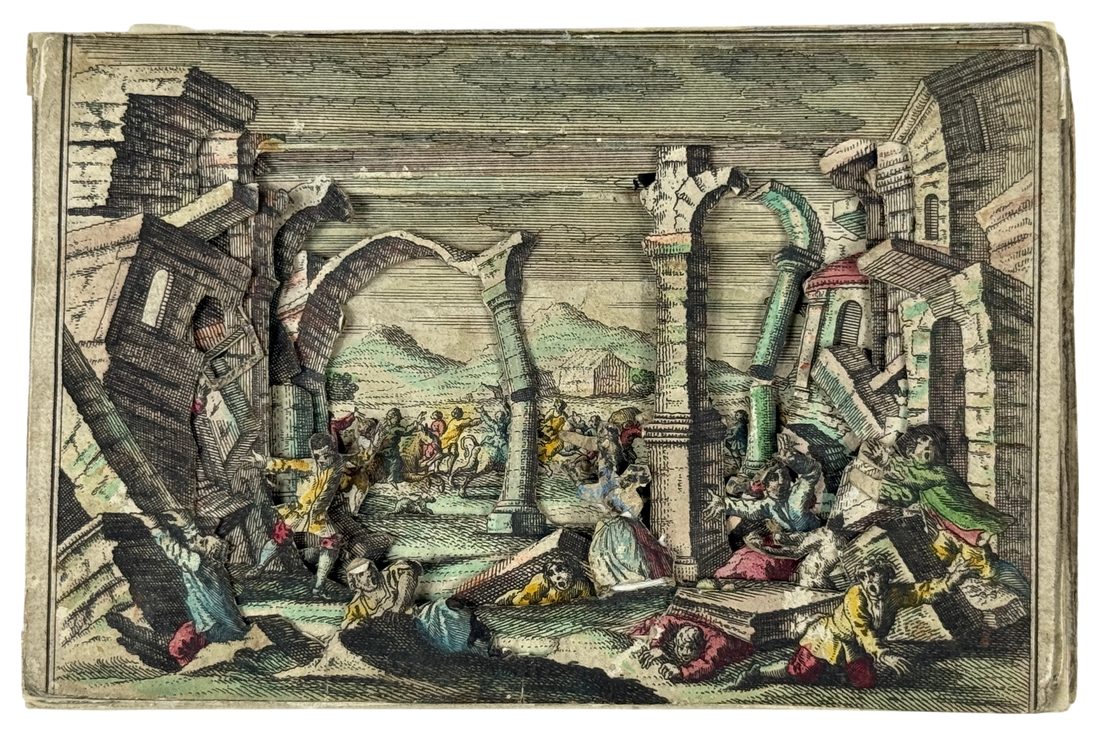
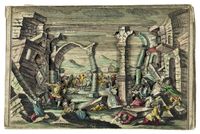
[Diorama]. Perspectivische Vorstellung eines Erdbebens (“Perspective Representation of an Earthquake”). Augsburg, Martin Engelbrecht, ca. 1756.
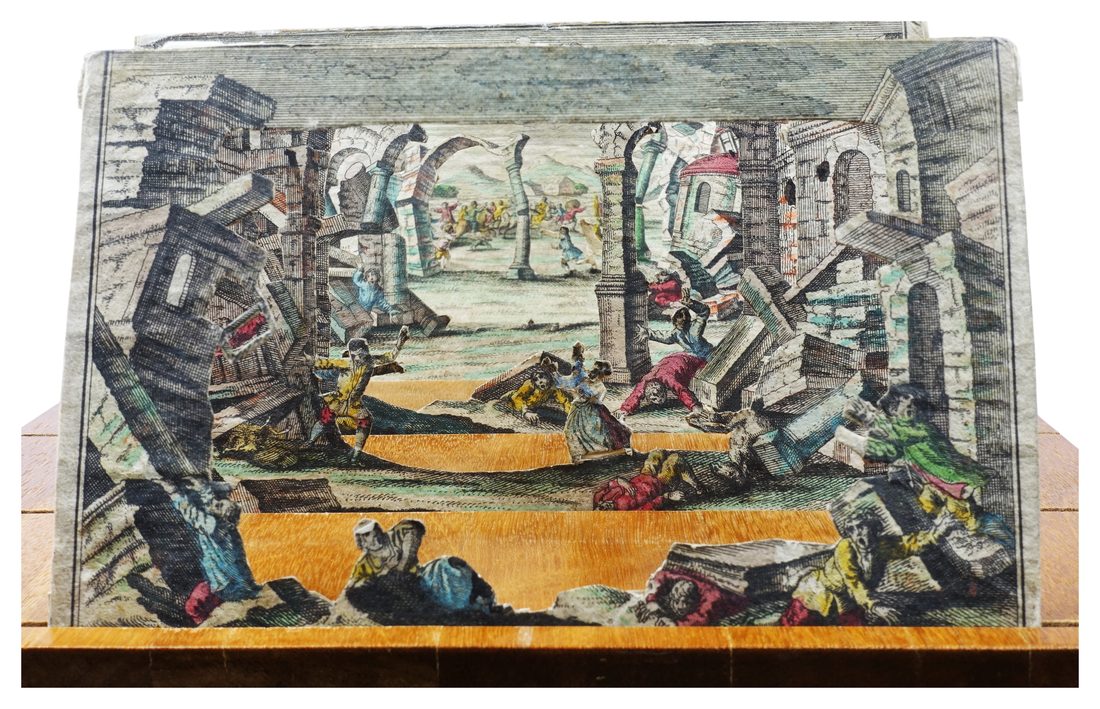
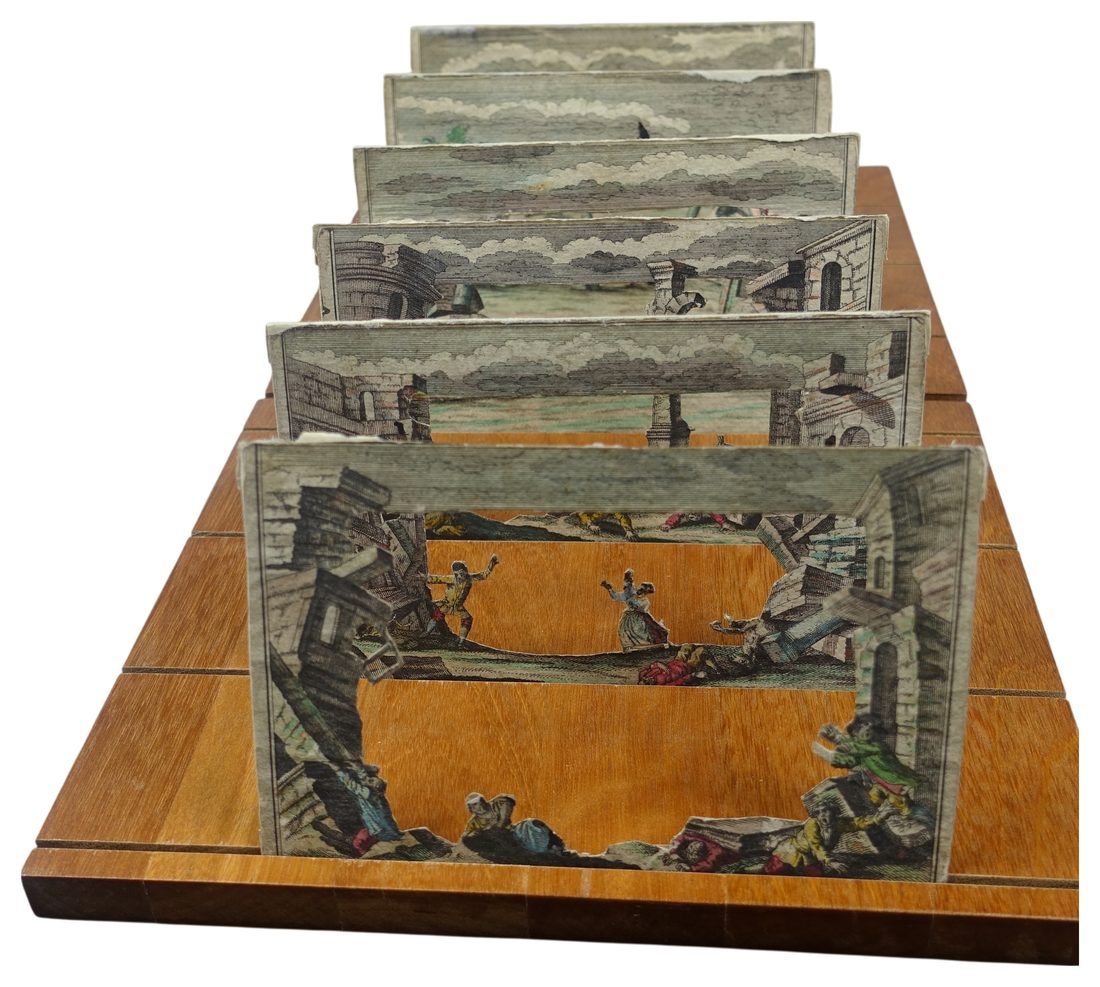
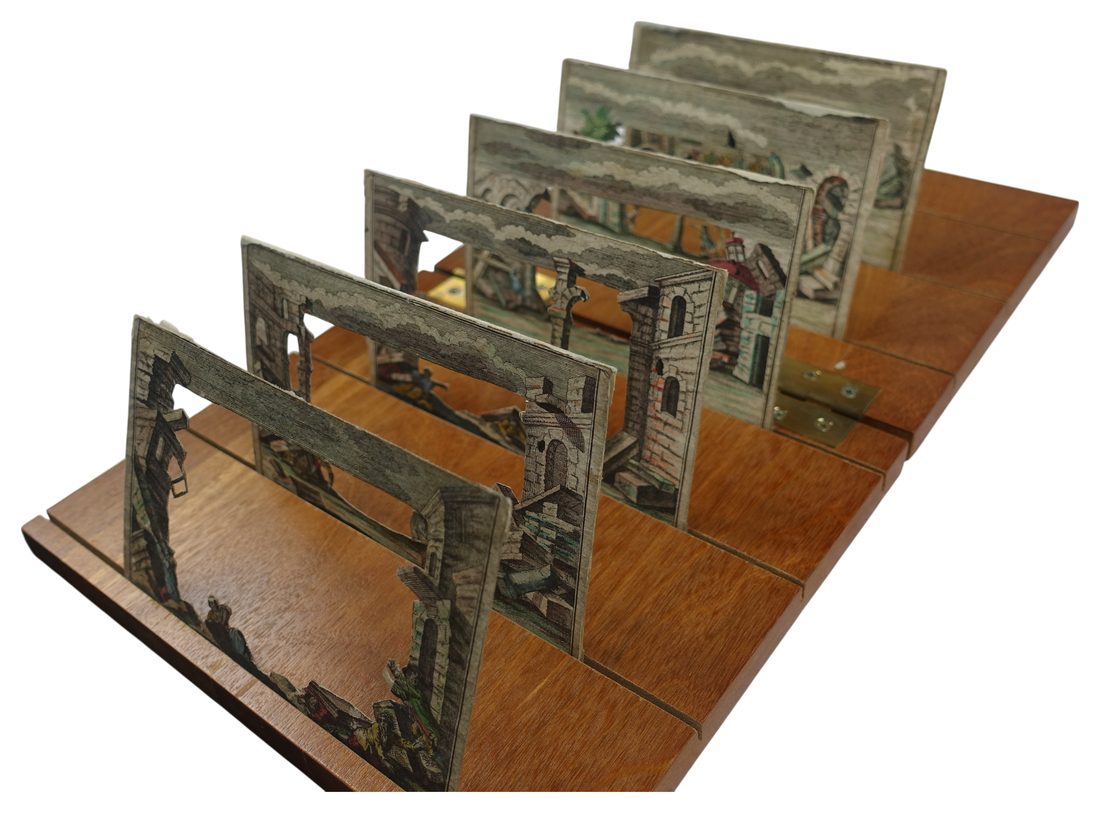
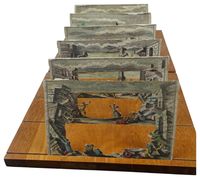
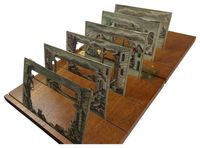
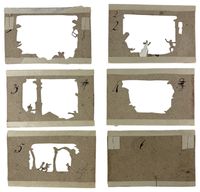
8vo perspective theatre (each sheet 135 × 90 mm, sheet measurement), complete set of six hand-coloured copper-engraved plates on thin laid paper. The first five sheets are cut through their central fields to form apertures of progressively diminishing span, functioning as scenic flats; the sixth is retained uncut as the closed background scene, and bears at the lower centre, engraved within the hatching of the ground, the series designation 7 F. Classified as 7 F within the Engelbrecht corpus, and illustrated under that designation in Alberto Milano’s census of the Augsburg workshop.
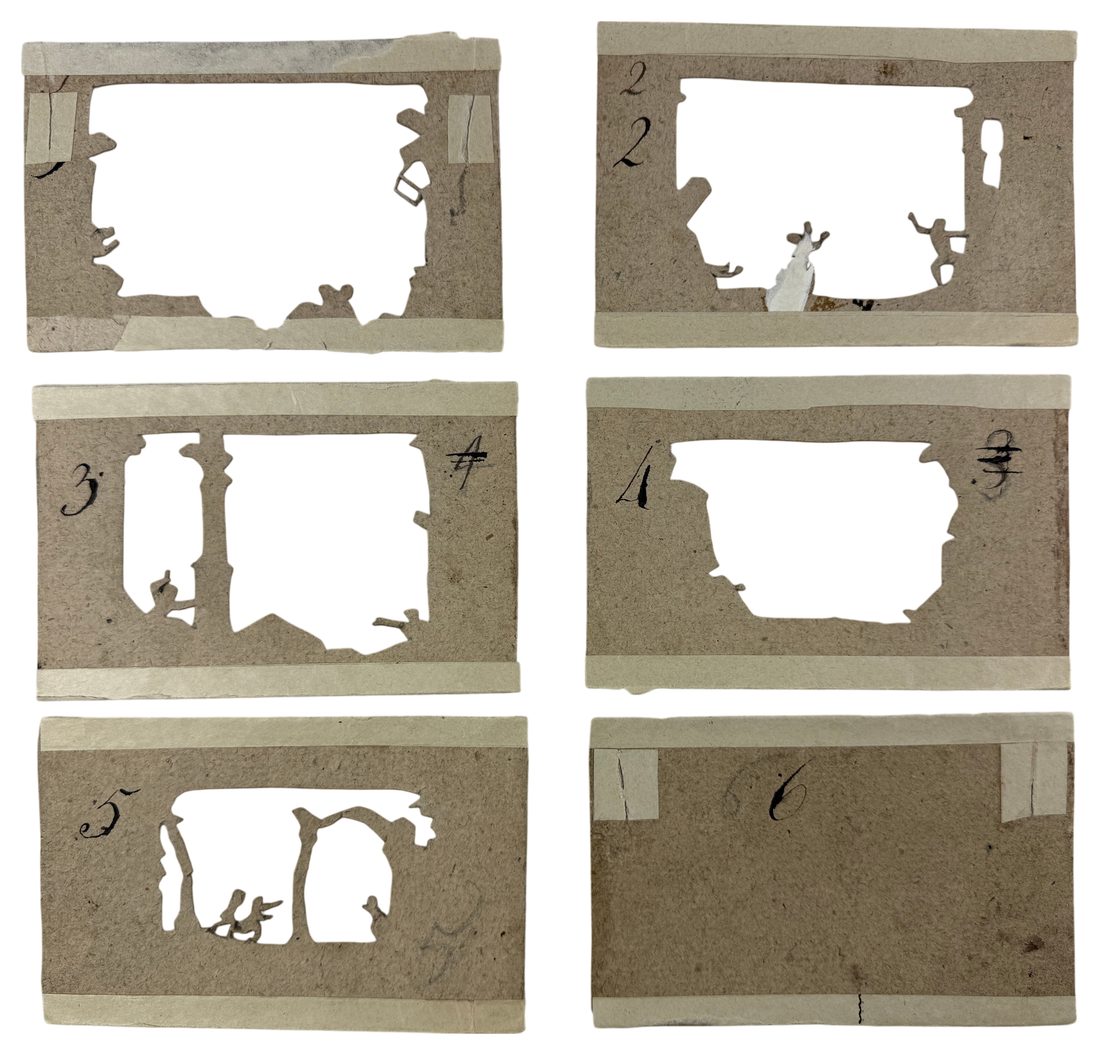
The hand-colouring is original, in transparent watercolour, and its palette is restrained and consistent across all six planes: greens and turquoise for the ground and for shadowed masonry, ochre and white for the stonework, saturated reds and yellows reserved for the costumes of the figures and for a single tiled dome. Each sheet is backed with a coarse brown paper to give rigidity, and retains at the upper and lower edges the paper mounting tabs by which the planes were seated within the viewing box. The versos carry a contemporary manuscript numbering, 1 to 6, in brown ink, establishing the order of assembly.
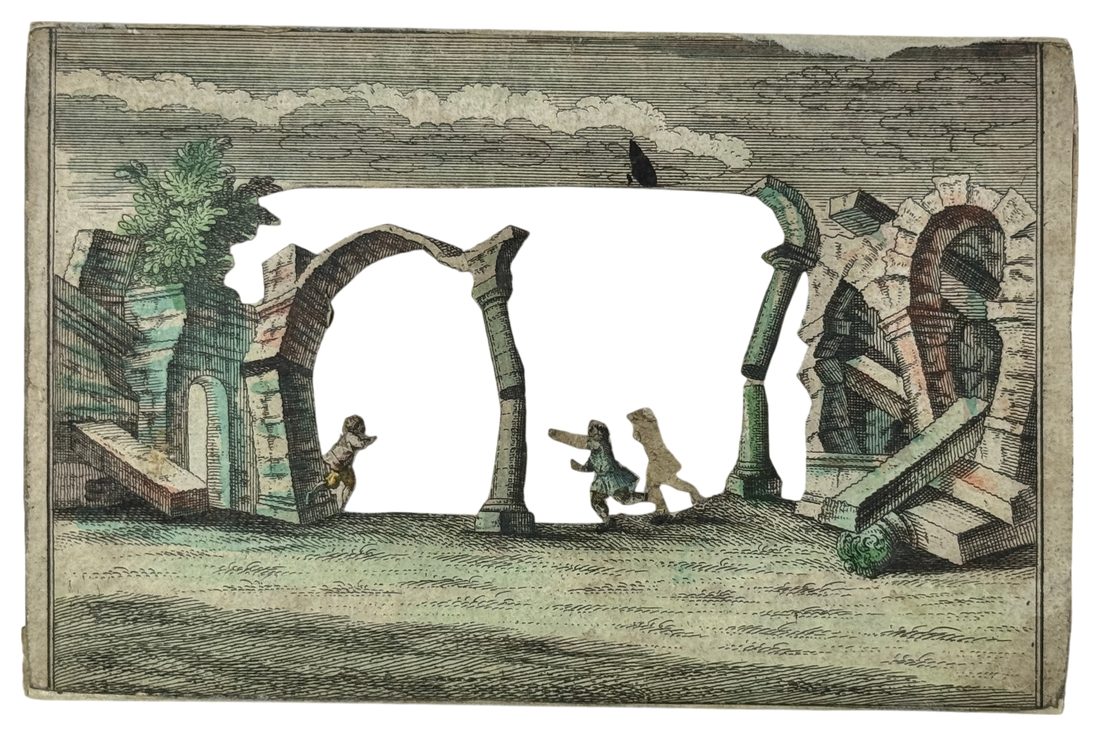
The cutting is executed with scissors and knife and follows the contour of the represented forms. Its refinement is most evident in the passages of greatest difficulty: the profiles of the fractured columns, the suspended fragments of entablature, the isolated silhouettes of figures standing free against the void, and the foliage of the tree on the fifth plane. Several figures are cut as autonomous silhouettes joined to the body of the sheet by slender bridges of paper.
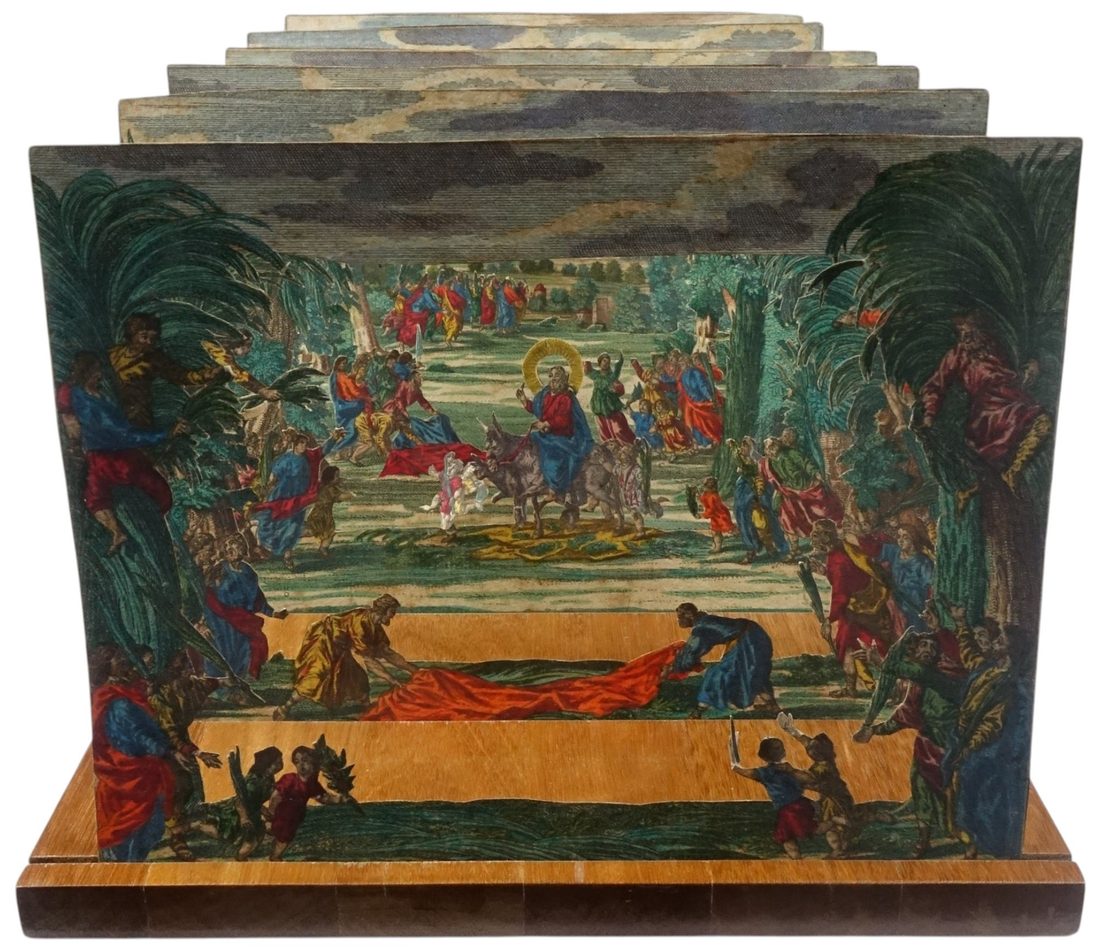
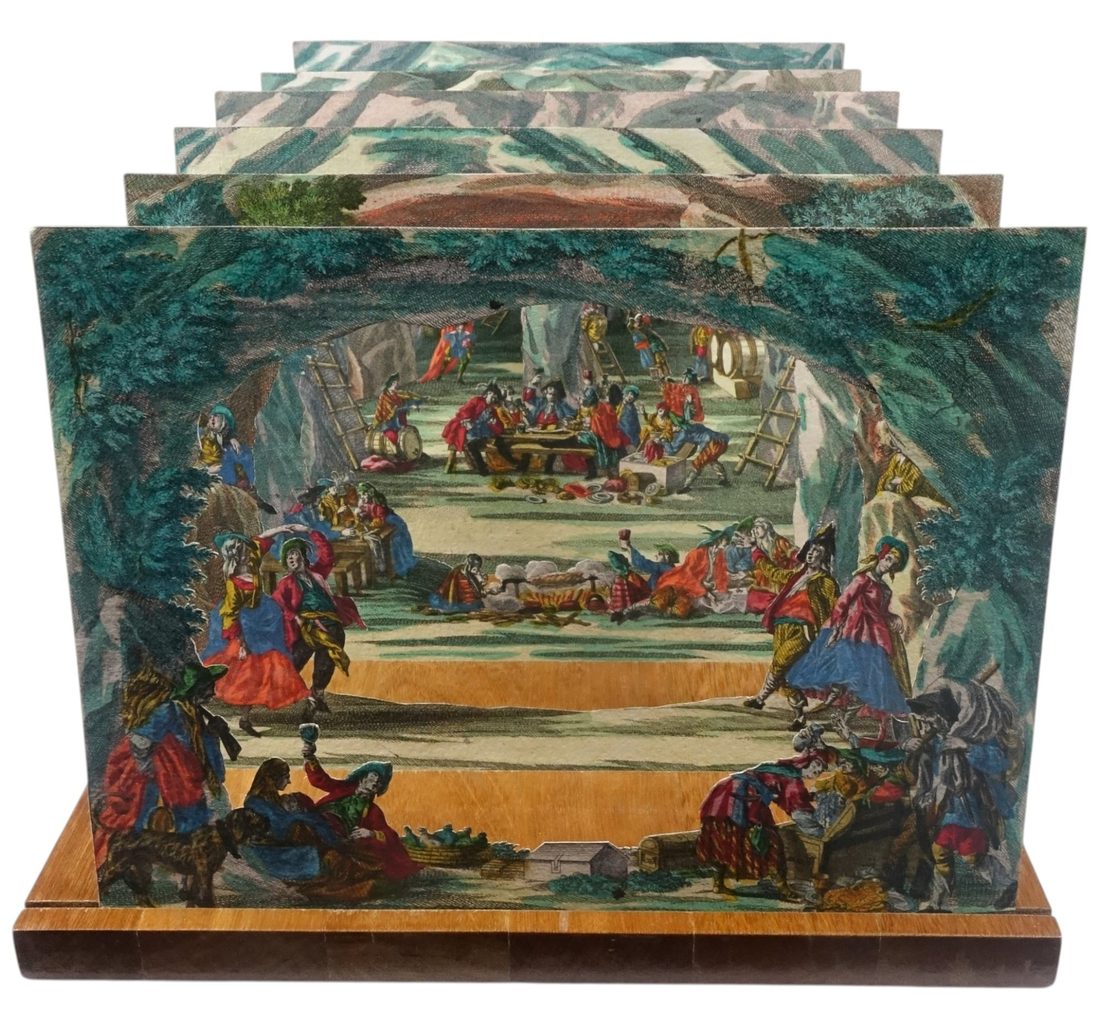
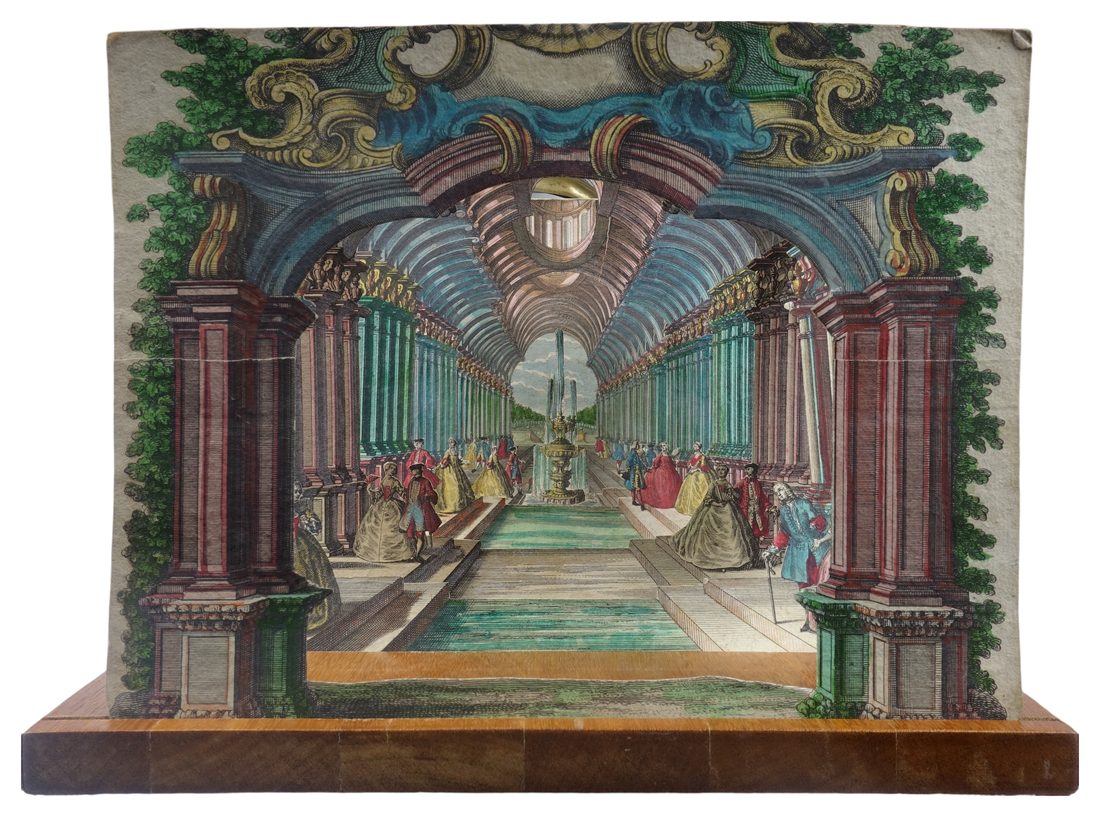
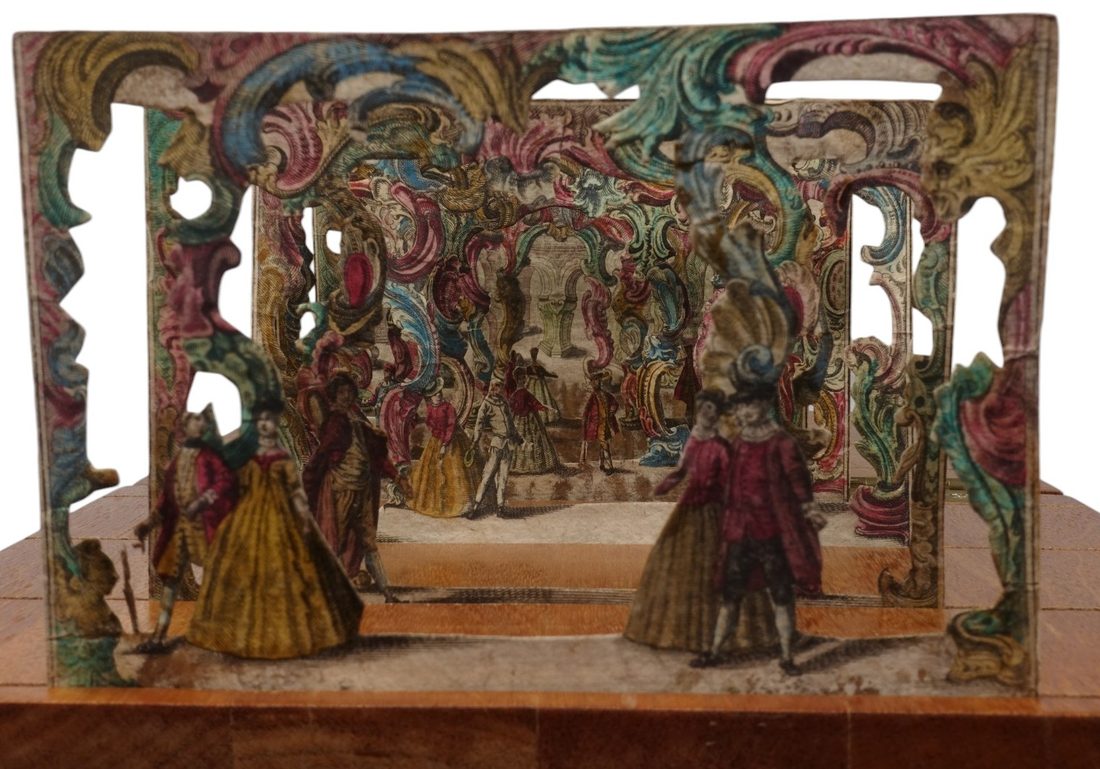
A complete set of the Engelbrecht perspective theatre devoted to an earthquake, in the medium octavo format, registered as 7 F in Alberto Milano’s census of the Augsburg workshop and there illustrated. The Engelbrecht theatres convert the engraved sheet into a three-dimensional stage, and stand between baroque scenography and the pre-cinematic culture of illusion. The present subject is among the gravest in the repertoire: where the workshop ordinarily staged gardens, hunts, feasts and biblical histories, here it stages catastrophe, and turns a device made for pleasure to the representation of the earth destroying the works of men.
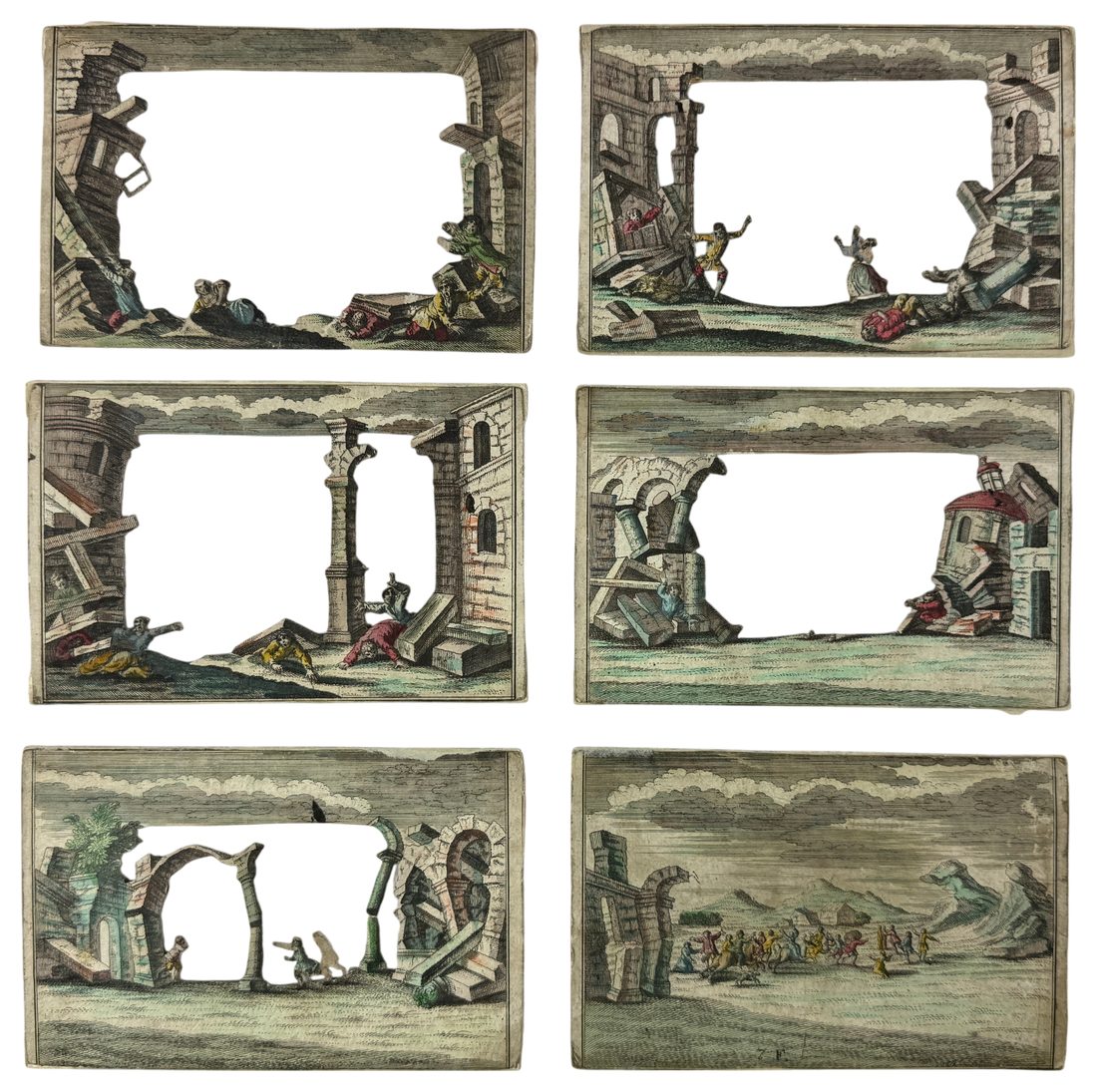
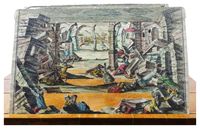
The diorama is conceived as a single perspectival construction decomposed across six successive engraved planes, each sheet operating both as an autonomous image and as one stratum of the larger spatial composition. Assembled in numerical order within a viewing box, the planes recreate the original recession and produce an illusion of depth particularly persuasive under frontal light. Here the recession carries a narrative as well as an optical function, since the sequence advances from the immediate aftermath of the collapse to the open country beyond it.
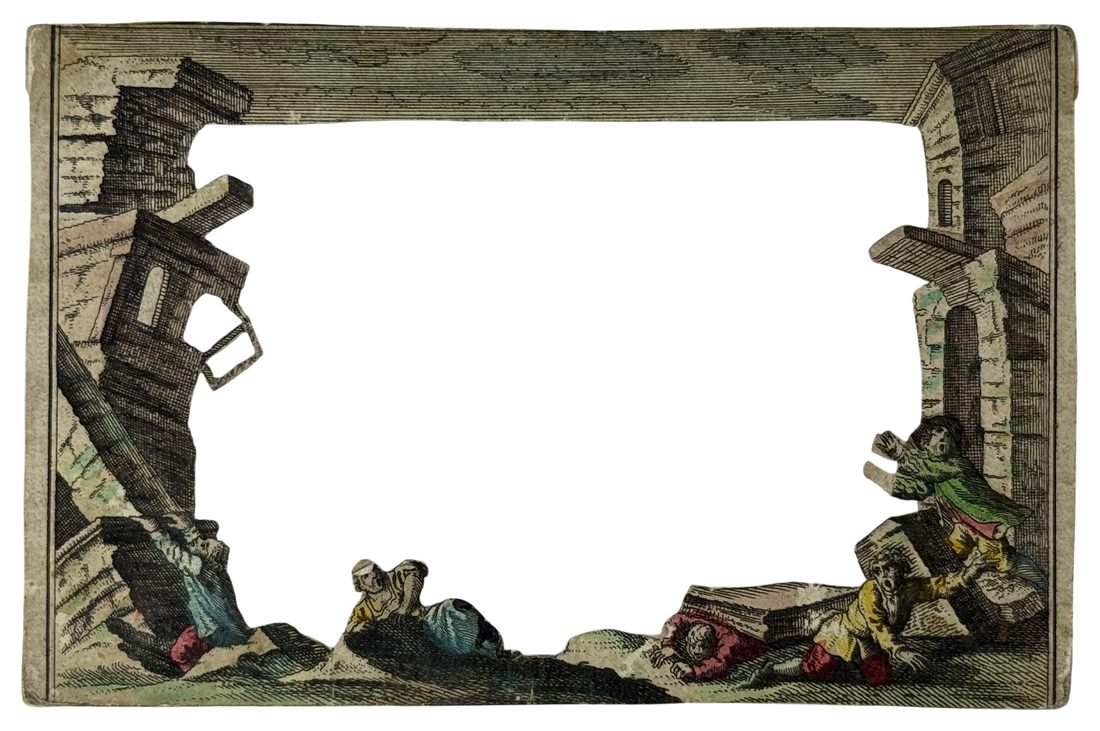
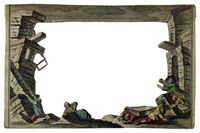
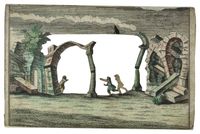
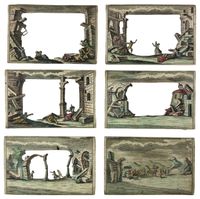
The first plate establishes the foreground of ruin. A tower leans and breaks to the left, its masonry sheared open; to the right a wall has split, disclosing the interior of a building. Along the lower margin lie the fallen: a man stretched face down in red, another struggling to rise from beneath the rubble, a third raising his arms. The aperture is cut low and wide, and the debris of the foreground is carried across the bottom edge as an unbroken band of overturned blocks.
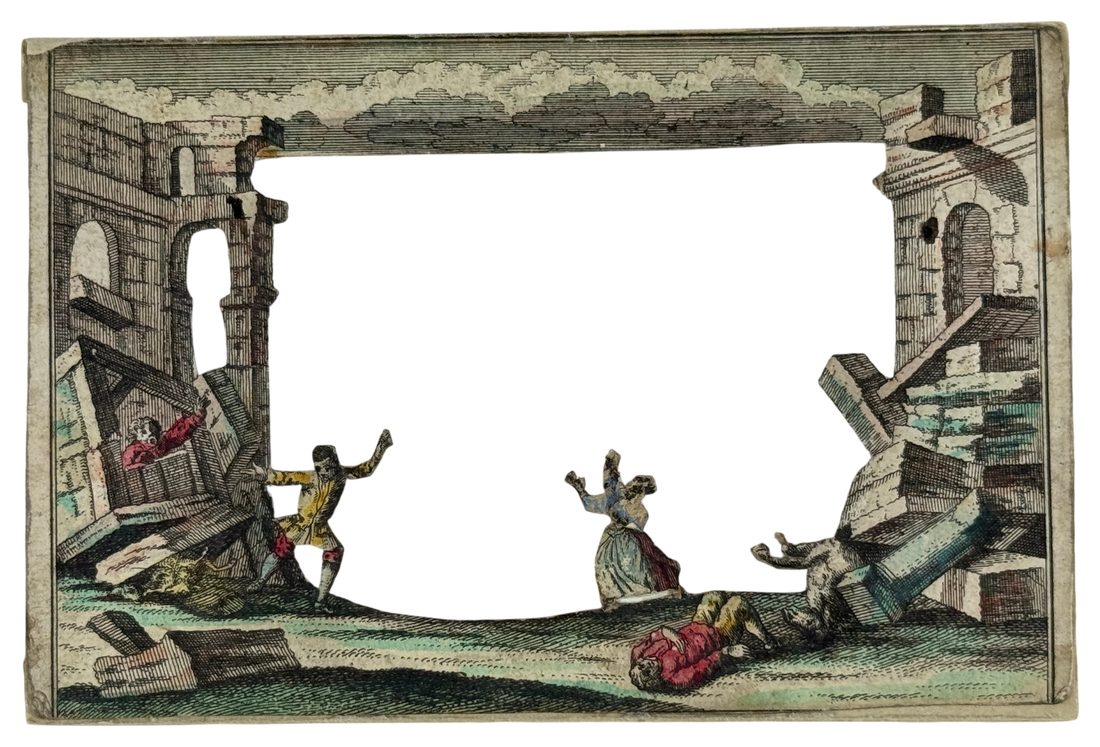
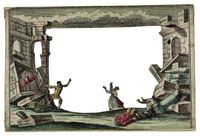
The second plate is the plane of human action. A man in yellow runs from the left with both arms flung up; near the centre a woman in a pale gown turns back with raised hands; a body lies in red at the right; a further figure emerges from beneath a fallen beam. At the far left a man is framed within a timber structure in the act of giving way. The cutting is at its freest here, and in the assembled construction these figures read as detached silhouettes suspended in the middle distance.
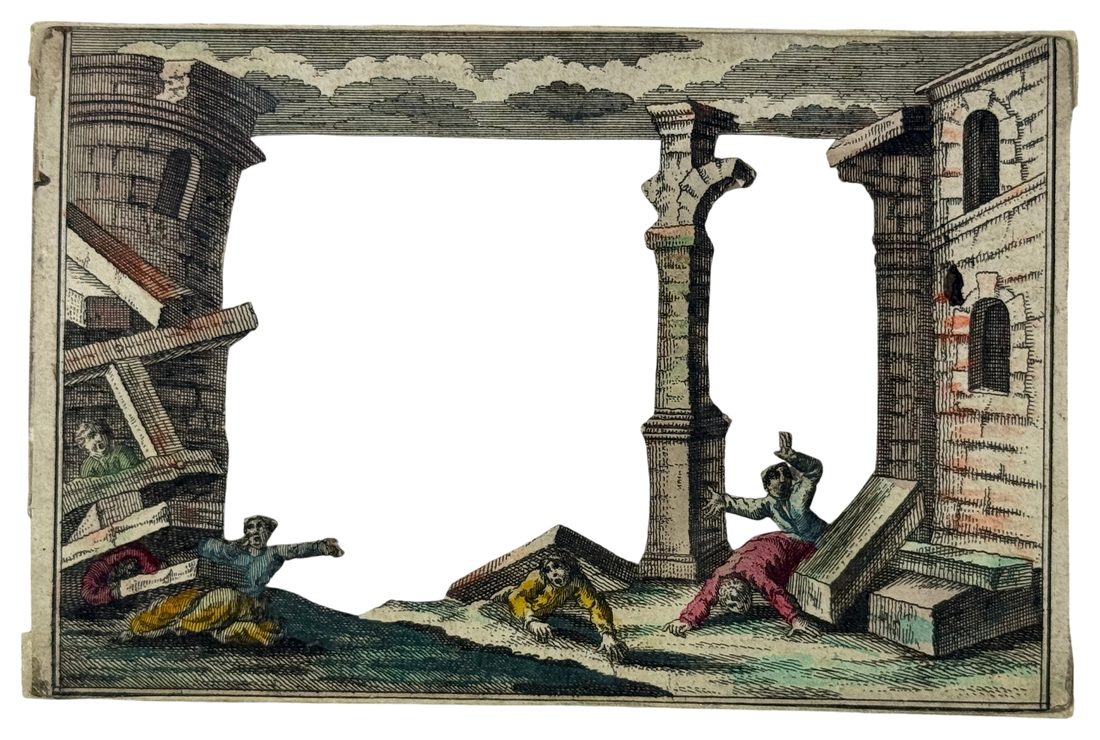
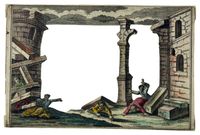
The third plate gives the architectural register its fullest statement. Two fractured columns still carry a fragment of entablature at the centre of the opening; to the left a collapsed mass of beams and dressed stone; to the right a building with arched windows opening in cracks. Figures crawl clear of the debris at the base, and one at the right is caught beneath a falling block.
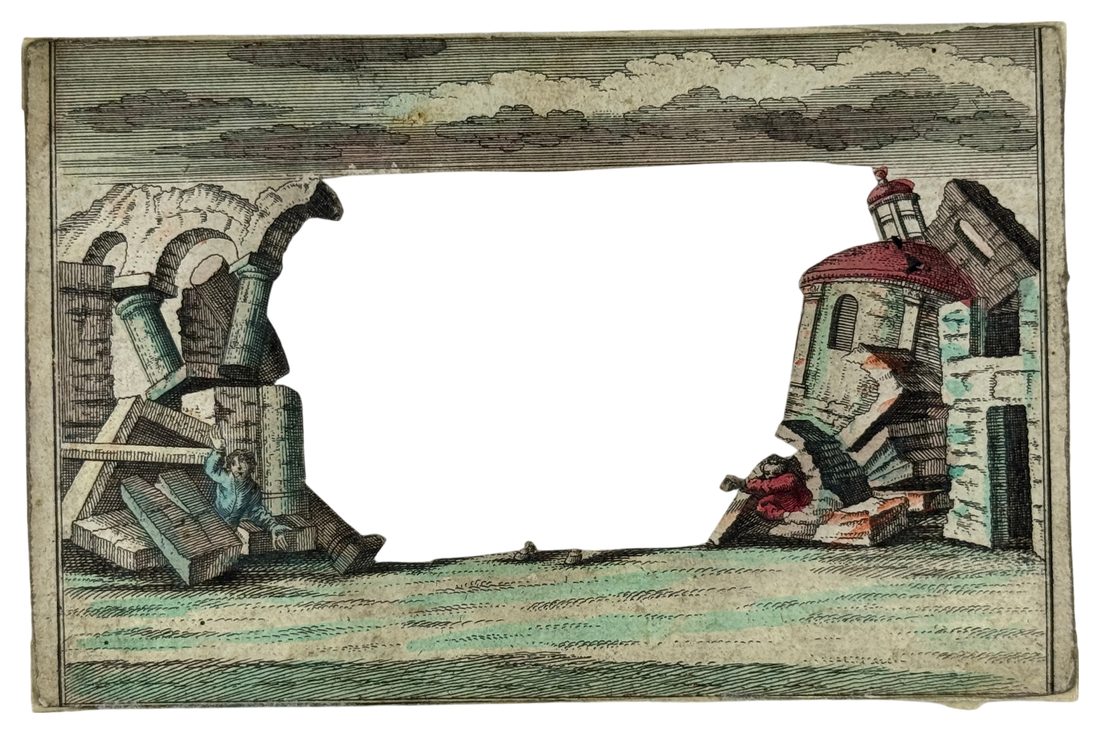
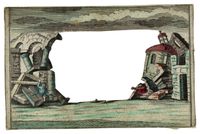
The fourth plate opens the depth. To the left a ruined arch is shored by fallen timbers; to the right a circular building with a red tiled dome and lantern breaks apart, its drum splitting from the base. The figures are fewer and smaller, and the aperture closes in from the sides, so that the eye is drawn through the ruin rather than held within it.
The fifth plate is the last of the scenic flats. Surviving arcades stand at either side, a tree in leaf rises at the left, and a broken column lies across the right foreground. Two small figures run towards the background accompanied by an animal. The plane serves as the final frame before the vista, and its cut is the narrowest of the sequence.
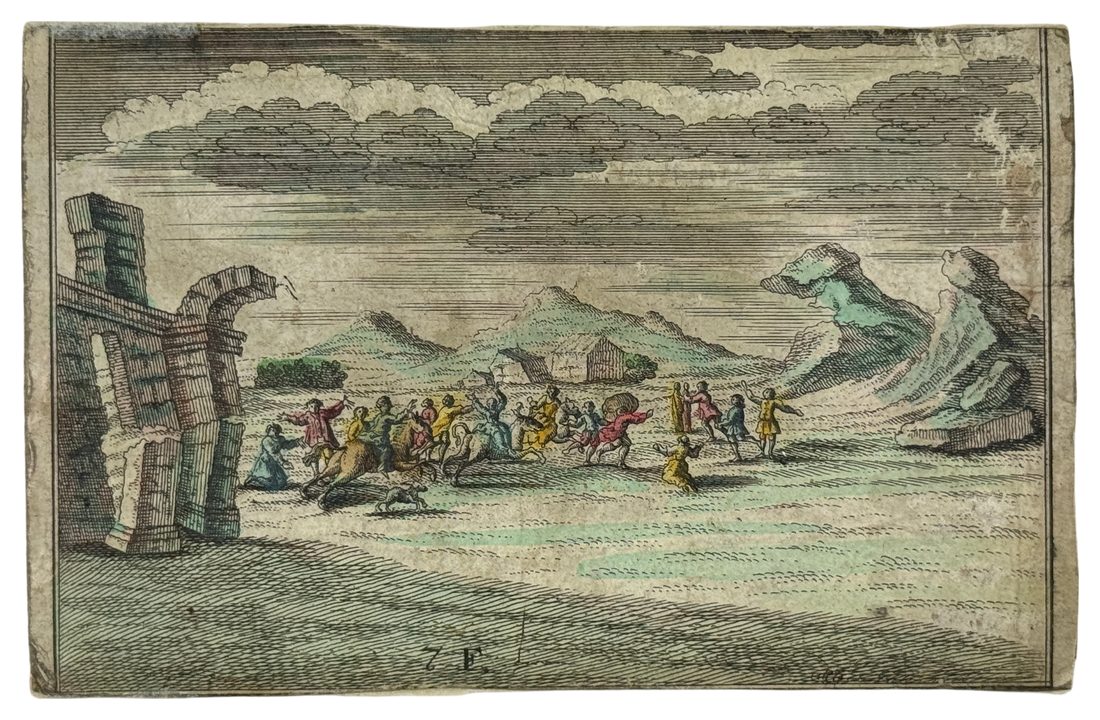
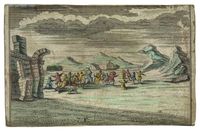
The sixth and final plate closes the construction as the uncut background. It shows the country beyond the ruined city: an open plain, mountains at the horizon, a distant settlement. A crowd of small figures flees in disorder across the middle ground, some on foot, some mounted, scattering into separate groups. A single surviving arcade stands at the left. At the right the ground itself heaves and tears open in great waves of earth, rendered in the same hatching and the same green and ochre colouring as the surrounding terrain.
This last passage is the key to the whole. The optical construction carries the viewer through the collapse and out of it, only to disclose, at the point of deepest recession where the workshop ordinarily placed a serene distance, the cause of the destruction still at work. The device is thus turned against its own convention, and the vista does not resolve the scene but reopens it.
Engelbrecht’s perspective theatres are inseparable from the intellectual climate of the German Enlightenment in its Augsburg variant, where popular print culture, the science of perspective and the taste for optical curiosities converged within a single commercial enterprise. The first half of the eighteenth century saw the codification of linear perspective in widely diffused treatises, the spread of the camera obscura, the magic lantern and the perspective box, and a growing appetite, in noble cabinets as in bourgeois interiors, for devices capable of staging the illusion of depth in domestic space. The Augsburg theatres translate this scientific and recreational culture into a printed object, accessible to an international public and intended to be assembled by the owner.
Within the discipline of the printed image the genre descends from the seventeenth-century peep-box tradition of the Netherlands and Germany, takes its characteristic layered form in the Augsburg perspective theatres of the first half of the eighteenth century, and prepares the ground for the nineteenth-century paper theatre and for the dioramas of Louis Daguerre, first exhibited in Paris in 1822. Engelbrecht’s particular contribution consists in the systematic adoption of the multi-plane structure as a serial publishing programme, and in the elaboration of an entire iconographic repertoire ranging from biblical histories and royal ceremonies to gardens, theatres, encampments and hunts.
The present subject is unlike the rest of that repertoire. The earthquake admits none of the pleasures the genre ordinarily supplies: no order, no leisure, no cultivated nature. It belongs instead to the European visual culture of catastrophe, a tradition of printed disaster imagery that ran through the eighteenth century and reached its greatest intensity after the Lisbon earthquake of 1 November 1755, an event that occupied the presses of Augsburg as it occupied the philosophers. The specialist literature refers the present subject to that earthquake, an identification that remains inferential rather than documented. Martin Engelbrecht died on 18 January 1756, seventy-eight days after it, so that a set of this date belongs either to the last months of his life or to the first years of the house under his heirs.
The choice of subject carries a formal consequence as well. The perspective theatre depends for its effect on architecture, since it is the receding succession of built forms that generates the illusion of depth. To construct such a theatre out of architecture in the act of collapsing is to set the device against itself, and it is this, rather than any documentary intention, that gives the sheets their force. The ruins are classical and generic, not the buildings of any identifiable city, and the workshop attempts no topography. What is staged is not a place but an event.
Martin Engelbrecht (1684-1756) ranks among the most enterprising German engravers and print publishers of his generation. Born in Augsburg on 16 September 1684, he was the son of a colour merchant and trained as an engraver in Augsburg under Gabriel Ehinger. He worked in the orbit of his elder brother Christian (1672-1735), joining him in Berlin about 1708 and returning with him to Augsburg in 1711. In that year he entered the art-publishing house founded by his brother together with Johann Andreas Pfeffel, becoming a partner after Pfeffel withdrew. In 1719 he secured an imperial privilege, renewed in 1729 and again in 1739, which protected his editions and underwrote the exclusivity of his optical productions. The house rapidly became one of the principal European centres for coloured popular prints, devotional sheets, allegorical series, costume books and optical novelties. He died in Augsburg on 18 January 1756, and the workshop continued afterwards under his heirs.
Within an output estimated in several thousand sheets, the Perspektivtheater constitute a small and highly specialised strand of the production, technically the most exacting the workshop undertook and without competitors elsewhere in Europe, designed in close partnership with the leading Augsburg draughtsmen of the period. Jeremias Wachsmuth (1711-1771), active for the house from 1731, and Johann David Nessenthaler (1717-1766), from 1737, supplied the inventions for many of the perspective theatres. The sheets were etched on copper and printed on thin but resilient paper suitable for precise cutting. The engraver began from a conventional two-dimensional perspective view and then reconstructed the same composition across successive layers, each subtly modified to enhance the recession. Customers could acquire the scenes finished in the workshop, mounted on card, cut out and coloured, or as plain sheets to be cut out and assembled at home; the sheets were sold both coloured and in black and white, for the purchaser to colour.
The theatres were issued in three formats designated by the conventions of book sizes: quarto, the large format, of which some sixty-seven titles are recorded; octavo, the medium format and the most widely diffused, with approximately one hundred and fifty-five titles known; and duodecimo, the small format. The present set belongs to the octavo, and its designation, 7 F, falls in the upper reach of that sequence, the highest recorded numbering in the format being 7L, so that the subject is among the later titles issued by the house.
Conditions: Very good overall, with the defects of handling proper to the category. Small losses and old repairs occur at the most exposed of the cut elements, together with light age toning, minor surface soiling, and slight creasing at the edges. The colouring is bright and unrubbed throughout. The set is complete: consistency of paper, colouring and backing across the six sheets, together with the contemporary manuscript numbering on the versos, establishes that it is homogeneous and has never been made up from separate sources.
References: A. Milano, Martin Engelbrecht. Perspektivtheater, Dioramen. Stuttgart: Füsslin Verlag, 2016, no. 7 F, ill. p. 261; P. Grandi, I Diorami teatrali di Martin Engelbrecht. Medium, 9 March 2021, online.
Ti potrebbero interessare