Presentation of Christ's Entry into Jerusalem
| Macro-category | Ancient Games and Pre-cinema |
| Subcategory | Diorama |
| Author | Martin Engelbrecht |
| Provenance | Augsburg |
| Publisher / Maker | Martin Engelbrecht |
| Year | 1750 |
the triumphal entry into the Holy city
a complete set of the rare 4to Engelbrecht perspective theatre,
# 37 of the milano census
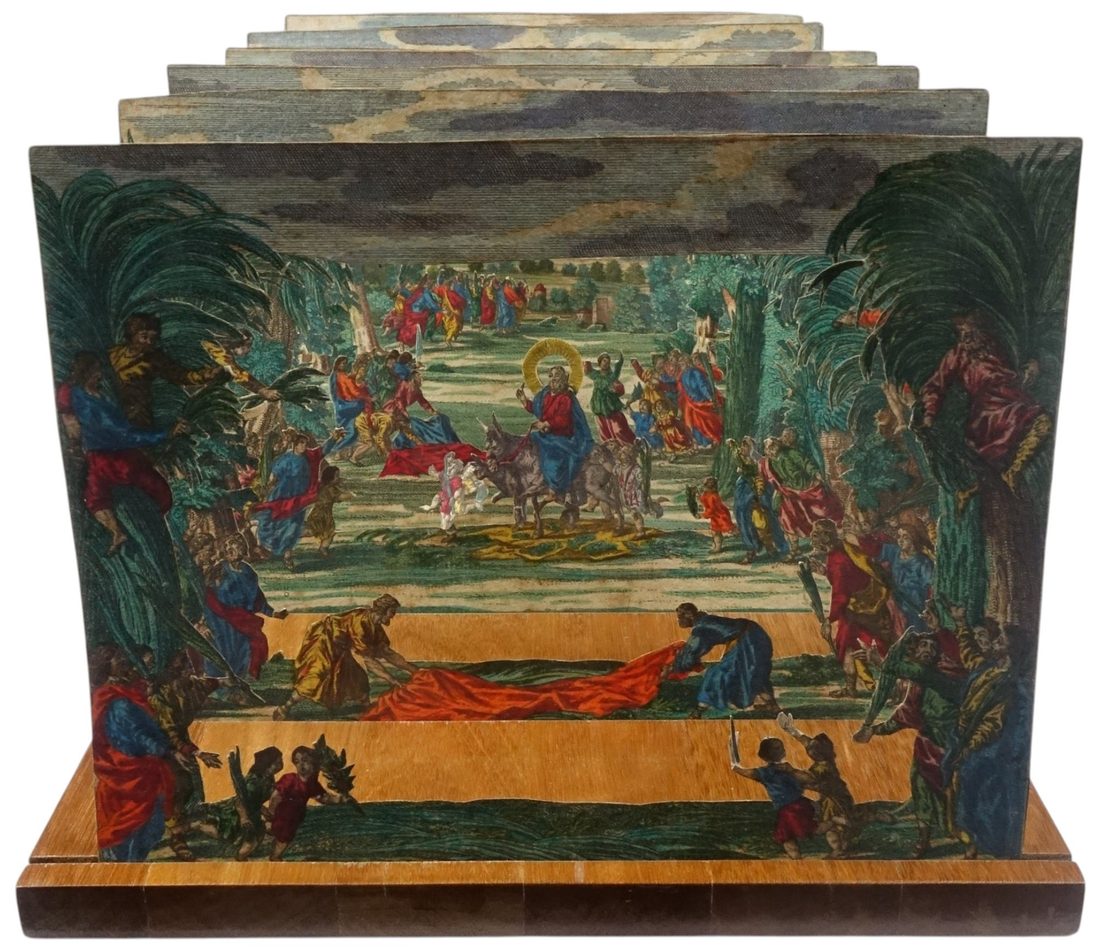
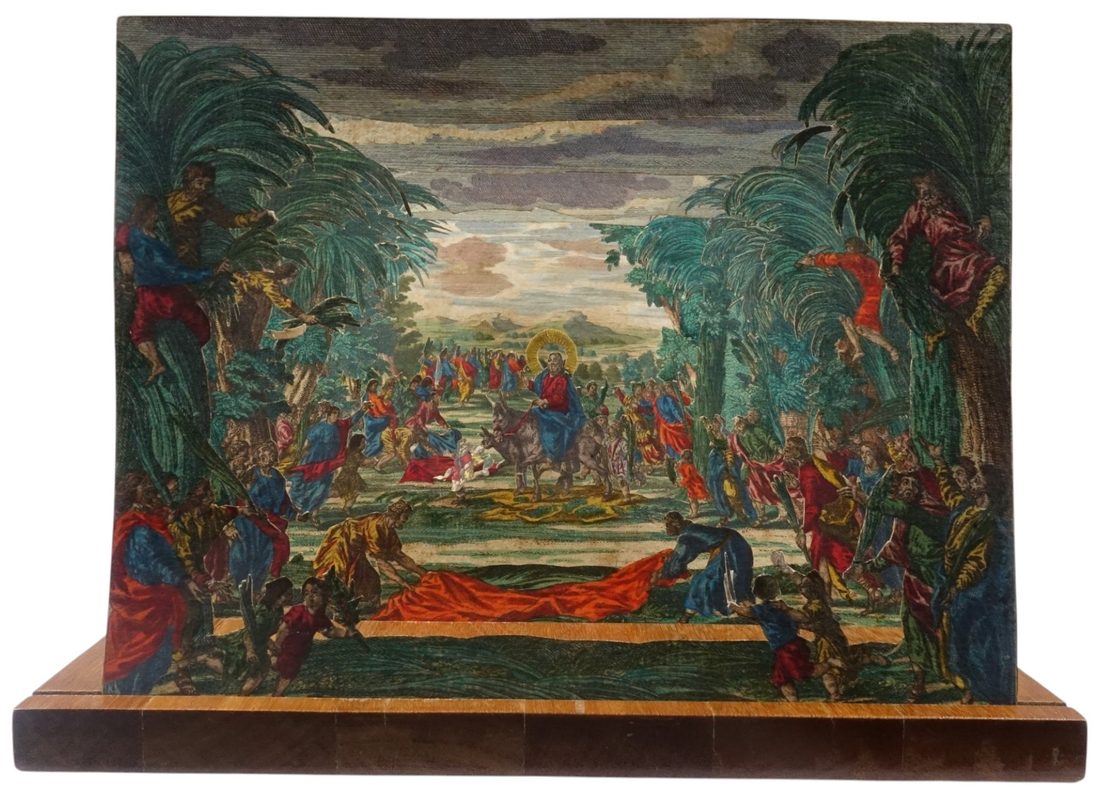
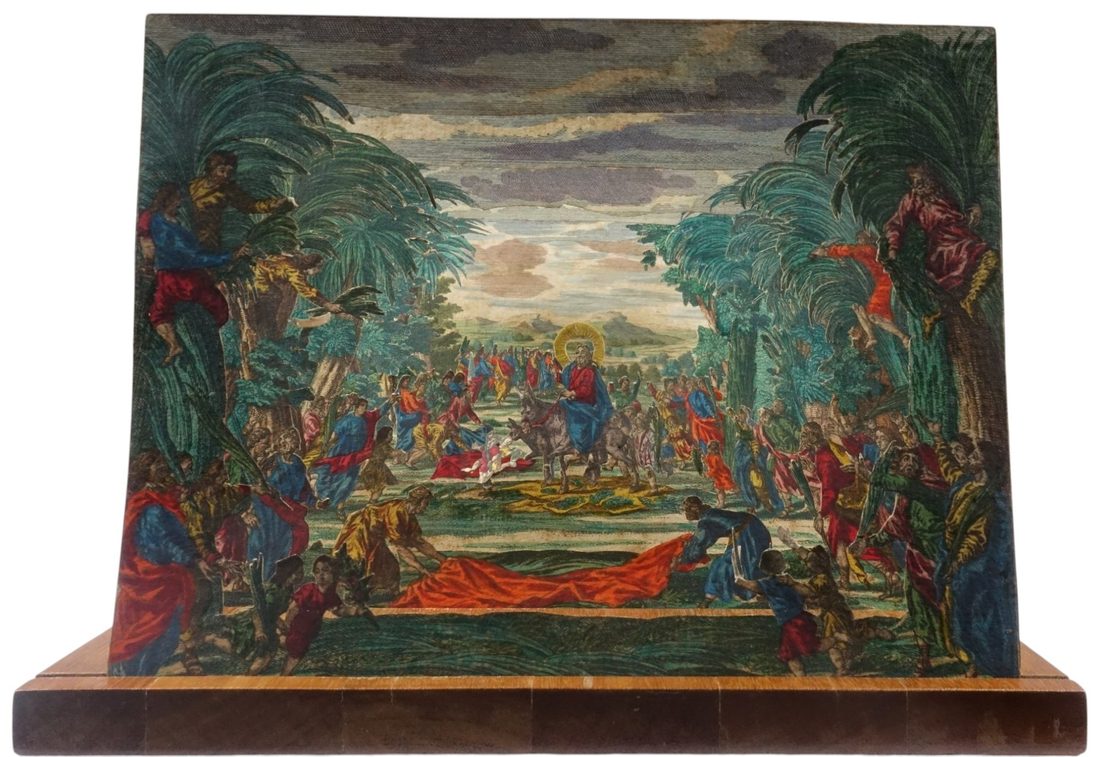
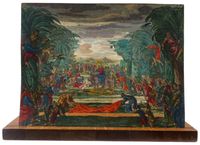
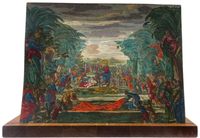
[Diorama]. Praesentation des Einzugs Christi in Jerusalem (“Presentation of Christ's Entry into Jerusalem”). Augsburg: Martin Engelbrecht excudit, ca. 1750
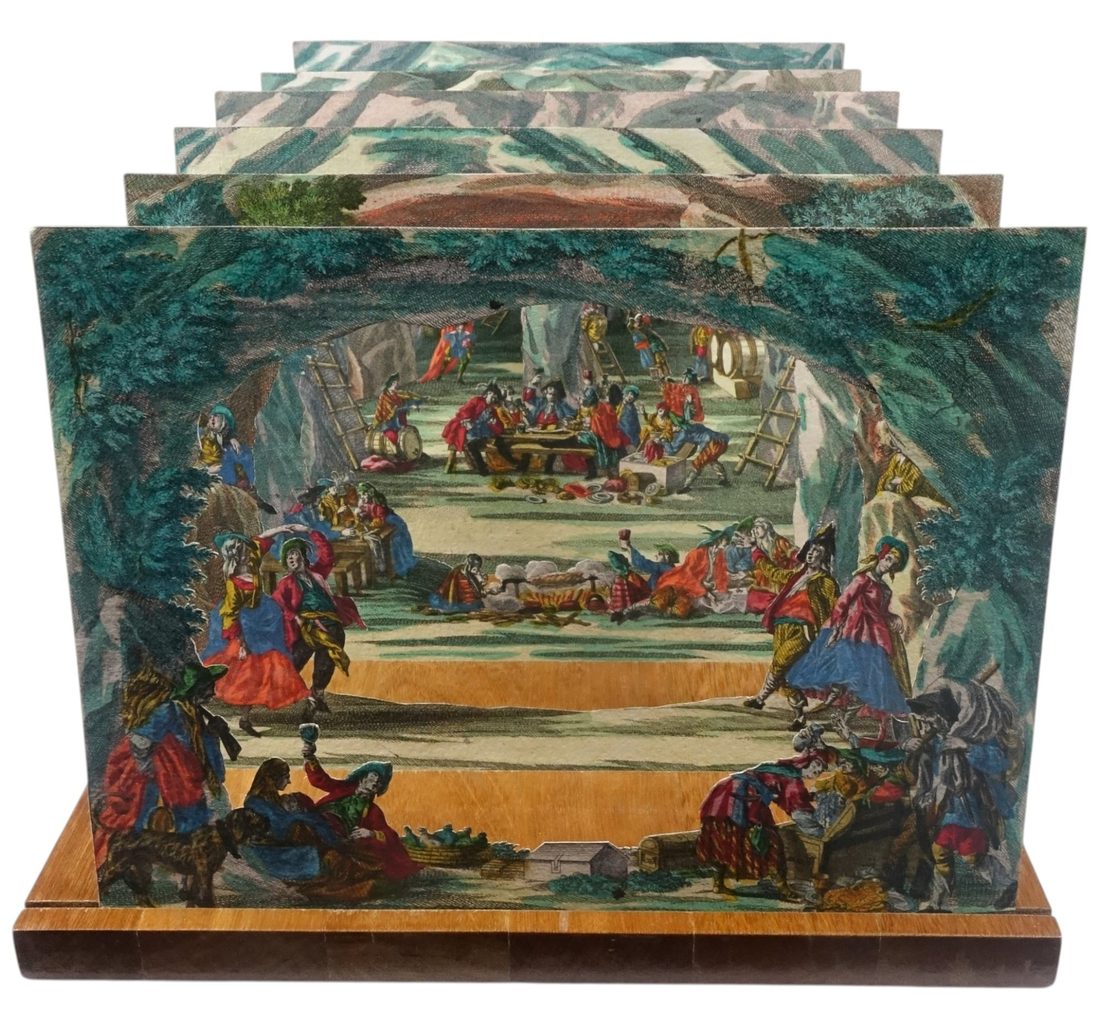
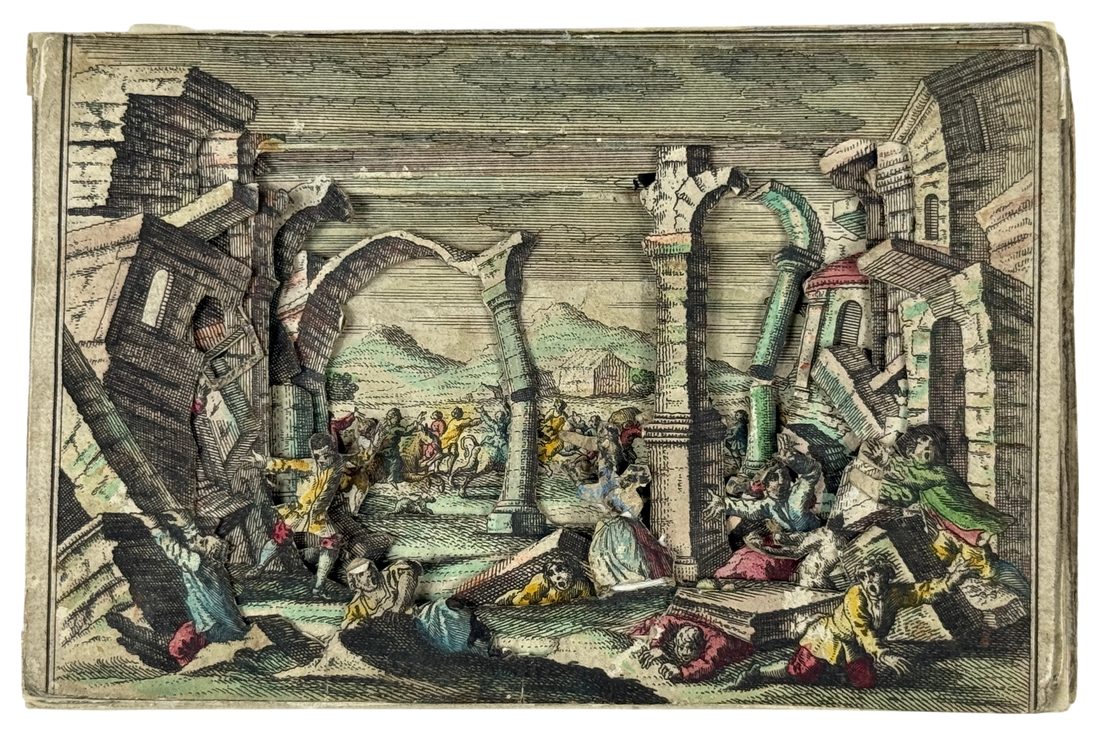
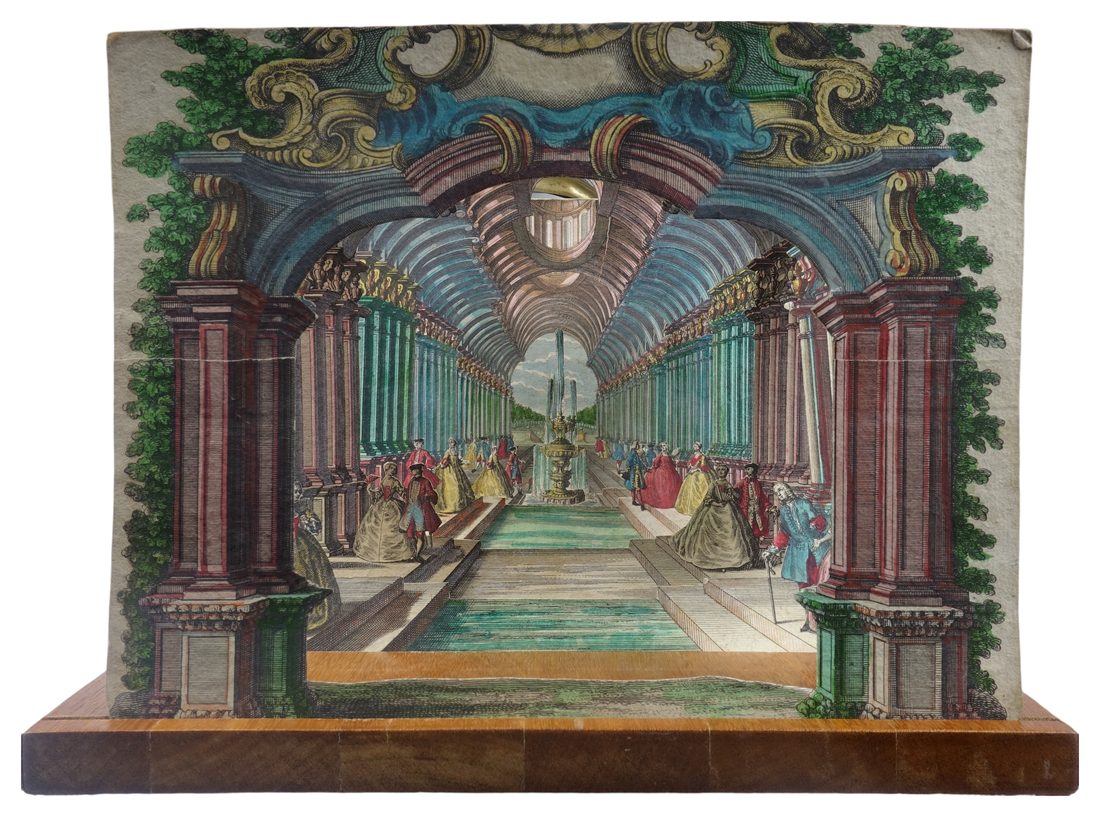
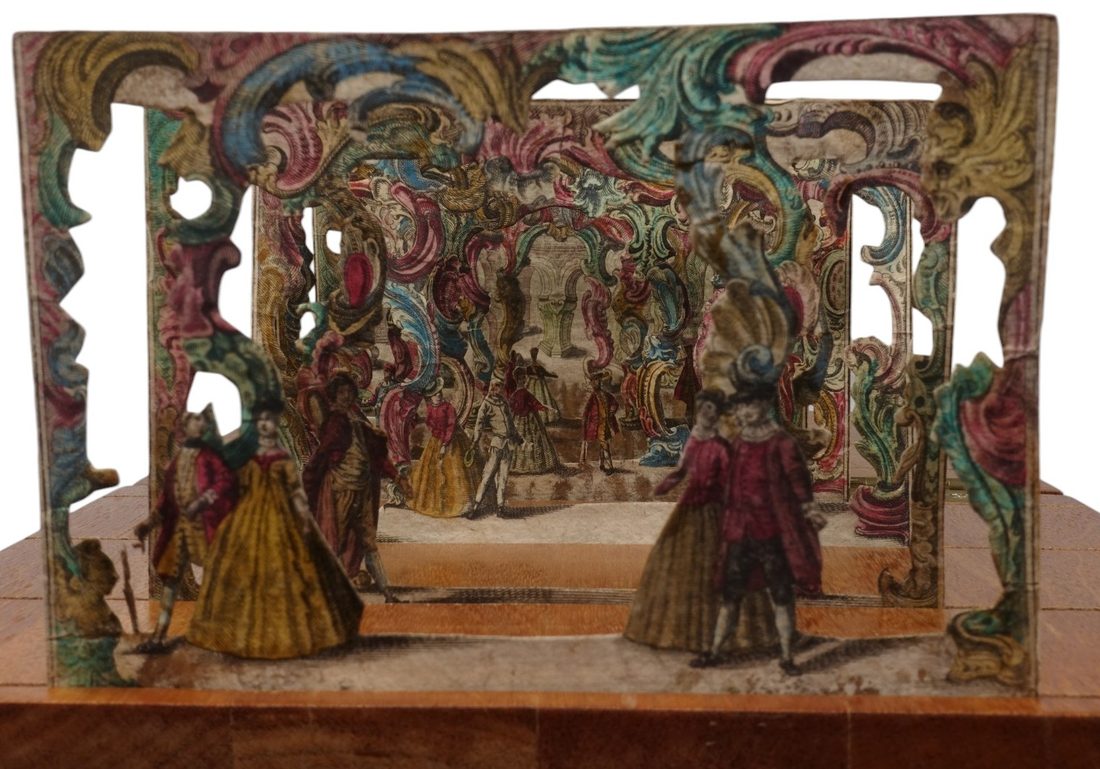
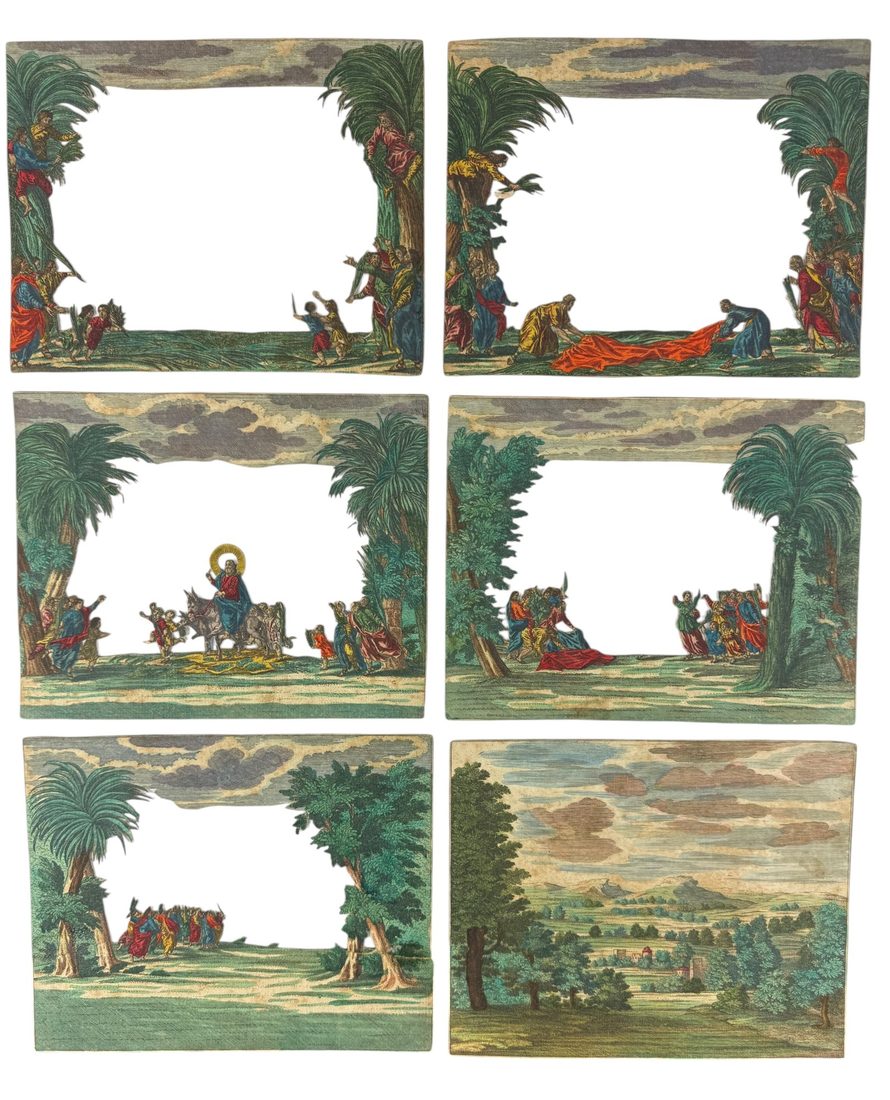
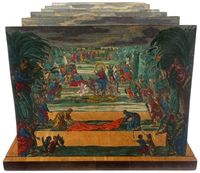
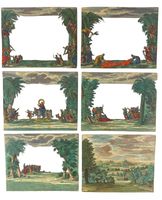
4to perspective theatre (each sheet 210 × 155 mm), complete set of six hand-coloured copper-engraved plates on laid paper, numbered 240–245. The first five sheets are cut through their central fields to form arched apertures of progressively diminishing span, the sixth retained as the uncut background landscape. Original hand-colouring in transparent watercolour with selective gouache highlights, designed to be assembled in numerical order within a viewing box or upon a wooden support, generating the layered three-dimensional illusion characteristic of the Engelbrecht workshop.
Engelbrecht’s dioramas were most commonly produced in 8vo format, while those in quarto are exceedingly rare, particularly in perfect condition. Only 67 4to dioramas have been identified as having been produced by Engelbrecht, and the present example is number 37.
“The number of published large-format Engelbrecht perspective theatres is given as 67. Even though we cannot say with certainty that this number is correct, it is nonetheless very likely, as not a single sheet suggests that additional series may have existed” (Milano).
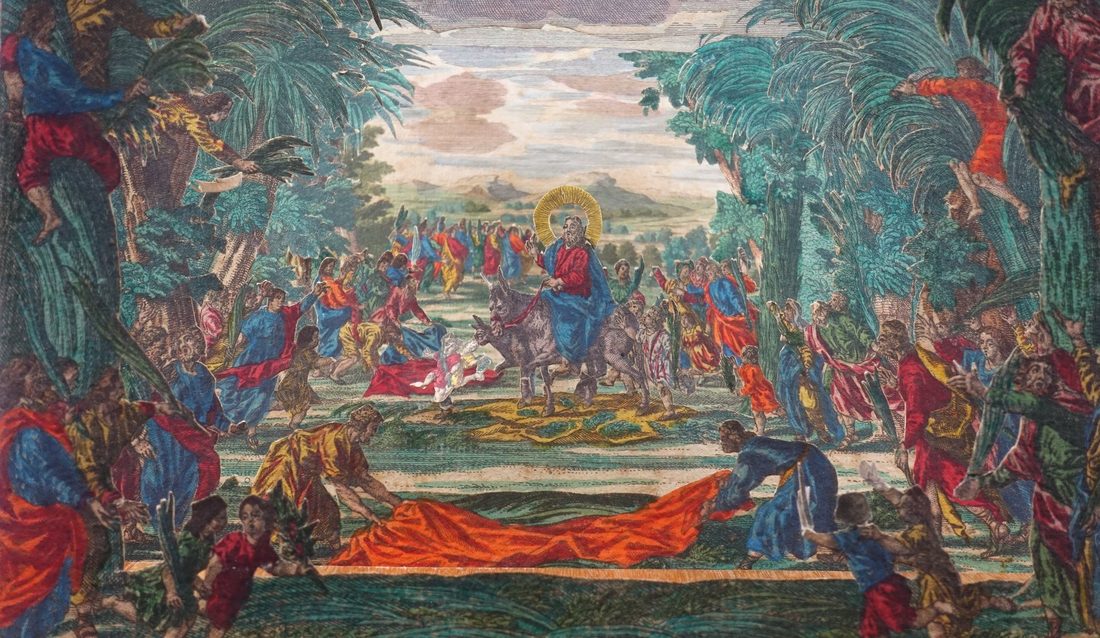
A complete and finely preserved example of one of the rarest products of the Augsburg printed image, the quarto Perspektivtheater devoted to the Entry of Christ into Jerusalem, registered as no. 37 in Alberto Milano's census of the workshop's large-format dioramas, of which only sixty-seven distinct subjects are recorded. Designed by Jeremias Wachsmuth, the diorama transposes a foundational episode of the Passion cycle into a six-plane theatrical construction at the threshold between baroque scenography and the pre-cinematic culture of illusion. The work bears witness to the meeting of religious iconography, perspective theory, and Enlightenment visual curiosity in Augsburg, then one of Europe's leading centres for coloured prints.
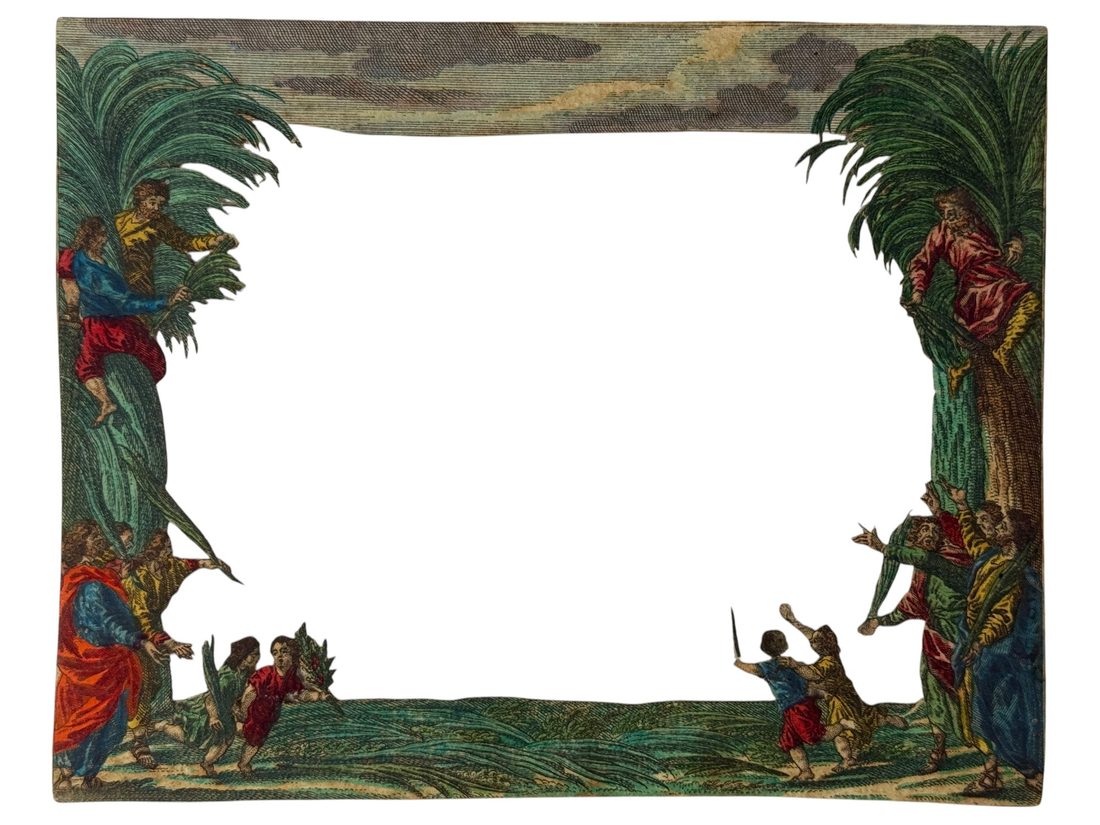
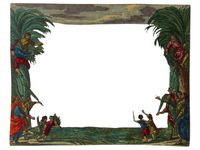
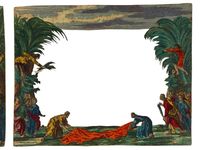
The diorama is conceived as a unified perspectival construction articulated across six successive engraved planes, each plate operating both as an autonomous image and as one stratum of a larger spatial composition centred on the procession of Christ through a palmed avenue leading to the gates of Jerusalem. The first sheet (no. 240) forms the front scenic plane, or proscenial flat, framed by two great date palms; on the left a boy climbs a trunk to gather palm fronds while his companion offers them downwards, on the right a corresponding figure ascends the second palm under the gaze of a group of onlookers, two children with daggers and palm leaves animating the foreground. The aperture left at the centre opens broadly upon the deeper planes.
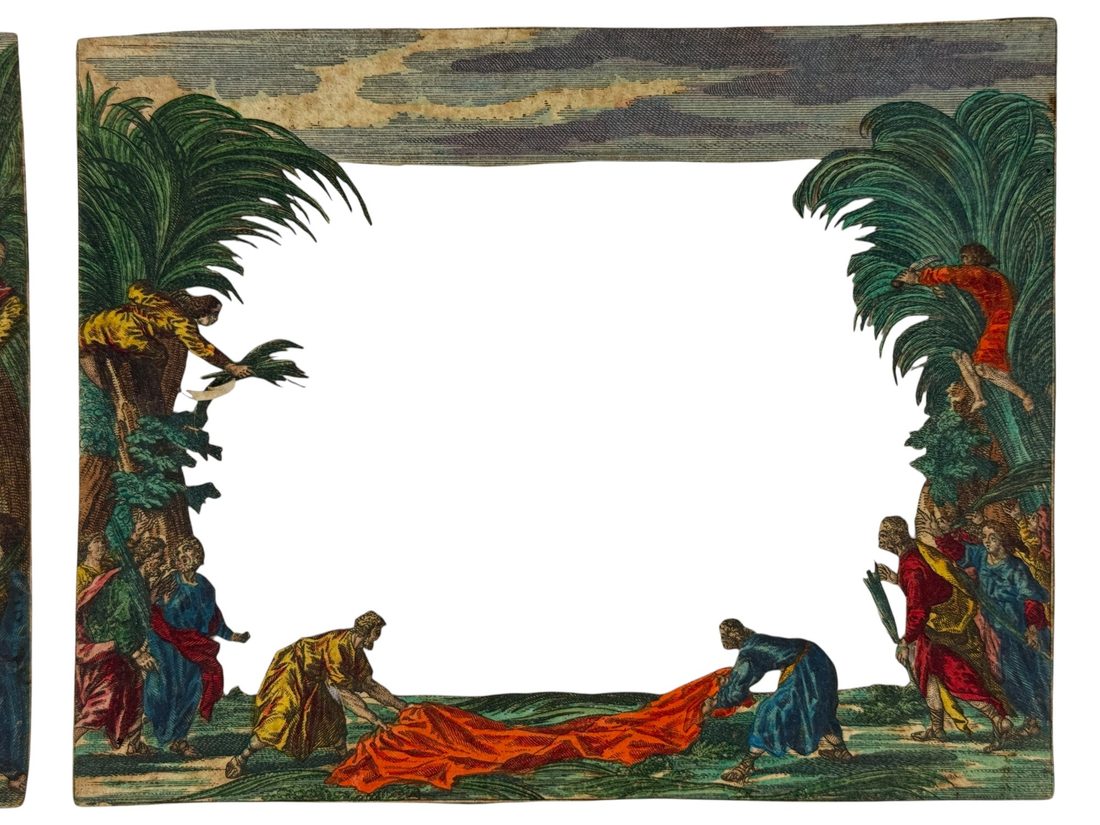
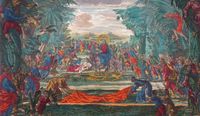
The second sheet (no. 241) advances within the procession. Beneath a sky striated with cirrus clouds, a youth on the left climbs a palm carrying a freshly cut frond, while at the right a similar figure performs the same gesture; in the foreground, two attendants in yellow and blue tunics spread a large vermilion mantle along the path, a gesture central to the Gospel narrative of the “Strewing of the Garments”. The plane operates as a transitional stratum between the agitated foreground and the central theophany.
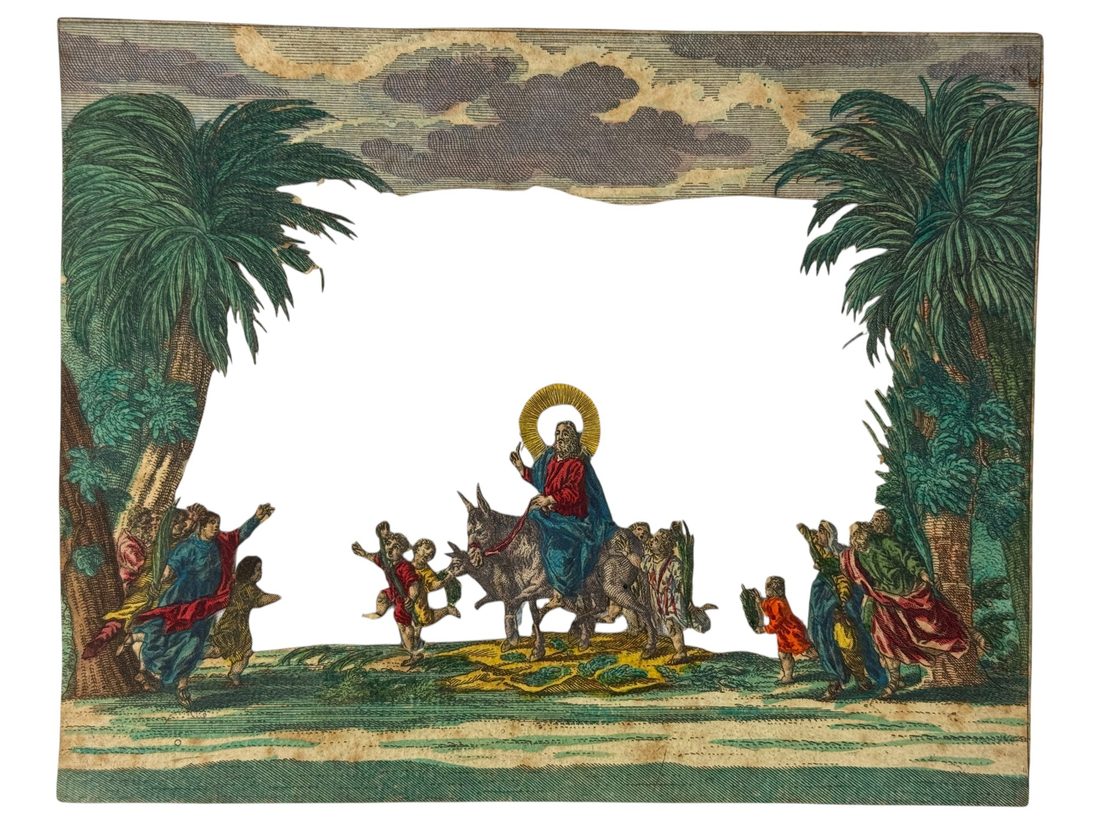
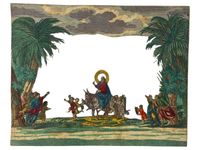
The third sheet (no. 242), the iconographic heart of the composition, presents the figure of Christ at the centre of the perspective. Seated upon the ass, his head encircled by a vivid gilt nimbus, he raises his right hand in benediction; to his left, children and youths exult, one descending from a tree, others raising palms, while on the right two acolytes lead the procession with palm fronds and books, the donkey advancing over a strewn cloak in the foreground.
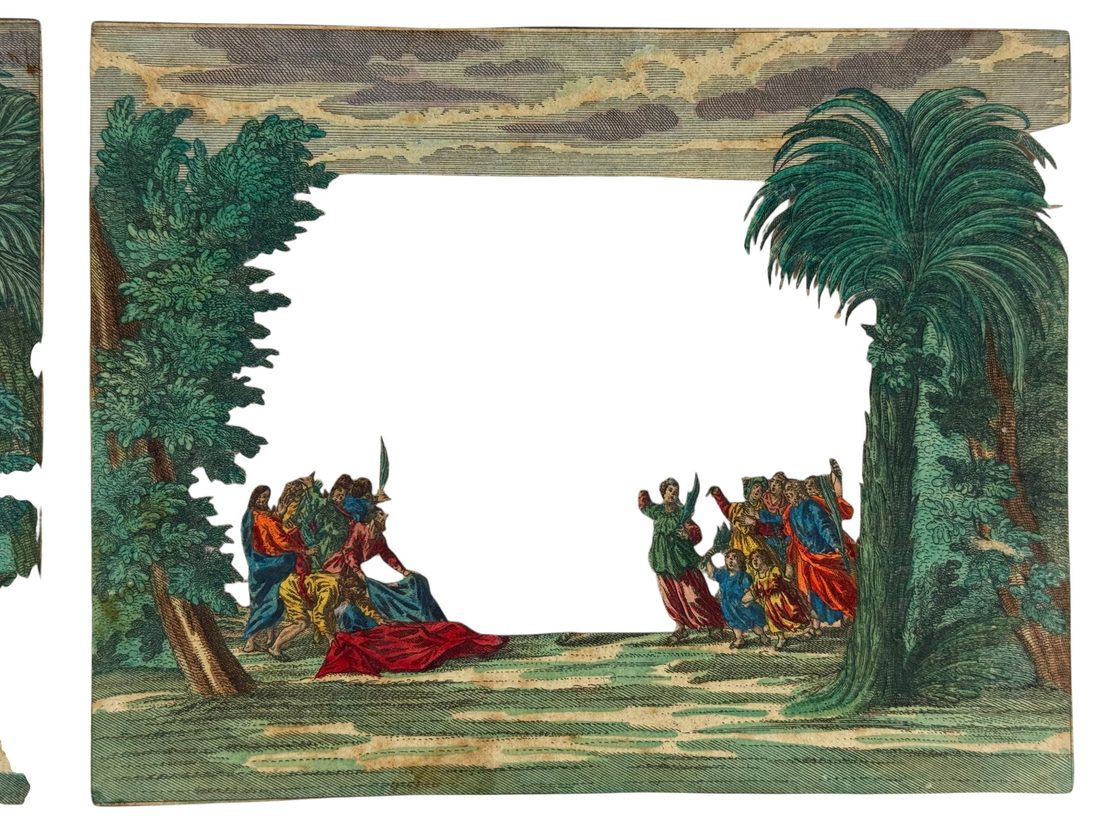
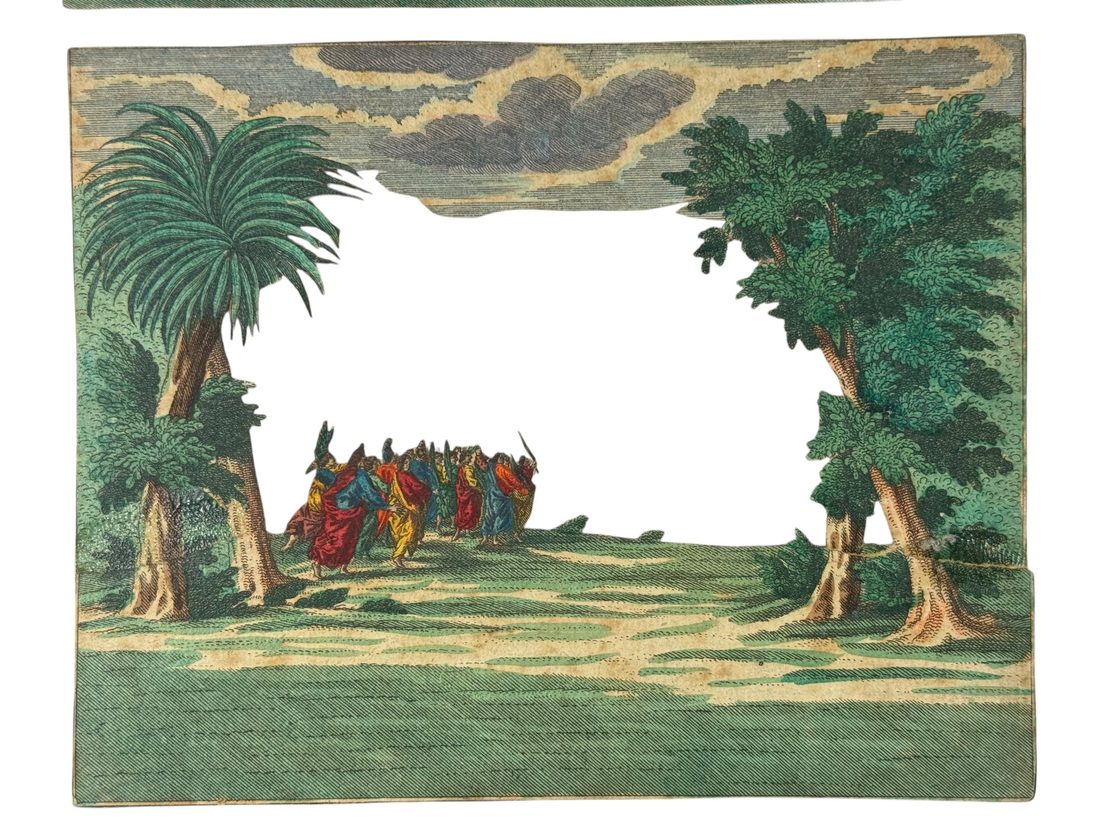
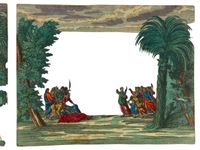
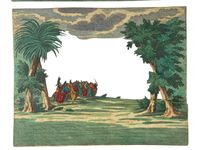
The fourth and fifth sheets (nos. 243 and 244) develop in succession the marginal animation of the crowd, the human chorus framing the central procession. On plate no. 243, a tight group of figures advances along the left margin behind a kneeling acolyte who pulls a red mantle along the ground, while on the right a corresponding cluster raises hands and palms in acclamation, women and children animated by dance-like gestures. Plate no. 244 recedes still further beneath the canopy of palms, where a compact phalanx of figures in red, blue, and yellow robes advances toward the viewer with raised swords and palms, evoking the convergence of the Jerusalem multitudes upon the city gates; the lateral trees, more darkly hatched than in the preceding planes, narrow the optical channel and direct the eye towards the closing background.
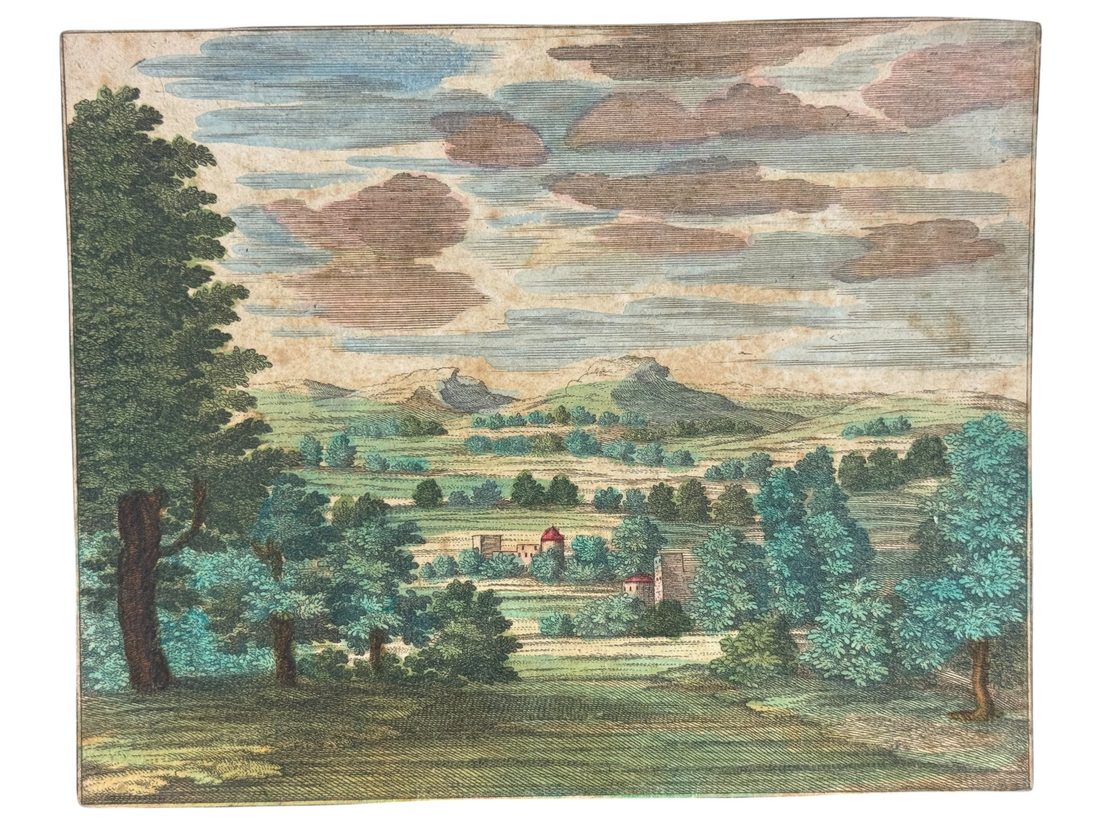
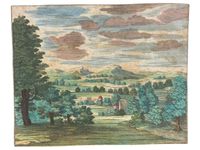
The sixth and final sheet (no. 245) closes the perspectival sequence as the uncut background. A serene landscape of cultivated fields, hedgerows, and low hills extends towards a horizon of mountainous profiles, with a small clustered settlement, plausibly identifiable as the distant Jerusalem, visible at the centre middle ground. Tall trees at the lower margins, picked out in luminous emerald and viridian tones, optically seal the depth of the construction and grant the procession a tranquil pastoral terminus.
The methodological achievement of the device lies in the unified perspectival design from which the six planes derive. The workshop conceived a single coherent recession and decomposed it into successive engraved leaves, each one partially cut so as to function as a scenic flat, so that, when reassembled in numerical order, the planes recreate the original construction and produce an illusion of depth particularly persuasive under frontal lighting or candlelight.
Engelbrecht's perspective theatres are inseparable from the intellectual climate of the German Enlightenment in its Augsburg variant, where popular print culture, the science of perspective, and the taste for optical curiosities converged within a single commercial enterprise. The first half of the eighteenth century witnessed the codification of linear perspective in widely diffused treatises, the spread of the camera obscura, the magic lantern, and the perspective box, together with a growing appetite, in noble cabinets as in bourgeois interiors, for visual devices capable of staging the illusion of depth in domestic space, a culture which the Augsburg theatres translated into a printed object accessible to an international public and intended to be assembled by the collector himself.
Within the discipline of the printed image, the work belongs to a tradition extending from the perspectival experiments of Brunelleschi in early fifteenth-century Florence and from the seventeenth-century peep-show print of the Netherlandish and German tradition, which the Augsburg and Nuremberg perspectival theatres of the early eighteenth century recast as a serial publishing genre and which would in turn prepare the ground for the nineteenth-century paper theatre and for the dioramas of Louis Daguerre, first exhibited in Paris in 1822. Engelbrecht's contribution consists in the systematic adoption of the multi-plane structure as a serial programme, and in the elaboration of an iconographic repertoire ranging from biblical histories and royal ceremonies to gardens, theatres, military encampments, hunts, and picturesque genre subjects.
The choice of the Entry into Jerusalem situates the present diorama within the devotional core of Engelbrecht's output. Beyond its liturgical resonance as the inaugural episode of Holy Week, the subject lends itself with exceptional efficacy to the perspectival machine, since the Gospel narrative of a procession advancing along an avenue between cheering crowds and palms naturally generates the layered spatial recession upon which the medium depends. In a city such as Augsburg, where the Palm Sunday processions and the dramatic Palmesel, the wooden donkey carried in cortege through the streets, formed an established element of the south German Holy Week tradition, the diorama could function simultaneously as a devotional aid for domestic meditation and as a refined optical spectacle, transposing a major Christological istoria of the late baroque stage into the durable medium of layered hand-coloured print.
Martin Engelbrecht (1684–1756) trained as a weaver before entering the workshop of his elder brother Christian and the orbit of Johann Andreas Pfeffel in Vienna, founded his own publishing house in Augsburg in 1719 and developed it, under imperial privilege, into one of the principal European centres for coloured prints and devotional sheets. Within his vast output, the Perspektivtheater form the most original strand of the production, and the devotional series, of which the present Einzug Christi is a particularly accomplished example, document the workshop's close engagement with the Catholic confessional culture of the imperial city and its Holy Week iconography. The inventions for the perspective theatres, including the present subject, were largely supplied by Jeremias Wachsmuth (1711–1771), Engelbrecht's most regular inventor and one of the most refined Augsburg draughtsmen of the period.
Conditions: Light age toning and minor traces of handling at the margins, consistent with the fragility of the object; the gilt nimbus of Christ on plate no. 242 remains particularly vivid. Overall, a very good copy of a fragile and rarely complete object.
References: A. Milano, Martin Enghelbrecht Persperktivtheater Dioramen, Verklag, Stuttgart, 2016: pp. 76-77, no. 37; P. Grandi, I Diorami teatrali di Martin Engelbrecht, 2021.
You might also like