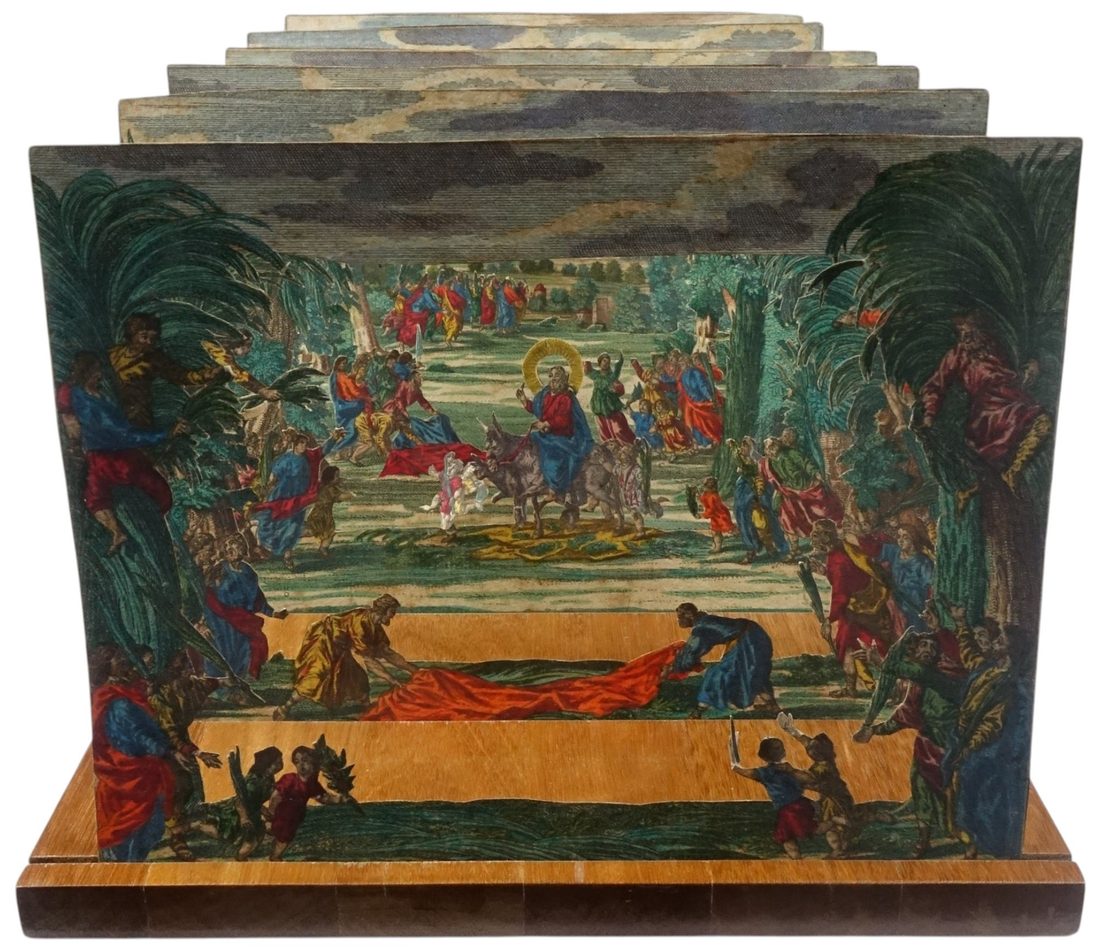
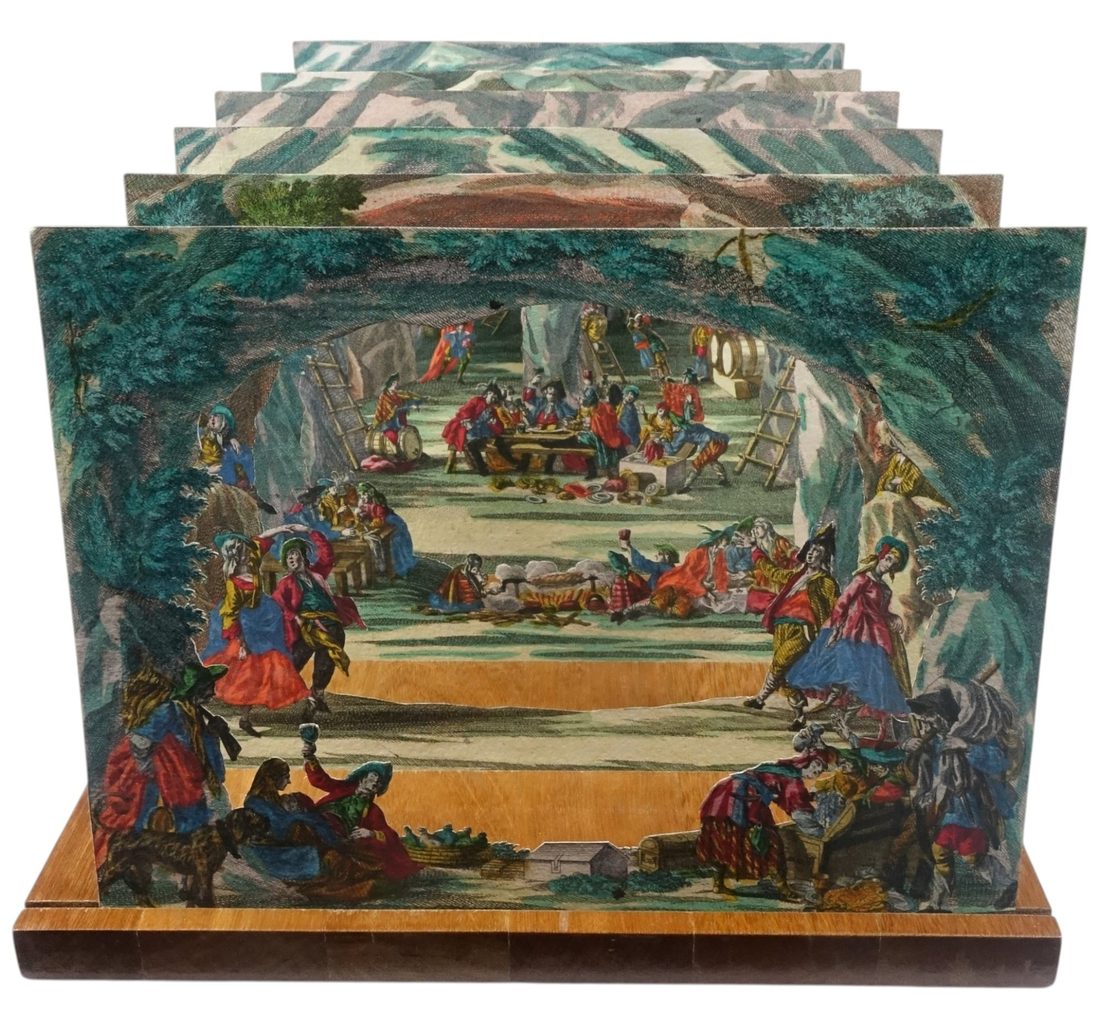
A Drawing, Cut to Pieces
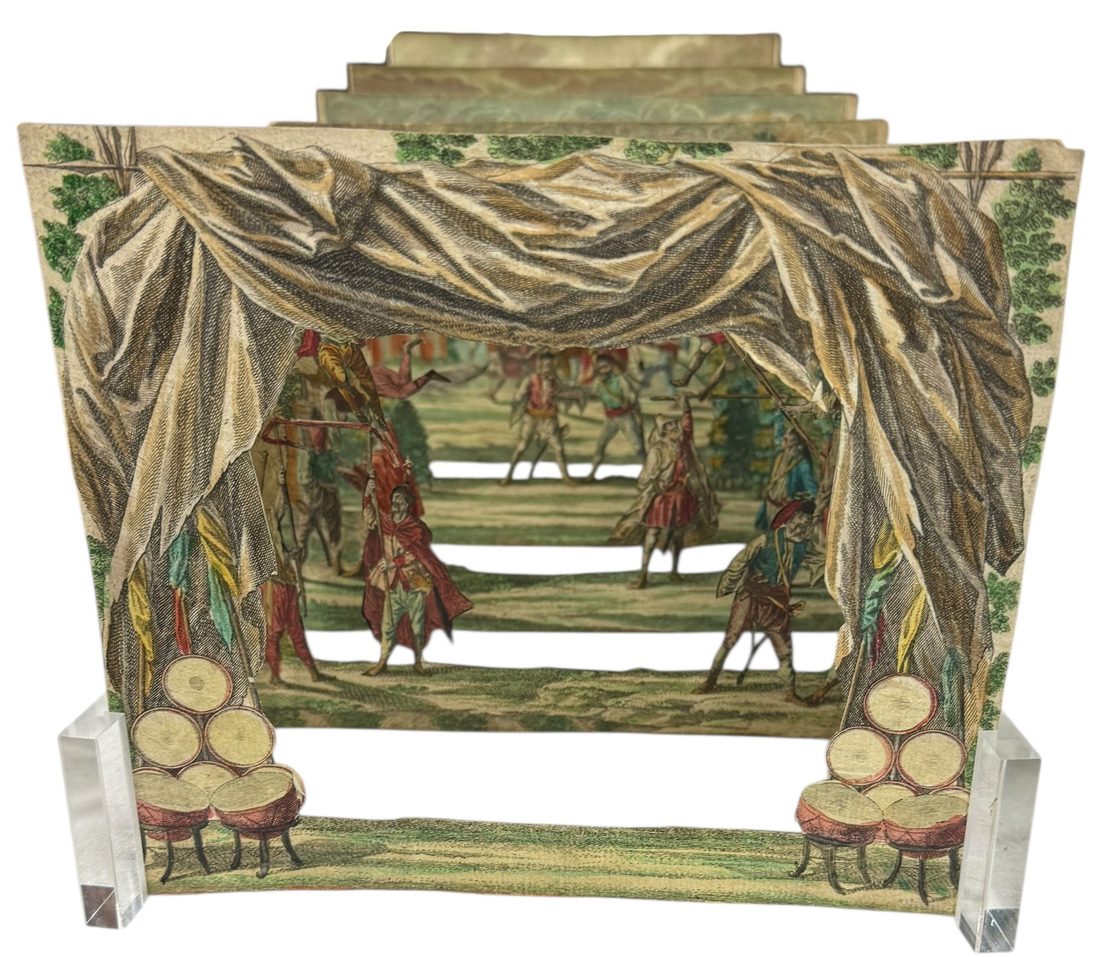
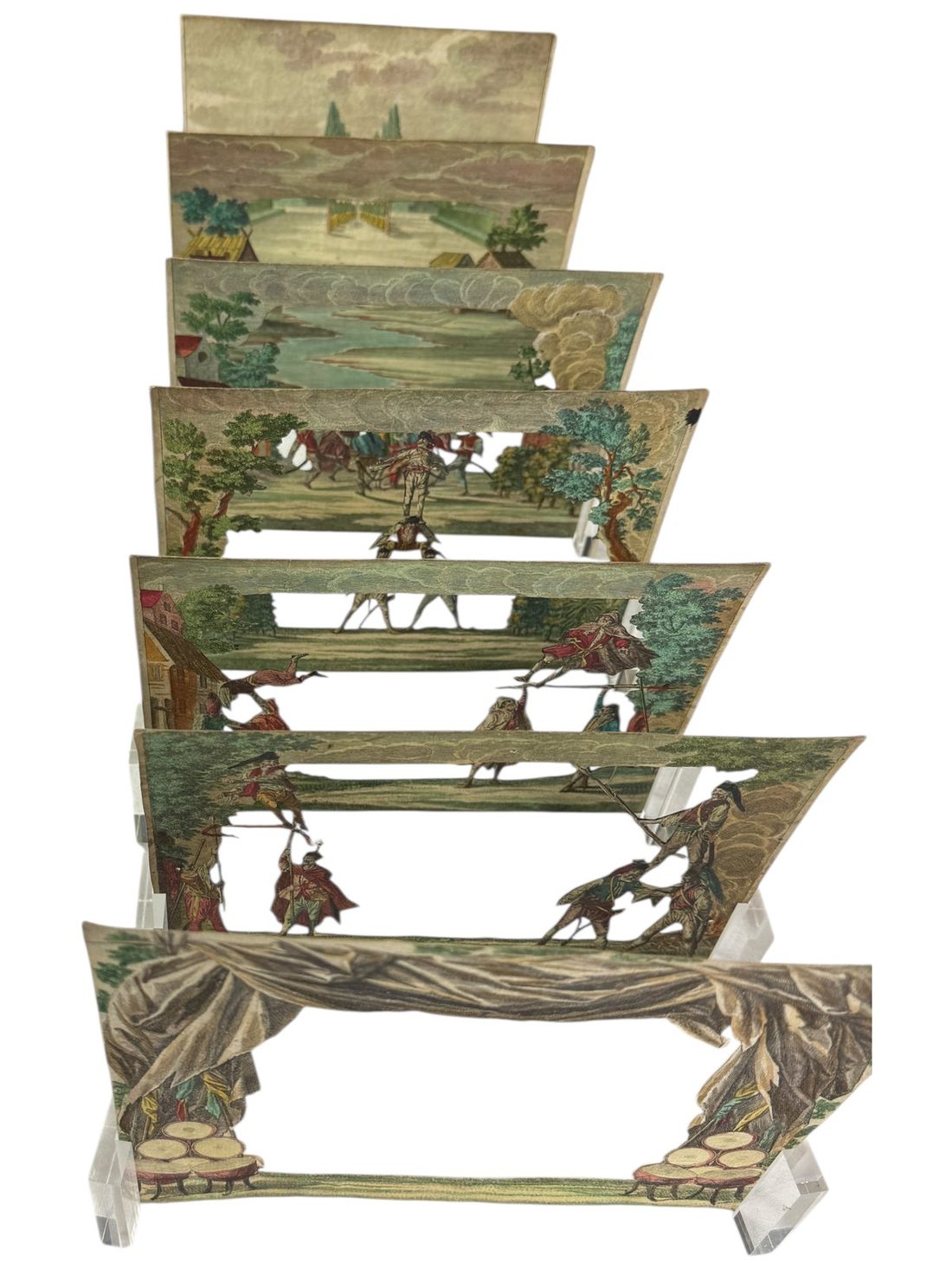
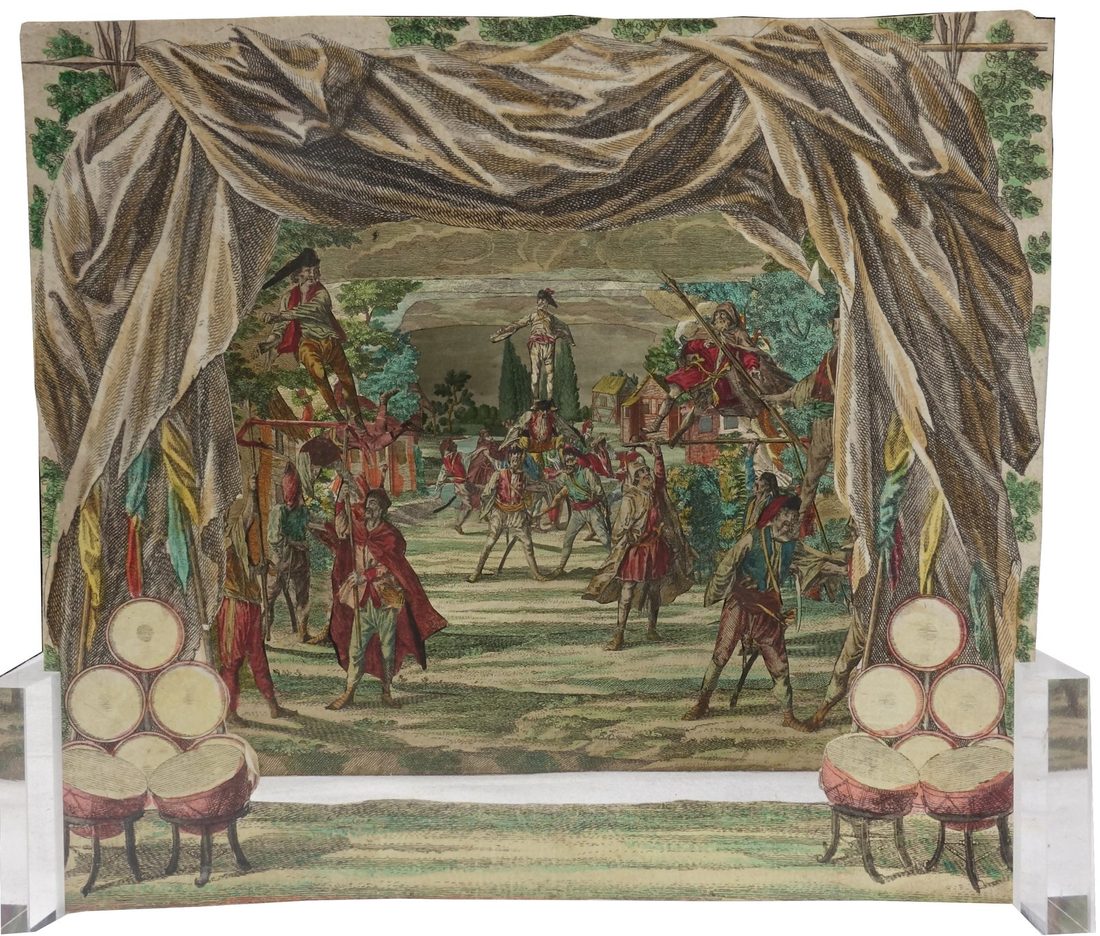
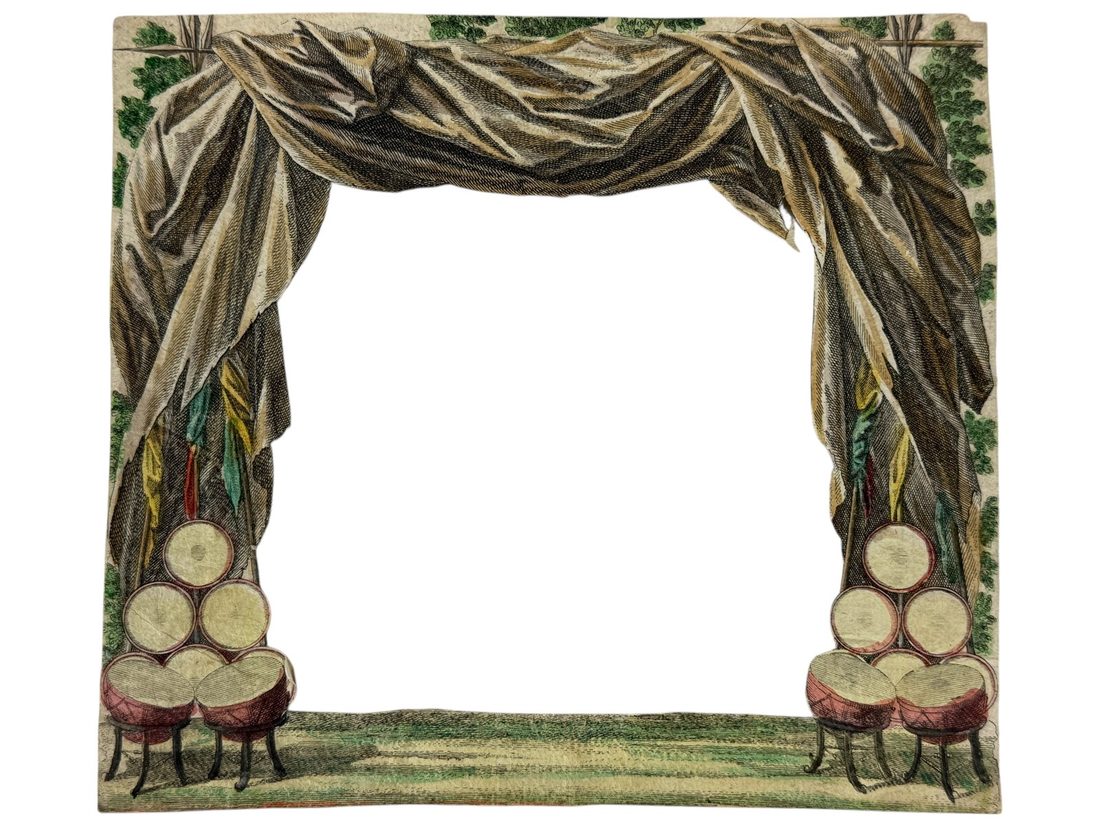
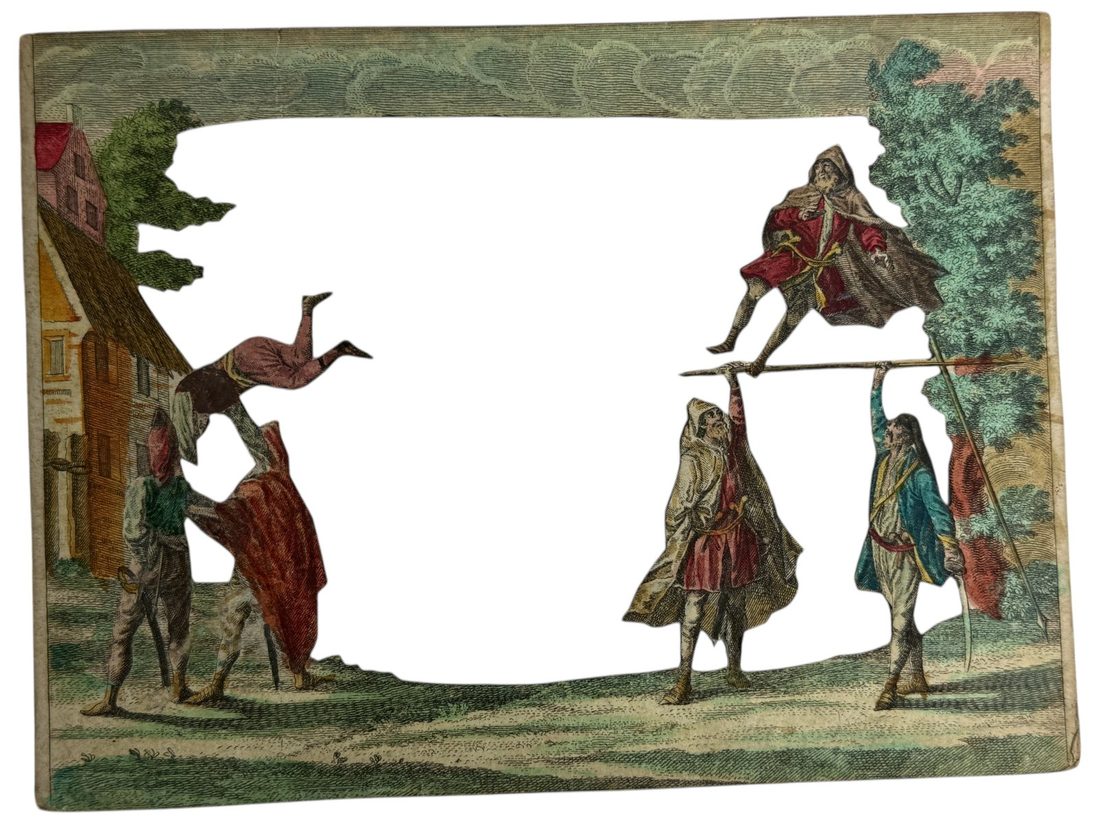
Picture an engraver who has just finished a perspective scene, a complete little world incised on copper. He prints it, colors it by hand, and then takes a blade to it. He cuts the sky away from behind the figures on one sheet. He cuts around the tents on another, around the trees on a third. What remains is a set of lacy, perforated prints that look ruined on their own. But slot them upright into a frame, one behind the other with a finger's width of air between them, and the ruin reverses: the scene reassembles, and this time it has depth you could reach into.
The eighteenth century did not lack ways to fake depth. The fashionable one was the vue d'optique: a flat print viewed through a zograscope, a device pairing a large lens with an angled mirror (the image had to be printed reversed to compensate). There the illusion lives in the machine; remove the lens and you hold an ordinary print. In these layered scenes the illusion lives in the paper itself. They could be viewed with or without a peep-box, the Guckkasten, a closed box with an eyehole, and a candle set behind the last sheet deepened the effect. But the depth was physically present either way: staggered planes, real air between them.
The man behind them was Martin Engelbrecht, an Augsburg engraver, printer and publisher who trained in copper engraving under Gabriel Eigner and worked alongside his elder brother Christian. Most of his output was the ordinary business of a Baroque print house: portraits, landscapes, illustrations of Ovid, views of Venice, costume series. Then, from around 1730, the layered scenes appear. And here the record is genuinely unusual: some 67 standard quarto set-motifs are known, and all of them come from this one house. As far as research has established, no other European publisher produced this specific genre of cut, layered perspective sets. That is not the same as calling him the inventor of the diorama, a claim best avoided, since "diorama" is Daguerre's word from the 1820s, borrowed backwards by collectors as a convenient label. The period-appropriate names are Guckkastenbild, or perspective theatre.
The technique is easy to state and slow to execute. A set runs to roughly six to eight sheets: copper engravings, hand-colored, then cut out along their contours. The lineage is theatrical. Baroque stages produced depth with parallel painted flats, wings sliding in from the sides in receding pairs, and these sets miniaturize that machinery onto a tabletop.
What lifts them above a paper toy is the unity of conception. Each set behaves like a single perspective drawing that has been decomposed along its own depth: a framing proscenium in front, figures in the middle distance, a landscape terminus at the back. The perspective stays coherent across the sheets, as if the scene had been drawn once, whole, and then sliced where the space folds.
One set makes the point vividly. Its subject is the Pandours, irregular infantry of the Habsburg military sphere, whom mid-eighteenth-century Europe regarded with a mix of fascination and fear. The front planes show acrobats; behind them rises a human pyramid; behind that, massed drill; then an encampment pulling away; and finally an empty pastoral horizon. Read front to back, the entertainment thins out into landscape. The narrative progression, from stunt to formation to camp to countryside, coincides exactly with the recession of space. Depth, here, is not a backdrop for the story: it is the story. There is also a quieter irony in the subject, feared soldiers restaged as parlor spectacle.
The numbers around the corpus come from one source, Alberto Milano's 2016 catalogue, and should be quoted as his figures rather than as absolutes: 67 quarto motifs (a count Milano himself calls very probable rather than certain), 155 in octavo, the most widespread format, and at least 87 in duodecimo. One detail from the plates is worth pausing on. The quarto copperplates are numbered continuously across the entire series, reportedly up to around 455, not one to seven within each set. So a single set carries numbers like 125 to 130: mute evidence that it sat inside a workshop production line, not a one-off experiment. An imperial privilege protecting the series is likely but not documented with certainty. The workshop itself outlived its founder, continuing after his death in 1756.
Which brings us back to the blade. Engraving is a flat art by definition; everything it knows about space is a convention of lines converging on paper. Engelbrecht's sets suggest that the depth was in the drawing all along, waiting. The cut did not add anything. It released what perspective had only ever promised, and let a viewer, for the first time, look into a print instead of at one.