Praesentation eines Festes mit Tanz um zwei brennende Herzen (“Presentation of a Festival with a Dance around Two Burning Hearts”)
| Macro-category | Ancient Games and Pre-cinema |
| Subcategory | Diorama |
| Author | Engelbrecht, Martin |
| Provenance | Augsburg |
| Publisher / Maker | Martin Engelbrecht |
| Year | ca. 1735 |
a wedding under the arbour:
an early festival subject of the Augsburg large format,
# 6 of the Milano census,
where the costume of the stage
meets the dress of the day around an altar of love
[Diorama]. Wachsmuth, Jeremias (inv. et del.). Praesentation eines Festes mit Tanz um zwei brennende Herzen (“Presentation of a Festival with a Dance around Two Burning Hearts”). Augsburg: Martin Engelbrecht excudit, ca. 1735.
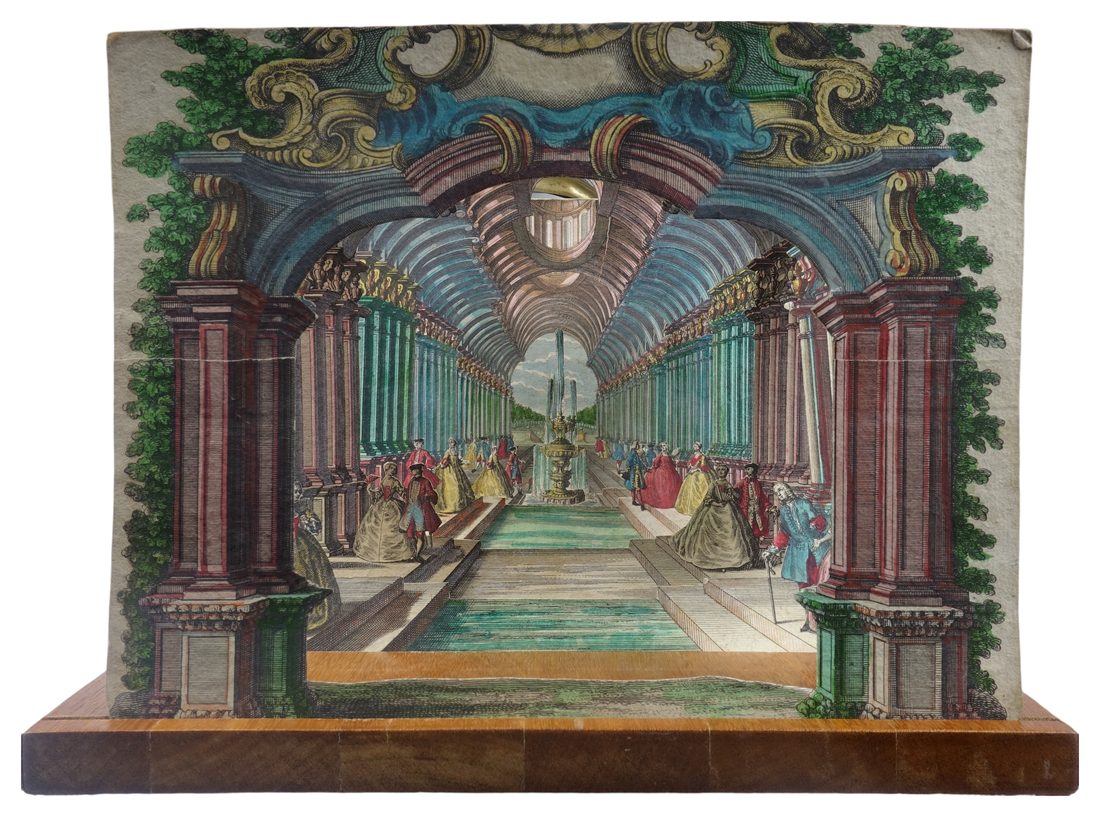
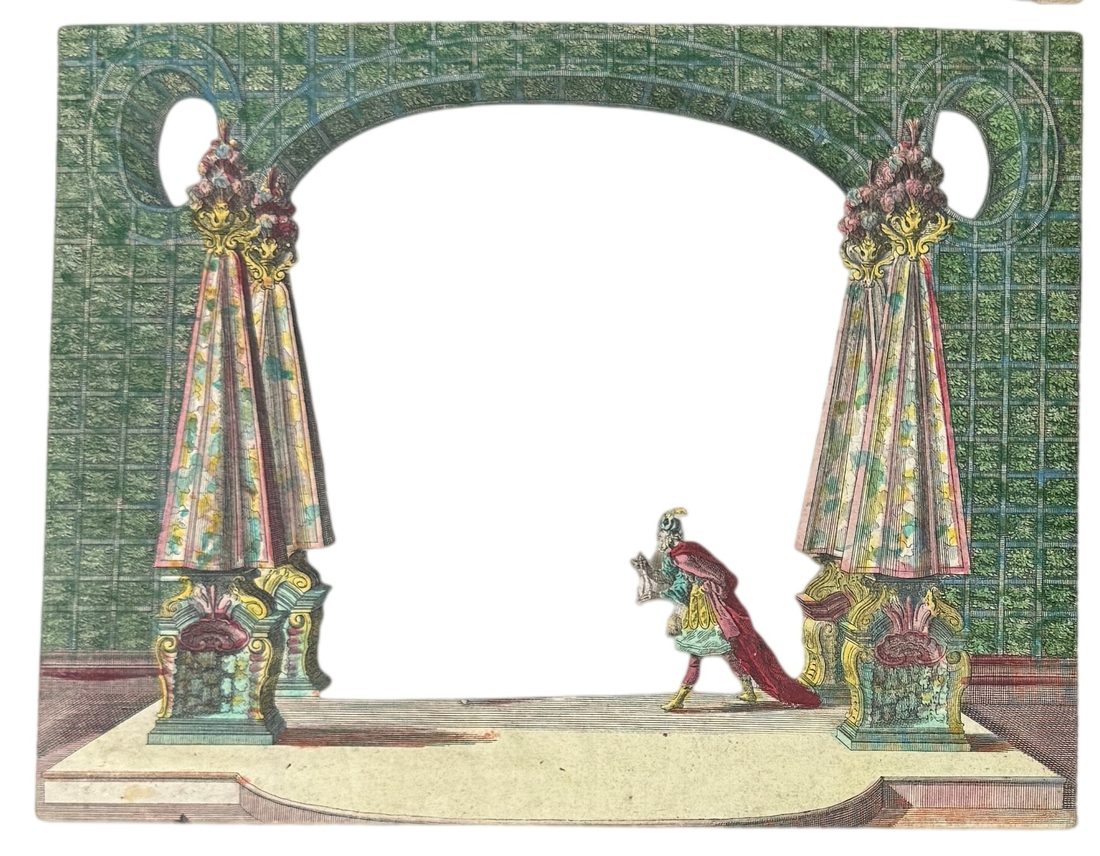
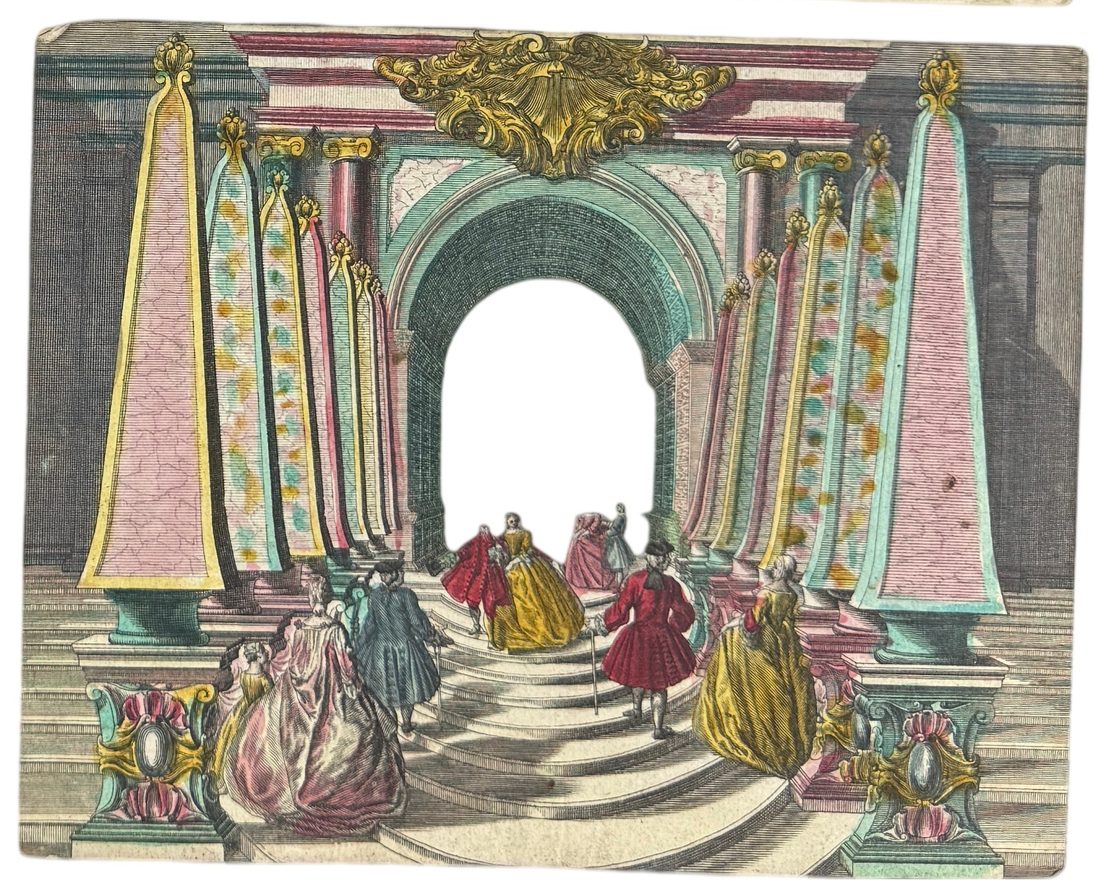
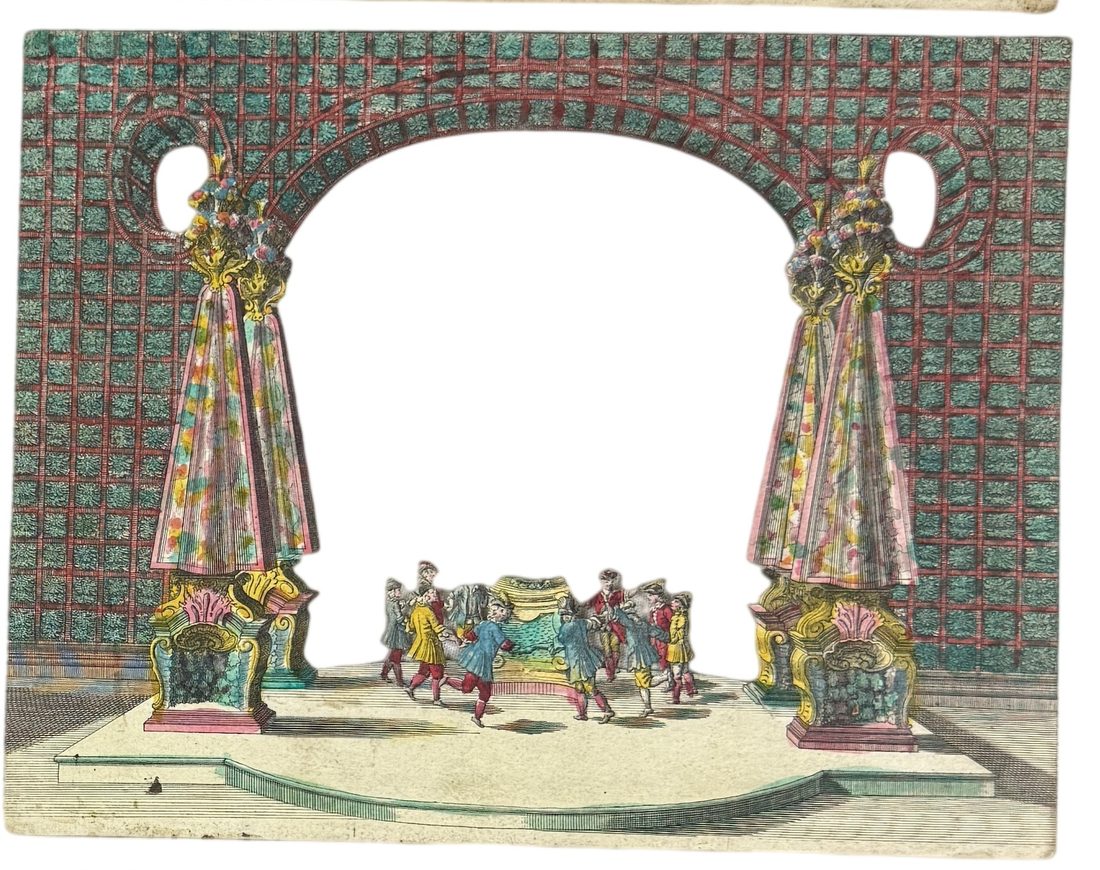
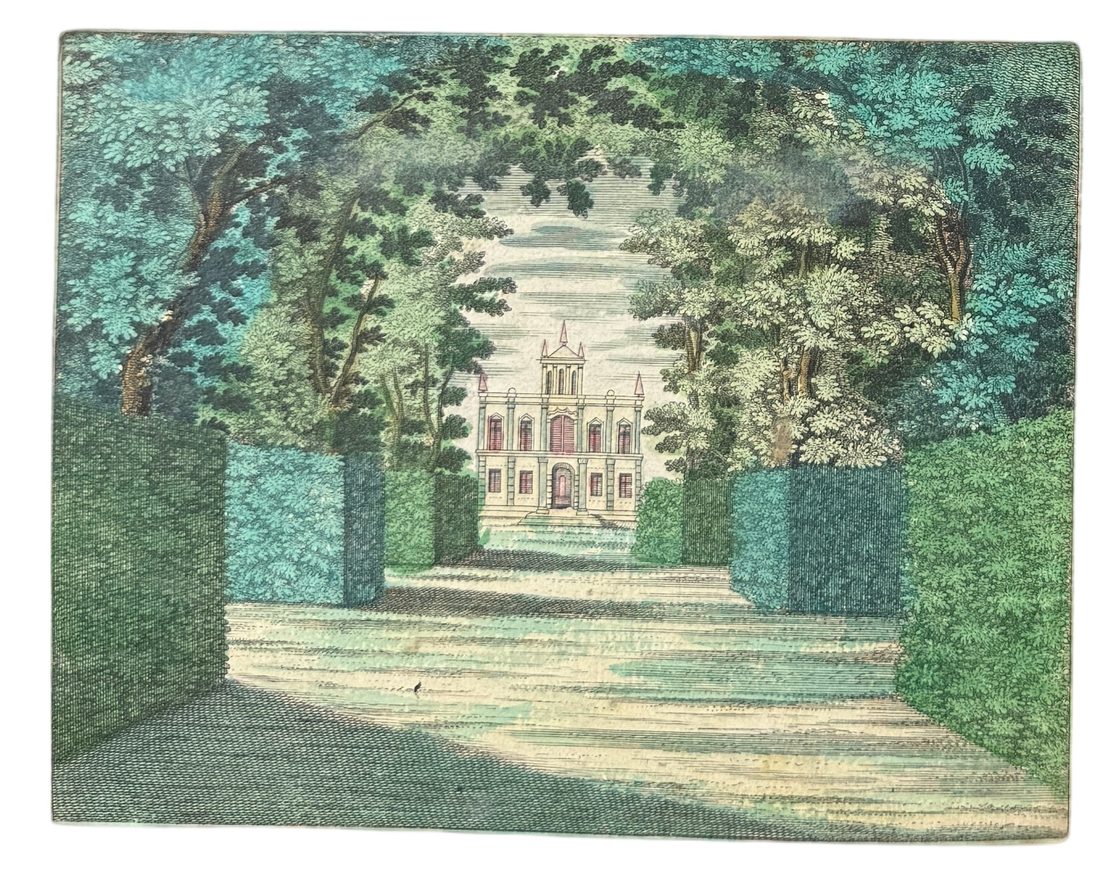
4to perspective theatre (each sheet 220 × 165 mm), complete in six planes: hand-coloured etched copper plates with burin work, laid down on card and cut by hand. The first sheet forms the proscenial flat; the second to the fifth are cut through their central fields to form arched apertures of progressively diminishing span, the third and fourth being pierced in addition with oval oculi in the spandrels; the sixth is retained as the uncut background. Contemporary hand-colouring in watercolour, laid in broad fields of green and blue for the foliage of the trellis, red and rose for the draperies and costumes, and yellow for the rocaille ornament.
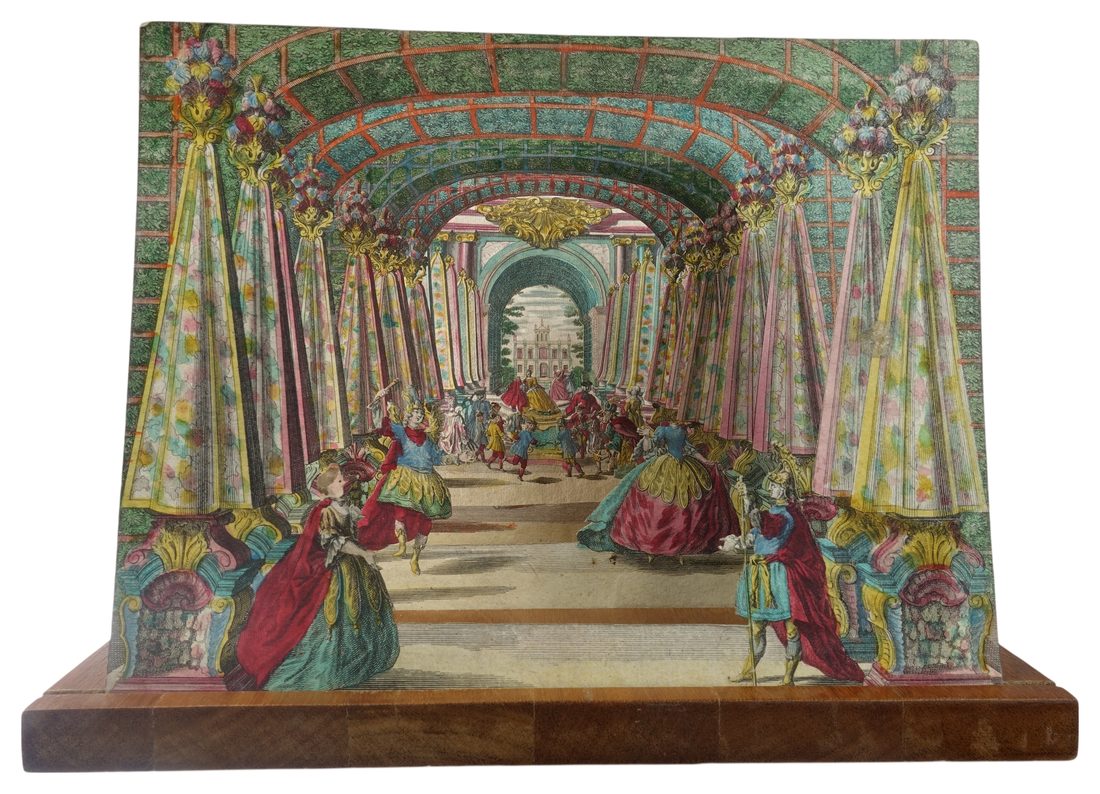
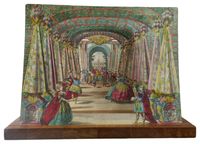
The six planes assembled in sequence on a grooved wooden stand.
The set is the sixth series of the large format in Alberto Milano’s census and occupies sheets 31 to 36 of the publisher’s running sequence. The engraved lettering at the edges, the running number at the head of each sheet and the designer’s signature at the foot, was lost when the sheets were trimmed for mounting. Each verso carries along one edge a manuscript inscription in brown ink, in a single early Dutch hand: “N.”, a number, the title “Bruyloft” and a second number. The two figures give the position of the sheet counted from either end of the sequence, from “N. 1” and “6” on the background to “N. 6” and “1” on the first plane, a few of them retouched in pencil or in a darker ink; the first sheet adds the word “Compleet.”
Versos of the first plane, above, and of the background, below: the early Dutch inscriptions numbering the sheets from either end, the first adding “Compleet.”
Engelbrecht’s perspective theatres are most often met with in 8vo; the quarto series are far less common, and only sixty-seven of them are recorded. “The number of published large-format Engelbrecht perspective theatres is given as 67. Even though we cannot say with certainty that this number is correct, it is nonetheless very likely, as not a single sheet suggests that additional series may have existed” (Milano).
This is the sixth of Martin Engelbrecht’s large-format perspective theatres, designed by Jeremias Wachsmuth in the first years of the series and dated, by its place in the publisher’s sequence, to about 1735. Under a trellised arbour of the formal garden, figures in stage costume and guests in the dress of the day dance around an altar of love. The present set is complete in its six planes, and an early Dutch owner recorded it so, writing “Bruyloft”, wedding, on every sheet and “Compleet” on the first. No institutional example of the subject has been traced.
The diorama is conceived as a single perspectival construction decomposed across six engraved planes, each sheet serving both as an autonomous image and as one stratum of a larger spatial composition. The workshop designed one coherent recession and divided it into successive leaves, cutting each so that it would function as a scenic flat. Reassembled in order and spaced apart in the grooves of a viewing box, the planes recreate the original construction. In the closed box they were observed through a single aperture, normally by means of a lens, while a tissue frame above diffused daylight or candlelight across the scene. The early series were designed for boxes with six slots; a seventh was introduced from the twenty-fifth series, when an additional intermediate sheet took the place of the alternative background.
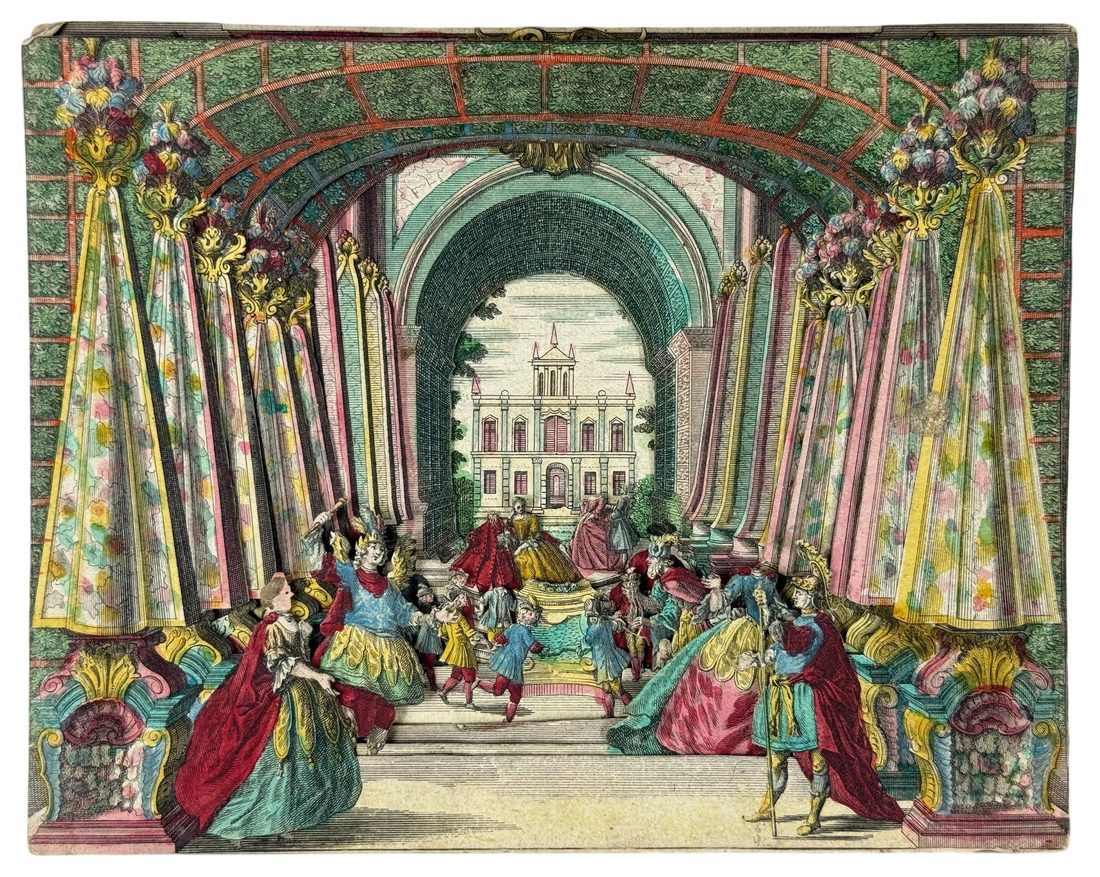
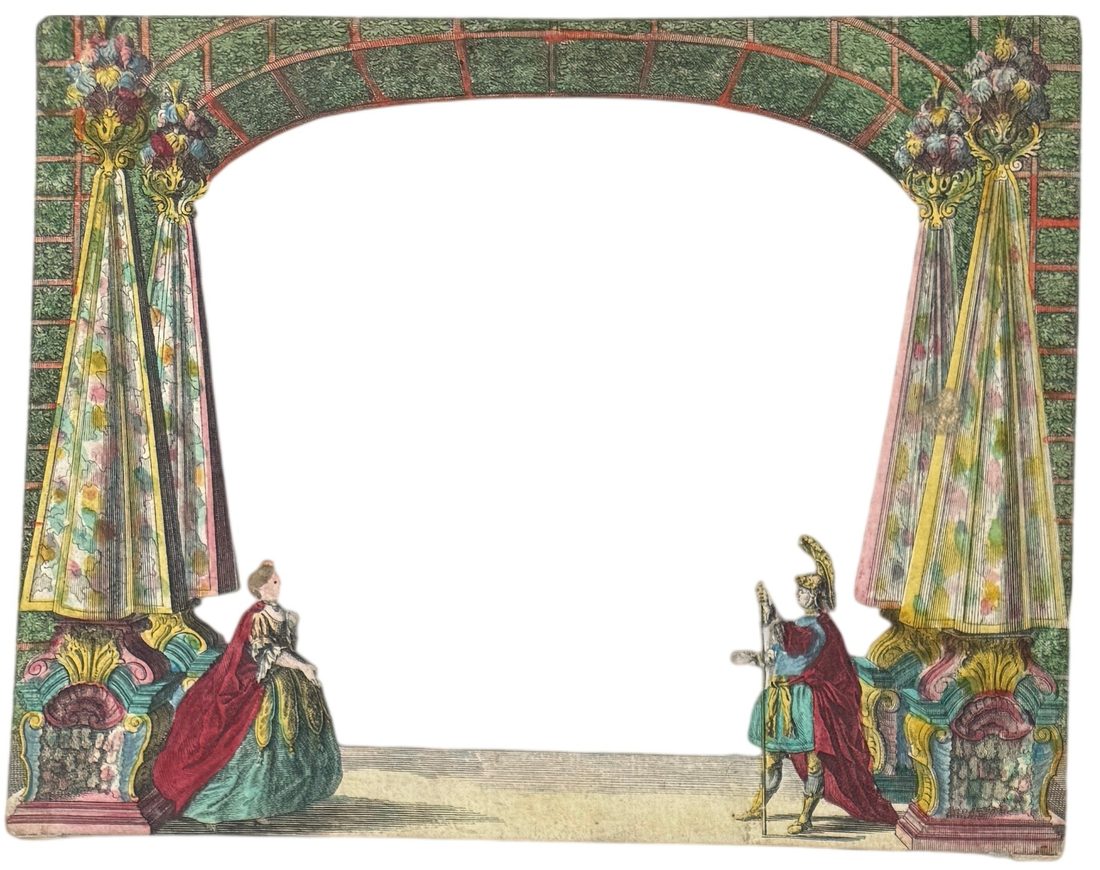
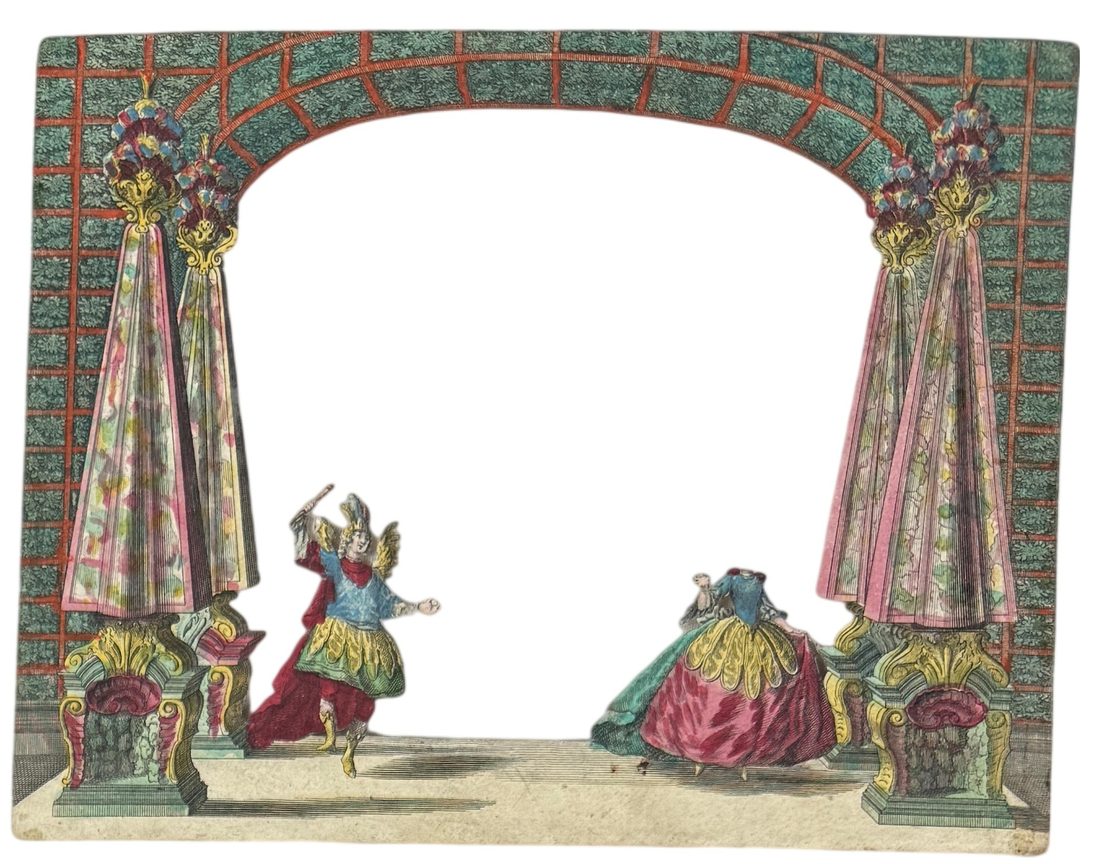
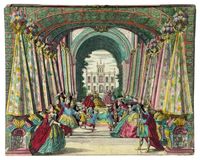
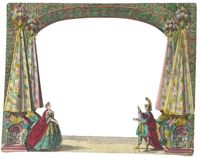
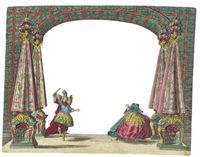
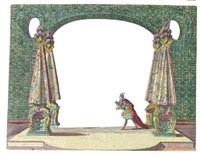
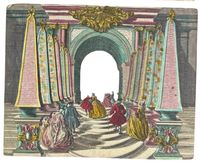
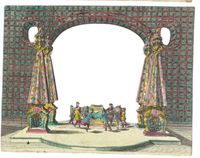
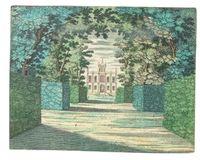
The first sheet presents a wide arch of trellis-work, green foliage on red laths, carried at either side upon paired pillars swathed in flowered drapery, gathered beneath rocaille capitals crowned with plumes and rising from high rocaille pedestals set with shells. Upon the strip of floor stand, at the left, a lady in a red cloak over a green gown and, at the right, a warrior in Roman costume with plumed helmet, cuirass and lance. The second sheet repeats the arch upon a denser red lattice: at the left a winged and plumed dancer raises a baton, at the right stands a lady in a rose and green gown. The third, in green trellis on blue laths, opens two oval oculi beside the arch and raises the floor into a low stage, across which a bearded old man in theatrical dress, plumed cap and red cloak advances with a paper in his hand. The fourth, in red and green lattice with oval oculi, sets upon a stepped and curving stage a ring of small figures in contemporary coats and tricorns, dancing hand in hand around a round, garlanded rocaille altar. The fifth exchanges the arbour for architecture: a curved flight of steps rises between two files of obelisks veined in rose and flecked in turquoise, beneath an arch surmounted by a great rocaille cartouche, and courtiers in the dress of the seventeen-thirties ascend towards further couples in conversation at its head. The sixth and final sheet opens upon an avenue between clipped hedges and tall trees. At its end stands a small two-storey garden house with a central lantern and pinnacles, its door and shutters touched in red.
The six sheets of the set.
Assembled, the four arbour sheets multiply into a vaulted walk of trellis, the draped pillars receding in a double file towards the centre. The figures of the first three planes keep to the flanks and leave the axis free, until the fourth brings the eye to the centre of the subject, the ring of dancers turning about the altar at the foot of the steps. Beyond it stone takes the place of foliage: the staircase and the obelisks lead the eye upward through the arch, and the background releases the view into the open garden and the house at the end of the avenue. The apertures narrow plane by plane, the first being almost nothing but frame and the fifth the narrowest opening of the sequence, so that the depth is measured upon the return of the arch at a diminishing scale.
First and fifth planes: the widest and the narrowest aperture of the sequence.
The subject is announced in the publisher’s title, a festival with a dance around two burning hearts, and in the copy reproduced by Milano the two hearts rise from the altar. Two flaming hearts joined were a familiar emblem of two lovers made one: Daniel de la Feuille’s Devises et emblemes (Amsterdam, 1691) gives them the motto Ex duobus unum, and a German edition of that collection was printed at Augsburg in 1693. The scene therefore reads as a festival of love or of marriage, as it did to the early owner who named it “Bruyloft”. Its figures belong to two registers. Those of the foreground wear stage costume, among them the warrior à la romaine, the conventional dress of the tragic hero in drama, opera and heroic ballet; the dancers about the altar and the courtiers on the steps wear the coats, tricorns and gowns of the seventeen-thirties. Wedding celebrations of the period could join masques and staged dances to the guests’ own ball, and the festival is presented as a type rather than as the record of a particular wedding.
Two registers: the warrior à la romaine of the first plane, and the ring of dancers in contemporary dress around the altar of the fourth.
The berceau of treillage, a covered walk of wooden lattice clothed in greenery, was a fixture of French and German formal gardens in the early eighteenth century; here it replaces the architectural wings of the stage while retaining their function, each arch marking one step of the recession. The copy reproduced by Milano is mounted with a different proscenium, crowned with a red coronet between flowered obelisks, and with a different background, a hedged garden closed by a portal. The publisher printed most series on eight sheets: in the first, an alternative proscenium and an alternative background; in the series that followed, until the twenty-fourth, an alternative background beside the six planes of the sequence and a flat overview of the whole scene. The present set preserves the theatre in the form in which its early owner knew it, six planes closing upon the garden house.
The background: the avenue closed by the garden house.
Engelbrecht’s perspective theatres belong to the intellectual climate of the German Enlightenment in its Augsburg variant, where popular print culture, the science of perspective and the taste for optical curiosity converged within a single commercial enterprise. The first half of the eighteenth century saw the codification of linear perspective in widely diffused treatises, the spread of the camera obscura, the magic lantern and the perspective box, and a growing appetite, in noble cabinets as in prosperous bourgeois interiors, for devices capable of staging the illusion of depth within domestic space. The Augsburg theatres translated that culture into a printed object, distributed to an international public and intended for assembly by the purchaser himself.
About 1730 Engelbrecht re-engraved and published at Augsburg the eight scenes invented by Pietro Righini (1683-1742), a pupil of Ferdinando Galli Bibiena, for Frugoni and Vinci’s Medo at the Teatro Ducale of Parma in 1728, issuing them as Theatralische Veränderungen vorgestellt in einer zu Mayland gehaltenen Opera; a complete set survives at the Deutsches Theatermuseum in Munich, each scene signed in the plate “Pietro Righini inv. e del.” and bearing Engelbrecht’s imprint, “Mart. Engelbrecht exc. A. V.” or “excud. A. V.” The house thus had the Italian baroque stage before its eyes a few years before the perspective theatres began, and the present subject draws upon that repertory: the proscenium arch, the recession by paired wings, the staircase between obelisks rising towards a single vanishing point. Festival subjects, staged in the halls of palaces, in gardens and on terraces, are far more numerous in the large format than strictly theatrical ones, and the present series is among the earliest of them.
The cut, multi-plane perspective theatre is distinct from the flat single-sheet optical view, the Guckkastenblatt or vue d’optique, which is larger, almost always horizontal, commonly topographical, and viewed through a lens, often by way of an inclined mirror. The Augsburg publishers took up that second genre on a large scale only in the second half of the century, after Engelbrecht’s death. Paper peepshows are popularly taken for children’s toys, but Engelbrecht’s were made chiefly for adults, and were owned by prosperous households of the middle and upper classes, who held them to be diverting and instructive furnishings for their houses. In the longer history of the medium the genre is recognised as the model upon which the nineteenth-century paper peepshow was formed, and as a document in the prehistory of cinema.
Martin Engelbrecht (Augsburg, 16 September 1684 to 18 January 1756) was among the most productive German engravers and print publishers of his generation. The son of a Farbenhändler, a dealer in pigments, he was apprenticed as an engraver in Augsburg to Gabriel Ehinger. In 1711 he entered the Augsburg publishing house founded by his elder brother Christian Engelbrecht (1672-1735) together with Johann Andreas Pfeffel, and after Christian’s death in 1735, in the years in which the present series was issued, he directed the house alone. He obtained an imperial privilege in 1719, renewed in 1729 and again in 1739, and sat on the council of the Imperial City from 1743. Within an output running to several thousand sheets, the perspective theatres are the works for which he is chiefly remembered. Through the eighteenth century the genre is known almost entirely from his house and its successors; his privilege protected his publications against unauthorised reprinting. After his death the firm was continued by his heirs, and his copperplates remained in use well into the nineteenth century.
Jeremias Wachsmuth (Augsburg, 1711-1771) entered the workshop in 1731 and supplied the inventions of the early large-format series, signing them at the lower margin, in the spelling of the plates, “I. Wachsmuht inv. et del.”; Milano records the signature for the present series and finds Wachsmuth’s name on twenty-eight of the large-format theatres. Johann David Nessenthaler (1717-1766), the second designer of the house, worked for Engelbrecht from 1737, and the series attributable to him begin only at the forty-fifth. The engraving was executed within the workshop under Engelbrecht’s direction.
Besides its series number, from 1 to 67, each sheet of the large format carries a running number, from 1 to 455. A recent quantitative study of the corpus converts the series numbers into years, anchoring them on two subjects tied to datable events, the masked ball of the twenty-fifth series to a court wedding of January 1744 and the earthquake of the fiftieth to Lisbon in 1755, and places the first series in 1732 or 1733; by the same method the sixth, on sheets 31 to 36, falls about 1735.
Conditions: Complete in its six planes, the sheets uniform in size, card, cutting and colouring, and belonging beyond question to a single set, as the early manuscript numbering on the versos also attests. The head of the lady on the second plane is lost along the cut line, and the two flaming hearts that rise from the altar in the copy reproduced by Milano do not survive on the fourth plane, the cutting following the rim of the basin. A pale stain to the drapery at the right of the first plane; a small loss at the upper left corner of the fifth; a few scattered spots to the floor of the third and fourth planes and to the avenue of the background, with a lighter area in the foliage at its upper right; old glue staining at the edges of the versos. The colouring is fresh, and the cut-out tracery of the trellis and of the oculi is intact. A very good set of a fragile object; no original viewing box accompanies it.
Provenance: Early Netherlandish ownership, attested by the inscription in an early Dutch hand on the verso of every sheet, “Bruyloft”, wedding, with the position of the sheet counted from either end of the sequence, and by the word “Compleet” on the first. Manuscript Dutch titles and numbers of this kind are documented on the wrappers and versos of perspective sets that circulated in the Low Countries.
References: A. Milano, Martin Engelbrecht. Perspektivtheater – Dioramen, Stuttgart: Füsslin Verlag, 2016, p. 30, no. 6, plate p. 39; A. C. Hübler, Simple mathematical function for more accurate dating of 18th-century printed perspective sheets, in npj Heritage Science, 13, art. 552, 31 October 2025; F. Schott, Der Augsburger Kupferstecher und Kunstverleger Martin Engelbrecht und seine Nachfolger, Augsburg: Schlosser, 1924; G. Füsslin et al., Der Guckkasten. Einblick, Durchblick, Ausblick, Stuttgart: Füsslin Verlag, 1995; T. Ganz, Die Welt im Kasten. Von der Camera obscura zur Audiovision, Zürich: Verlag Neue Zürcher Zeitung, 1994; R. Hyde, Paper Peepshows. The Jacqueline and Jonathan Gestetner Collection, Woodbridge: Antique Collectors’ Club, 2015; B. M. Stafford and F. Terpak, Devices of Wonder. From the World in a Box to Images on a Screen, Los Angeles: Getty Research Institute, 2001; La camera dei sortilegi. Autoritratto di una società nei diorami teatrali del ’700, exhibition directed by G. Strehler, research and catalogue by S. Vitali Angrisani and A. Milano, Milan: Electa, 1987.
The assembled theatre seen frontally.
You might also like