Myriorama: Nine Engraved Landscape Cards
| Macro-category | Ancient Games and Pre-cinema |
| Subcategory | Pre-cinema / Motion & Animation Devices |
| Author | Anonymous |
| Year | ca. 1875 |
an endless landscape without a maker:
nine engraved cards cut so that any order
composes a coherent panorama
unrecorded edition of Myriorama
preserving at the head of every card a functional notch
for which no parallel has yet been traced
[Myriorama]. Nine engraved landscape cards composing a continuous and endlessly recombinable panorama. [Europe]: unidentified publisher, ca. 1875.
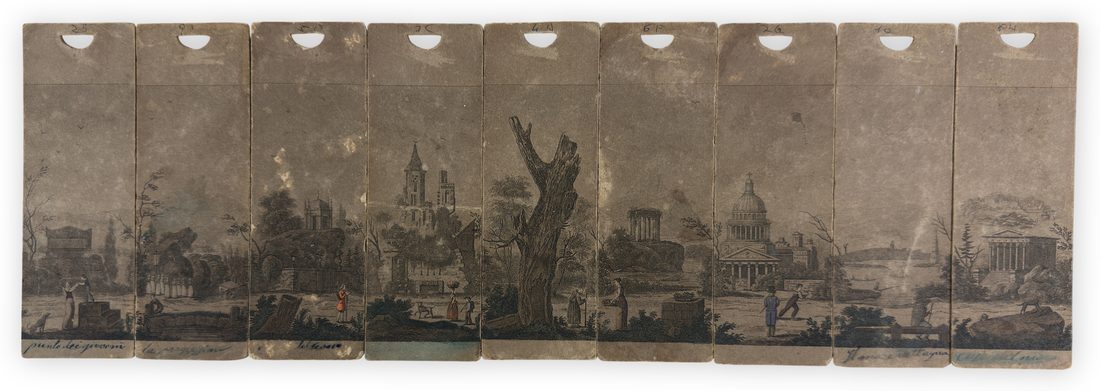
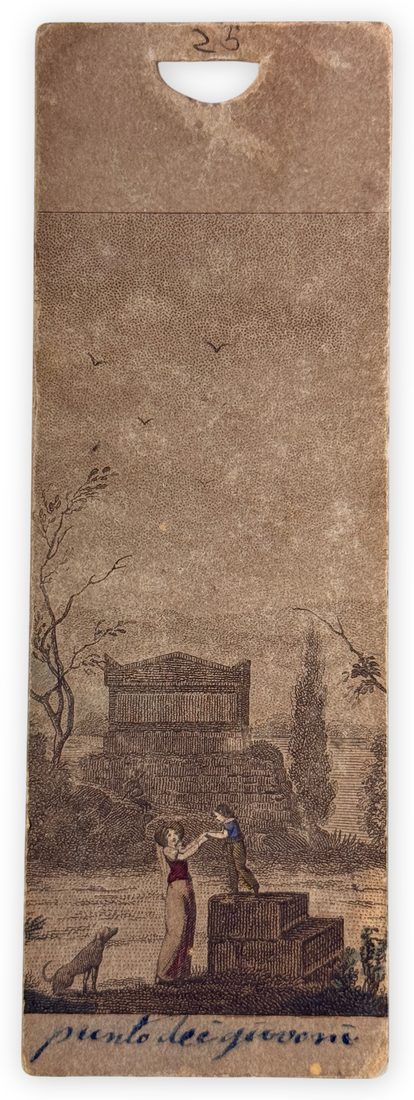
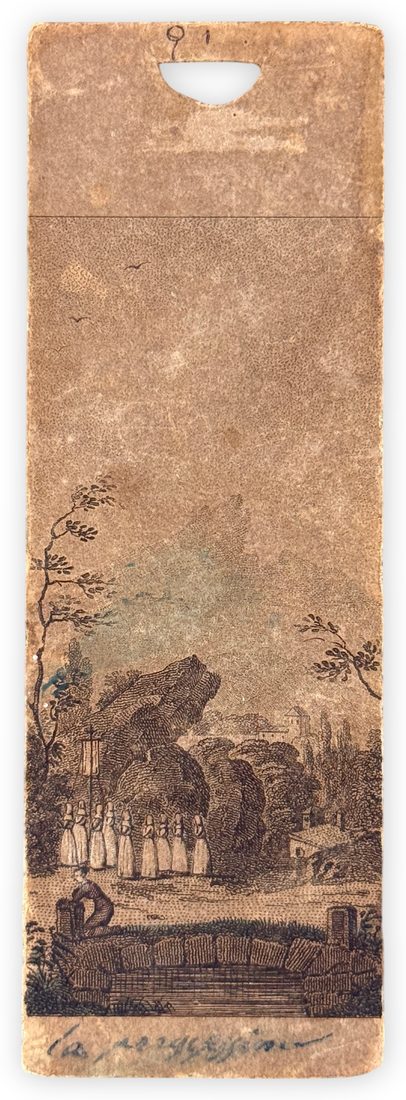
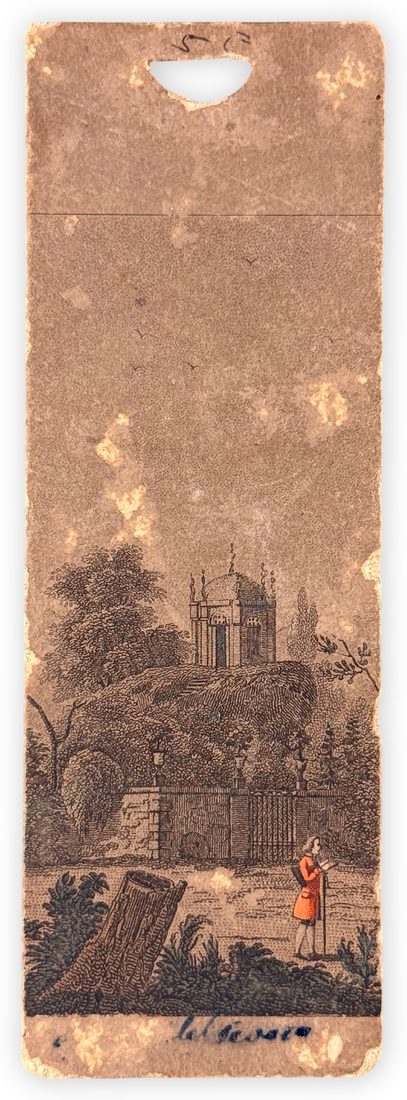
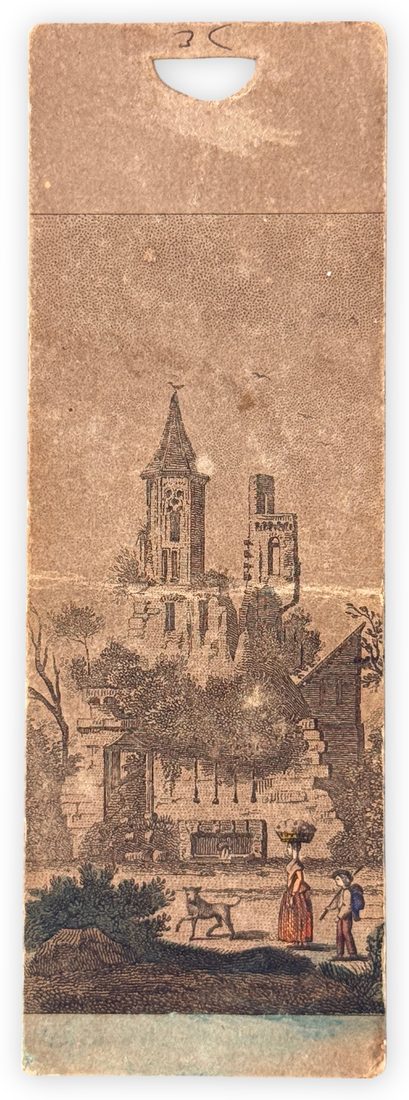
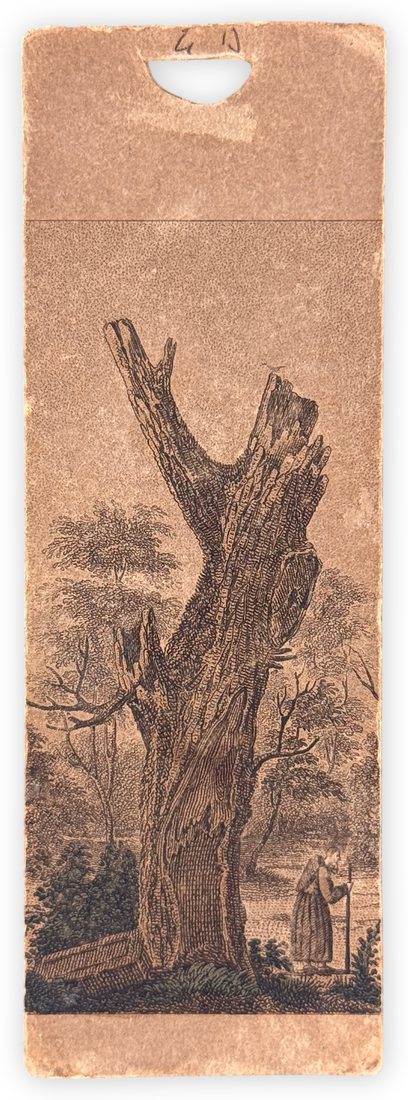
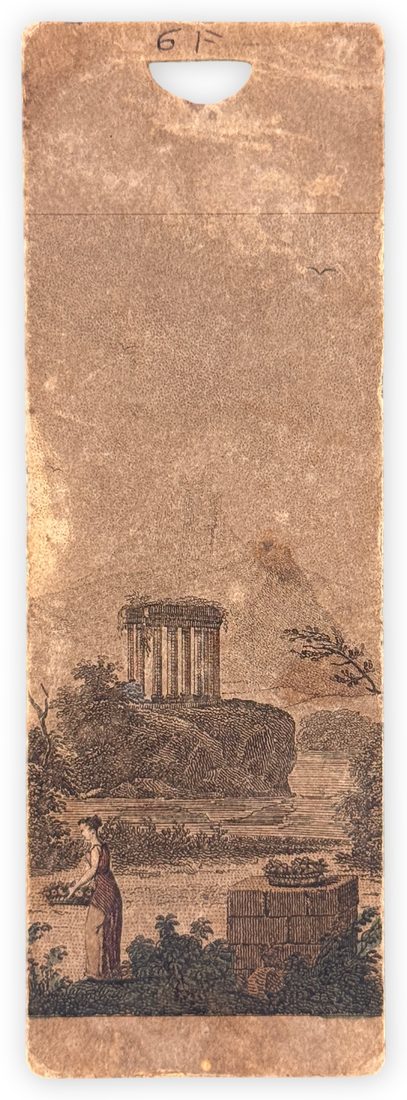
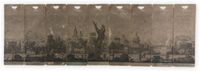
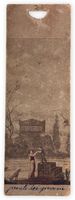
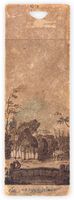
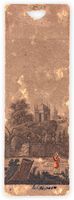
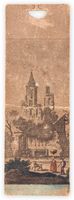
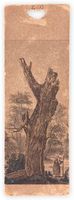
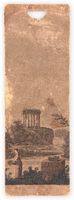
Nine cards of thin pasteboard, each approximately 120 × 42 mm, of upright format in the proportion of about 2.9 to 1 measured upon the objects, forming when assembled a panorama of approximately 12 × 39 cm; each cut at the centre of the upper edge with a semicircular notch of some 12 mm pierced clean through the board; etched line and fine stipple printed in brownish black over an even punctate ground, with contemporary hand colouring confined to the staffage figures; the printed area closed at the head by a ruled line, above which runs a narrow band of unprinted card carrying the notch, and ending at the foot above a second narrow band of unprinted card, which carries the manuscript captions; the sides running to the cut edge; versos unprinted; no printed lettering of any kind, whether title, imprint, address, plate number or signature; manuscript alphanumeric marks at the head of each card, and captions in Italian along the lower edge of five of the nine, in a nineteenth-century hand; mounted within a passe-partout of approximately 29 × 54 cm.
A myriorama is a set of engraved cards, each carrying a vertical slice of landscape cut so that any card will join any other and every arrangement yields a coherent panorama. The type appeared in Paris about 1822 and in London in 1824, and became one of the most successful parlour amusements of the Romantic age. The present nine cards belong securely to that family, and their interchangeability holds under trial; yet they answer to none of the recorded editions, English, French or German, and they carry at the head of every card a notch to which no recorded fitting answers.
The device rests upon a single and elegant constructional idea. Each card carries a fragment of landscape drawn so that the horizon, the plane of the ground and the level of the water fall always at one height, while the upper register is kept free of any incident that would interrupt continuity. The cards may therefore be laid down in any sequence whatever, and every permutation composes a landscape that reads as though it had been conceived entire. For nine cards the number of linear arrangements is 362,880. That the plates were cut for interchangeability is confirmed upon the objects themselves: exchanged one for another, the cards continue to hold, horizon, ground plane and water level coinciding in every permutation examined. This is a property of the design and not an accident of drawing, and it distinguishes a manufactured myriorama from a continuous panorama afterwards divided into strips. The uniform ground belongs to the same calculation, for had the upper register been left as bare paper every difference of discoloration between one card and its neighbour would have declared itself at the join.
The repertory of the nine is the codified vocabulary of the picturesque. A domed classical rotunda with colonnade rises above small figures and a kite in flight; a circular colonnaded tempietto stands ruined upon a mound; an immense dead tree, stripped of its bark, occupies one card entire; a Gothic church lifts its spire among trees; a Gothic abbey lies in ruin beside a fallen column, with a figure in red; a Greek Doric portico is attended by a dog and a fallen column drum; a ruined walled enclosure stands among trees; a stepped plinth or tomb is watched over by a second dog; and at the right a colonnaded water structure closes the sequence, with a figure carrying a barrel and a boat upon the water. In use the cards were dealt out upon a table, arranged, admired and rearranged, and the myriorama was sold upon that promise of inexhaustibility. It was at once an amusement and a lesson, the label on the reverse of the wrapper of the small Juvenile Myriorama published in London about 1840 recommending such a set as “beautifully adapted for young persons who display a taste for the fine arts”, and claiming that it will “supersede the necessity of a number of drawing books”.
The myriorama emerged at the moment when the panorama and the diorama, the great commercial spectacles of the age, were being reduced to portable and domestic form, and its name follows the same commercial grammar, joining the Greek myrias, a multitude, to orama, a view. Ralph Hyde, whose survey of the genre remains the standard account, attributes the invention of the scenic myriorama to the writer for children Jean Pierre Brès and dates the first issue to about 1822 or 1823. That set, a Myriorama. Collection de plusieurs milliers de paysages, was published in Paris by Le Fuel, bookseller in the rue Saint Jacques at number 54, at the sign of the Bon Pasteur, whose label Hyde reproduces; a complete example of thirty two cards is recorded in a private collection. The label bears no date, so the priority of the French issue rests upon Hyde’s dating rather than upon a dated imprint. In London, Samuel Leigh of the Strand published in 1824 the Myriorama, a Collection of Many Thousand Landscapes, designed by John Heaviside Clark, in sixteen hand coloured aquatint cards, followed in the same year by a second series of Italian scenery in twenty four.
The idea was seized upon at once. Hodgson and Company of London issued a rival set of sixteen lithographed cards as the Polyorama, or Endless Changes of Landscapes; the drawing master T. T. Dales produced a panoramacopia in eighteen; a Dutch edition after Clark appeared in 1824; and at Nuremberg the publisher and printseller Friedrich Campe brought out a myriorama in at least two series, the first in sixteen cards of classical ruins, now in the Werner Nekes collection at the Getty Research Institute, the second in twenty four numbered cards of Italian and Mediterranean subject, in hand coloured lithography, in the Stadtmuseum Berlin. By about 1840 the type had descended to a cheaper juvenile form.
Ann Bermingham has observed that by the nineteenth century the formulaic character of picturesque landscape had become so much a visual cliché that it could be fashioned by Clark into a children’s game, and she relates the second series of Italian scenery to the Claudean ancestry of that formula. The observation goes to the heart of the type. Only a landscape assembled from interchangeable conventions can be shuffled without absurdity, and the coexistence of Gothic and classical ruin within a single panorama is therefore no incoherence but the condition of the game: these are not topographical views but modules, and the toy is a document of the moment at which a school of taste had hardened sufficiently to be played with. Within the longer history of visual entertainment the myriorama takes its place beside the folding panorama, the vue d’optique, the paper peepshow and the movable book, among the domestic ancestors of the pictorial narrative. It is not to be confused with the Polyorama Panoptique, an entirely different apparatus of transparencies viewed through a bellows, with which it shares only a family of names.
The present cards carry no maker’s name, and none has been identified. What may be established with precision is what they are not, and the exclusions are themselves informative. They are not cards of either Clark and Leigh series. The Leigh cards measure about 200 × 70 mm, roughly half as long again as the present ones; they are hand coloured aquatints, against line and stipple with selective colouring; and, most tellingly, each is closed at head and foot by a ruled line beyond which runs a band of unprinted card, and in the centre of the lower band is engraved a number from 1 to 16, the numbering being one of Leigh’s recorded innovations. The present cards observe the same convention of a ruled line and an unprinted band, so that the space in which a number would have been printed survives untouched upon them, and is empty. The absence of numbering is therefore not an argument from silence but a positive observation, though it should be added, in fairness to the evidence, that it tells specifically against Leigh and not against every published edition.
Nor are they cards of the Juvenile Myriorama published by Joseph Thomas about 1840, the small format edition to which they might most plausibly have belonged. In that set, which measures 102 × 59 mm, the sky is printed, with engraved and pink washed cloud banks and a continuous grey blue mountain range at a constant horizon; the colouring is overall rather than selective; the format is markedly squarer than the present one; the motifs are ruined castles, thatched cottages, a river with sailing boats and a round flagged tower, among which none of the present subjects appears; and no card is notched. This excludes the Thomas edition; it does not exclude a related edition of the same branch by another publisher. Nor, finally, do the present cards belong to the family of transparencies, whose views are worked for transmitted light, commonly pierced and locally thinned and painted on both sides, whereas these are opaque pasteboard with unprinted versos and combinatorial in function.
The purpose of the semicircular notch remains undetermined. It is certainly original and certainly functional, and four explanations offer themselves: that the cards were drawn by it from a grooved box, that they were seated by it in a slotted base or rack, that they were hung upon pegs within a frame, or that they were suspended before a light. The third may be dismissed, since a notch opening upwards will not retain a card, and the fourth is excluded by the opacity of the support. Between the first two the evidence does not decide. No fitting to which such a notch would answer has been identified, and the notch is not recorded in the catalogue descriptions of the principal public holdings consulted; but those records describe the number of the cards, their technique, their dimensions and their housing, and never the treatment of their edges, so that the silence measures the limit of the search rather than the survival of the type. The recorded publishers are Le Fuel in Paris, Samuel Leigh and Hodgson and Company in London, Friedrich Campe at Nuremberg and Joseph Thomas in London. The present cards are the production of none of them, and remain the work of an unidentified hand.
Conditions: Generally good, with the wear proper to a fragile object of domestic use. The pasteboard is lightly browned throughout. The versos show vertical bands of discoloration left by an earlier mount, together with abrasions and residues of adhesive; one card has a tear with small losses at the notch. Several of the captions along the lower margin have faded, and certain of the marks at the head are abraded or clipped by the trimming of the edge. One card, photographed in transmitted light, shows no watermark. The nine are complete as a group, the engraved surfaces unrubbed and the colouring fresh.
Provenance: Captions in Italian, in a nineteenth-century hand, survive along the lower edge of five of the nine cards; one reads “il tesoro”, the others are abraded and only partly legible, one of them ending in the word for water in a spelling anterior to the modern Italian form. They document use or ownership in an Italian speaking milieu; they do not establish Italian manufacture, and no myriorama of the period has been traced to an Italian publisher or to an Italian public collection. The alphanumeric marks at the head, of the same period and probably of the same hand, are read as 2G, 6F, 4D, 3C, 5F, 84, 91, 25 and 10; four of them are unambiguously numerals, so that the cards were at some point numbered as high as ninety one. Whether this implies a numbered series of that extent depends upon the marks forming a single progression, which is not demonstrated; since no recorded edition approaches ninety cards, the more economical reading is that of an inventory applied by a collector or a dealer, consistent with the entire absence of printed numbering. Earlier provenance is not known.
References: A. Bermingham, Learning to Draw: Studies in the Cultural History of a Polite and Useful Art, New Haven, CT: published for the Paul Mellon Centre for Studies in British Art by Yale University Press, 2000, pp. 105-106; R. Hyde, Myrioramas, Endless Landscapes: The Story of a Craze, in Print Quarterly, XXI, 4, December 2004, pp. 403-420; R. Hyde, Panoramania! The Art and Entertainment of the “All-Embracing” View, London: Trefoil Publications in association with the Barbican Art Gallery, 1988; B. M. Stafford and F. Terpak, Devices of Wonder: From the World in a Box to Images on a Screen, Los Angeles: Getty Research Institute, 2001.