Planches anatomiques du corps humain


| Macro-category | Rare Books and Manuscripts |
| Subcategory | Medicine |
| Author | MASCAGNI, Paolo; ANTOMMARCHI, Francesco |
| Place of printing | Paris |
| Publisher / Maker | C. de Lasteyrie |
| Year | [1823-] 1826 |
The Human Body at Its Real Size
A life-size anatomical atlas from the first years of lithography
Mascagni’s life-size anatomy published in Paris
by Napoleon’s last physician
Complete in 83 plates, with the sheets untrimmed
[Mascagni, Paolo (1755-1815).] Antommarchi, Francesco (1780-1838), editor. Planches anatomiques du corps humain, exécutées d’après les dimensions naturelles, accompagnées d’un texte explicatif, par F. Antommarchi, publiées par le Comte de Lasteyrie, éditeur. Paris: C. de Lasteyrie, [1823-] 1826. Atlas volume only, without the accompanying volume of text issued in 1826.
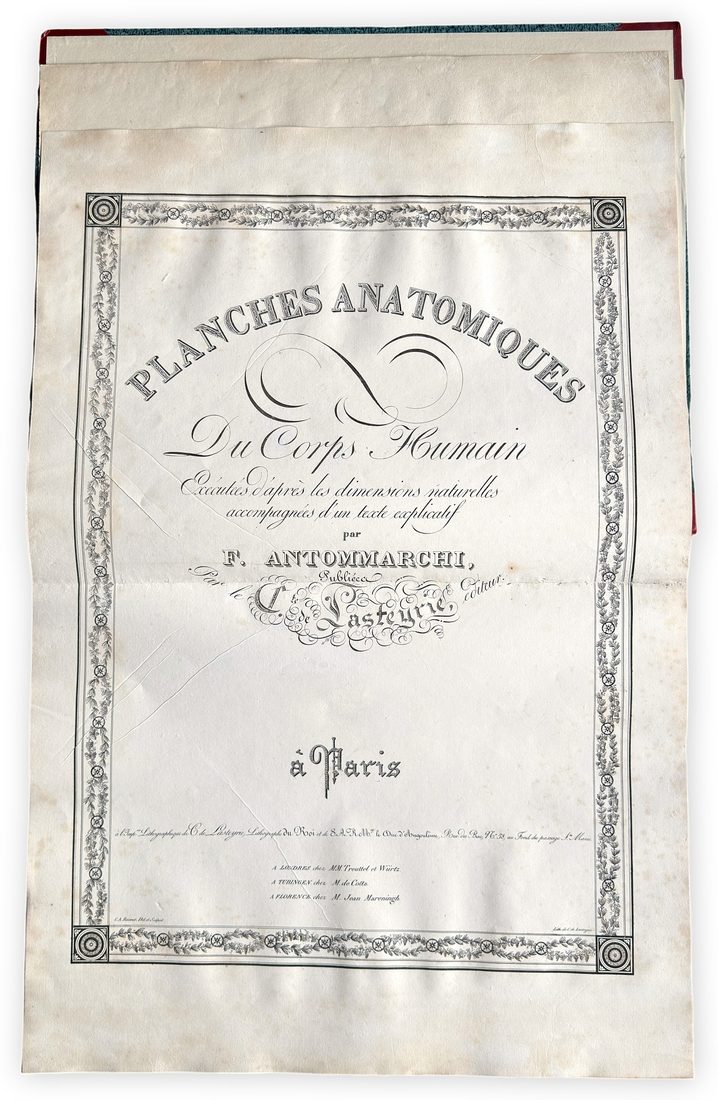
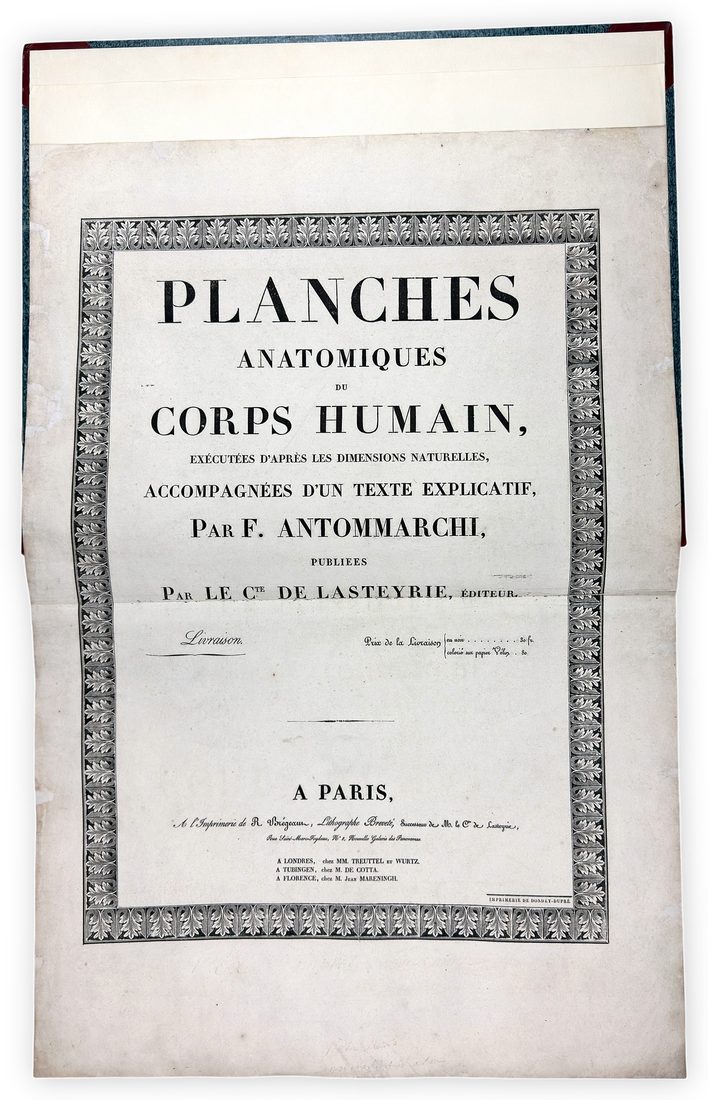
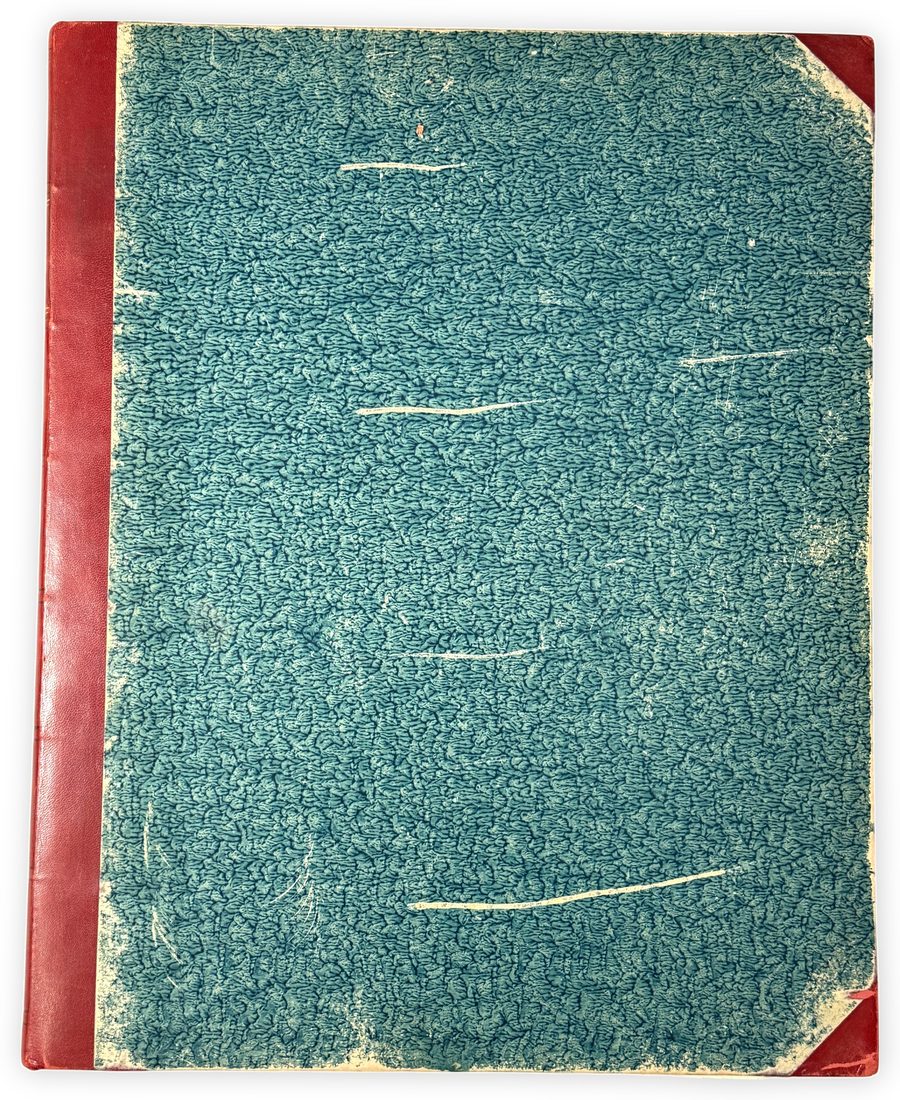
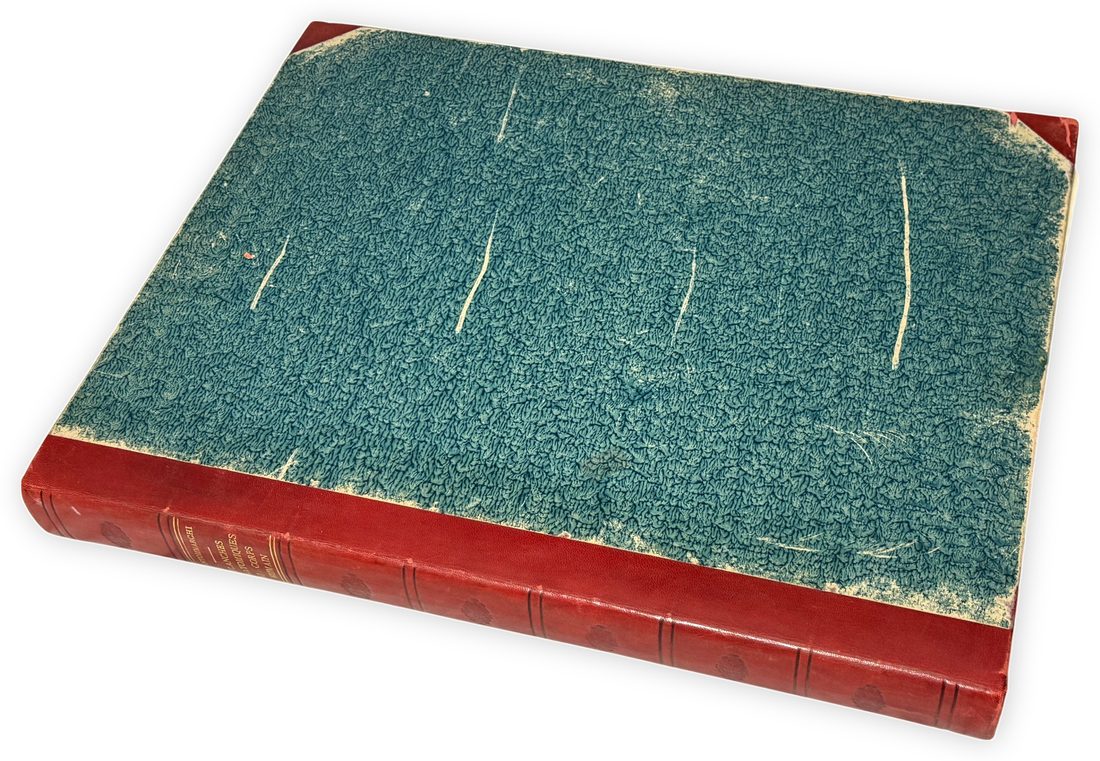
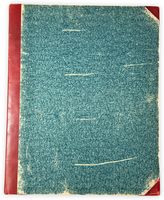
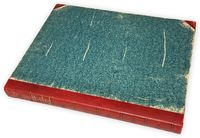
Atlas folio (bound volume 623 × 509 mm; the sheets measure 907 × 623 mm fully opened), twentieth century half red morocco with corners and marbled paper boards, flat spine divided by blind double fillets with a blind fleuron in each compartment, lettered in gilt within gilt fillets F. Antommarchi and Planches Anatomiques Du Corps Humain, unsigned. Letterpress part-title within a wood-engraved acanthus border, with the number of the part left blank and the tariff printed below the title, and at the foot the imprint of R. Brégeaut, successor to Lasteyrie, with the names of his agents in London, Tübingen and Florence, subscribed Imprimerie De Dondey-Dupré; lithographed calligraphic title within a border of vine and laurel with rosette corners, signed C.A. Racinet, Del. et Scripsit and subscribed Lith. de C. de Lasteyrie; and 83 lithographed plates, namely 48 shaded plates numbered 1-3 and IV-XLVIII, plate XLVII misnumbered LXVII in both states, and 35 outline plates. Each sheet folded once horizontally and mounted on a guard, without linen backing and without loss of image.
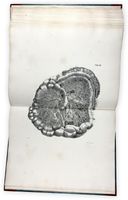
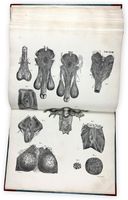
The Paris lithographic edition of Paolo Mascagni’s posthumous anatomy at natural scale, issued in fifteen parts between 1823 and 1826 by the lithographic press of the Comte de Lasteyrie and published under the name of Francesco Antommarchi, Napoleon’s last physician at Saint Helena. It was conceived so that three superimposed sheets compose an entire human figure at life size. Its contemporaries already counted it among the greatest undertakings of its kind, and its first parts were before the Académie des sciences while the Pisan edition was still a prospectus. The present copy is complete in 83 plates, on sheets that retain the whole dimension of their paper format.
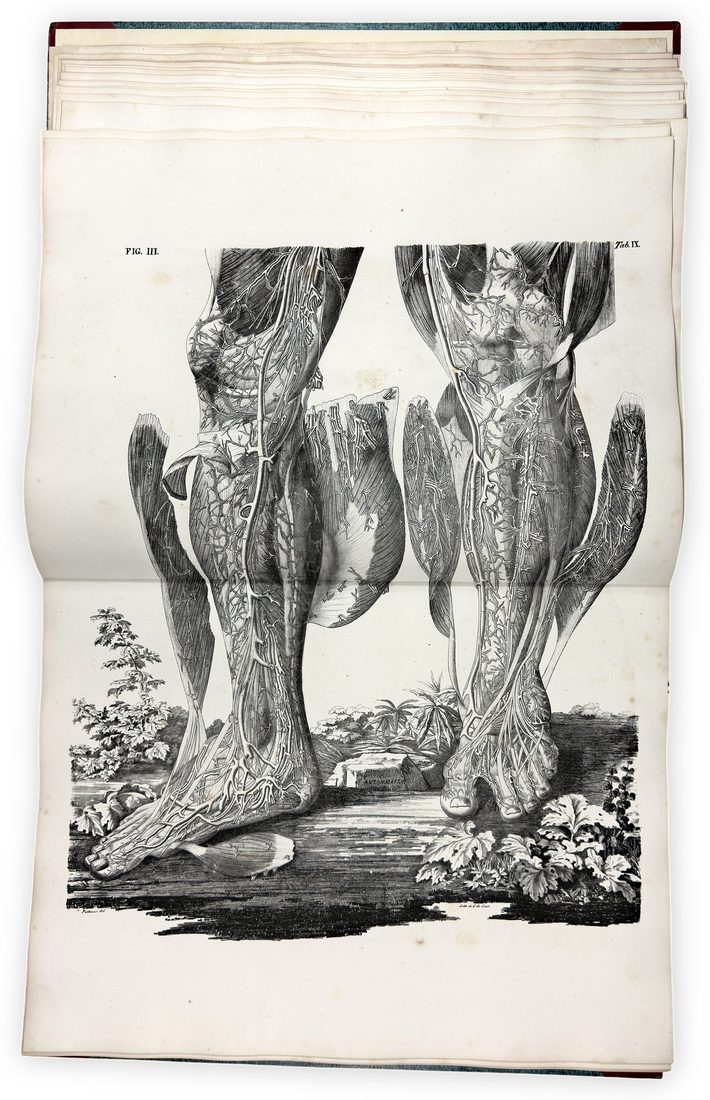
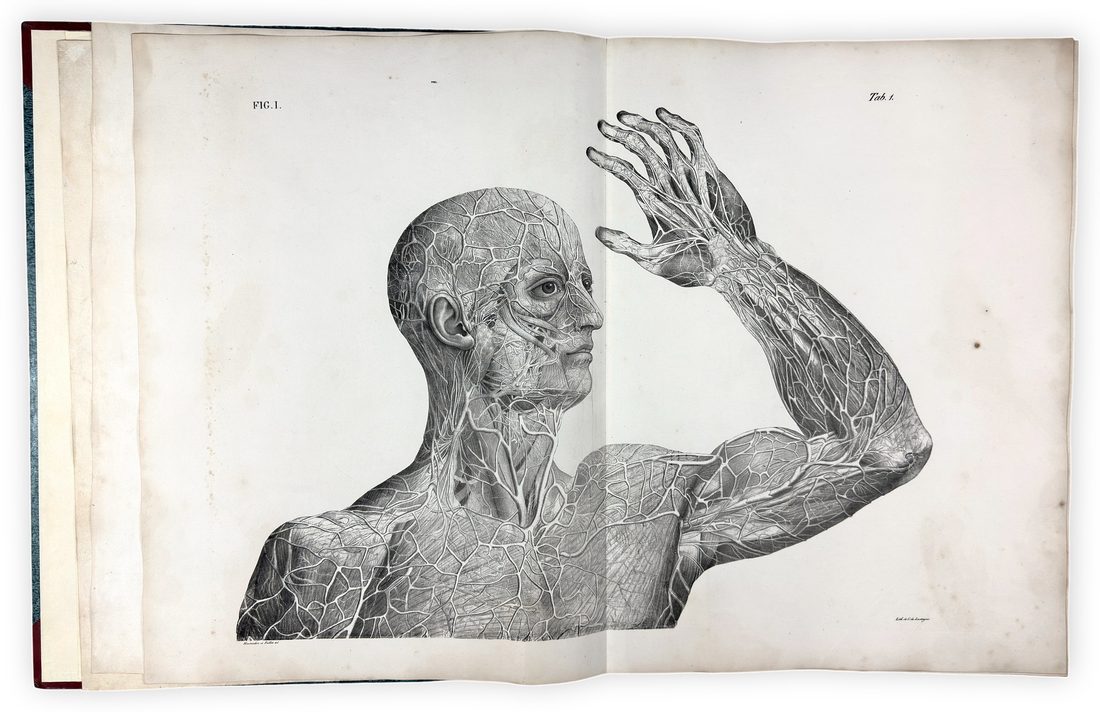
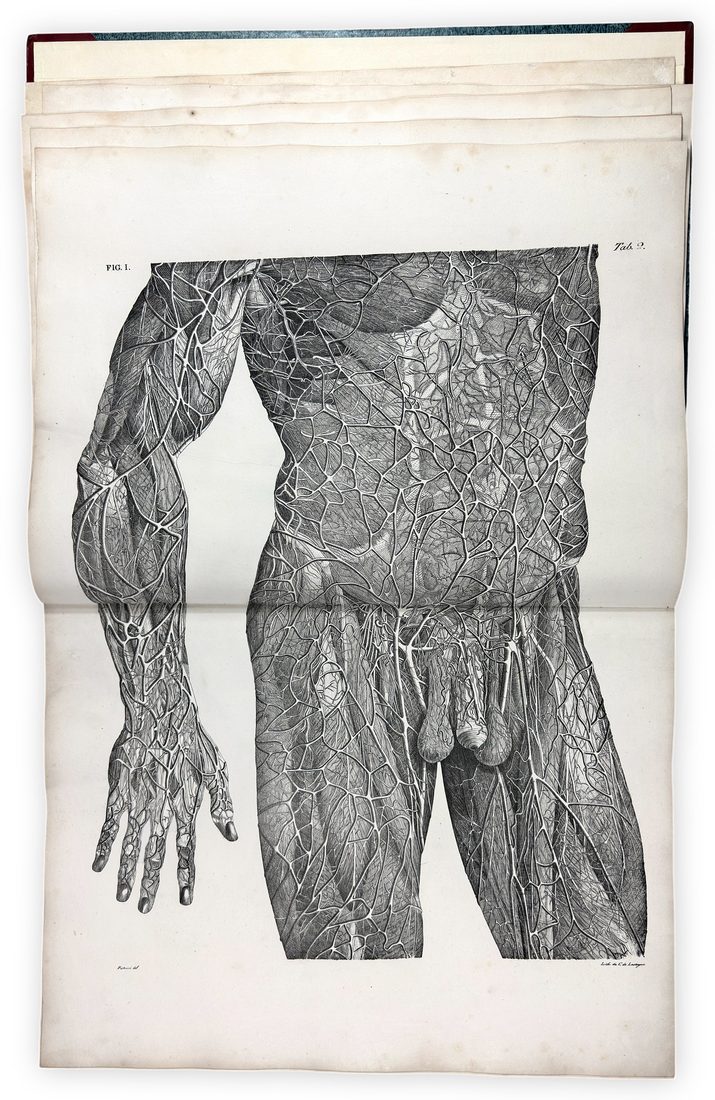
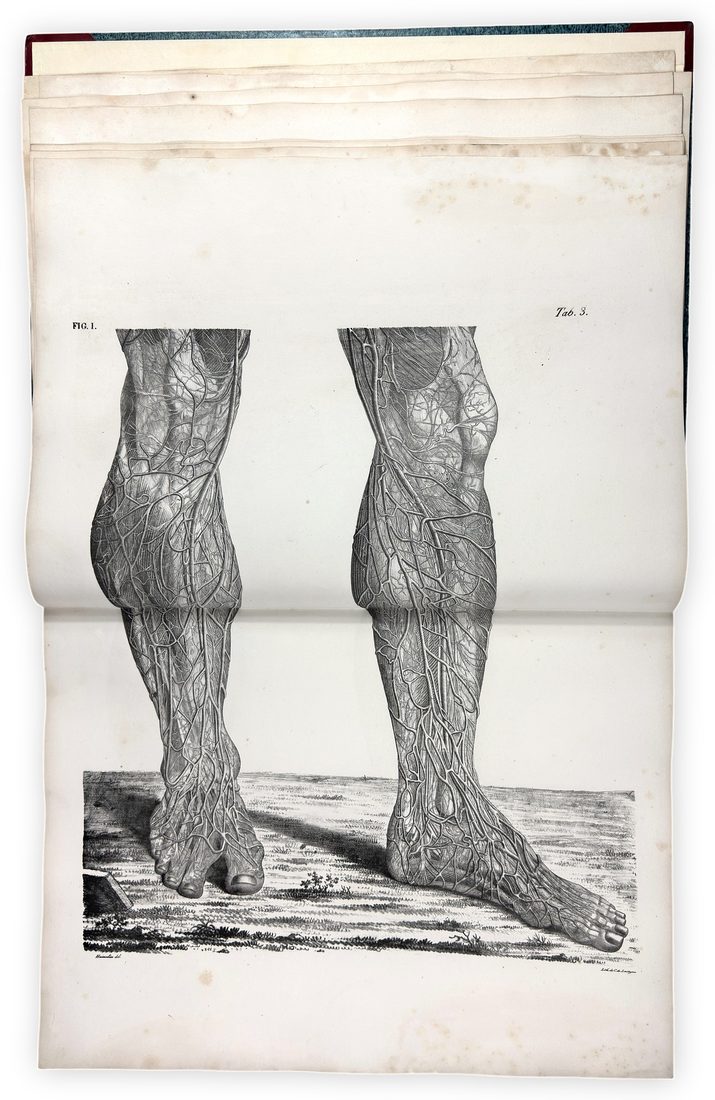
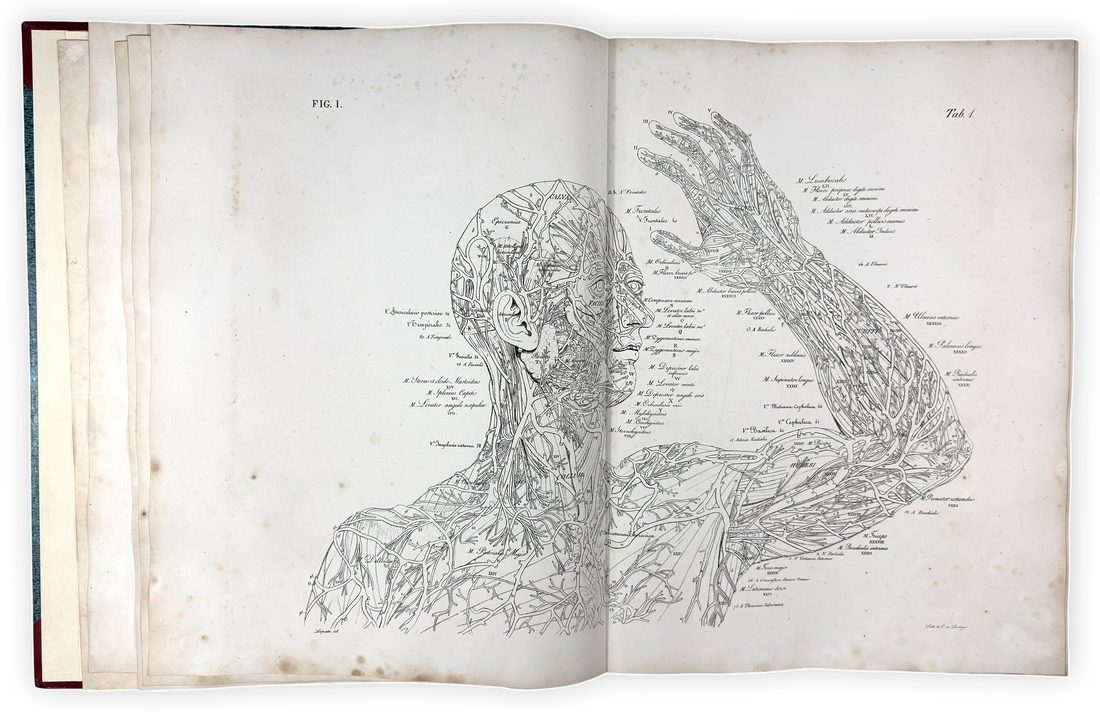
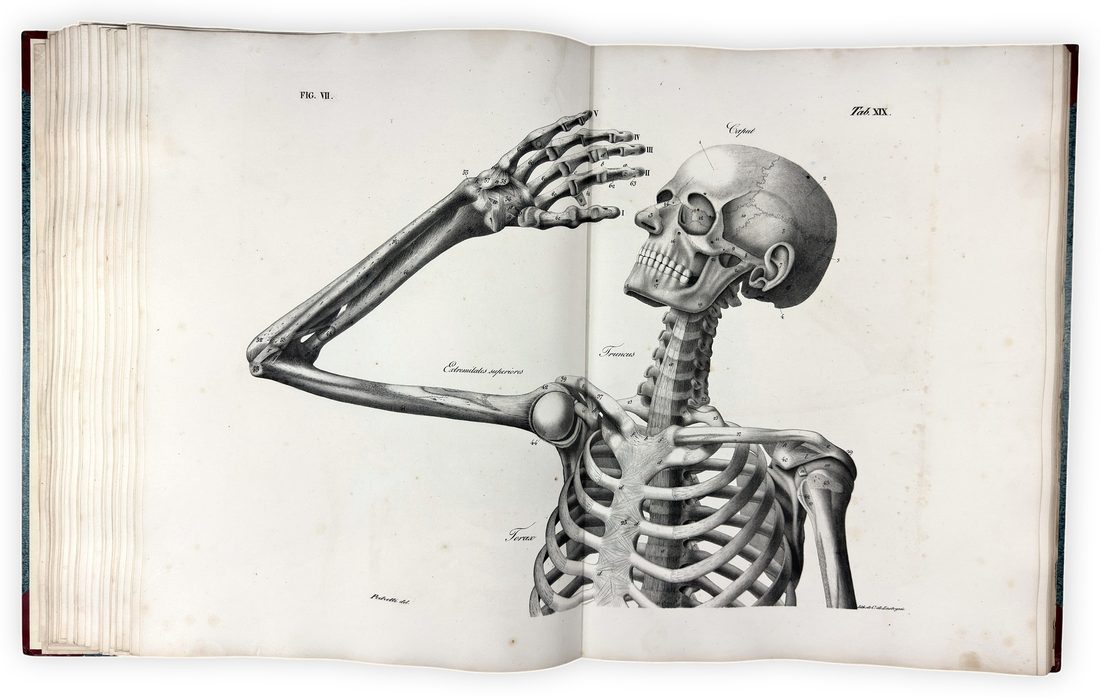
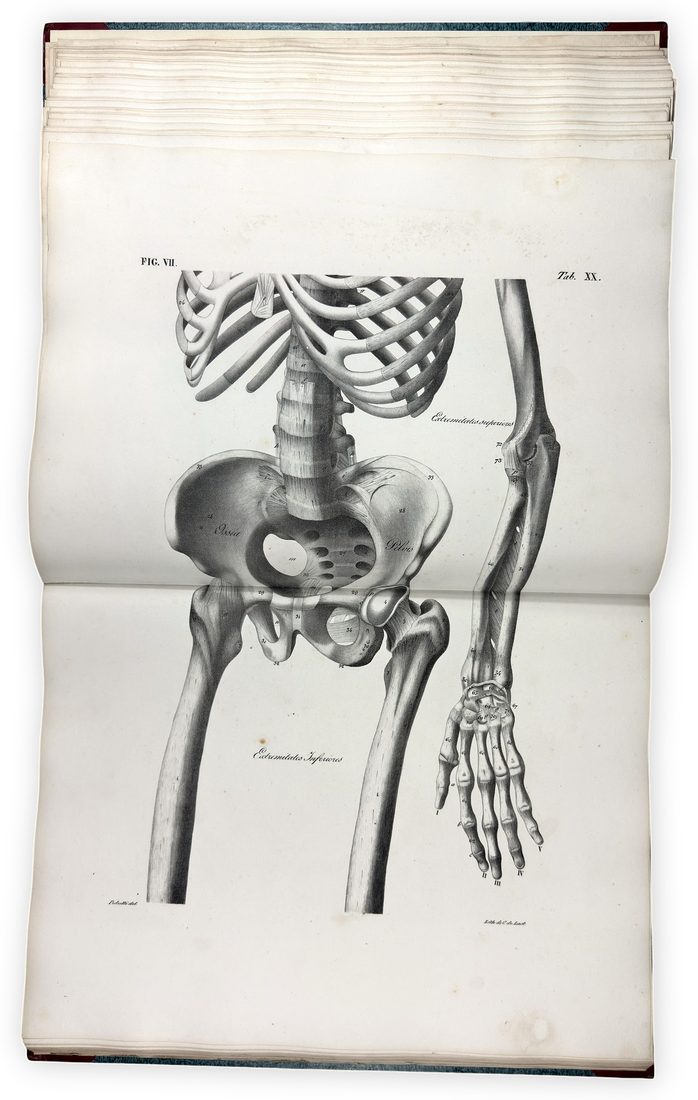
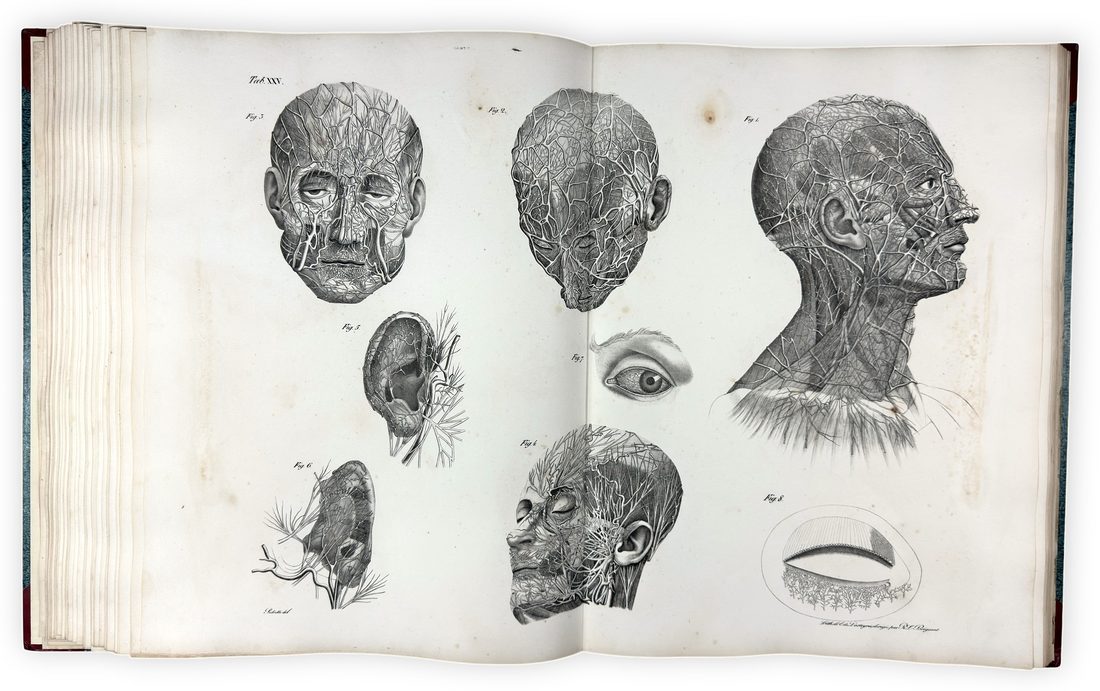
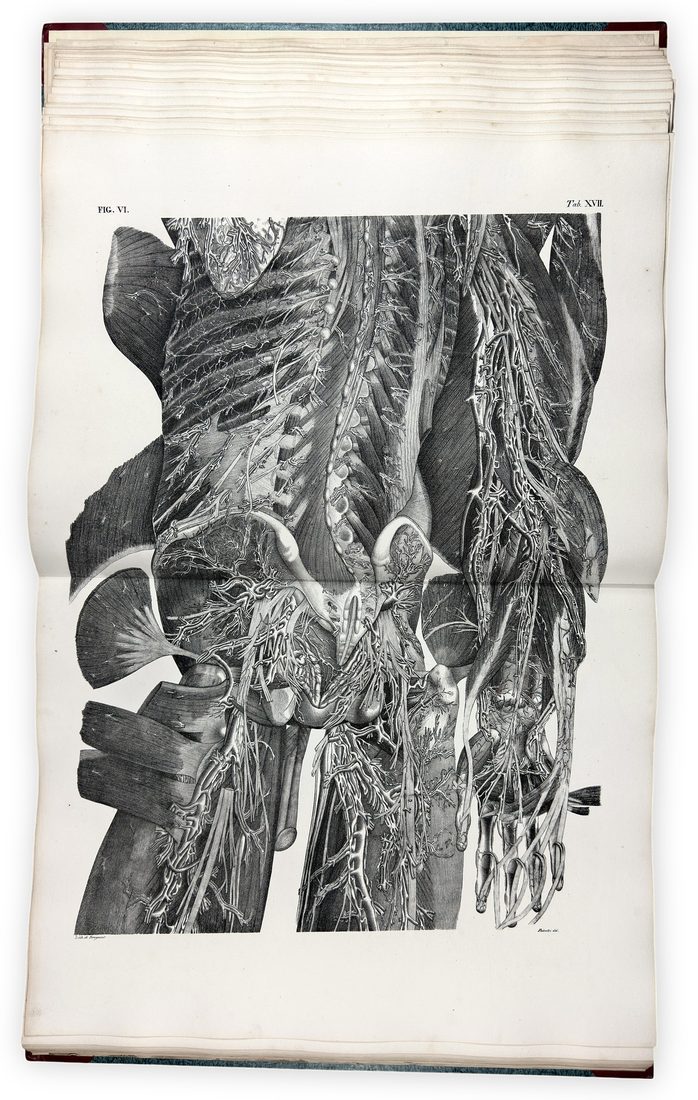
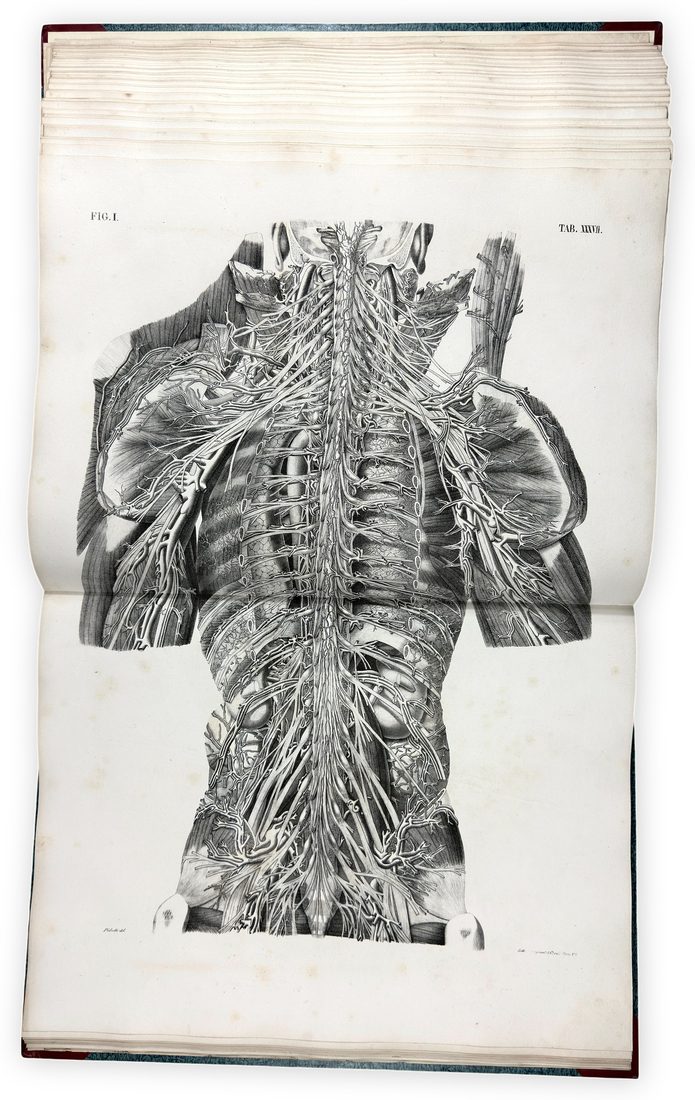
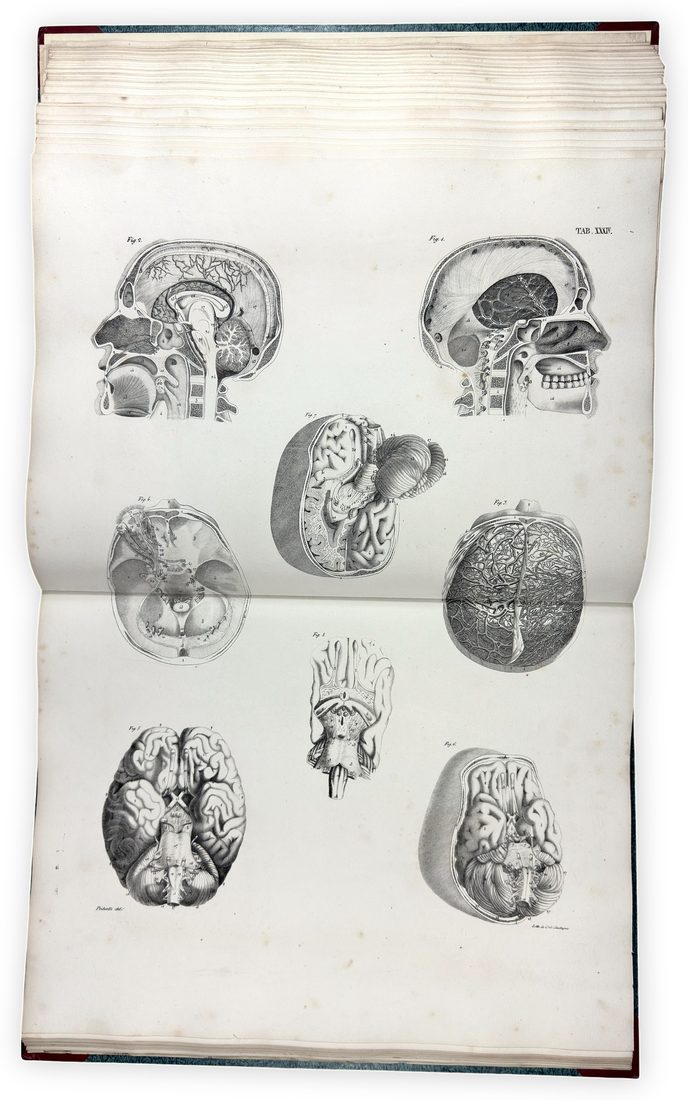
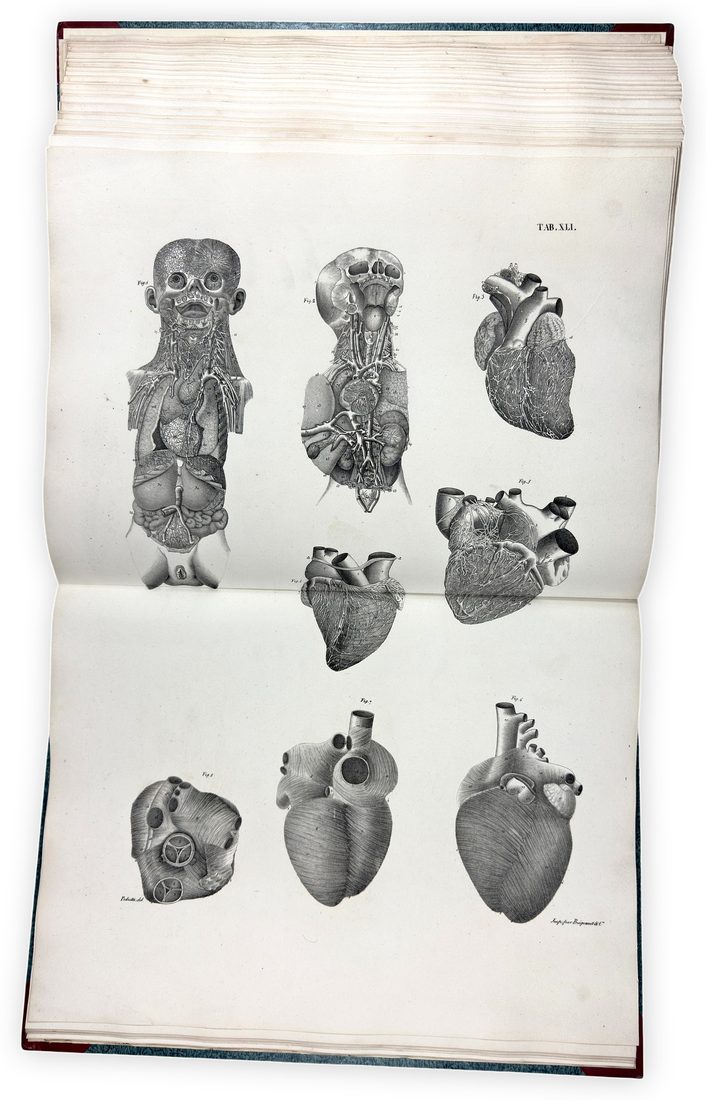
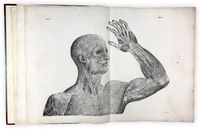
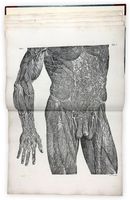
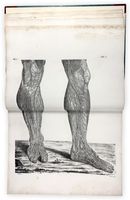
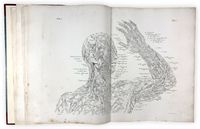
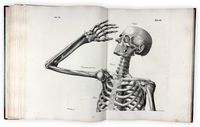
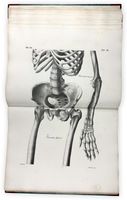
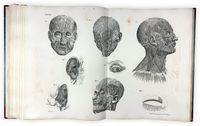
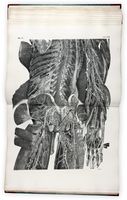
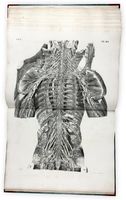
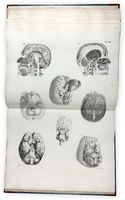
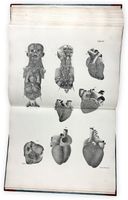
The atlas follows a single principle: the human body should be shown at its real size and read by successive layers, as it presents itself to the anatomist on the table. Three plates placed one above the other compose an entire figure at natural scale; twenty four plates, properly assembled, yield eight complete human figures, seen from the front and from the back; the remaining plates are devoted to the viscera and to particular organs. The sequence proceeds from the layer immediately beneath the common integument, with the subcutaneous arterial and venous network and the nerves covering the first muscular layer, through the successive muscular strata, to the skeleton. In the author’s own phrase, the atlas is a topographical map of the human body.
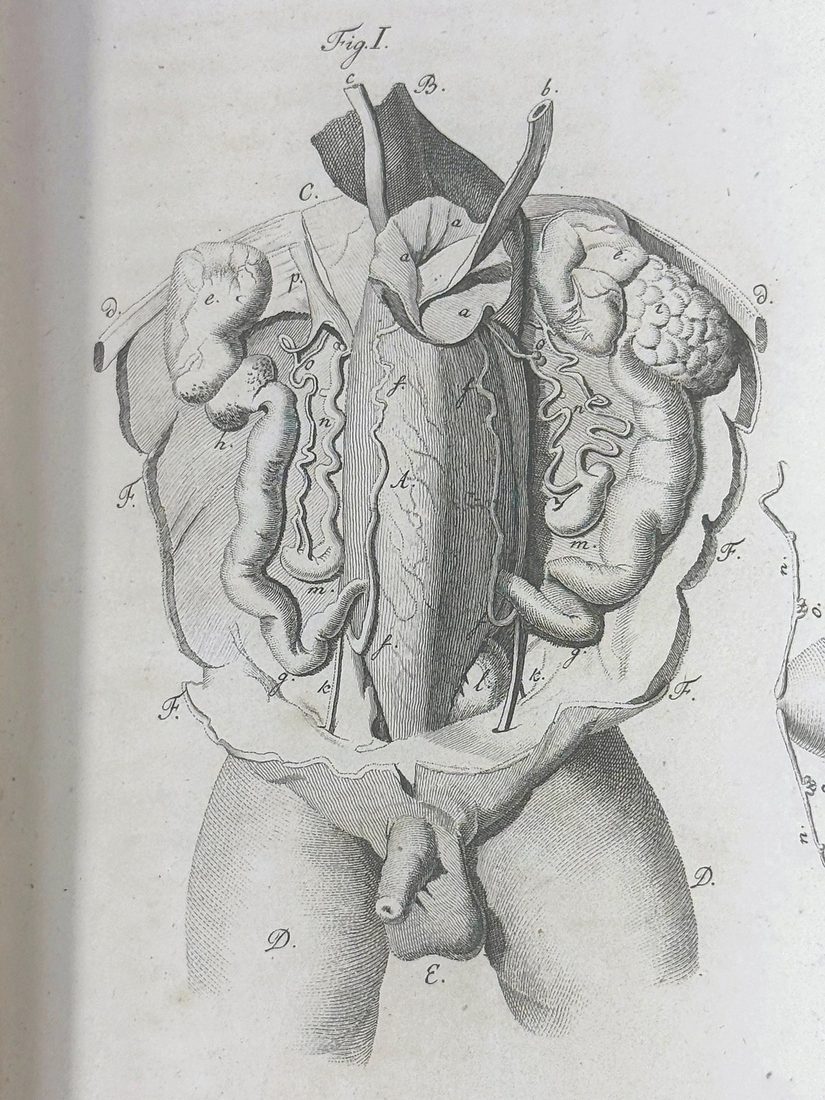
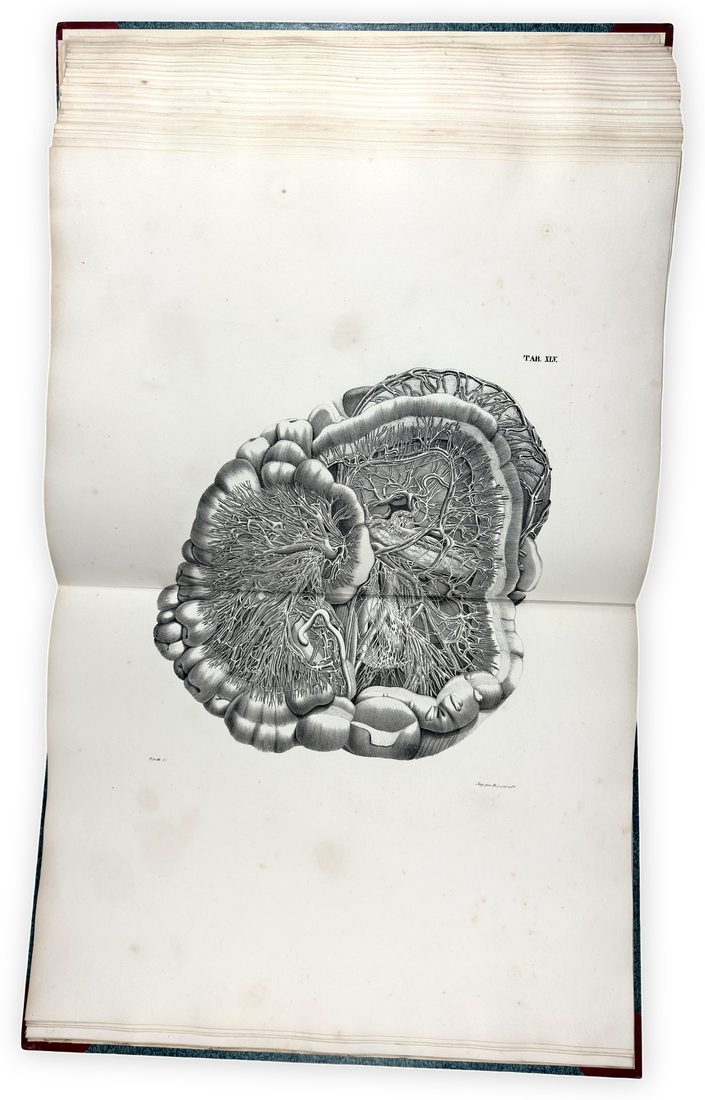
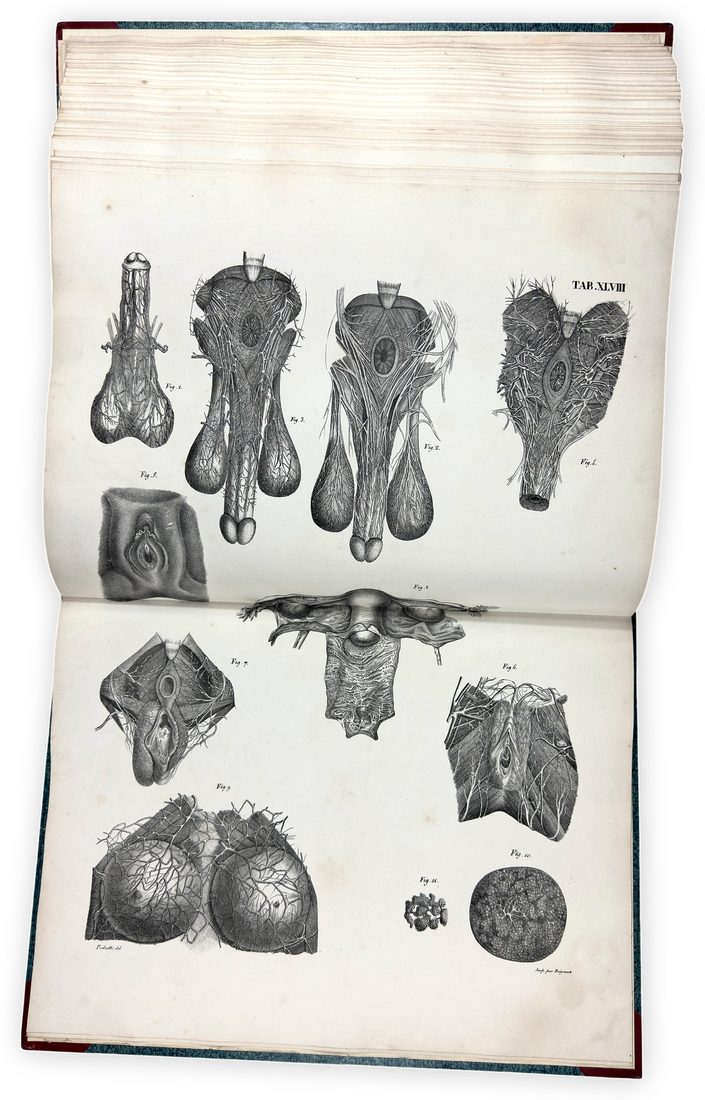
A consistent graphic code, described by Duméril and Magendie in their report, governs the reading of the plates. Muscles are rendered by parallel series of lines and points, tendons by finer and closer lines, arteries by lines with short oblique hatching, veins by longitudinal and transverse lines that restore their rounded form, nerves by simple linear strokes, and the lymphatic vessels and their nodes by sinuous lines. The code carries the information the plate cannot label, and keeps an image of extreme density legible.
The plates work in pairs. Each shaded plate has, as a rule, a counterpart drawn in outline, on which the names of the principal parts are written together with the letters and figures referring to the explanatory text. Thirty five of the forty eight subjects are accompanied by such an outline plate. The remaining thirteen, namely plates 19 to 24, 33 to 35, 39, 41, 43 and 46, have no counterpart, because on those less crowded subjects the reference letters were drawn directly within the image itself, which made the outline plate unnecessary. The present copy has been collated plate by plate: the numbered plates run from I to XLVIII without gaps, the thirteen plates without counterpart are exactly those listed above, and the keys are present within the image on each of those thirteen plates, from the skeleton of plate 19 onwards, while plate 1 in its shaded state carries none.
The work appeared in fifteen parts. The first two were published by June 1823 and comprised twelve plates, six of them shaded, issued both coloured and in black. According to Duméril’s report of August 1824, each part contained six plates, three shaded and three in outline, and in the last parts, which represent the skeleton, a fourth plate was added to show details of particular regions of the body. In the present copy the images of plates XXX and XLIV to XLVI are markedly smaller than the rest: plate XLV measures 440 × 410 mm against the 700 × 520 mm of plate 1.
The plates are printed on laid paper of Colombier format, untrimmed and retaining the deckle edges, only lightly dressed by the binder, with two countermarks, T △ D and E ▽ D, the inverted device indicating twin moulds. They are signed by several draughtsmen, Haincelin and Feillet, together and separately, Pistrucci, Roux and, from plate VII, above all Pedretti, whose name is on every plate from XVI to the end. The imprints follow the history of the press: Lith. de C. de Lasteyrie on the plates to XXXVI, Lith. de Brégeaut & C.ie on plates XXXVII to XXXIX, with the address rue S.t Marc N.° 8 on plates XXXVII and XXXVIII, then Imp. par Brégeaut & C.ie and, on the last plates, Imp. par Brégeaut alone.
An accompanying volume of text, the Explication des planches anatomiques du corps humain, was issued in 1826 with the imprint of R. Brégeaut and comprises [16], 228 pages. It explains the forty eight subjects one by one, with the Latin nomenclature to which the letters and figures on the outline plates refer, and contains besides the author’s preface, which is the primary source for the editorial history of the undertaking, and an appendix of contemporary reviews and academic reports. It is not present with this copy, but is digitised in full from the copy of the Bibliothèque interuniversitaire de santé, Paris, shelfmark 1898, and may be consulted freely on the Internet Archive.
Paolo Mascagni died at Castelletto, near Chiusdino in the Sienese, on 19 October 1815 leaving three works unfinished, an anatomy for artists, the Prodromo della grande anatomia, and the great anatomy at natural scale, his principal project. Francesco Antommarchi, who had been his prosector at Santa Maria Nuova, was placed at the head of the editorial undertaking by an anonymous company formed on behalf of the family, and brought out the anatomy for artists in 1816 and the Prodromo in 1819. In that year he left for Saint Helena as Napoleon’s physician, taking with him, according to Choulant, three sets of impressions taken from Mascagni’s plates.
During his absence the negotiation for the purchase of the materials failed; in April 1822 the company was declared dissolved before the court and the heirs sold the texts, drawings and copperplates to three professors of the University of Pisa, Andrea Vaccà Berlinghieri, Giacomo Barzellotti and Giovanni Rosini, who produced from them the engraved edition entitled Anatomia universa, printed at Pisa by Nicola Capurro between 1823 and 1831. Antommarchi, returning to Europe, considered himself released from his obligations, had new drawings made and had them lithographed in Paris.
The two editions therefore appeared almost simultaneously and by different processes, and the resemblance of their images has caused them to be confused ever since. They are readily distinguished. The Pisan edition consists of forty four engraved plates with forty four outline counterparts; the Paris edition of forty eight lithographed subjects with thirty five counterparts. Antommarchi introduced imaginary landscape backgrounds at the base of some of his figures, which do not appear in the Italian edition, and on plate IX a block of stone in the landscape bears his own name, F. Antommarchi; he placed the reference letters within the image on the less complex subjects; and his text is substantially different. Choulant, who preferred the copper, observed that twenty four figures present in Mascagni’s anatomy are omitted from the lithographed edition, and that Antommarchi supplied a few figures of his own in their place. He confined his charge with precision, holding that the impropriety consisted in the omission of Mascagni’s name from the title and in the editing, to their loss, of a work undertaken for the benefit of Mascagni’s heirs. Italian scholarship, then and now, has judged the matter more severely, and the printed Lettre des héritiers de feu Paul Mascagni à M. le Comte de Lasteyrie, signed by Nicole Mascagni and Jérôme Mattei on 30 June 1823 and printed at Pisa by Capurro, was addressed to the Paris publisher himself.
The dedication of the Paris edition grew out of the same dispute. Antommarchi states in his preface that the Emperor had in life accepted the dedication of the work. Unable to offer it to the living, he inscribed it to the tomb: AU TOMBEAU DE SAINTE-HÉLÈNE, with the words puisse cet ouvrage durer aussi long-tems que le souvenir du grand homme que tu renfermes.
The undertaking also belongs to the history of printing. Charles-Philibert de Lasteyrie was among the first promoters of lithography in France, and in 1819 received an honourable mention as its importer; he had bought stones as early as 1804, learned the process at Munich, where he reached an agreement with Senefelder, and opened his Paris establishment in 1816. In 1825 he ceded his patent and press to his works manager, Rémy-Louis Brégeaut, who obtained the patent by transfer in the same year.
That transfer can be followed step by step in the present copy. The lithographed title carries the imprint of Lasteyrie in the Rue du Bac; plate XXV is subscribed Lith. de C. de Lasteyrie, dirigée par R. L. Brégeaut, the press still bearing Lasteyrie’s name but already directed by Brégeaut; plates XXXVII to XXXIX carry Brégeaut’s own imprint, the first two with his address in the Rue Saint-Marc, and the later plates Imp. par Brégeaut; the part-title, finally, carries the same address together with the increased tariff of thirty francs for a part in black and eighty for a part coloured on vellum paper, against the twenty five francs in black and seventy coloured of the original subscription. The atlas thus dates itself: the plates to XXXVI were printed at Lasteyrie’s press between 1823 and 1825, plates XXXVII to XLVIII by Brégeaut between 1825 and 1826. One sheet stands apart: the shaded state of plate XVII is subscribed Lith. de Bregeaut, while its outline carries Lasteyrie’s imprint, and is probably a later impression from Brégeaut’s press.
The standard authority is misleading on the number of plates. Choulant describes the Paris edition as consisting of ninety lithographic plates, forty five finished and forty five in outline, and the same total may be deduced from Brunet, who records fifteen parts of six plates each. Ninety is the figure announced in June 1823 by the Revue Encyclopédique, about ninety plates shaded and in outline, although the report of May 1823 already spoke of forty five shaded plates with about thirty five in outline. It was never realised. The work as published consists of eighty three plates, and the collation is confirmed by the copy at the Staatsbibliothek zu Berlin, catalogued from the object, and by the present copy, which agrees with it plate for plate. The present copy is the Dean Edell copy, whose collation Christie’s published in 2007.
The scientific substance of the work is Mascagni’s own. His Vasorum lymphaticorum corporis humani historia et ichnographia, printed at Siena in 1787 with forty one engravings, for the most part by Ciro Santi, gave the fullest account and by far the finest iconography of the human lymphatic system then achieved, based on injections of mercury into subjects dead of anasarca, and following Hewson’s description of 1774 and Cruikshank’s of 1786. The great anatomy was to show that network at the size of life, and the Paris atlas, lithographed from new drawings, reached the public first: when Duméril and Magendie reported to the Académie des sciences on 21 April 1823, the Pisan edition existed only as a prospectus with a single specimen plate, while the first lithographed parts were already before the Academy. The Revue Encyclopédique, introducing the report, described the two works as les plus grandes entreprises de ce genre qui aient été faites jusqu’ici, and Duméril, reviewing Antommarchi’s first parts, recalled telling the Academy that he knew of aucun ouvrage exécuté dans le même but.
Paolo Mascagni was born at Pomarance in 1755 and took his medical degree at Siena in 1778, where he became assistant and then successor to Pietro Tabarrani in the chair of anatomy. His European reputation was established by the Vasorum lymphaticorum corporis humani historia et ichnographia of 1787. In 1801 he was appointed professor at Pisa, with the obligation of teaching at the Arcispedale di Santa Maria Nuova in Florence. Already in the 1780s, through Felice Fontana, he had prepared anatomical specimens for the grand ducal collection, and several of his dissections were modelled in wax for La Specola by Clemente Susini. The project of a complete anatomy at natural scale, conceived immediately after the Vasorum, occupied the remainder of his life and was left unfinished at his death in 1815. His date of birth is given as 1752 by Choulant and by the older cataloguing tradition, and as 1755 by the modern scientific literature and by the Dizionario Biografico degli Italiani.
Francesco Antommarchi was born in Corsica, at Morsiglia, and died at Santiago de Cuba in 1838. He was Mascagni’s last prosector and the editor of the two posthumous works published at Florence in 1816 and 1819. Chosen as Napoleon’s physician in December 1818, he reached Saint Helena on 20 September 1819 and continued to work there upon the anatomical project. He directed the autopsy of the Emperor on 6 May 1821, published the death mask, an attribution disputed in his own lifetime, and published a successful memoir of the last months at Saint Helena in 1825. The Paris edition of the anatomy occupied him from 1823 to 1826. His date of birth is given as 1780 by the scientific and museum literature and as 1789 by part of the bibliographical tradition.
Conditions: Light and scattered foxing, more marked on a few plates (XXXI, XLIV in outline, XLV and XLVI); light tide marks with traces of set-off on plate XXII, two faint brown lines across plate XXIV, light damp marks in the margins of plate XXXVII in outline and of plates XXXIX and XL, small round stains in the margin of plate XLIII; a light brown stain at the upper corner of the first leaves; occasional isolated marks and faint set-offs in the blank margins. Discreet repairs to the margins of the part-title; light diagonal creases in the lithographed title. The paper is strong, with one tear in the right-hand half of the last plate skilfully repaired and visible only against the light; the median folds are clean and unbroken. The plates have not been backed with linen and have not been cut along the fold, and no image is lost. The paper of the boards is much rubbed along all the edges and at the corners, with loss of the coloured surface and a few long scratches on the front board; the morocco of the spine and corners is sound.
Provenance: Dean Edell (his sale, Christie’s, New York, Anatomy as Art: The Dean Edell Collection, 5 October 2007, lot 118), the copy identified by its binding, its collation and the repaired tear in the last plate.
Census: Bibliothèque nationale de France, GR FOL-TA9-254, plates and text in two volumes; Staatsbibliothek zu Berlin, Kt 10399, catalogued from the object, the record listing the plates existing in two states; Biblioteca Medica Pietro Giuseppe Corradini, Reggio Emilia, whose notes record the signatures on the plates; The Metropolitan Museum of Art, New York, accession number 60.653.22.
References: L. Choulant, History and Bibliography of Anatomic Illustration in its Relation to Anatomic Science and the Graphic Arts, translated and edited by M. Frank, Chicago: University of Chicago Press, 1920, pp. 319-320; K. B. Roberts and J. D. W. Tomlinson, The Fabric of the Body: European Traditions of Anatomical Illustration, Oxford: Clarendon Press, 1992, pp. 384-396; J.-Ch. Brunet, Manuel du libraire et de l’amateur de livres, 5th ed., Paris: Firmin Didot, 1860-1865, vol. I, col. 326; P. Dumaître, Les planches anatomiques d’Antommarchi, Clio Medica, vol. 16, no. 1, 1981, pp. 13-23; Christie’s, New York, Anatomy as Art: The Dean Edell Collection, 5 October 2007, lot 118; A.-M.-C. Duméril and F. Magendie, Rapport verbal fait à l’Académie des sciences, séance du 21 avril 1823, in Revue Encyclopédique, vol. XVIII, Paris, 1823; A.-M.-C. Duméril, Rapport à l’Académie des sciences, séance du 9 août 1824, Paris: Rignoux, [1824]; Lettre des héritiers de feu Paul Mascagni à M. le Comte de Lasteyrie, à Paris, Pisa: N. Capurro, 1823; F. Antommarchi, Explication des planches anatomiques du corps humain, exécutées d’après les dimensions naturelles, Paris: R. Brégeaut, 1826.