Historique et description des procedes du Daguerreotype et du Diorama

| Macro-category | Rare Books and Manuscripts |
| Subcategory | Science |
| Author | DAGUERRE, Louis-Jacques-Mande |
| Place of printing | Paris |
| Publisher / Maker | Delloye |
| Year | 1839 |
«Printing and the Mind of Man, no. 318b»
the Incunable of photography, first edition fourth issue
first published complete recipe for printing a photograph
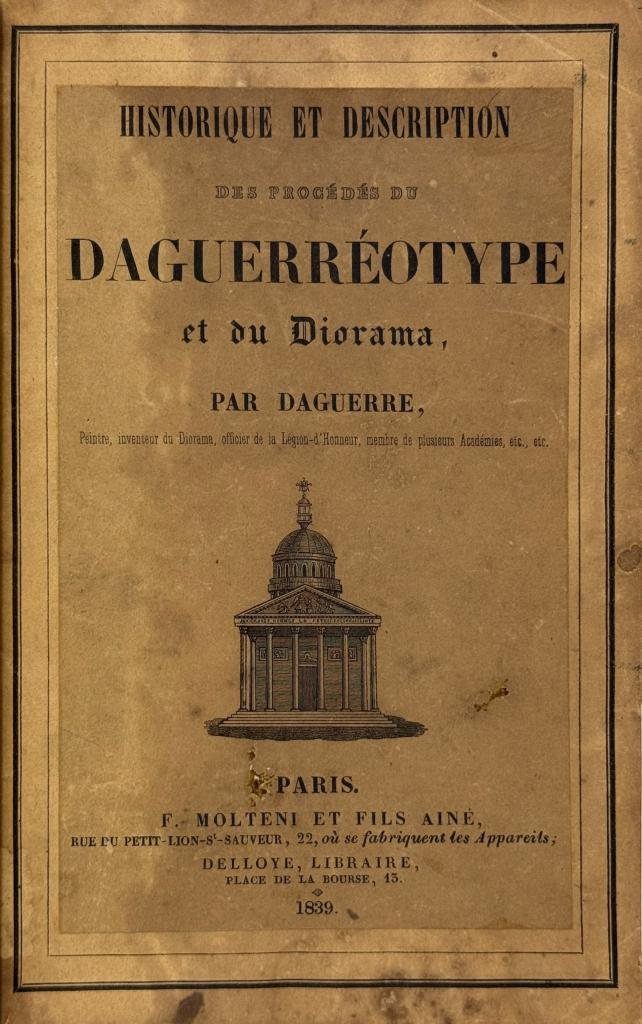
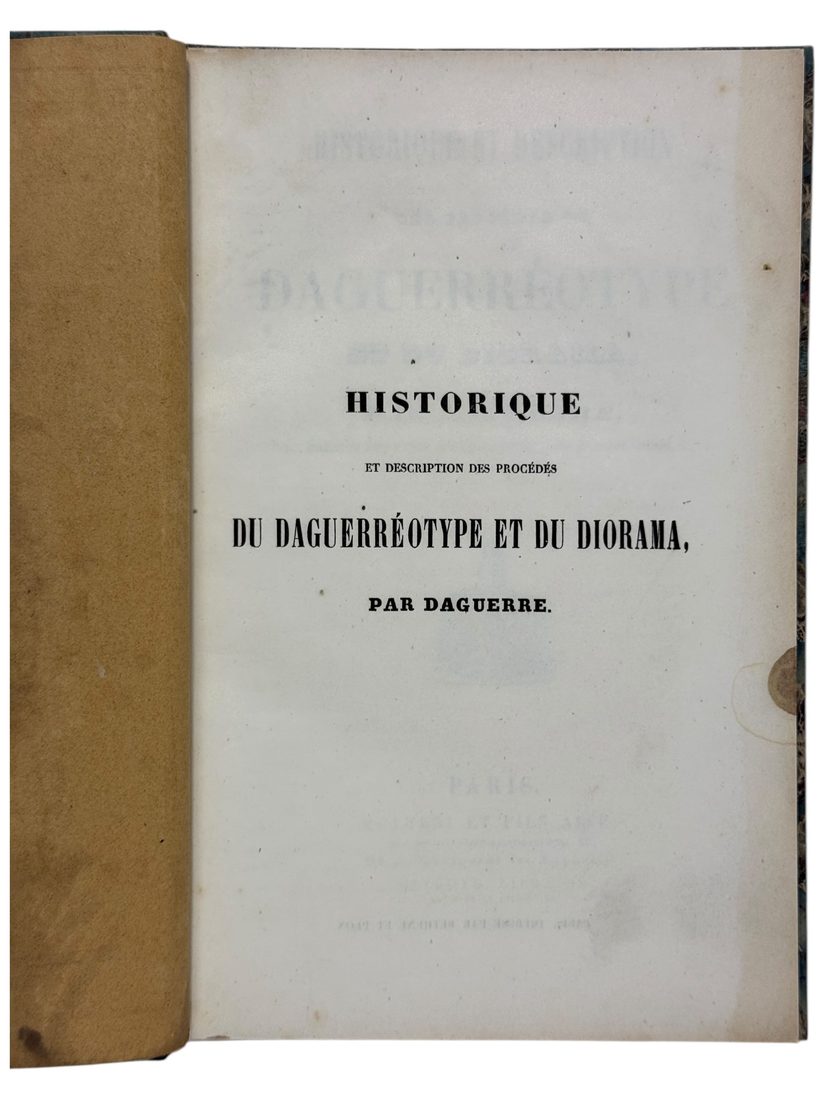
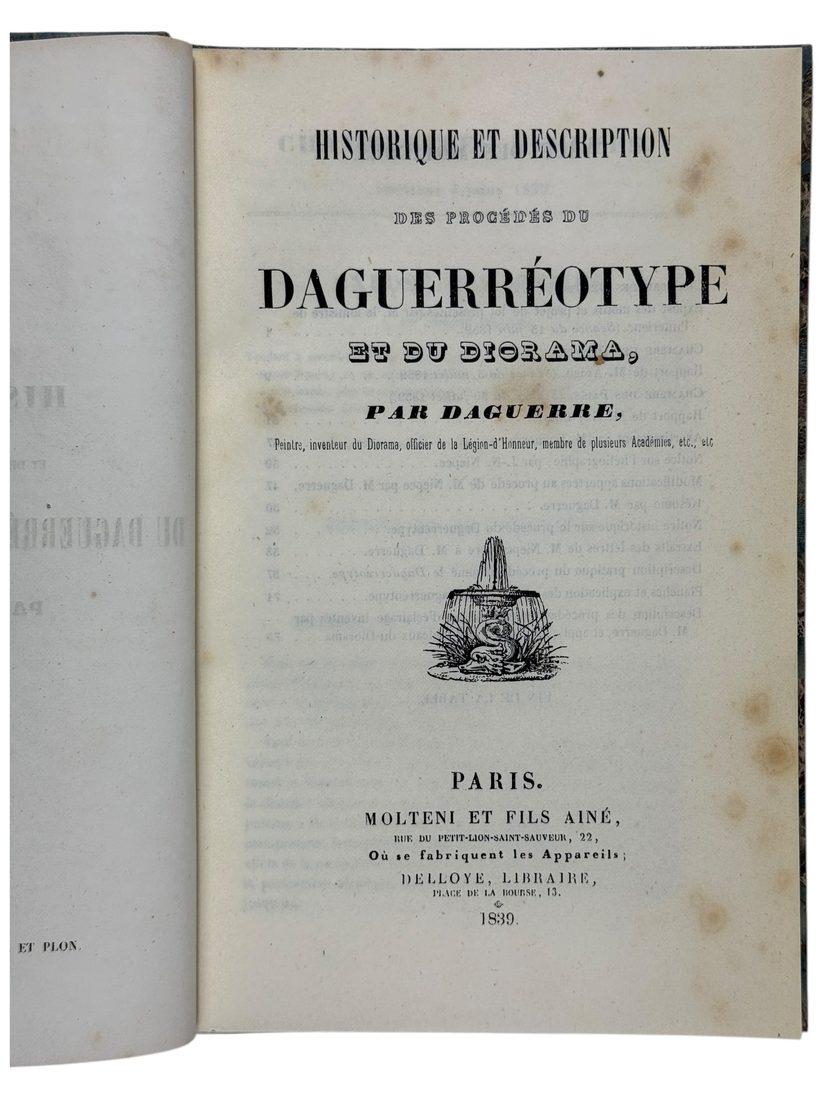
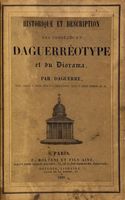
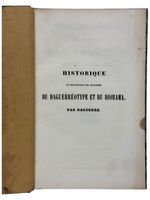
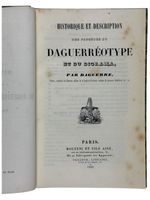
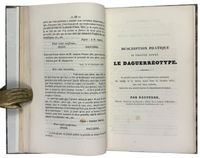
Daguerre, Louis Jacques Mandé. Historique et description des procédés du daguerréotype et du diorama par Daguerre, peintre, inventeur du Diorama, officier de la Légion d'honneur […]. Paris, Molteni et Fils aîné, et Delloye, libraire, 1839.
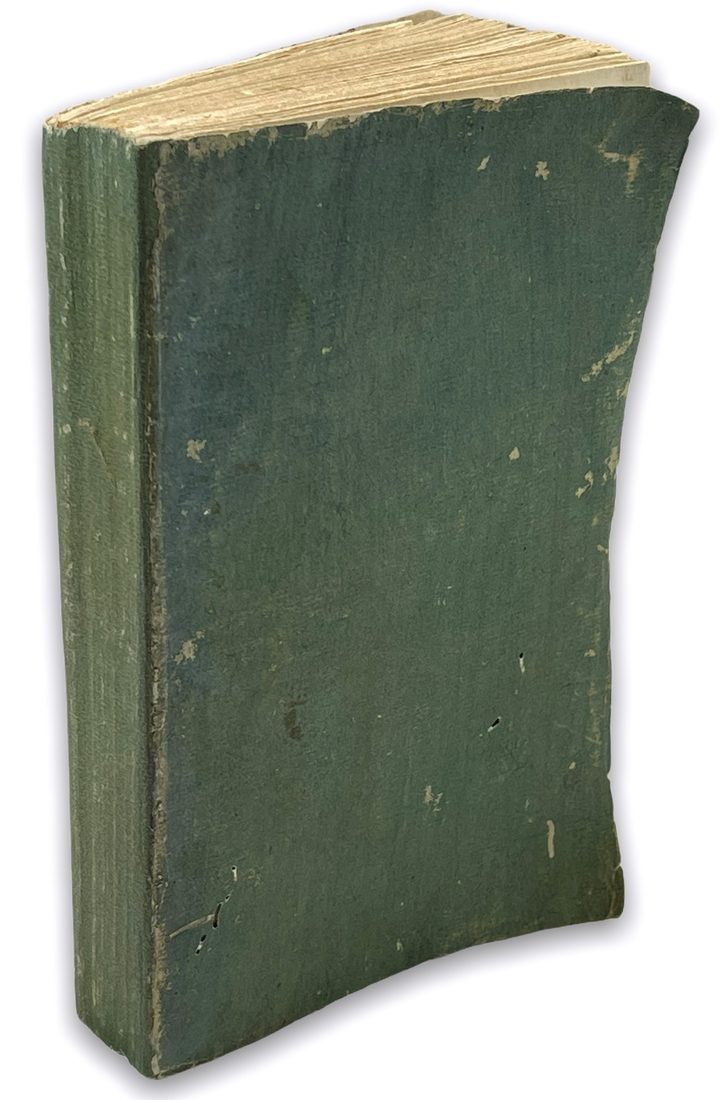
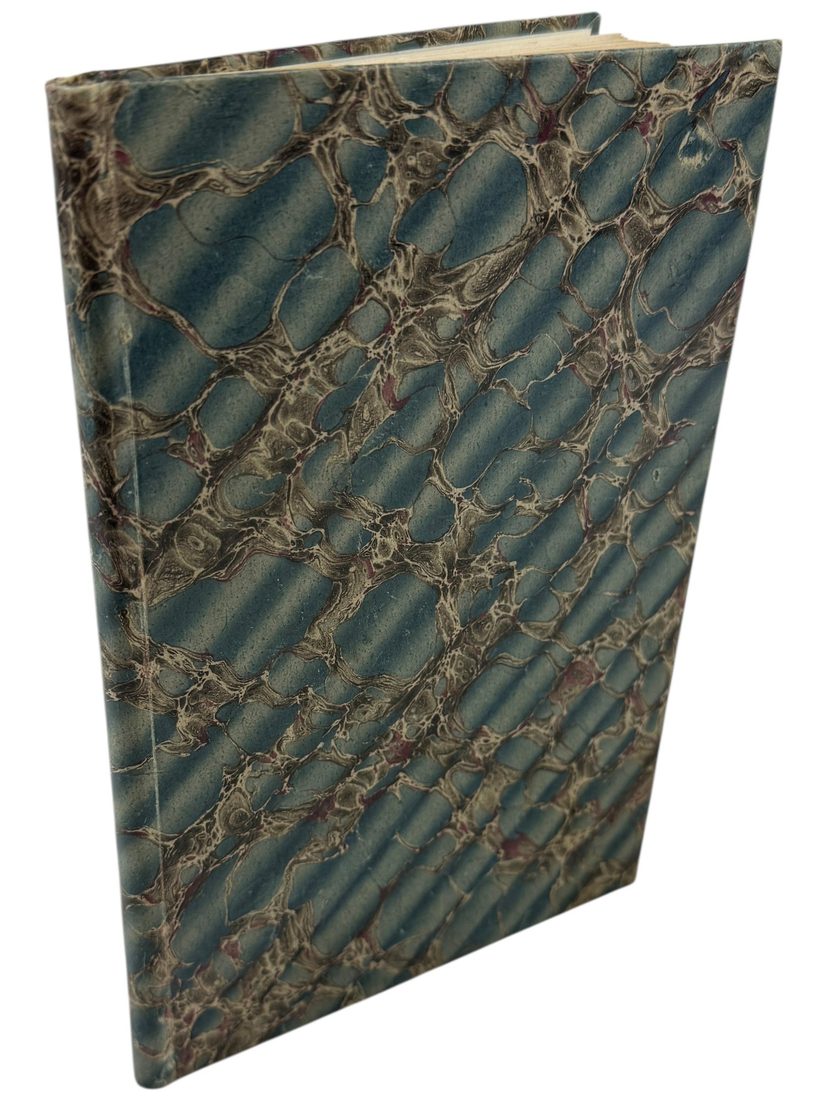
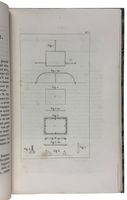
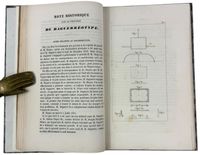
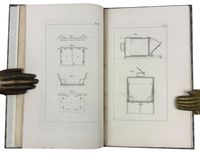
8vo (210 × 135 mm), nineteenth-century marbled paper cartonnage, original printed and illustrated front wrapper preserved and remounted inside, renewed endpapers. ff. [2], pp. 79, [1]. Six lithographed plates hors text on separate leaves. No portrait frontispiece in this Molteni issue; the portrait appears only in later issues.
Daguerre’s authoritative disclosure of his process, linking optical theatre, chemistry, and state sponsorship; a rare witness to the first months of photography’s diffusion.
“No one individual can be called the true inventor of photography, but Daguerre’s technique of fixing photographic images on a metallic surface was the first to capture the public’s curiosity and imagination, bringing photography out of the laboratories of a few researchers into the mass market” (J. Norman).
“The beginnings of photography, a major tool in science” (Horblit).
Foundational printed disclosure of a fully operational photographic process, this is the first manual to standardize every stage from plate preparation to presentation. Daguerre specifies the silvered copper support, progressive iodization of the surface, exposure parameters under different lighting, development by mercury vapor, fixation in common salt, and protective framing of the plate, all accompanied by six didactic plates translating the procedure into reproducible workshop practice. To affirm priority and public access, the volume reprints the law that placed the process in the public domain and the scientific reports by Arago and Gay-Lussac, followed by Niépce’s Notice sur l’héliographie, which secures the genealogy from heliography to daguerreotype. As an instrument of innovation, the book moved photography out of the realm of private experiment and theatrical optics into a codified technology that apparatus makers and opticians could immediately reproduce, initiating the first global photographic practice.
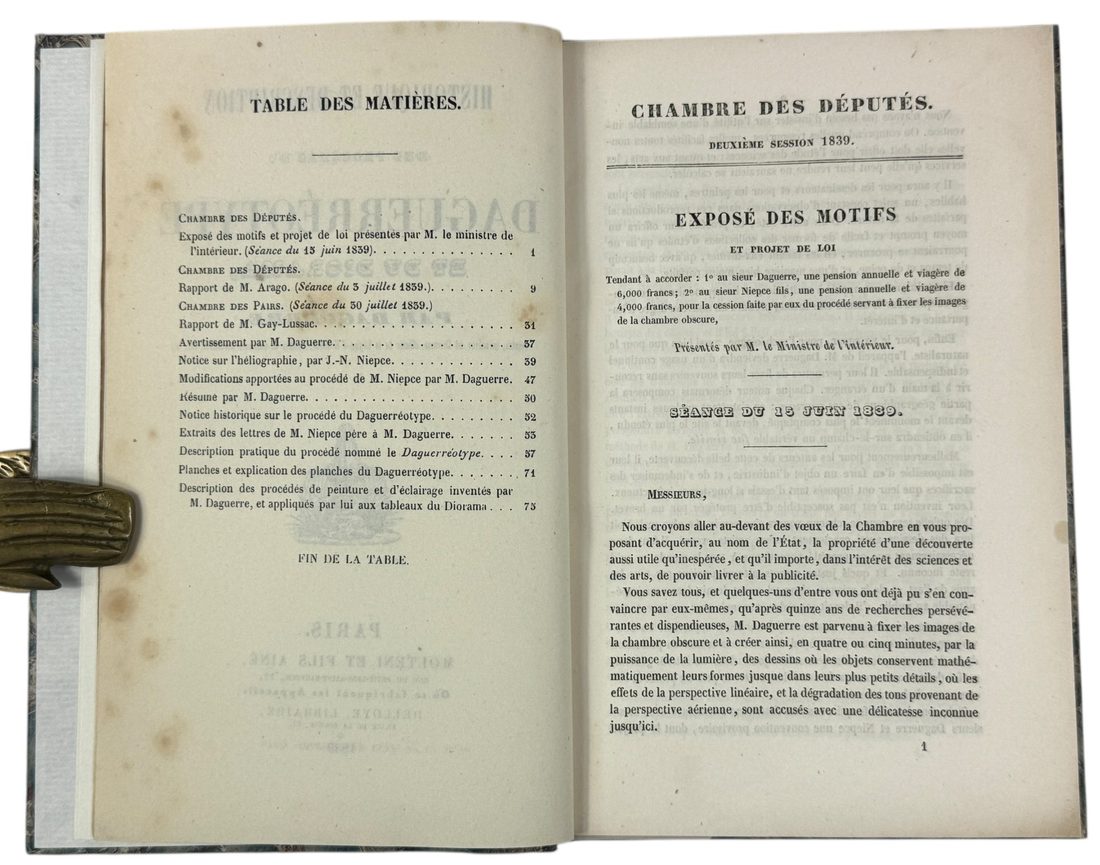
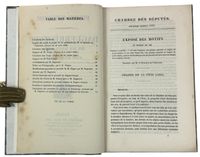
The internal architecture of the volume reflects Daguerre’s intention to provide not merely a technical disclosure but also an official, scientifically and institutionally validated framework for the new photographic process. The sequence follows the order of the printed table of contents, guiding the reader from legislative recognition of the invention to the operative instructions necessary for its full reproduction.
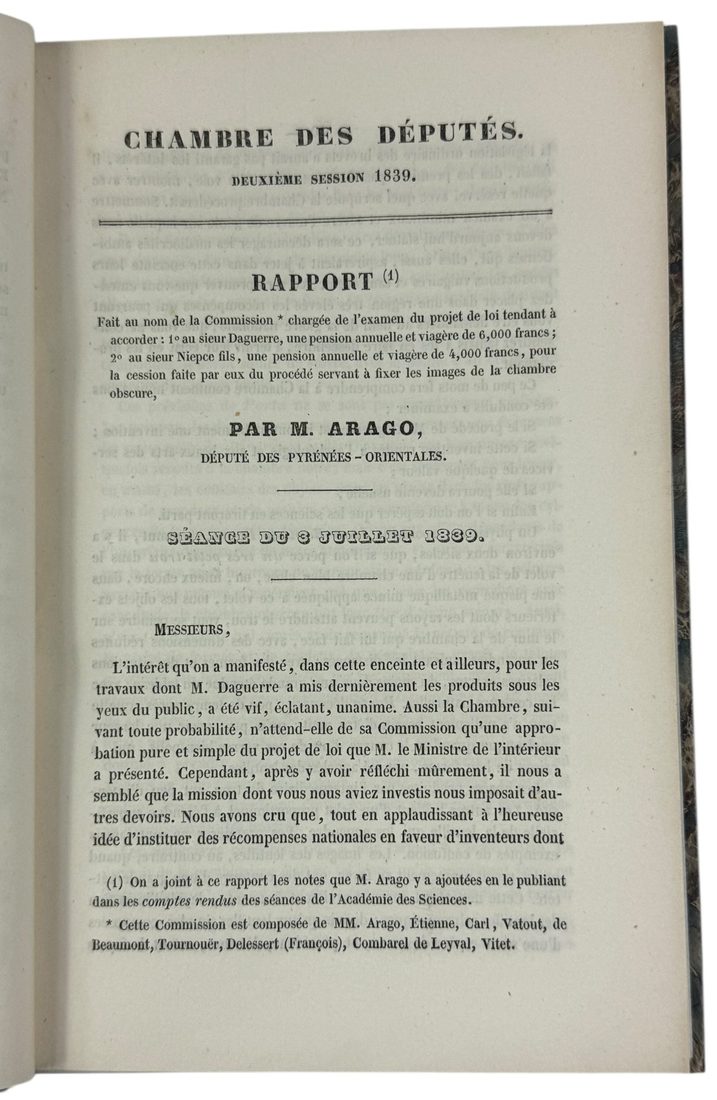
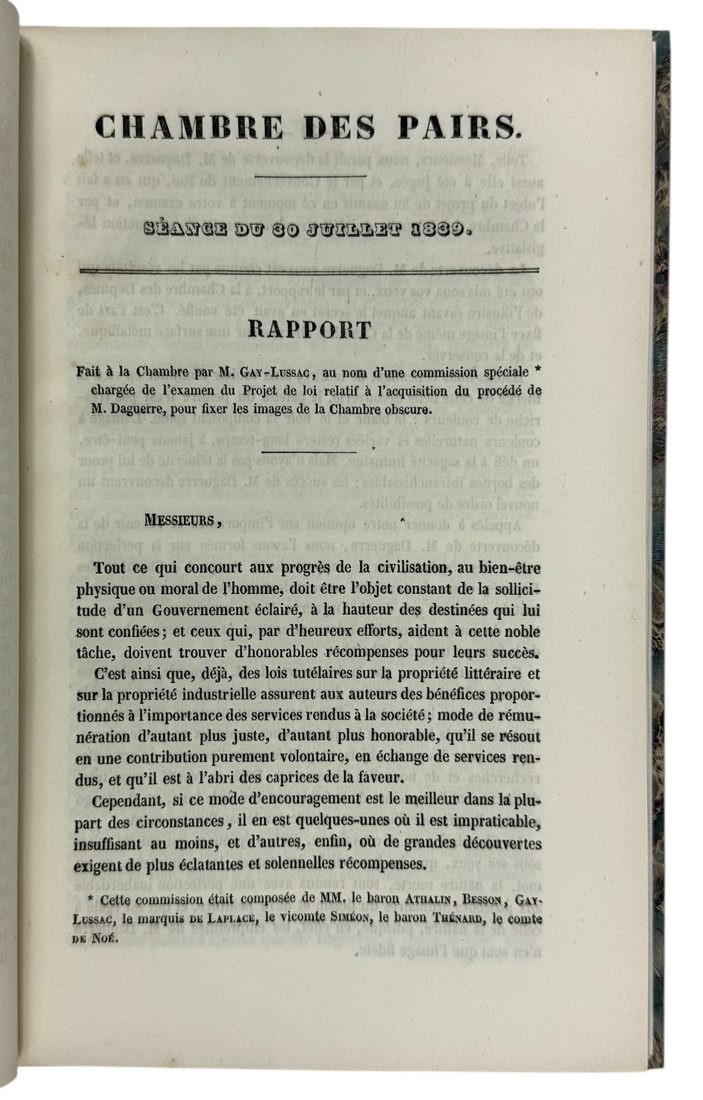
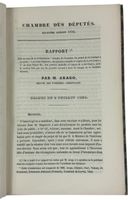
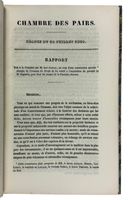
The text opens with the law of 15 June 1839 (p. 1), through which the French state formally acknowledged the invention, granted pensions to Daguerre and to the heir of Nicéphore Niépce, and placed the process in the public domain. This is followed by Arago’s report to the Chamber of Deputies of 3 July 1839 (p. 9), the first authoritative scientific exposition of the method, emphasizing its reproducibility and civic utility. Gay-Lussac’s report to the Chamber of Peers of 30 July (p. 31) offers a chemical justification of the procedure, confirming its scientific legitimacy.
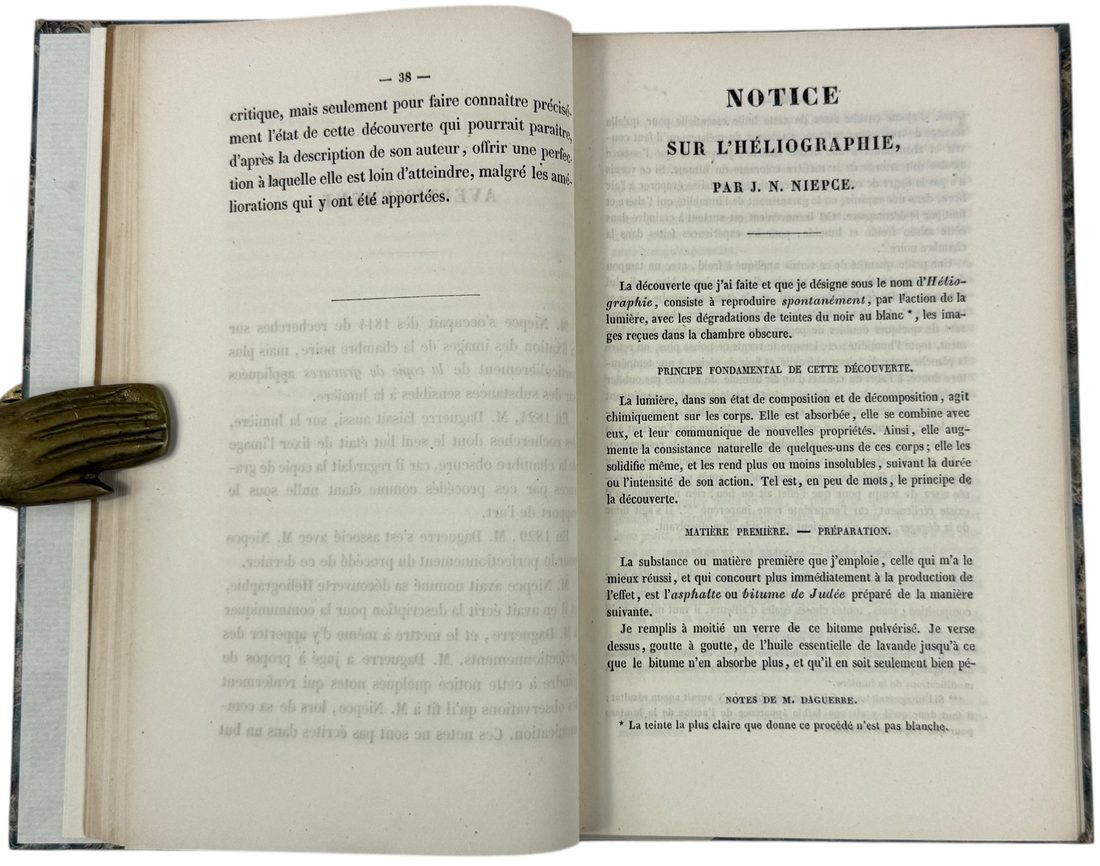
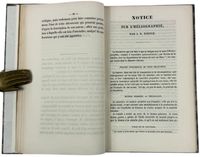
At p. 37 begins Daguerre’s Introduction, preparing the reader for the technical chapters and delineating the conceptual path from the optical experiments of the Diorama to the stabilization of a photographic image on an iodized silver surface. The following section, Niépce’s Notice sur l’héliographie (p. 39), is of exceptional historiographical significance: it documents the origins of heliography and secures the intellectual lineage connecting Niépce’s early experiments with Daguerre’s later refinements. The subsequent Modifications apportées au procédé de M. Niépce par M. Daguerre (p. 47) details the innovations that transformed heliography into a viable photographic process—most notably the adoption of silvered copper plates, controlled iodization, shortened exposure times, and mercury development.
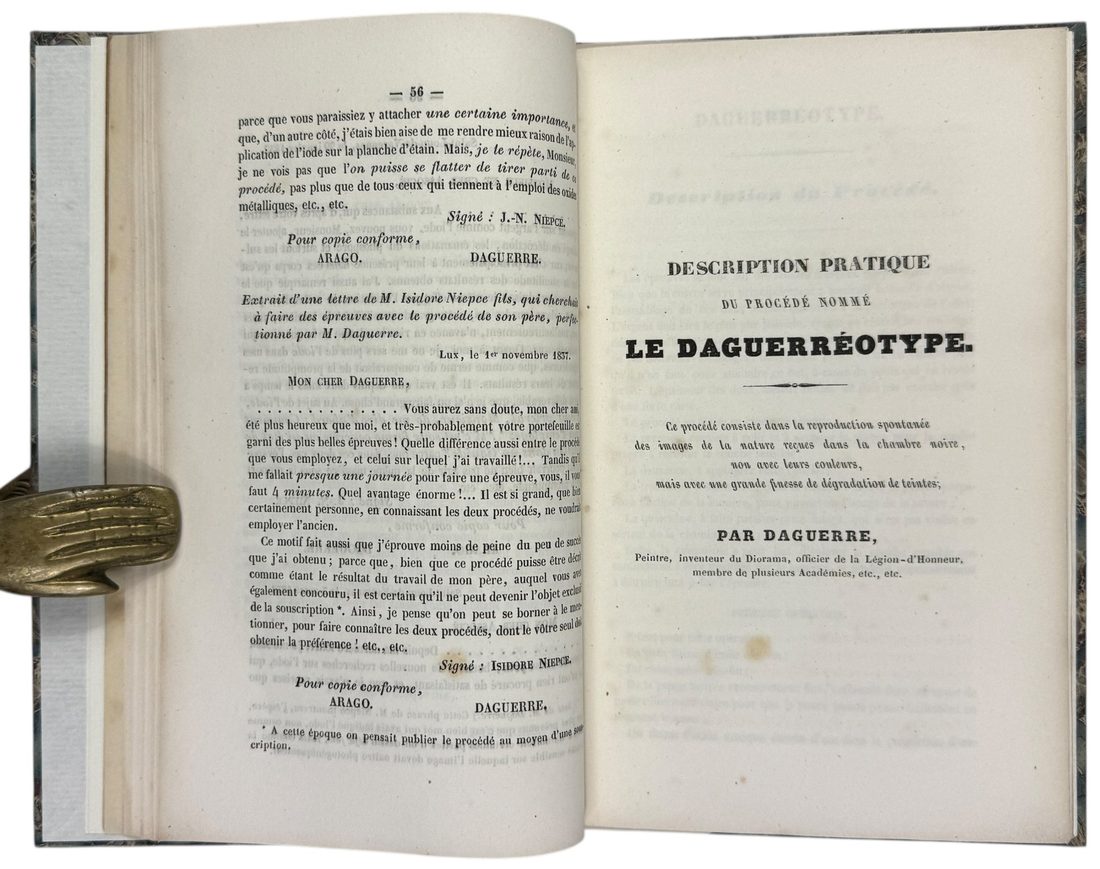
Daguerre then offers a Résumé (p. 50) and Notice historique (p. 52), retracing the experimental progression that led to the definitive formulation of the daguerreotype. This is followed by excerpts from Niépce’s letters to Daguerre (p. 55), shedding light on the intellectual partnership underlying the invention.
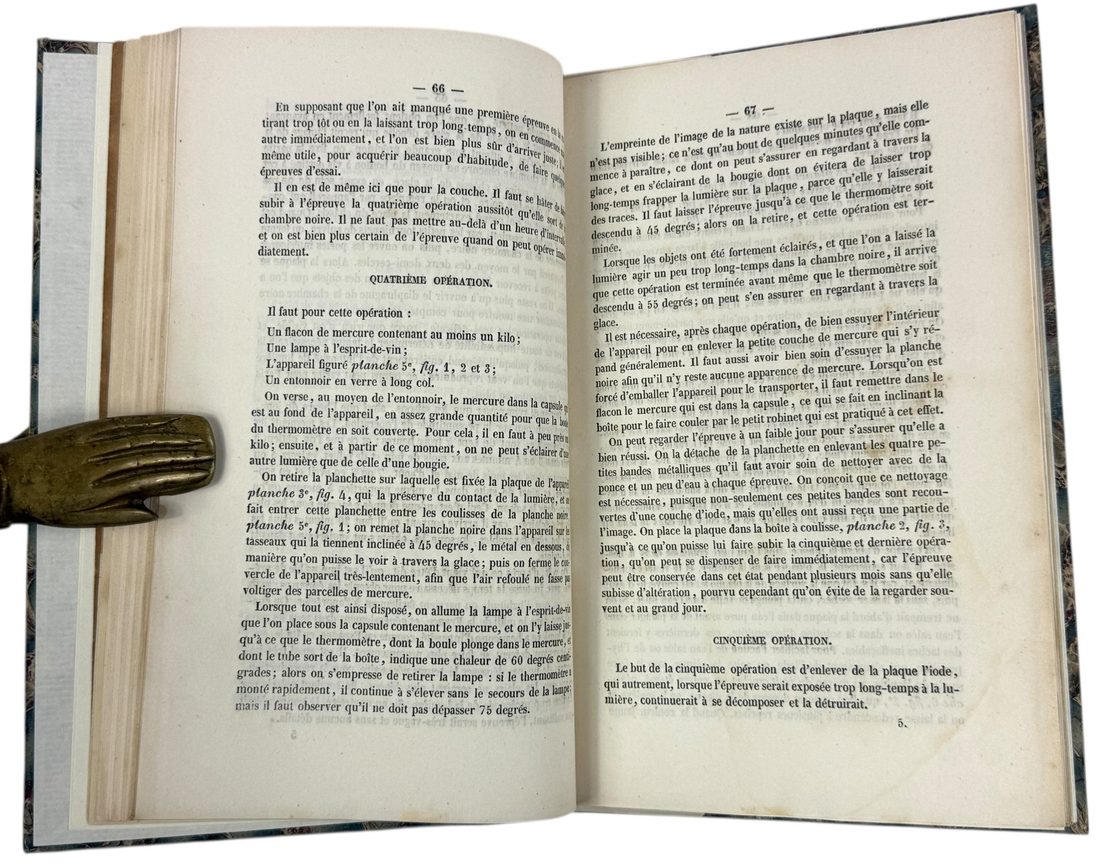
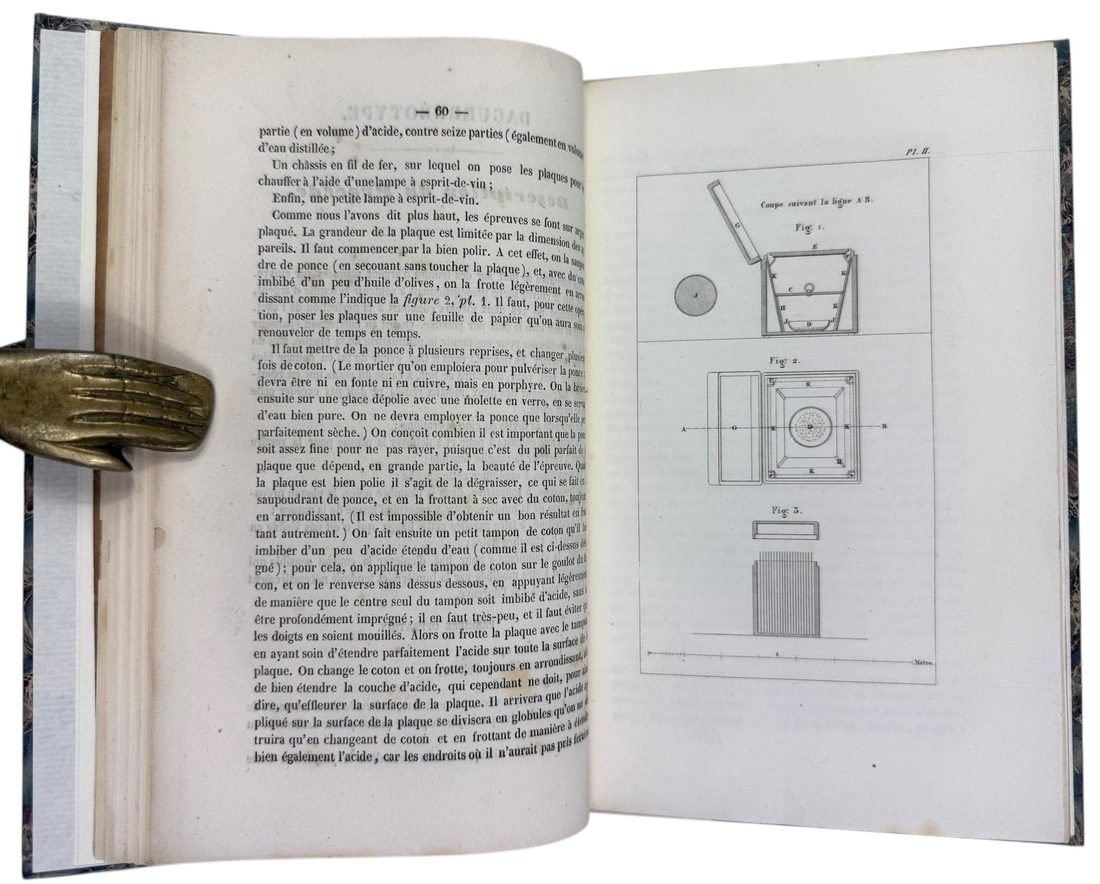
The core of the manual begins at p. 57, setting out a complete procedure intended for competent workshops. The instructions cover the preparation of silvered copper plates to a mirror finish, controlled iodization by exposure to iodine fumes until the desired chromatic stage of silver iodide is reached, exposure under calibrated lighting, development above heated mercury, fixation in a saline bath, washing, and final presentation of the image under glass.
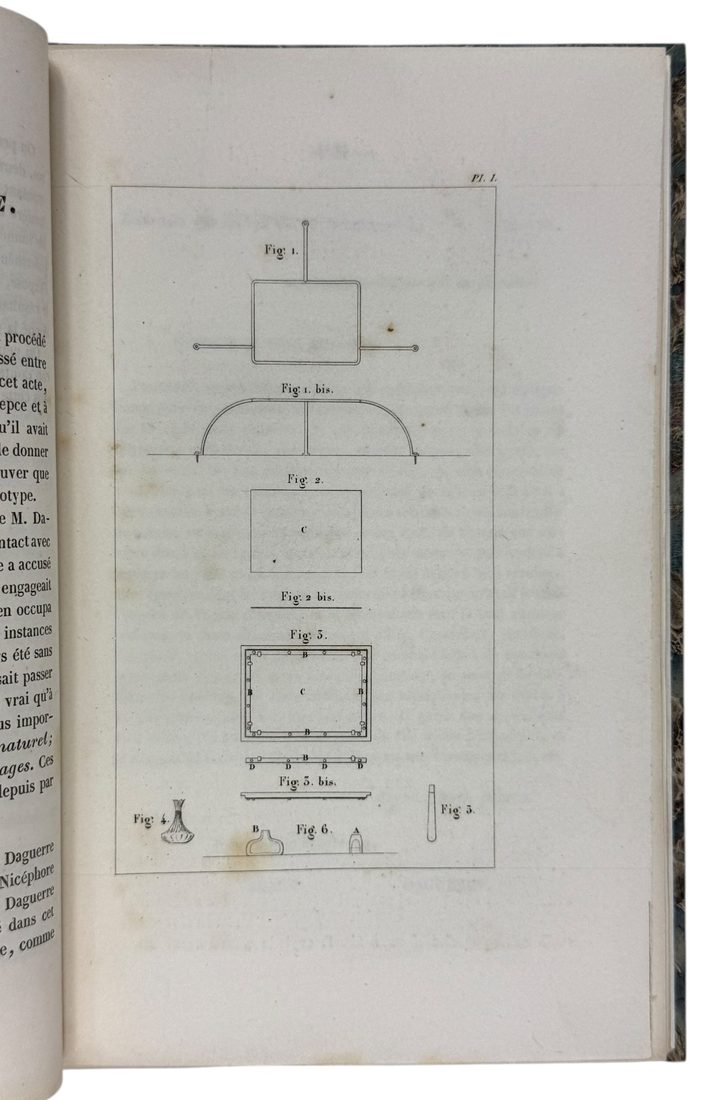
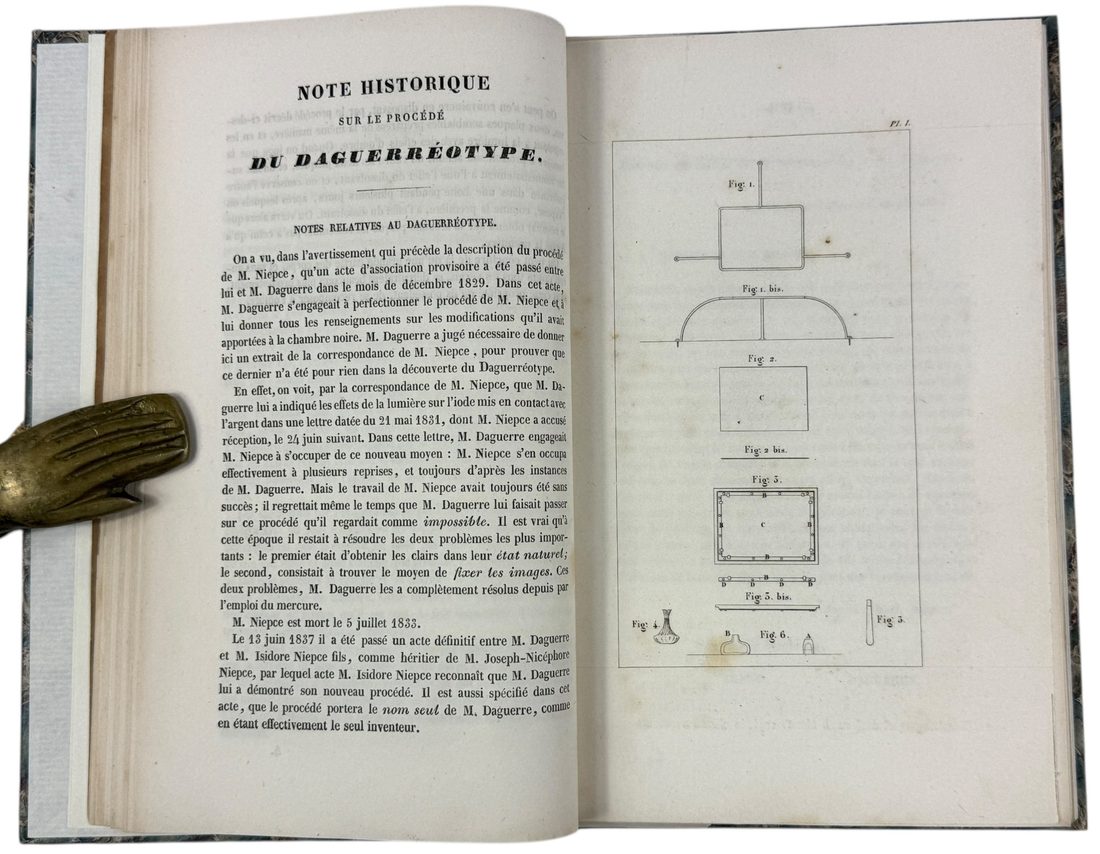
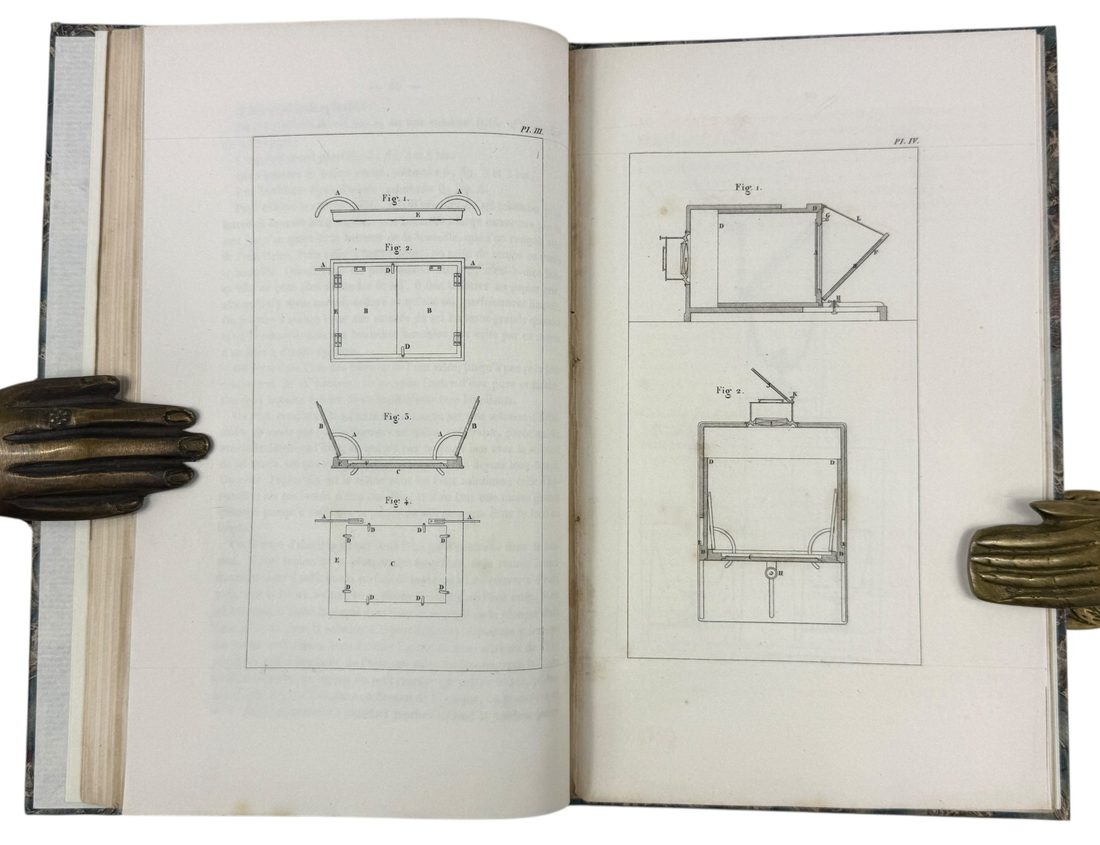
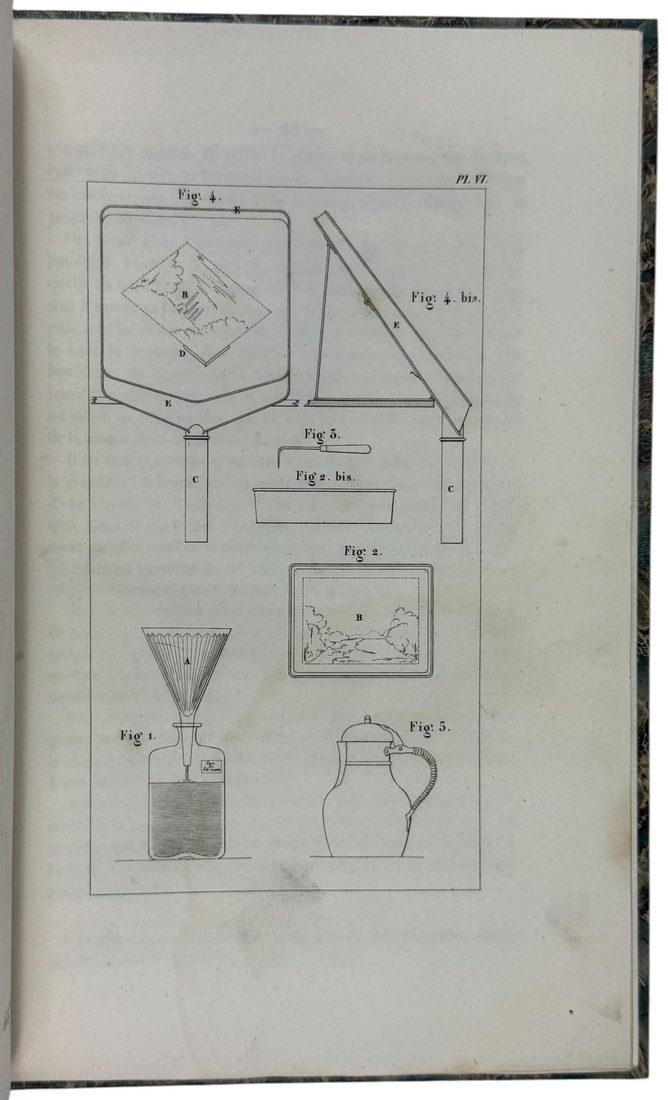
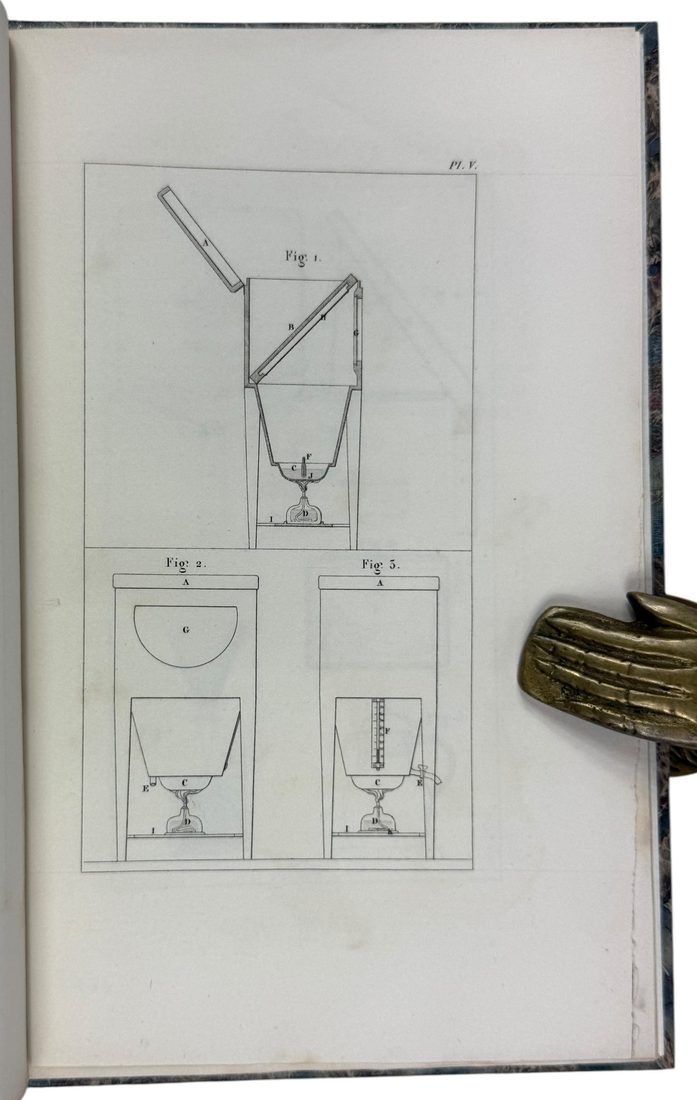
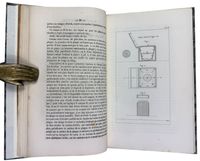
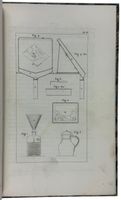
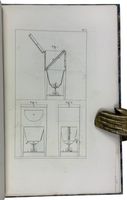
The six engraved plates, introduced on p. 71, serve as precise workshop schemata. They depict the camera, iodine box, mercury apparatus, plate holders, stands, and related components, enabling artisans and opticians to reproduce the equipment exactly as Daguerre intended.
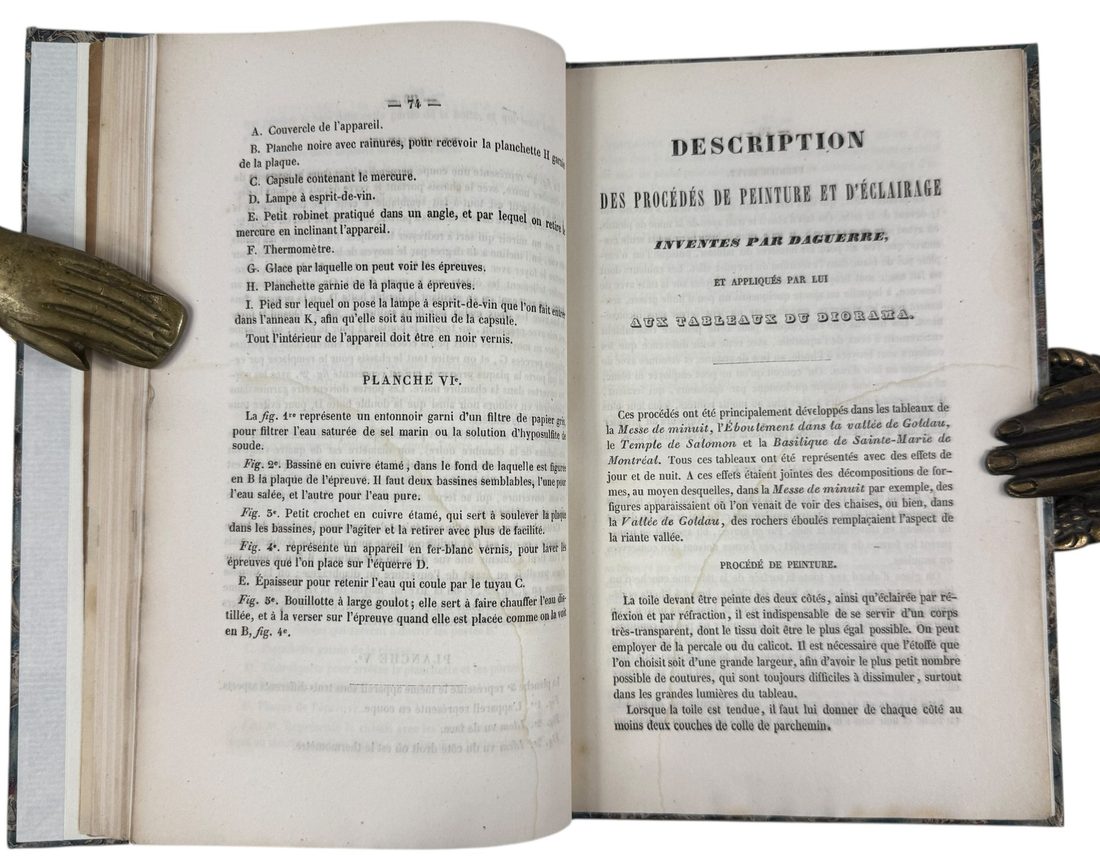
The volume concludes at p. 75 with a description of Daguerre’s earlier innovations in painting and illumination for the Diorama. This section highlights the conceptual continuity between his studies of luminous transitions and perspective effects in scenic art and his subsequent discovery of the photographic image, underscoring the interdependence of artistic experimentation and scientific innovation.
The Paris first edition of 1839 circulated from a single setting in four imprint issues, Susse Frères, Alphonse Giroux et Cie, Lerebours, and Molteni et Fils aîné. The distinctions are confined to wrapper and title imprints and to any publisher advertisements, while the text and the six plates remain invariant page‑for‑page. Distribution appears to begin with Susse, followed within days by Giroux and Lerebours, with Molteni, an optician and supplier of apparatus, entering slightly later in the autumn of 1839 to align his stock with a house‑imprint manual for clients. Later in 1839 a second wave of augmented issues introduced a portrait and short practical additions without altering Daguerre’s core disclosure; these belong to the same year but are bibliographically later than the four initial imprints.
Arago’s interventions in 1839 established the civic and scientific framework that transformed a private experiment into a public technology, and Daguerre’s manual served as its operative charter. By codifying apparatus, chemistry, and workflow, the book created a common technical language for opticians, chemists, artists, and artisans, enabling immediate teaching, demonstration, and production. Its impact was immediate and far-reaching: within months, dedicated studios appeared in major cities, public and scientific bodies commissioned views, and the process entered travel, commerce, and administration. The manual also catalyzed technical evolution by providing a baseline against which improvements were measured—from the adoption of thiosulfate as fixer and bromine or chlorine accelerants to faster portrait lenses and more sensitive plates—refinements that perfected, rather than replaced, Daguerre’s original protocol. Artistically, the text bridges theatre and image-making: lessons of the Diorama in staging, light, and contrast migrated into a new medium that redefined portraiture, architectural and topographical record, and the graphic arts. Culturally, it inaugurated a reproducible instructional model that underpinned subsequent treatises and translations, establishing photography as an autonomous field of practice and knowledge.
Louis Jacques Mandé Daguerre (1787–1851), trained as a scene painter, achieved renown with the Paris Diorama, an immersive luminous theatre. From the 1820s he pursued the chemical fixation of the camera obscura image, forming a partnership in 1829 with Nicéphore Niépce, whose death in 1833 left Daguerre to perfect mercury development on iodized silver and to collaborate with Arago for the official disclosure. The 1839 manual constitutes his major printed work and remains the canonical source for his process. Its authority derives from the combination of authorial exposition and appended governmental and academic reports, which together defined the scientific and legal status of photography at birth.
Dominique François Jean (François) Arago (1786–1853) French physicist, astronomer, and statesman, was trained at the École Polytechnique and later joined the Bureau des Longitudes and the Paris Observatory. His work on geodesy with Jean-Baptiste Biot extended the meridian arc toward the Balearic Islands, fundamental to the metric system’s geodetic basis. A leading experimentalist in optics and electromagnetism, Arago decisively supported the wave theory of light, experimentally verified Fresnel’s diffraction theory (the Arago/Poisson spot), and discovered magnetic rotations in conducting disks—an early manifestation of electromagnetic induction. In 1830 he became Perpetual Secretary of the Académie des Sciences and, effectively, director of the Paris Observatory; in 1848 he served in the Provisional Government as Minister of War and Marine, and was a prominent advocate of the abolition of slavery
Conditions: Light foxing throughout; overall a very good copy of a rare issue.
References: J. Carter and P. Muir, Printing and the Mind of Man, no. 318b, London: Cambridge University Press, 1967; J. Norman, The H. Norman Library of Science and Medicine, San Francisco: Dorset Press, 1991, no. 569; N. Horblit, One Hundred Books Famous in Science, New York: Grolier Club, 1964, no. 21a; H. Gernsheim, The History of Photography, London: Thames and Hudson, 1969, pp. 70-71; P. Harmant, Daguerre’s Manual, a Bibliographical Enigma, in History of Photography, vol. 1, 1977, pp. 79–83; J. Hannavy, ed., Encyclopedia of Nineteenth-Century Photography, New York:Routledge, 2013, pp. 363-366.
The Haskell F. Norman Library of Science and Medicine, Auction Catalogue, New York, Christie’s, 1998, no. o1004 (first edition, second issue), estimate $6,000–8,000.