De Waarzegster Mlle Lenormand (36 oracle cards)
| Macro-category | Playing Cards and Tarot |
| Subcategory | Divination (Cards, Games & Devices) |
| Author | Mlle Lenormand |
| Provenance | Coblenz |
| Publisher / Maker | J.B. Ruhl |
| Year | 1850 |
a complete early Koblenz edition of the «Petit Lenormand»:
Rühl’s foundational contribution to nineteenth-century cartomancy
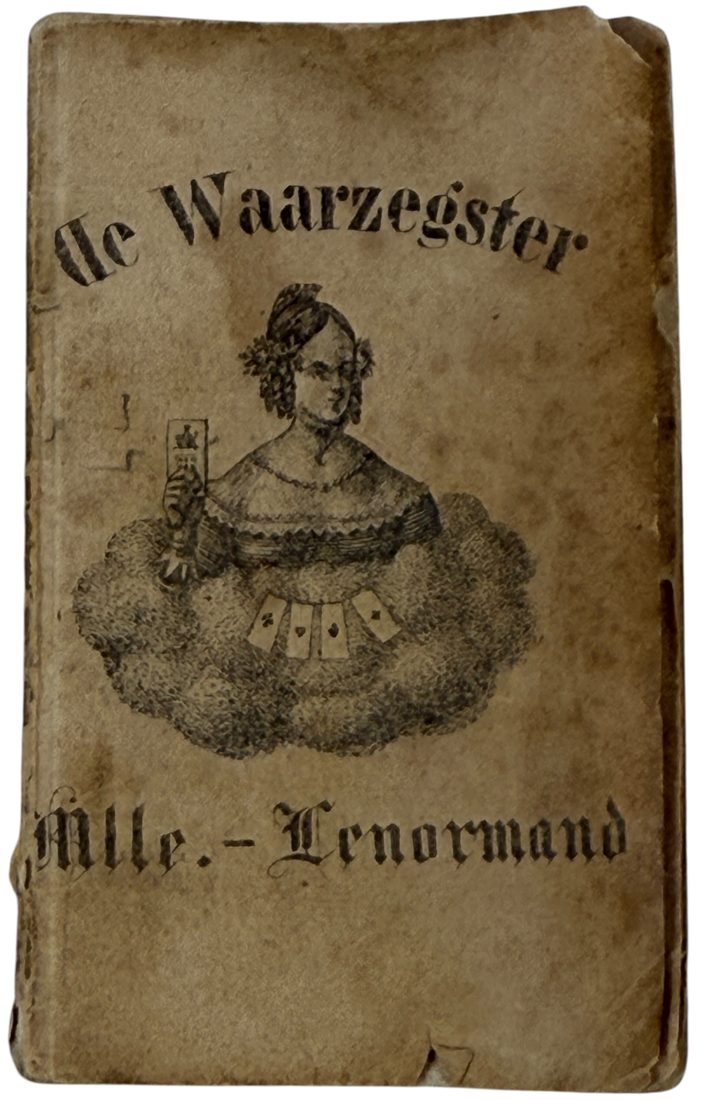
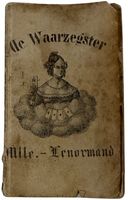
[Divination Deck]. De Waarzegster Mlle. Lenormand [Petit Jeu de Mlle. Lenormand]. Koblenz, Johann Baptist Rühl, ca. 1850.
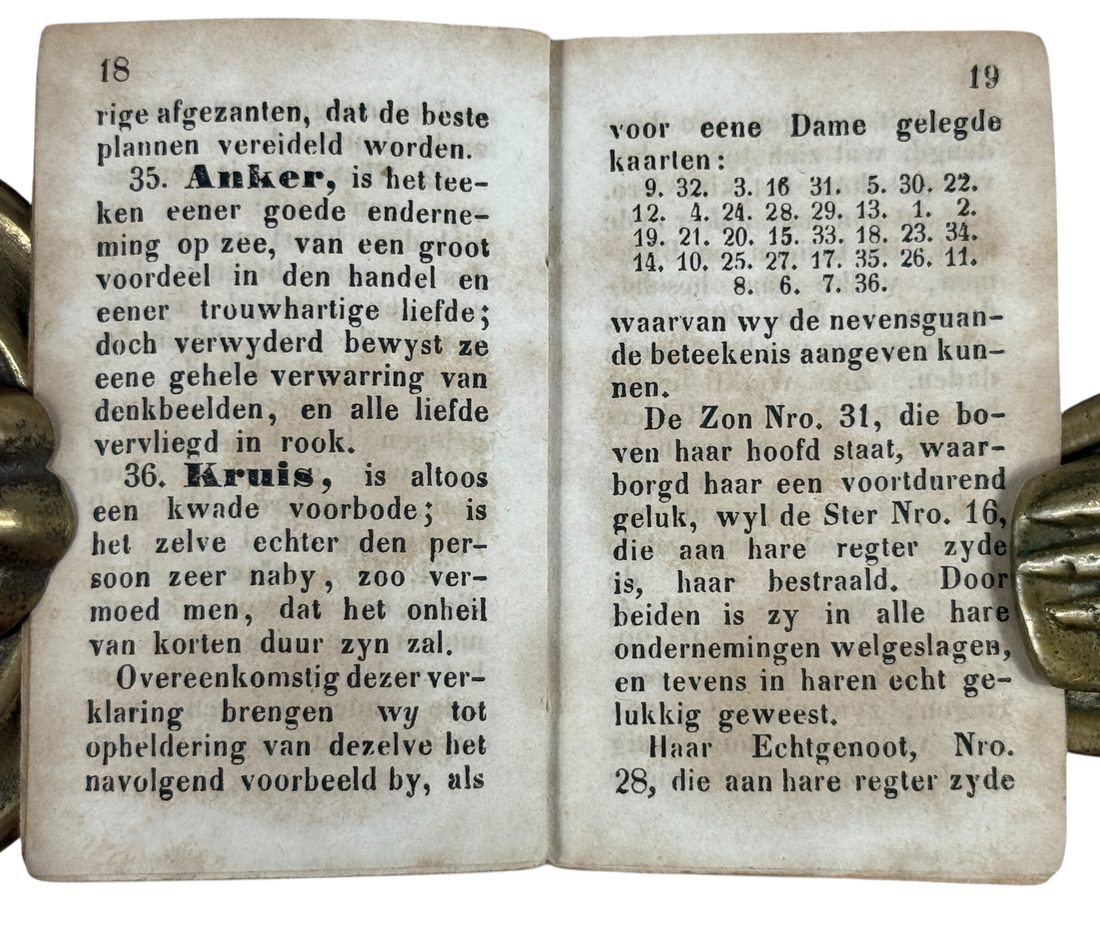
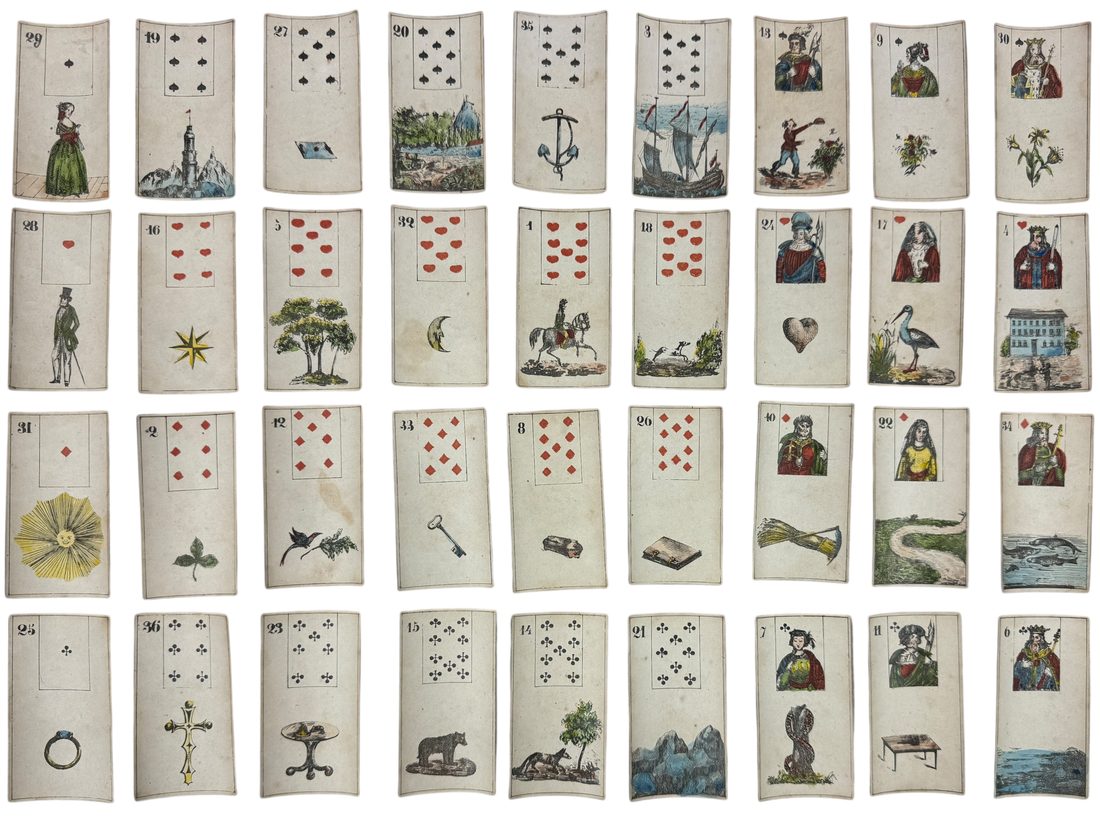
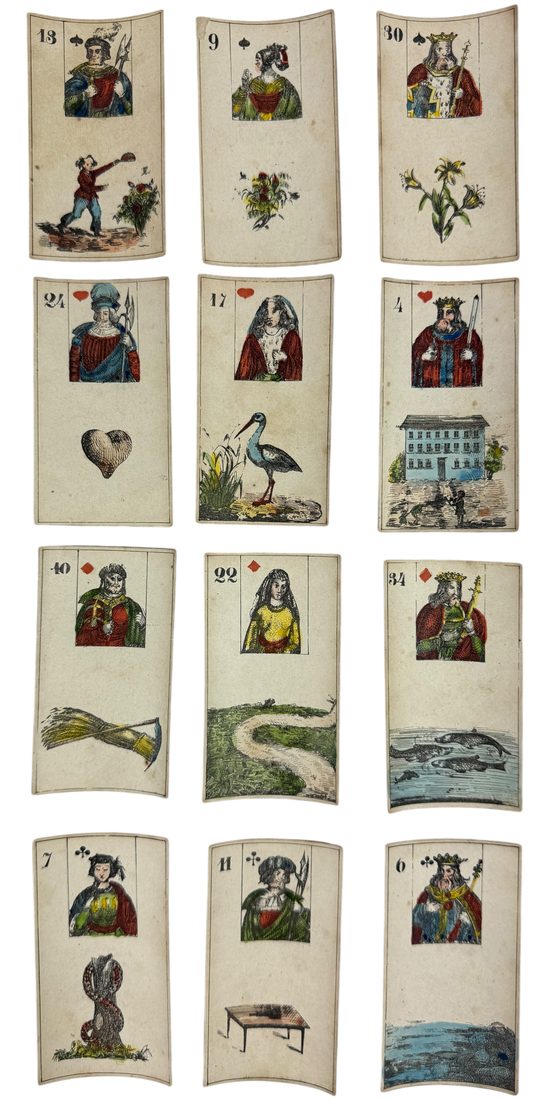
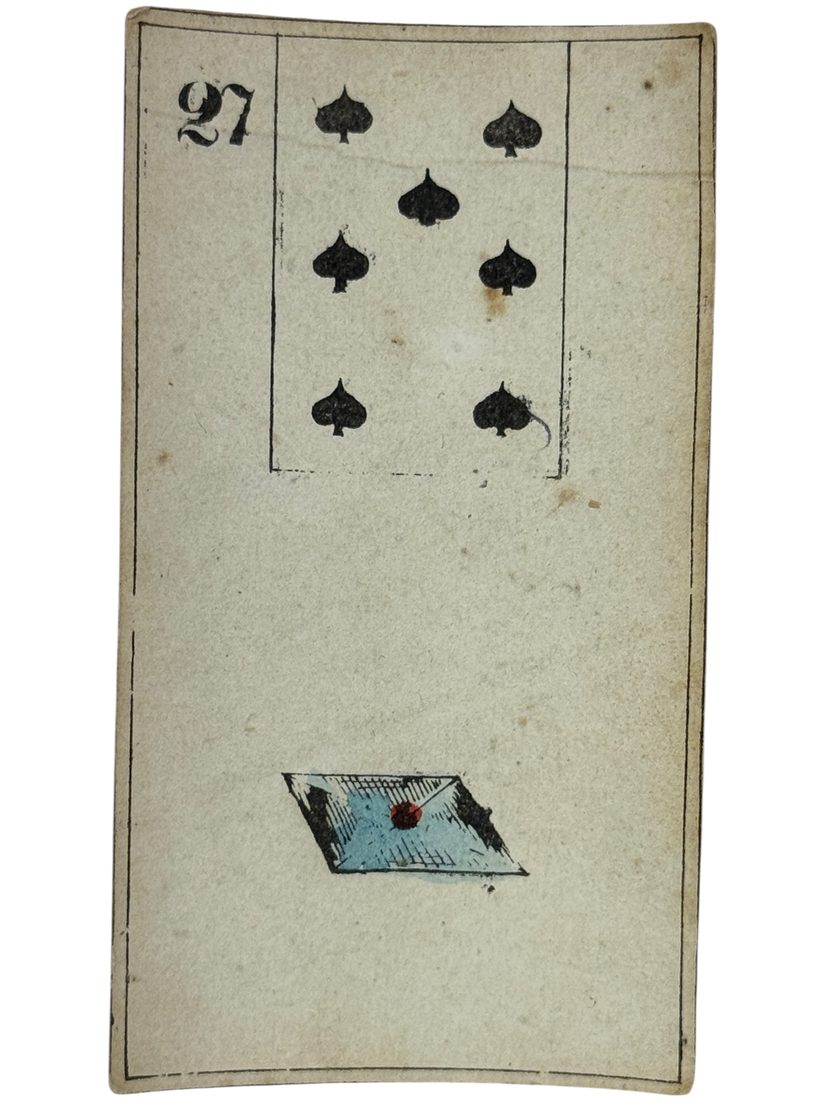
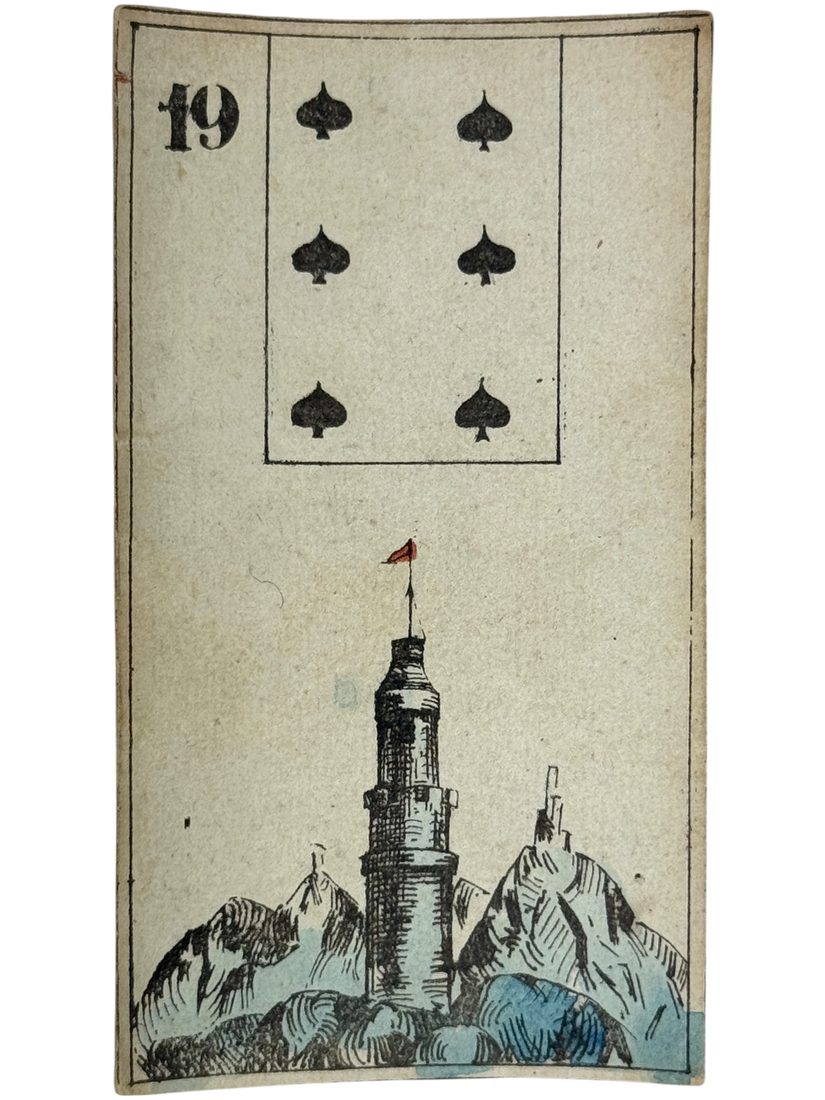
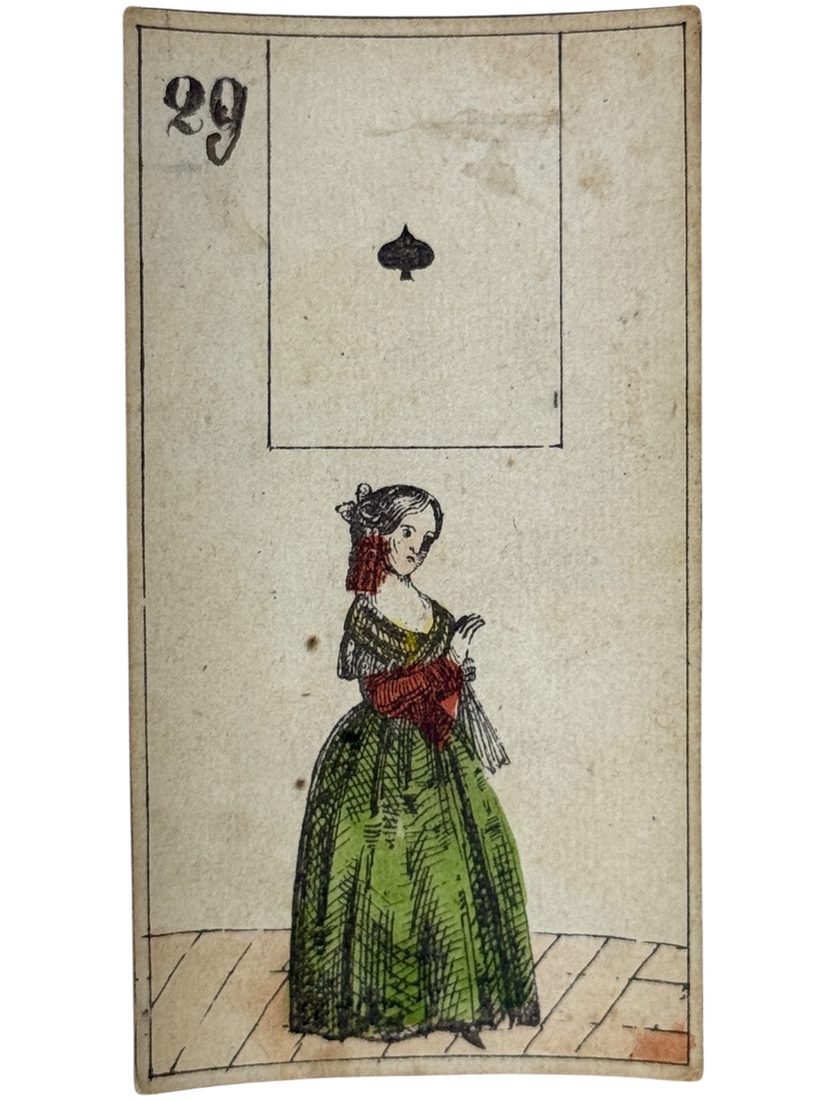
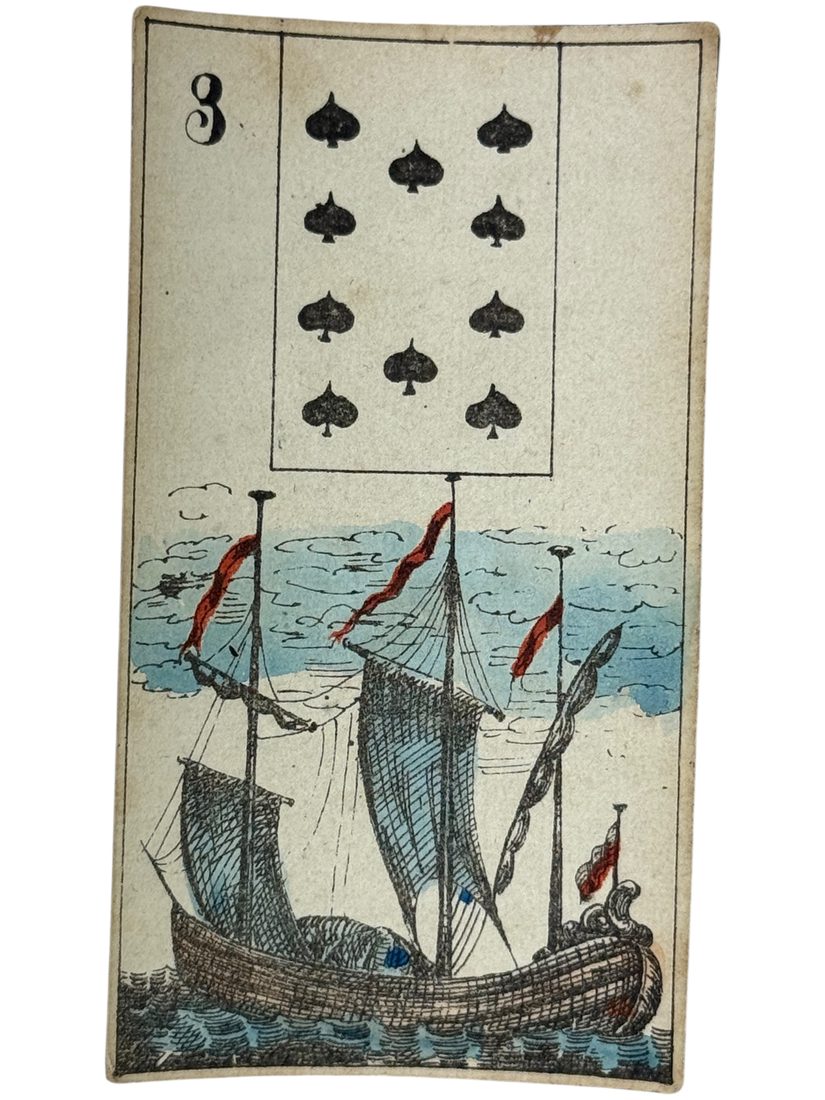
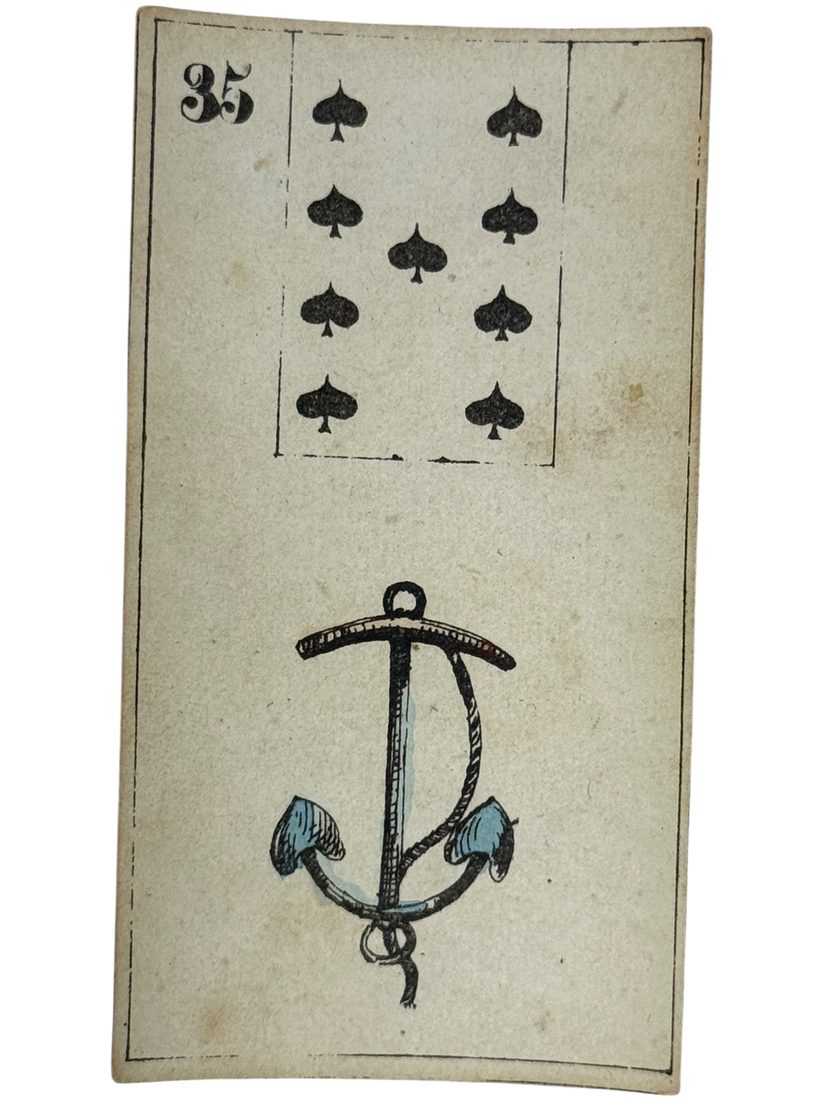
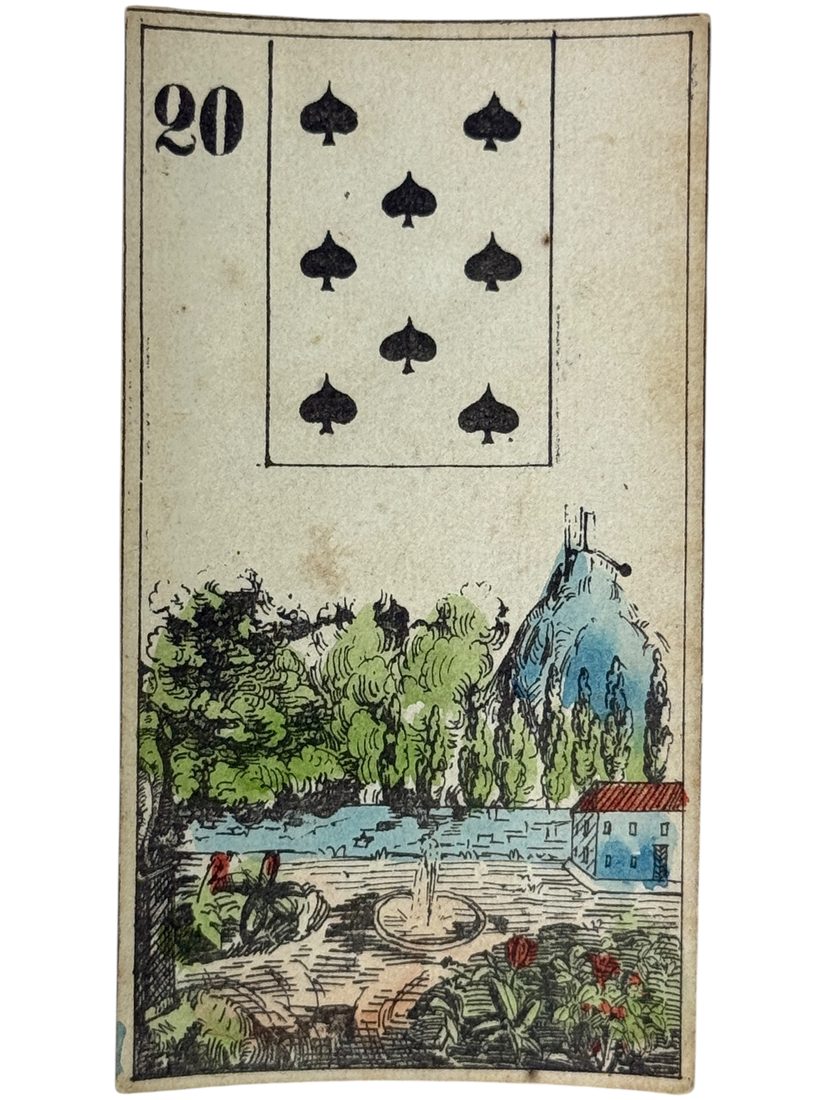
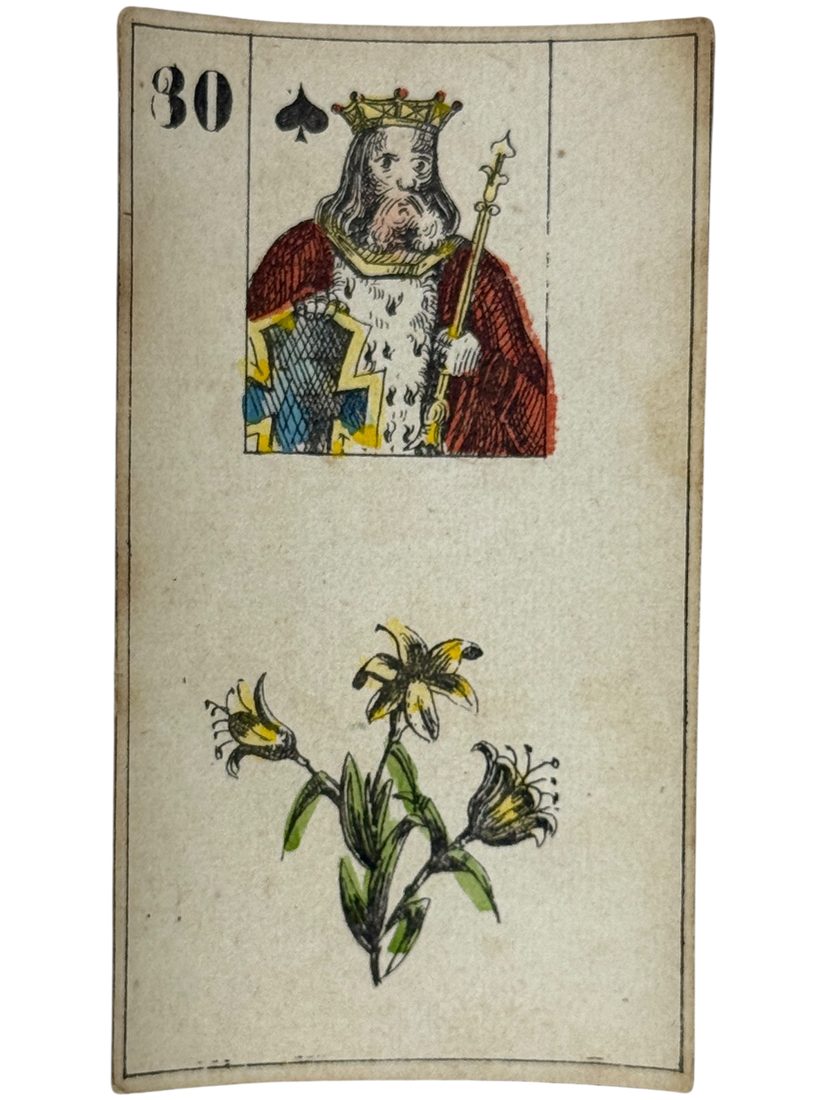
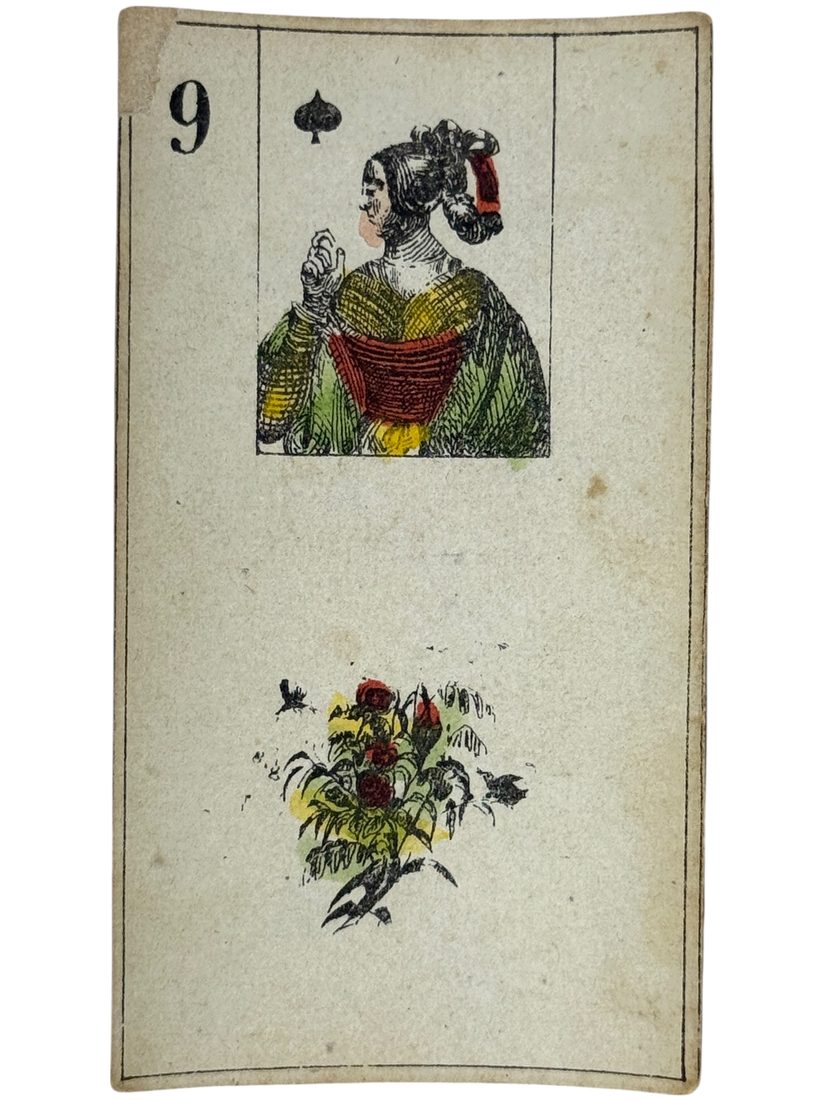
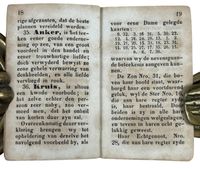
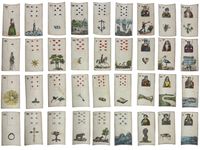
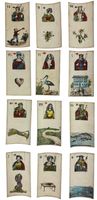
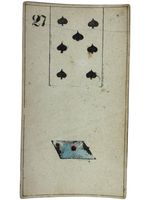
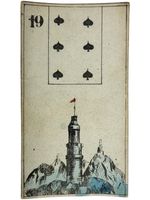
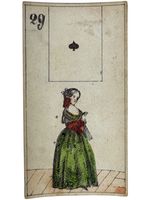
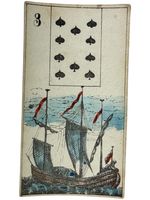
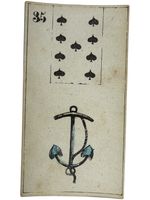
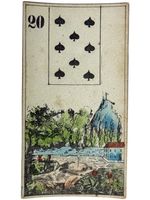
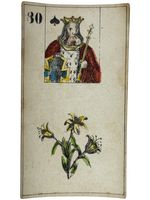
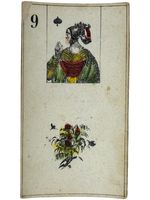
36/36 divinatory cards (75 × 45 mm) lithographed and partially hand-coloured. Each card bears at the top its progressive number from 1 to 36 together with the indication of the corresponding French-suit playing card. The principal image, occupying half the card, depicts an allegorical or symbolic subject rendered in a naïve style, with essential outlines and restrained colouring. The backs are uniformly decorated in a cream tone, embellished with a fine pattern of small dots arranged for ornamental effect. The deck is preserved with its contemporary instruction booklet, entitled De Waarzegster Mlle. Lenormand, in Dutch, with a woodcut on the title-page depicting the fortune-teller in the act of displaying the cards.
The deck was published in Koblenz by Johann Baptist Rühl around 1850, at a time when the name of Mlle. Lenormand was frequently employed as an editorial brand for works of divination. The Rühl edition represents one of the earliest and most significant testimonies of the transition from the so-called Spiel der Hoffnung devised by Johann Kaspar Hechtel (1799), a board game of 36 illustrated cards conceived as a family pastime and entertainment, in which participants advanced along a numbered path to the final square represented by the Anchor, towards the standardized form of the Petit Jeu de Mlle. Lenormand.
Compared with contemporary publications, the Koblenz edition is distinguished by the small format of the cards, the simplicity of the lithographic execution, and the inclusion of a 24-page booklet that systematized the rules and interpretations in a language accessible to a wide readership. Rühl’s editions appeared both in German and in Dutch, a clear indication of the publisher’s intent to address diverse markets in Central and Northern Europe. These printings were among the first to disseminate the 36-card model within the German-speaking world, establishing a corpus that inspired numerous later publishers, including Reiff in Vienna, Dondorf in Frankfurt, Vereinigte Stralsunder and Altenburger. From these roots emerged an iconographic and symbolic canon that spread throughout Europe and became the foundation of the nineteenth-century Lenormand Sibyl tradition.
From an iconographic perspective, the Rühl deck preserves the graphic framework of Hechtel’s Spiel der Hoffnung of 1799: thirty-six numbered vignettes each representing a familiar symbol (Rider, Clover, Ship, House, etc.), every one of them associated with a French-suit playing card. Unlike the prototype, which included German suits as well, Rühl’s edition retained only the French suits, a choice that contributed decisively to the standardization of the divinatory system.
The thirty-six cards reproduce the figures established in the tradition of the Petit Lenormand, each marked with a number and a French suit. The iconographic program is simple and direct: the Dog signifying fidelity, the Heart love, the Cross destiny or burden. Each card presents an easily recognizable scene, often drawn from daily life or archetypal symbols, enabling an immediate mental association between image and divinatory meaning. The clarity of these figures, together with their correspondence to the French suits, constituted the strength of the divinatory system, which gained widespread success in Central Europe. This coherence, combined with the uncluttered imagery, free from superfluous elements, made the Petit Lenormand a versatile instrument, equally suited to social play and to esoteric practice. The language of images could speak both to an educated audience initiated into occult traditions and to a popular readership in search of straightforward answers to daily concerns, a quality that ensured the deck’s broad diffusion.
Click for Appendix – detailed description of cards
The iconographic and structural model established by the Koblenz editions was subsequently adopted by numerous German publishers of the later nineteenth century, most notably Dondorf in Frankfurt and the Vereinigte Stralsunder Spielkartenfabriken. The figures and their associated meanings, defined in this formative phase, became normative, granting cohesion to the Petit Lenormand tradition. At this stage the Rühl edition imposed itself as the true prototype, serving as a stable and easily recognizable iconographic model that distilled the essential symbols. The wide dissemination of later editions consolidated a shared visual language across Central Europe, with graphic variations kept minimal and marginal. The Rühl deck thus played a decisive role in the consolidation of the symbolic repertoire, which remained largely unchanged throughout the nineteenth century and became the unavoidable reference for all subsequent Lenormand Sibyl decks. Many later editions may, in fact, be regarded as mere restylings of the Koblenz model.
Marie Anne Adélaïde Lenormand (1772–1843), the renowned French cartomancer, practiced her divinatory art in Paris during the Revolution and the Empire. She moved in political and literary circles, and tradition holds that she advised such figures as Joséphine de Beauharnais, Robespierre, and Marat. Skilled in the use of diverse techniques, cards, palmistry, astrology, she published works on her practices and soon became a legendary figure. Her influence on the world of divination was profound: under her name one of the most enduring European traditions of card reading was consolidated, and her example helped to legitimize the practice of cartomancy in France. In a time when women were often marginalized in intellectual and artistic pursuits, Lenormand asserted herself as an undisputed authority, creating a space of social and professional recognition for female fortune-tellers. Her fame was cemented above all after her death, when numerous decks and manuals were attributed to her name, transforming her into a cultural icon whose model endured well into the nineteenth century. It should also be recalled that already during the lifetime of the famous cartomancer, texts were published that fuelled her reputation, for example Les Oracles sibyllins (Paris, 1817), attributed to Mlle. Lenormand, and Mémoires historiques et secrets de l’Impératrice Joséphine (Paris, 1829), which helped to consolidate her legend. After her death further manuals and commemorative decks appeared, such as the Grand Jeu de Mlle. Lenormand (54 cards, Paris, ca. 1845), which permanently associated her name with the world of cartomancy.
Johann Baptist Rühl, active in Koblenz in the first half of the nineteenth century, was a bookseller and printer specializing in the production of popular works, games, and manuals of divination. His editions of the Petit Lenormand in both German and Dutch constitute some of the earliest and most important printed testimonies of the cartomantic tradition attributed to Lenormand. His publications include various editions of divinatory manuals and instruction booklets accompanying the decks, which played a fundamental role in diffusing the rules and meanings of the cards among a broad readership. Through his editorial activity, Rühl contributed to the dissemination of the Lenormand Sibyls across Germany and the Netherlands, fixing a model that influenced numerous later publishers.
Conditions: Slightly warped cards; overall, perfectly preserved.
References: Catherine Perry Hargrave, A History of playing cards, Dover publications, 2021: pp. 149, 155, 356; Peter Endebrock, 2021; Henry Rene D'Allemagne, Les cartes à jouer du XIV au XX siècle, Paris : Librairie Hachette, 1906; W. Gurney Benham, History of the Pack and Explanations of Its Many Secrets, Read Books, 2019; K. Wowk, Playing cards of the World, 1983: p. 142.
Appendix: The 36 Cards of the Petit Lenormand (Rühl Deck, Koblenz ca. 1850)
1. Rider (9 ♥) – A messenger on horseback arriving at a gallop. Iconography: a young man on a steed. Meaning: news on the way, imminent developments, a messenger or visitor bringing change. Represents movement and initial impulse; traditionally announces good tidings or an event that suddenly “breaks into” the querent’s situation.
2. Clover (6 ♦) – A small green clover among the grass, often depicted as a simple sprig with three or four leaves. Meaning: fleeting luck, a propitious but ephemeral opportunity. Indicates a small stroke of fortune, something positive but minor or of short duration (to be seized “while the grass still grows”).
3. Ship (10 ♠) – A sailing vessel with full sails upon the waves. Meaning: travel, trade, expeditions, and distant journeys. Symbolizes movement into the unknown, adventure, financial dealings, and a change of horizons. Generally considered a positive card (adventure, success overseas), though its association with the Ten of Spades in traditional play carries negative connotations.
4. House (♣ K or ♠ K) – A solid house or cottage with a pitched roof, surrounded by its own garden or fence. Meaning: the hearth, family, stability, and secure foundations. Represents the safety of one’s home, family matters, patrimony, and belonging. In some editions, associated with the King of Hearts (the “father of the family”).
5. Tree (7 ♥) – A large tree with roots and broad branches, often an oak or leafy specimen in isolation. Meaning: health, slow and vital growth, longevity, and development. Symbolizes biological life and the passage of time—indicates gradual maturation, deep roots, physical well-being, and family lineage.
6. Clouds (♣) – An image of dark and light clouds in the sky; often half the card shows stormy black clouds while the other half depicts bright skies. Meaning: uncertainty, mental confusion, passing troubles that obscure clarity. An ambivalent card: dark clouds bring worry or depression, while light ones suggest that the storm will soon pass.
7. Snake (♣ Q) – A large coiled serpent (sometimes a boa or tropical snake) in a natural setting. Meaning: betrayal, deceit, hidden complications; in some traditions also wisdom or transformation. Often interpreted as a duplicitous person (“a snake in the grass”) or tortuous obstacles. In readings it may also signify a complex female figure (the Queen of Clubs).
8. Coffin (9 ♦) – A sarcophagus or funerary chest (sometimes shown open with a figure lying within, other times closed). Meaning: end, loss, conclusion, mourning, or illness. Signals closure of a phase, drastic change, or stagnation; negatively, it may indicate depression or a “dead” situation with no progress.
9. Bouquet (Q ♠) – A colourful bouquet of flowers in a vase or tied with ribbon. Meaning: joy, homage, unexpected gift, or gallant invitation. Considered a positive card, bearer of happiness, harmony, and gratitude. May announce an invitation, compliment, or a small success to celebrate.
10. Scythe (J ♦) – A sharp agricultural scythe, often with the blade prominently displayed. Meaning: sudden cut, imminent danger, or abrupt turning point. Indicates an event that “severs” the situation (a
rupture, accident, or abrupt separation). Threatening if near positive cards (it cuts benefits), but may also represent “harvest,” reaping what has been sown.
11. Whip and Broom (J ♣) – Traditionally a whip crossed with a broom, or two whips crossed. Meaning: conflict, quarrels, heated and repetitive arguments. Represents the stress of disputes, polemics, or the idea of “cleansing” through confrontation. In some modern interpretations, also refers to sexual passion (as ambivalent symbolic instruments). Sometimes called “Rod” or “Scourge.”
12. Birds (Owls) (7 ♦) – A pair of birds on a branch, often owls or small chattering birds. Meaning: communication, gossip, chatter, and nervous agitation. Symbolizes news passing from mouth to mouth, rumours, phone calls, or conversations. May indicate stress, minor alarms, or excitement (positive or anxious). In German tradition often depicted as owls, nocturnal creatures associated with malicious gossip or fears.
13. Child (J ♠) – A blond boy in period clothing, or a baby in swaddling clothes (depending on the edition). Meaning: novelty, new beginning, innocence, and sincerity. Suggests something young or just begun (a fledgling project), or a young person/child. Characteristically represents candour, purity, but also immaturity.
14. Fox (9 ♣) – A cunning red fox in the woods, often shown watching intently (lying in wait). Meaning: deceit, trickery, traps, or subterfuge. The card of lies and strategic manoeuvring in the shadows; may also advise caution with someone overly shrewd. In modern readings sometimes linked to work or livelihood, but classically bears a negative connotation of falsity.
15. Bear (10 ♠) – A powerful brown bear in a dominant pose (either standing or on all fours). Meaning: strength, authority, protective or possessive figure. May represent an influential person (leader, elder, mentor) or one’s own resources of power and protection. Positive as guardian and symbol of abundance, negative if denoting tyranny or jealousy. In German tradition, also associated with wealth or financial investments (“a great fortune to protect”).
16. Stars (6 ♥) – A night sky studded with stars, often with a radiant central star. Meaning: guidance, hope, inspiration, and spiritual success. The Stars illuminate the path ahead: they signify fortune from above, divine protection, talent, and ideals. A highly positive card bringing clarity and solutions; also associated with dreams and astrology.
17. Storks (Q ♥) – A stork (often a pair) depicted near a nest or in flight. Meaning: change, migration, evolutionary movement. Storks herald forthcoming change, typically relocation, a job shift, or pregnancy (symbolic arrival of a baby). Imply improvement, as storks are seen as bearers of family good fortune.
18. Dog (10 ♥) – A loyal domestic dog sitting beside its master (or a hunting dog poised). Meaning: fidelity, sincere friendship, loyal ally. Represents a trusted friend or steadfast partner in the querent’s life. Symbol of support, companionship, and protection. Near negative cards may indicate worry over a friend, but usually a beneficial card of affection.
19. Tower (6 ♣) – A tall solitary tower (medieval tower or lighthouse, depending on edition) rising skyward. Meaning: authority, institution, isolation, or elevation. Symbolizes formal structures (government, offices, companies) as well as the solitude of power. May represent the querent if independent and self-contained. Temporally indicates endurance and the long term. Ambivalent: protection (defensive tower) or emotional distance (walls around oneself).
20. Garden (Park) (8 ♠) – A pleasant public garden or park with figures strolling. Meaning: sociability, public events, community, and interactions in the open. Represents gatherings, festivities, social life, and networks of acquaintances. The card of publicity: what is open and visible. Suggests broadening connections or that a matter will become public.
21. Mountain (8 ♣) – A high snow-capped mountain, often blocking a path. Meaning: obstacle, block, delay, and challenge to overcome. Represents a formidable impediment on the querent’s path, requiring time or detour. Sometimes signifies a cold or distant person. Not wholly negative, but denotes trials of perseverance.
22. Paths (Crossroads) (Q ♦) – A junction of roads or a path diverging in two directions. Meaning: choice, decision, multiple options, free will. Appears when an important choice must be made or at a turning point in destiny. Invites evaluation of alternatives; carries uncertainty but also autonomy. Often called Les Chemins (“the Roads”) in French editions.
23. Mice (7 ♣) – Two or more mice gnawing food or objects (bread, sacks of grain, textiles). Meaning: loss, gradual erosion, worries, and stress. Represents something that slowly “gnaws away” at resources or energies: unexpected expenses, daily troubles, or draining anxieties. A minor but negative card: indicates gradual diminishment of money, time, or health.
24. Heart (J ♥) – A large red heart, often decorated with flowers or romantic motifs. Meaning: love, feelings, passions, and relationships. Unequivocally the card of love and emotional harmony. Suggests romance, affection, joys of the heart. Negative neighbours may suggest disappointments, but it is among the most favourable cards, also representing kindness and compassion.
25. Ring (A ♣) – A golden (wedding) ring, often with a gemstone, sometimes strung on a ribbon. Meaning: union, marriage, contract, cyclical commitment. Symbolizes formal bonds between parties—marriage above all, but also agreements, pacts, and mutual obligations. Evokes completeness (a closed circle). Negatively, may denote constraining ties or vicious cycles.
26. Book (10 ♦) – A closed leather-bound book, sometimes inscribed with “Etteilla” or esoteric titles in French editions. Meaning: secret, hidden knowledge, study, and education. Refers to what is unknown and to be revealed: secrets, unrevealed truths, or fields of learning (exams, research, culture). If illustrated open (rarely), suggests revelation.
27. Letter (7 ♦) – A sealed letter with wax, a packet of documents, or a written message. Meaning: written communication, news, formal notices. Represents mail, email, or messages in modern context—the arrival of important information. May also denote legal documents, contracts (especially near the Ring), or official invitations.
28. Gentleman (King of Hearts in modern editions) – A refined man in 19th-century attire (sometimes in Napoleonic uniform). Meaning: represents the male querent or an important man in the querent’s life. A significator card: if the querent is male, this identifies him; if female, denotes the partner, husband, or man of interest. Neutral in itself, with meaning defined by neighbouring cards.
29. Lady (Queen of Clubs/Hearts) – A well-dressed woman in period attire, often with hat or elaborate hairstyle. Meaning: represents the female querent or a significant woman in the querent’s life. Like the Gentleman, it is a significator card: denotes the consulting woman or the female partner in a man’s life. Specific meaning depends on surrounding cards.
30. Lily (3 ♣ / King of Clubs in some editions) – A bunch of white lilies (flowers), often in a vase, symbolizing purity. Meaning: family harmony, peace, traditional values, sexuality as intimacy and private virtue. Originally symbolized purity, virtue, and domestic peace. Over time, due to its association with the King of Clubs, also read as father figure or mature sexuality in relationships.
31. Sun (3 ♦) – A radiant sun with golden rays, often with a stylized face. Meaning: success, vitality, happiness, glory. The most positive card: illuminates all, negating negativity. Signifies triumph, optimism, fame, and outstanding results. Near difficult cards, it lessens their impact; near Heart or Ring, brings joy in love; as a final card, assures a favourable outcome.
32. Moon (3 ♠) – A large silver moon (usually crescent) in the night sky with stars. Meaning: intuition, emotions, public recognition, honours. Dual significance: governs emotions, dreams, the unconscious; in French tradition, linked to reputation and honours. Strongly positive in creativity, artistic success, and matters of the heart.
33. Key (3 ♣) – An antique iron key, often shown in a lock or beside an opened padlock. Meaning: solution, discovery, security, inevitability. The Key “opens doors”: announces resolution of a problem, or that an event is certain to occur (“the key of destiny”). Symbol of decisive knowledge and guaranteed success.
34. Fish (King ♦ / A ♦ in some editions) – A group of fish swimming (river or sea), often three symbolizing abundance. Meaning: money, material wealth, business, and flow of resources. Represents liquid capital (fish “swim”), cash flow, investments, and profit. Positive card of economic and entrepreneurial abundance. May also denote freedom or emotional depth.
35. Anchor (9 ♣) – A solid ship’s anchor fixed on shore or seabed. Meaning: stability, security, hope, long-term goals. Holds the ship steady: represents what provides safety and hope (in German, “Hope” was the name of the final winning square in Hechtel’s Spiel der Hoffnung). In cartomancy signifies steady work, vocation, and secure harbour in life. Very positive in career and family matters, denoting tenacity and firmness.
36. Cross (A ♣) – A heavy Latin cross (often on a hill, sometimes with symbols of sorrow such as wilted roses). Meaning: destiny, painful trial, burden, faith. The final card, embodying karma or inevitable conclusion: suffering, sacrifice, but also spiritual fulfilment. Considered negative in hardship, yet in an evolutionary sense may mark the “trial” destined to strengthen the querent. In final position, indicates grave outcomes or predestined events.