Tarocchi (78 carte), Milano
| Macro-categoria | Carte & Tarocchi |
| Sottocategoria | Tarocchi |
| Autore | LAMPERTI, Lattanzio |
| Luogo di fabbricazione | Milano |
| Editore / Fabbricante | Lattanzio Lamperti |
| Anno | 1863-1874 |
A Milanese tarot of 1863–1874:
Lattanzio Lamperti’s woodcut pack for the game of tarocchi,
with the arms of Savoy and the first duty stamp of united Italy
78/78 cards; no other example of this issue traced in a public collection
[Tarocchi, Lombard pattern]. Milan: Lattanzio Lamperti, [1863–1874].
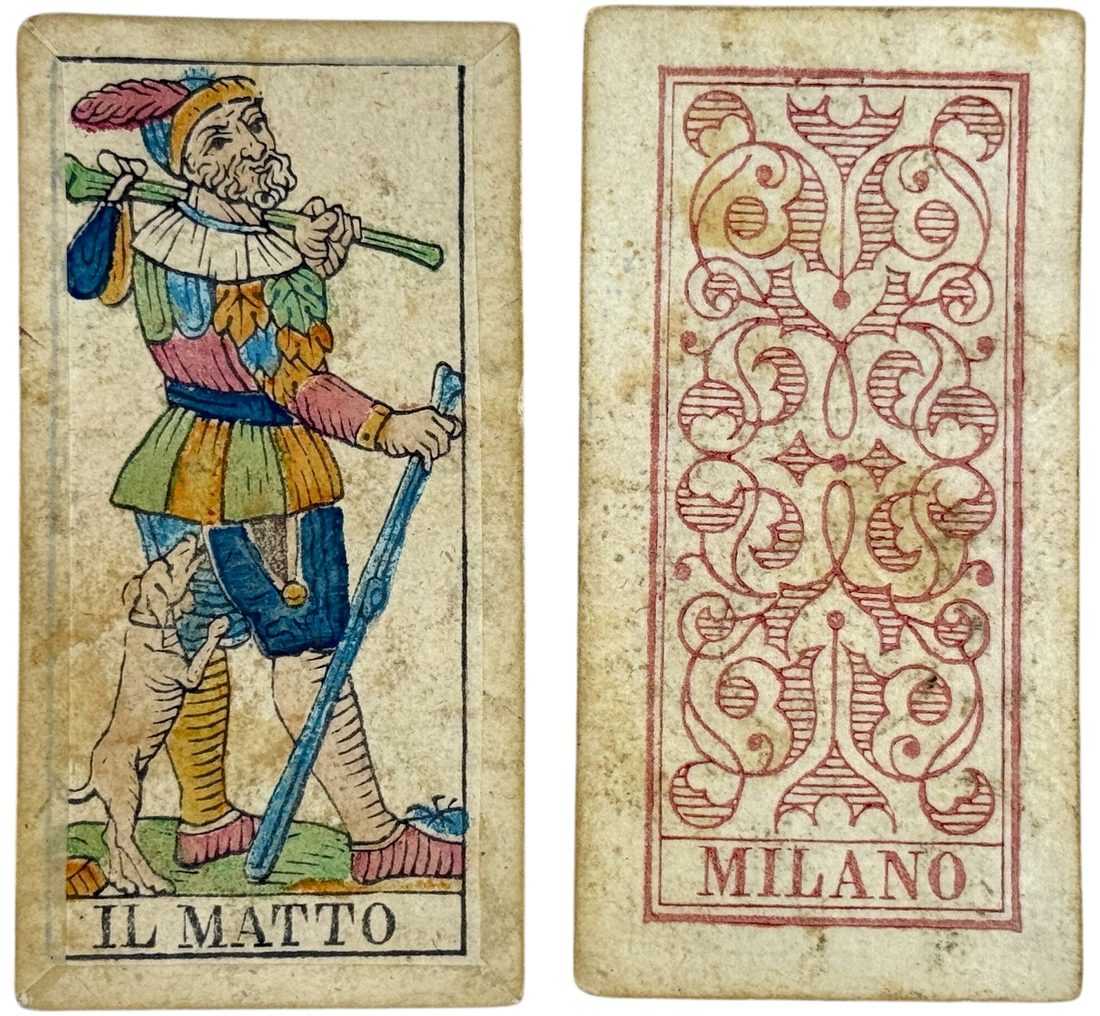
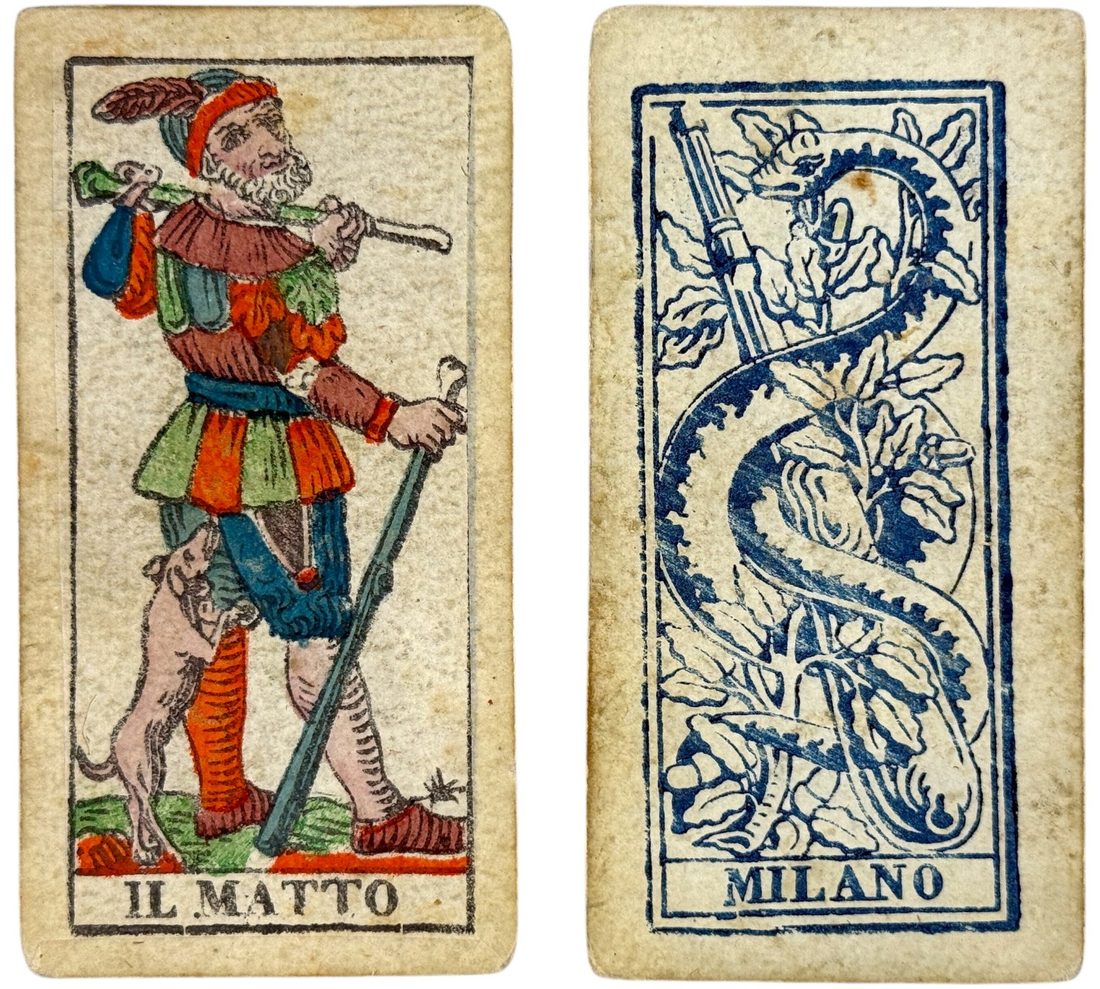
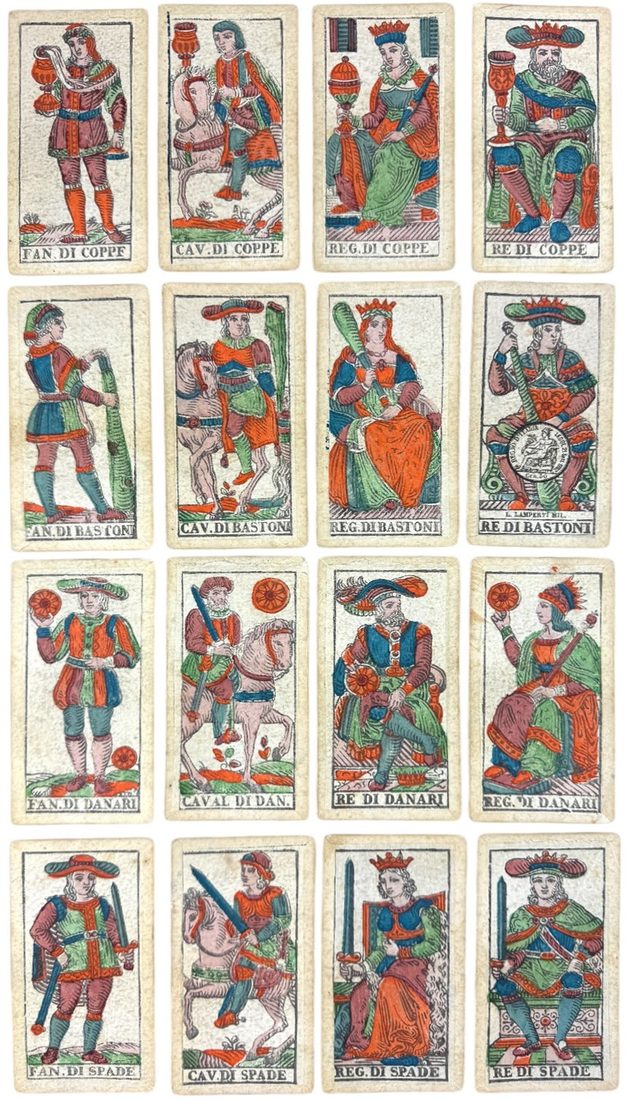
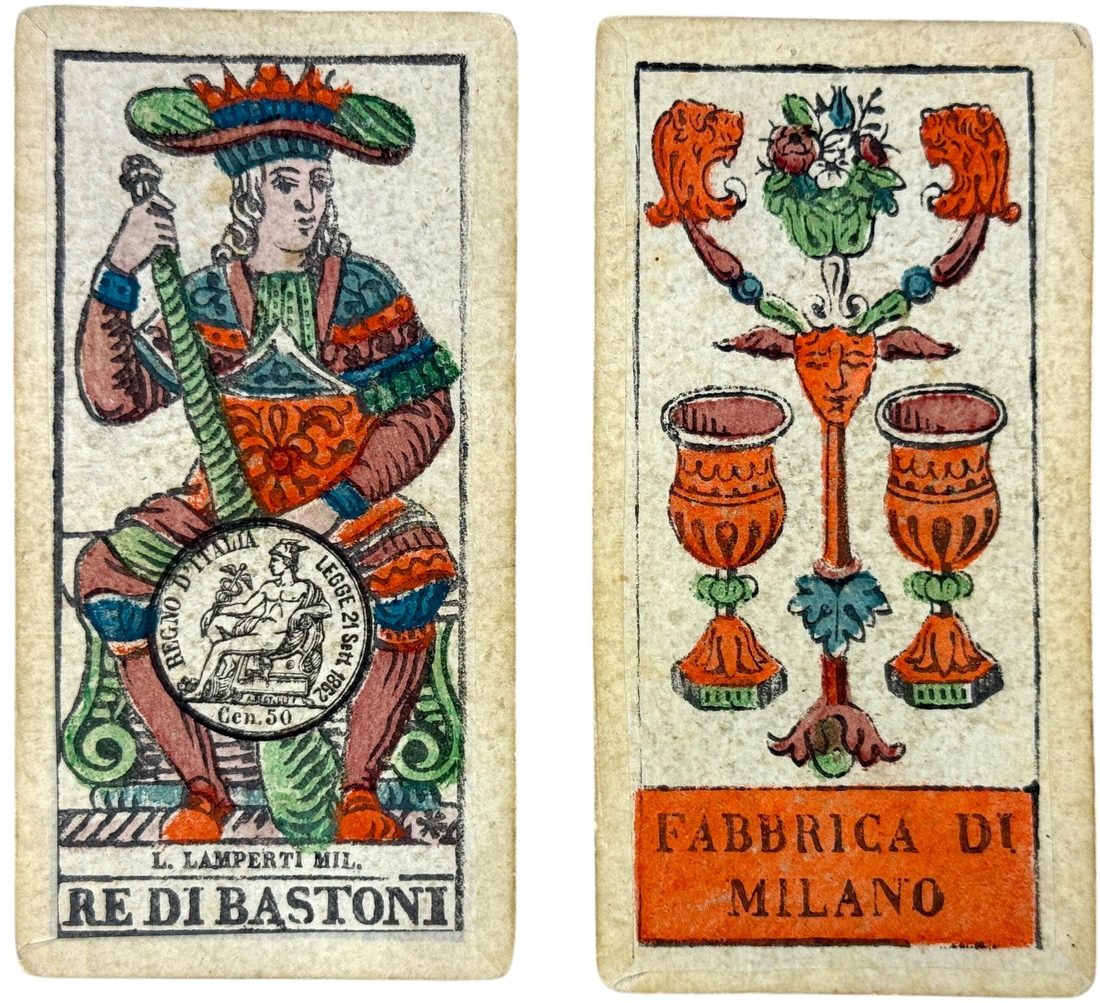
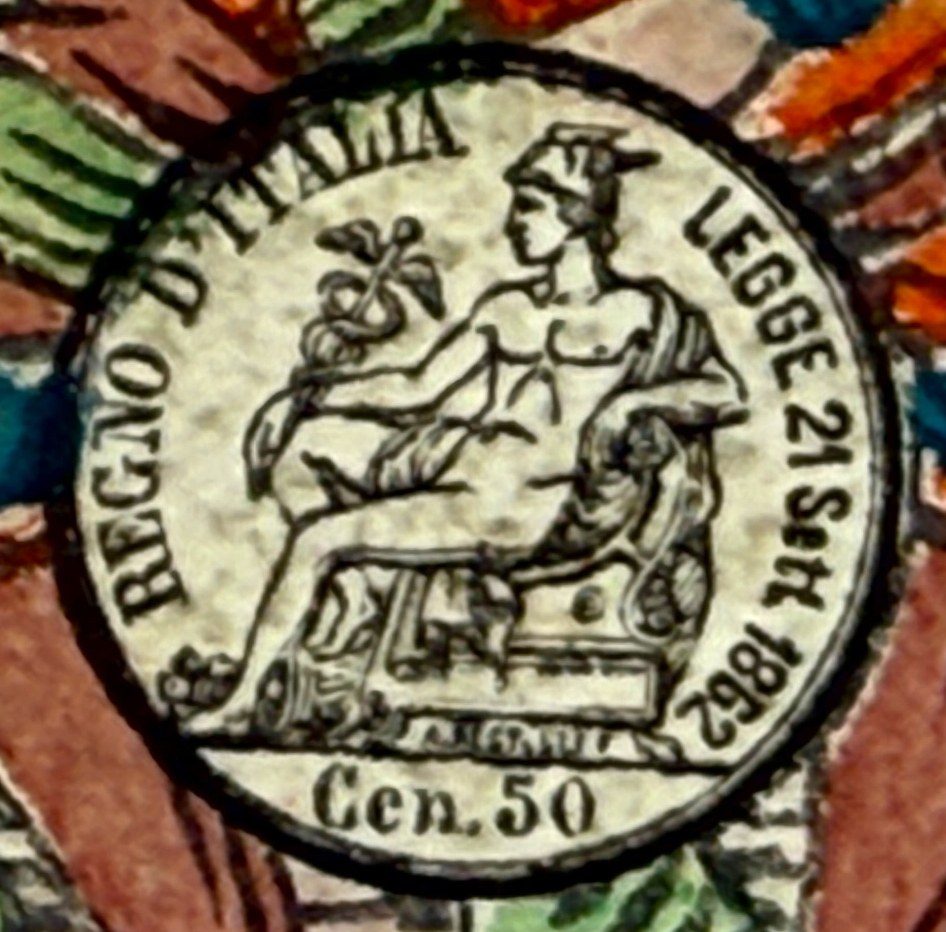
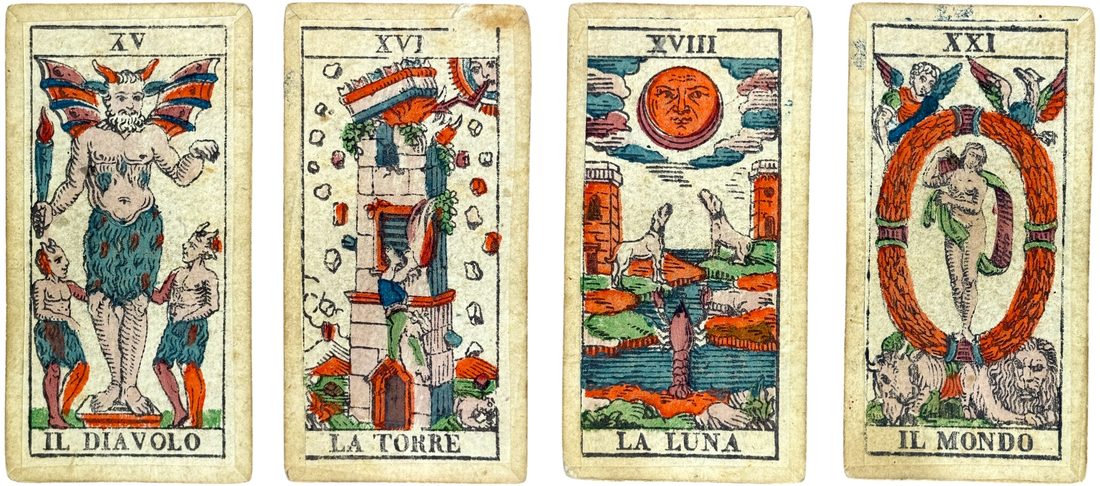
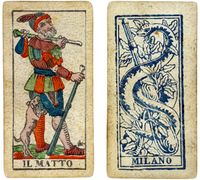
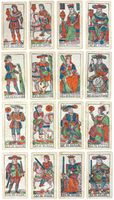
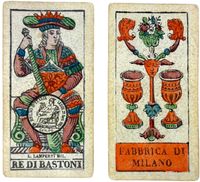
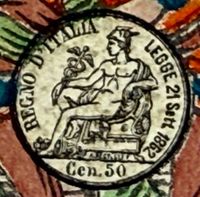
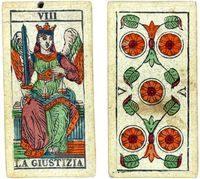
78 cards (106 × 55 mm), woodcuts coloured by stencil in orange, green, blue, pink and crimson; single-ended figures; the back paper folded over the edges of the face in the Italian manner; rounded corners. Backs printed in blue with a serpent coiled round a staff among leafy branches, in a ruled frame, and «MILANO» in a cartouche at the foot. King of Batons lettered «L. LAMPERTI MIL.» beneath the round Italian duty stamp «REGNO D’ITALIA / LEGGE 21 Sett. 1862 / Cen. 50», with Mercury seated; Two of Cups lettered «FABBRICA DI MILANO».
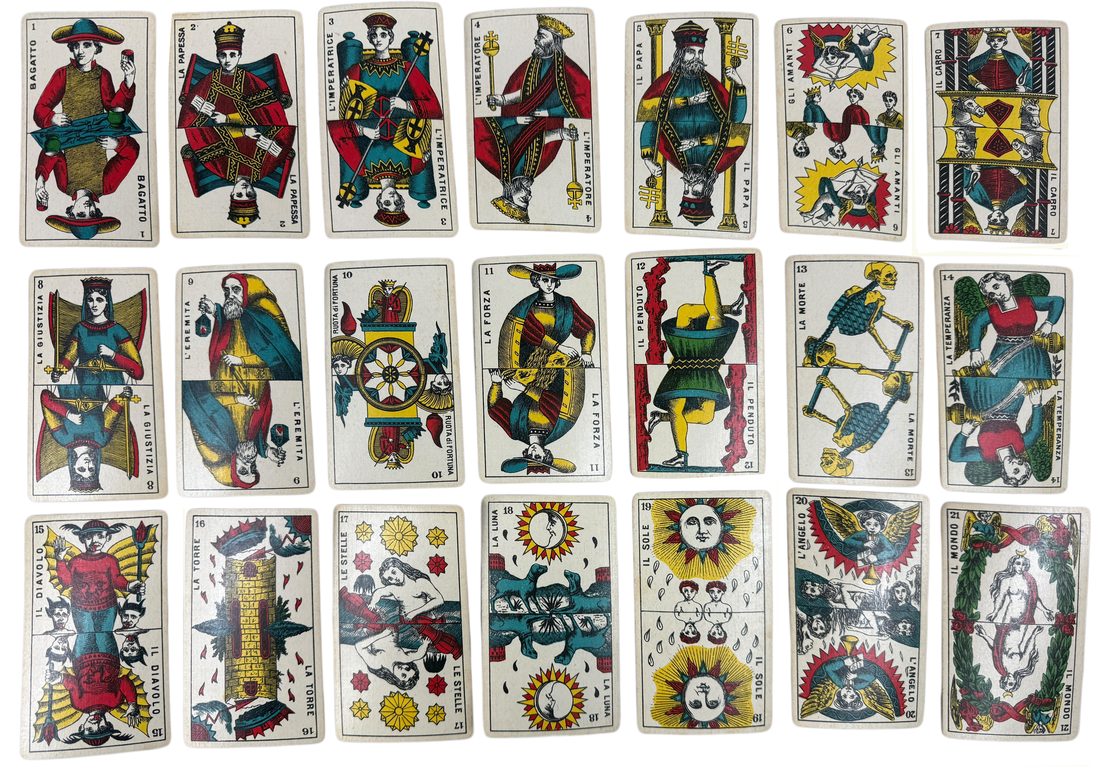
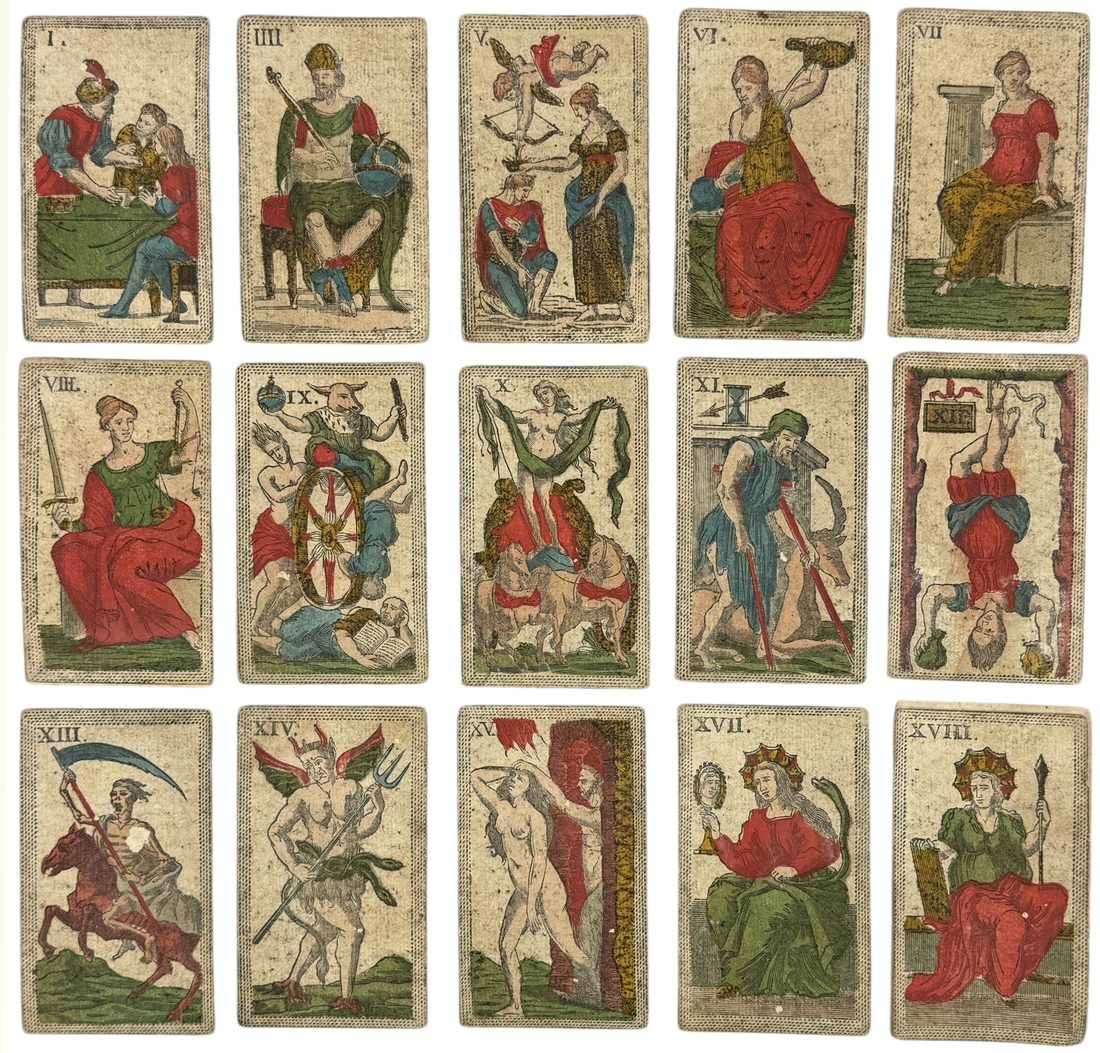
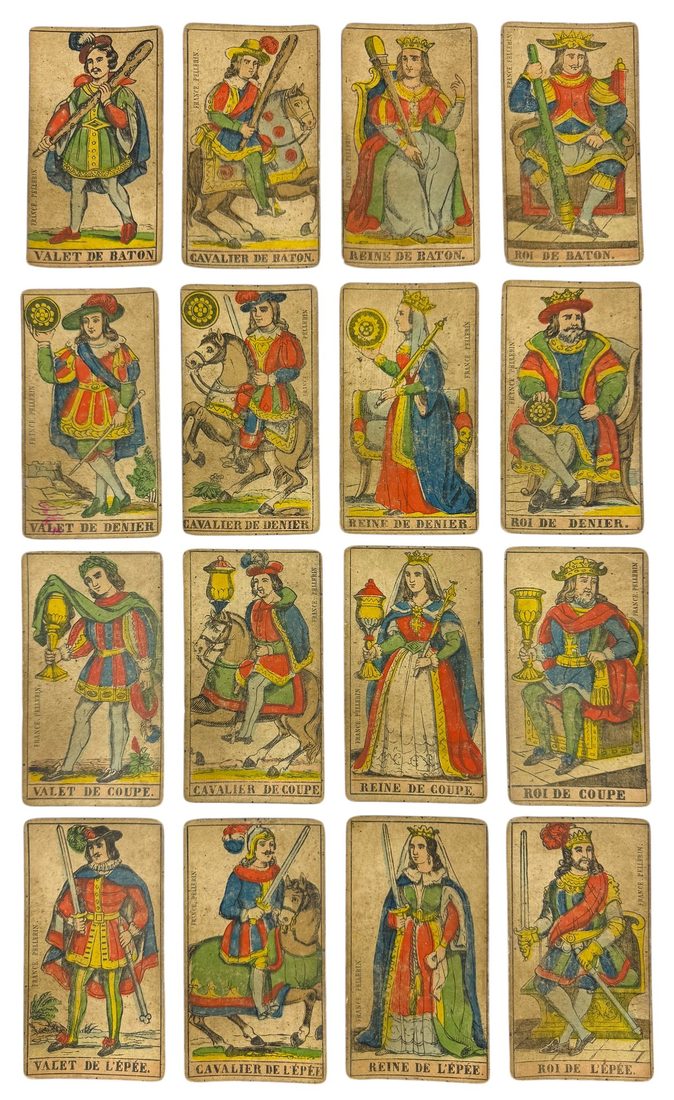
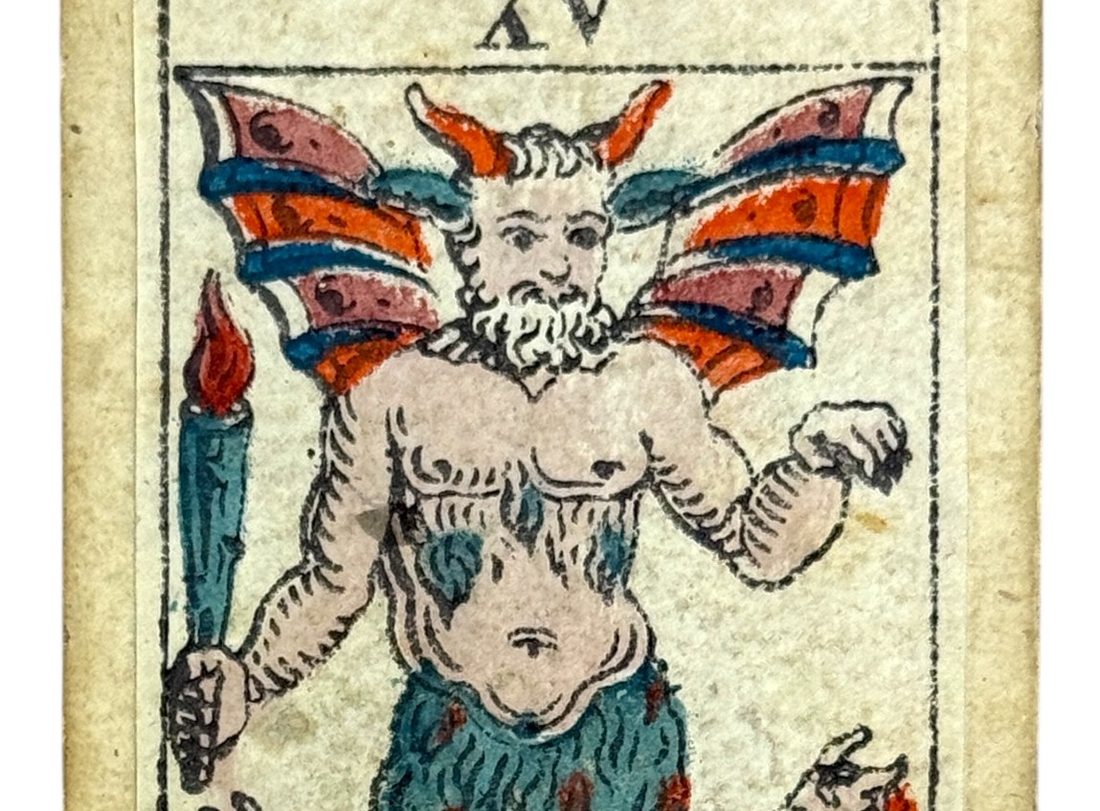
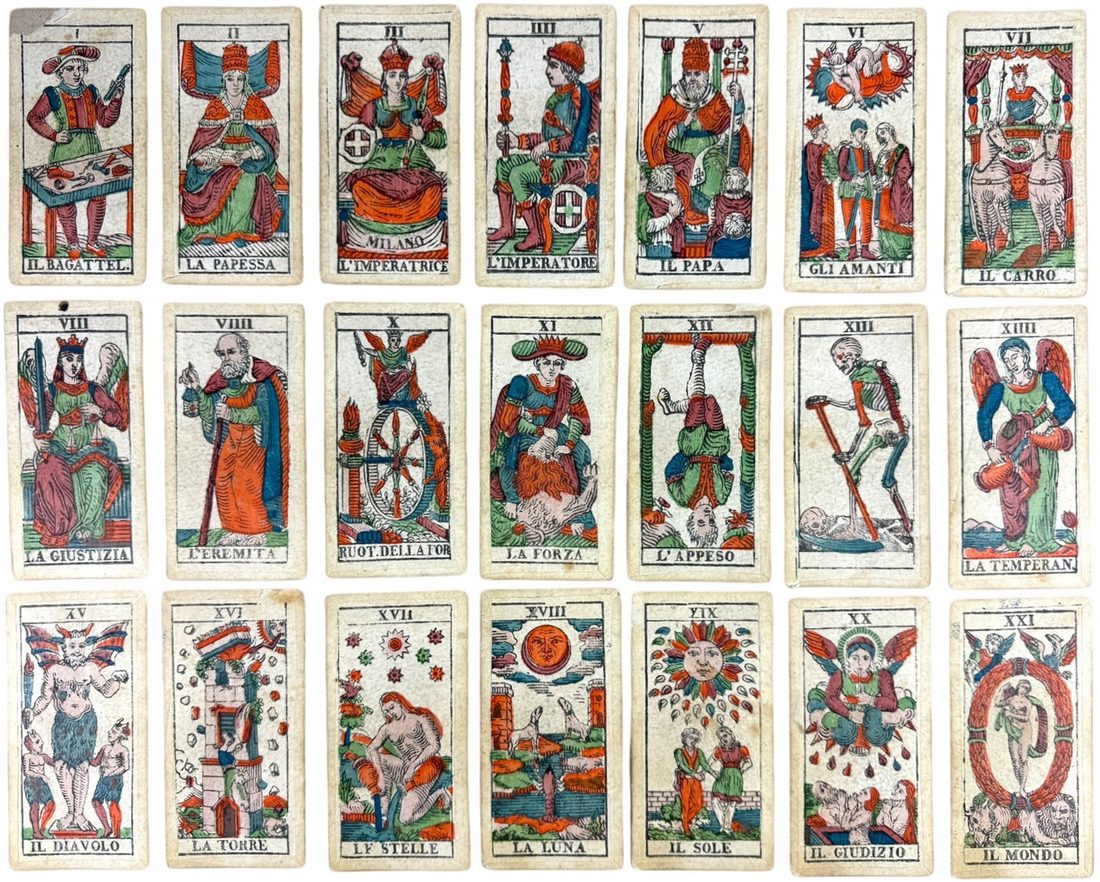
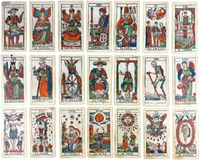
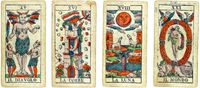
The pack is complete: fifty-six cards in the Italian suits of Coins, Cups, Swords and Batons, each of ten numerals and four full-length courts, Fante, Cavallo, Regina and Re, with swords and batons interlaced on the numerals; twenty-one trumps numbered in Roman figures and, except XIII, titled in Italian, from I Il Bagattel to XXI Il Mondo; and the unnumbered Il Matto.
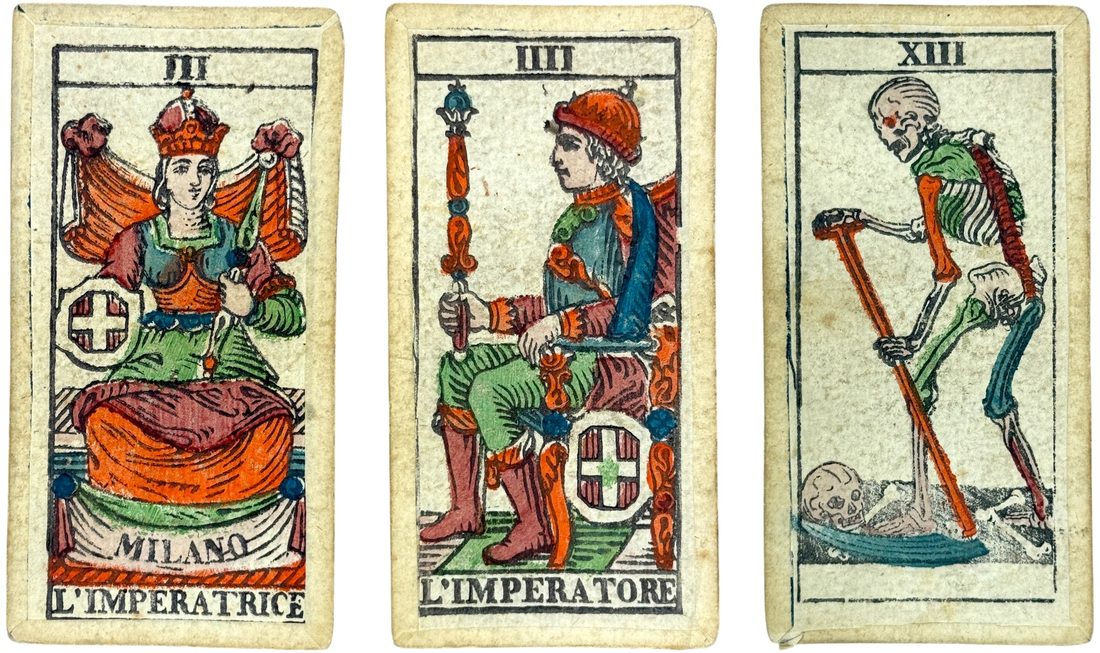
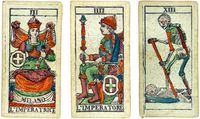
The maker signs the King of Batons, «L. LAMPERTI MIL.», below the duty stamp; the Two of Cups reads «FABBRICA DI MILANO», made in Milan, and «MILANO» is lettered again on the drape at the Empress’s feet and on the backs.
The pack can be dated by its duty stamp. The Italian law of 21 September 1862 taxed playing cards from January 1863, at fifty centesimi for packs of more than fifty-two cards; its first stamp, with Mercury seated and the words «REGNO D’ITALIA / LEGGE 21 Sett. 1862», was replaced in July 1874. A ministerial decree of November 1862 designated the Ace of Coins to receive it, but the regulation required the stamped card to carry the maker’s name and place, and on Lamperti’s blocks these stood on the King of Batons: the stamp is struck there, in the roundel that the card had long kept for the duty stamp. A Teodoro Dotti woodcut tarot in the Kaplan collection has the same stamp on its King of Batons.
Lamperti’s woodblocks had earlier been used under Austrian rule, with the Austrian eagle on the shields of the Empress and the Emperor; after 1859, when Lombardy passed to the House of Savoy, these shields were given the white cross of Savoy. Kaplan published this Savoy state from an unstamped copy in his own collection and dated it 1859–61; the present pack, with the same shields and the Italian stamp, shows that it was still being issued after 1862. It differs from Kaplan’s copy on the Wheel of Fortune, captioned «RUOT.DELLA FOR» where his has «RUOTA» in full, and its trump XIX is numbered «YIX». As on his copy, trump XIII has no title.
The design is the Lombard pattern, as Michael Dummett named it, a narrow-format Italian derivative of the Tarot de Marseille, classified by the International Playing-Card Society as Pattern Sheet 3 (formerly IT-1.1).
French captions on the earliest Italian packs of this kind point to French influence behind the eighteenth-century revival of tarocchi, which took hold at about the same time in Piedmont and in Lombardy. The Lombard cards were made in the narrow Italian format, almost invariably with the back paper folded over the edges, and followed the Tarot de Marseille closely, with a few features of their own; French-captioned examples of the eighteenth century are recorded from Bologna, Modena, Padua, Gorizia, Trieste and Wels, and from Serravalle in Piedmont. In Milan, where the game was played from about 1740, the cards were later printed with Italian captions until the last years of the nineteenth century.
Two Gumppenberg tarots of the Napoleonic years read «Regia Fabbrica di Milano», the state card factory he was called to run in 1809. The words «Fabbrica di Milano», made in Milan, recur on the Two of Cups of woodcut tarots by Gumppenberg, by his son-in-law Lattanzio Lamperti, by Teodoro and Edoardo Dotti, by their contemporary Giuseppe Sironi and later by Bordoni.
This was a pack for play. In Lombardy the seventy-eight-card tarot served the four-handed partnership game of tarocchi, as well as Reseghino and the Tarocc’Ombre bidding games; in these Lombard games, unlike those of Piedmont, the World ranks above the Angel.
Lattanzio Lamperti, listed in the Milan directory of 1846 as a ragioniere, was the son-in-law of the card maker Ferdinando Gumppenberg; according to Kaplan he had married his daughter Paola and took over the factory around 1847. The firm went on under his name after the unification of Italy: the Milan directories of 1870 and 1871 list «Lamperti eredi di Latanzio», card makers at corso Magenta 34, and by 1879 the business, at the same address, belonged to Pietro Negri, who styled himself successor to Lamperti and Gumppenberg.
Census: no other Lamperti woodcut tarot with the arms of Savoy and the Italian duty stamp has been traced in the public collections and sale records we have been able to search. The only Lamperti woodcut tarot we have traced in a public collection, at the Fitzwilliam Museum in Cambridge, is, according to the museum’s records, of the earlier Austrian state, with the arms of Lombardy-Venetia; the only other copy of the Savoy state we have found recorded, published by Kaplan from his own collection, is unstamped.
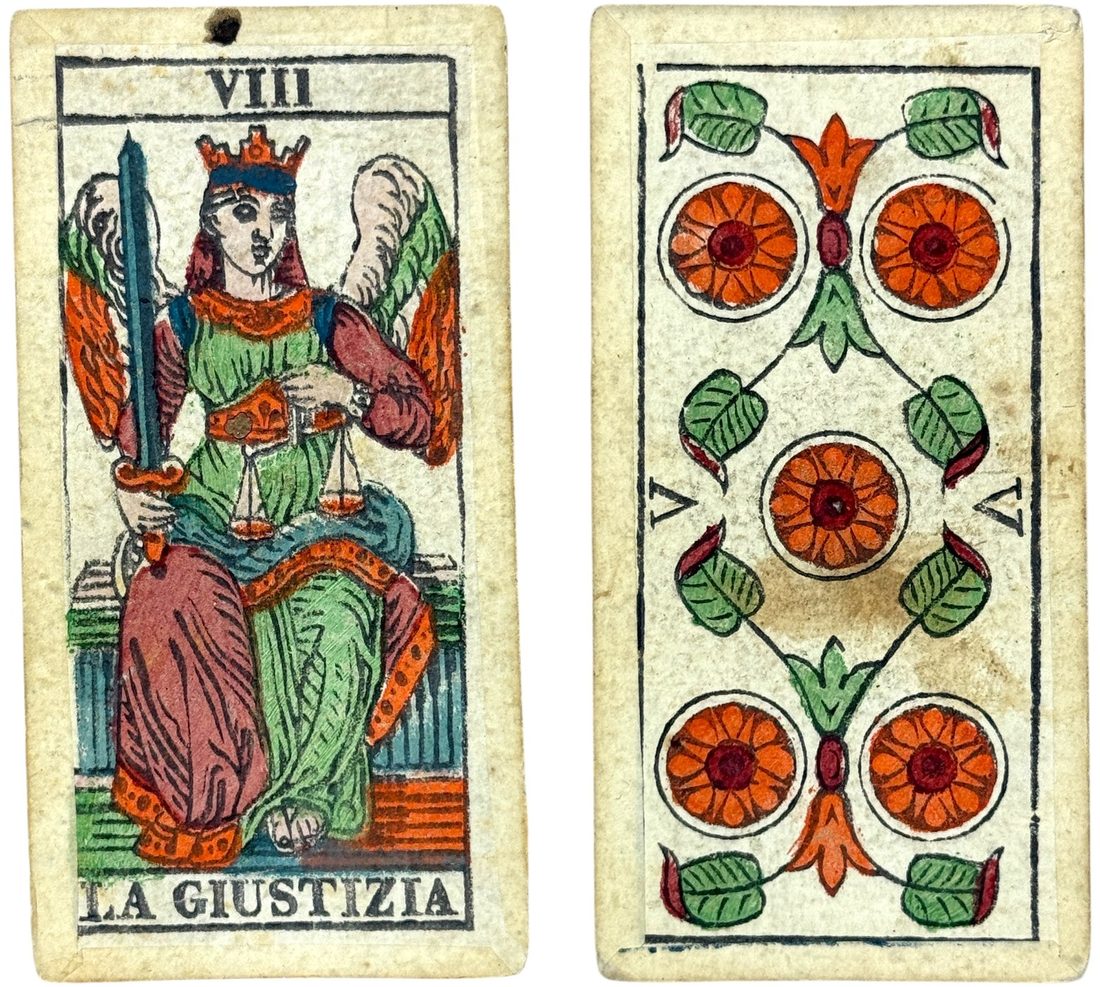
Conditions: complete, 78/78, in good condition. Light marks of use; a small dark brown mark in the upper margin of trump VIII; the upper corner of trump I soiled and rubbed; a brown stain on the five of Coins and a few small spots elsewhere; the turnover lifting at one corner of trump XIII.
References: S. R. Kaplan, The Encyclopedia of Tarot, vol. II, New York: U.S. Games Systems, 1986, pp. 200, 246, 367, 370; S. R. Kaplan and J. Huets, The Encyclopedia of Tarot, vol. IV, Stamford, CT: U.S. Games Systems, 2005, p. 678; M. Dummett, The Game of Tarot, London: Duckworth, 1980, pp. 196–198; M. Dummett and J. McLeod, A History of Games Played with the Tarot Pack: The Game of Triumphs, Lewiston, N.Y.: Edwin Mellen Press, 2004, vol. I, pp. 111–124; International Playing-Card Society, Pattern Sheet 3, «Unnamed (IT-1.1)», https://i-p-c-s.org/pattern/ps-3.html.