Perspective Representation of an Opera Hall with Acting Figures
| Macro-category | Ancient Games and Pre-cinema |
| Subcategory | Diorama |
| Author | Engelbrecht, Martin |
| Provenance | Augsburg |
| Publisher / Maker | Martin Engelbrecht |
| Year | 1750 |
A Stage Made of Paper for a Stage Made of Canvas
Martin Engelbrecht, Perspective Theatre HHH in 8vo
The Complete Scenic Series of an Opera House
with Its Performers in Action
[Diorama]. Perspectivische vorstellung eines ganz besonders Operalischen Sahls mit agierenden Personen (“Perspective Representation of a Most Particular Opera Hall with Acting Figures”). Augsburg: Martin Engelbrecht, ca. 1750.
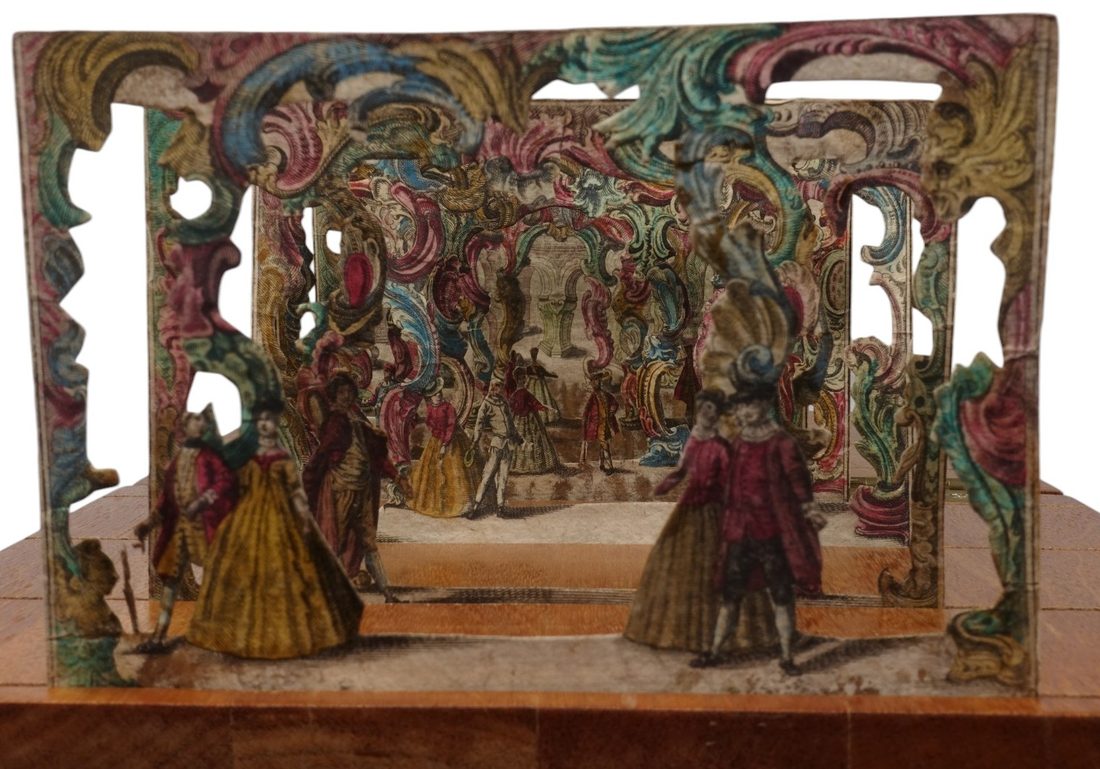
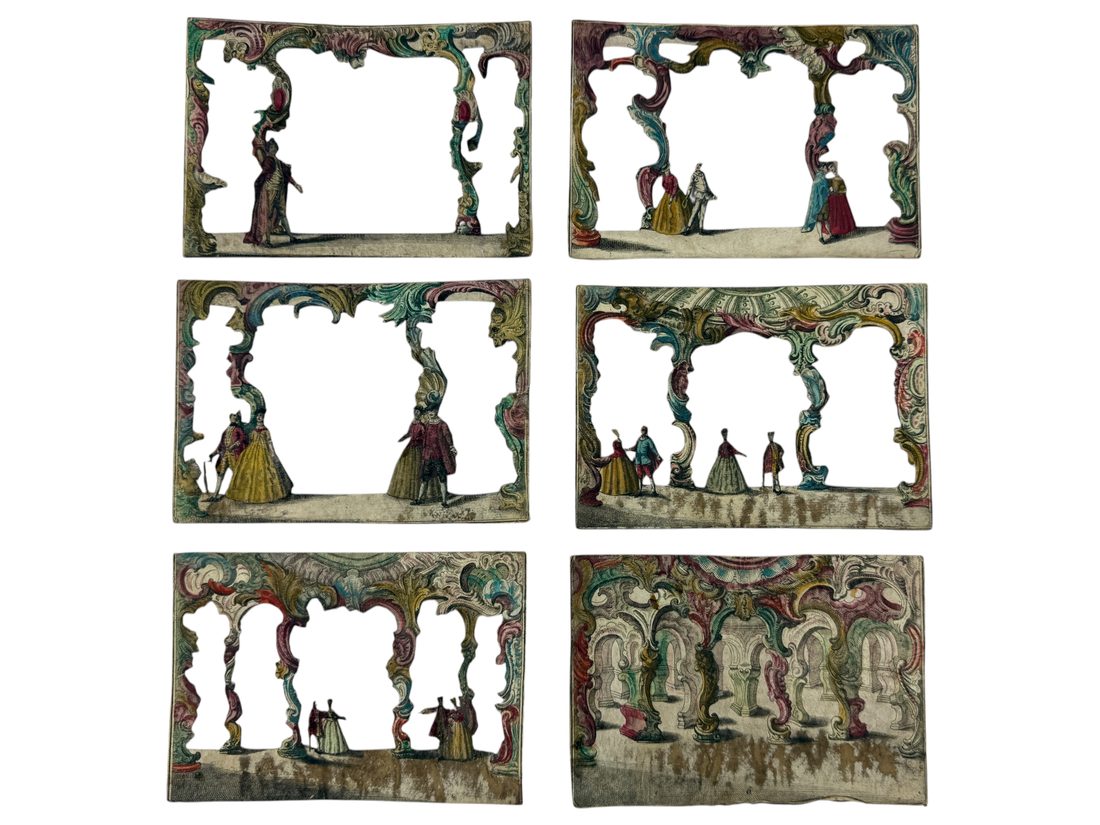
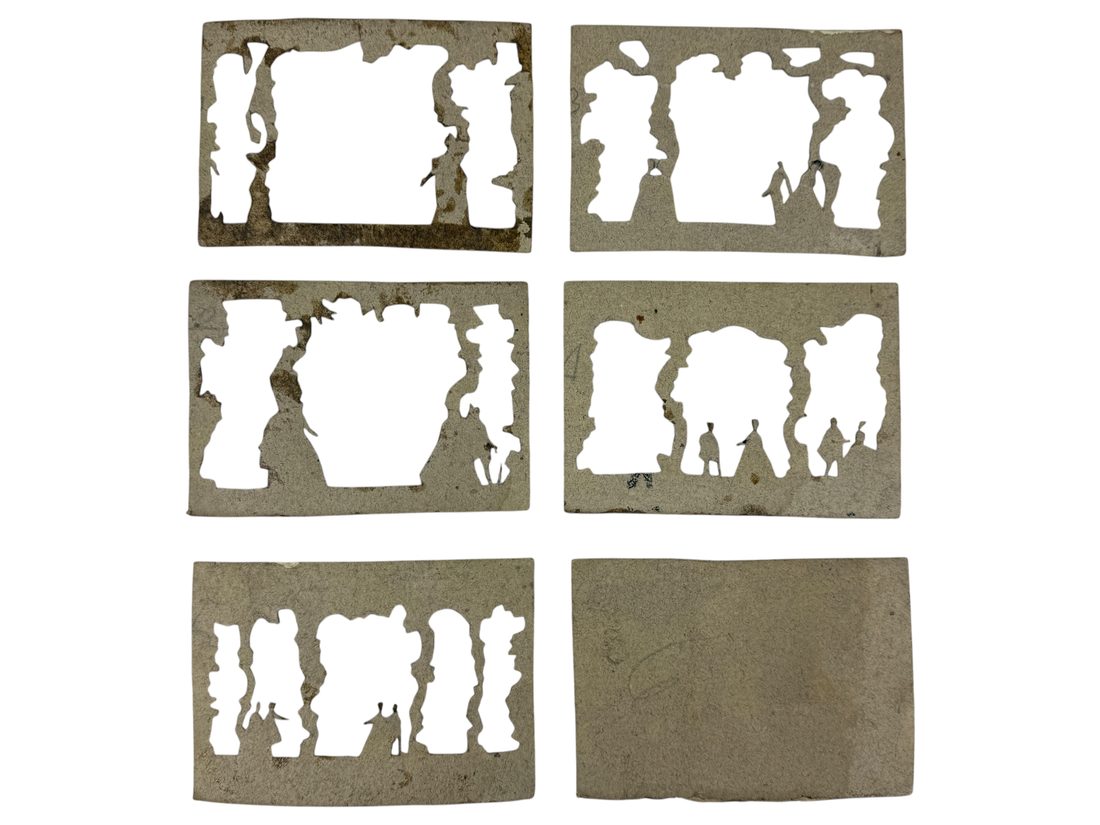
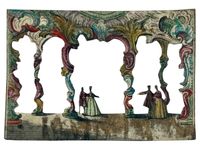
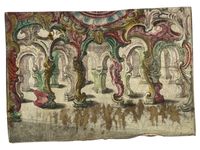
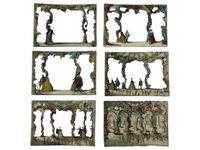
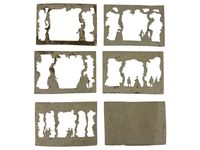
8vo perspective theatre (each sheet 135 × 90 mm), the complete scenic series of six copper engravings on thin laid paper, in original hand colouring. The first five sheets are cut through their central fields to form apertures of progressively diminishing span and serve as scenic flats, while the sixth is retained uncut as the closed background and bears the engraved numeral 6 at the lower centre. The engraving is fine and even, the cutting executed with scissors and knife along the contour of the represented forms, the colouring applied in transparent watercolour. The versos are clean and carry a numbering that establishes the order of assembly. The series is classified as HHH in Alberto Milano’s census of the Augsburg workshop, where it is illustrated; that designation is engraved at the lower centre of the title plate, not present here, together with the privilege line «C. P. Maj.» at the left and the imprint «Mart. Engelbrecht excud. A.V.» at the right.
The complete scenic series of the Engelbrecht perspective theatre devoted to the opera house, in the medium octavo format, classified HHH in Alberto Milano’s census of the Augsburg workshop. Where the workshop ordinarily staged gardens, hunts, harbours and biblical histories, here it stages the theatre itself. The result is a paper stage that represents a stage, and an optical device that reproduces, in the hand of its owner, the very illusion of depth that the scene painters of the period constructed for the opera public.
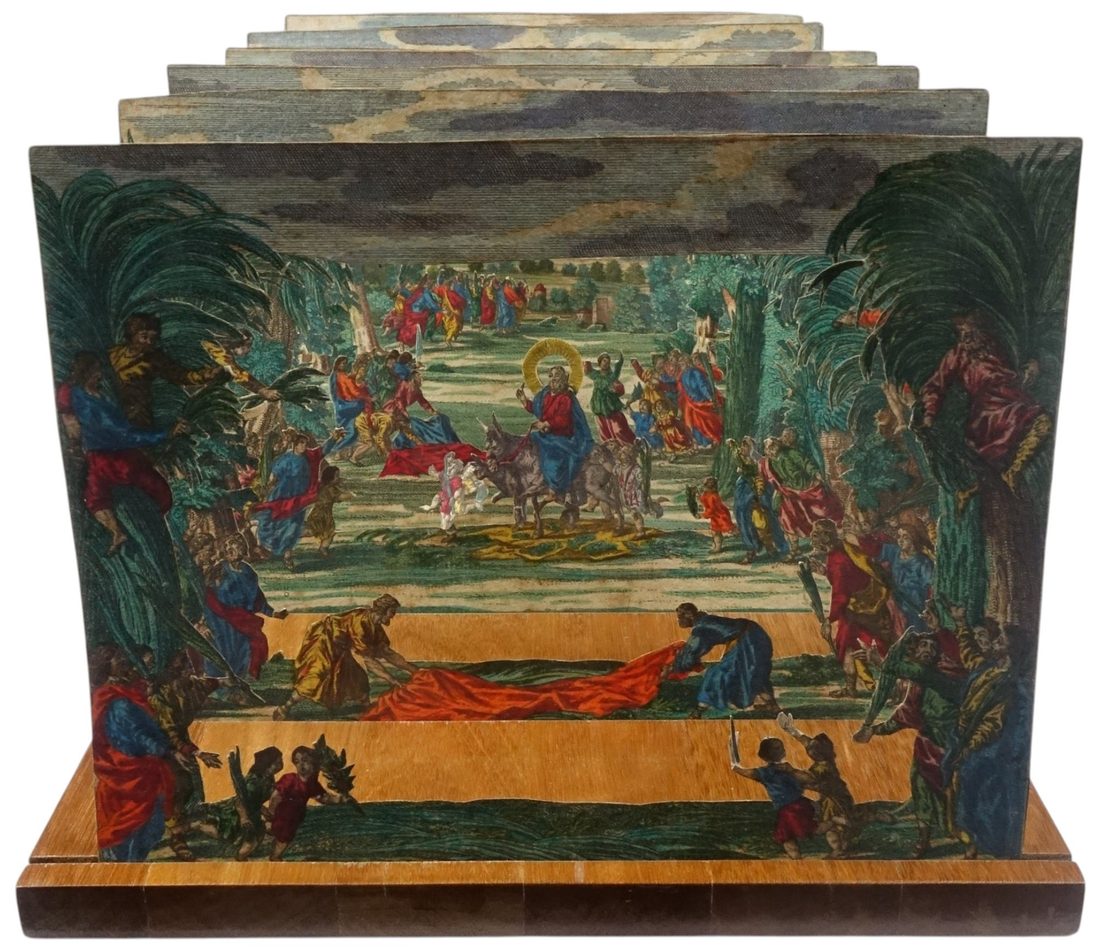
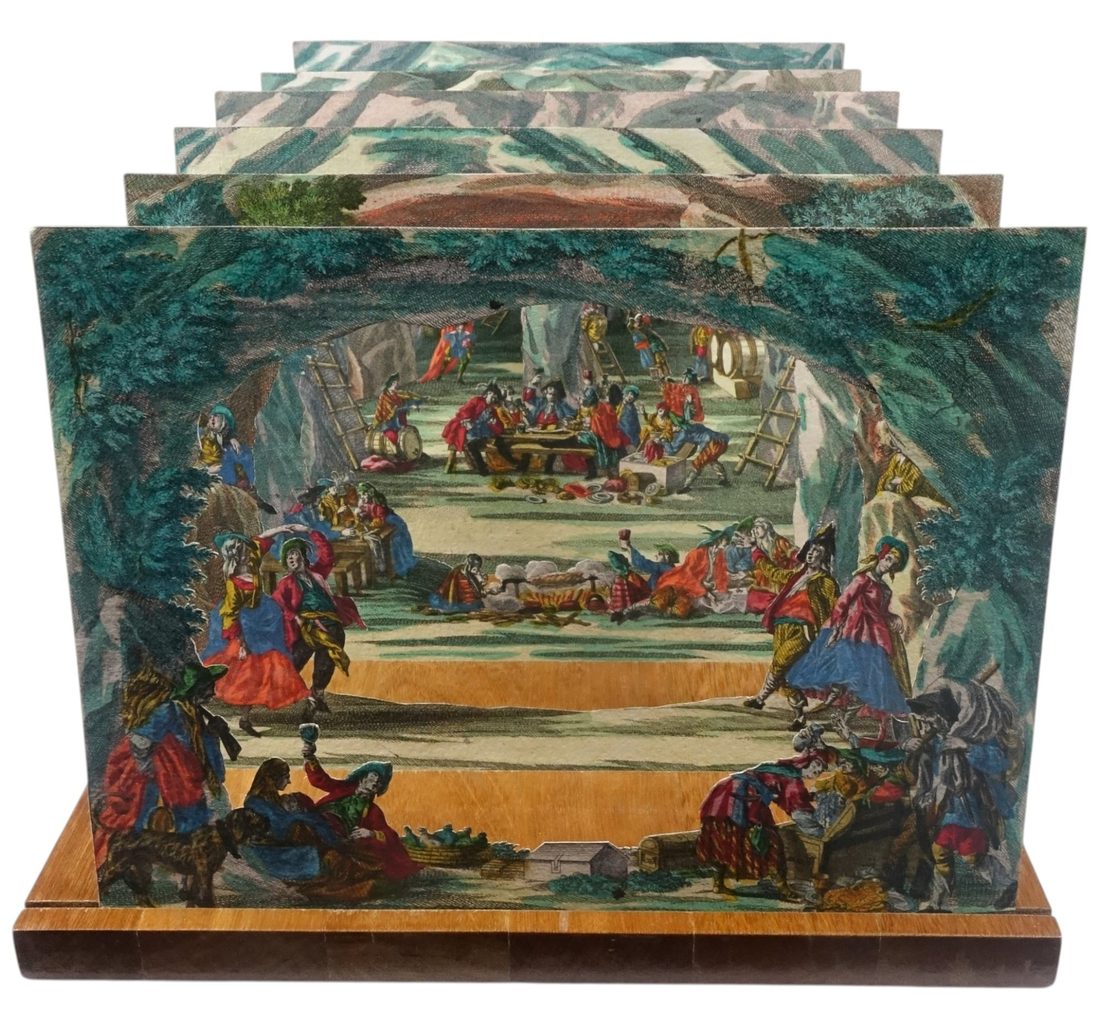
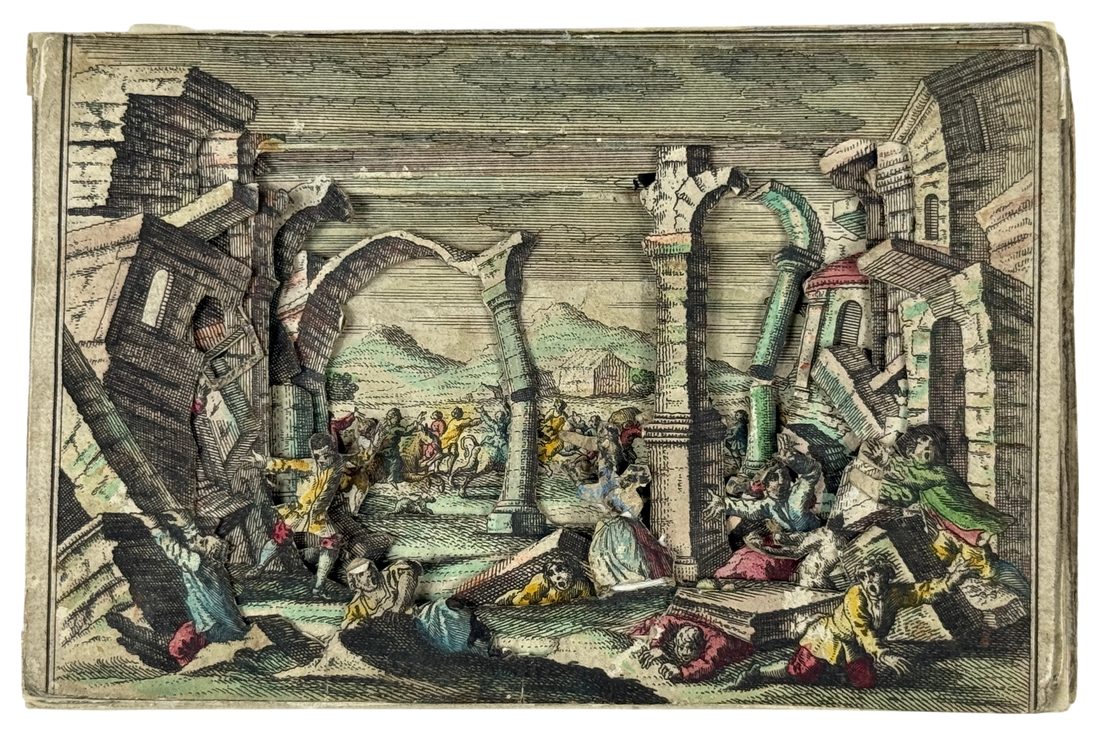
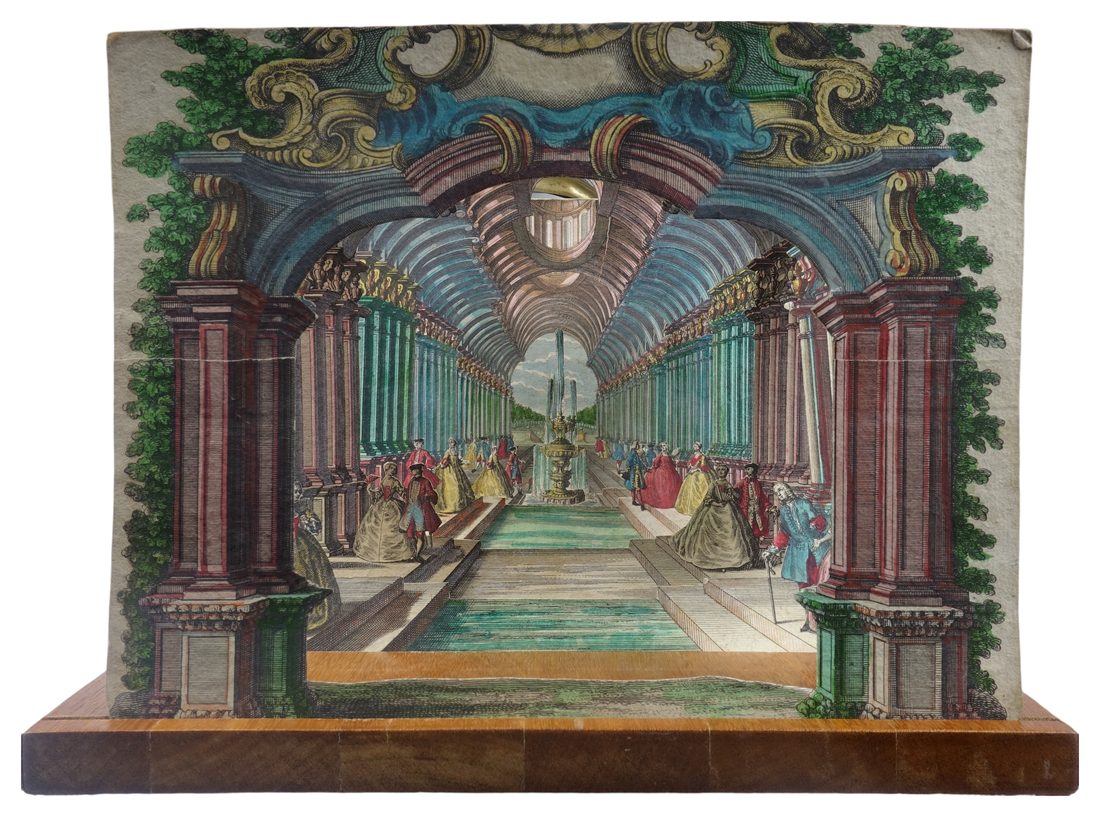
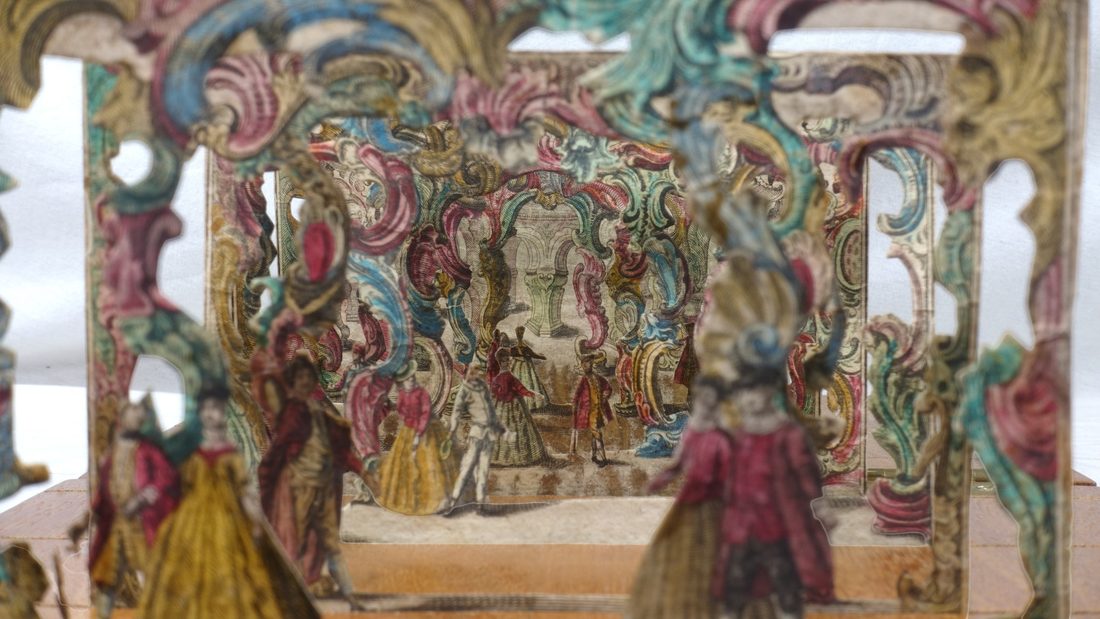
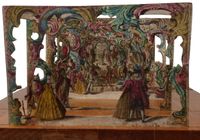
The theatre is conceived as a single perspectival construction decomposed across six successive engraved planes, each sheet operating both as an autonomous image and as one stratum of the larger composition. Assembled in order within a viewing box and observed frontally through an aperture, the planes recreate the original recession and produce a persuasive illusion of depth. Here the device is turned upon the interior of an opera house, seen from the place of the spectator, so that the receding planes reproduce the wings of a stage set and the illusion of the paper theatre coincides with the illusion it depicts.
Proscenium and flats are built throughout of rocaille: shells, cartilaginous volutes, palm fronds and scrolling foliage, coloured in rose, turquoise, ochre, olive and carmine, which rise at either side and meet overhead in a cusped arch. This vocabulary is not ornament applied to an architecture, it is the architecture, and it dissolves the frame of each plane into a growth of curling forms.
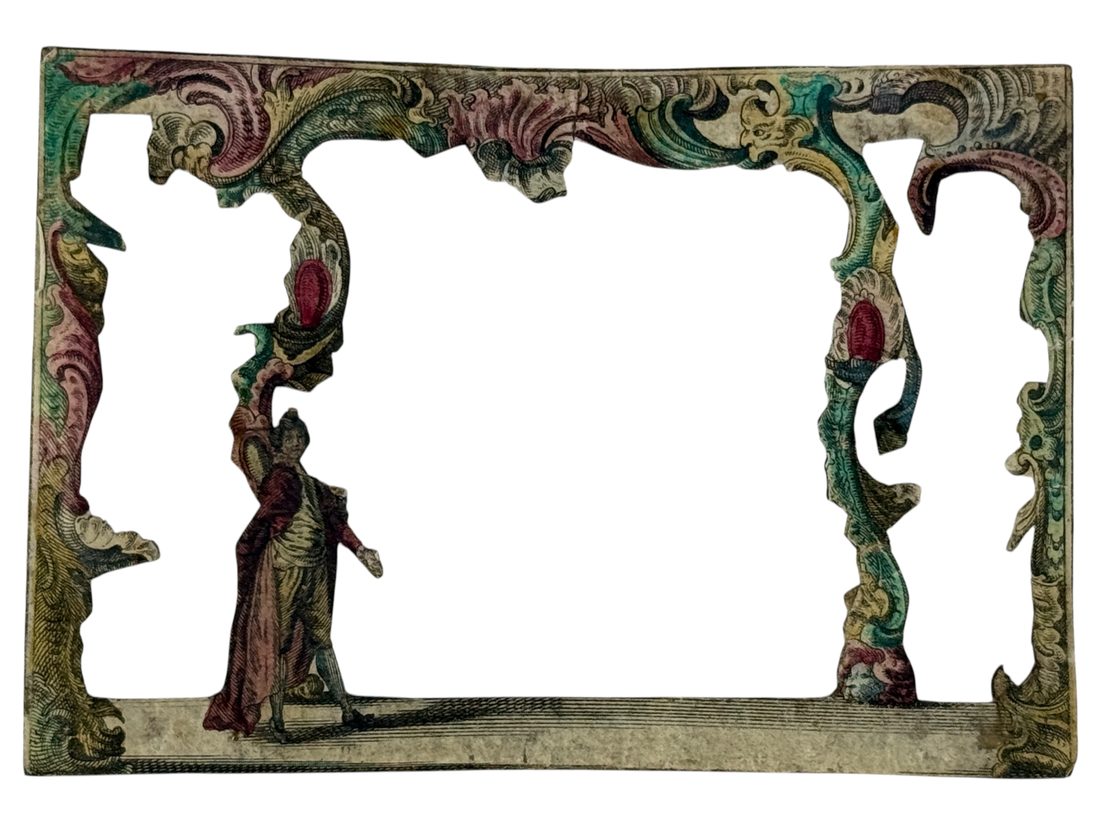
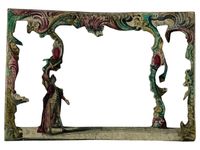
The first plate carries the widest opening and the fewest figures. At the left a lady in a mauve gown is seen from behind beside a gentleman in an olive coat who extends his arm towards the stage; the ground is drawn in close parallel hatching, and the aperture is cut so generously that the plate reads almost as a frame alone.
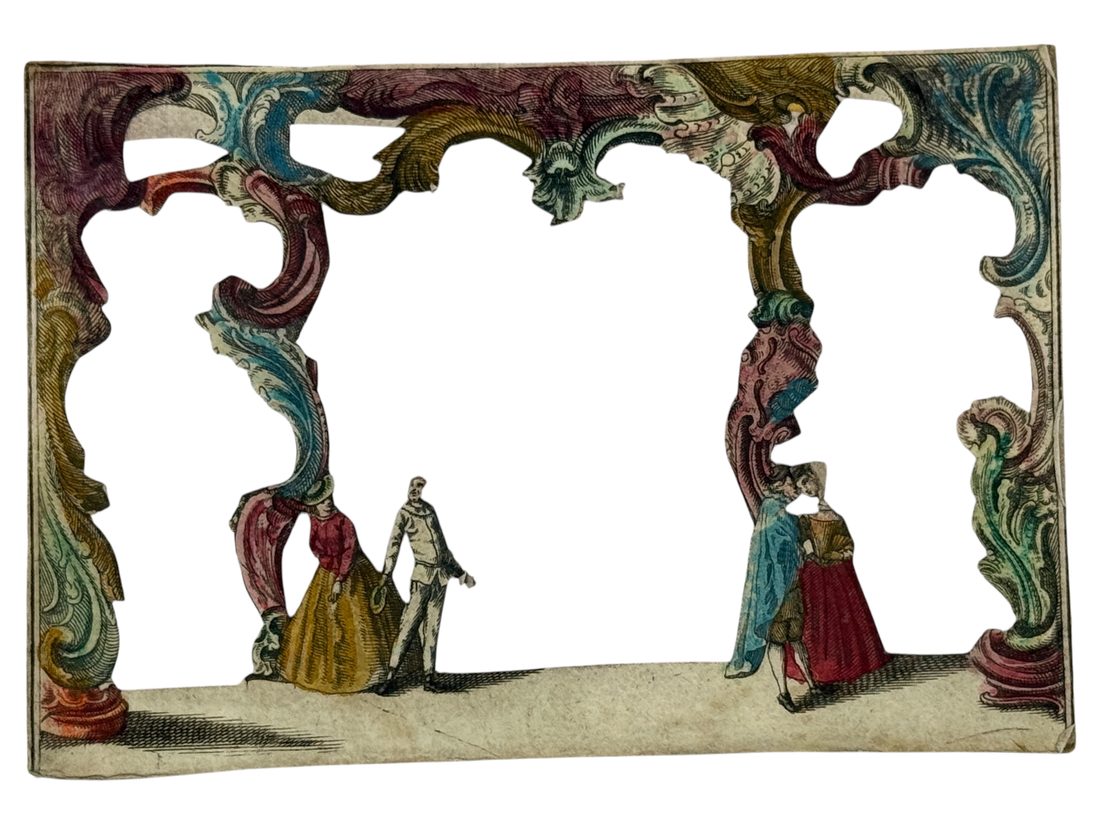
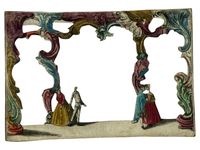
The second plate brings the performers forward. Left of centre a lady in a gold gown with a carmine bodice stands with her back to the viewer beside a figure dressed wholly in white, whose loose costume and attitude place him in the comic repertoire of the commedia dell’arte; at the right a gentleman in a blue cloak inclines towards a lady in a red skirt. The figures are cut as autonomous silhouettes joined to the sheet by slender bridges of paper.
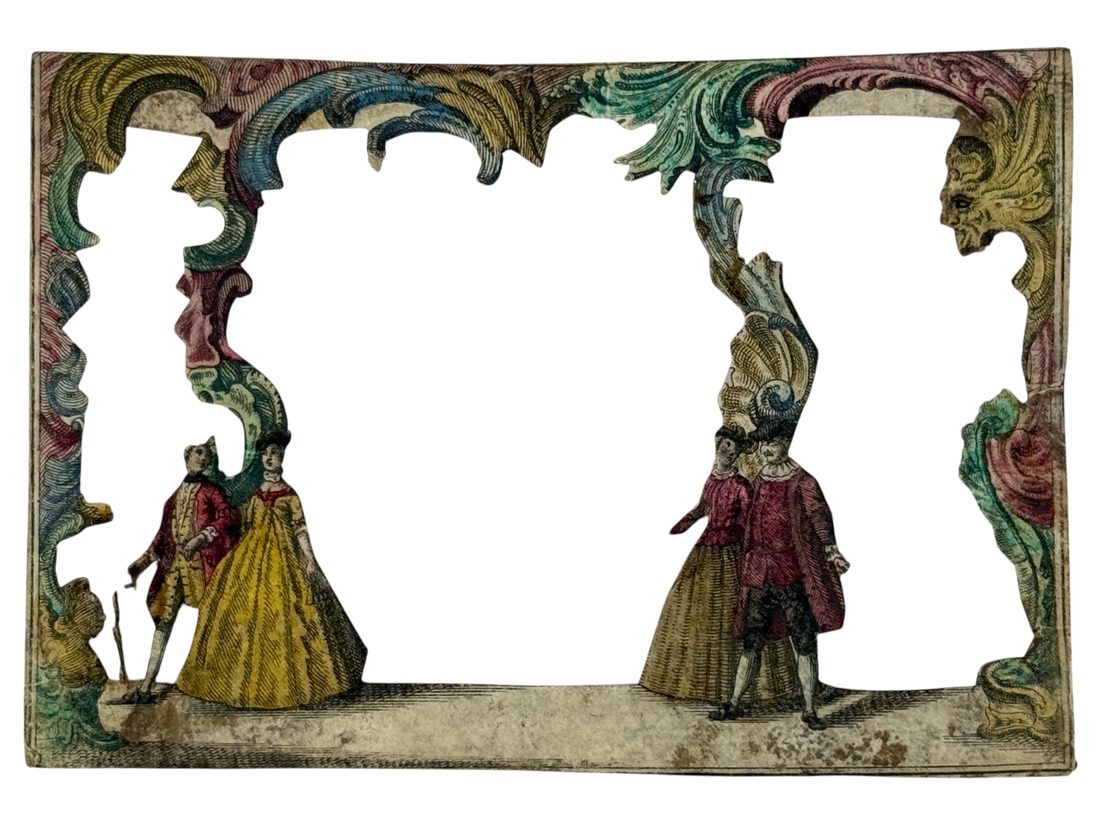
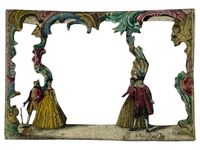
he third plate is the fullest in incident. At the left a gentleman in a red coat attends a lady in a wide gold gown; at the right a second couple stands beneath a great plumed head-dress, the lady in olive seen from behind, her companion in carmine. The rocaille encroaches further upon the opening, which is now divided towards the centre.
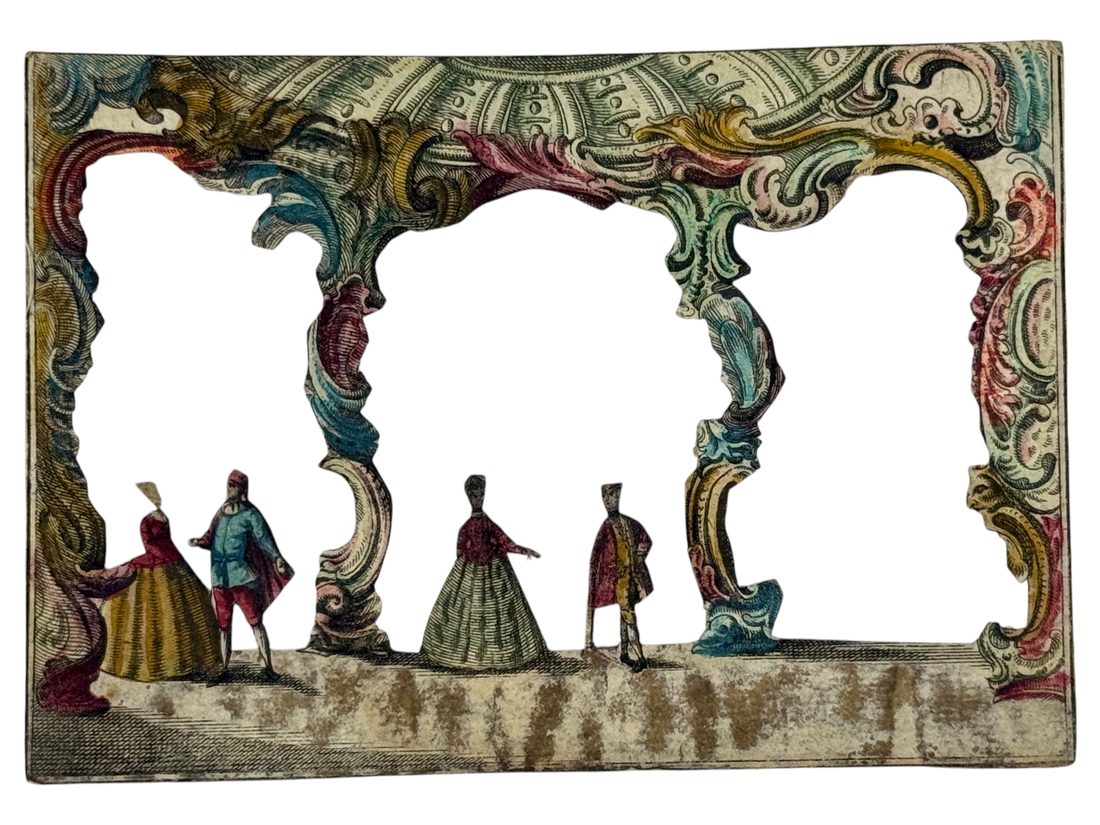
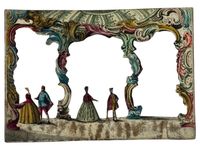
The fourth plate parts the field into bays by means of scrolling piers. Four figures remain, smaller and more widely spaced: a lady in gold with a feathered head-dress and a gentleman in a blue coat at the left, a lady in pale green at the centre, a solitary gentleman with a cane at the right.
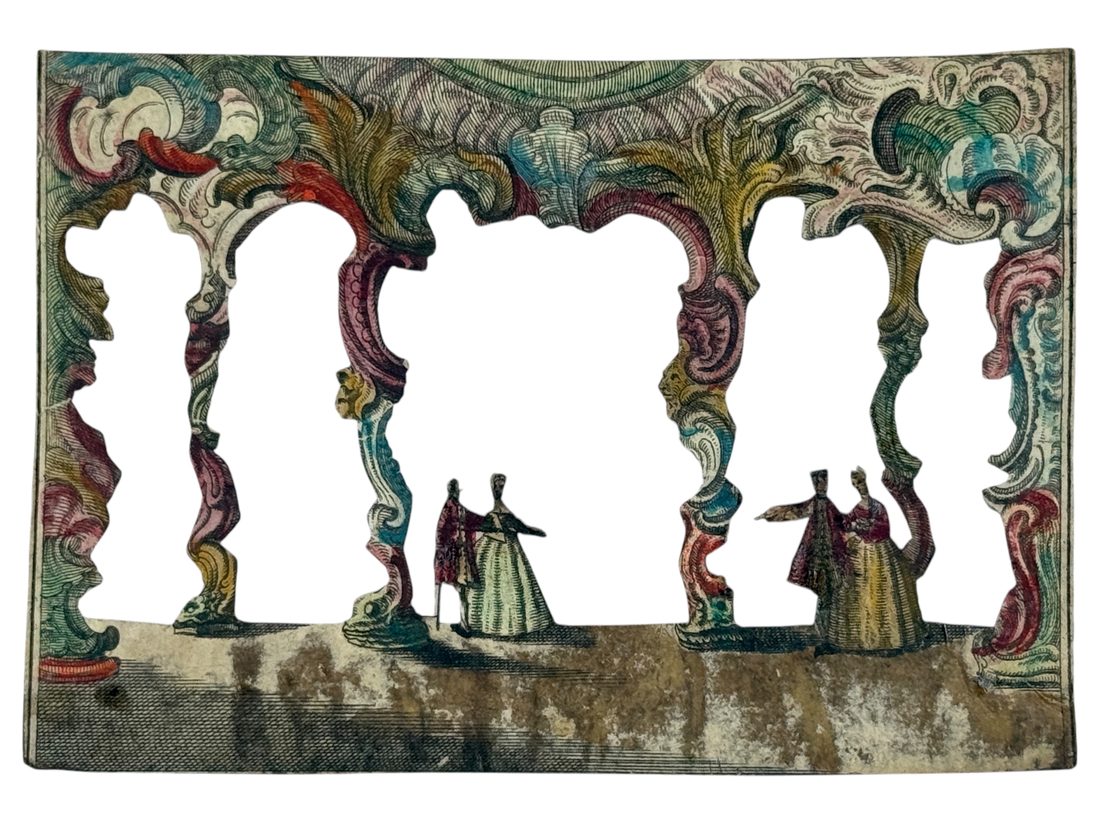
The fifth plate is the last of the scenic flats and the narrowest. Its piers form a shallow arcade, and the four surviving figures, reduced almost to accents of colour, stand at the threshold of the background.
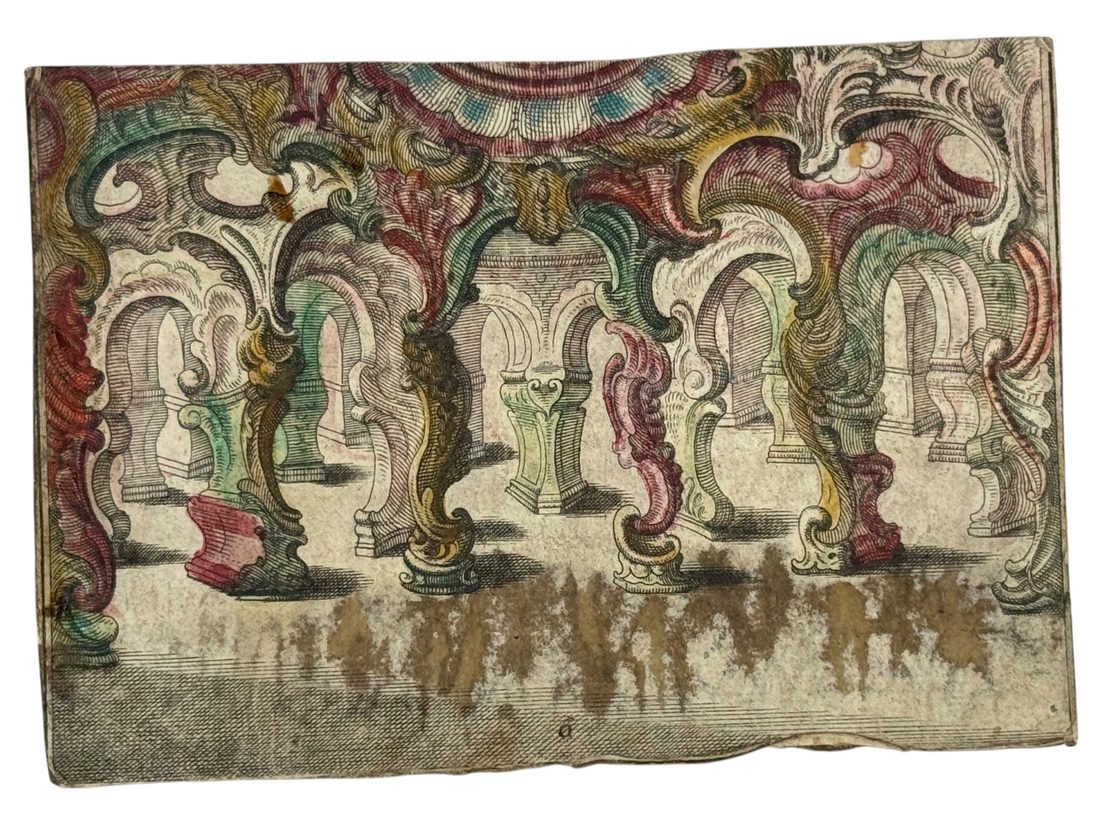
The sixth and final plate closes the construction as the uncut background. It shows the further reach of the scene, an arcade of pedestals, balusters and niches receding in diminishing scale, drawn in the same rocaille idiom but coloured in pale and desaturated tones, so that the eye reads distance in the loss of colour as much as in the loss of scale.
Read in sequence the six planes describe a double recession, of space and of population. The figures diminish in size, in number and in chromatic intensity from the first plane to the last, while the apertures contract steadily around them. The construction is therefore rhetorical as well as spatial, carrying the eye from the immediate company of the audience into an architecture that continues beyond the reach of the stage.
Engelbrecht’s perspective theatres are inseparable from the intellectual climate of eighteenth-century Augsburg, where popular print culture, the science of perspective and the taste for optical curiosities converged within a single commercial enterprise. The first half of the century saw the codification of linear perspective in widely diffused treatises, the spread of the camera obscura, the magic lantern and the perspective box, and a growing appetite, in noble cabinets as in bourgeois interiors, for devices able to stage the illusion of depth in domestic space. The Augsburg theatres translate this scientific and recreational culture into a printed object, accessible to an international public and meant to be assembled by its owner.
Within the discipline of the printed image the genre descends from the seventeenth-century peep-box tradition of the Netherlands and Germany, assumes its characteristic layered form in the Augsburg perspective theatres of the first half of the eighteenth century, and prepares the ground for the nineteenth-century paper theatre and for the dioramas of Louis Daguerre, first exhibited in Paris in 1822. Engelbrecht’s particular contribution lies in the systematic adoption of the multi-plane structure as a serial publishing programme, and in the elaboration of an entire iconographic repertoire ranging from biblical histories and royal ceremonies to gardens, encampments, harbours and hunts.
The opera house is a singular subject within that repertoire. The scenic illusion of the eighteenth-century theatre rested upon painted flats set one behind another in converging perspective, precisely the arrangement that the paper theatre reproduces in miniature. To take the opera house as a subject is therefore to make the device transparent to itself: the purchaser who assembles these six planes in a viewing box performs, at the scale of the hand, the operation that the scene painter performed at the scale of the auditorium. The rocaille idiom in which the whole is drawn belongs to the same moment, when the ornamental invention of southern Germany was at its height and Augsburg its principal centre of diffusion across Europe..
Martin Engelbrecht (1684-1756) was among the most active German engravers and print publishers of his generation. Born in Augsburg on 16 September 1684, he was the son of a colour merchant and trained as an engraver in Augsburg under Gabriel Ehinger. He worked in the orbit of his elder brother Christian (1672-1735), joining him in Berlin about 1708 and returning with him to Augsburg in 1711. In that year he entered the art-publishing house founded by his brother together with Johann Andreas Pfeffel, becoming a partner after Pfeffel withdrew. In 1719 he secured an imperial privilege, renewed in 1729 and again in 1739, which protected his editions and underwrote the exclusivity of his optical productions; it is that privilege the line «C. P. Maj.» asserts. The house rapidly became one of the principal European centres for coloured popular prints, devotional sheets, allegorical series, costume books and optical novelties. He died in Augsburg on 18 January 1756, and the workshop continued afterwards under his heirs.
Within an output estimated in several thousand sheets, the Perspektivtheater form a small and highly specialised strand of the production, technically the most exacting the workshop undertook and without rival elsewhere in Europe. The sheets were etched on copper and printed on thin but resilient paper suited to precise cutting. The engraver began from a conventional two-dimensional perspective view and then reconstructed the same composition across successive layers, each subtly altered to deepen the recession. They were sold along two independent axes, cut out, whether in the workshop or by the purchaser at home, and coloured or plain for the purchaser to colour.
The theatres were issued in three formats named by the conventions of book sizes: quarto, the large format; octavo, the medium format and the most widely diffused; and duodecimo, the small format. The present set belongs to the octavo, and its designation, HHH, falls in the third alphabetical run of that sequence, at rather less than half its recorded extent, so that the subject belongs to the earlier and central reach of the octavo series rather than to its later titles.
Conditions: Good overall, with the defects of handling proper to the category. Diffuse damp staining runs along the lower margins of several sheets and is most pronounced on the background plate; light age toning and minor surface soiling throughout; slight creasing at the edges, with small losses and old repairs at the most exposed of the cut elements. The hand colouring remains fresh and unrubbed, and is consistent in palette across all six planes. The scenic series is complete in its six sheets, and the consistency of paper, colouring and cutting establishes that it is homogeneous and has not been made up from separate sources.
References: A. Milano, Martin Engelbrecht. Perspektivtheater, Dioramen. Stuttgart: Füsslin Verlag, 2016, p. 173; P. Grandi, I Diorami teatrali di Martin Engelbrecht. Medium, 9 March 2021, online.
You might also like