Compendio del trattato de'generi e de'modi della musica


| Macro-category | Rare Books and Manuscripts |
| Subcategory | Music |
| Author | DONI, GIOVANNI BATTISTA |
| Place of printing | Roma |
| Publisher / Maker | Andrea Fei |
| Year | 1635 |
Exceedingly rare first edition
of Doni renowned landmark of music theory
The innovation of the "Lyra Barberina"
Only one copy sold at auction in the last 50 years
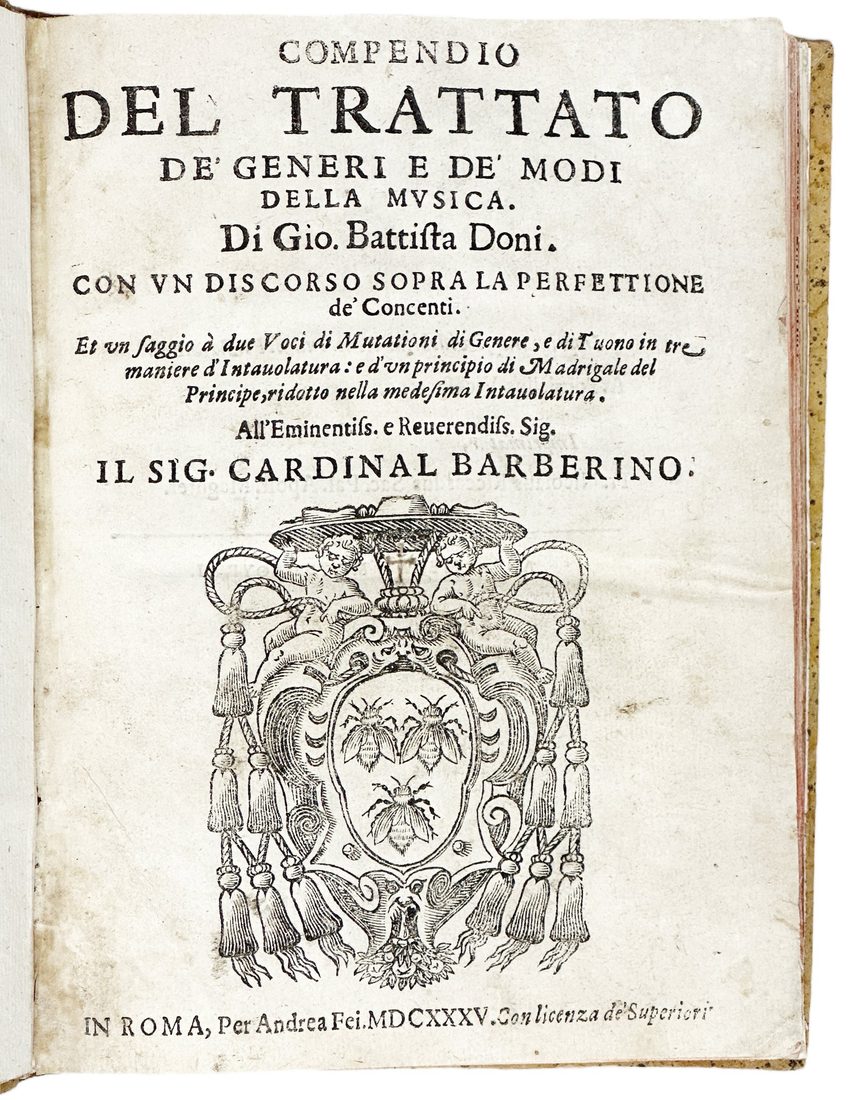
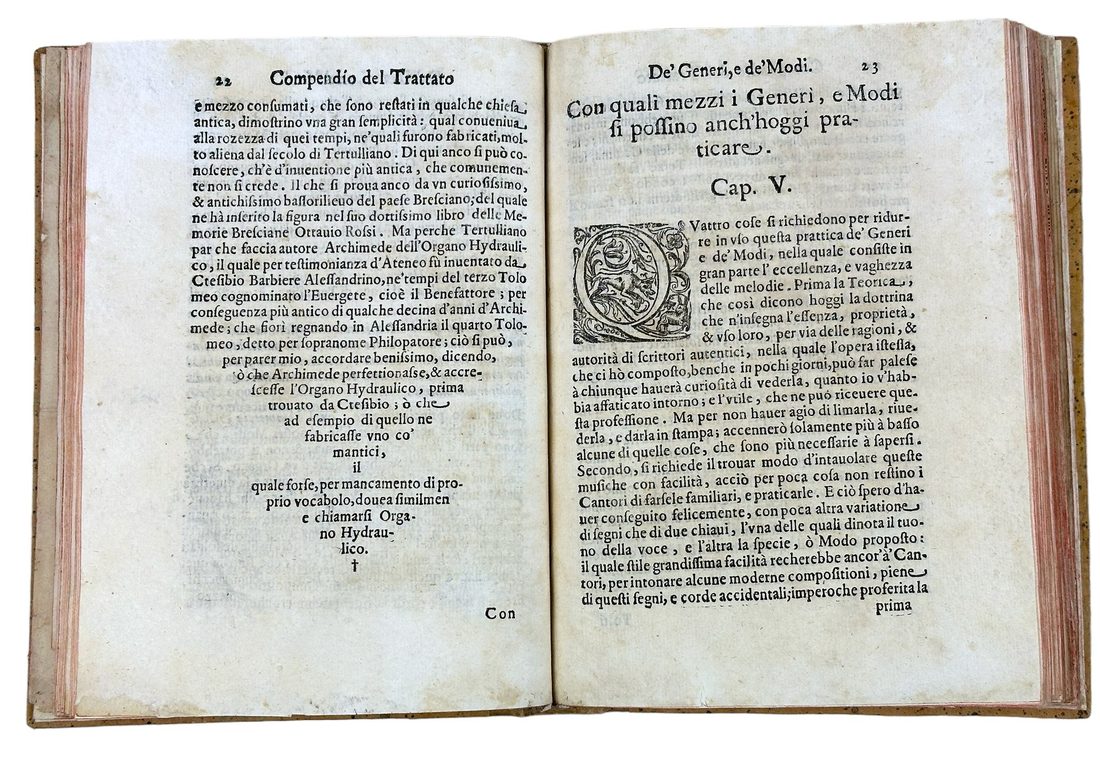
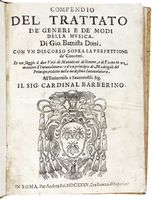
Doni, Giovanni Battista. Compendio del trattato de'generi e de'modi della musica. Di Gio. Battista Doni. Con un discorso sopra la perfettione de' concenti. Et un saggio a due voci di mutationi di genere, e di tuono in tre maniere d'intauolatura: e d' vn principio di madrigale de principe, ridotto nella medesima intauolatura. All'eminentiss. e reuerendiss. sig. il sig. cardinal Barberino. In Roma : per Andrea Fei, 1635.
4to (20 x 15 cm), half vellum binding, boards enriched with hand-colored paper, pp. [40], 171, [1], signature †⁴ a-d⁴ A-V⁴ X⁶ (leaf b1 incorrectly numbered c1), xylographic decorations and headpieces, on title page the coat of arms of Cardinal Francesco Barberini, text in Latin and Greek.
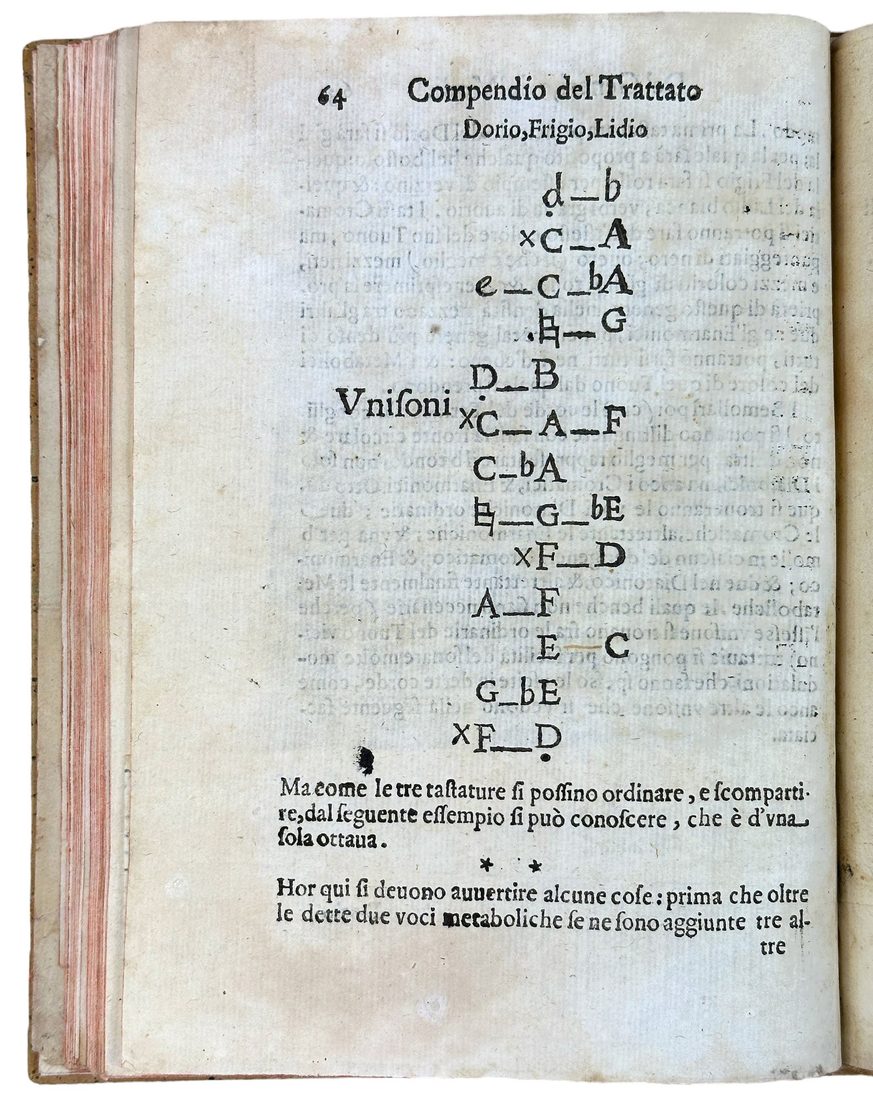
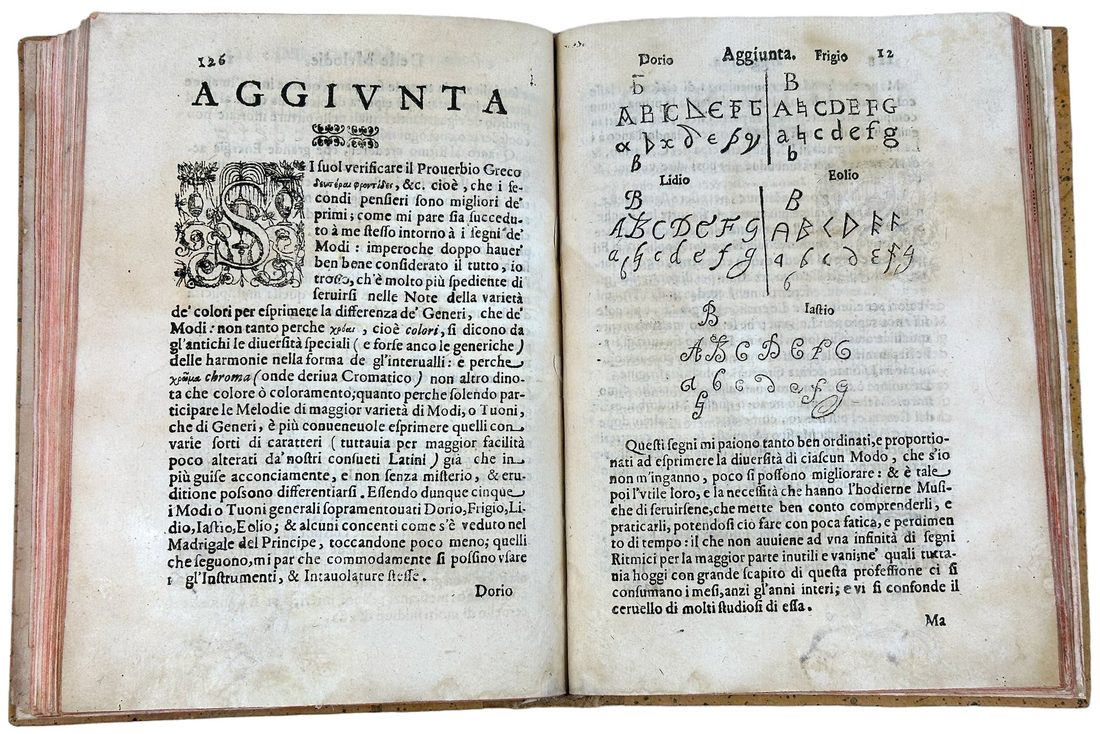
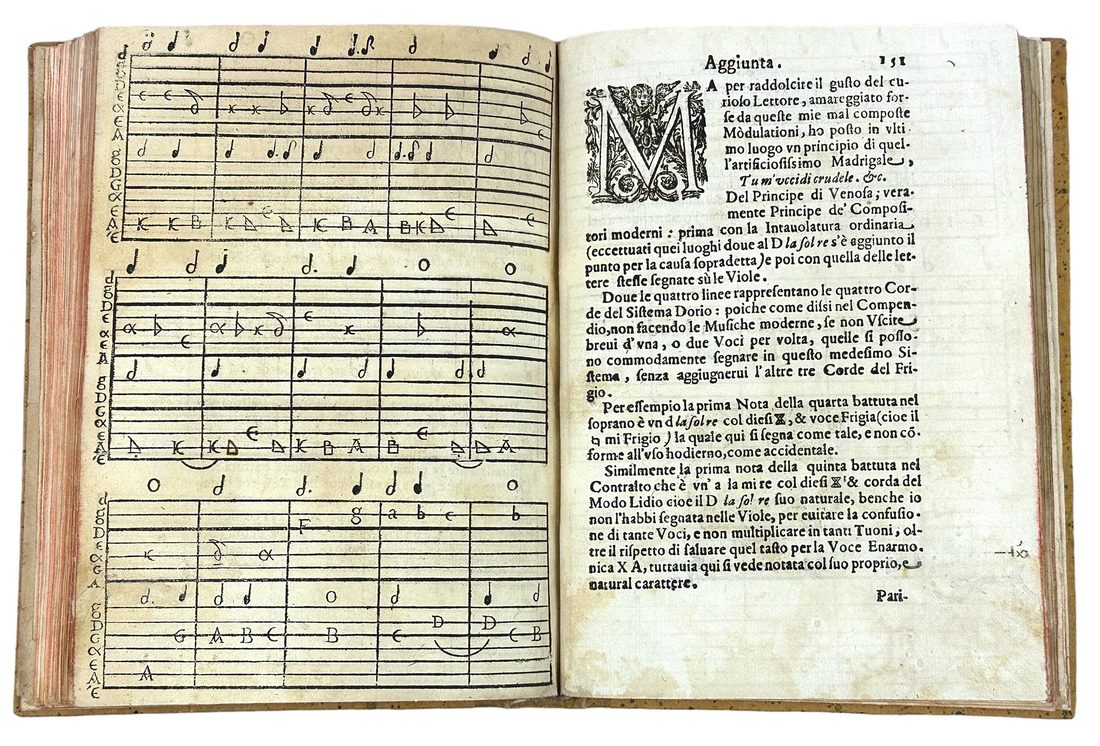
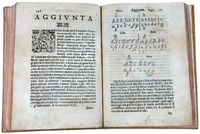
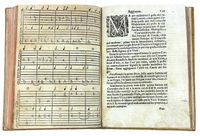
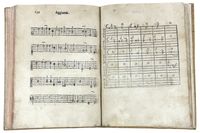
At leaf Q3v: Aggiunta con descrizione e rappresentazione in spartito dei cinque Modi o Tuoni generali denominati Dorio, Frigio, Lidio, Iastio, Eolio; at leaf V1r: Il principio d'un madrigale del Principe.
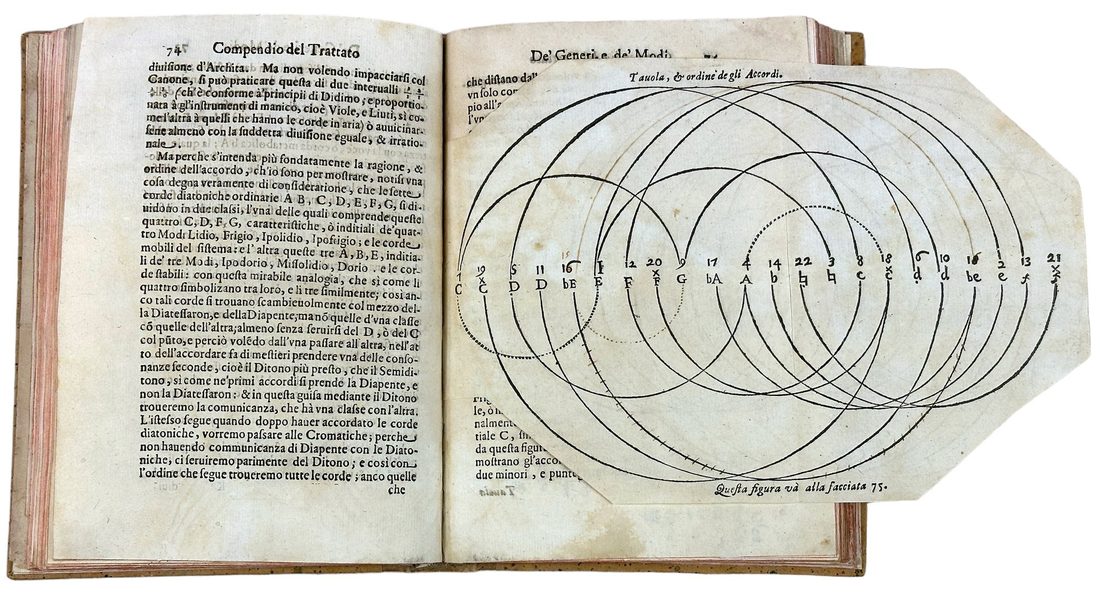
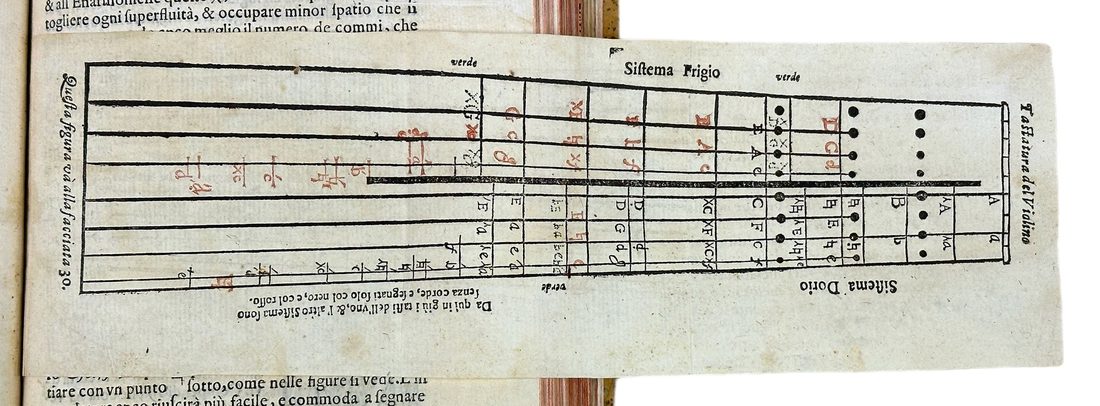
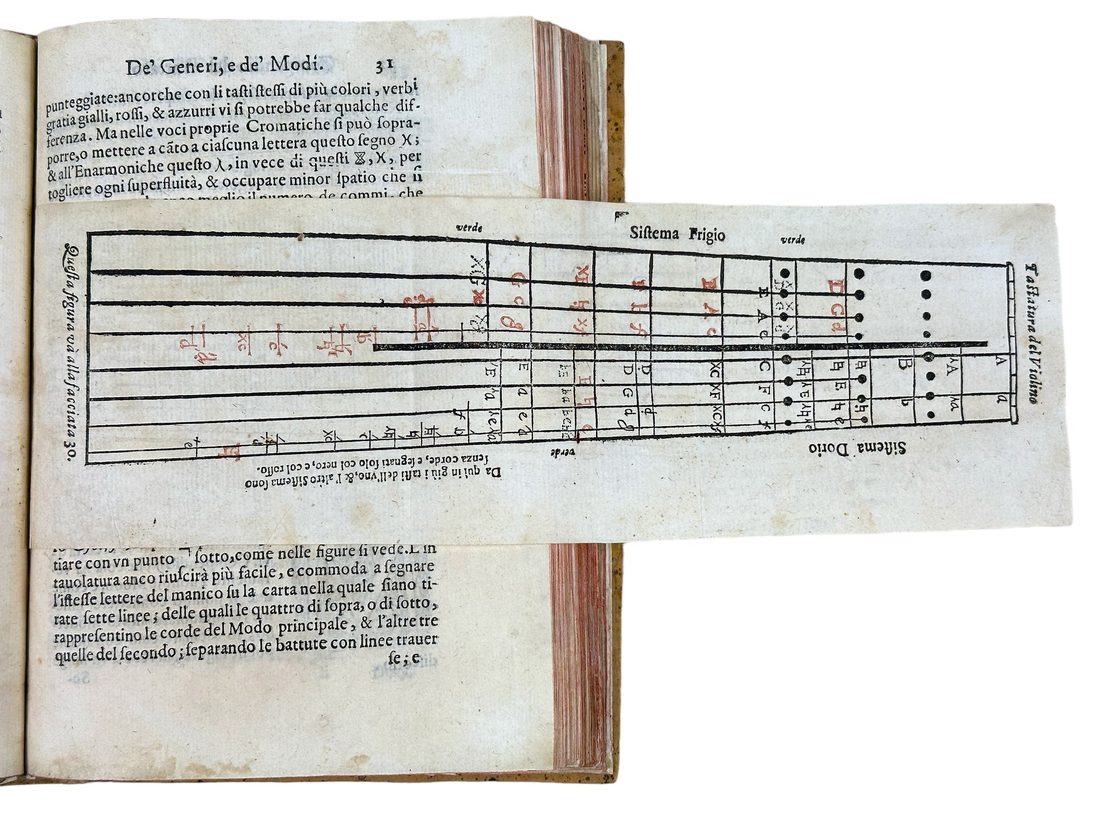
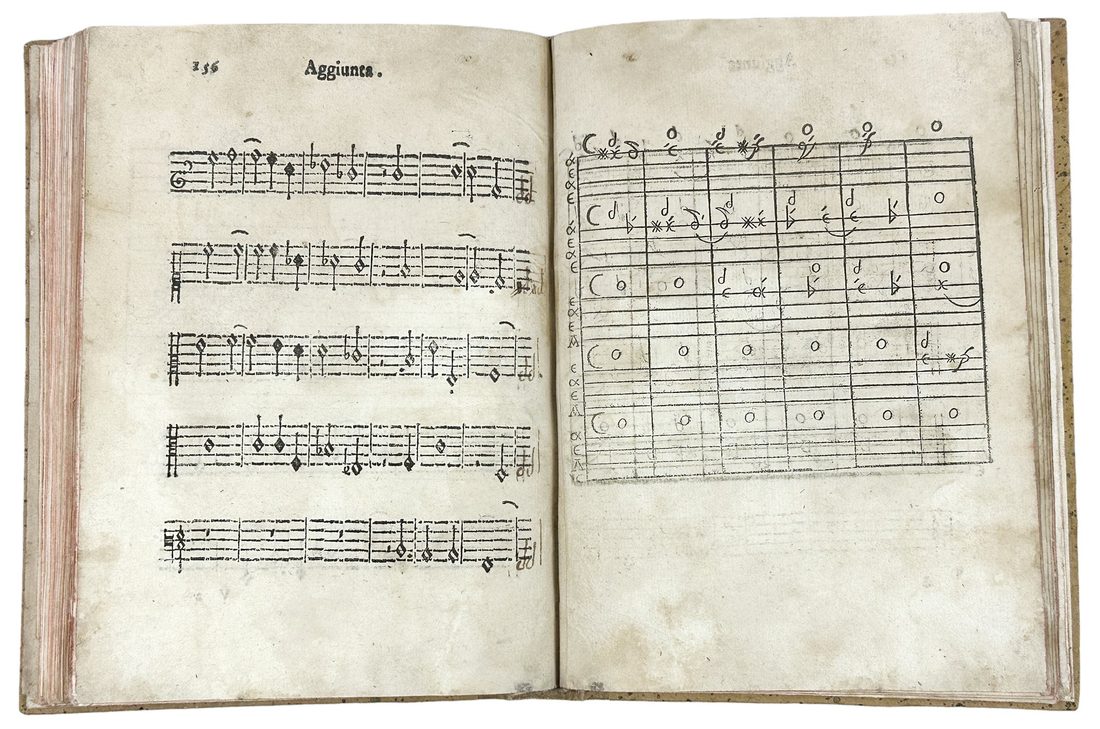
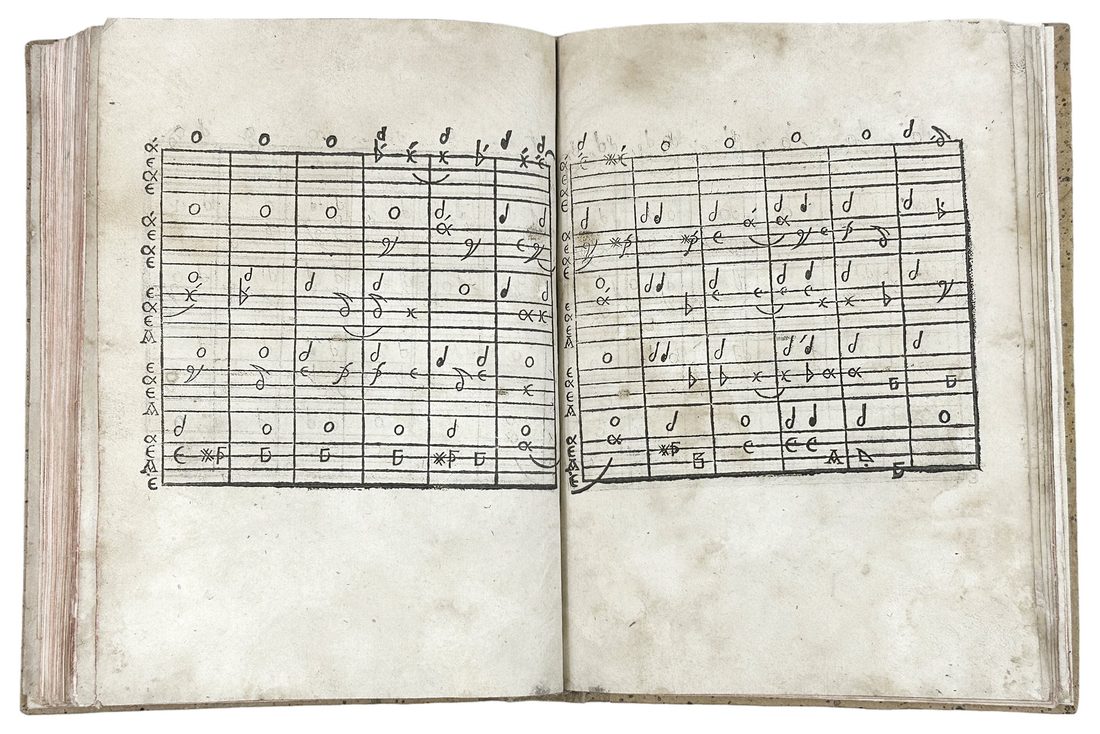
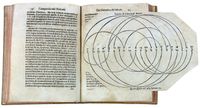
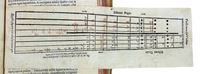
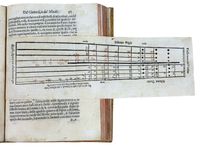
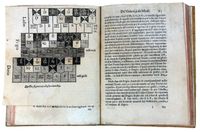
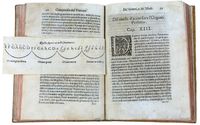
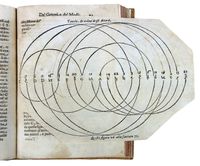
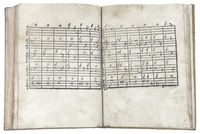
5 folding plates with musical notations
In his Compendio Doni is the first to theorise the introduction of elements of the ancient tonal system into contemporary musical practice and the need to return to the Greek tonal system, an ancient music theory characterized by its use of tetrachords (four-note scale segments), various modes named after Greek regions like Dorian, Phrygian, and Lydian, and the concept of octave species, which describes different arrangements of whole and half steps within an octave.
His theories took up the themes that Vincenzo Galilei had expressed in his Dialogo della musica antica e moderna. He compared the moderns to the ancients, concluding that apart from very few examples (Monteverdi in particular) true chromatic compositions do not exist. Very important in these works is the clear distinction that the author places between the madrigal genre and the recitative style, following the reform of the Camerata Fiorentina.
Doni recognized the advancements made by his predecessors, such as Mei (1573) and Salinas (1577), in understanding the Greek tonal system, though he disagreed with some of their interpretations. He was critical of others like Glareanus, whom he accused of falsely claiming to have revived Greek modes without properly engaging with the ancient Greek musical sources. Doni also dismissed Nicola Vicentino's attempts to revive the ancient chromatic and enharmonic genera as mistaken and useless.
A significant aspect of Doni's work was his interpretation of the tonoi and octave species, based on close readings of the original Greek treatises. His analysis provided a basis for our contemporary understanding of these concepts.
Doni differentiated between tonos and mode, drawing insights from Ptolemy's discussions on the modulation of tonos compared to melody. He highlighted how modulation in tonos involves altering the pitch of the voice throughout the melody while keeping the intervals suitable, as opposed to changing only a part of the melody.
Additionally, Doni credited Ptolemy with establishing the distances between the tonoi, describing the specific intervals that separate various tonoi such as Dorian, Phrygian, Lydian, and Mixolydian.
This understanding of the relationships between different tonoi was crucial in the historical study and interpretation of ancient Greek music theory.
One of Doni's significant innovations was his modification of the lyre, an instrument he renamed the Lyra Barberina in honor of his patron, Cardinal Francesco Barberini.
This instrument was intended to revive the ancient Greek lyre, reflecting Doni’s passion for connecting past and present musical traditions.
In the Appendix we find the Pedro de Heredia's madrigal Passa la vita, on a text by Pope Urbanus VIII
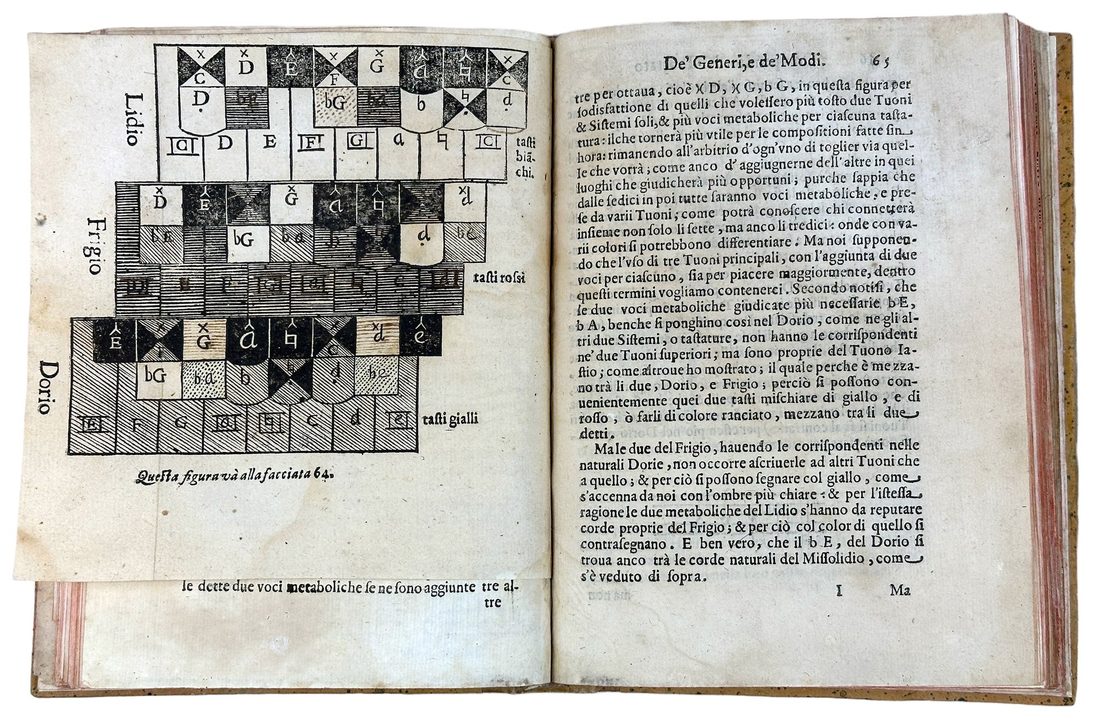
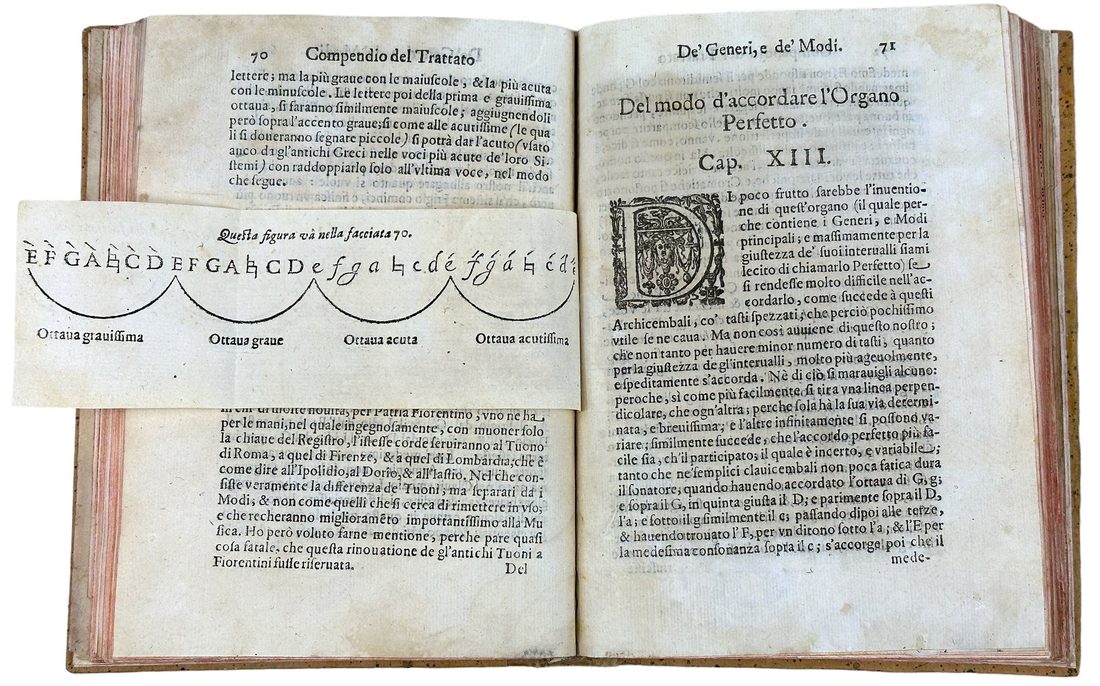
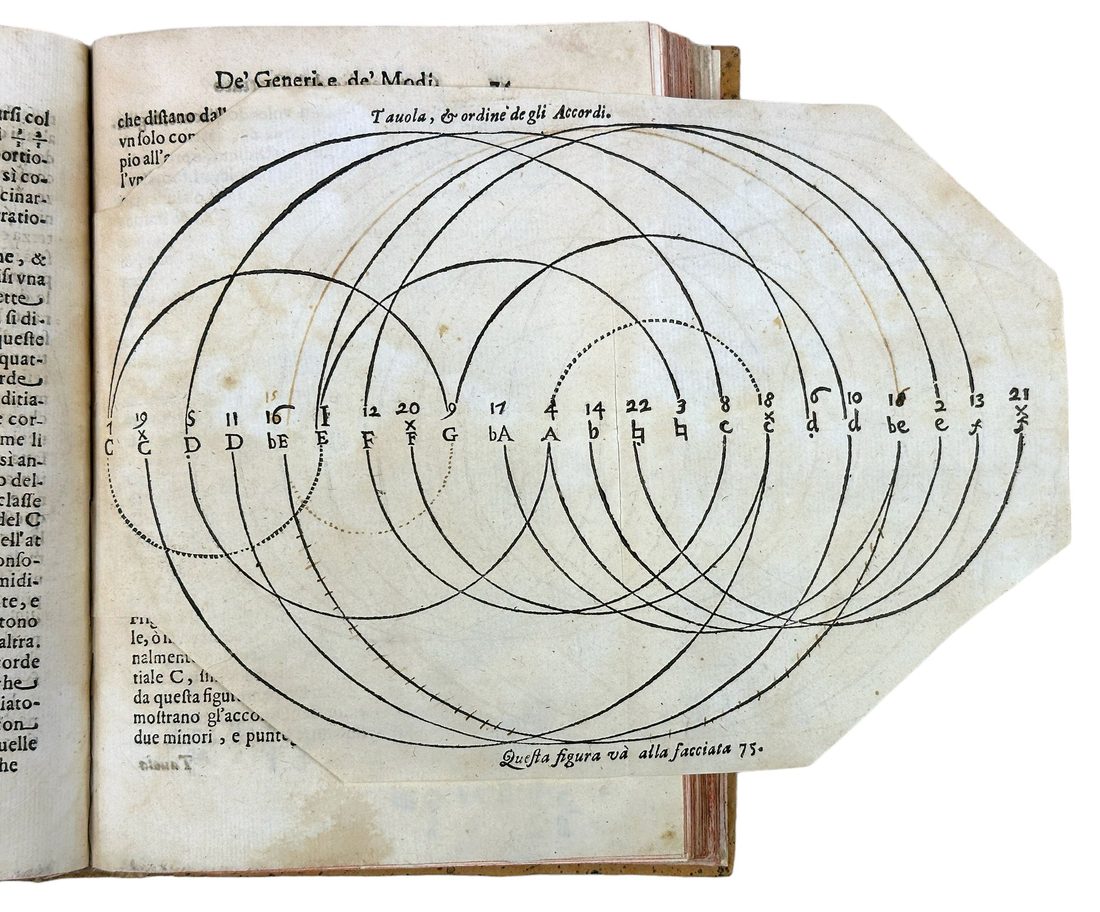
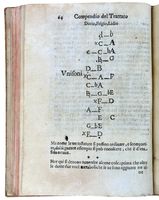
One of the woodcuts in the book shows a violin fingerboard with a layout for the ancient Doric mode. Other woodcuts illustrate Greek tonalities and chromatic musical progressions.
Book structure:
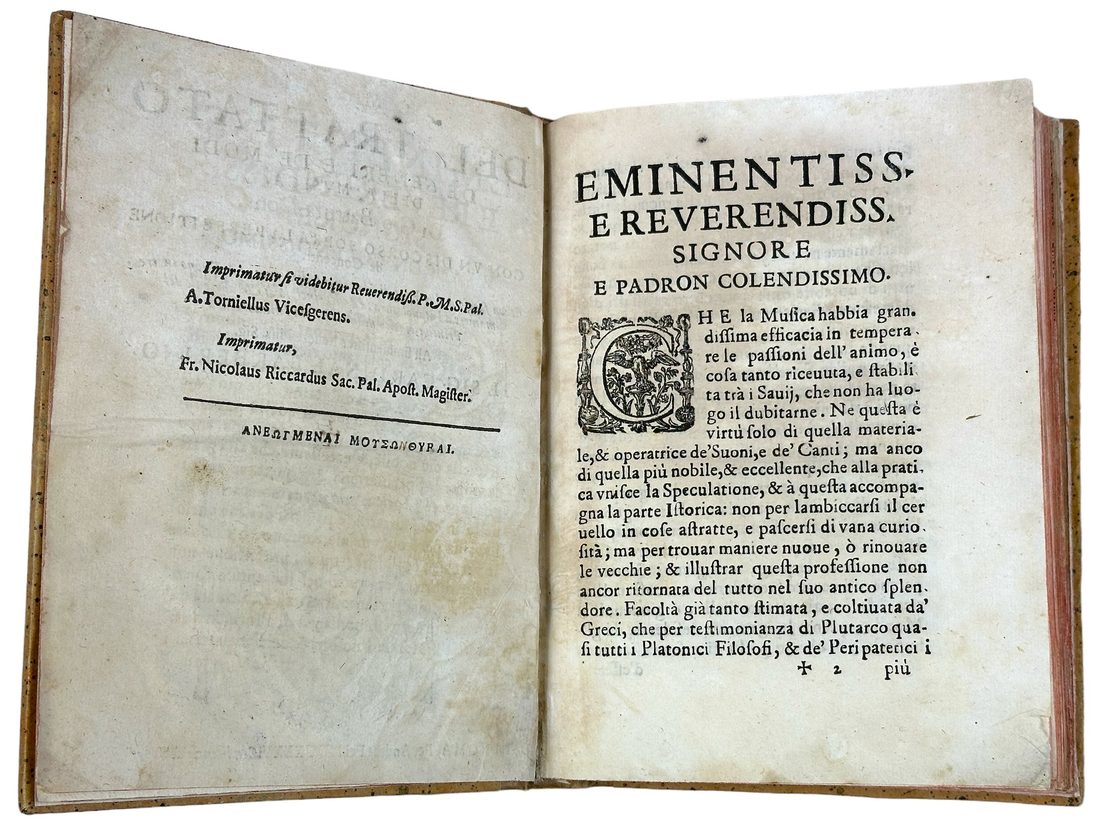
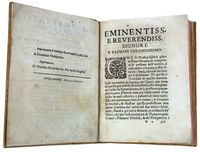
- Dediche, preamboli, indici, avvertimenti, tavole - Eminentiss. e revendiss. signore e padron colendissimo - Al discreto lettore - Ad librum - Tavola de' capitoli - Avvertimento à chi legge - Tavola delle cose più notabili del compendio - Tavola delle cose più notabili del discorso - Tavola delle cose notabili dell'aggiunta, 38 pp. (7,3 Mb.)
- Capitolo I - Quanto mal'intesa sia hoggi la materia de' Generi, e de' Modi, 7 pp.
- Capitolo II - Quanto sia grande la diversità tra i Modi antichi, & i moderni, 5 pp.
- Capitolo III - Altre differenze tra i Modi antichi, & i nostri, 6 pp. (
- Capitolo IV - Che per la restaurazione de' Generi, & de' Modi gl'instrumenti d'Archetto sono più a proposito de gl'altri: e dell'origine dell'Organo, 4 pp.
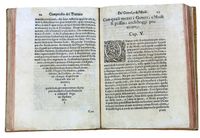
- Capitolo V - Con quali mezzi i Generi, e Modi si possino anch'hoggi praticare, 7 pp.
- Capitolo VI - Come nelle Viole suddette si debbono segnare le voci, & intavolarle, 5 pp.
- Capitolo VII - Della vera differenza de' Tuoni, e Modi; e dell'intavolatura, e connessione loro, con le giuste distanze, 12 pp.
- Capitolo VIII - Quanto sia commoda, & utile la predetta Divisione, 6 pp.
- Capitolo IX - Altre considerazioni intorno le dette Viole, 4 pp.
- Capitolo X - Della divisione de gl'Organi, & altri instrumenti di tasti per l'uso de' Generi, e de' Tuoni, 9 pp.
- Capitolo XI - Della divisione Harmonica de gl'Instrumenti di tasti, 9 pp.
- Capitolo XII - Dell'uso, & utilità di questa Divisione, 5 pp.
- Capitolo XIII - Del modo di accordare l'Organo perfetto, 7 pp.
- Capitolo XIV - Catalogo delle Consonanze di ciascuna voce de' tre Sistemi, 5 pp.
- Capitolo XV - Sommario de' Capi più principali, che si contengono nell'Opera intera, 15 pp.
- Discorso sopra la perfettione delle melodie - Nel quale si scoprono, e conferiscono insieme le Perfettioni, & Imperfettioni de' due più generali stili della Musica: mostrandosi come in molte cose si potrebbero migliorare, e rimettere in uso le Rapsodie, cioè Recitationi col Canto de' Poemi Heroici, 31 pp.
- Aggiunta - Si vuol verificare il Proverbio Greco..., 47 pp.
Giovan Battista Doni (1593 – 1647), was an influential Italian musicologist, composer, and theorist whose contributions significantly impacted the development of music and its historical understanding.
Doni’s most notable contributions to music are his works on music history and theory. His two major works, Compendio del trattato de' generi e de' modi della musica (1635) and Trattato della musica scenica (1640), stand as monumental texts in the history of musicology. In these works, Doni meticulously examined the modal systems of ancient Greek music, drawing parallels and contrasts with the music of his era. He emphasized the importance of understanding historical contexts and cultural backgrounds in the study of music, an approach that was pioneering for his time.
He contributed to the development of opera and the understanding of dramatic music, His insights into staging, orchestration, and the role of music in drama significantly influenced the burgeoning genre of opera.
His writings and ideas were widely influential, impacting the work of contemporary and later music theorists.
Conditions: wormholes restored at last 40 leaves sometimes touching few letters, some marks of use and light waterstains along the text.
References: C. V. Palisca, Giovanni Battista Doni’s Interpretation of the Greek Modal System, The Journal of Musicology, 1997; Gregory, p. 76; Gamba 1912; Damschroder & Williams, p. 74.