The Pyramids of Egypt: a Day-and-Night Optical View
| Macro-category | Ancient Games and Pre-cinema |
| Subcategory | Vue d'Optique |
| Author | PROBST, Georg Balthasar |
| Place of manufacture | Augsburg |
| Publisher / Maker | Georg Balthasar Probst |
| Year | 1770 |
fire on the tower, gold on the river
Probst’s Pyramids of Egypt,
an Augsburg optical view prepared to turn day into night
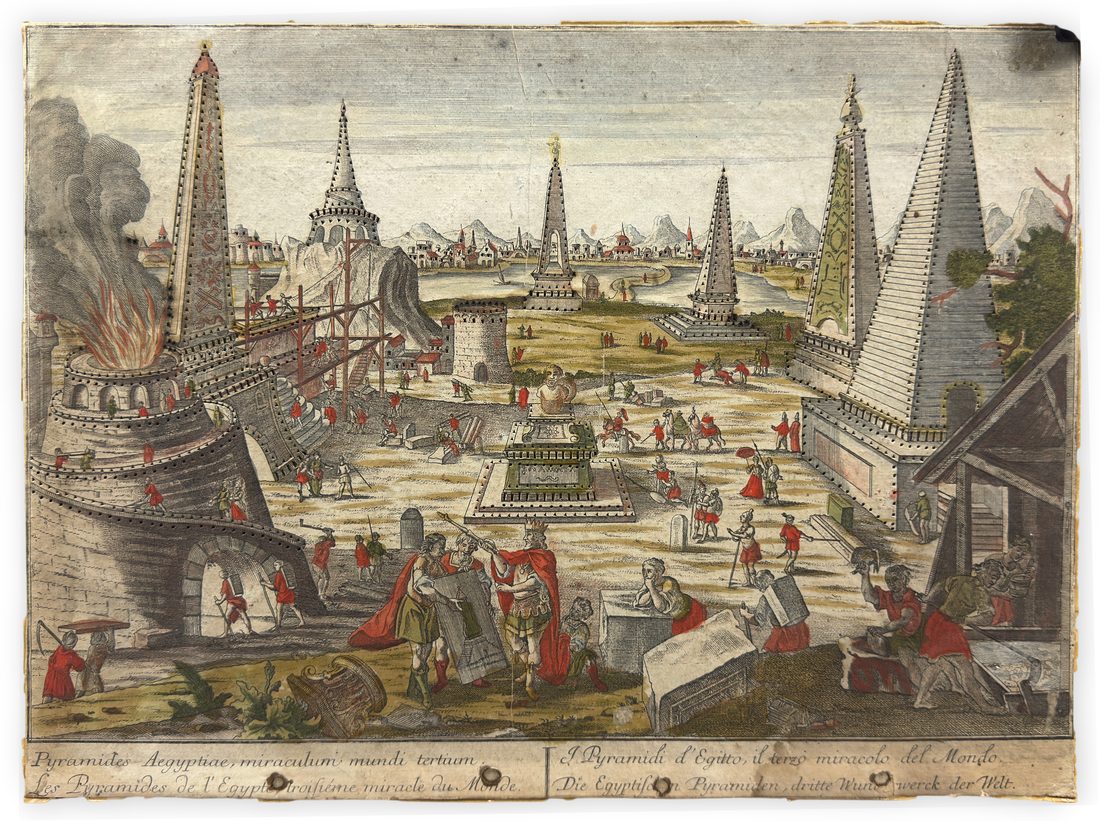
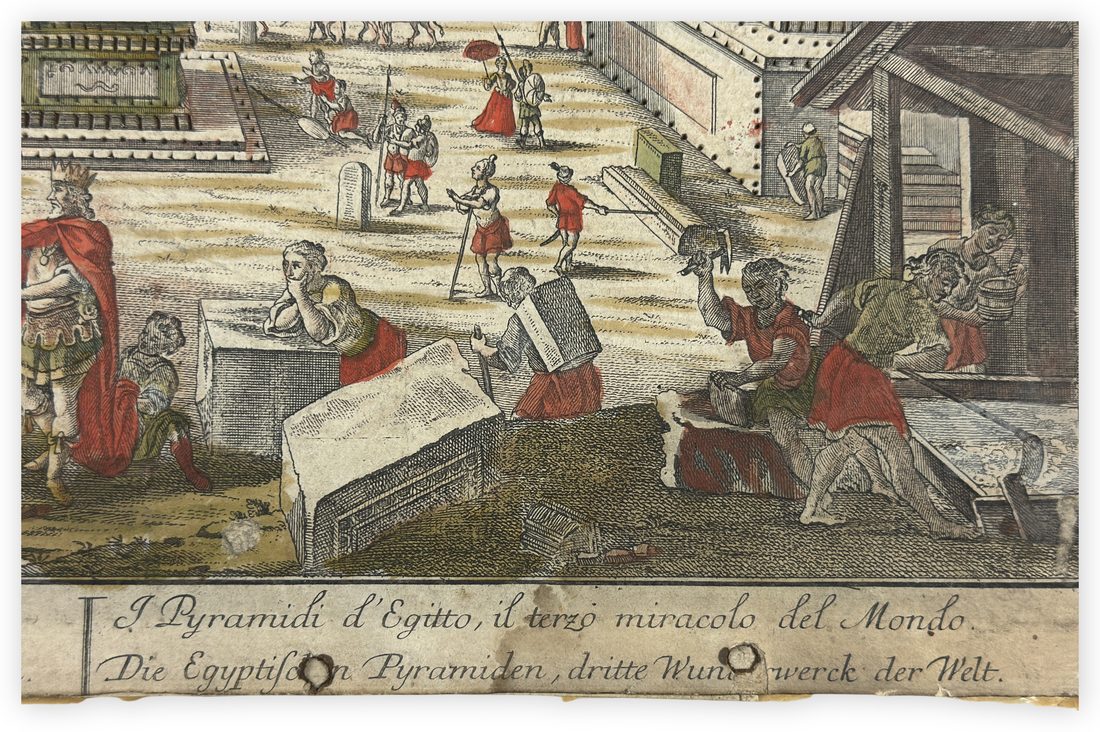
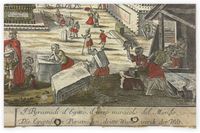
[Vue d’optique.] Probst, Georg Balthasar (1732-1801), publisher. Pyramides Aegyptiae, miraculum mundi tertium. Les Pyramides de l’Egypte, troisiéme miracle du Monde. I Pyramidi d’Egitto, il terzo miracolo del Mondo. Die Egyptischen Pyramiden, dritte Wunderwerck der Welt. Augsburg: Georg Balthasar Probst, ca. 1770.
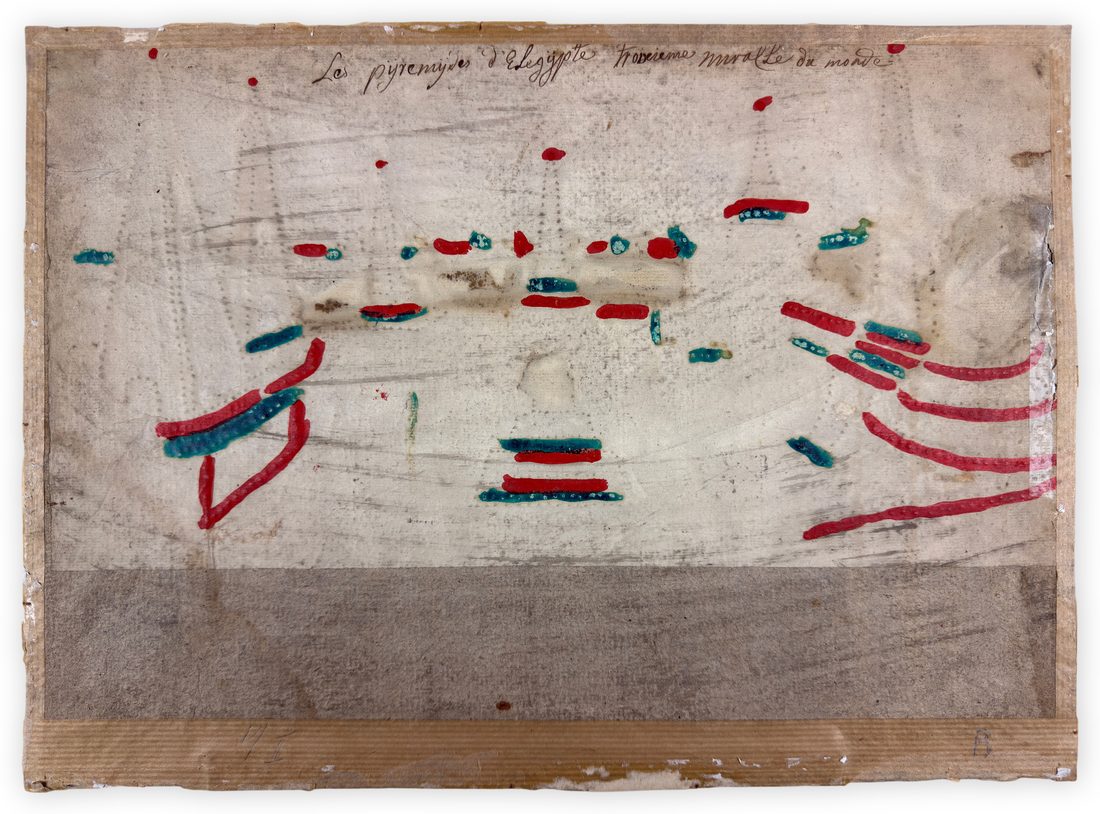
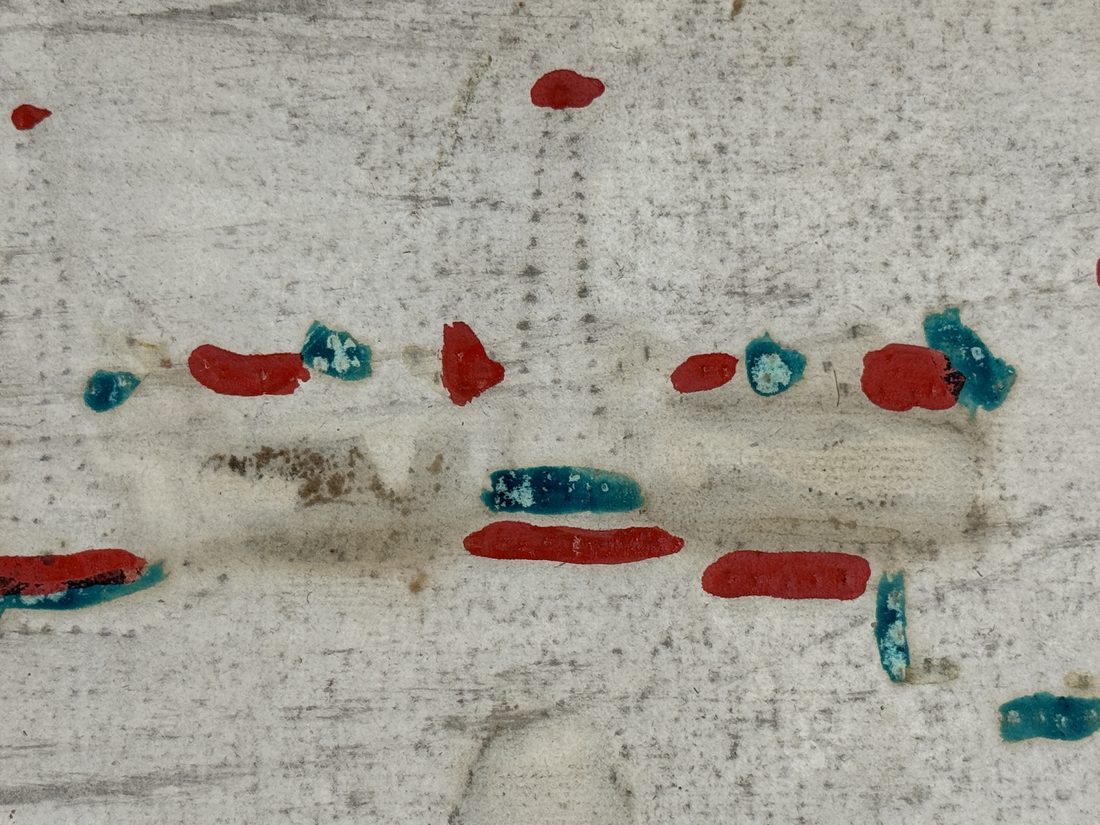
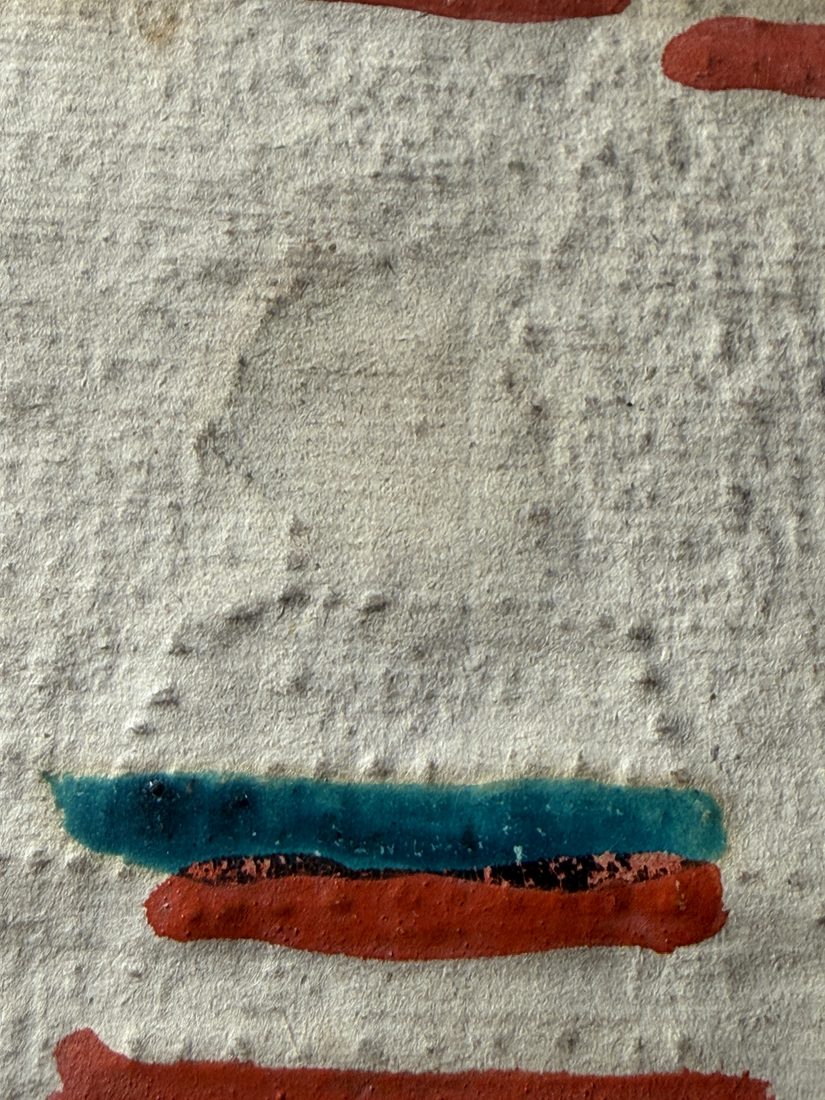
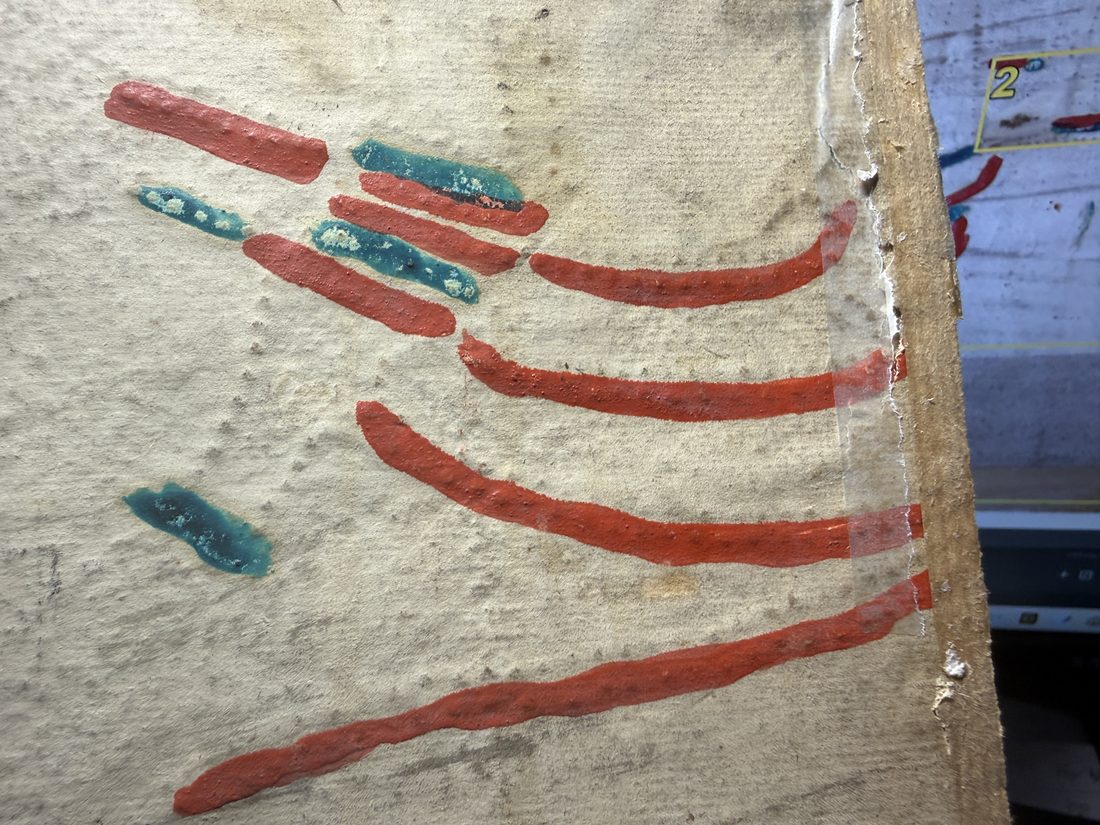
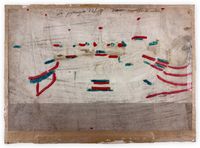
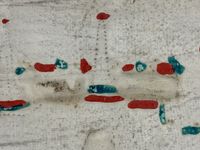
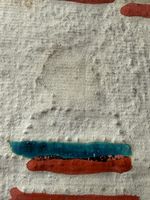
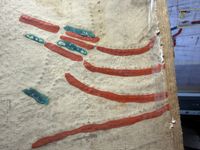
Hand-coloured etching and engraving on paper, the sheet trimmed within the plate mark (405 × 295 mm) and laid down on thin opaque card with perimeter strips. Four-language caption in two columns below the image, complete; the reversed title, plate number, series designation and imprint found on full-margined impressions are not present. Prepared on the verso for transmitted light: the backing is cut away along the bust on the central altar and along the band of the river, the fire on the tower is also opened to the light, the outlines of the monuments are pierced with rows of small triangular cuts, with round holes and short slits in places, and several rows are washed over on the verso with red and blue-green. Early manuscript title in brown ink on the verso, “Les pÿremÿdes d’Elegÿpte [sic] troiseieme [sic] miralle [sic] du monde”.
Click to Explore the Day/Night Effect
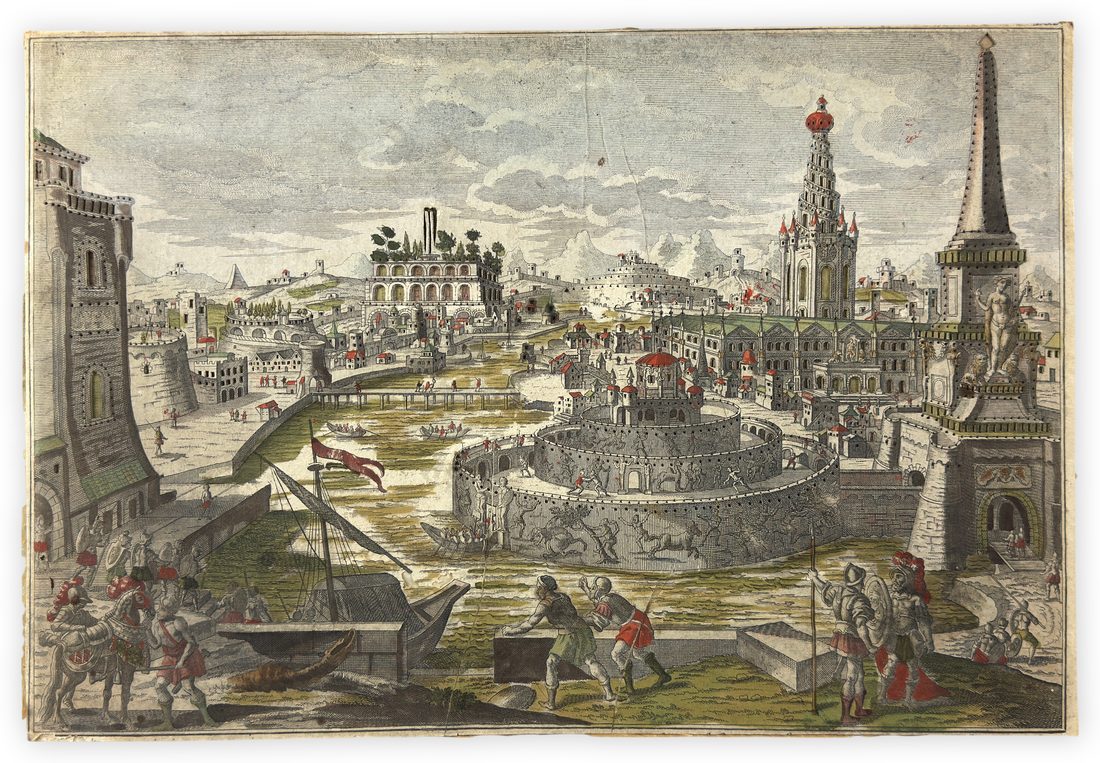
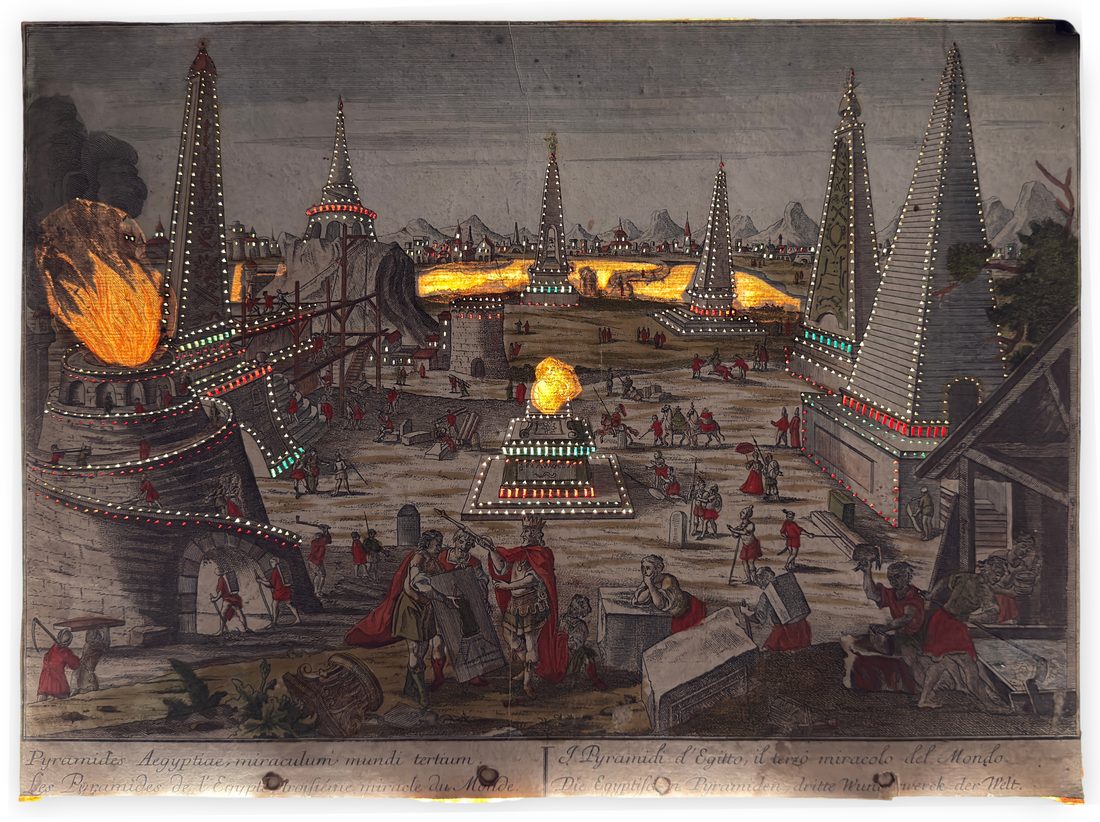
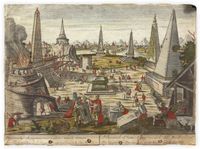
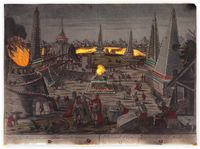
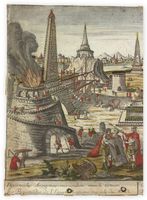
A hand-coloured optical view of the Pyramids of Egypt, the third plate of Georg Balthasar Probst’s Augsburg series of the Wonders of the World, prepared at an early date as a day-and-night transparency. Lit from the front, the building site of the pyramids lies in full daylight, crowded with masons, porters and soldiers. Lit from behind, the fire on the spiral tower flares up, the river turns to gold, the bust on the altar becomes a flame, and obelisks and pyramid are traced in points of white, red and green light. The preparation survives intact and still works.
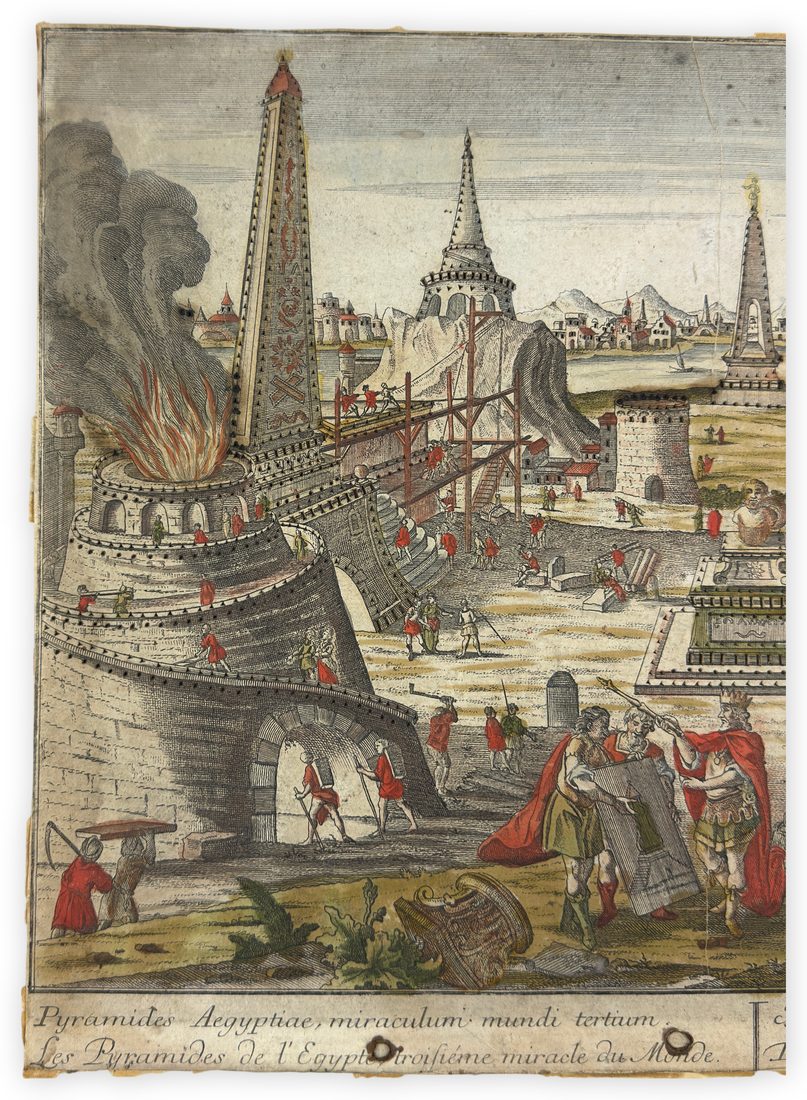
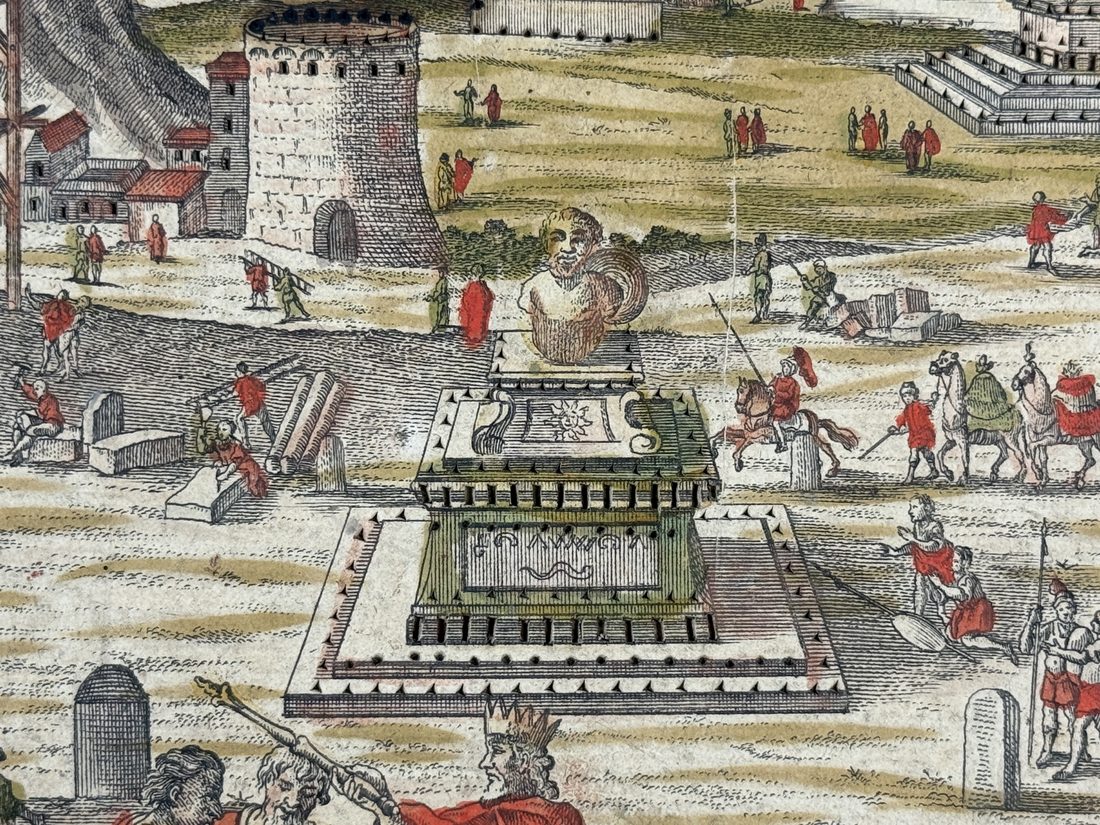
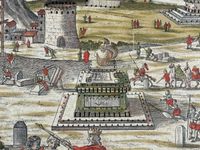
The scene is an imaginary Egyptian square under construction, enclosed by monuments. On the left rises a great round tower in diminishing tiers, climbed by a spiral ramp on which porters carry their loads, opened at the foot by an arch and crowned by a fire that sends up a heavy cloud of smoke; behind it stands a tall obelisk covered with pseudo-hieroglyphs. In the distance a round tower with a conical spire is being raised on a rocky hill from a timber scaffold. Further right an obelisk pierced by a tall arch and crowned by a small statue, a second obelisk on a stepped base, a river with a sailing boat, a town and a range of mountains close the view. On the right a decorated obelisk with a ball finial stands beside a great stepped pyramid on a high plinth, entered by an arched door. At the centre a bearded bust rests on a large stepped altar whose panel bears pseudo-Greek letters and a serpent.
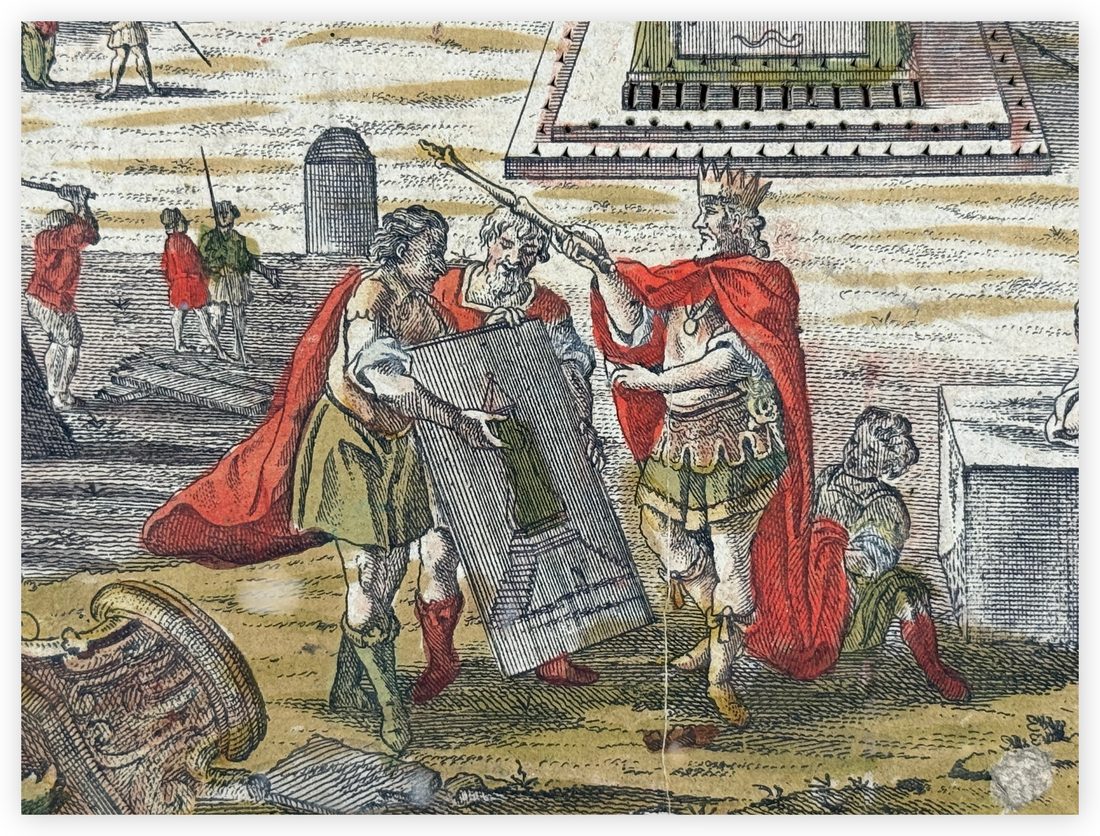
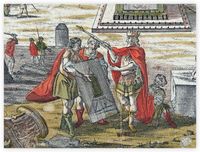
In the foreground a crowned king in a red cloak, sceptre in hand, is shown the drawing of a monument by two men. Around them masons dress squared blocks, a woman rests her head on her hand against a block, and two porters carry a slab above their heads; under a timber shed on the right a stonecutter swings his hammer, a labourer works a trough with a hoe and a woman brings a bucket. Soldiers with lances and shields, a lady with a parasol, a horseman and laden pack animals animate the square, and a toppled carved capital lies at the front.
Like every vue d’optique, the print was designed to be seen through a lens, in the drawing-room zograscope or in the showman’s box. This impression can also be shown by night. Lit from the front, it shows the building site by day; when the front is darkened and a candle or lamp is placed behind the sheet, the scene turns to night. The fire on the tower blazes, the river fills with golden light and the bust glows like a flame, its engraved lines still legible. Rows of white points trace the obelisks, the pyramid and the spire, while red and green lights run along the tiers of the tower, the steps of the altar and the bases of the monuments. Sky, square and figures sink into darkness.
The effect was obtained on the verso. The card backing was cut away along the bust and the river, so that the printed paper alone carries the light; the edges of the cut-outs stand in slight relief on the back. The perforations pass through print and backing, and several rows were washed over with colour. The manuscript title on the back, copying the French line of the caption, allowed the operator to identify the view from behind, where the subject cannot be seen, while preparing or changing the display.
Optical views were printed in large numbers and sold widely in the second half of the eighteenth century. Produced chiefly in London, Paris, Bassano and Augsburg, they served as entertainment and as a window on distant places, enjoyed at home through the zograscope and in the streets through the mondo nuovo of itinerant showmen. Augsburg became a major centre of the genre from the mid-1760s, and its publishers addressed a European clientele.
Ordinary views were often turned into night scenes. Pricking, cutting and backing the sheets with coloured silk or translucent paper, then alternating light from the front and from behind, allowed one sheet to show the same scene by day and by night. A set of sixty-nine views, assigned by the library to Augsburg and mounted as a roll in the second half of the eighteenth century, now in the Biblioteca Casanatense in Rome, is entirely prepared for night viewing in this manner, and a Milanese mondo nuovo of 1792 in the Cinémathèque française still holds its fifteen hand-coloured engravings, most of them perforated, together with the shutters that let in the light from front and back.
Of the seven wonders only the pyramids of Giza still stand, yet the plate owes nothing to their actual appearance. Its architecture recalls the print that opens Philips Galle’s Octo mundi miracula, engraved after Maarten van Heemskerck and published in Antwerp in 1572, which already shows the burning kiln with arched openings at its foot, here grown into the tiered tower with its spiral ramp, the slender obelisk crowned by a statue, the stepped pyramid with its arched door, the obelisk with a ball finial and the crowned king who inspects the works with his sceptre. The Augsburg plate omits Galle’s seated pharaoh and the eagle carrying the sandal of Rhodopis, and adds the architects with their drawing, the bust on the altar, the spire on the hill and the masons’ shed. A reversed copy with a French caption, “Les Piramides d’Egipte regardés comme une des merveilles du Monde”, was published in Paris by Louis-Joseph Mondhare; an impression is in the Musée de l’Image at Épinal. The fire that in Galle bakes the bricks becomes, lit from behind, the brightest light of the night scene.
Georg Balthasar Probst (1732-1801) belonged to the Augsburg family of print publishers descended from the business of Jeremias Wolff (1663-1724), continued by his son-in-law Johann Balthasar Probst (1673-1750). After 1750 the firm was divided among the heirs, and Georg Balthasar published under his own name with an imperial privilege. His optical views, numbered and lettered in several languages, run to more than 400 sheets; they are catalogued by S. von Kapff (2010).
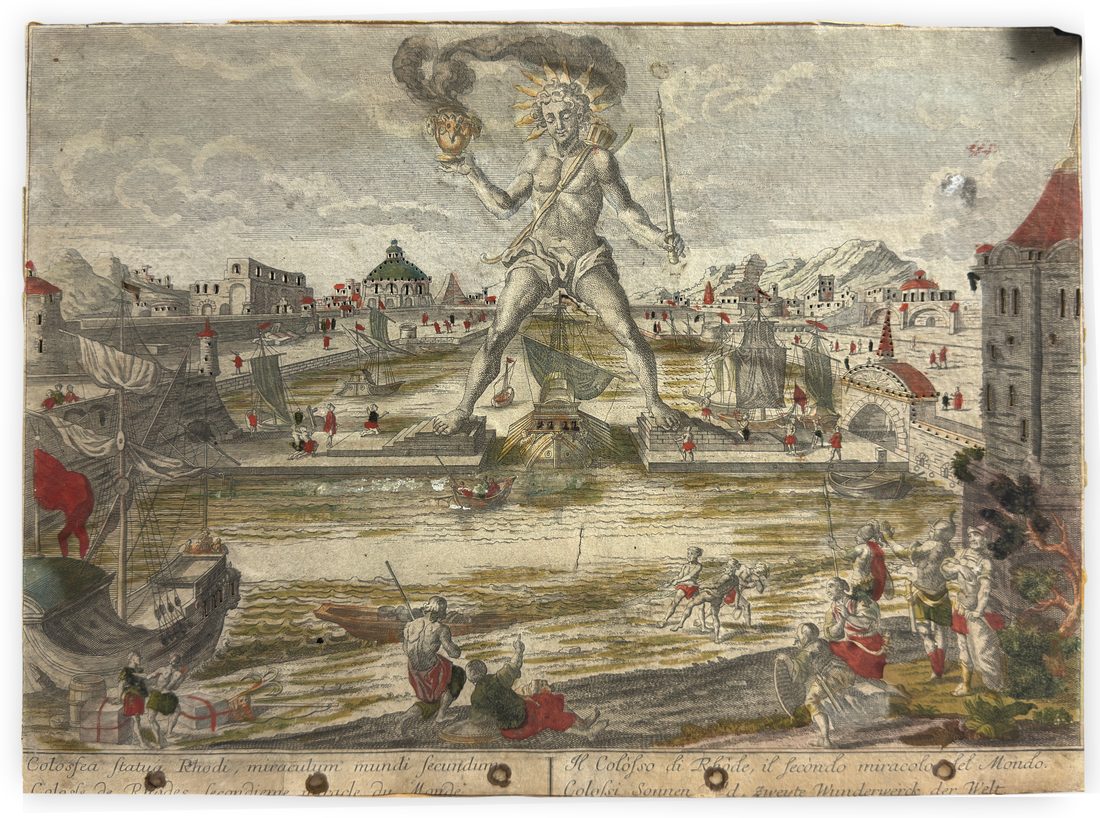
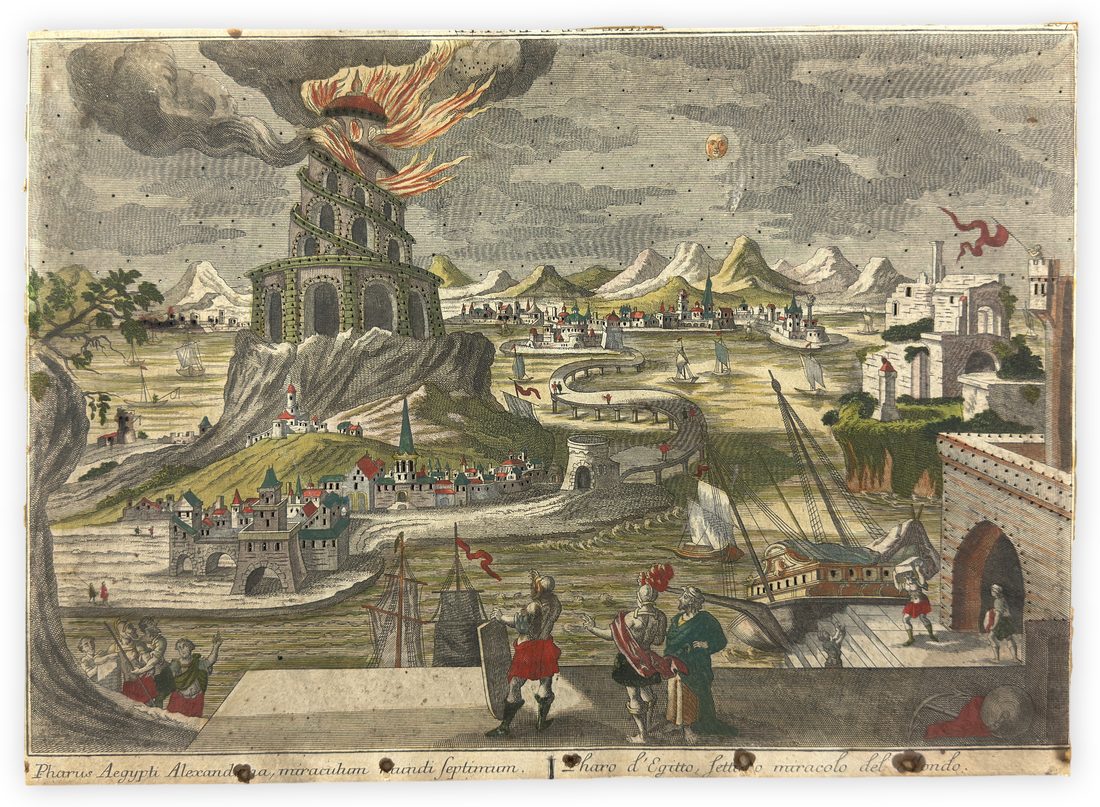
The Wonders of the World comprise seven plates numbered 161 to 167: the Walls of Babylon, the Colossus of Rhodes, the Pyramids of Egypt, the Mausoleum of Halicarnassus, the Temple of Diana at Ephesus, the Roman amphitheatre and the Pharos of Alexandria, each caption stating its place in the sequence. Full-margined impressions, such as that in the Bibliothèque nationale de France, carry above the image the reversed title “LES PYRAMIDES DE L EGYPTE” and the number 163, and below it “Med. Fol:° N°. 43”, “Cum Gratia et Privilegio Sac: Cæs: Majestatis” and “Georg Balthasar Probst, excud. A.V.”.
Conditions: Trimmed within the plate mark; four small round holes from early fixings in the caption band, touching a few letters; a fine vertical crease through the centre of the sheet; a few small abrasions in the foreground; light staining in the river; edges slightly irregular with small losses at the foot, margins reinforced on the verso. Colour fresh and bright; the night effect in full working order.
Provenance: Early manuscript title in French on the verso, indicating use in a French-speaking context.
Census: Paris, Bibliothèque nationale de France, Département des Estampes et de la photographie, LI-72 (9)-FOL, full-margined impression.
References: S. von Kapff, Guckkastenbilder aus dem Augsburger Verlag von Georg Balthasar Probst (1732-1801): Gesamtkatalog, Weißenhorn: Konrad, 2010; P. Galle after M. van Heemskerck, Octo mundi miracula, Antwerp: Philips Galle, 1572, pl. 1 (New Hollstein Dutch, Galle, 478); C. A. Zotti Minici (ed.), Il mondo nuovo: le meraviglie della visione dal ’700 alla nascita del cinema, Milan: Mazzotta, 1988; A. Milano (ed.), Viaggio in Europa attraverso le vues d’optique, Milan: Mazzotta, 1990; R. Balzer, Peepshows: A Visual History, New York: Harry N. Abrams, 1998; R. Hyde, Paper Peepshows: The Jacqueline and Jonathan Gestetner Collection, Woodbridge: Antique Collectors’ Club, 2015.