The Colossus of Rhodes: a Day-and-Night Optical View
| Macro-category | Ancient Games and Pre-cinema |
| Subcategory | Vue d'Optique |
| Author | PROBST, Georg Balthasar |
| Place of manufacture | Augsburg |
| Publisher / Maker | Georg Balthasar Probst |
| Year | 1770 |
the sun god lights the harbour
Probst’s Colossus of Rhodes,
an Augsburg optical view prepared to turn day into night
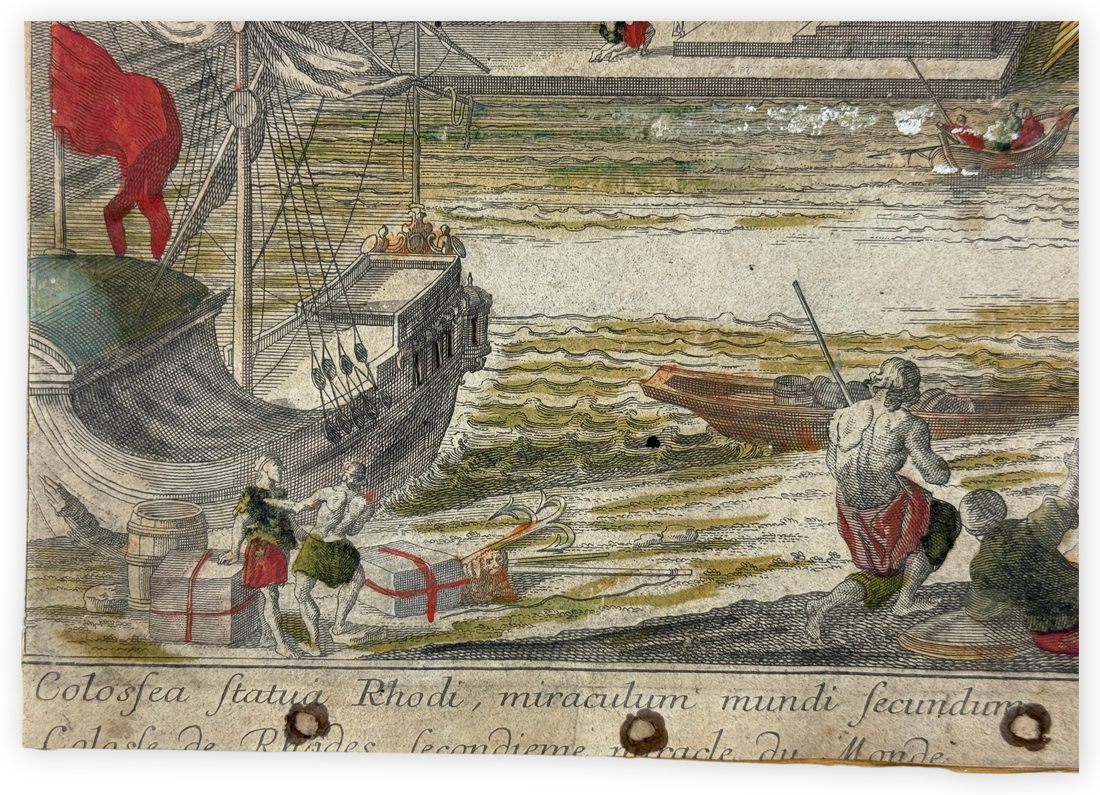
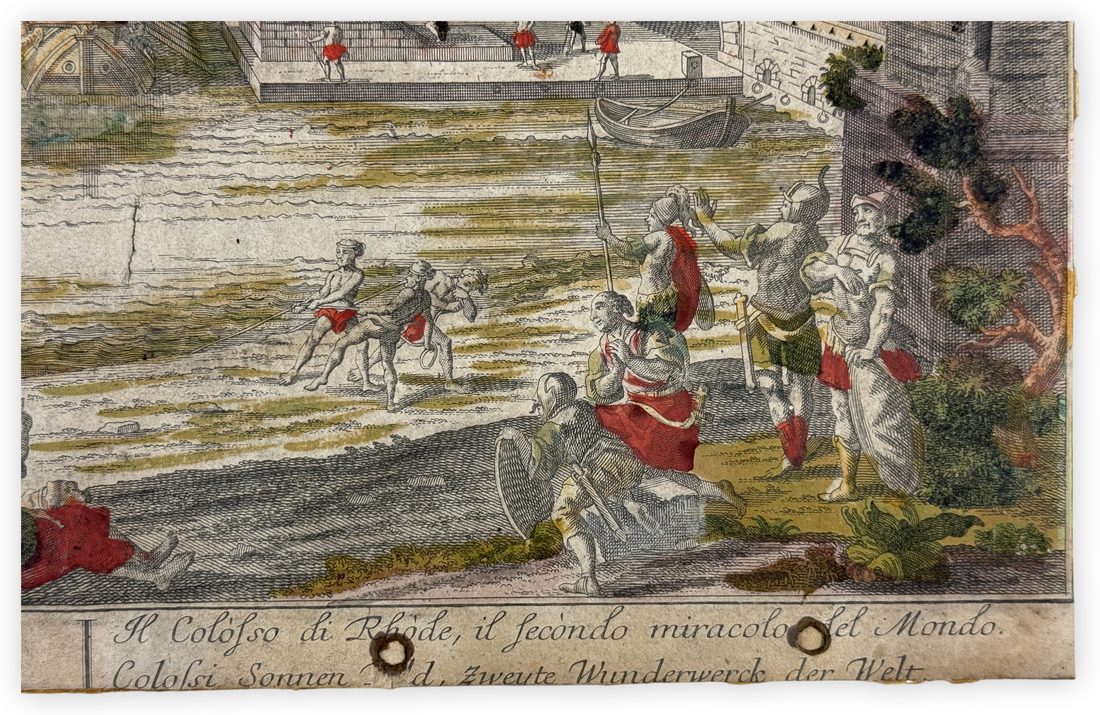
[Vue d’optique.] Probst, Georg Balthasar (1732-1801), publisher. Colossea statua Rhodi, miraculum mundi secundum. Colosse de Rhodes, secondieme miracle du Monde. Il Colosso di Rhode, il secondo miracolo del Mondo. Colossi Sonnen Bild, Zweyte Wunderwerck der Welt. Augsburg: Georg Balthasar Probst, ca. 1770.
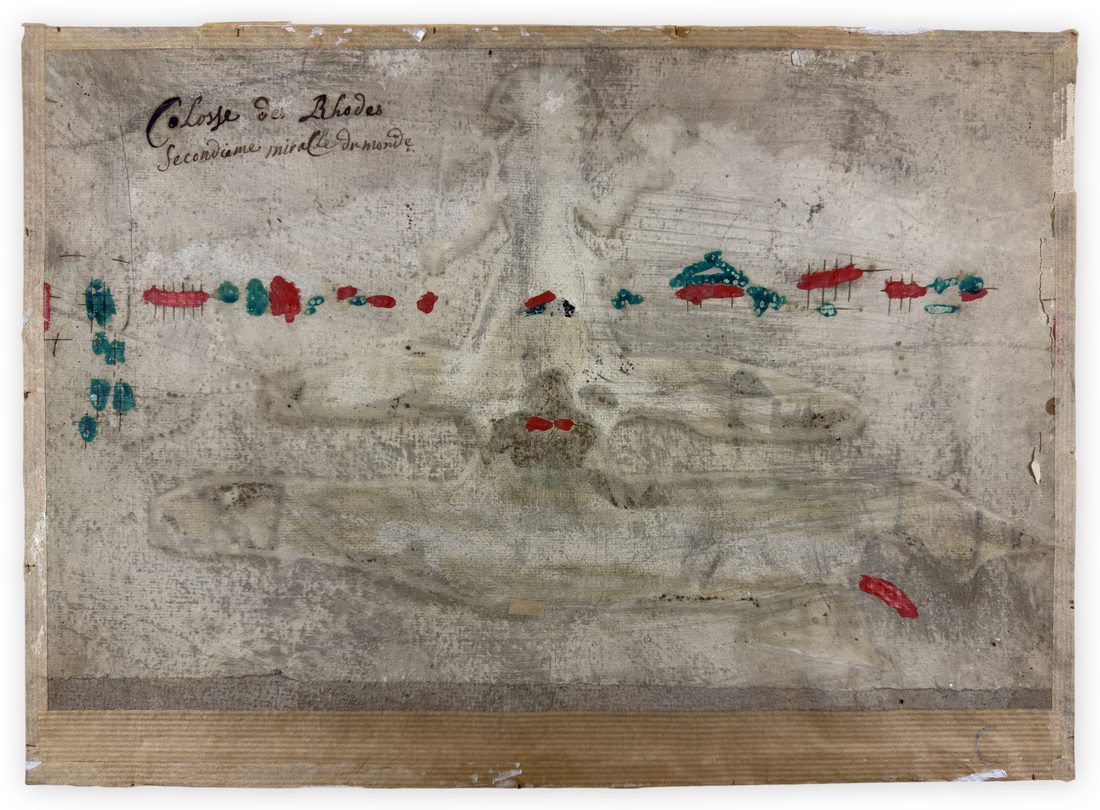
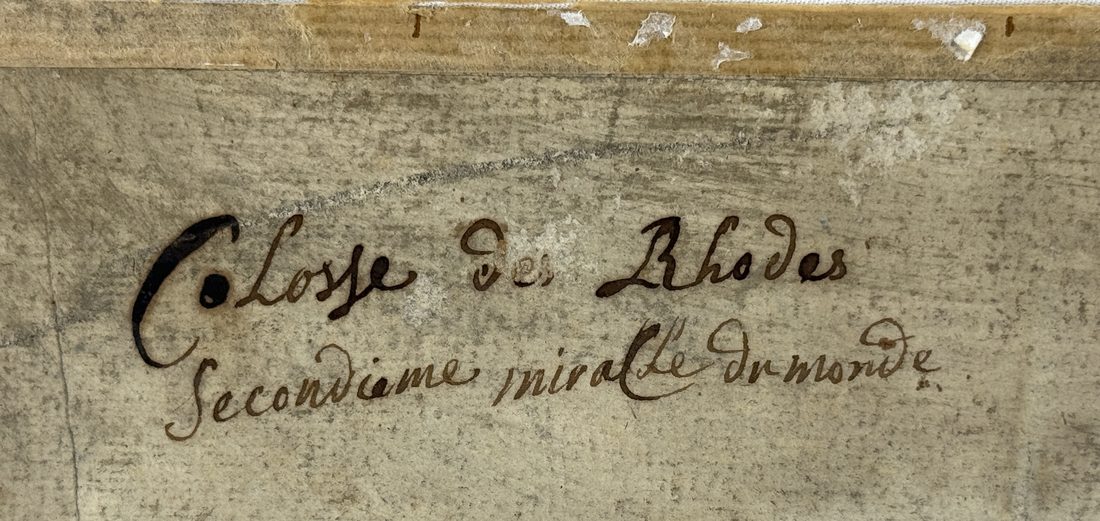
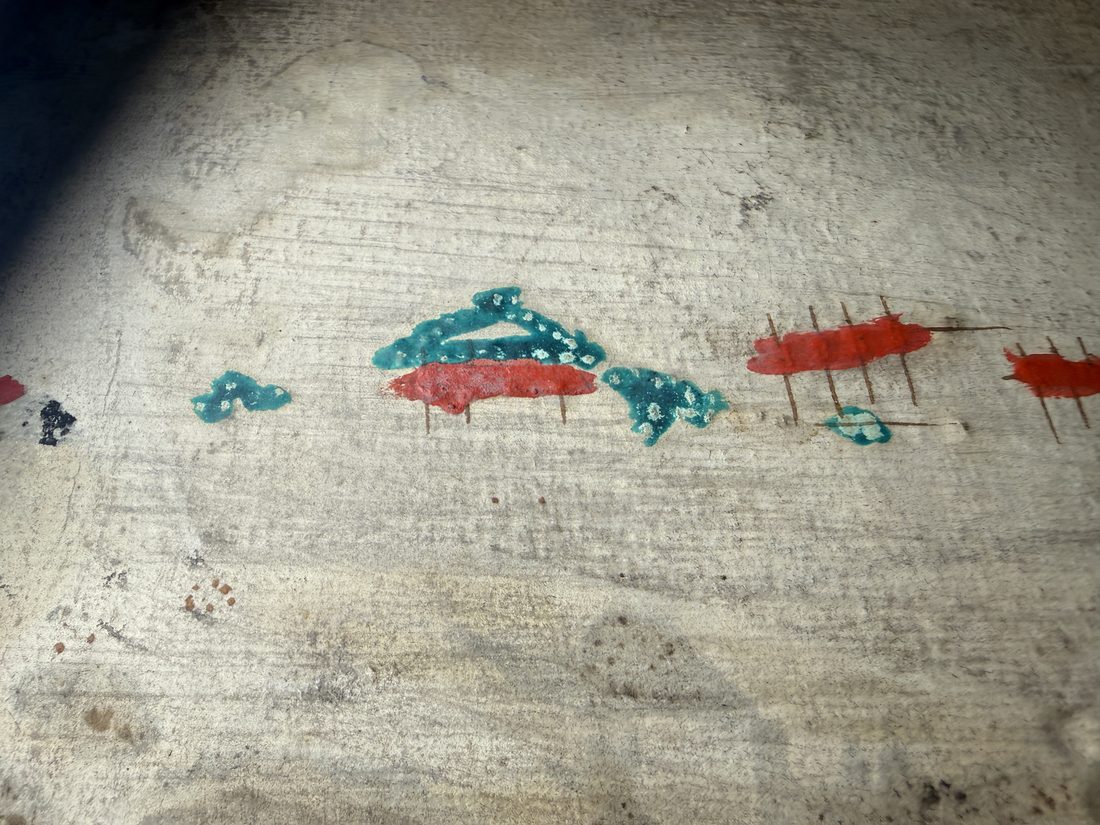
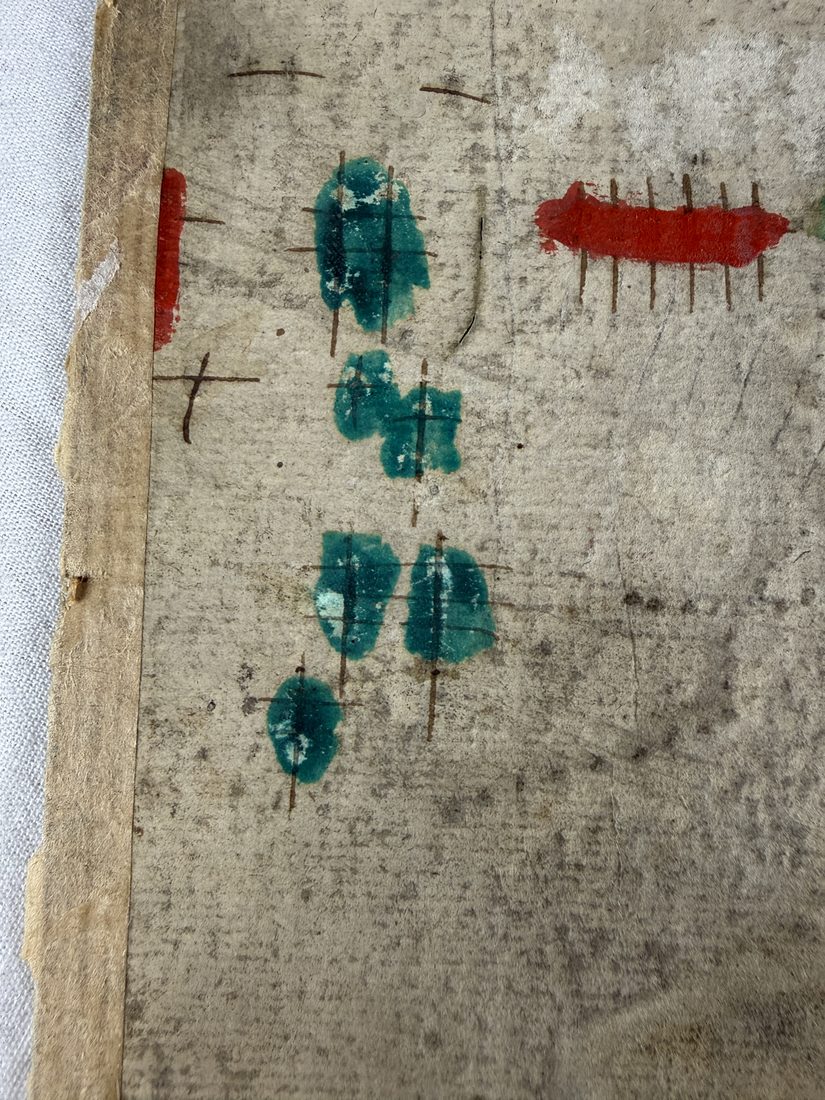
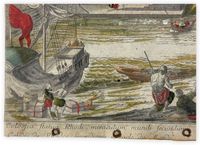
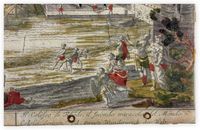
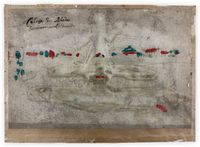
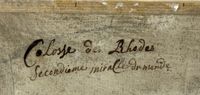
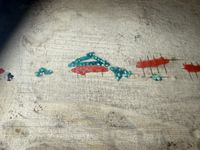
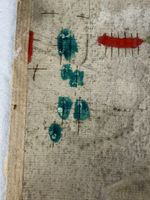
Hand-coloured etching and engraving on laid paper, the sheet trimmed within the plate mark (405 × 295 mm) and laid down on an opaque paper backing with perimeter strips. Four-language caption in two columns below the image, the French and German lines shaved at the foot; the reversed title, plate number, series designation and imprint found on full-margined impressions are not present. Prepared on the verso for transmitted light: the backing is cut away along the figure of the Colossus, a broad band of water and the central quay, with the boats reserved in silhouette, and the windows of the town are pierced with pinholes or short knife slits, most of them washed over with translucent red and blue-green. Early manuscript title in brown ink on the verso, “Colosse des Rhodes / Secondieme miralle [sic] du monde”.
Click to Explore the Day/Night Effect
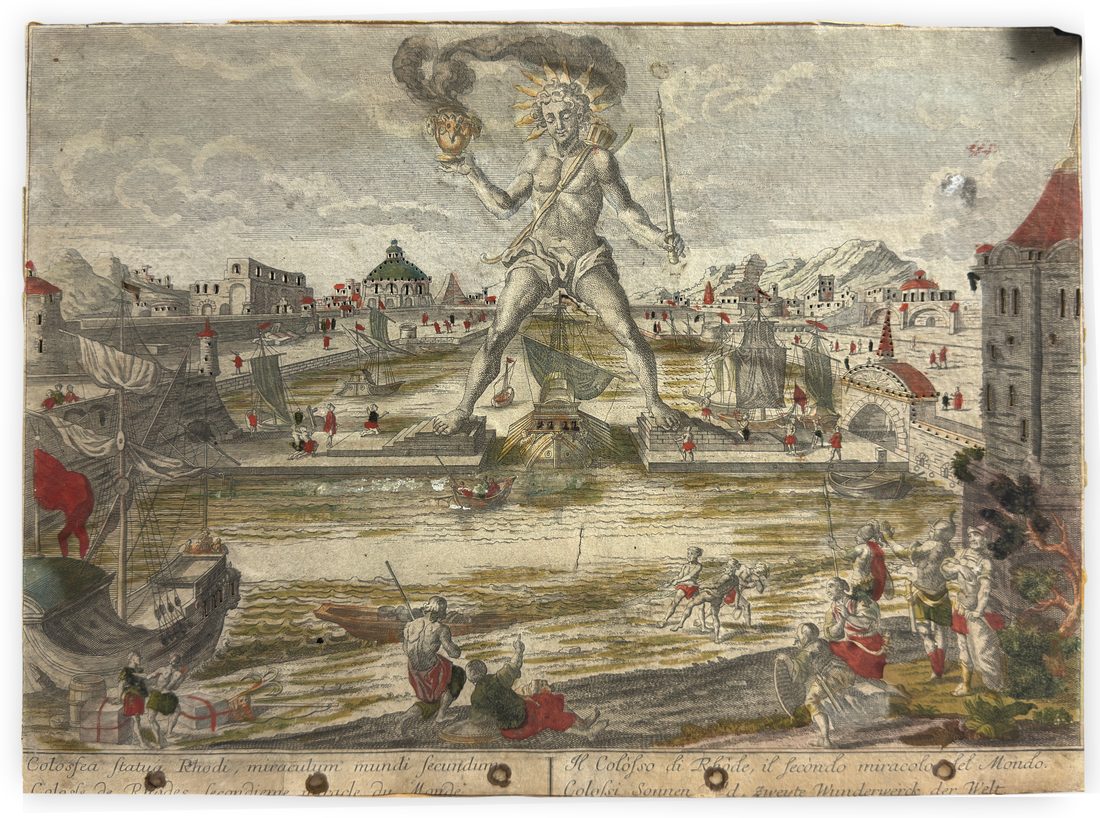
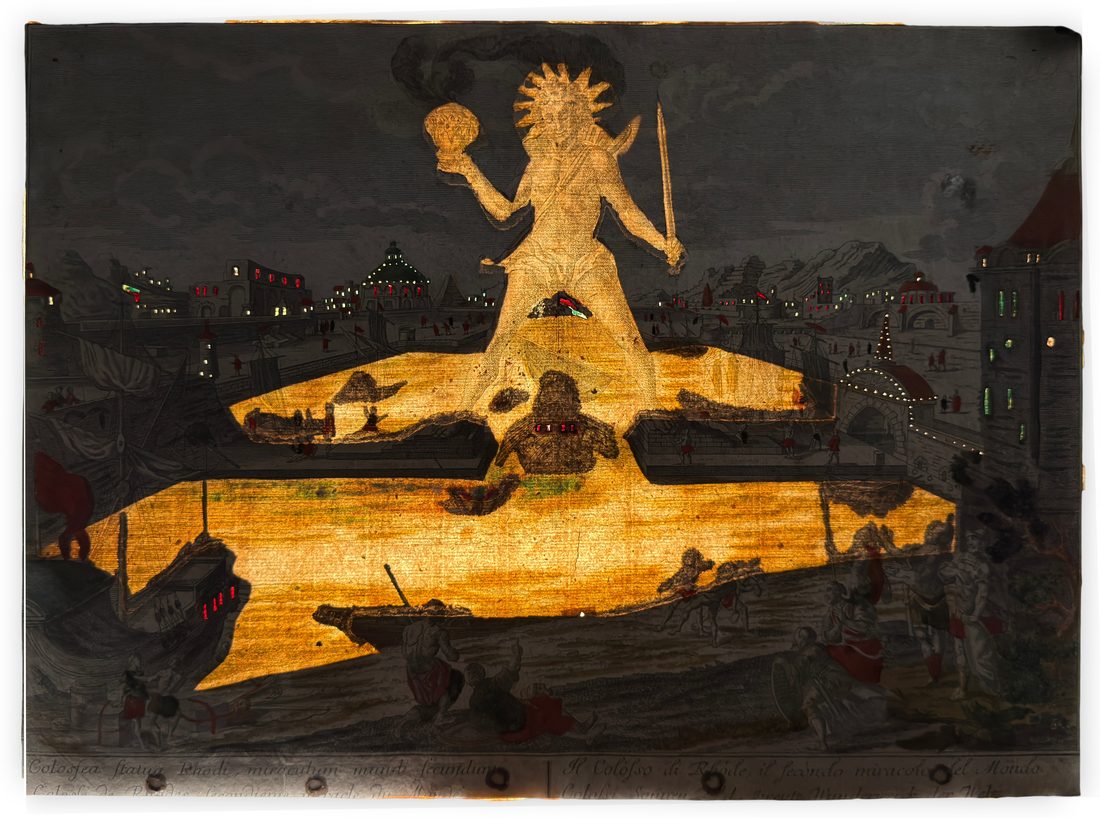
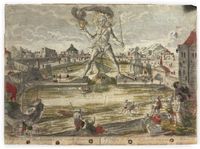
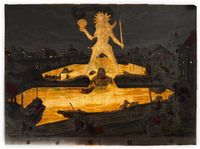
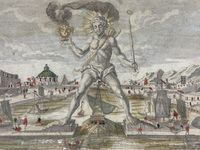
A hand-coloured optical view of the Colossus of Rhodes, the second plate of Georg Balthasar Probst’s Augsburg series of the Wonders of the World, prepared at an early date as a day-and-night transparency. Lit from the front, the harbour of Rhodes lies in full daylight. Lit from behind, the sun god blazes like a beacon over a darkened port, the water turns to gold and the windows of the town shine red and green. The preparation survives intact and still works.
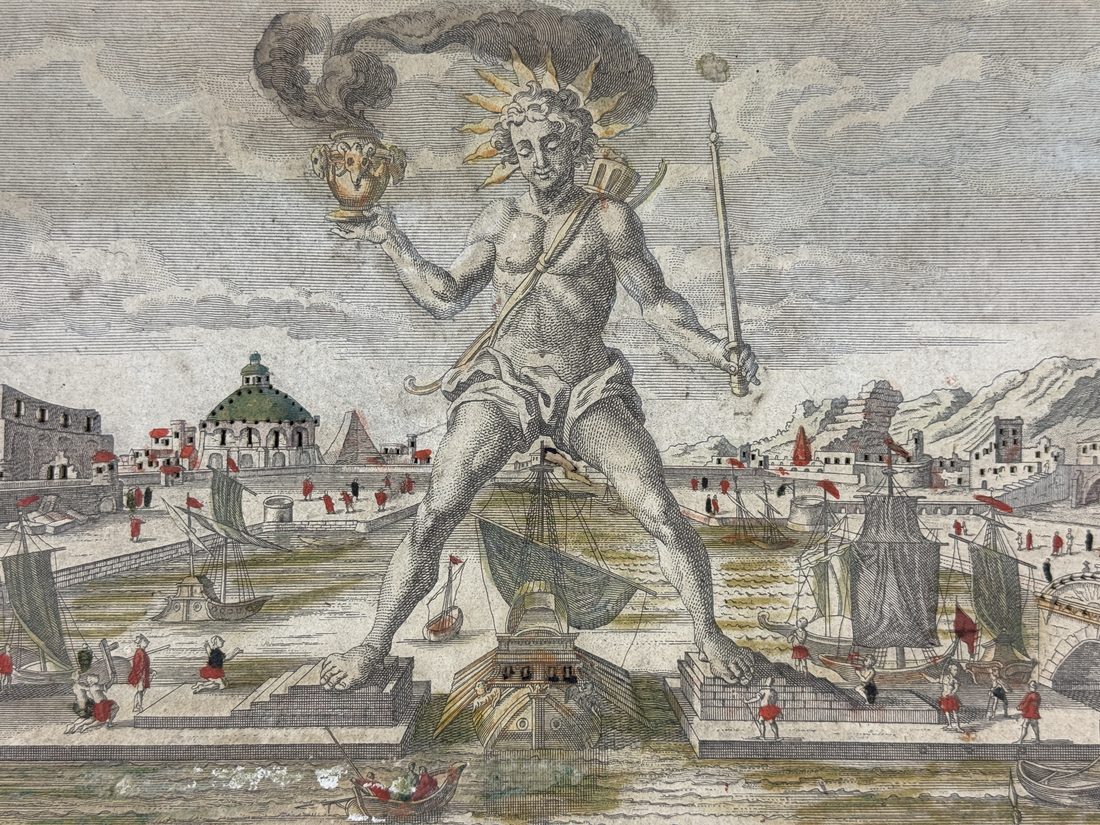
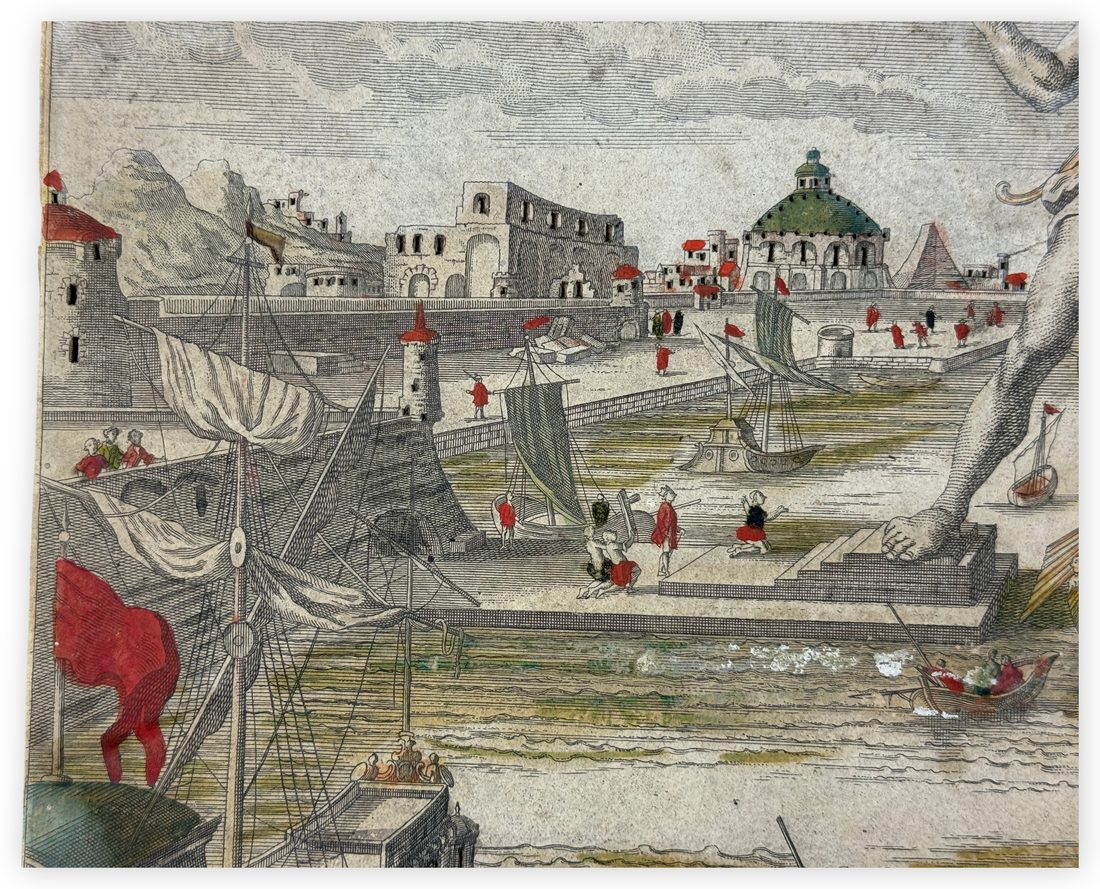
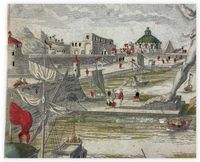
The colossal sun god stands astride the mouth of the harbour, one foot on each of two stepped masonry piers, while a ship passes between his legs. He is nude but for a cloth about the hips, crowned with rays, with bow and quiver slung across his shoulder; his right hand raises a flaming vessel that sends up a great cloud of smoke, his left holds a long sword, point upward. Behind him extends a walled city with a domed rotunda, a pyramid, towers and distant mountains, closed on the right by a tall red-roofed tower and an arched bridge. In the foreground porters unload bales from a moored ship flying a red flag, boatmen haul a skiff ashore, and a group of soldiers with helmets, shields and lances gathers on the right bank, while small figures in red animate the quays.
Like every vue d’optique, the print was designed to be seen through a lens, in the drawing-room zograscope or in the showman’s box. This impression can also be shown by night. Illuminated from the front, it shows the harbour by day; when the front is darkened and a candle or lamp is placed behind the sheet, the scene turns to night. The whole figure of the Colossus lights up, its engraved lines still legible within the glow, the water between the piers and the central quay are flooded with golden light, and the boats stand out in silhouette. Along the skyline the windows appear as rows of points and slits of coloured light, white and green on the dome of the rotunda, red in the palaces and in the stern of the ship, while sky, foreground and figures sink into darkness.
The effect was obtained on the verso. The print is laid down on an opaque sheet, and it is this backing that was cut away along the outlines of the statue, the water and the quay, so that the printed paper itself carries the light. The windows were pierced through print and backing, those of the rotunda with a needle, the others with short knife cuts, single, crossed or in parallel rows, then brushed over with translucent red and blue-green; a few were left uncoloured and shine white. The manuscript title on the back, copying the French line of the caption, allowed the operator to identify the view from behind, where the subject cannot be seen, while preparing or changing the display.
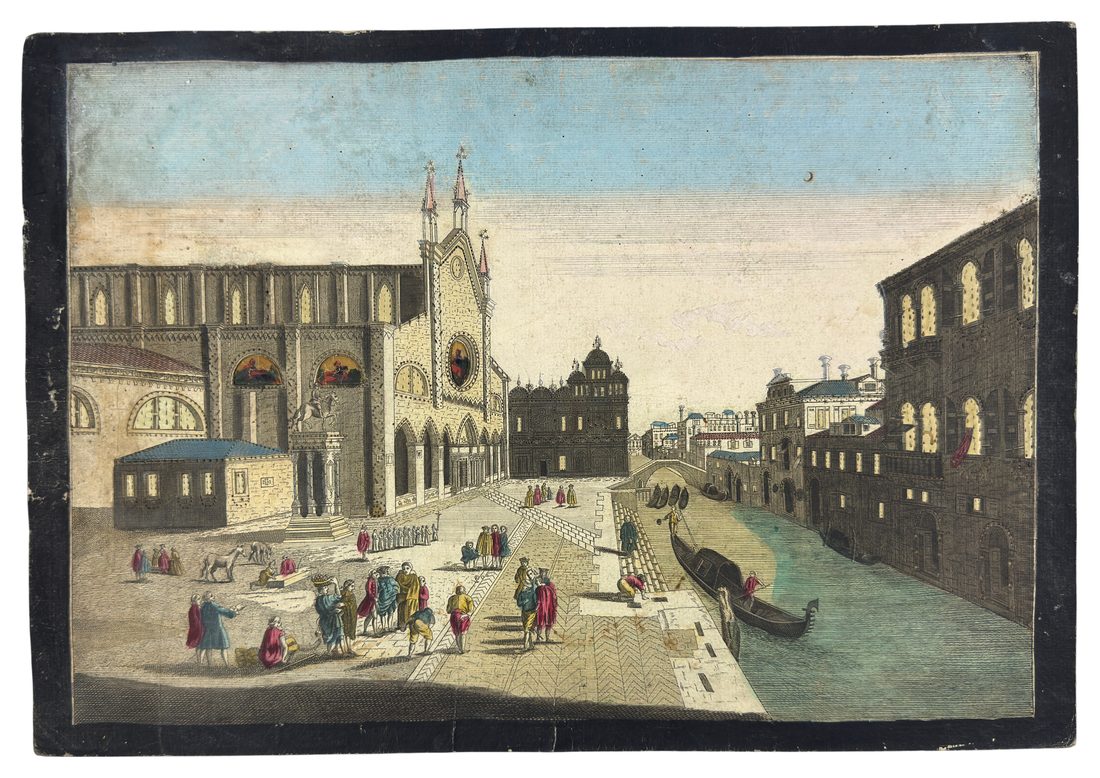
Optical views were printed in large numbers and sold widely in the second half of the eighteenth century. Produced chiefly in London, Paris, Bassano and Augsburg, they served as entertainment and as a window on distant places, enjoyed at home through the zograscope and in the streets through the mondo nuovo of itinerant showmen. Augsburg became a major centre of the genre from the mid-1760s, and its publishers addressed a European clientele.
Ordinary views were often turned into night scenes. Pricking, cutting and backing the sheets with coloured silk or translucent paper, then alternating light from the front and from behind, allowed one sheet to show the same scene by day and by night. A set of sixty-nine views, assigned by the library to Augsburg and mounted as a roll in the second half of the eighteenth century, now in the Biblioteca Casanatense in Rome, is entirely prepared for night viewing in this manner, and a Milanese mondo nuovo of 1792 in the Cinémathèque française still holds its fifteen hand-coloured engravings, most of them perforated, together with the shutters that let in the light from front and back.
The image of the Colossus belongs to the reception of antiquity rather than to archaeology. The bronze statue of Helios by Chares of Lindos stood at Rhodes for little more than half a century before an earthquake brought it down around 227 BC, and no ancient source describes it astride the harbour. The pose, already printed in André Thevet’s Cosmographie de Levant (1554), was given its canonical form in 1572 by Philips Galle’s engraving after Maarten van Heemskerck, and taken up again in 1721 in Johann Bernhard Fischer von Erlach’s Entwurff einer historischen Architectur. The Augsburg plate draws on both: from Galle the bent arm presenting the flaming vessel, the bow and quiver and the mountainous shore; from Fischer the radiate crown, the towering cloud of smoke and the stepped piers. The crowded foreground is its own invention. The fire in the god’s hand turned the Colossus, in early modern eyes, into something close to a lighthouse, and lit from behind this impression shows it as one.
Georg Balthasar Probst (1732-1801) belonged to the Augsburg family of print publishers descended from the business of Jeremias Wolff (1663-1724), continued by his son-in-law Johann Balthasar Probst (1673-1750). After 1750 the firm was divided among the heirs, and Georg Balthasar published under his own name with an imperial privilege. His optical views, numbered and lettered in several languages, run to more than 400 sheets; they are catalogued by S. von Kapff (2010).
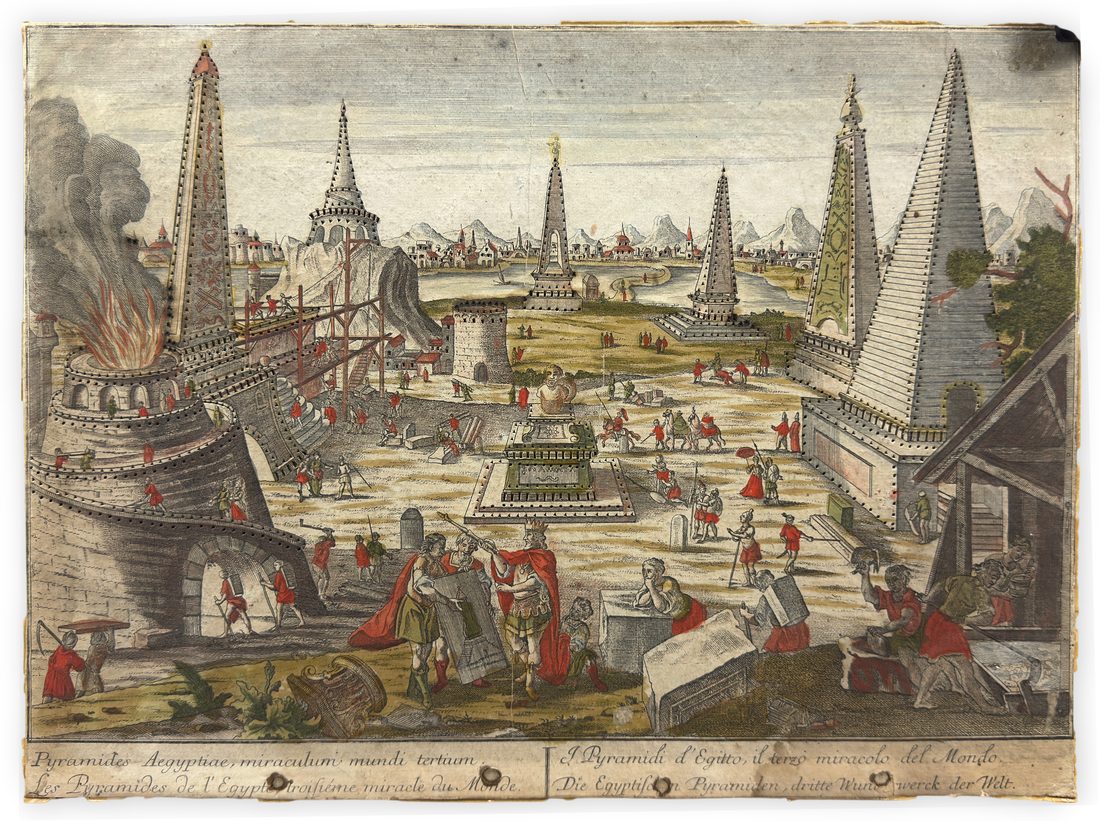
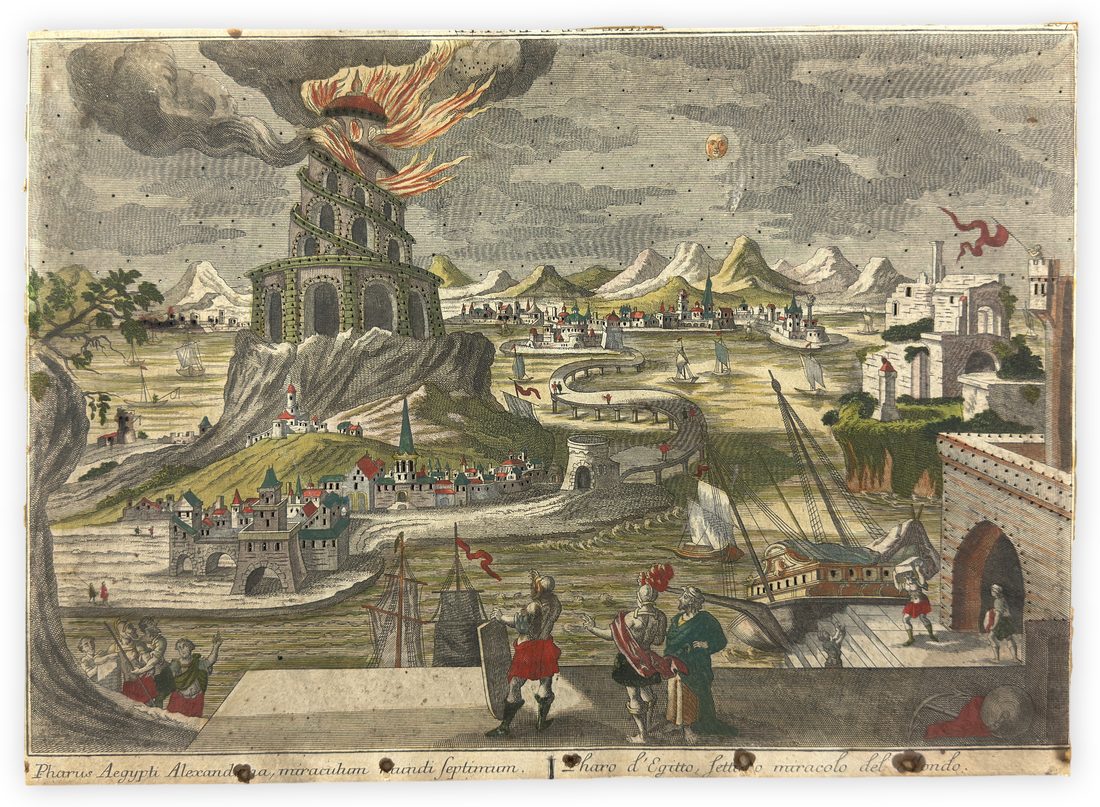
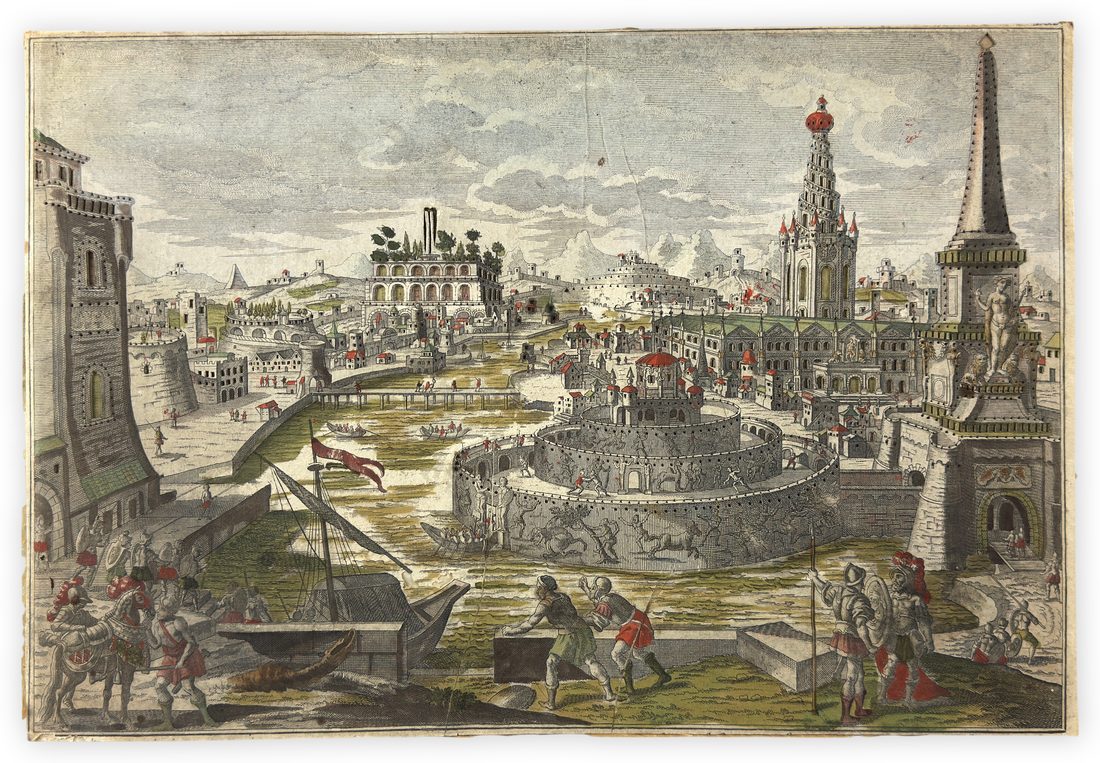
The Wonders of the World comprise seven plates numbered 161 to 167: the Walls of Babylon, the Colossus of Rhodes, the Pyramids of Egypt, the Mausoleum of Halicarnassus, the Temple of Diana at Ephesus, the Roman amphitheatre and the Pharos of Alexandria, each caption stating its place in the sequence. Full-margined impressions, such as that in the Bibliothèque nationale de France, carry above the image the reversed title “COLOSSE DE RHODES” and the number 162, and below it “Med. Fol. N° 43”, “Cum Gratia et Privilegio Sac: Cæs: Majestatis” and “Georg Balthasar Probst, excud. A.V.”.
Conditions: Trimmed within the plate mark, the lower caption line shaved; five small round holes from early fixings in the caption band; a small abrasion in the sky, light rubbing and a faint crease in the water; edges slightly irregular, margins reinforced on the verso. Colour fresh and bright; the night effect in full working order.
Provenance: Early manuscript title in French on the verso, indicating use in a French-speaking context.
Census: Paris, Bibliothèque nationale de France, Département des Estampes et de la photographie, LI-72 (9)-FOL, full-margined impression.
References: S. von Kapff, Guckkastenbilder aus dem Augsburger Verlag von Georg Balthasar Probst (1732-1801): Gesamtkatalog, Weißenhorn: Konrad, 2010; P. Galle after M. van Heemskerck, Octo mundi miracula, Antwerp: Philips Galle, 1572; J. B. Fischer von Erlach, Entwurff einer historischen Architectur, Vienna: [s.n.], 1721, book I, pl. VIII; C. A. Zotti Minici (ed.), Il mondo nuovo: le meraviglie della visione dal ’700 alla nascita del cinema, Milan: Mazzotta, 1988; A. Milano (ed.), Viaggio in Europa attraverso le vues d’optique, Milan: Mazzotta, 1990; R. Balzer, Peepshows: A Visual History, New York: Harry N. Abrams, 1998; R. Hyde, Paper Peepshows: The Jacqueline and Jonathan Gestetner Collection, Woodbridge: Antique Collectors’ Club, 2015; N. Badoud, The Colossus of Rhodes: Archaeology of a Lost Wonder, Oxford: Oxford University Press, 2024.