Nuovo e dilettevole Giuoco Chinese
| Macro-category | Rare Books and Manuscripts |
| Subcategory | Educational Games & Cards |
| Author | BARDI, Lorenzo |
| Place of printing | Firenze |
| Publisher / Maker | Lorenzo Bardi |
| Year | 1817 |
The first puzzle craze of the modern world, in its inaugural year:
Three hundred and twenty-three engraved problems from the Chinese puzzle, issued at Florence within months of its arrival from London
the only Italian edition of the tangram to bear an explicit date of 1817, of extreme rarity: two institutional copies only.
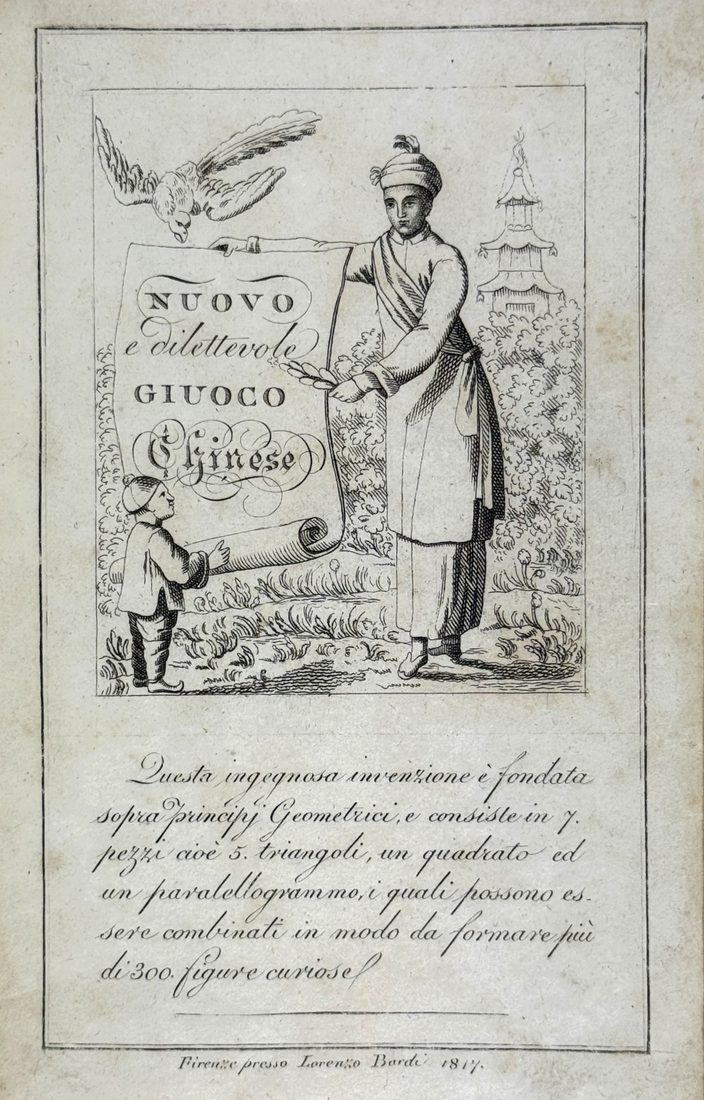
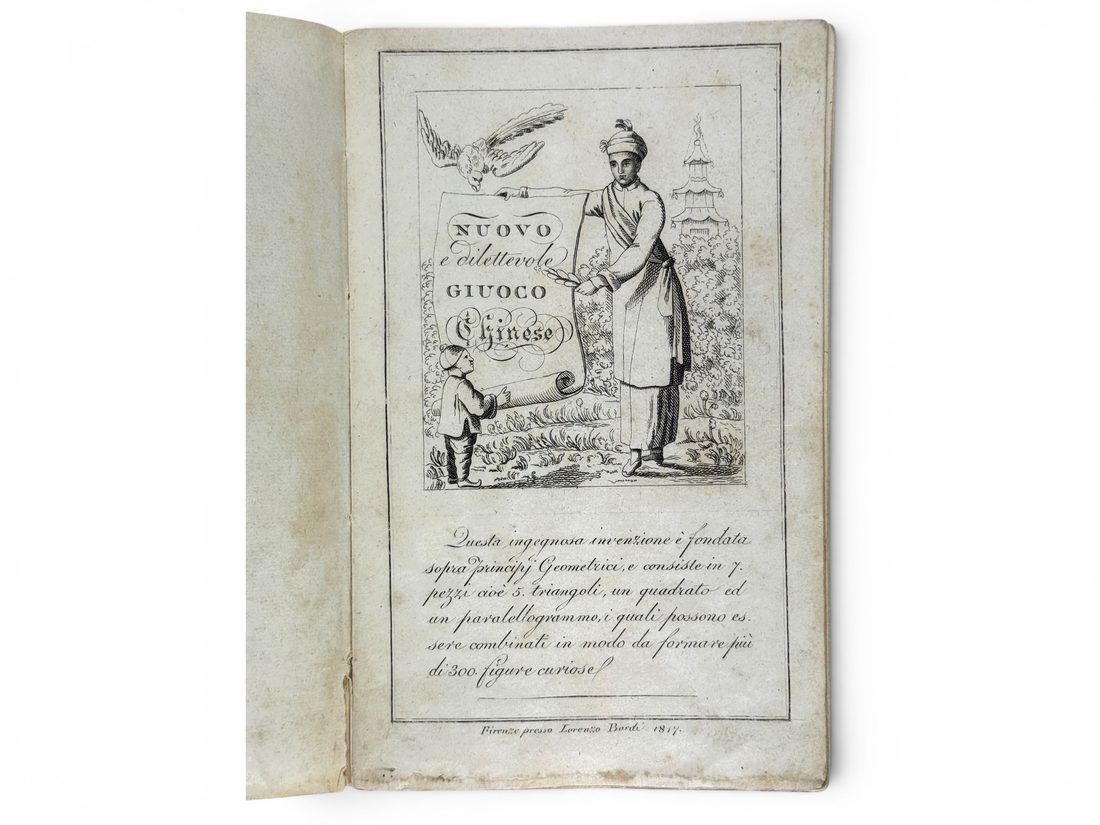
[Tangram.] Bardi, Lorenzo, publisher. Nuovo e dilettevole Giuoco Chinese. Questa ingegnosa invenzione è fondata sopra Principj Geometrici, e consiste in 7. pezzi cioè 5. triangoli, un quadrato ed un paralellogrammo [sic], i quali possono essere combinati in modo da formare più di 300. figure curiose. Firenze: presso Lorenzo Bardi, 1817.
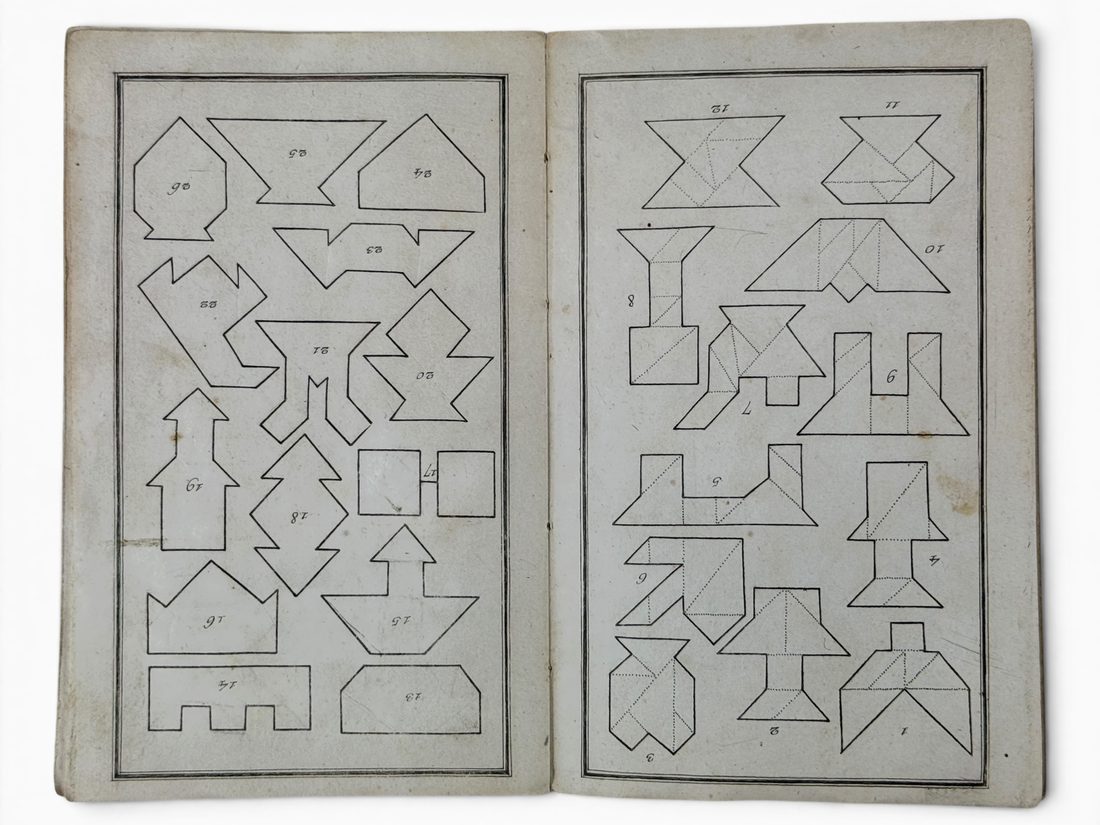
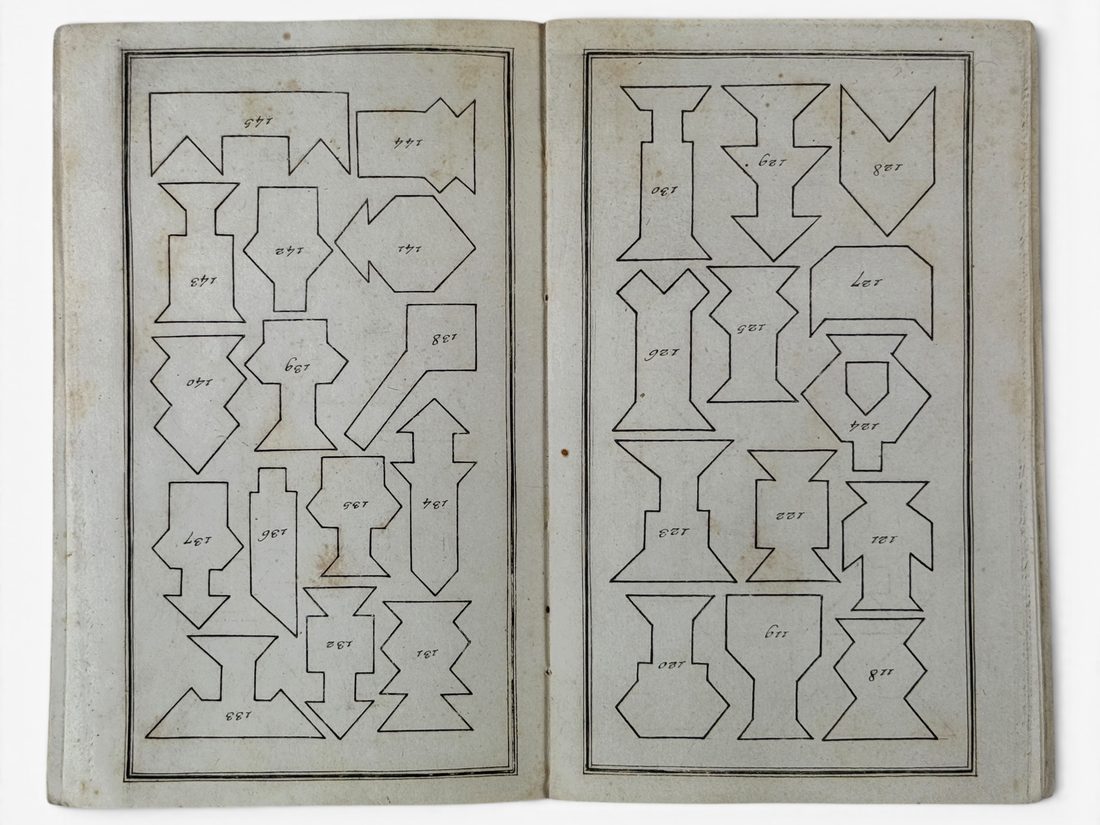
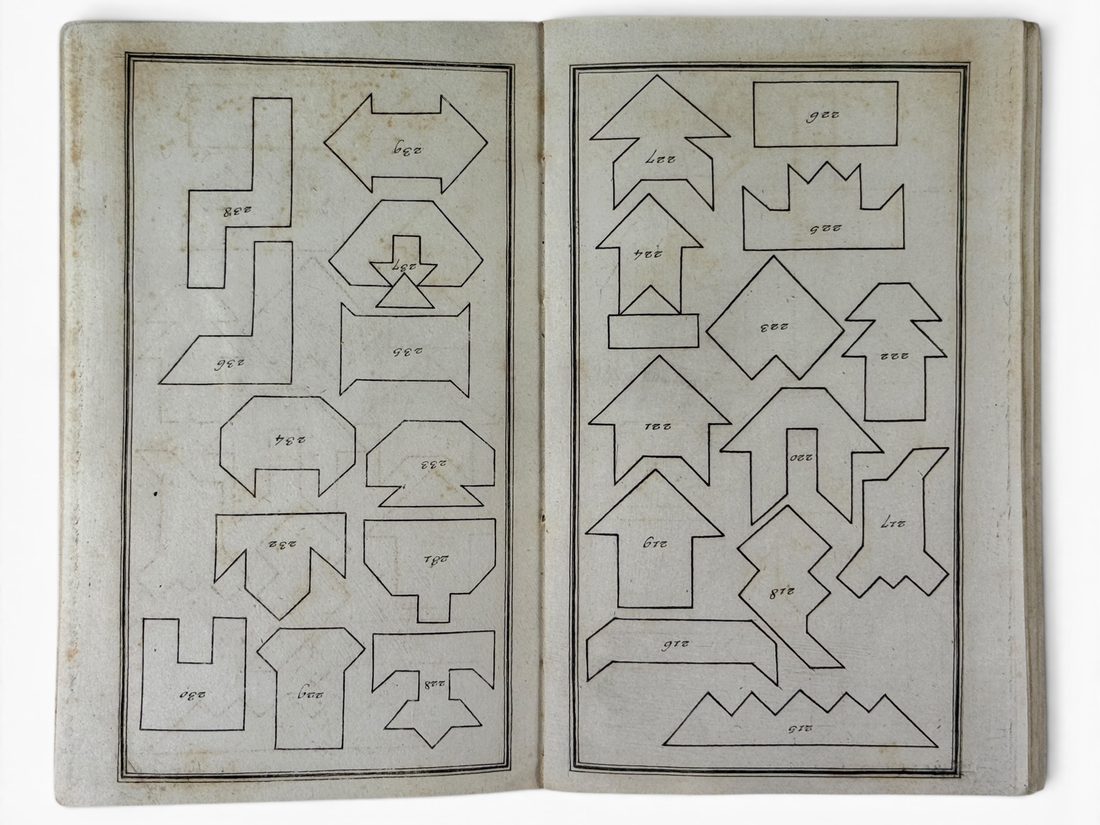
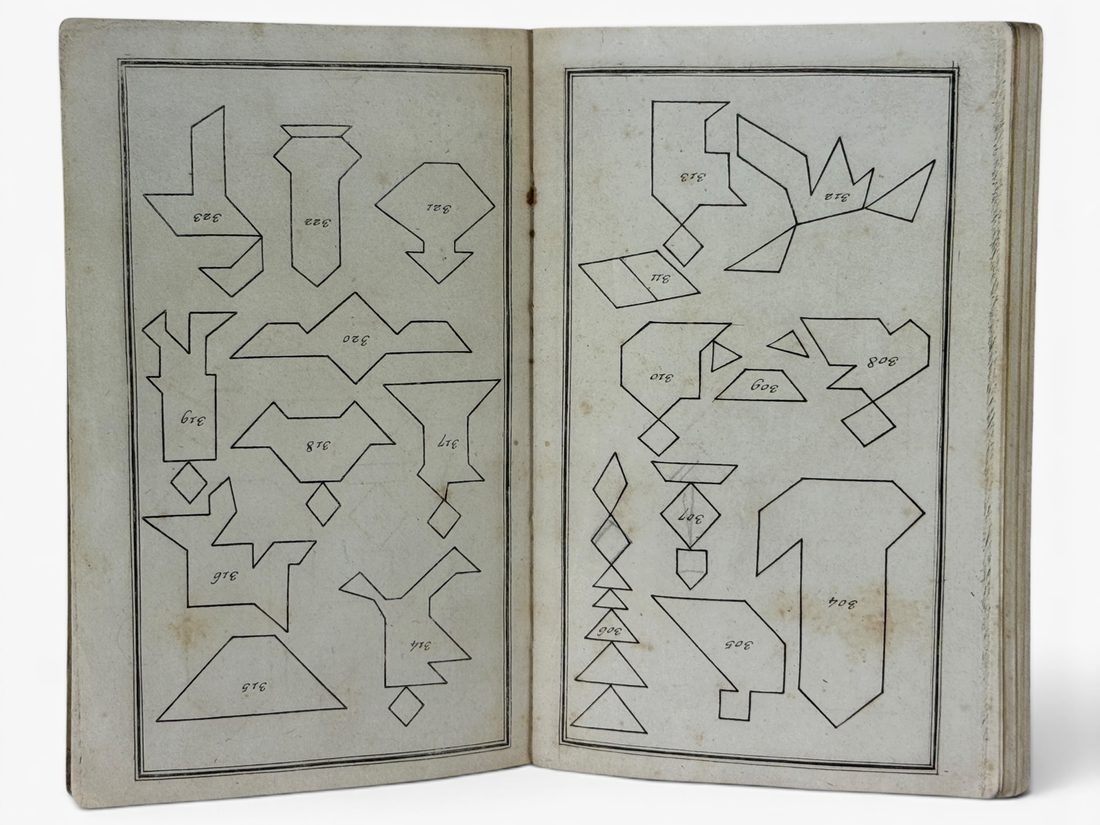
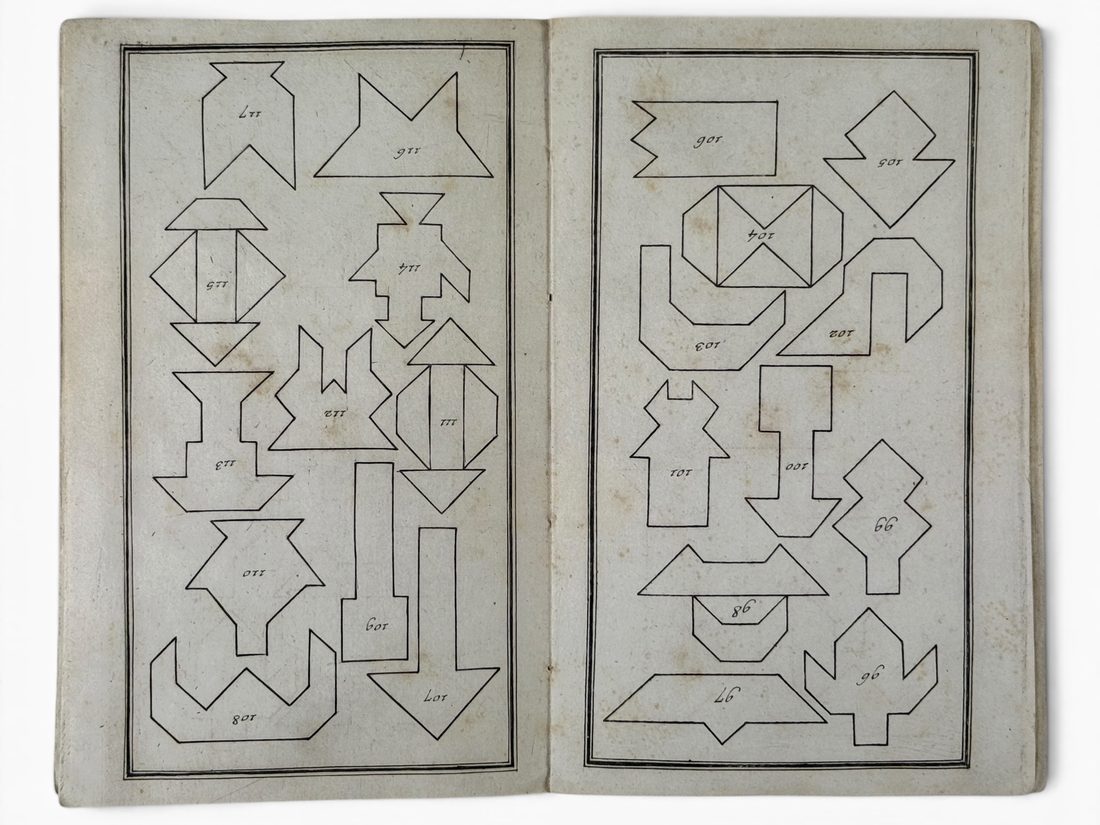
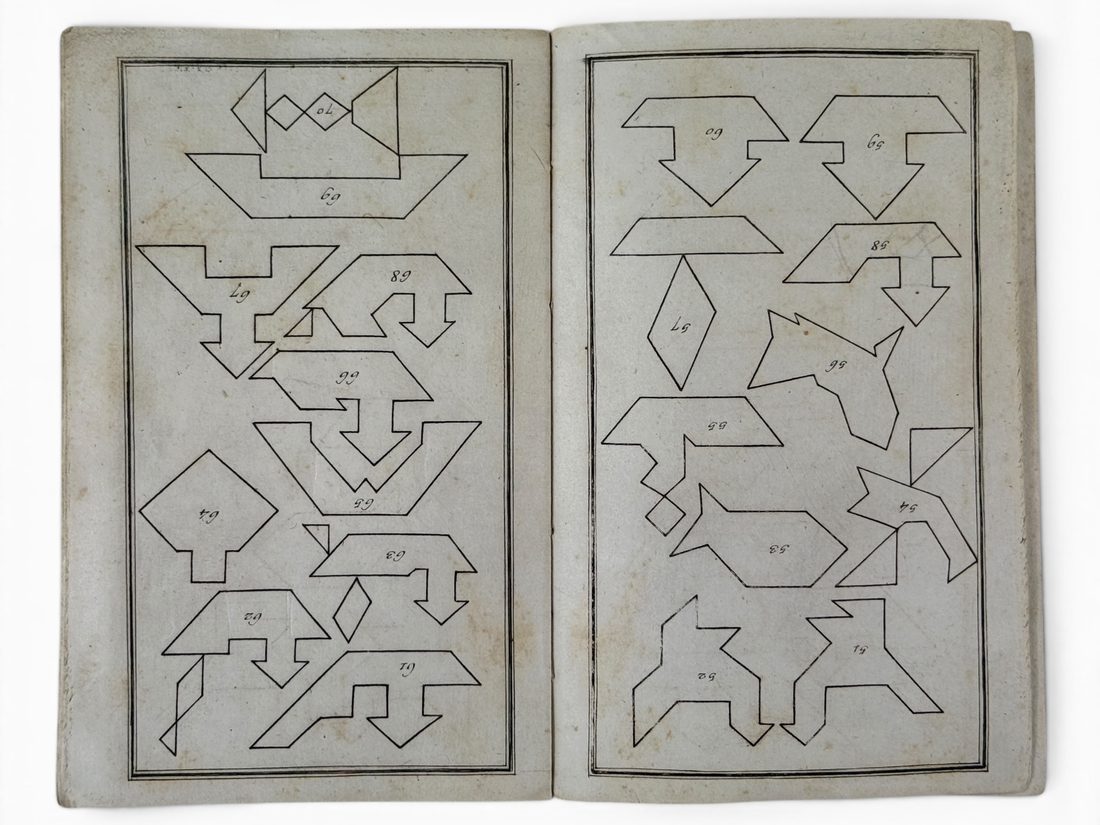
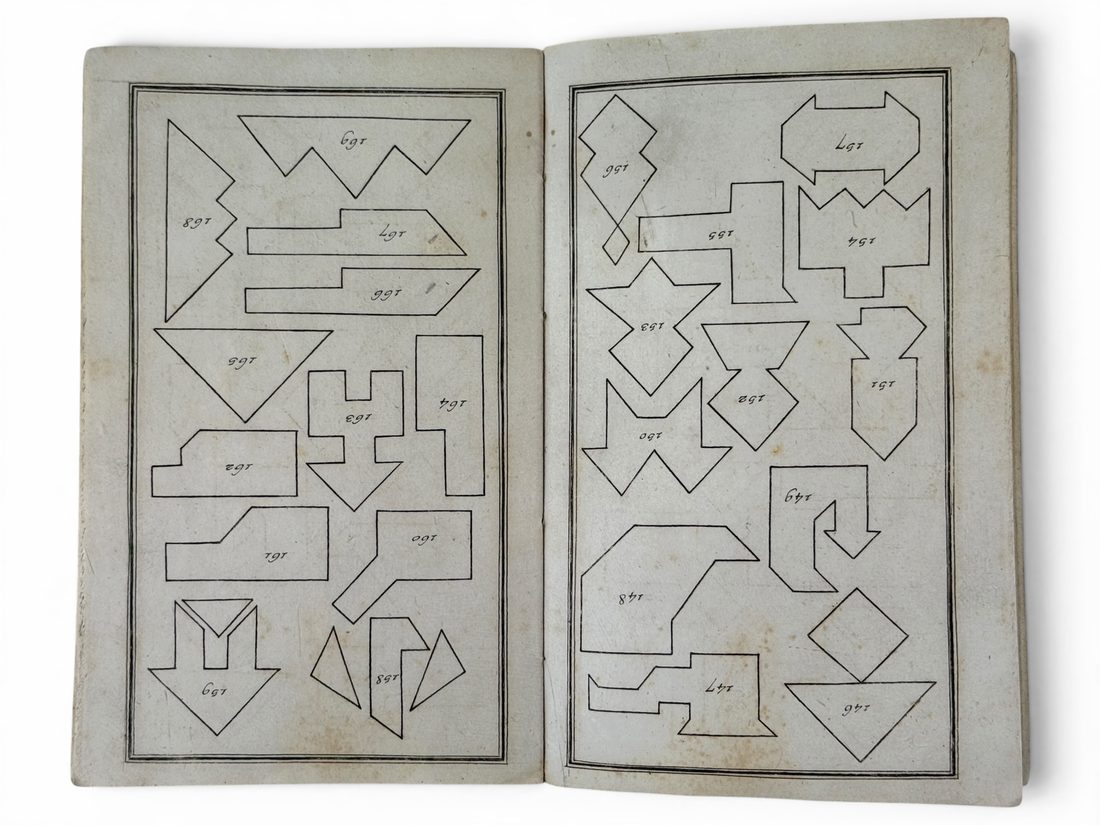
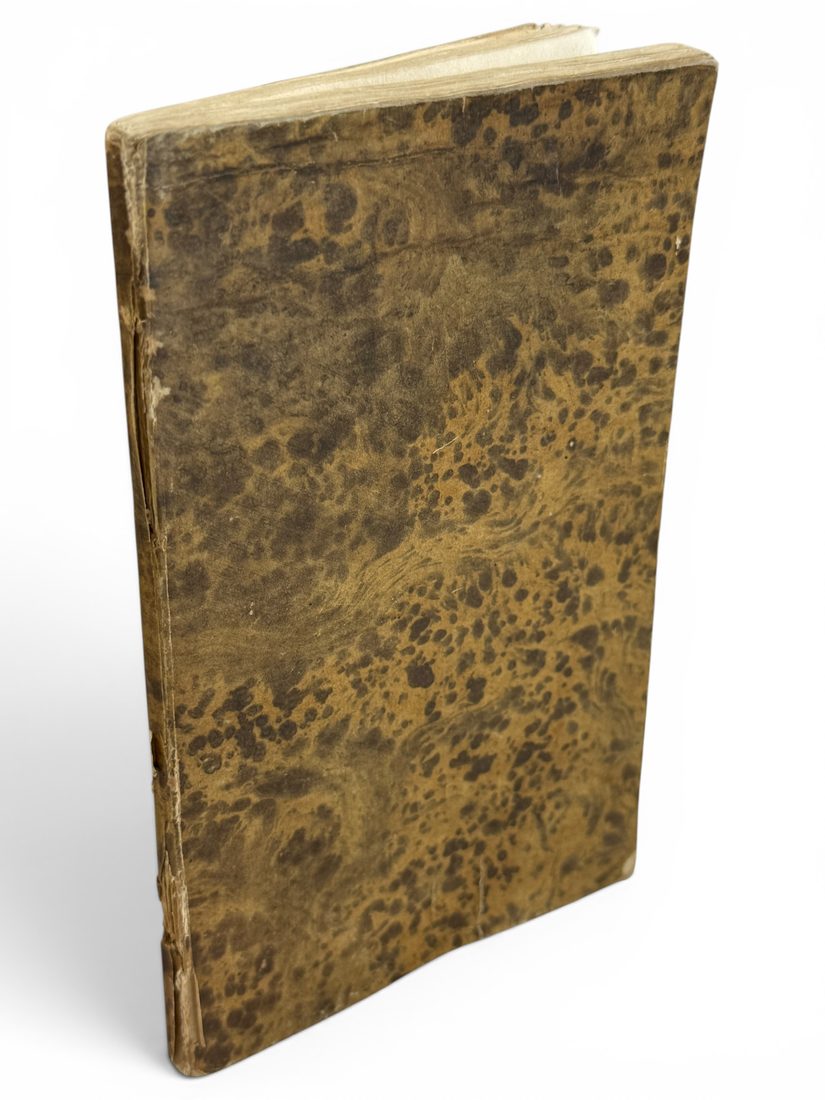
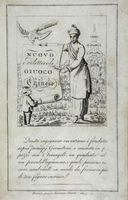
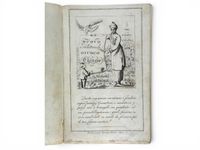
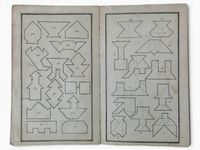
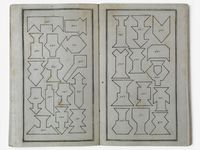
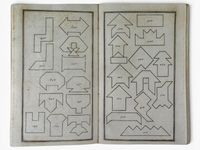
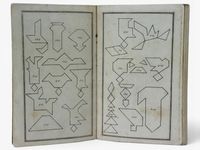
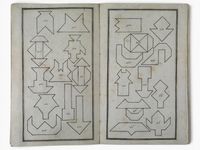
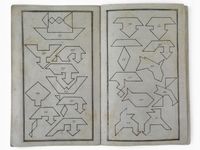
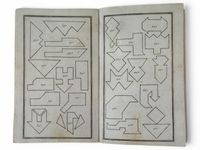
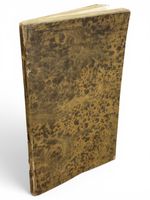
16mo (113 × 178 mm), contemporary sponge-marbled paper boards over thin card, front joint open with losses at head and foot; 29 unnumbered leaves, engraved throughout. The volume is printed anopisthographically, upon one side of the sheet alone, the engraved surfaces disposed to face one another so that fully printed and wholly blank openings alternate with regularity; leaf 1 recto carries the engraved pictorial title, its verso blank, and leaves 2 to 29 carry 323 numbered tangram figures across 28 engraved pages, the final leaf printed on the recto and blank on the verso. The title, wholly calligraphic and without letterpress of any kind, shows a standing figure in long robe and turban unrolling a scroll lettered with the title, a Chinese boy supporting its lower end, a pagoda among foliage to the right and a bird in flight above, the whole within a double-ruled border repeated on every subsequent page. At colophine: “Firenze presso Lorenzo Bardi 1817.” The plates present 323 silhouette figures, from eight to fifteen to the page, the first twelve carrying interior dotted lines that disclose the arrangement of the seven pieces and the remainder given as unsolved outlines.
First edition, and the only Italian tangram publication to bear an explicit date of 1817, of the earliest wave of European books devoted to the Chinese puzzle. The tangram reached the West through Chinese albums carried home aboard merchant vessels and became, in that year, the first international craze of its kind, spreading from London across the Continent within a matter of months. The present work belongs to that inaugural season and stands at the head of the Italian tradition, its plates reissued in Milan by the Bettalli brothers with a new title-leaf alone and imitated at Bologna, at Rome and elsewhere.
The book is almost wholly iconic and contains neither preface, nor index, nor instructions of any extent. Its only continuous prose is the six engraved lines beneath the title vignette, which perform three offices at once: they introduce the game, declare its geometrical foundation and enumerate its seven constituent pieces, five triangles, a square and a parallelogram, and they serve as an advertisement in promising “more than 300 curious figures”. The undertaking is honoured with a margin, for the plates in fact supply three hundred and twenty-three.
The remainder of the volume turns upon a single pedagogical articulation, falling between the twelfth figure and the thirteenth. The first twelve silhouettes are printed with interior dotted lines revealing how the seven tans are to be disposed, and so serve as worked examples and as the key to the method. From the thirteenth to the last the outlines are given solid and without internal indication, and are therefore problems. For these three hundred and eleven the work supplies no solutions whatever, and no separate key is recorded for any surviving copy, whereas in London the book of problems and its key circulated as two distinct publications.
The figures proceed without evident system, and their variety is part of the book’s appeal. They comprise pure geometrical forms, squares, rhombi, trapezia and triangles; architectural subjects such as houses, bridges and towers; domestic objects including vases, cups, candlesticks and implements; stylised human figures in varied attitudes; animals; vessels; letters; and shapes purely abstract. Several compositions incorporate small detached elements, lozenges or triangles set beside the principal silhouette, which form an integral part of the figure to be assembled. The density varies irregularly, reflecting the differing dimensions of the silhouettes rather than any deliberate arrangement.
The tangram was devised in China at the turn of the nineteenth century. The earliest book upon the subject is the Qiqiao tu hebi, whose preface and figures are dated 1813; of that printing no copy is known to survive, and the earliest preserved is the new edition of 1815, which repeats the same preface and the same problems and circulated widely in China, in Europe and in America beside a distinct volume of solutions, the Qiqiao tu jie. In October 1815 the American captain M. Donnaldson received the pair at Canton, and carried them to Philadelphia the following year. Sets and albums travelled westward aboard merchant vessels, and in 1817 the puzzle became what is generally reckoned the first international craze of its kind. The earliest recorded non-Chinese tangram was a set published in London by J. Leuchars of 47 Piccadilly, whose copyright was registered on 3 February 1817 and which was first advertised on 19 March; the fashion itself was set off, in the same March, by the first Western book upon the puzzle, The Fashionable Chinese Puzzle of John and Edward Wallis. A Parisian edition, Énigmes Chinoises, followed on 19 July, the first published on the Continent, and before the year was out further publications had appeared in France, in Italy and in the United States, with Switzerland, the Netherlands, Denmark and Germany following in 1818.
The speed of this propagation is the historically remarkable fact. Fewer than twelve months separate the London registration from the appearance of dated Florentine editions, in a Europe barely emerged from the Napoleonic wars and with its commercial circuits still precarious. The present volume is the material witness of that velocity, and its date makes it a chronological document and not merely a surviving copy.
The dependence of the Continental editions upon the London model is well attested, the Parisian Énigmes Chinoises having been modelled upon the Wallis book, and the Italian editions being likewise held to derive from The Fashionable Chinese Puzzle. For the Florentine edition the quantitative evidence is striking: the Wallis book is described as containing 323 problems, and the present work contains exactly that number. The coincidence should nevertheless be weighed with care, for those 323 problems are themselves described as copied from Chinese books, so that the count does not originate with the Wallis brothers but is inherited from a Chinese prototype. It places the present edition securely within the family of 1817 without determining by which of its channels the figures reached Florence. It has further been observed that the cover of the Milanese Bettalli issue reproduces the Wallis illustration with the text alone altered, and that one of its openings is identical with pages 3 and 4 of the English book.
The engraved title deserves a word of its own, for it stages the European idea of China rather than China itself. The robed and turbaned figure, the child, the pagoda and the bird belong to a repertory of manner inherited from the eighteenth-century vogue for chinoiserie, and are here applied to an object that had in truth come from China. The tension is instructive, and characteristic of the moment: a genuinely Chinese content presented in a wholly European fancy dress.
On a third level the book belongs to the long tradition of recreational mathematics, the title being explicit in presenting the game as founded upon geometrical principles. The puzzle passed rapidly into polite culture, and a roster of illustrious devotees attached itself to it in later tradition, most of it unverifiable; of the names commonly repeated, only those of Lewis Carroll, whose library is reported to have contained a copy of the Wallis book, and of Edgar Allan Poe rest upon anything resembling testimony.
The Florentine edition founded a small Italian tradition of its own. At Bologna in 1818 the Bertinazzi firm, under the direction of Carlo Bruera, issued two lithographic booklets remembered as the first lithographic work produced in that city; at Milan the text was copied by the Bettalli brothers and by Pietro and Giuseppe Vallardi, and later by Ubicini; at Rome it was taken up by Agapito Franzetti. Florence itself saw at least three further tangram publications within two years, from Chiari, from Giuseppe Landi and from the Insegna dell’Ancora, evidence of a local trade that answered the fashion with remarkable promptness.
Lorenzo Bardi is documented in Florence as a publisher and dealer in prints. The authority index of the Istituto Centrale per la Grafica records him among the publishers, and not among the printers, as “Bardi Lorenzo, attivo Firenze prima metà sec. XIX”, an entry kept distinct from those of Giuseppe Bardi and of the better-known engraver Luigi Bardi, with whom he is not to be confused. The single print there attributed to him as publisher is a Scala della Fortuna, an allegorical game sheet etched in the first half of the century, a coincidence of type that bears directly upon the attribution of the present booklet to his shop.
His imprints are recorded in the Italian union catalogue from 1819, when he published in partnership with the Florentine bookseller Angiolo Garinei, and continue with a suite of Florentine views engraved by Matteo Carboni and Giovan Battista Cecchi after Giuseppe Zocchi and others, the so-called Zocchino, and with a collection of architectural plates issued when he styled himself negoziante di stampe. The address of the firm is preserved in the imprint of a topographical plan of Florence of 1837, “presso Lorenzo Bardi via de’ Cerretani da Santa Maria Maggiore”, and is therefore documented for the house, though by a witness later than the present book. For 1817 the evidence is the engraved title-page itself. The profile that emerges is coherent and pertinent: a Florentine printseller and copperplate publisher, active from at least 1817 into the 1830s and beyond, dealing in views, in reissues of eighteenth-century plates, in game sheets, in suites of architectural plates and, in partnership with a bookseller, in illustrated books engraved throughout. The present work stands not as an isolated curiosity but within a consistent shop production.
Conditions: Spine almost wholly perished and front joint open, with tears and losses at head and foot. Internally sound and complete, the sequence of figures running without interruption from 1 to 323. Light to moderate foxing and marginal browning throughout, with a few scattered brown spots of greater intensity, notably beside figures 31 and 203 and on the plate carrying figures 281 to 292. Sewing visible in the gutter at several openings. Beside figure 203 appears a small cross which does not seem to be engraved and may be an early manuscript annotation; the Lilly Library copy is similarly recorded as bearing pen and ink markings of solutions upon two of its leaves, so that such marks are to be understood as evidence of use rather than as blemishes. Traces of lettering are discernible below the foot of the standing figure on the title, possibly the engraver’s signature, but they have not been deciphered. No ownership inscription, book-label or stamp has been observed.
References: D. Singmaster, Sources in Recreational Mathematics: An Annotated Bibliography, eighth preliminary edition, 19 March 2004, sect. 6.S, entry Il Nuovo e Dilettevole Giuoco Chinese. Bardi, Florence, 1817, recorded as not yet seen and known only through Milano (an unpublished electronic work, issued by the author and available in full text on the site of the Puzzle Museum); A. Milano, Due giochi di società dell’inizio dell’800, in Rassegna di Studi e di Notizie, vol. XXIII, anno XXVI, 1999, pp. 131-177; Slocum, J., Botermans, J., Gebhardt, D. et al. The Tangram Book: The Story of the Chinese Puzzle with Over 2000 Puzzles to Solve, New York: Sterling, 2003 (LCCN 2003283690; OCLC 52469578); R. C. Read, Tangrams: 330 Puzzles, New York: Dover, 1965; A. Bellos, Here’s Looking at Euclid, New York: Free Press, 2010, p. 157; Opac SBN, Roma: Istituto Centrale per il Catalogo Unico, record BID IT\ICCU\UBOE\013409, sole holding at the Biblioteca comunale dell’Archiginnasio, Bologna, shelfmark 32. G.00 00047; IUCat, Bloomington: Indiana University, record 8431503, Lilly Library, shelfmark GV1507.T3 N97, formerly in the collection of Jerry Slocum; Jerry Slocum Mechanical Puzzle Collection, Bloomington: Lilly Library, record LL-SLO-029680, for The Fashionable Chinese Puzzle, London: J. & E. Wallis, 1817.