La Vie Gaie au Régiment: Complete Set of Ten Puzzle Postcards
| Macro-category | Rare Books and Manuscripts |
| Subcategory | History & Historical Documents |
| Place of printing | Paris |
| Publisher / Maker | Halte-Là! (E. R.) |
| Year | ca. 1922 |
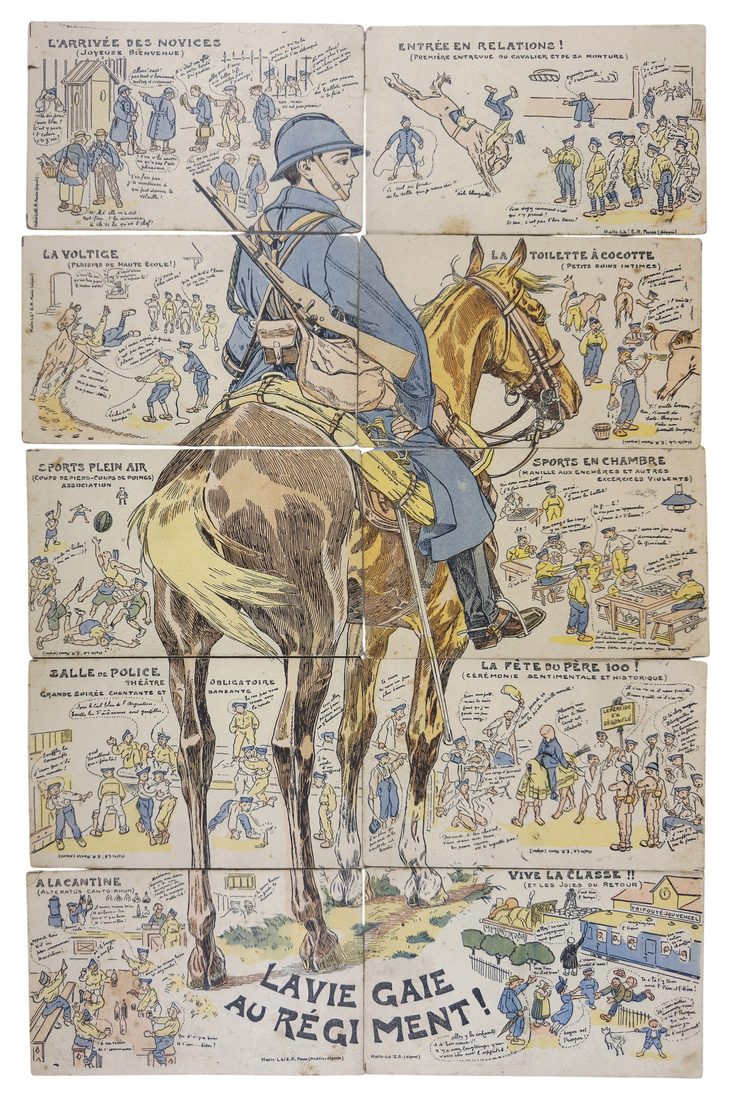
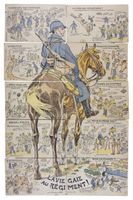
a complete postcard poster of a French cavalryman
ten interlocking comic scenes of barracks life
preserved with the correspondence of the conscript who filled them
halte-là!, paris
[Halte-Là!]. La Vie Gaie au Régiment. Paris, E. R., circa 1922.
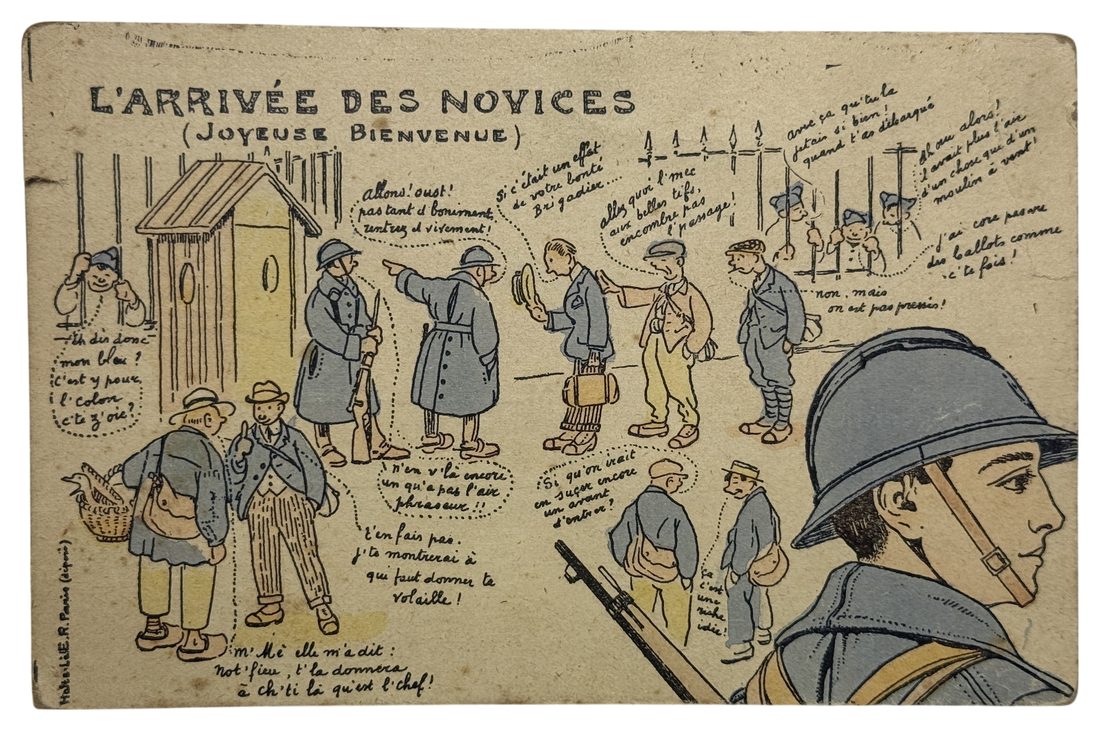
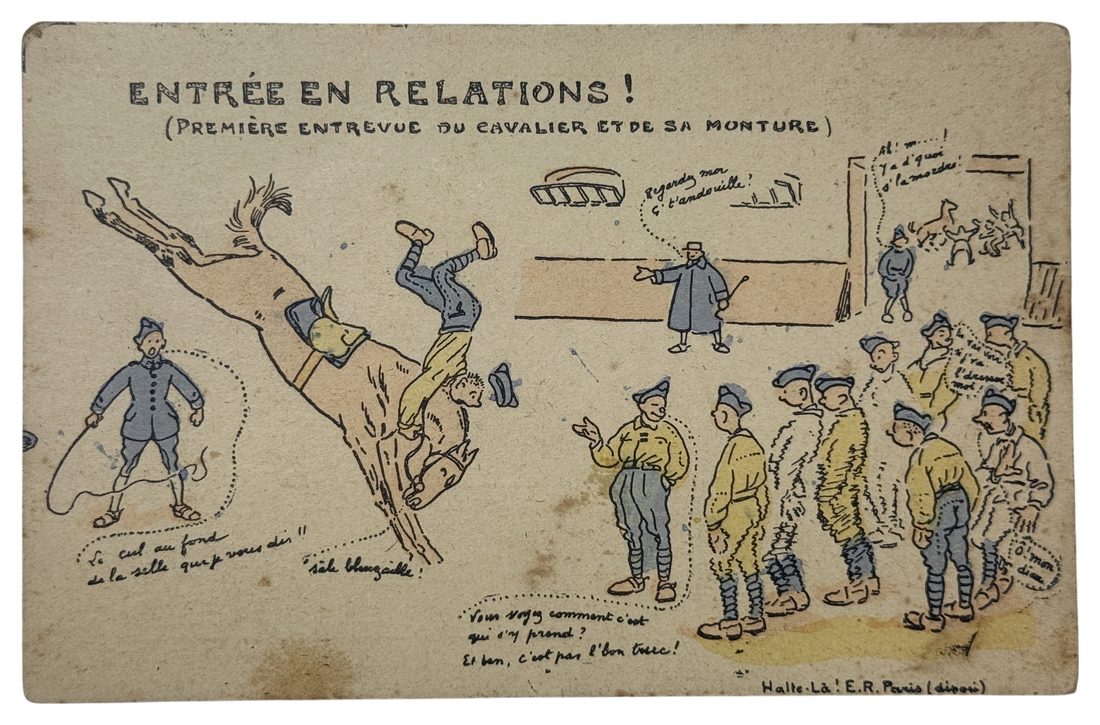
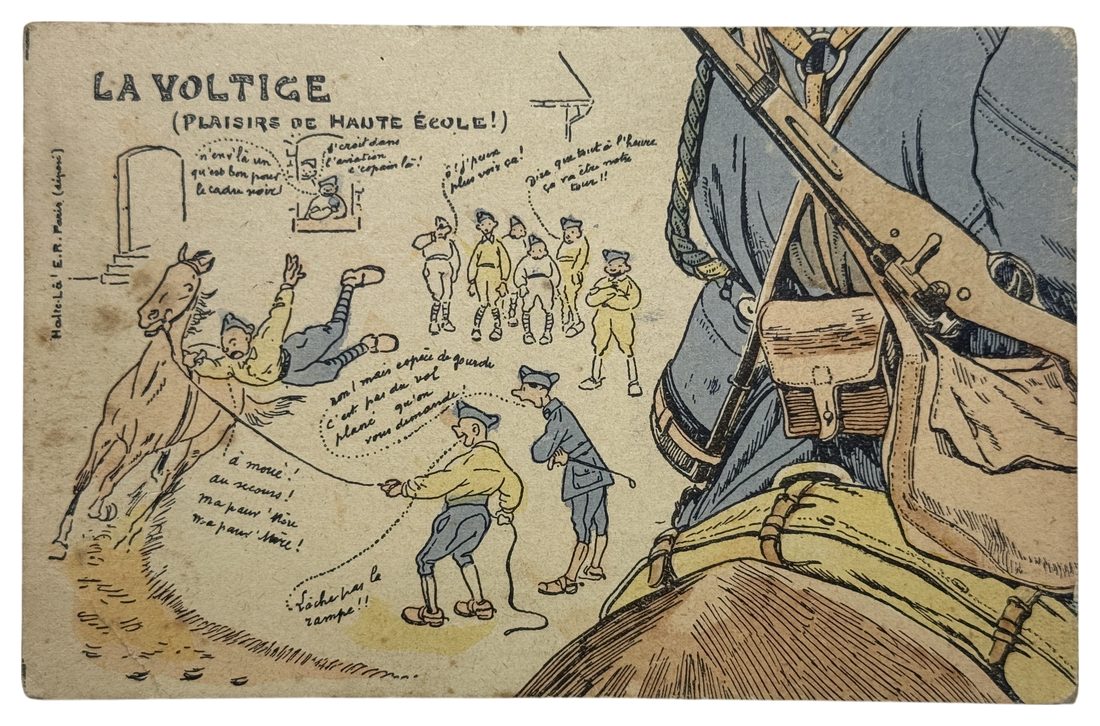
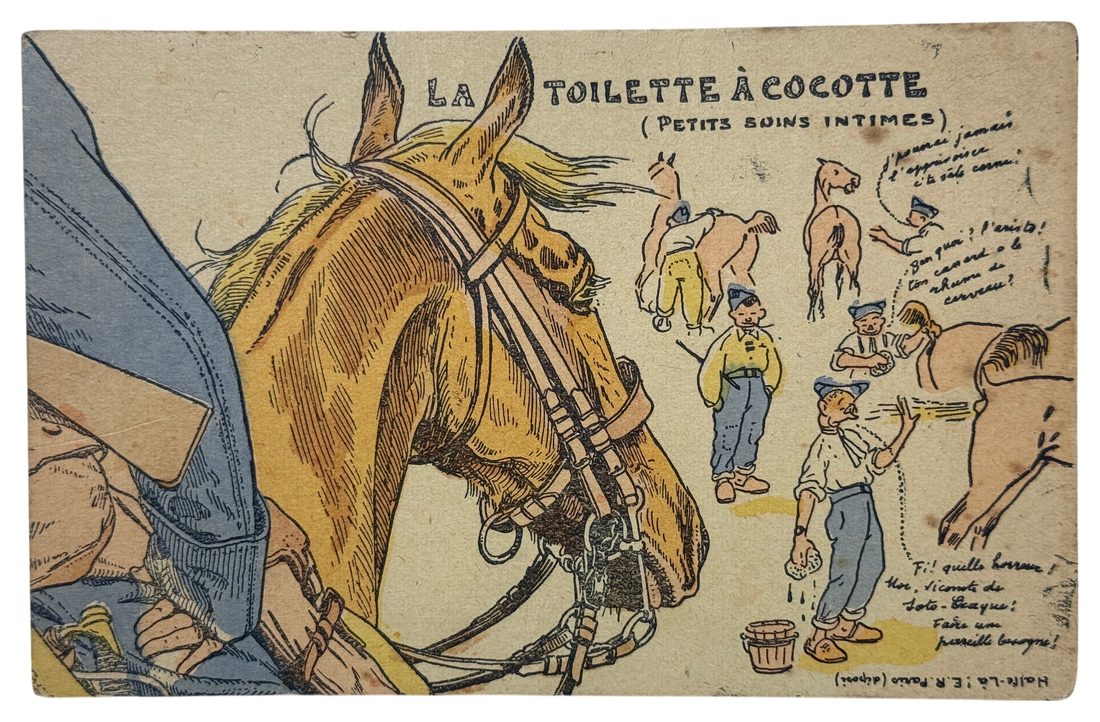
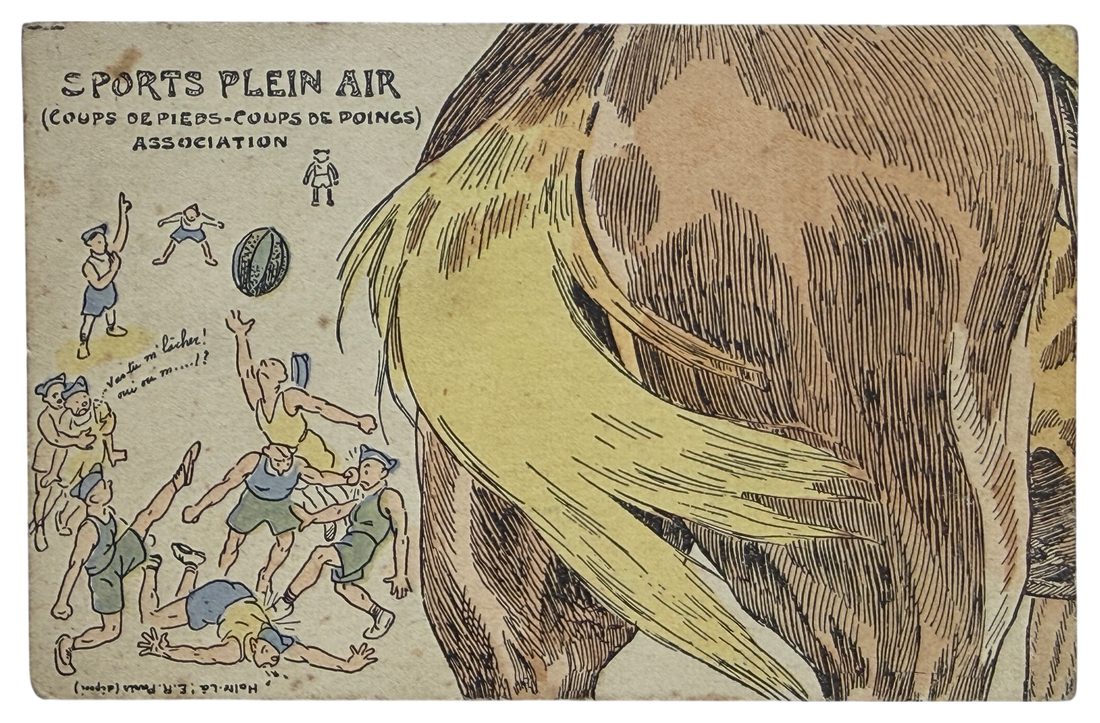
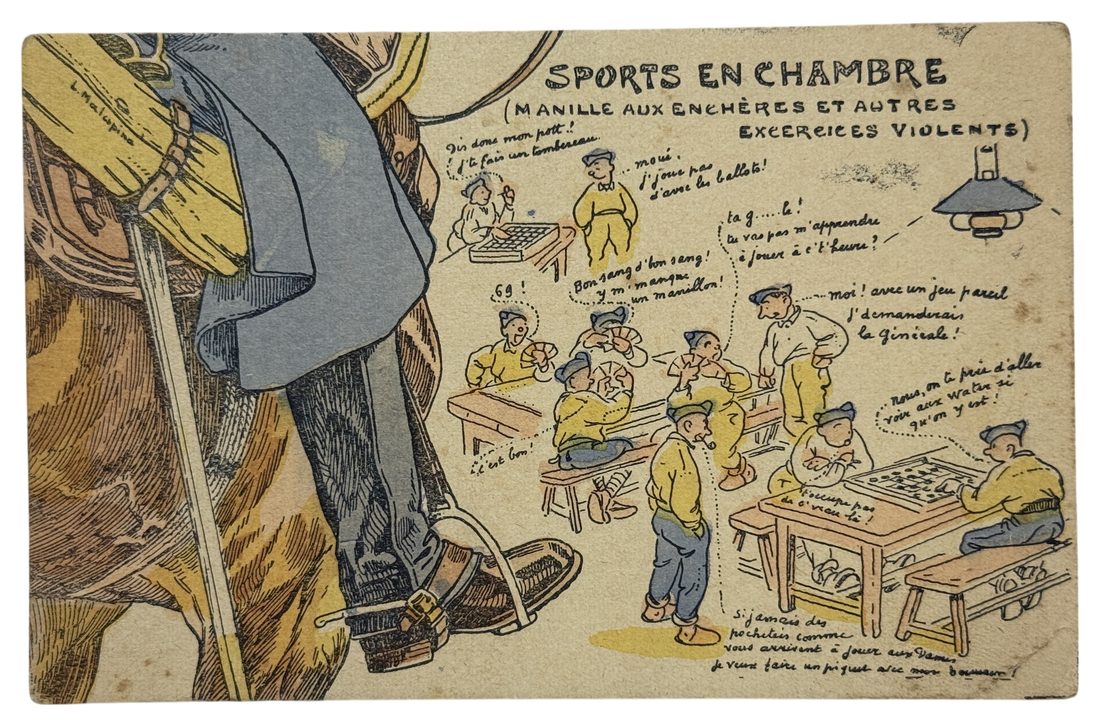
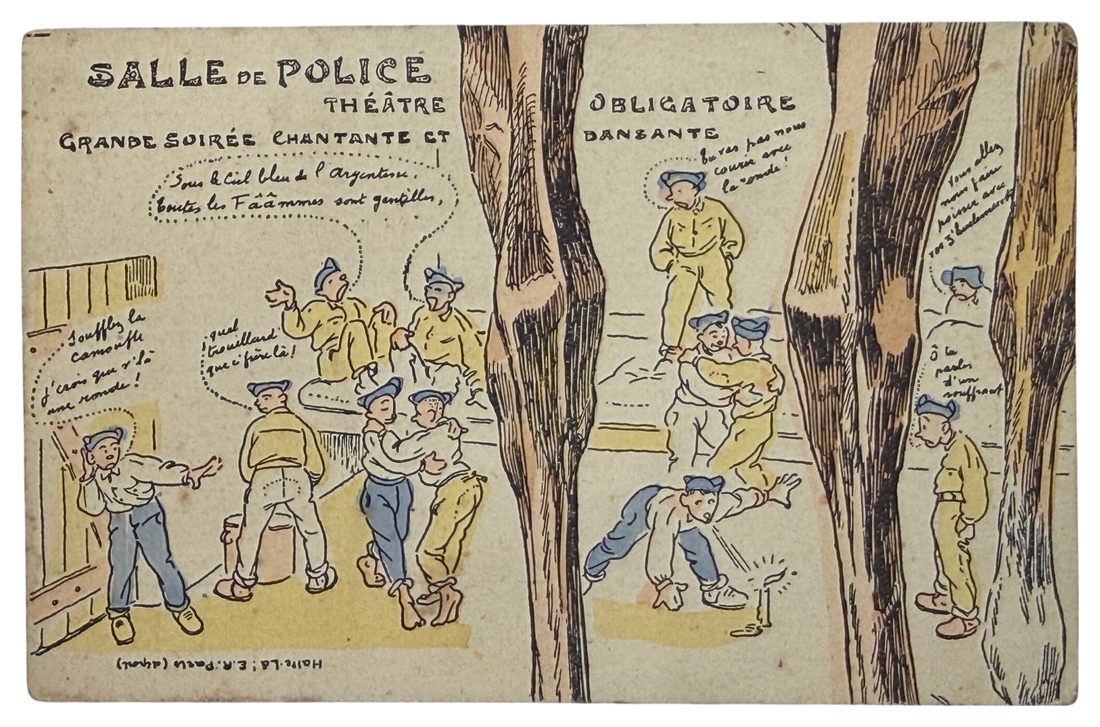
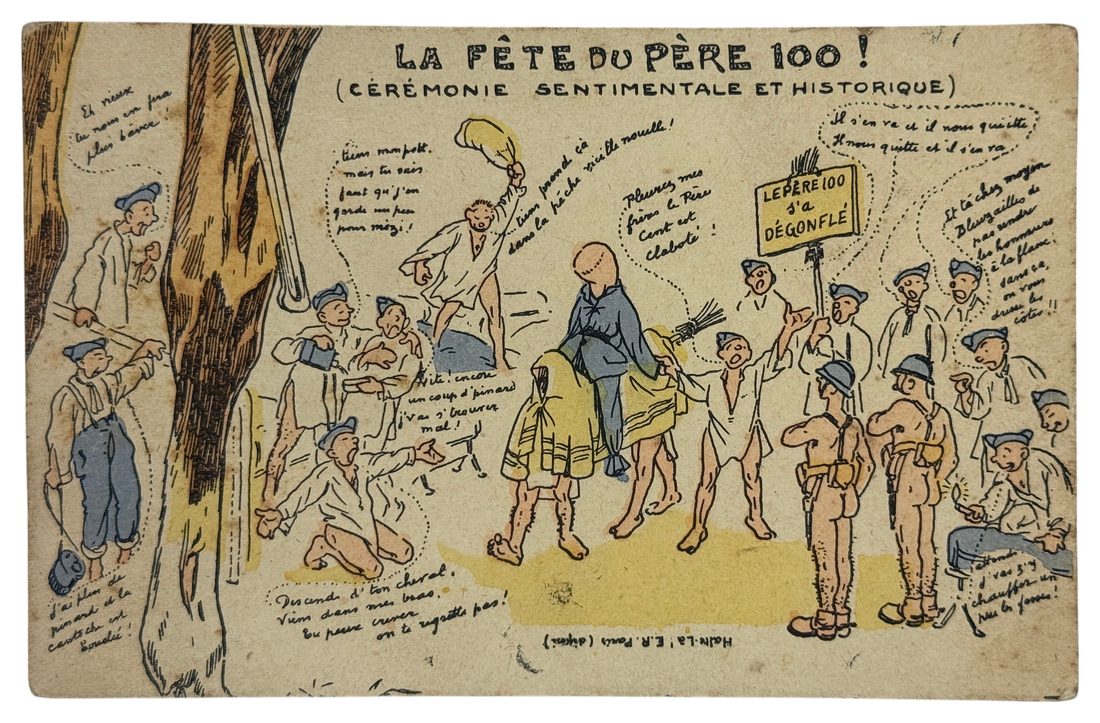
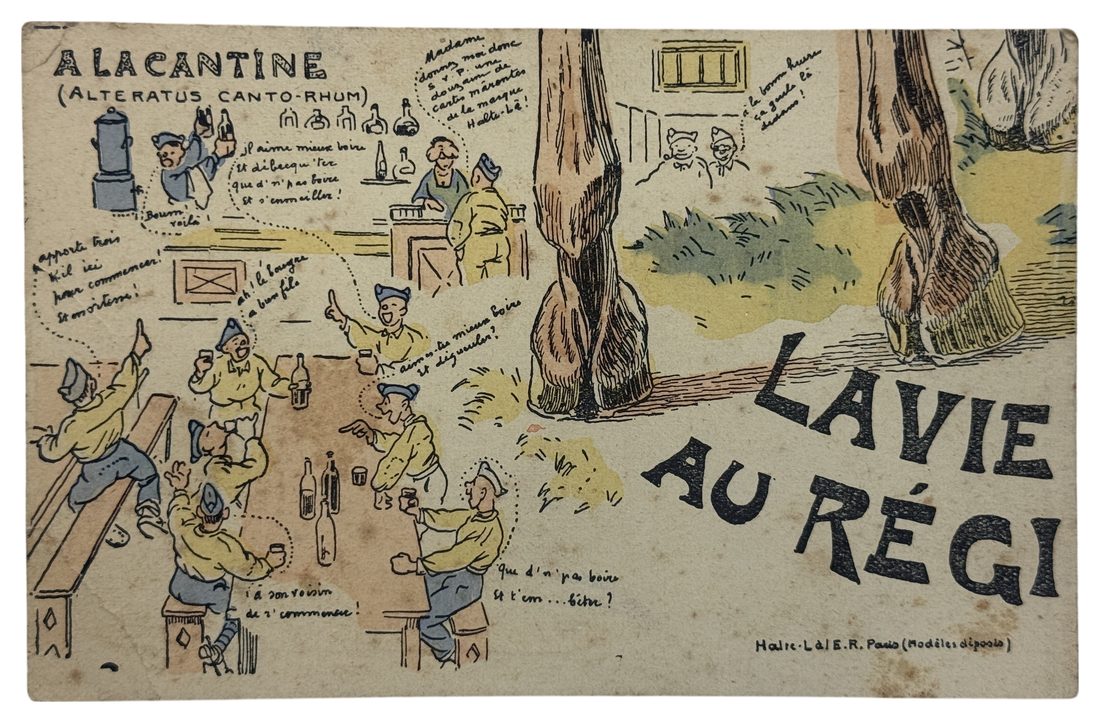
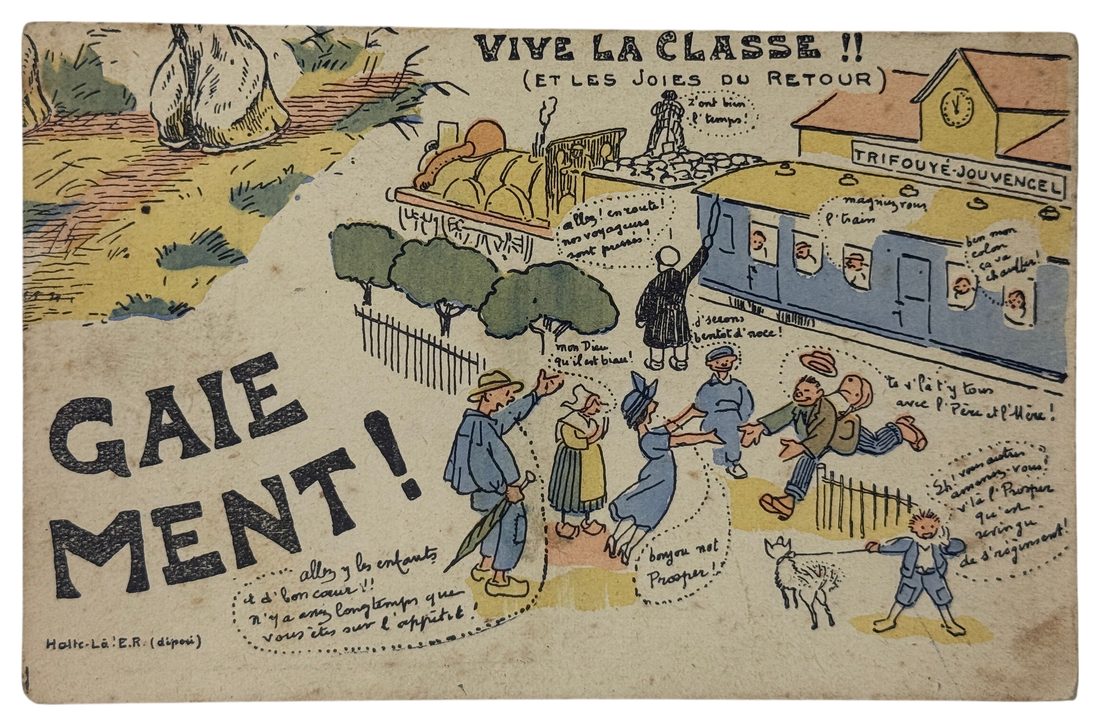
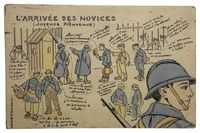
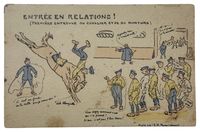
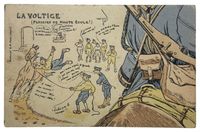
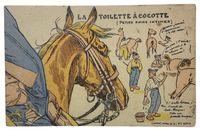
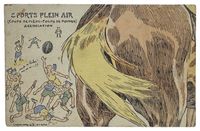
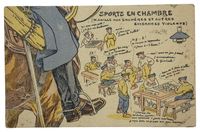
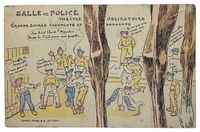
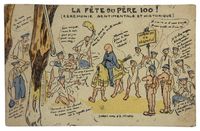
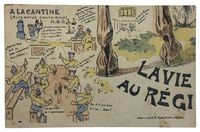
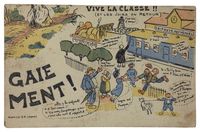
Complete set of ten illustrated postcards, (140 x 90 mm), forming when assembled in a grid of two columns and five rows a single composite image (460 x 280 mm). Each recto printed in black outline with flat colour applied in stencil, in a limited palette of grey blue, ochre, yellow, brown and green; a continuous design of a mounted cavalryman, seen from behind in full campaign equipment with slung carbine, sabre and rolled cloak, runs across the foreground of all ten cards, while the background of each carries an independent comic vignette with its own printed caption and hand lettered speech balloons in barracks argot. The composite title, La Vie Gaie au Régiment, is divided across the two lower cards; each recto bears, at the margin, the imprint Halte-Là! E.R. Paris, modèle déposé.
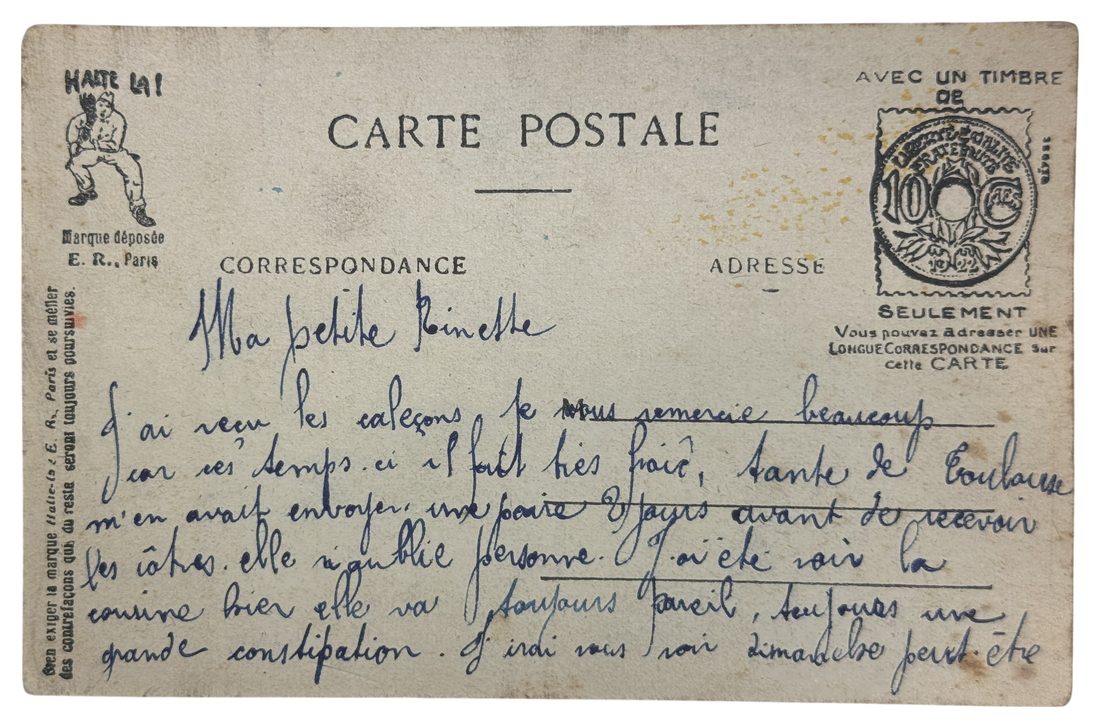
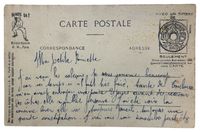
The verso, uniform throughout, follows the standard divided back French carte postale format: at upper left the publisher’s device, a soldier in a defiant crouching pose, above Halte-Là! and Marque déposée E. R., Paris; centrally Carte Postale with the Correspondance and Adresse fields; at upper right, in place of the customary stamp box, an engraved rendering of the reverse of the French ten centime pierced coin of Lindauer type, dated in the exergue 1922, with the printed assurance that a single ten centime stamp sufficed for a lengthy correspondence; along the left margin, printed vertically, an anti-counterfeiting notice urging the purchaser to require the genuine Halte-Là! mark.
Nine of the ten versos carry extended autograph correspondence in blue ink, in a single hand throughout, addressed either to Ma petite Rinette or to Bien chers parents. None bears a postage stamp, address, or postmark; the cards evidently travelled enclosed within an envelope rather than posted individually, a circumstance made explicit within the correspondence itself.
The series belongs to a distinct genre of interwar French military ephemera, the image reconstituée postcard, a commercial device by which ten individually humorous cards interlock, when complete, into a single large picture, rewarding the collector who assembled the whole set: the owner of one card possessed a joke, the owner of all ten possessed a poster. What distinguishes the present example is not the design, which survives elsewhere in isolated cards, but its completeness and the correspondence that accompanies it, nine of the ten cards having been filled, in a single hand, by a young cavalry conscript writing home from a garrison in or near Toulouse, so that the printed joke and the lived experience it caricatures survive together.
The ten vignettes narrate, in sequence, the stock episodes of a conscript’s term of service: the arrival of raw recruits and the mockery of veterans, in L’Arrivée des Novices; the first, disastrous encounter between the cavalryman and his mount, in Entrée en Relations!; riding instruction and falls, in La Voltige; grooming duties, punningly titled La Toilette à Cocotte; outdoor sport shading into brawling, in Sports Plein Air; indoor card games and boredom, in Sports en Chambre, which names the auction variant of the manille card game popular in French barracks; the disciplinary confinement room, ironically restyled as a theatre and compulsory dance hall, in Salle de Police; the mock ceremonial marking of the hundredth day before discharge, in La Fête du Père 100!; canteen drinking, in À la Cantine; and the joyful departure at the end of service, in Vive la Classe!!
The substitution, on the verso, of a printed coin for the customary stamp box, paired with the assurance that the minimum postal rate sufficed for a lengthy correspondence, was a piece of commercial persuasion: the printed jokes on the recto were meant to stand in for the letter itself. The nine surviving versos of the present set contradict that promise agreeably, being filled edge to edge with genuine handwritten news.
The series belongs to a wave of French postcards produced for conscript soldiers in the years following the First World War, once patriotic and wartime imagery gave way to a self mocking comic register aimed at the ordinary rites of barracks life. Halte-Là!, the trademark of the Paris publisher signed only E. R., issued a family of such assembling series, apparently one for each arm of service, of which the cavalry subject examined here is one instance; sister series bearing an analogous structure and an identical anti-counterfeiting formula, among them La Vie Militaire, L’Armée Moderne, Les Cinq Sens du Soldat, Les Premiers Jours d’un Bleu and Scènes Militaires, are documented under the same trademark. A closely comparable and independently documented competitor, Garde-à-vous!, operated from 68 rue Erlanger in the sixteenth arrondissement of Paris and is recorded in the Annuaire Didot-Bottin from 1928, publishing series such as Les Hors Rangs, Le Père Cent and Les Cinq Sens by the identical assembling poster device; the coexistence of the two houses situates Halte-Là! within a recognisable Parisian publishing genre rather than an isolated venture.
The eighth vignette depicts a genuine military folk tradition, the fête du Père Cent, celebrated one hundred days before a conscript’s discharge, in which the Père Cent, personified by a soldier or an effigy, was subjected to a mock funeral and burial or burning. A surviving mock death announcement of 1931, issued for a conscript of the 25th Artillery Regiment, confirms that the ritual was a lived practice among libérables, conscripts nearing the end of their term, and not merely a printer’s invention. The duration of French compulsory service itself changed twice within the likely production span of this series, from eighteen months under the law of 1 April 1923 to twelve months under the law of 31 March 1928, framing the conscript experience the cards depict.
The manuscript correspondence anchors the object to a specific milieu. The sender writes from a garrison in or near Toulouse, mentions an aunt resident in the city who supplies him with linen, and describes attending a rugby match in Toulouse against a team from Carmaux. One card, addressed to his parents, is a New Year greeting, signed Votre grand fils. Together these details situate the correspondence within the everyday experience of cavalry conscription in south western France in the early 1920s, the very world the printed jokes on the recto set out to caricature.
The publisher identifies itself throughout only by the trademark Halte-Là! and the initials E. R., Paris, registered as marque déposée and defended by a printed anti-counterfeiting notice on every card, itself indirect evidence of a successful and imitated product. The full name behind the initials has not been established with certainty. One unconfirmed proposal identifies E. R. with a Parisian publisher of Belle Époque views, but the surviving production associated with that name comprises only civic vedute and a series on the names of the Paris métro stations, material of an earlier period and unrelated in subject matter; the identification should be treated as unproven. Model deposit numbers 14877 and 15108, documented on other series issued under the same trademark, show that the firm registered its designs in bulk rather than series by series; no deposit number has been located for the present title. A partial signature reading L. Malespina has been reported on another card of the same trademark. If referable to Louis Ferdinand Malespina (1874 to 1949), a French painter trained under Édouard Detaille and specialised in cavalry subjects, official painter to the armies from 1914 and a gold medallist at the 1925 Salon, the attribution would sit comfortably with the equestrian subject of the present series, but no source connects the artist to postcard illustration, and the attribution remains an unverified hypothesis.
Condition: The set is complete, comprising all ten cards required to form the composite image, correctly matched and legible in sequence. The cards show even light toning and scattered brown foxing, somewhat heavier toward the margins, consistent with age and handling. Corners are lightly worn; no card is torn, creased through the image, or trimmed. Nine versos carry autograph ink correspondence, complete and undamaged; no card bears a postage stamp, postal address, or cancellation. No original wrapper, envelope or container accompanies the set.
References: CPArama, Militaires: humoristiques, forum thread documenting the Halte-Là! trademark and its deposit numbers 14877 and 15108 (cparama.com/forum/militaires-humoristiques-t4702.html); Passion Militaria, Cartes postales puzzle des années 20 sur le service militaire (passionmilitaria.com/t80393); Passion Militaria, Les cartes postales humoristiques Gardes à vos!, on the competing trademark Garde-à-vous!, 68 rue Erlanger, Paris (passionmilitaria.com/t207020); Généaven, La Vie Militaire, exercices de pointage (geneaven.fr, 2 September 2023); Bibliomab, Vivement la quille: le Père Cent au service militaire (bibliomab.wordpress.com, 15 February 2012); toutvendre.fr, Vie militaire, faire-part de deuil, Père Cent, 1931, 25e Régiment d’Artillerie (toutvendre.fr, item 663283003); Wikipédia, Percent; Wikipédia, Service militaire en France, on the reduction of compulsory service to twelve months in 1928; Légifrance, Loi du 1er avril 1923 sur le recrutement de l’armée (legifrance.gouv.fr/jorf/id/JORFTEXT000000684225); Wikipédia, Louis Malespina, for the biography of the painter to whom a partial signature on a comparable card has been tentatively, and as yet unverifiably, attributed.
The specialist forum and blog sources cited above are freely accessible online at the addresses given; no institutional or subscription database was required for their consultation.
The date of circa 1922 is inferred from the coin motif engraved on the verso rather than from an external documentary source. The identification of the publisher’s initials, and the attribution of the illustration to Louis Ferdinand Malespina, are reported as unverified hypotheses found in the specialist literature and are not presented here as established fact.