Tarocchi erotici: 23 hand-drawn plates, signed Zarmo '96
| Macro-category | Playing Cards and Tarot |
| Subcategory | Tarot |
| Author | Zarmo (pseud.) |
| Place of manufacture | Italy |
| Year | 1996 |
from allegory to eros: a hand-drawn tarot
in the Italian–Marseille tradition
Zarmo (pseud.). Tarocchi erotici. Italy, 1996.
Complete series of twenty-three hand-drawn plates (300 × 160 mm), comprising the twenty-one Major Arcana (I–XXI) plus Il Matto and an unnumbered introductory plate. Executed in black ink with pen and brush on textured drawing paper, with wide margins. Each plate bears the title in Italian, rendered in a consistent cursive script, Roman numerals (in the Marseille tradition, e.g., “XVIIII” for Il Sole), and the signature “ZARMO ’96” at the lower right. The corpus shows full consistency in paper tone, texture, and ink, confirming its unity as an autograph series. No printed elements, publisher’s marks, or tax stamps are present.
An original erotic reinterpretation of the Major Arcana of the Italian–Marseille tarot, executed by hand and signed “Zarmo ’96.” Each Arcane transforms the classical allegory into a bold, explicitly erotic scene while maintaining fidelity to the symbolic order of the tarot. The result is a work that merges esoteric iconography, erotic illustration, and graphic discipline, revealing both satire and formal sophistication. Unique in its entirety and unrecorded in bibliographic or auction sources, the corpus exemplifies the 1990s Italian revival of tarot as a medium of artistic expression and erotic allegory.
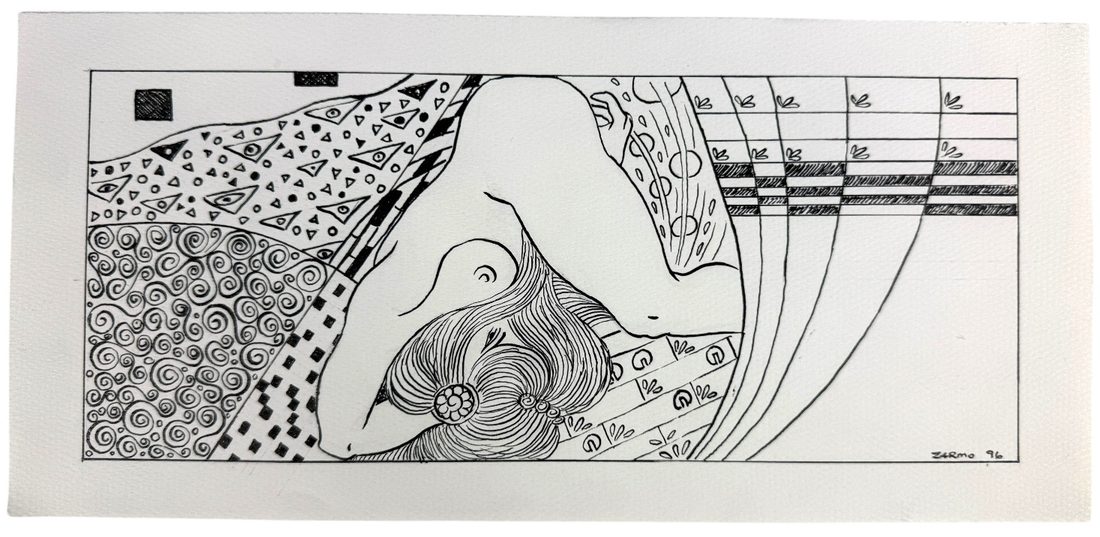
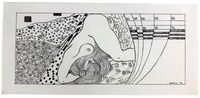
The titles and numbering of the cards follow the canonical order (Giustizia VIII, Forza XI, Il Sole XVIIII). The series opens with an introductory plate, horizontal in format, depicting a reclining nude female figure surrounded by ornamental motifs and tendrils, serving as an emblematic frontispiece to the sequence.
Further details are available in the Appendix (see link below):
Across all plates, the visual idiom is coherent: fine ink lines, flat black fields, and stylized anatomies. The handwriting of the titles and the recurring signature confirm a single hand. Compositionally, Zarmo’s work unites the frontal solemnity of tarot iconography with the transgressive imagination of Italian erotic illustration from the 1980s–1990s.
The corpus ZARMO 96 belongs to the prolific Italian revival of tarot art in the late twentieth century, when publishers such as Lo Scarabeo of Turin reimagined the tarot as a vehicle for thematic and artistic experimentation. Erotic variants emerged as a distinct genre, paralleling the adult comic tradition of Milo Manara, Giacinto Gaudenzi, and Luca Raimondo. Unlike printed decks, however, Zarmo’s hand-drawn series exists as a single artistic portfolio, more akin to an erotic ex-voto or an illuminated manuscript than a product of industrial printmaking. Its iconography remains rigorously aligned with the Marseille system while introducing postmodern irony and overt sensuality.
In the cultural climate of 1990s Italy, where eroticism, irony, and mystical symbolism often intersected, this work exemplifies an outsider’s synthesis of sacred and profane imagery. The use of black-and-white ink drawing situates it between the worlds of comic art and fine art, offering a visual language at once graphic, allegorical, and deliberately provocative.
No verified information exists regarding “Zarmo.” Searches in bibliographic and art databases (OPAC SBN, VIAF, WorldCat, Artnet, Artprice) yield no results. The signature’s Italian form and the cultural framework of the imagery suggest an Italian illustrator active circa 1996, possibly working in the erotic or underground art milieu. No evidence connects this artist to commercial publishers such as Lo Scarabeo, Modiano, or Italcards. The pseudonym likely conceals an independent draughtsman whose only known work is the present corpus. Pending further documentary discovery, Zarmo remains anonymous.
Conditions: Unused.
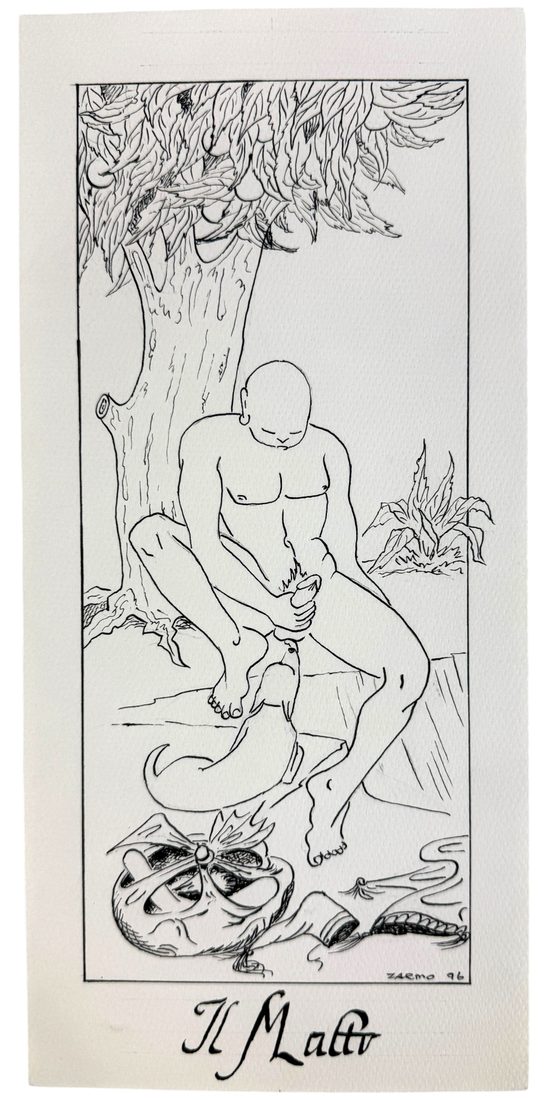
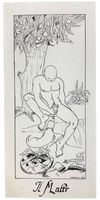
Il Matto (The Fool). A seated male figure beneath a tree, engaged in autoerotic contemplation; a mask and a stylized tail lie beside him. The classical theme of the vagabond freed from convention is recast as liberation through sexual instinct.
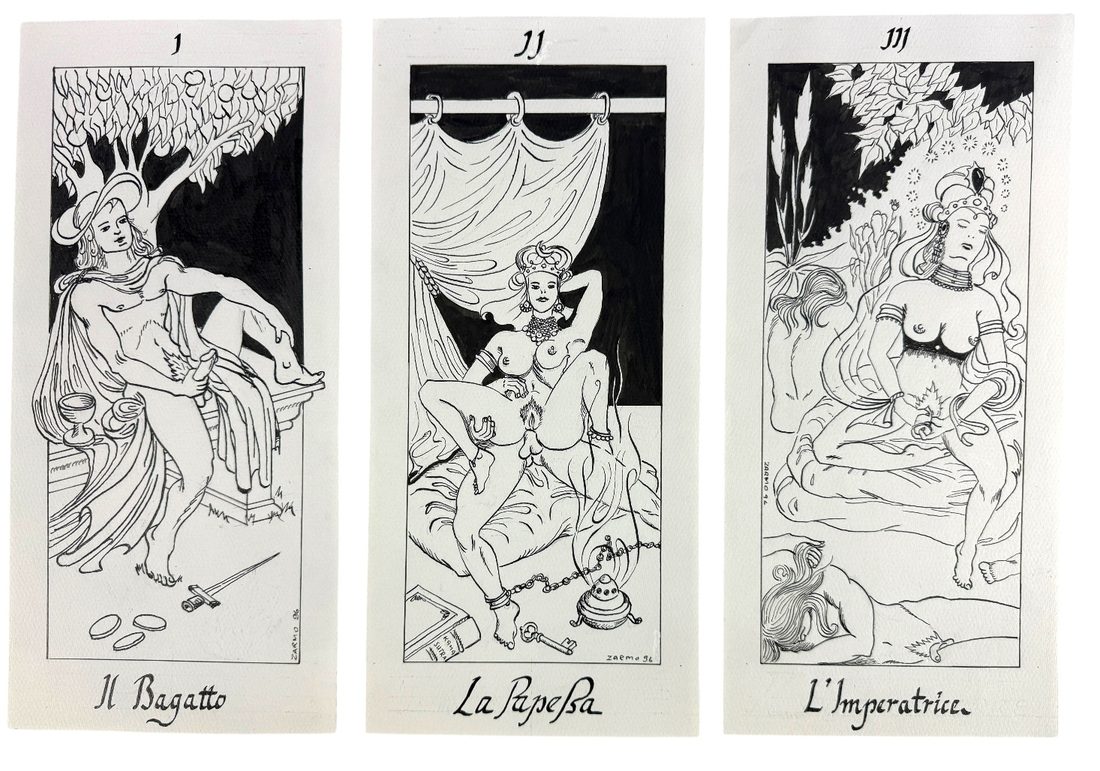
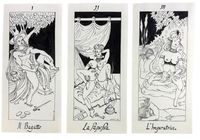
I. Il Bagatto (The Magician). A young man seated beside a table or altar bearing cups and a sword. His posture is languid, the instruments of his art transformed into emblems of seduction. The allegory of dexterity becomes one of erotic charisma.
II. La Papessa (The High Priestess). A woman reclining on a bed with drawn curtains, engaged in an explicit act; an incense burner occupies the foreground. The mystical wisdom of the Popess becomes the secret knowledge of sensuality.
III. L’Imperatrice (The Empress). A crowned woman within a forest setting, participating in a multi-figure erotic scene; a serpent winds through the composition. Fertility and sovereignty are transposed into physical and generative pleasure.
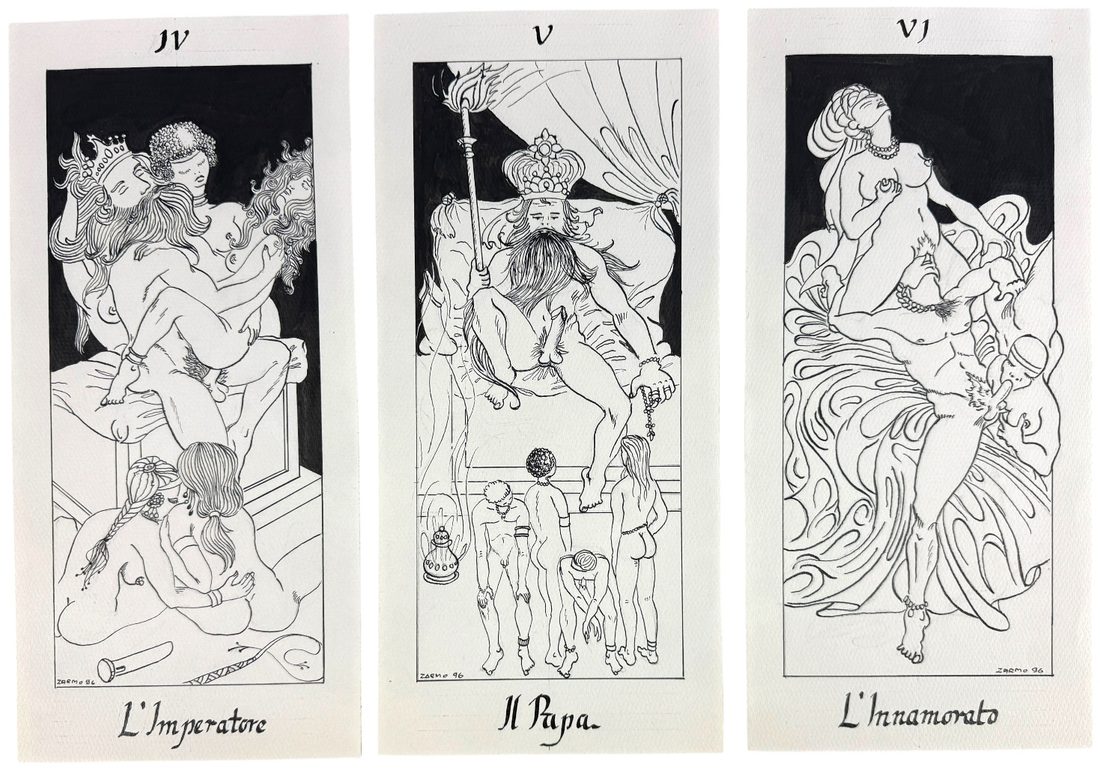
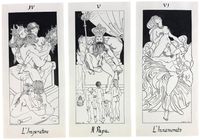
IV. L’Imperatore (The Emperor). A bearded ruler enthroned amidst partners in erotic embrace. Power is portrayed not as governance but as dominion of the body, transforming authority into carnal triumph.
V. Il Papa (The Hierophant). Enthroned and holding a censer, the Pontiff oversees two nude devotees at his feet. The scene eroticizes spiritual hierarchy, presenting submission as both ritual and desire.
VI. L’Innamorato (The Lovers). A couple intertwined within decorative volutes; the traditional theme of choice is reinterpreted as abandon to pleasure, love as ecstatic surrender rather than moral dilemma.
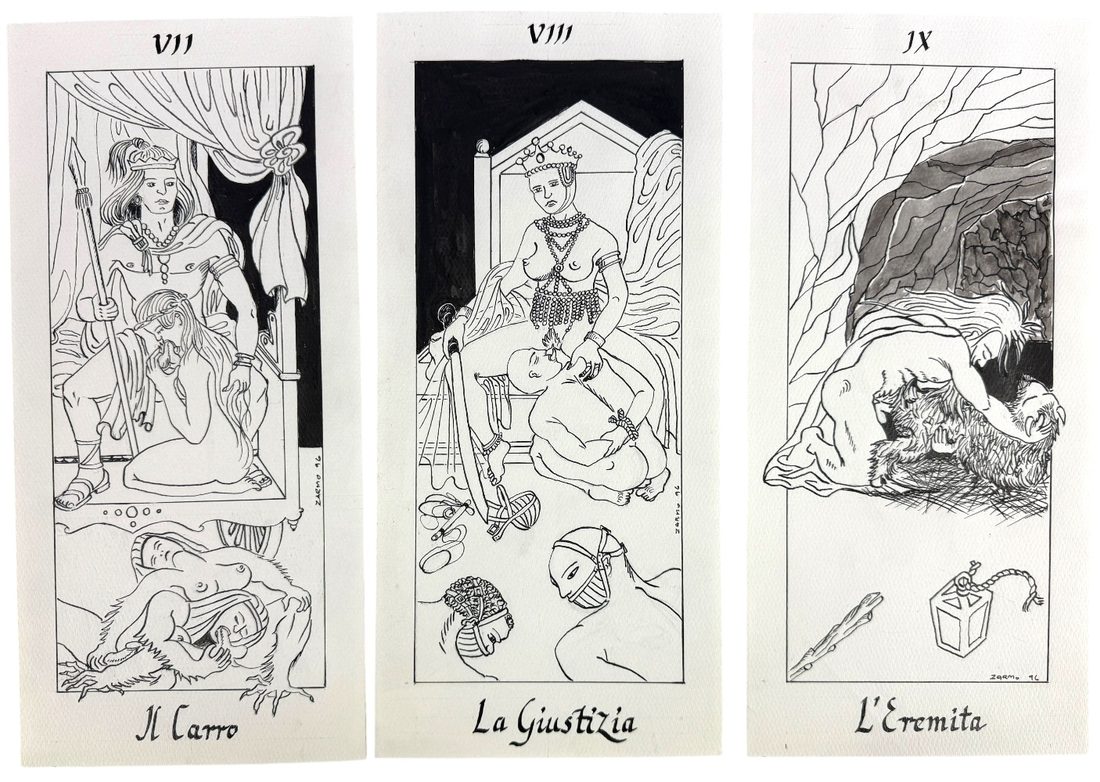
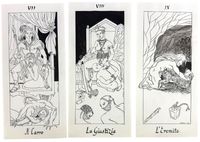
VII. Il Carro (The Chariot). A triumphant figure bearing a lance, enthroned while an explicit scene unfolds below. Victory and conquest are symbolized as erotic possession, echoing the martial confidence of the original archetype.
VIII. La Giustizia (Justice). A woman replaces the scales and sword with phallic emblems and belts. The scene plays on the double sense of punishment and delight, rendering justice as sensual equilibrium.
IX. L’Eremita (The Hermit). Within a cavernous interior, an ascetic figure holds a phallic staff while sharing intimacy in the half-darkness. Solitude is transfigured into introspective erotic experience.
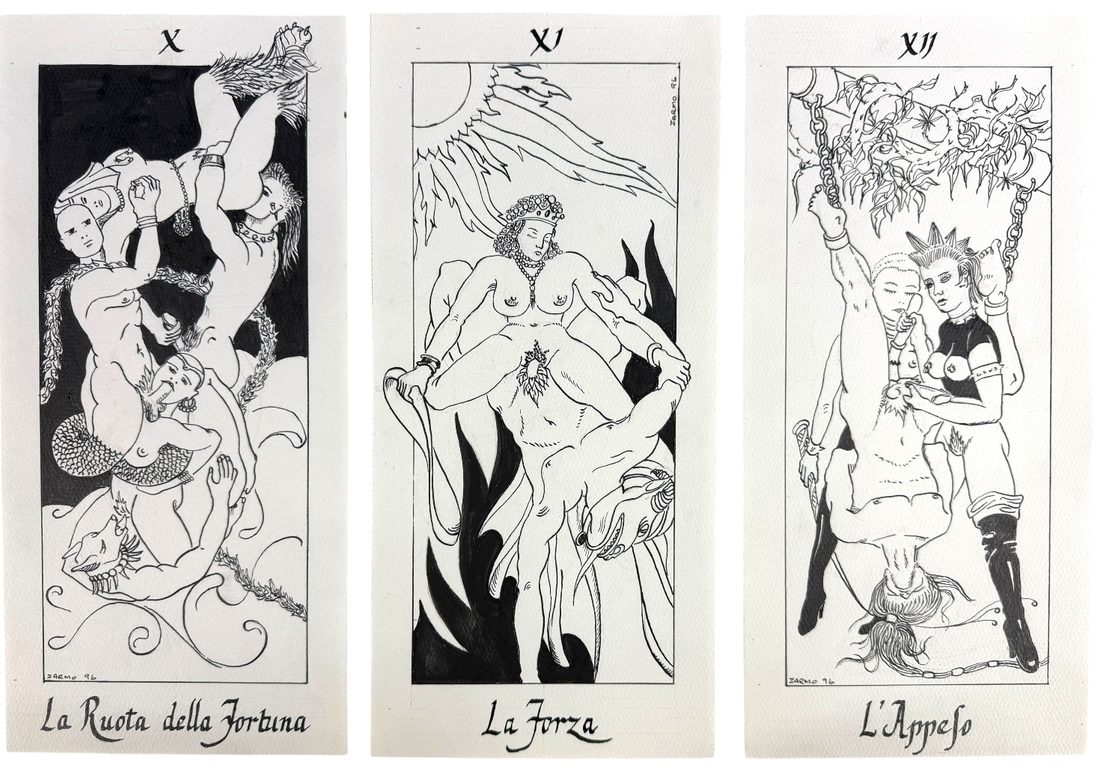
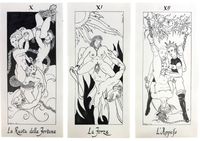
X. La Ruota della Fortuna (The Wheel of Fortune). A vertical composition of interlaced bodies forms a revolving structure. Fortune is visualized as a vortex of pleasure, cyclical and uncontrollable.
XI. La Forza (Strength). A woman dominates multiple partners, her gestures recalling the taming of the lion. Strength becomes the power of sensual mastery, an allegory of erotic control.
XII. L’Appeso (The Hanged Man). An inverted figure is grasped by partners dressed in fetish attire. Suspension becomes the locus of excitement; the inversion of gravity mirrors the inversion of conventional morality.
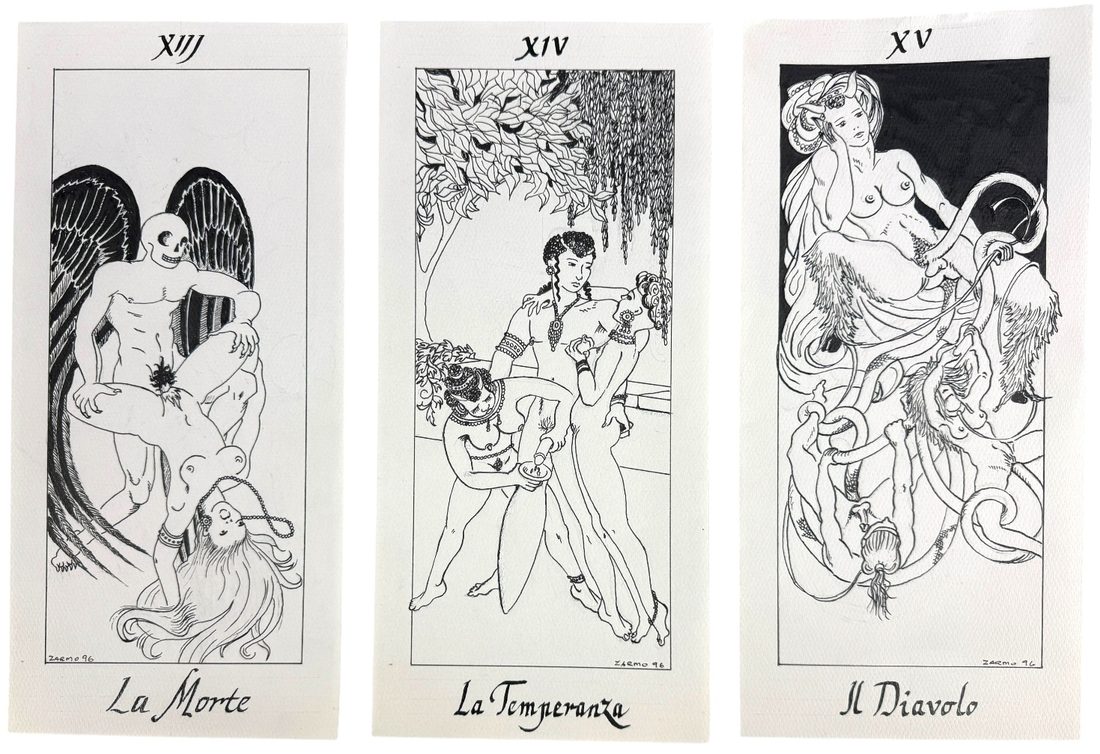
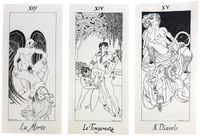
XIII. La Morte (Death). A winged skeleton participates in a sexual act, the classical memento mori eroticized into the conjunction of Eros and Thanatos. Death is not annihilation but the climax of transformation.
XIV. La Temperanza (Temperance). Three figures engage in sensual exchange; the traditional act of pouring liquid between vessels becomes the blending of bodily pleasures. Balance is represented as harmony of desire.
XV. Il Diavolo (The Devil). A female satyr binds her subjects with tentacular whips, combining themes of erotic slavery and infernal delight. The bondage imagery unites sin and pleasure in a single allegory.
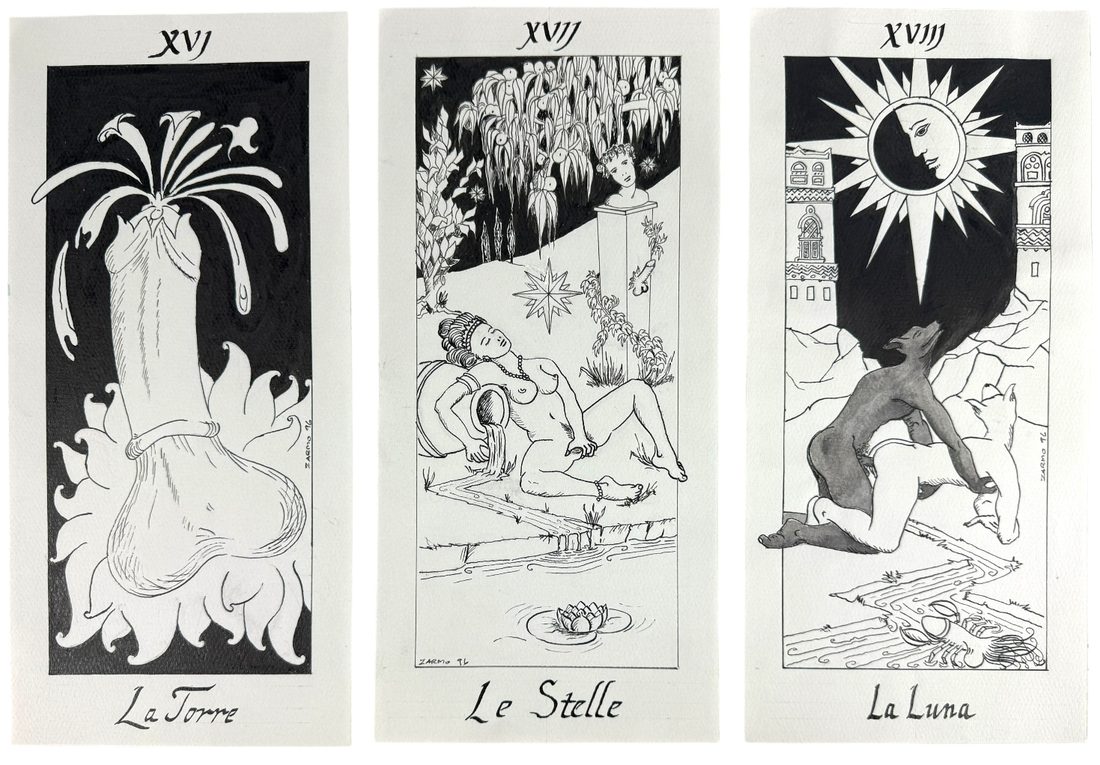
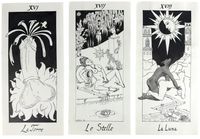
XVI. La Torre (The Tower). A monumental phallus erupts against a black background, struck by divine fire. The destructive lightning of revelation is transmuted into orgasmic explosion, the most direct of erotic symbols.
XVII. Le Stelle (The Star). A reclining nymph by a pool of water; the act of bathing becomes one of coupling. The serenity of the archetype is retained through the rhythm of the composition, despite its sensual explicitness.
XVIII. La Luna (The Moon). A nocturnal landscape wherein two figures engage in intercourse; the traditional dogs are replaced by human bodies, the lunar influence evoking instinct and illusion.
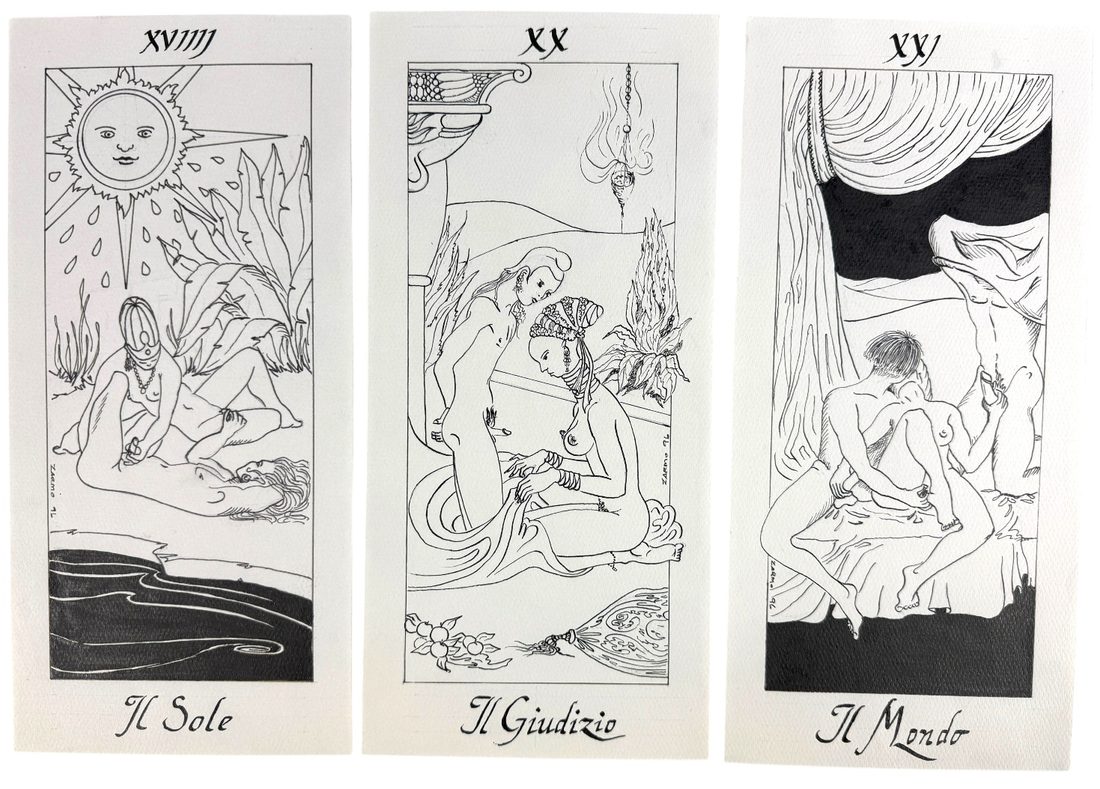
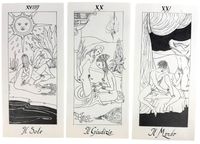
XVIIII. Il Sole (The Sun). A couple outdoors beside a reflective pool; the radiant sun amplifies their union. Echoing the “Gemini” theme of the Marseille tradition, the scene becomes a hymn to erotic vitality.
XX. Il Giudizio (Judgment). A triadic composition: three bodies entangled in awakening; the call to resurrection becomes the awakening of the senses, sensuality replacing salvation.
XXI. Il Mondo (The World). Within a theatrical interior framed by draped curtains, a couple unites beneath a veiled female figure who presides from above. The completion of the cycle coincides with the consummation of desire, Eros as cosmic harmony.
Across all plates, the visual idiom is coherent: fine ink lines, flat black fields, and stylized anatomies. The handwriting of the titles and the recurring signature confirm a single hand. Compositionally, Zarmo’s work unites the frontal solemnity of tarot iconography with the transgressive imagination of Italian erotic illustration from the 1980s–1990s.