The Jack Who Worked for the Tax Office
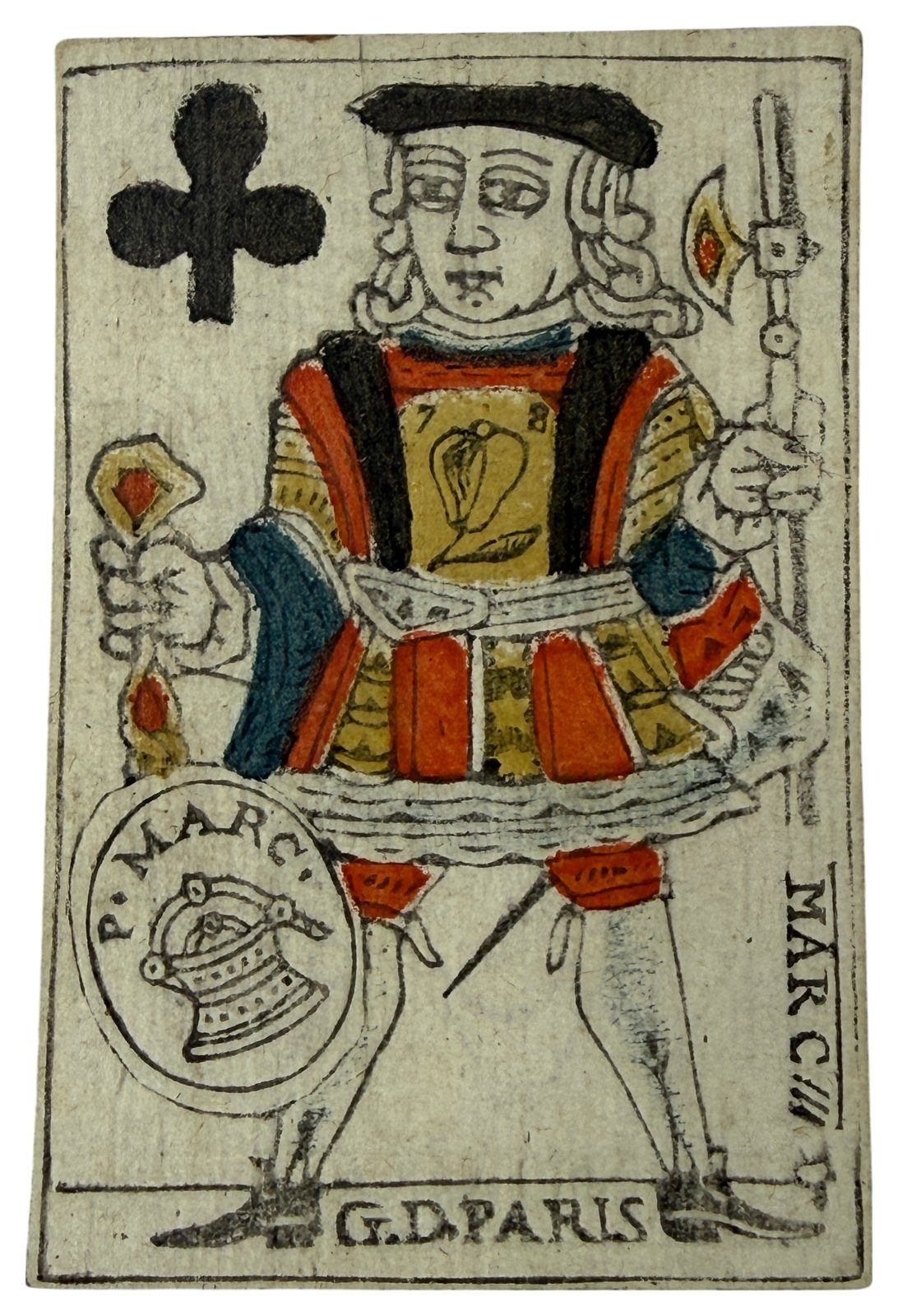
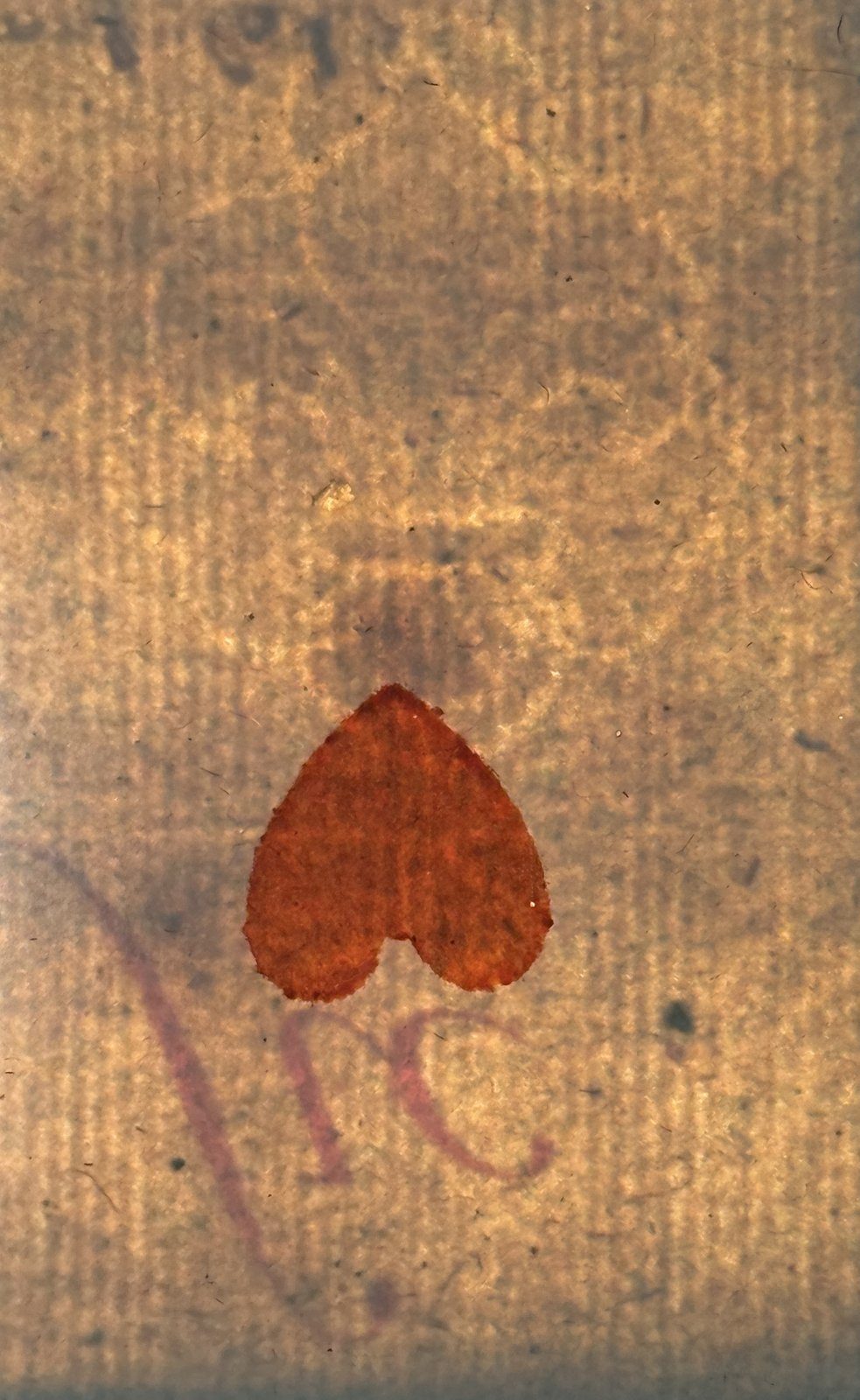
Picture a card-maker in a French provincial town, some time in the eighteenth century. He has paper, brushes and paint in his workshop, but he cannot simply print a deck of cards. The woodblocks that carry the faces of the kings, queens and jacks are not his: they are kept under lock in the office of the local tax collector. So he gathers his card stock, walks it to that office, and has the outlines of the court figures printed there, under official eyes. Only then does he carry the sheets home to add the colour through stencils: thin sheets cut with the shapes of the design, brushed with one colour at a time. The state, quite literally, held the faces of the cards.
Why would a kingdom care what a king of hearts looked like? Because cards were taxed, and a tax is only as good as its policing. The decisive step came in 1701, under Louis XIV: for the purposes of the card duty, France was divided into fiscal districts (the généralités), and each district was assigned one obligatory design. Old printing blocks were destroyed. New ones were supplied by the fermiers, the tax farmers who had bought the right to collect the duty. The result was the system of regional "portraits": court designs with fixed poses, attributes and names, frozen by law so that an inspector could recognize a legally stamped pack at a glance. A card printed from an unauthorized block was labelled "fraudulent", and fines followed.
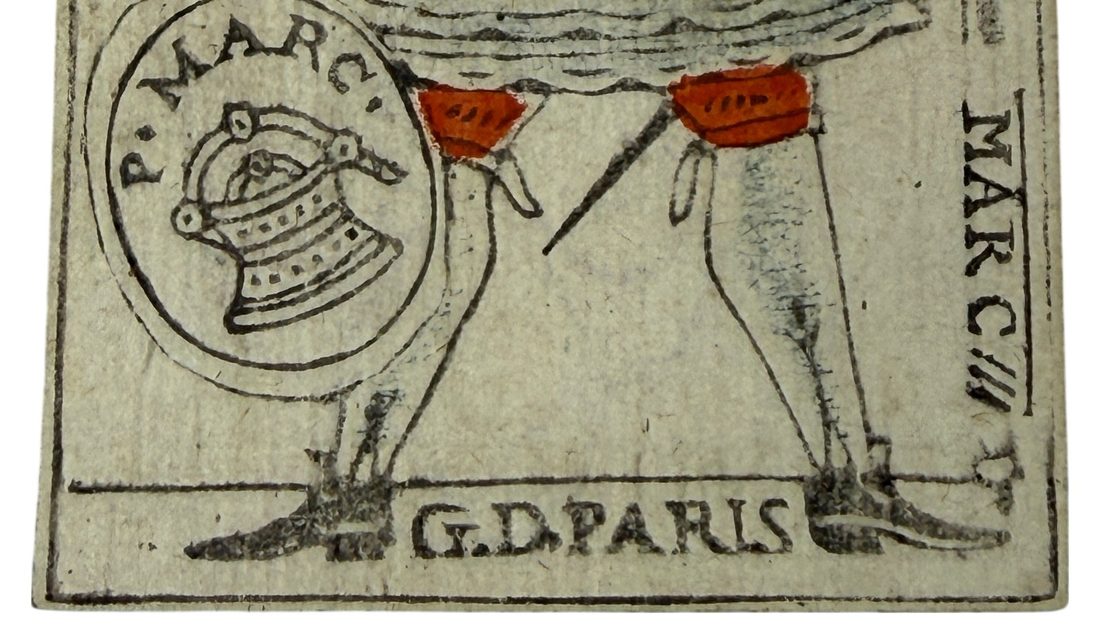
The control ran in layers. Since 1613, under Louis XIII, the maker's name had to appear on the jack of clubs, turning one court card into a signature. By the mid-century that followed, the crown went deeper still: from 1751 card-makers were required to use official paper bearing a fleur-de-lis watermark, a design pressed into the paper itself and visible against the light, which was also a tax mark. Outline by regulated woodblock, colour by hand stencil, all on stiff laid paper (hand-made paper showing fine parallel lines when held to the light): every layer of the object could be read by a tax man before it was ever read by a player.
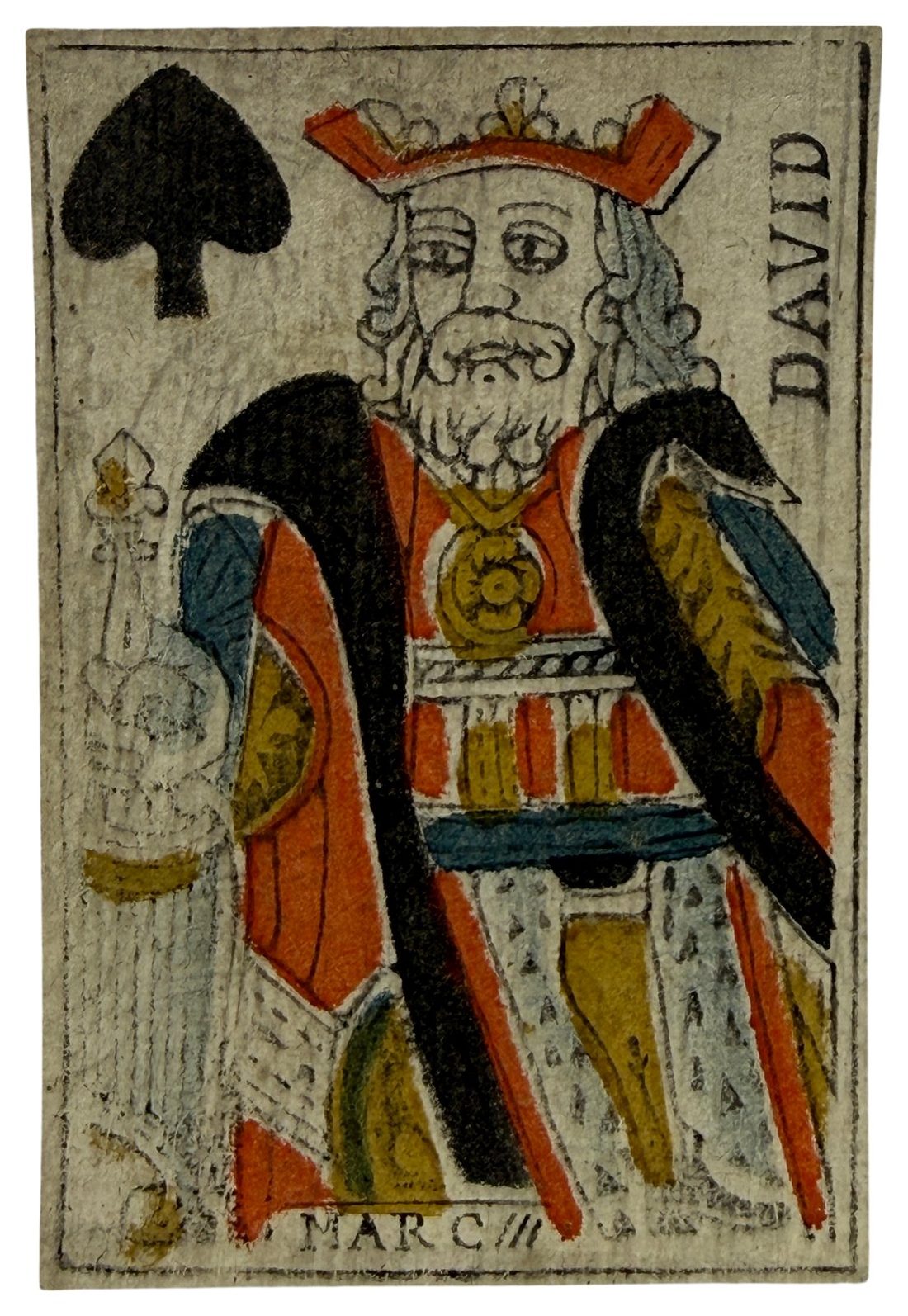
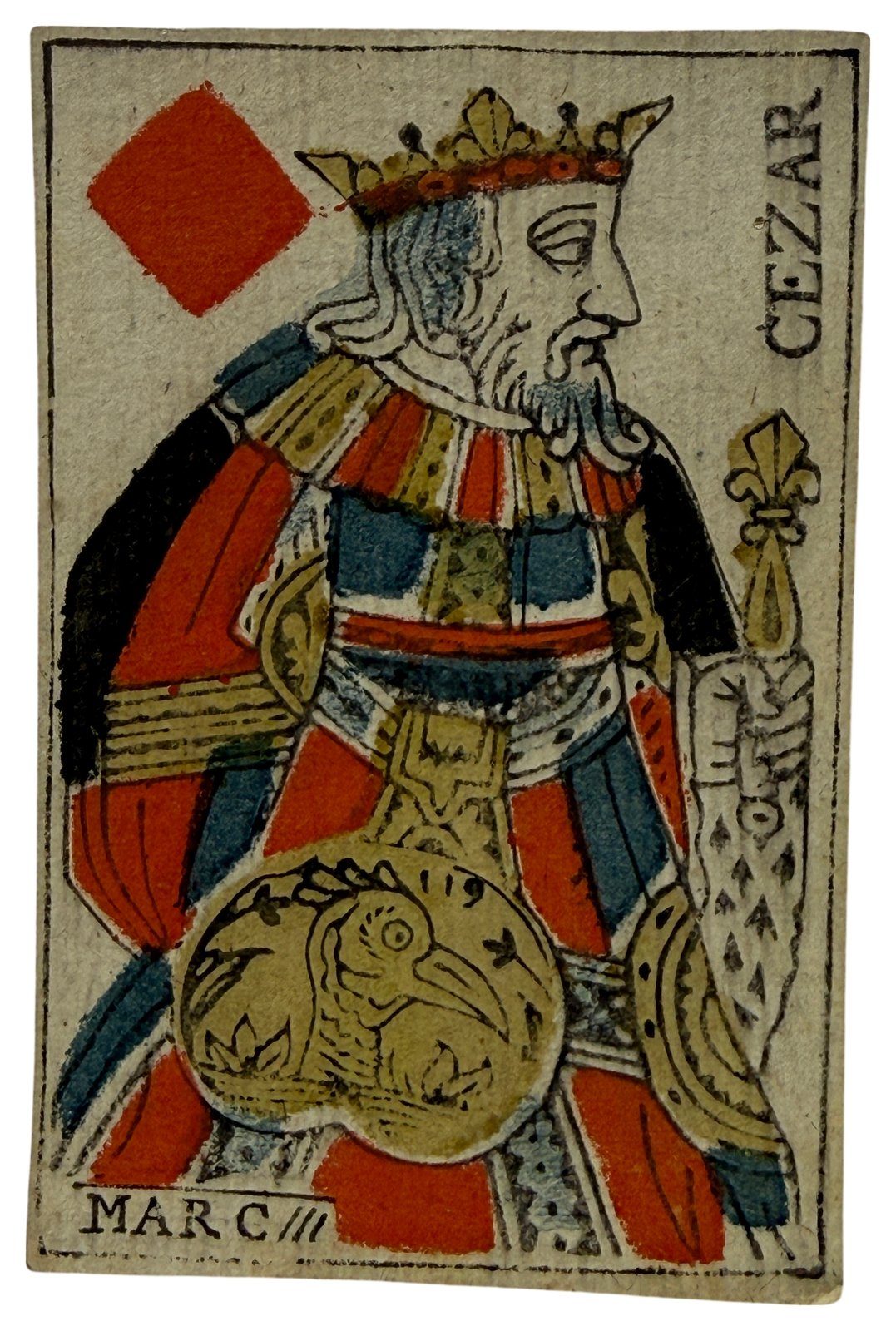
The patchwork this produced included the patterns of Paris, Lyon, Rouen, Provence and others, and the Paris portrait proved the most influential. Its defining trait was that the court cards had names, drawn largely from the Nine Worthies, the medieval canon of nine exemplary heroes. The four kings were David, Alexandre, César and Charles, evoking four empires: Hebrew, Greek, Roman and Frankish. The queens were Judic, Argine, Rachel and Pallas; the jacks Hector, Hogier and Lahire, while the jack of clubs went unnamed and carried the maker's mark instead. One such maker was a Paris card-maker who traded under the sign "Au Marc d'Or"; his packs are examples of the regional standard, not its origin. No individual invented the portrait de Paris. The law had already decided what it looked like.
A system this entrenched looked permanent. It was not. The Revolution abolished the card duty on 2 March 1791, and in 1793 the Convention ordered kings, crowns, sceptres and fleurs-de-lis removed from the cards altogether, replaced by figures of Genius, Liberty and Equality. The republican pack was a brief experiment. The kings would come back, but not from where anyone expected, and not by the hand of a king.
What the Revolution had loosened, the Empire tightened into a single grip. Around 1810 the regional patterns were given up, and in their place came one national design, the portrait français officiel, engraved by Nicolas-Marie Gatteaux and issued as the official pattern in 1813. Napoleon did not design it, and it would be wrong to say he did; his part was the will to uniformity under which it was commissioned. It belonged to the same drive to a single national standard that had already produced the metric system and the Code civil, one more local variety replaced by one national rule. The new deck was not an invention but a promotion: it was based on the old Paris pattern, now imposed on the whole country. And on the jack of clubs, where the maker's name had once stood, appeared the imperial bee, Napoleon's emblem. The painted kings had returned to the pack a year before the real one returned to France.
The pattern outlived its patron. When the Bourbons returned, they kept the national deck and simply changed the badge: in 1816 the fleur-de-lis replaced the bee, and from 1817 a dedicated printed tax stamp was applied to the ace of clubs. The jack of clubs thus became a small register of French history: a craftsman's signature under the kings, a bee under the emperor, a lily under the restored crown. Regimes rose and fell; the deck absorbed each of them and went on being shuffled. A state that wants to unify itself will standardize its weights, its laws and its measures. France also standardized its games, and the games, more durable than any of the governments that stamped them, kept the score.