The Image That Learned to Move
A sheet of paper lies on the table, coloured red, yellow, turquoise and black, and it makes no sense: two figures stretched along an arc into a smear, bent around a blank circle. Stand a polished metal cylinder on that circle and the reflection gathers the distortion and snaps it into order: a richly dressed gentleman and a beggar. Lift the mirror and they dissolve again. Sheets like this, sold with their mirrors, were a European fashion of the early eighteenth century; one series is attributed to the Leiden workshop of Jan van Musschenbroek, instrument makers better known for air-pumps and microscopes. The game carried a quiet moral (appearances rearranged by the right instrument) and a quieter lesson: the picture exists only when the viewer completes it.
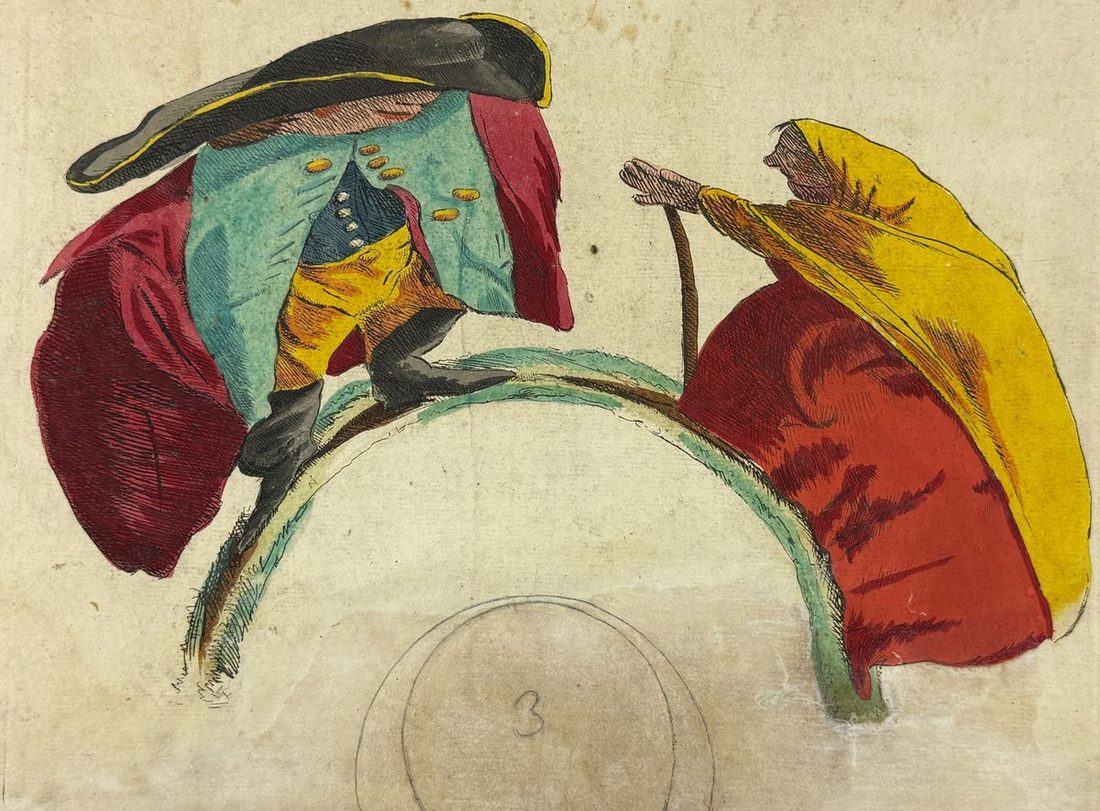
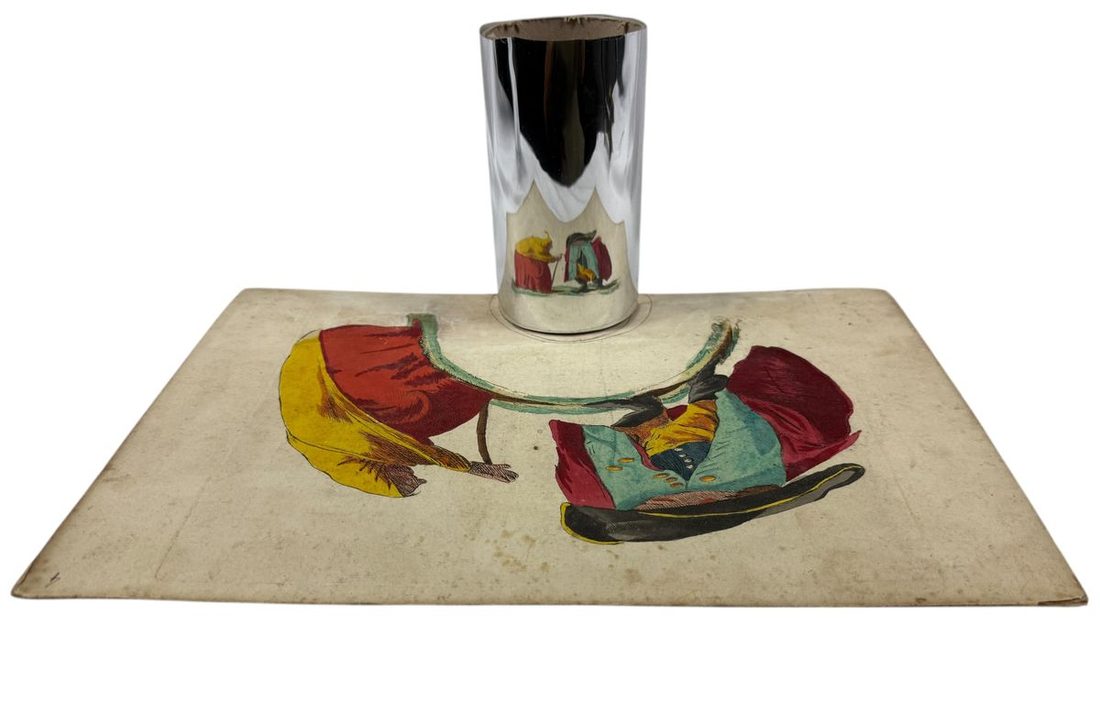
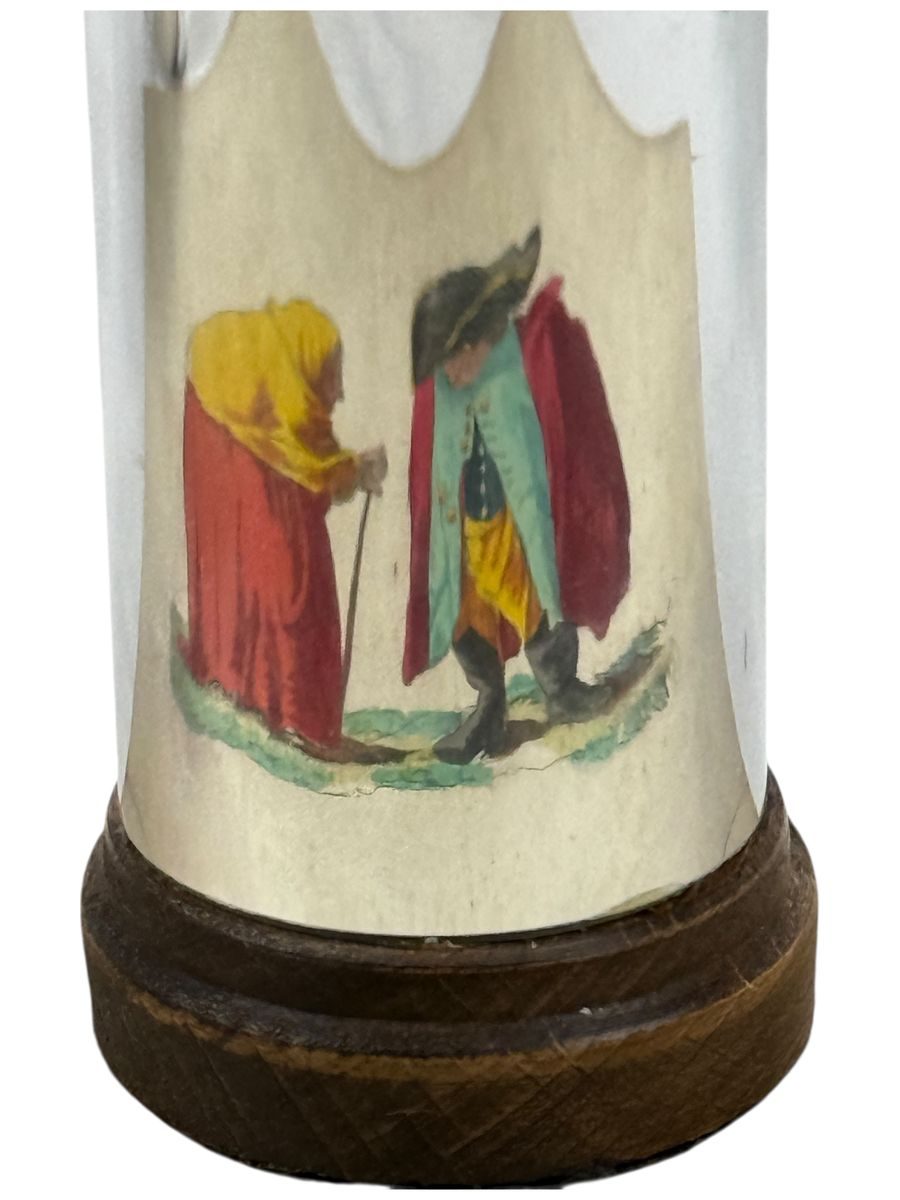
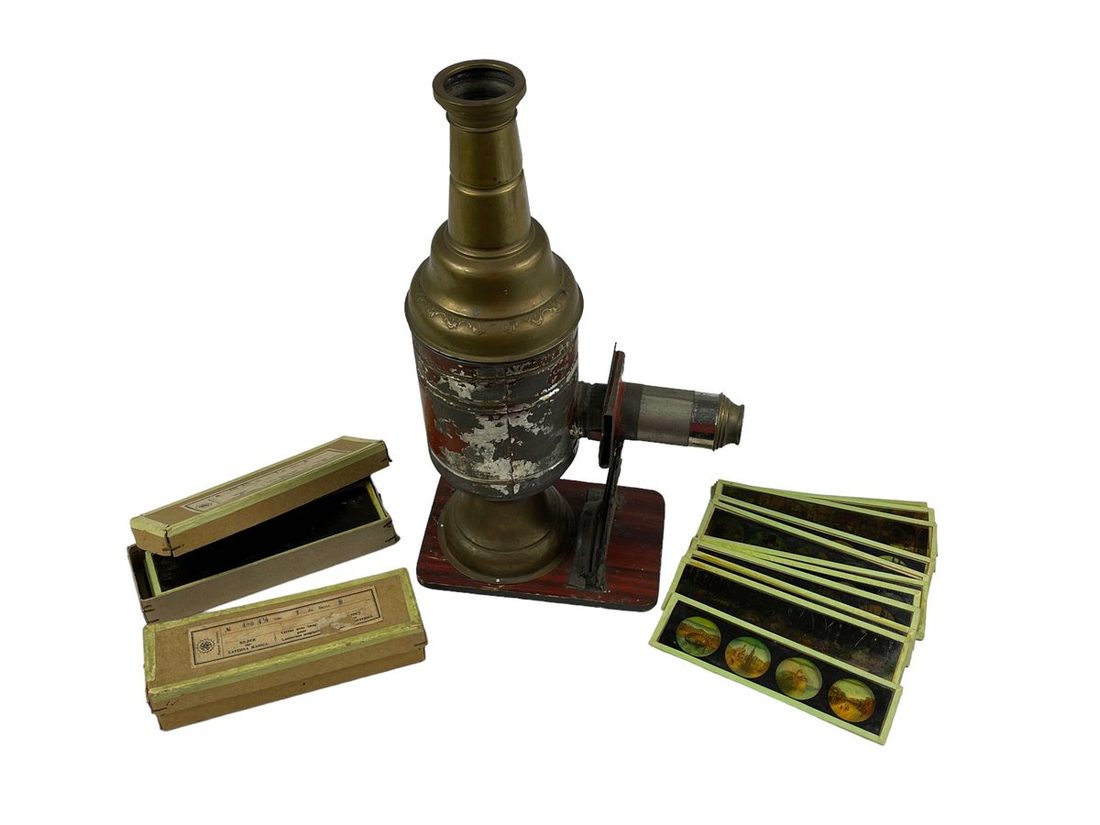
The trick is called catoptric anamorphosis: a picture drawn in calculated distortion, legible only in a curved mirror. The geometry was already old. Jean-François Niceron had published the methods in Paris in 1638 and called the effect artificial magic. By then the image had a second skill: the magic lantern, a lens-and-lamp device for projecting painted slides onto a wall, is credited to Christiaan Huygens around 1659; his surviving sketches show a skeleton removing its own skull. Huygens was embarrassed by the toy; in 1662 he asked his brother to disable one before it reached their father. The image could hide, recompose, haunt a dark room. What it could not yet do was change.
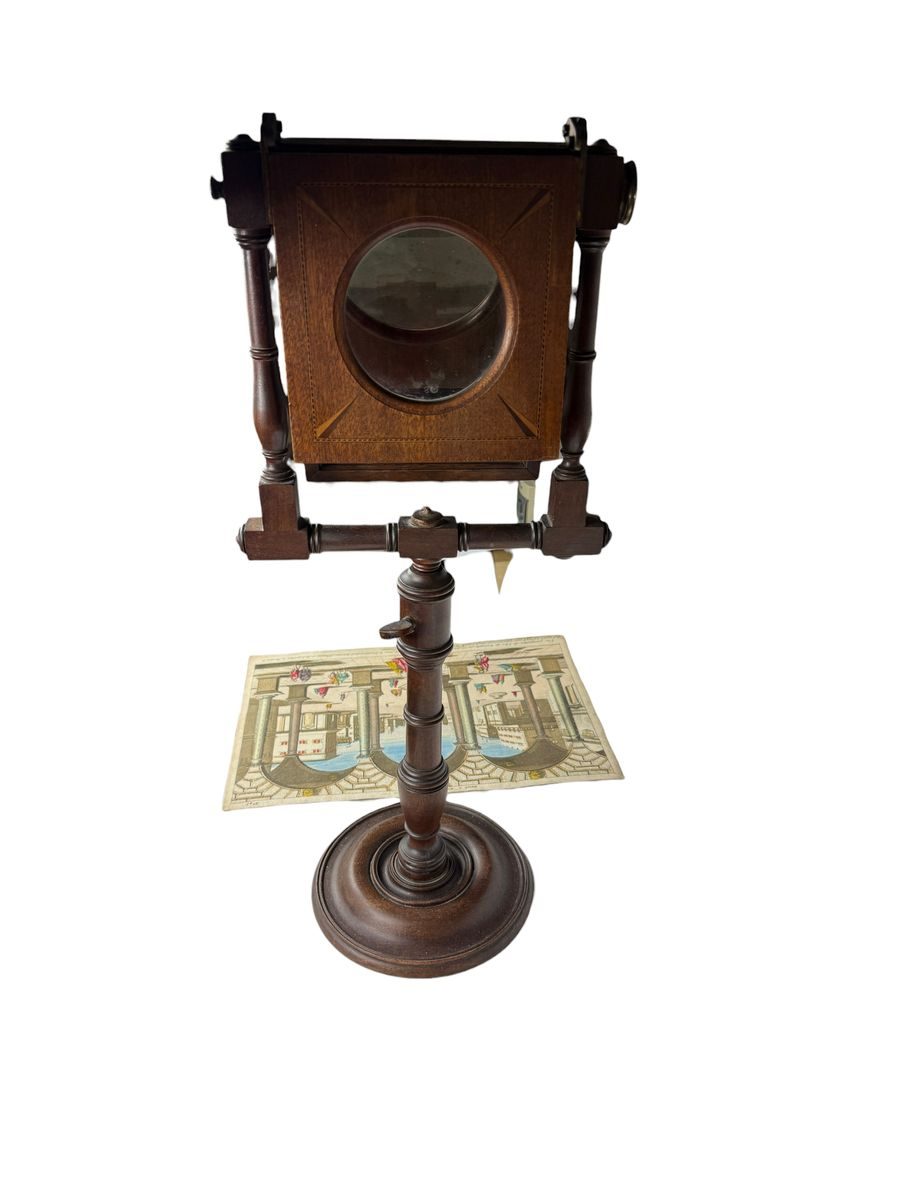
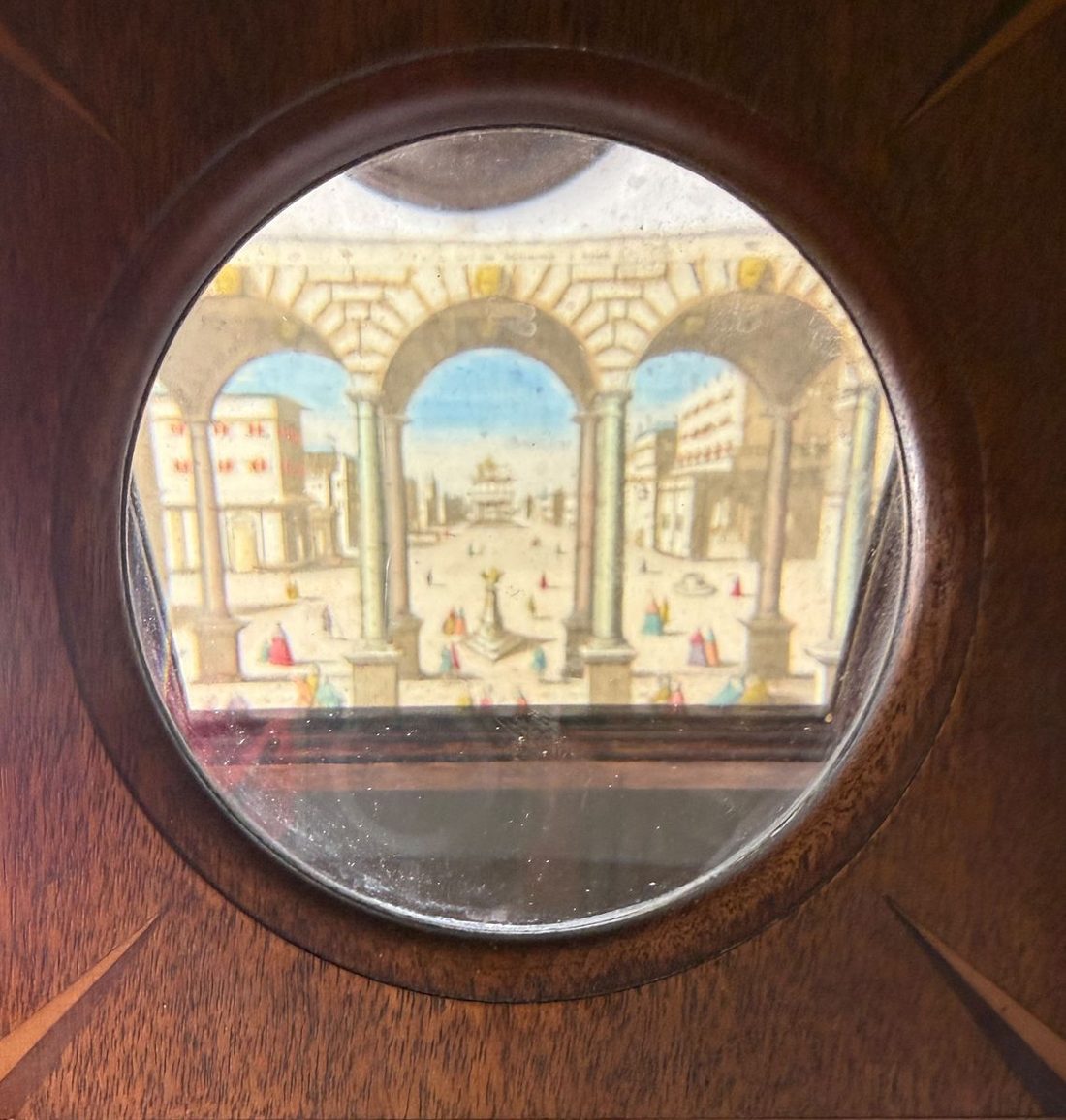
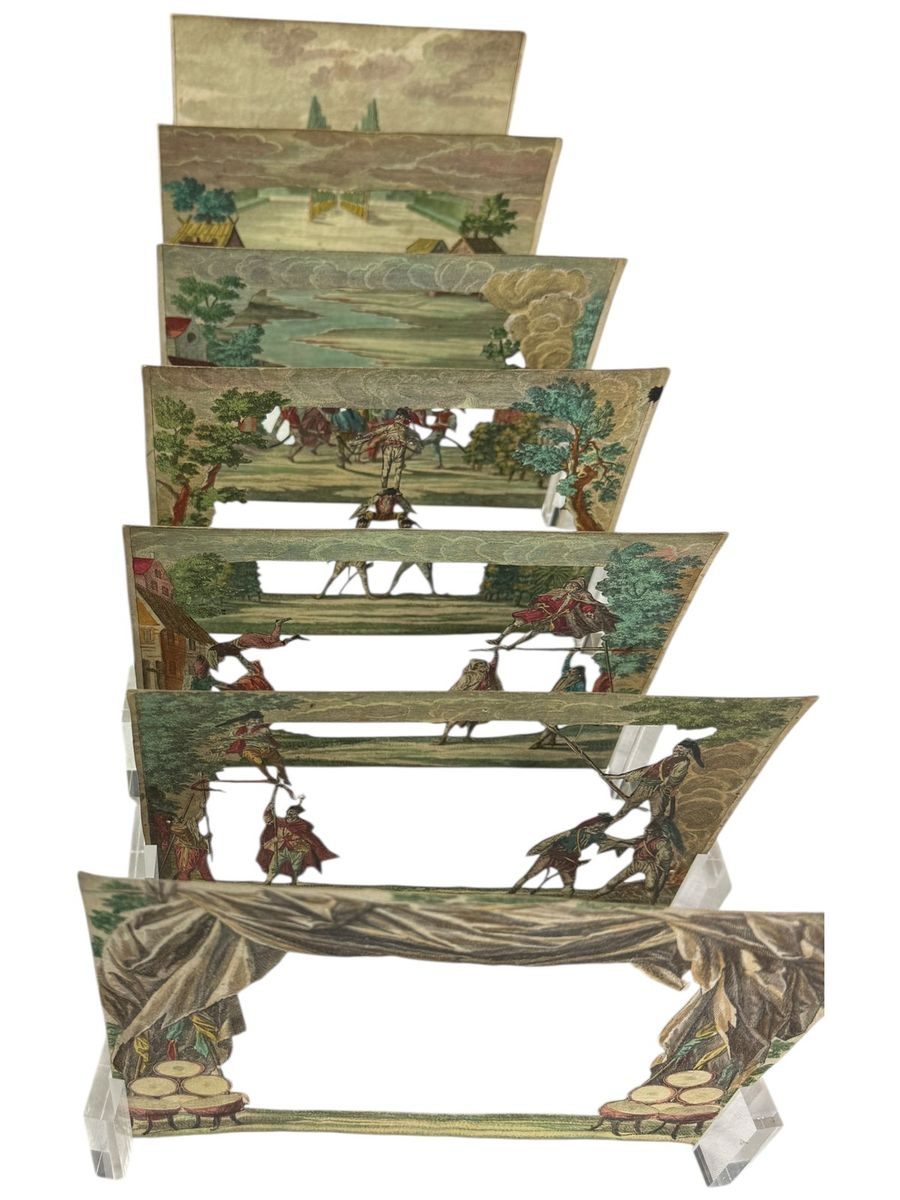
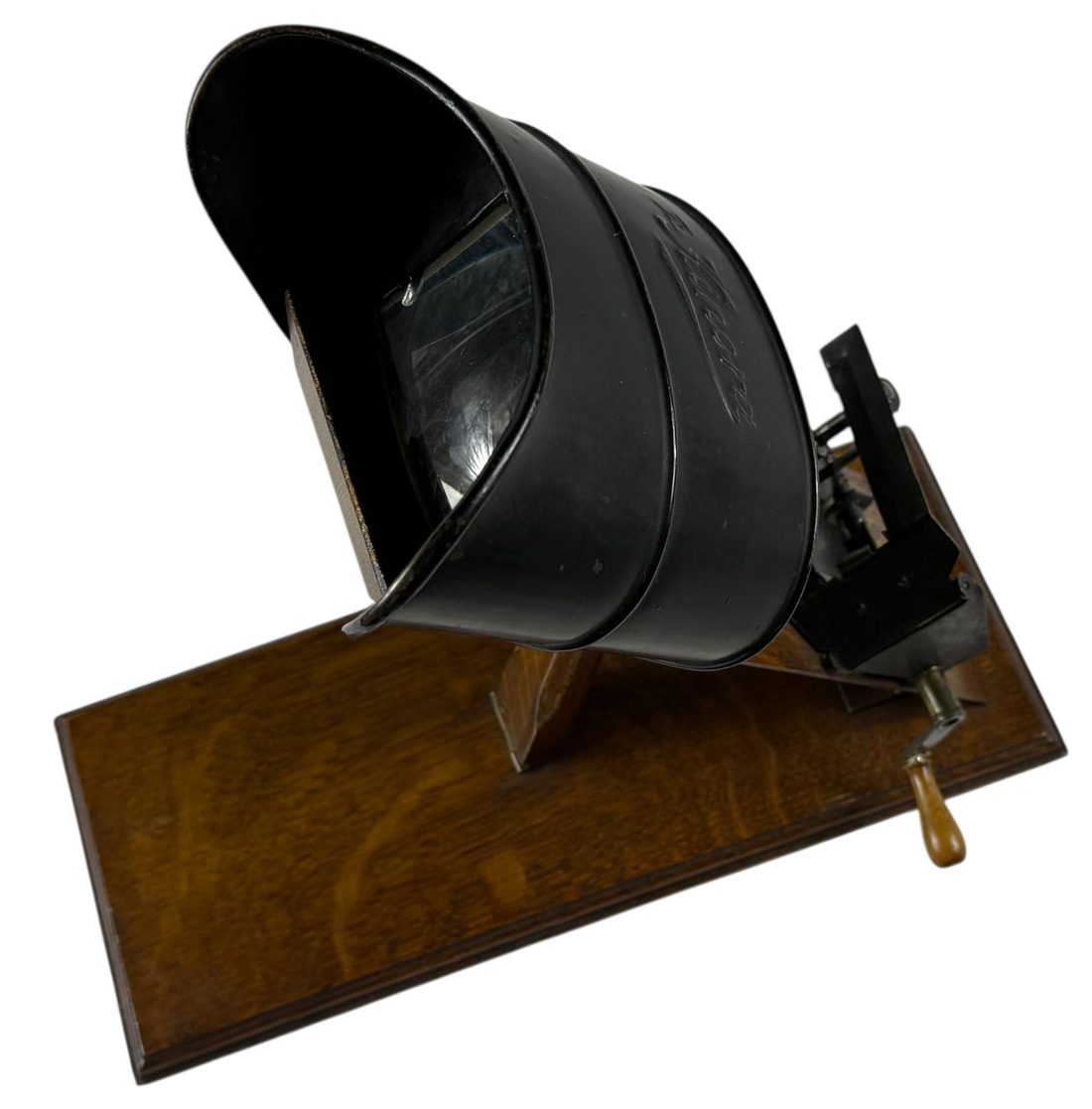
The eighteenth century taught the image depth, and put it on the market. The zograscope, a large convex lens set before a mirror angled at 45 degrees, made a flat print appear enlarged and strangely deep. Publishers answered with the vue d’optique: engravings made for the device, perspective deliberately exaggerated, titles printed in reverse because the mirror flips what it shows. From about 1730 they poured out of Paris, Augsburg, London and Bassano: distant cities, harbours and palaces, hand-tinted for the drawing room. Depth could also be built rather than drawn: Martin Engelbrecht of Augsburg issued perspective theatres, hand-coloured cut-out planes set one behind another and viewed through a peephole, a layering borrowed from Baroque stage scenery.
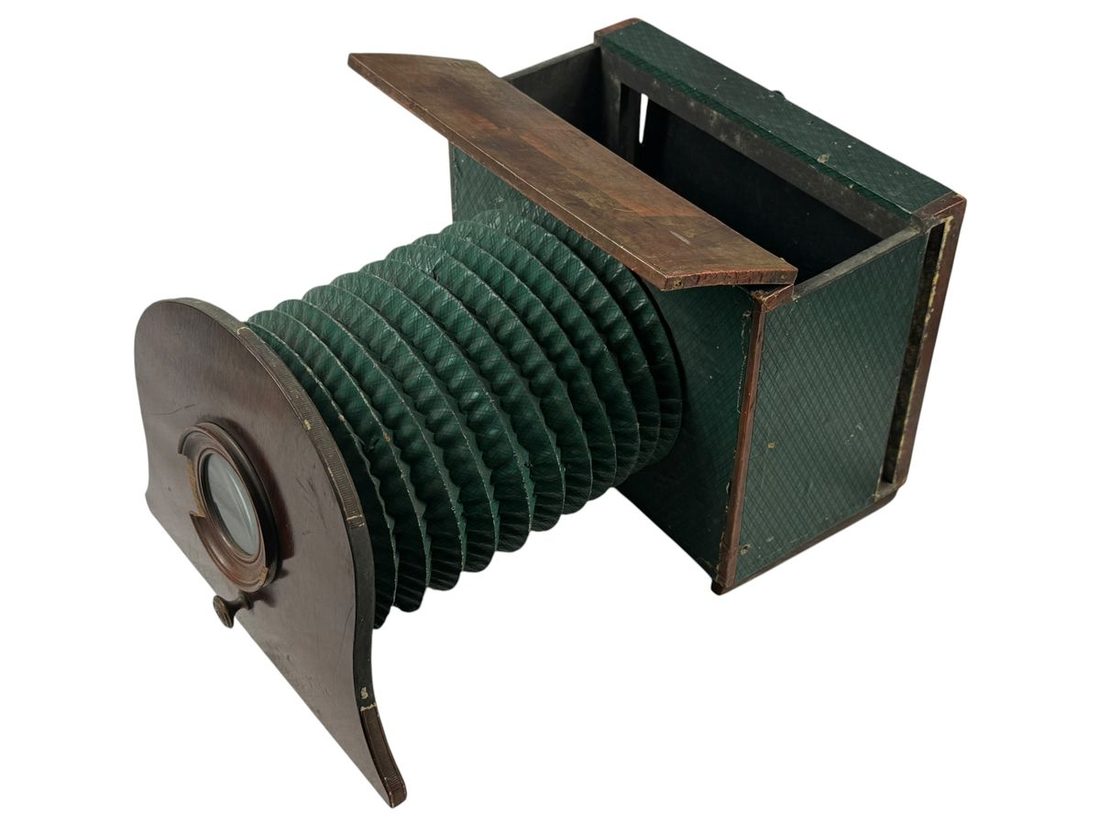
Some vues d’optique hinted at the next skill: pin-pricked and backed with translucent tissue, they glowed with lit windows and stars when held against the light. The Polyorama Panoptique made this a household instrument: a portable descendant of the Diorama spectacle Daguerre opened in Paris in 1822, a small box with lens and bellows taking pin-pricked, hand-coloured transparencies. Lit from the front, the print showed day; lit from behind, it turned to night, windows bright, fireworks overhead. One image now held two hours of the day.
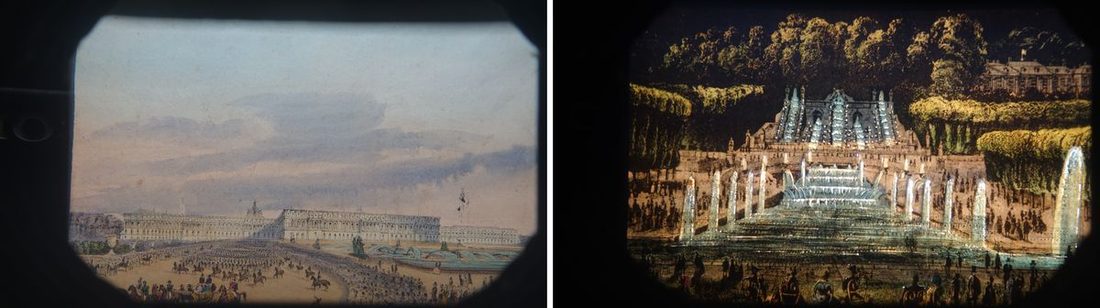
You can try that transformation yourself: one of these views has been recreated as an interactive image, with a slider that moves the scene from day to night.
Motion arrived with a theory attached. In 1824 Peter Mark Roget read the Royal Society a paper on a wheel seen through vertical apertures; Michael Faraday spun toothed discs before a mirror in 1830 and 1831. The century’s physicists concluded that the eye retains an image for a fraction of a second after it vanishes: persistence of vision. Today apparent motion is explained differently, as something built in the brain, but the idea did its work. In the winter of 1832-33 Joseph Plateau in Brussels and Simon von Stampfer in Vienna, independently and within weeks of each other, built the phenakistiscope: a slotted spinning disc of sequential images viewed in a mirror. Neither knew of the other.
Domestication took longer. William George Horner designed his Daedaleum, a slitted drum, in 1834; it sat dormant for three decades until William Lincoln moved the slits above the pictures so the strips could be swapped. Patented in 1867 and produced by Milton Bradley, it sold as the zoetrope, the wheel of life. In 1868 John Barnes Linnett, a Birmingham lithographer, patented the flip book as the kineograph. In 1877 Émile Reynaud replaced the slits with an inner ring of twelve flat mirrors, each holding one image roughly steady: the praxinoscope, a brighter, calmer picture. All of these were spun, cranked or flipped by hand. The spectator did not merely look. The spectator operated.
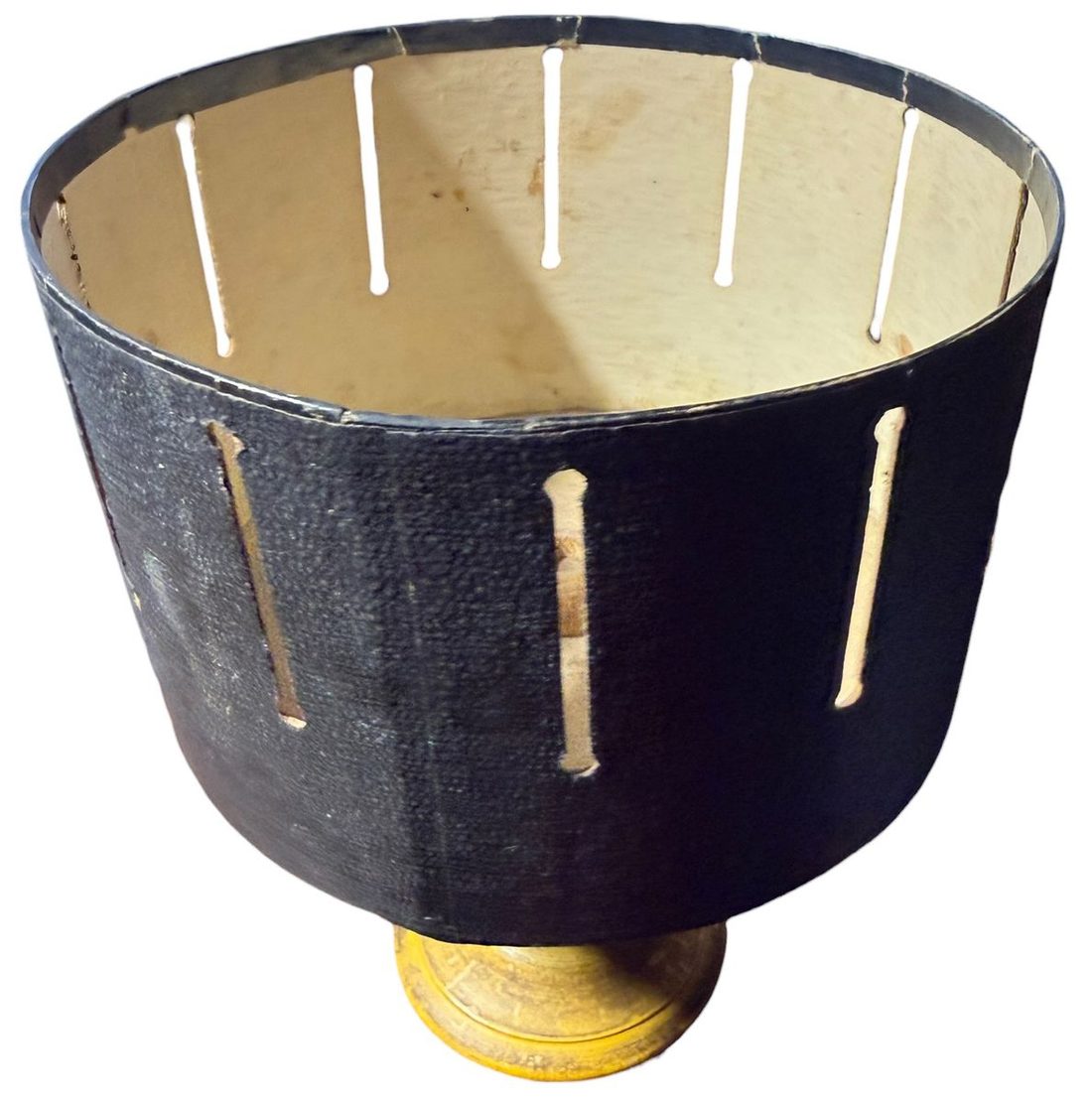
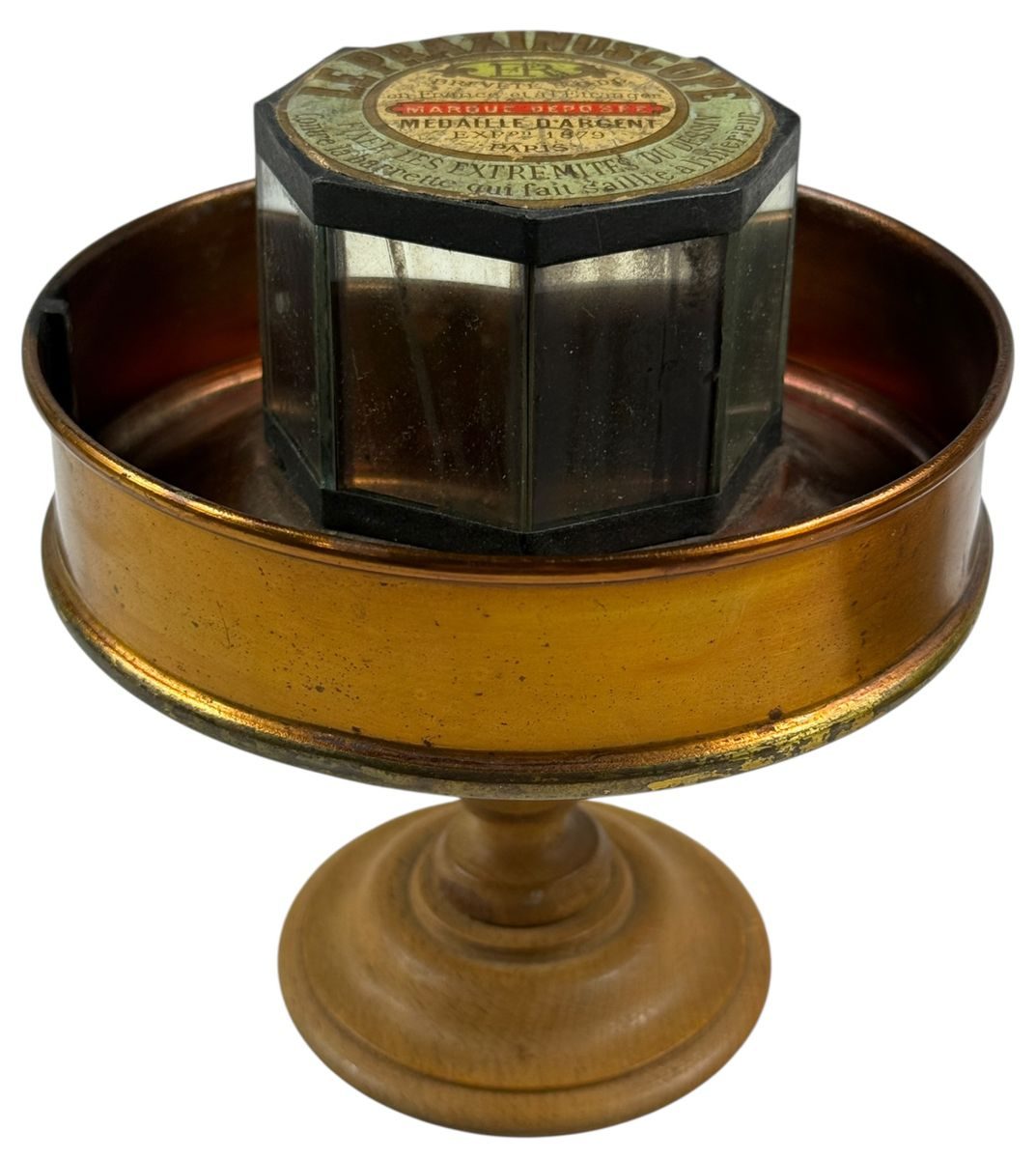
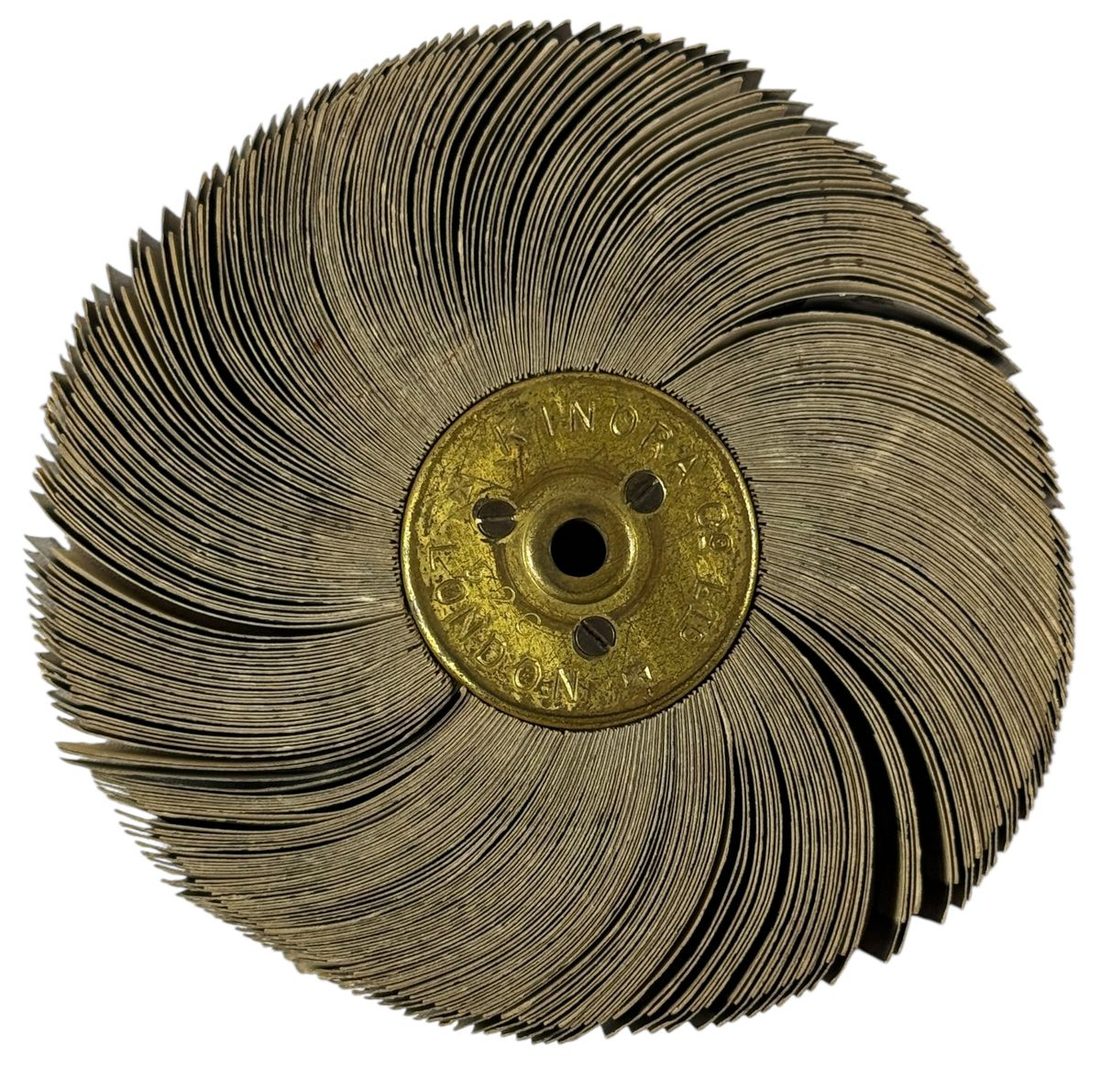
The screen came last. From 1892, at the Musée Grévin in Paris, Reynaud hand-cranked painted strips through his Théâtre Optique, a projecting praxinoscope, before a paying public. Edison’s Kinetoscope of 1894 was a single-viewer peep-box, the fairground peephole turned industry. On 28 December 1895, in the Salon Indien du Grand Café, the Lumière Cinématographe (camera, projector and printer in one machine) gave the first commercial, paying film screening. It was not the first projection of moving images; Reynaud’s audiences could have said so. A year later the Lumières patented the Kinora, photographic prints on flexible leaves turned by a crank: a clockwork flip book for the parlour.
It is tempting to read this story as the image outgrowing its viewer: from a smear that needed our mirror to a screen that needs nothing but a ticket. The nineteenth-century physicists were wrong about the eye, but right about the address. The motion is not on the screen; it is finished in the person watching. The gentleman and the beggar have not gone anywhere. We are still the ones standing the cylinder on the circle.