The Bible That Kept Its Own Promise
In 1530, a title page made a proud announcement to Italian readers: here was the Bible in their own language, translated from the original Hebrew and Greek. It was the claim of a new age, confident, philological, almost scientific. There was only one problem. On close inspection, it was not quite true.
The translator behind that page, Antonio Brucioli, had worked largely from Latin intermediaries: the Latin New Testament of Erasmus and the Latin Old Testament of Santes Pagnini. Nor was Italy short of Bibles in the vernacular. The Malermi Bible, translated from the Latin Vulgate (the Church's official Latin version, itself a fourth-century translation), had been in print since 1471. Another vernacular version, attributed to the Benedictine Massimo Teofilo, appeared around mid-century. What Italian did not yet have was the thing Brucioli's title page had advertised: a complete Bible actually carried over, book by book, from the Hebrew of the Old Testament and the Greek of the New. The claim existed. The work did not.
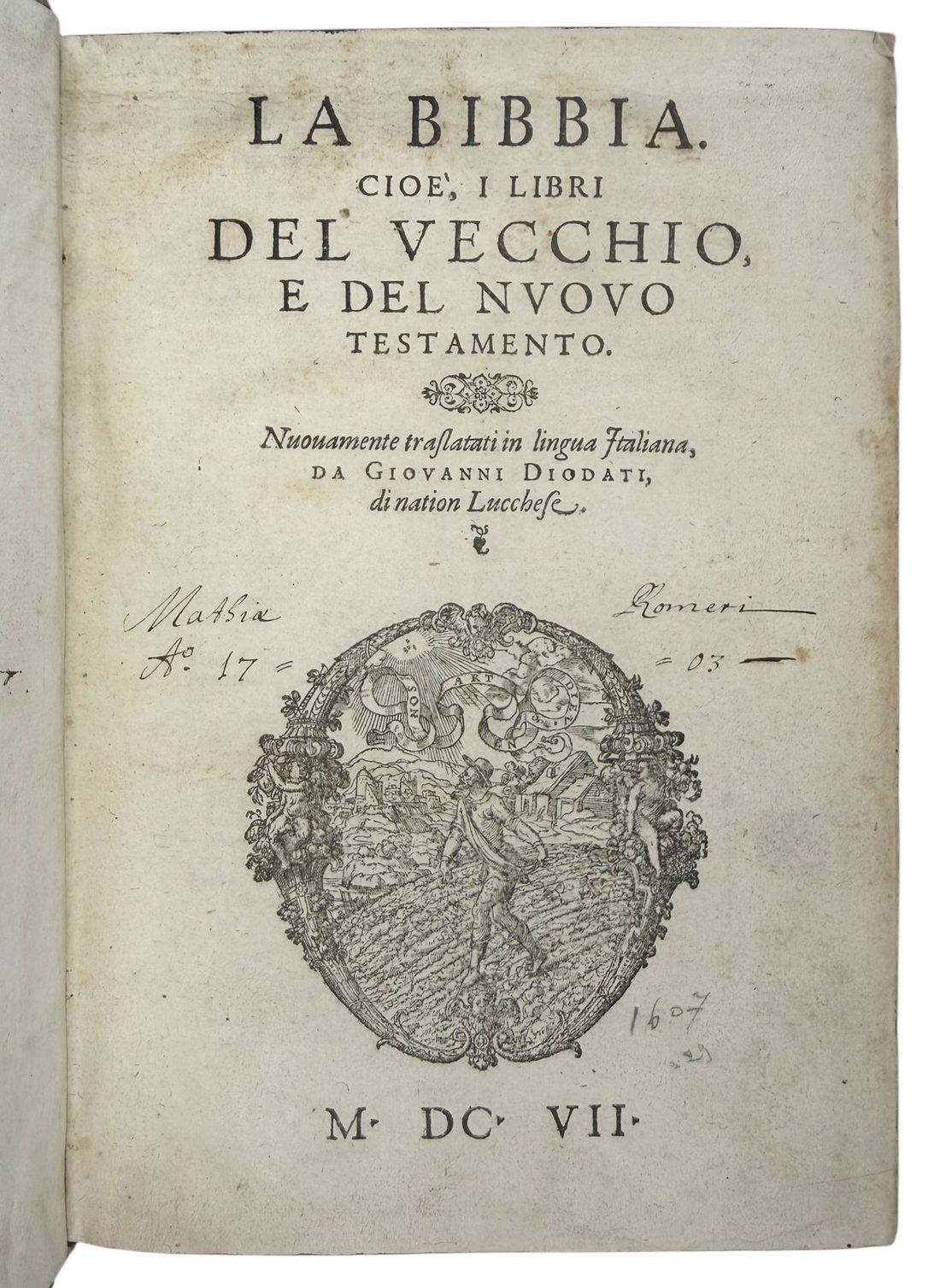
The man who finally did the work never lived in the country whose language he served. Giovanni Diodati was born in Geneva in 1576, to a noble family from Lucca that had left Italy for its Protestant convictions. He would describe himself as Italian "di nation lucchese," Lucchese by nation: an identity carried in the blood and the tongue rather than on any map he could safely cross. He entered the Genevan Academy in 1596, and at twenty-one, on the recommendation of Theodore Beza, John Calvin's successor at the head of the Genevan church, he was appointed professor of Hebrew. The scene is worth pausing over. The authority to handle the sacred text was being placed in the hands of a very young man for one reason only: demonstrated command of the original languages. Not rank, not seniority. Philology, the disciplined study of texts in the languages they were written in, had become the credential.
A decade later, in 1607, the result appeared from the press of Jean de Tournes in Geneva: the first complete Italian Bible translated directly from the Hebrew and Greek, conceived within an explicitly Reformed, that is Calvinist, framework. The primacy needs stating with care, because it is often stated wrongly. This was not the first Italian Bible; Malermi preceded it by well over a century. It was not even the first to claim the original languages; Brucioli had done that. Diodati's distinction is sharper and, in a way, more honorable: he delivered what others had only advertised. Nor was his method a purist's fantasy. Like every serious scholar of his period he consulted Latin aids alongside the originals, and his New Testament rested on the Textus Receptus, the printed Greek text then standard across Europe. The point was never to work in splendid isolation. The point was that every Italian sentence could be tested against the Hebrew and Greek, and defended there.
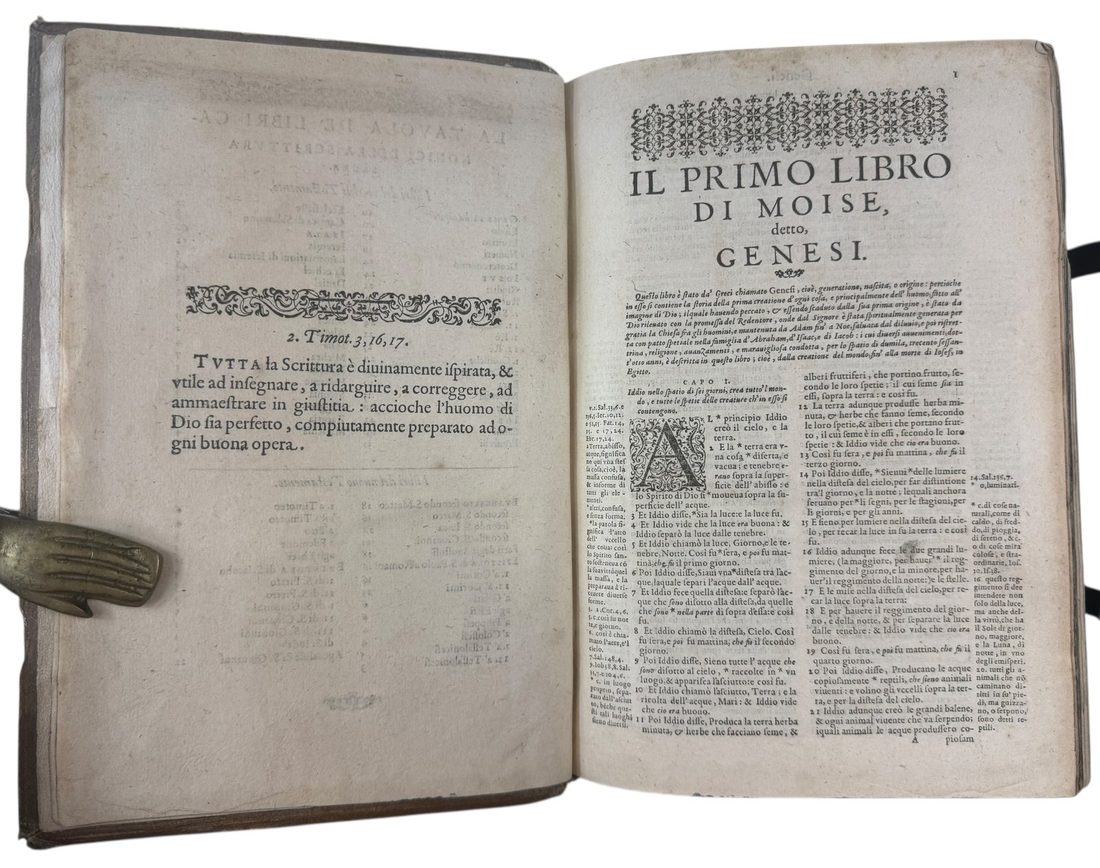
Why did this matter so much? Because for the Reformed tradition, Scripture was the final court of appeal, above popes, councils, and custom. A Bible mediated through the Vulgate asked the reader to trust a translation of a translation, filtered through the very institution whose authority was in dispute. A Bible drawn from the sources shortened the chain to two links: the ancient text and the believer's own language. Editions in this tradition carried dense apparatus, cross-references and clarifying notes crowding the margins, precisely so that a reader alone with the book could study rather than merely receive. The page itself made an argument: legibility over ornament, instruction over spectacle.
Geneva was the natural birthplace for such a book. The city had become the printing capital of the Reformed world, and the de Tournes press signed its work with a motto that reads like a small confession of faith: "Son art en Dieu," his art is in God, an anagram of the printer's own name, Ian de Tournes. Craft and creed folded into the same four words.
For its first readers, the book was something more intimate than a monument of scholarship. Italian-speaking Protestants were by then a scattered people, settled in Geneva, Zurich, Basel, cut off from the peninsula that spoke their language. For them, a shared, authoritative Scripture in Italian was the one object that could hold a dispersed community together: a homeland reduced to portable form. Diodati kept working at it, issuing a substantially revised edition with a metrical psalter in 1641 and a French translation in 1644, and over the following centuries his version became the standard Bible of Italian Protestantism.
He himself never went back to Lucca. He could not. But there is a sense in which the translation was his return journey: an exile giving Italy, in its own words, the book his family had been driven out for wanting to read.