The Name on the Stone
Articolo disponibile solo in inglese.
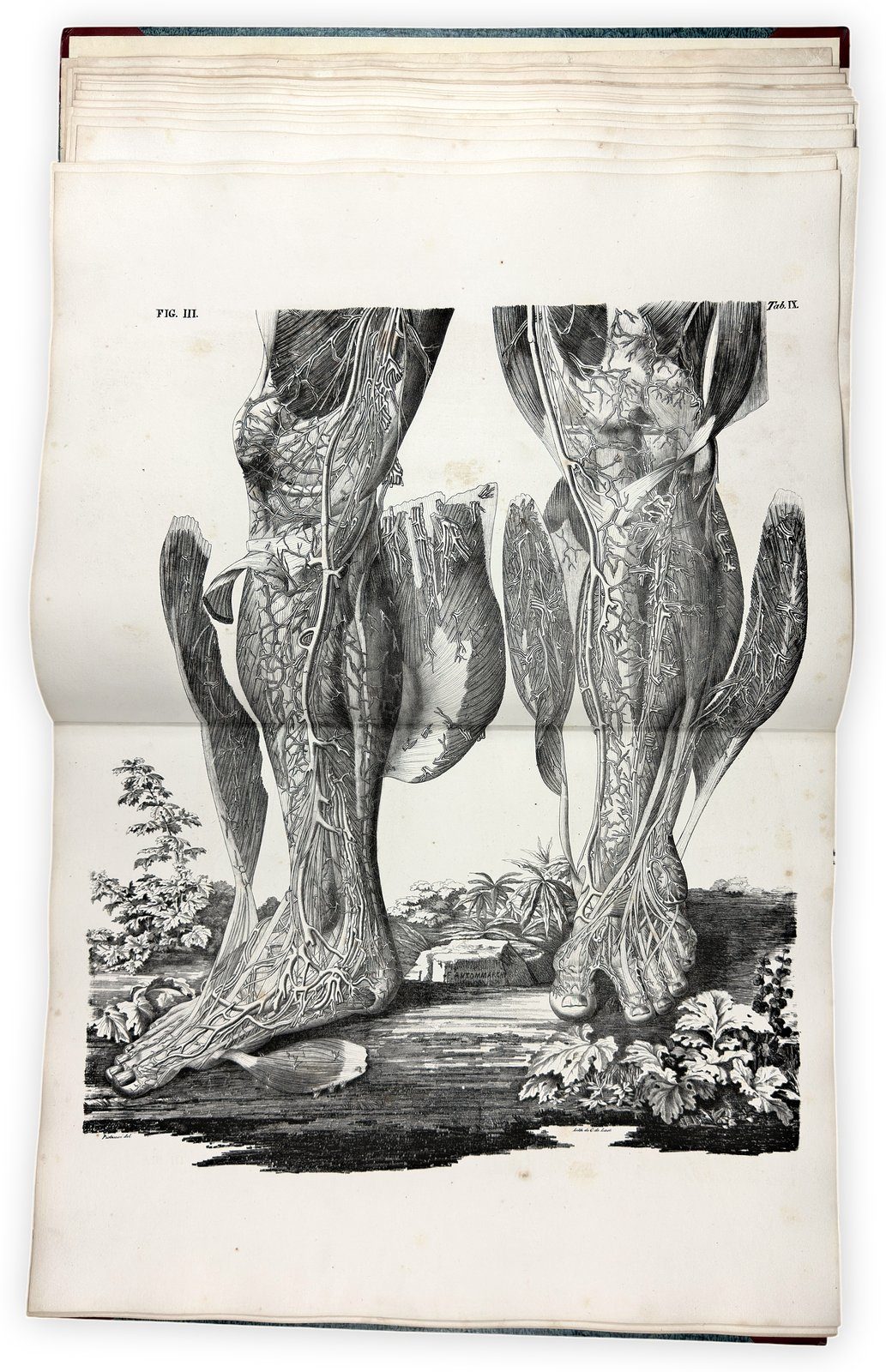
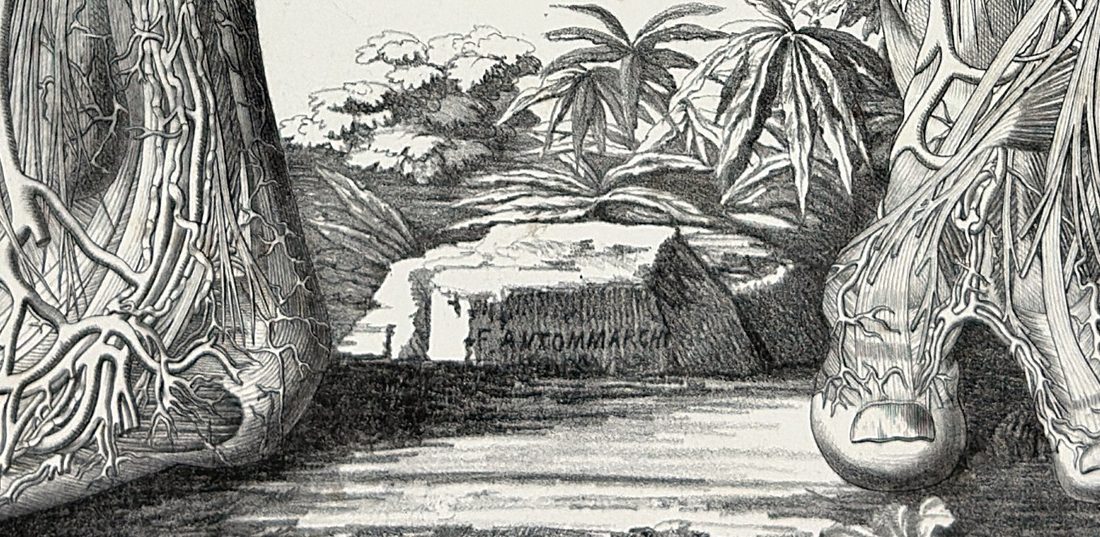
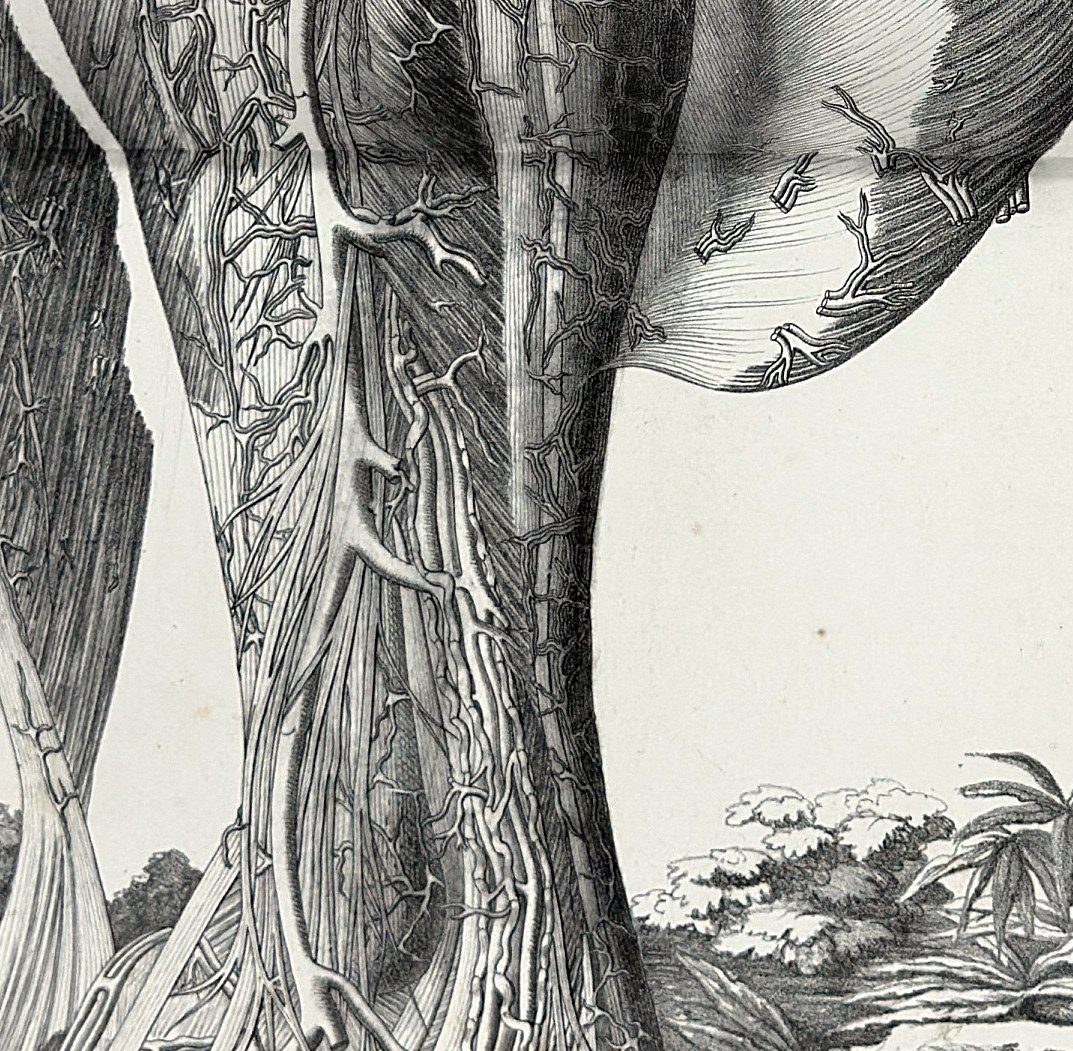
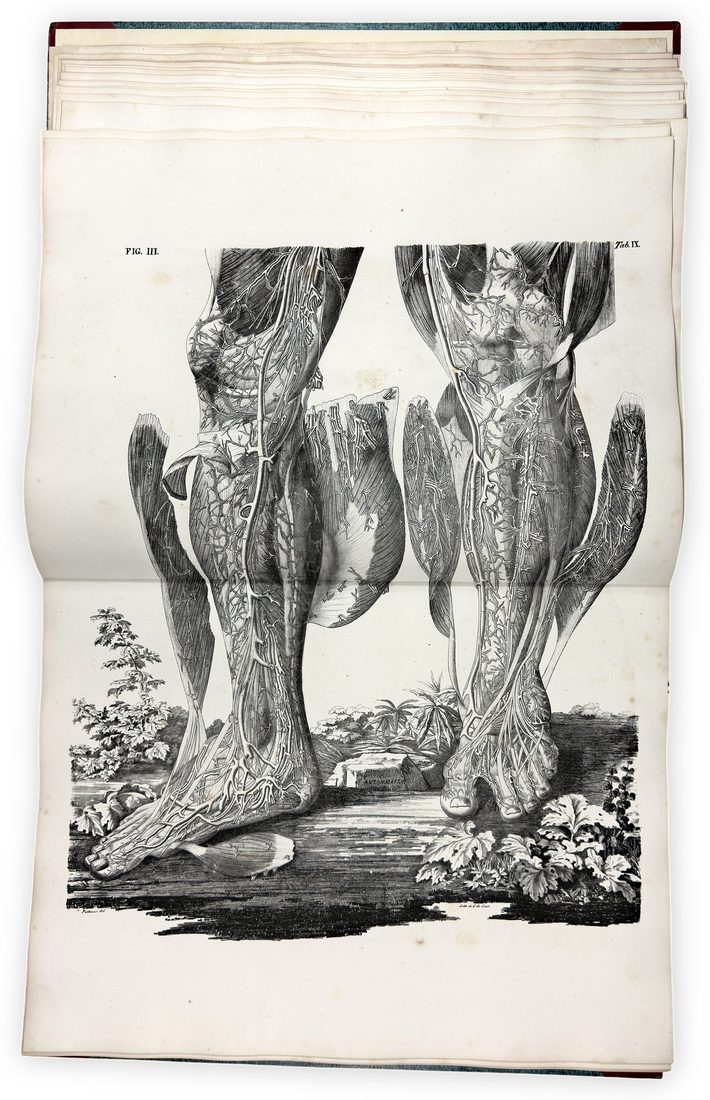
A pair of human legs stands among leafy plants. The skin is gone, and a net of vessels is traced over the muscles at the size of life: the legs are as long as your own. Between the feet lies a block of stone, and on the stone a name is lettered in capitals: F. ANTOMMARCHI. It is the name of the man who published the plate. It is not the name of the anatomist whose work the plate records.
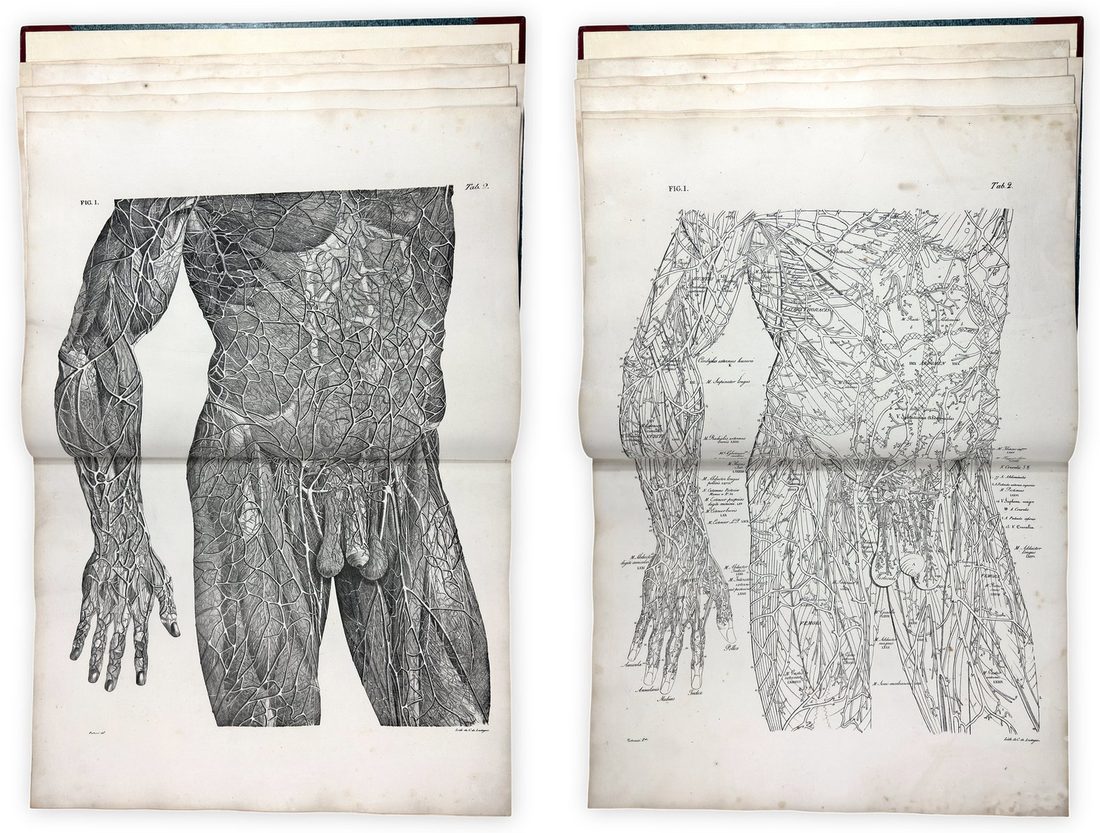
That anatomist was Paolo Mascagni, a Tuscan known across Europe since 1787 for a book on the lymphatic vessels (the fine channels that carry lymph through the body), which he had made visible by injecting them with mercury. He then gave some thirty years to a larger plan: an anatomy at natural scale. Three sheets placed one above the other would make a whole figure. The body would be read in layers, from the vessels just under the skin down to the skeleton, and each shaded plate would have a twin drawn in outline, carrying the letters and numbers that lead to the explanation. It was meant for students who had no cadaver to learn from. Mascagni died in October 1815 with the work unfinished.
His last prosector (the assistant who prepares the dissections) was a Corsican, Francesco Antommarchi. A company was formed on behalf of the family to publish what Mascagni had left, and Antommarchi directed its scientific side, editing two posthumous books. In December 1818 he was chosen as physician to Napoleon. He reached Saint Helena in 1819, and in his luggage went manuscripts and sets of proof impressions, the trial prints pulled from Mascagni's copperplates.
The proofs travelled. The copper did not. Sales were poor, and according to the family it was Antommarchi who, writing from Saint Helena, asked for the company to be wound up and offered to pay them in unsold copies. After Napoleon's death and the autopsy of May 1821, which he directed, he returned to Europe. In April 1822 the company was dissolved in court, and the heirs sold texts, drawings and copperplates to three professors at Pisa. His own account is different: he had been negotiating to buy the material when a professor of literature stepped in and wrecked the deal. Either way, he was left with the images and without the plates to print them.
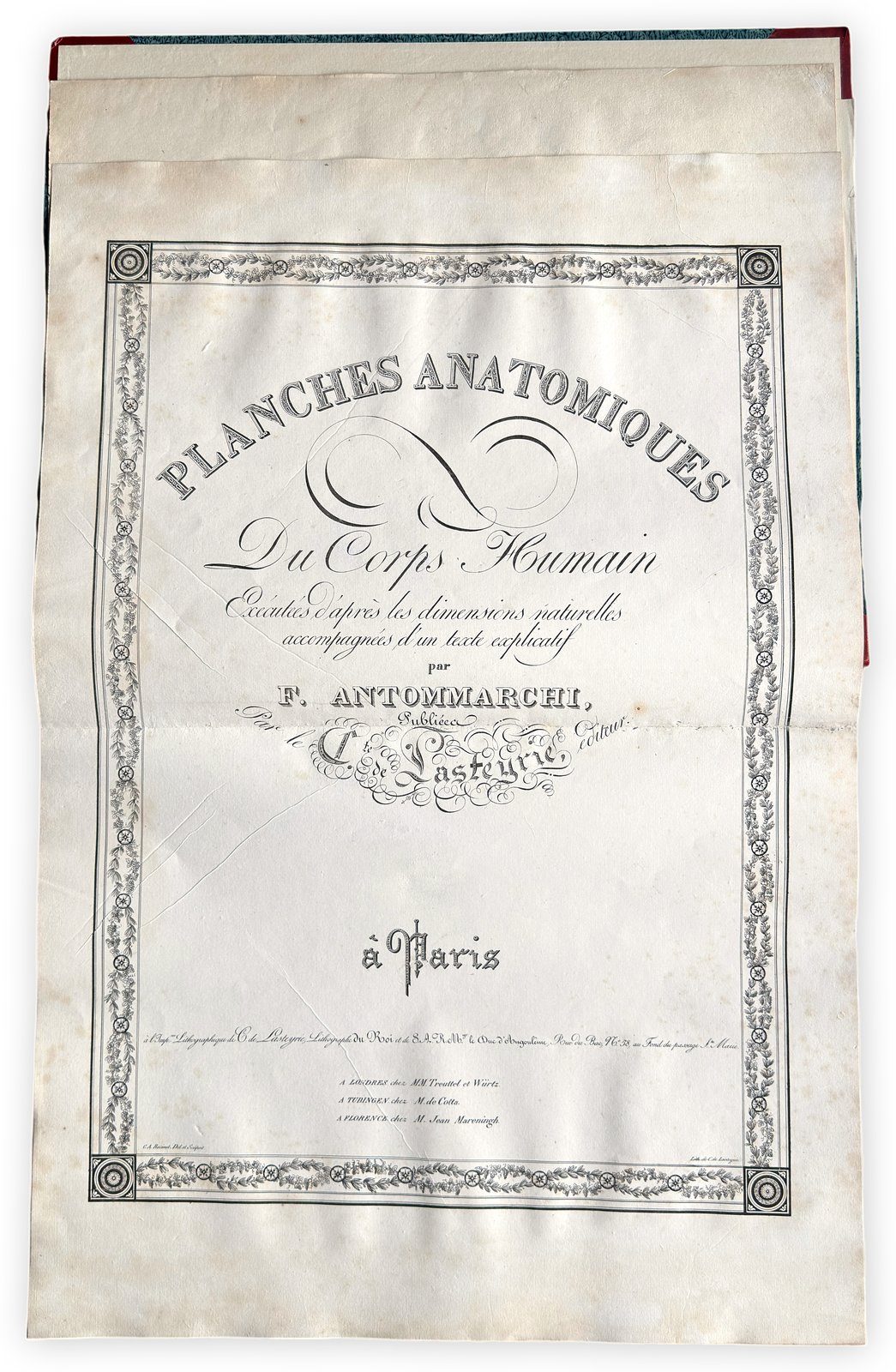
Copper is slow: every line has to be cut with a tool or bitten with acid into the metal, and the Pisan editors planned nine parts, one a year. Lithography, literally writing on stone, was newer: it had been invented in Munich in the late 1790s. The artist draws with a greasy crayon on a slab of limestone; the stone is wetted and inked, and the ink clings to the drawing and is refused everywhere else. In Paris the Comte de Lasteyrie had opened a lithographic press in 1816, and there Antommarchi had the figures drawn again by draughtsmen and printed in parts from 1823. The whole set, uncoloured, was priced at 375 francs. The Pisan one, on larger sheets, cost 1,125.
The stone reached the Académie des sciences first. Antommarchi laid his opening parts before it in March 1823. When the report was read in April, the Pisan edition existed as a prospectus (the announcement printed to attract subscribers) and a single specimen plate. Duméril, who reported, wrote afterwards that he knew of no work executed with the same aim. The title named Antommarchi and left Mascagni out. The heirs answered with a printed letter addressed to Lasteyrie, and in July 1824 Stanislao Grottanelli de' Santi, a Sienese physician and pupil of Mascagni then seeking subscribers for Pisa, stood before the same Academy and, by his own later account, said that "swindle" was hardly an academic word, but a more adequate one than "plagiarism". Two weeks later Duméril praised the lithographs again.
How should the case be judged? Ludwig Choulant, the historian of anatomical illustration, writing in 1852, judged it more narrowly than the heirs. He preferred the copper, yet he put the fault in two things only: the missing name on the title, and the editing, to the heirs' loss, of a work undertaken for their benefit. The Paris atlas was not the first anatomy on stone: Jules Cloquet had begun one in 1821. And the life-size plan was Mascagni's; Pisa kept it, finishing in the early 1830s. A recent Sienese study finds the engraved line finer and the lithographed one heavier and blacker, while two historians of the anatomical atlas, Le Minor and Sick, credit lithography with a softness and a range of greys closer to anatomical reality.
Antommarchi dedicated the work to a tomb, the one on Saint Helena, wishing it might last as long as the memory of the man inside; the Emperor, he says, had accepted the dedication in life. He died of yellow fever in Cuba in 1838. A lithograph is a drawing on stone, and his name was drawn on a stone inside the drawing. It is still there.