The Hell That Fit on a Table
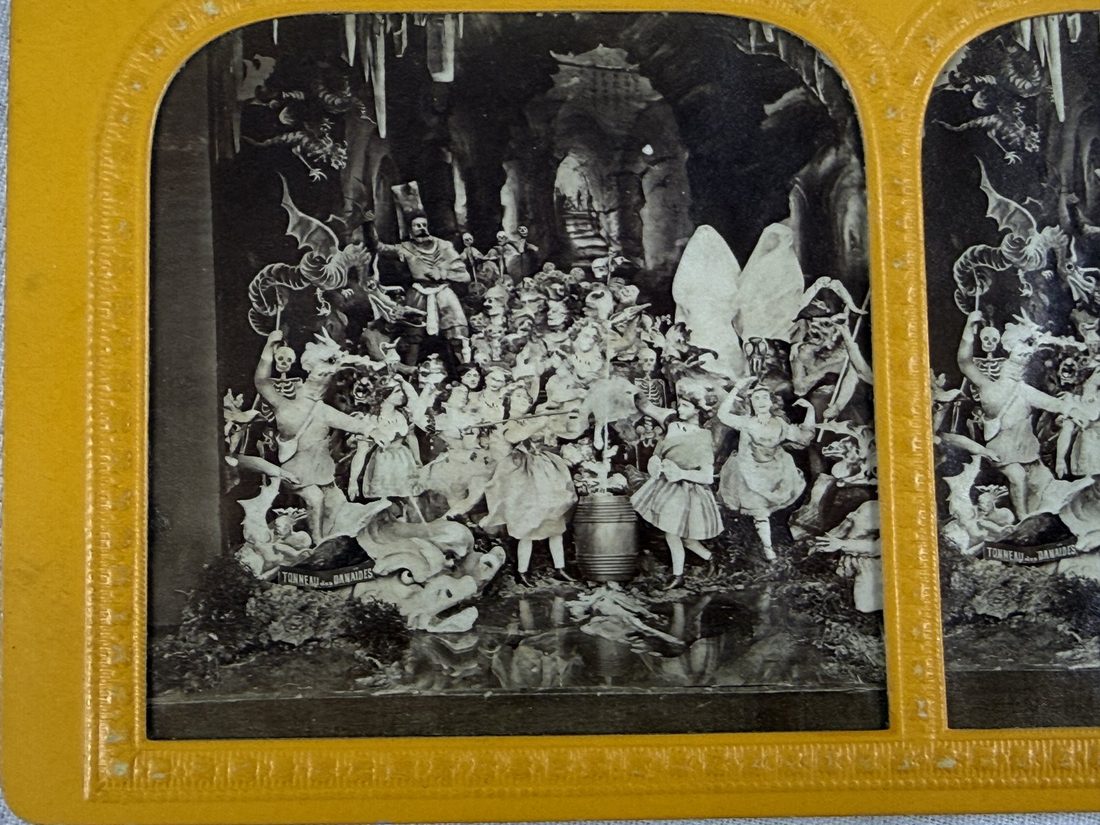
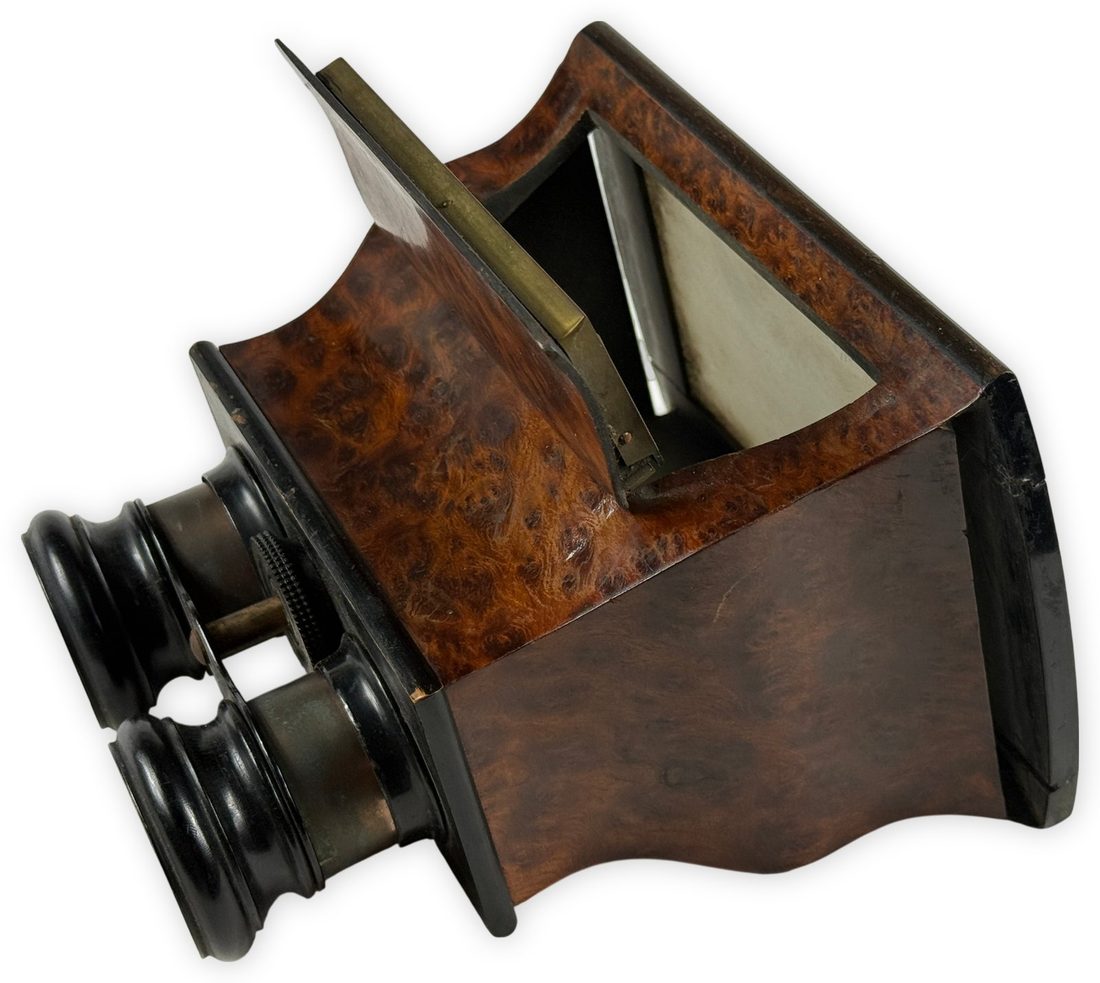
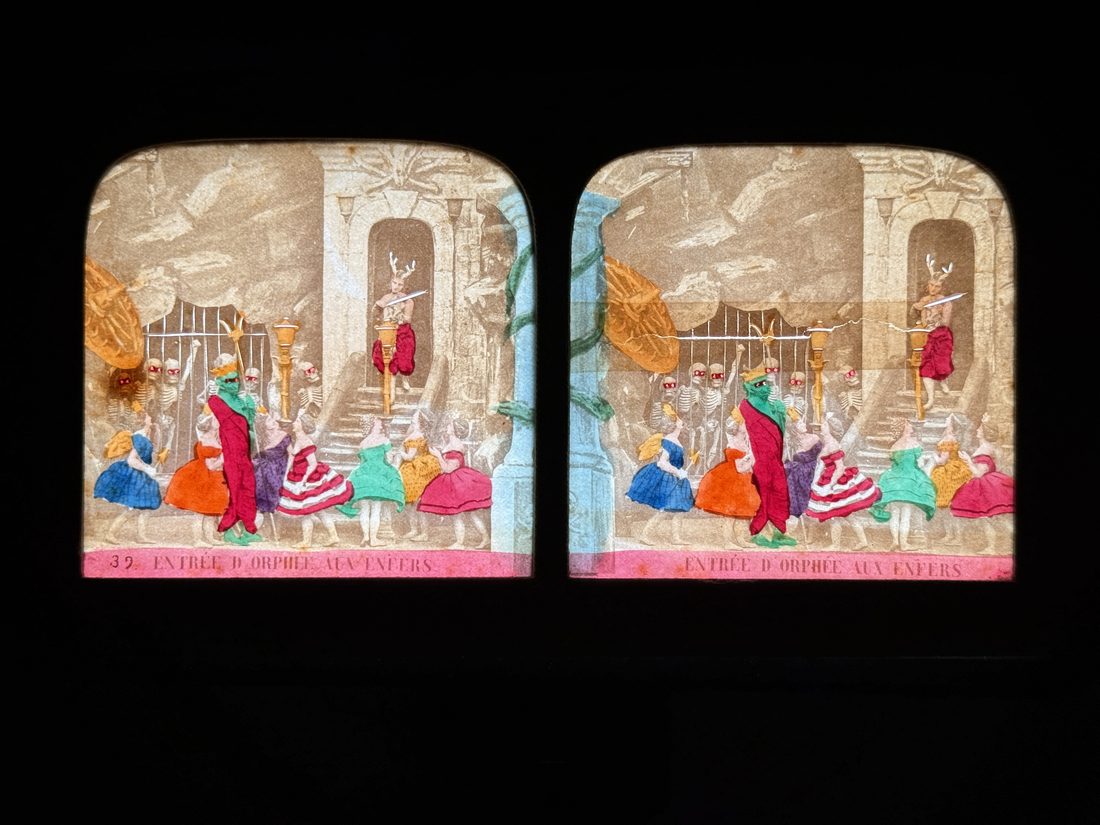
Somewhere in Paris, in the 1860s, a sculptor bends over a table. On it, in clay, a ballroom is taking shape: skeletons and demons dancing, a skeleton orchestra at the back. When the last figure is in place, a camera with two lenses is set up, an exposure is made, and the work is finished. Not the photograph: the sculpture. Soon the ballroom will be gone.
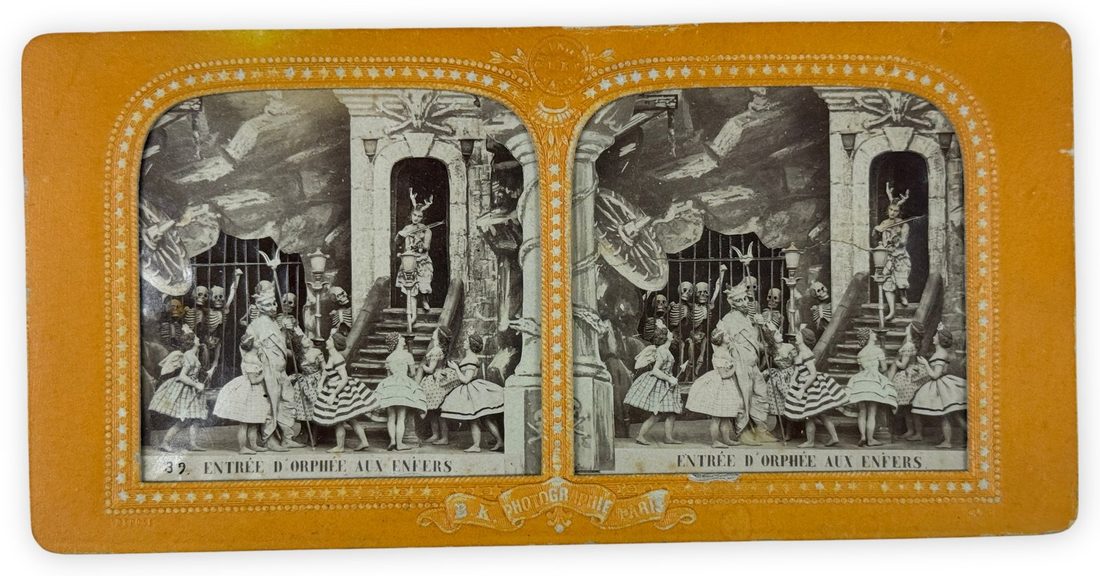
That, in outline, is how the Diableries were made. The word means "devilries", and it names a genre of French stereoviews produced from about 1860 to around 1900. A stereoview is a card carrying two nearly identical photographs taken from viewpoints a few centimetres apart; seen through a stereoscope (a viewer with a lens for each eye) the pair fuses into one scene with depth. The Diableries used that depth for daily life in hell, and hell looked a great deal like Paris: Satan gives a ball, runs a kitchen, opens a café, edits a newspaper. The earliest Diableries on record were entered in the legal deposit register in Paris in 1860 by the photographer François Benjamin Lamiche; the publisher Adolphe Block issued a series of seventy-two subjects in 1868.
Here is the tension. These are photographs of sculptures, and the sculptures no longer exist. The tableaux were modelled in clay, photographed, and then destroyed. Three modellers have been identified so far: Louis Alfred Habert, a pupil of the sculptor Pradier, who had begun around 1858 making small theatre and opera scenes for the stereoscope; Pierre Adolphe Hennetier, whose style is described as very similar to Habert's yet distinct; and Louis-Edmond Cougny. Most tableaux are attributed to the first two. The clay was a stage set in miniature, raw material for a picture; once the camera had seen it, it had served.
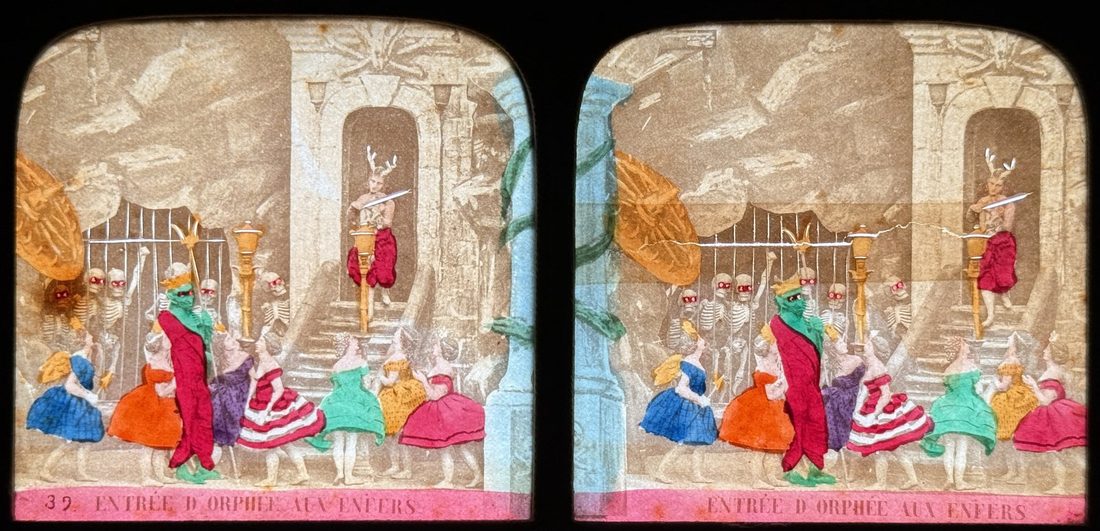
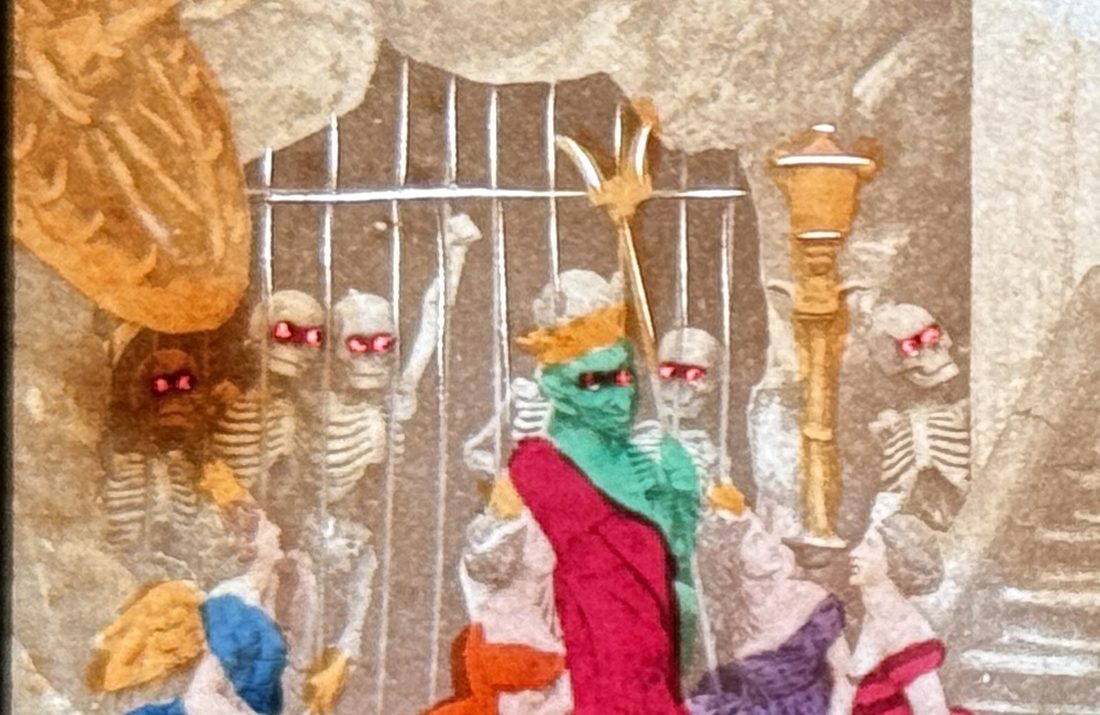
So the burden of survival falls on a piece of paper, and the paper was made with care. The type is known as a French tissue. The photograph is an albumen print (paper coated with egg white to hold the light-sensitive silver) on very thin stock. On its reverse, colour was painted by hand where dresses, lamps and flames would be, then hidden behind a sheet of tissue paper. The whole was sandwiched between two card mounts, each cut with two windows: a four-layer laminate. Finally, tiny holes were pierced with a sharp point wherever a light should be: lamps, jewels, stars, and above all the eye sockets of the skeletons, which were backed with a dab of red.
What that red is, we now know. Conservators at the Los Angeles County Museum of Art, treating a group of Diableries in a study published in 2019, analysed the material behind the eyes by infrared spectroscopy (which identifies a substance by the infrared wavelengths it absorbs). It was animal protein: glue or gelatin, applied in two ways, sometimes as tiny cut rectangles, sometimes as a liquid held by a second, inner tissue. The conservators wondered whether the two methods point to two workshops. It is the kind of evidence the vanished sculptures never left: a trace of somebody at a bench, choosing between a knife and a brush.
All this construction has a consequence, and the consequence is its purpose. By ordinary reflected light a Diablerie is a sepia photograph of a clay scene; the colour sits behind the tissue and the pinpricks are barely visible. Let light through from behind and the thin print shows the colour, the holes become points of light, and the skeletons' eyes glow red. A day scene in monochrome becomes a night in colour. Box stereoscopes of the period could serve both readings, with a hinged mirrored lid to throw light onto the card and a ground glass behind to let light through it. That trick has its own post on this blog; the point here is that it was built in, layer by layer.
Block's list reads like a city guide to the afterlife: Les Cuisines de Satan, La Bourse aux Enfers (a stock exchange), Le Chemin de fer infernal (a railway), Les Cocottes chez Satan. Historians read them as satire on the excess of Second Empire Paris and the rule of Napoleon III. It should be held loosely, though: the series outlived the Empire, and one Block subject, Madame Angot aux Enfers, refers to an operetta first staged in 1872 and 1873. The dead kept up with the theatre.
One inversion is worth carrying away. Usually the sculpture is the original and the photograph the copy. Here the order runs the other way: the clay was provisional, the print was the point, and the sculptor worked knowing his ballroom would not outlast the photograph. What has come down to us is the light that fell on that clay for the length of an exposure, fixed in egg white and silver, with a speck of red glue where the eyes should be. Hell was built on a table, photographed, and swept away. The photograph is its only witness, and it still opens its eyes when you hold it to the window.